From Surf Wiki (app.surf) — the open knowledge base
Eurovision Young Musicians
International youth classical music competition

International youth classical music competition
| Field | Value |
|---|---|
| italic_title | no |
| image | Eurovision Young Musicians generic logo.svg |
| alt_name | Eurovision Competition for Young Musicians |
| genre | Music contest |
| creator | European Broadcasting Union |
| based_on | BBC Young Musician |
| presenter | Various presenters |
| country | Various participating countries |
| language | English |
| num_episodes | 21 contests |
| location | Various host cities |
| runtime | 90 minutes (2010–12, 2018) |
| 120 minutes (2014–2016, 2022–present) | |
| company | European Broadcasting Union |
| Various national broadcasters | |
| first_aired | |
| last_aired | present |
| related | Eurovision Young Dancers |
120 minutes (2014–2016, 2022–present) Various national broadcasters
Eurovision Young Musicians (), often shortened to EYM, or Young Musicians, is a biennial classical music competition for musicians aged between 12 and 21. It is organised by the European Broadcasting Union (EBU) between members of the union, who participate representing their countries. Some participating broadcasters hold national selections to choose its representative for the contest.
The first edition of Eurovision Young Musicians took place in Manchester, United Kingdom on 11 May 1982, with six countries taking part. The contest was won by representing , who played the piano. is the most successful country in the contest, having won six times: in , , , , , and , and has hosted the contest a record six times. The twenty-first and most recent edition of this competition took place in Bodø, Norway on 17 August 2024 and was won by Leonhard Baumgartner, who played the violin for Austria.
Background and history
Main article: BBC Young Musician
The idea to organise a competition for young musicians was first examined by the EBU Expert Group for television music programmes in March 1980 during a meeting chaired by BBC's Humphrey Burton in Geneva, Switzerland.
Eurovision Young Musicians, inspired by the success of BBC Young Musician, is a biennial competition organised by the European Broadcasting Union (EBU) for musicians that are 18 years old or younger. The BBC competition was established in 1978 by Burton, Walter Todds and Roy Tipping, former members of the BBC Television Music Department. Michael Hext, a trombonist, was the inaugural winner that year.
As a result of the success of the British competition, the Eurovision Young Musicians competition was initiated in 1982. The first edition of Eurovision Young Musicians took place in Manchester, United Kingdom on 11 May 1982, with six countries taking part. Some participating broadcasters held national heats in order to select its representative for the contest. Germany's won the contest, with France and Switzerland placing second and third respectively. It was also notable that Germany won the Eurovision Song Contest 1982 just a few weeks earlier. Three years later, the EBU decided to create a dance version based on this competition, which became Eurovision Young Dancers. That event took place in odd years, while Eurovision Young Musicians takes place in even years.
In 1986, due to the increasing number of participating broadcasters, a semi-final round was introduced at the competition, from which, according to the results of the jury's voting, five to eight of them progressed to the televised final. Following this, the competition did not undergo any major changes for a number of years. In 2006, the competition was one of the central events of the Year of Mozart and to celebrate the 250th anniversary of the birth of Wolfgang Amadeus Mozart, the pieces performed by the finalists were restricted to Mozart or pieces from his contemporaries.
Between 2006 and 2012, the competition was the opening event of one of the largest festivals in Europe, Vienna Festival and was held on an open-air stage for the first time. The 2018 contest was hosted by the BBC in partnership and as a highlight of the annual Edinburgh International Festival. The 2020 edition of the contest was scheduled to take place in Zagreb, Croatia on 21 June to coincide with World Music Day celebrations. The final of the contest would have taken place on an open-air stage in King Tomislav Square, with the semi-finals held on 17 June in the Bers Hall of the Zagreb Academy of Music. However, on 18 March 2020, it was announced that the event had been postponed indefinitely due to the COVID-19 pandemic in Europe. The future of the contest remained uncertain until 3 February 2022, when Norwegian broadcaster NRK confirmed, in an online article regarding its national selection Virtuos, that the upcoming edition would instead now be held in Montpellier, France in July.
In August 2025, the EBU announced a series of reforms that would be implemented ahead of the 2026 edition. Key points of the reform include a two-year broadcast contract cycle, inflation-based fee indexation, an improved fallback hosting rule, and improved rights management. These changes aim to provide greater "predictability and stability", enabling both participating broadcasters and hosts to plan their activities more effectively well in advance.
Format
Each country is represented by one young talented musician that performs a piece of classical music of their choice accompanied by the local orchestra of the host broadcaster and a jury, composed of international experts, decides the top three participants. From 1986 to 2012 and again in 2018, a semi-final round took place a few days before the contest, and the jury decided as well which participants qualified for the final.
A new feature added for the 2008 contest was the audience prize, with both the live audience at the venue and television viewers in the host country being able to vote by SMS to choose their favourite musician.
A new preliminary round took place in 2014, with the jury scoring each musician and performance, however all participants automatically qualified for the final. The scores in this round were taken into consideration with those in the Grand Final to help the jury decide the three prize winners. The semi final elimination stage of the contest was expected to return in 2016. However the semi-finals were later removed due to the low number of participants that year.
For a number of past contests (1992, 1994, 1998 and 2002), a compilation album was released by the host broadcaster and supported by an independent record label.
Participation
Eligible participants include primarily active member broadcasters (as opposed to associate members) of the EBU. Active members are located in countries that fall within the European Broadcasting Area, or are member states of the Council of Europe.
The European Broadcasting Area is defined by the International Telecommunication Union:
:The "European Broadcasting Area" is bounded on the west by the western boundary of Region 1, on the east by the meridian 40° East of Greenwich and on the south by the parallel 30° North so as to include the northern part of Saudi Arabia and that part of those countries bordering the Mediterranean within these limits. In addition, Armenia, Azerbaijan, Georgia and those parts of the territories of Iraq, Jordan, Syrian Arab Republic, Turkey and Ukraine lying outside the above limits are included in the European Broadcasting Area.
The western boundary of Region 1 is defined by a line running from the North Pole along meridian 10° West of Greenwich to its intersection with parallel 72° North; thence by great circle arc to the intersection of meridian 50° West and parallel 40° North; thence by great circle arc to the intersection of meridian 20° West and parallel 10° South; thence along meridian 20° West to the South Pole.
Active members are broadcasting organisations whose transmissions are made available to at least 98% of households in their own country which are equipped to receive such transmissions. If an EBU active member broadcaster wishes to participate, it must fulfil conditions as laid down by the rules of the contest (of which a separate copy is drafted annually).
Eligibility to participate is not determined by geographic inclusion within the continent of Europe, despite the "Euro" in "Eurovision" – nor does it have any relation to the European Union. Several countries geographically outside the boundaries of Europe have been represented: , , and , in Western Asia, since , , and respectively. In addition, several transcontinental countries with only part of their territory in Europe have competed: , since ; and , since 2012.
Broadcasters from forty-two countries have participated in the Eurovision Young Musicians since it started in 1982. Of these, eleven have won the contest.
As of 2024, Eurovision Young Musicians has had the most "one-and-done" participants of any continuous Eurovision event that has run for more than two years, along with Eurovision Young Dancers. No fewer than eight countries have made only one appearance at the event prior to withdrawing (Albania, Bosnia and Herzegovina, Bulgaria, Georgia, Lithuania, Moldova, North Macedonia and Serbia and Montenegro). Comparatively, there have been two (Serbia and Montenegro and Switzerland) for the Junior Eurovision Song Contest, and one (Morocco) for the flagship Eurovision Song Contest. It also has one case of a country withdrawing after winning the previous edition, which happened when Russia withdrew from the planned and later cancelled 2020 contest, along with 2022 where Russia was banned from entering); there was also one instance each at Eurovision Young Dancers (Ukraine withdrawing from the 2005 edition) and the Eurovision Song Contest (Israel withdrawing from the 1980 edition).
It was the first EBU event to include a large number of former Soviet states and Warsaw Pact member states, many of whom debuted in the Young Musicians prior to their Eurovision Song Contest debut (including the Czech Republic, Hungary, Latvia, North Macedonia, and Poland).
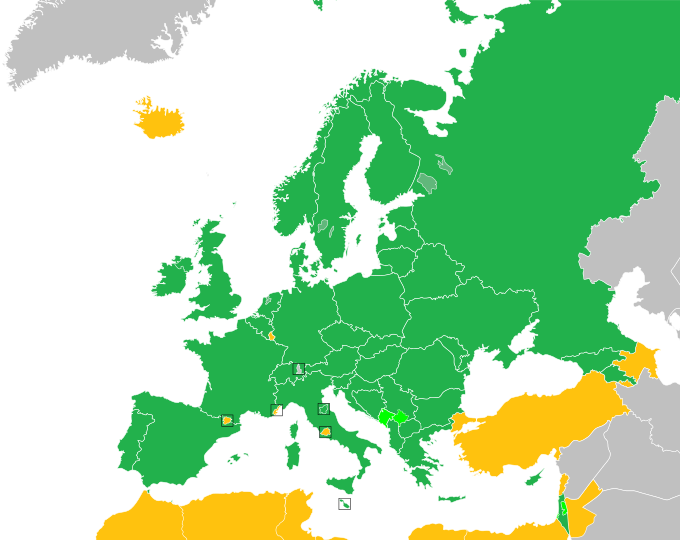
| Year | Country making its début entry | |
|---|---|---|
| {{flatlist | ||
| {{flatlist | ||
| {{flatlist | ||
| {{flatlist | ||
| {{flatlist | ||
| {{flatlist | ||
| {{flatlist | ||
| {{flatlist | ||
| {{flatlist | ||
| {{flatlist | ||
| {{flatlist | ||
| {{flatlist | ||
| {{flatlist | ||
| {{flatlist | ||
| {{flatlist | ||
| {{flatlist | ||
| {{flatlist |
Hosting
Most of the expense of the contest is covered by commercial sponsors, the host broadcaster, and contributions from the other participating broadcasters. The contest is considered to be a unique opportunity for promoting the host country as a tourist destination. The table below shows a list of cities and venues that have hosted the Eurovision Young Musicians, one or more times. Future venues are shown in italics. With 6 contests, Austria and its capital, Vienna have hosted the most contests. It has also shared two venues with the Eurovision Song Contest (Edinburgh's Usher Hall, which hosted both the 1972 song contest and the 2018 Young Musicians; and Bergen's Grieg Hall, which hosted both the 1986 song contest and the 2000 Young Musicians).

| No. | Country | City | Venue | Years | |
|---|---|---|---|---|---|
| 6 | Vienna | Musikverein | {{flatlist | ||
| Konzerthaus | {{flatlist | ||||
| Rathausplatz | {{flatlist | ||||
| 3 | Berlin | Konzerthaus | |||
| Cologne | Cologne Cathedral | {{flatlist | |||
| 2 | Geneva | Victoria Hall | |||
| Lucerne | Culture and Congress Centre | ||||
| Manchester | Free Trade Hall | ||||
| Edinburgh | Usher Hall | ||||
| Bergen | Grieg Hall | ||||
| Bodø | |||||
| 1 | Copenhagen | Radiohuset | |||
| Amsterdam | Concertgebouw | ||||
| Brussels | Cirque Royal | ||||
| Warsaw | Philharmonic Concert Hall | ||||
| Lisbon | Cultural Centre of Belém | ||||
| Montpellier | The Corum | ||||
| Yerevan |
Instruments and their first appearance
List contains only instruments played in the televised finals (preliminary rounds or semi finals are not included).


| Order | Instrument | First | |||||||||||||||||||||||||||
|---|---|---|---|---|---|---|---|---|---|---|---|---|---|---|---|---|---|---|---|---|---|---|---|---|---|---|---|---|---|
| appearance | Country | First performer | 1 | 2 | 3 | 4 | 5 | 6 | 7 | 8 | 9 | 10 | 11 | 12 | 13 | 14 | 15 | 16 | 17 | 18 | 19 | 20 | 21 | 22 | 23 | 24 | 25 | ||
| Piano | Anna Markland | ||||||||||||||||||||||||||||
| Clarinet | Paul Meyer | ||||||||||||||||||||||||||||
| Violin | Atle Sponberg | ||||||||||||||||||||||||||||
| Viola | Sabine Toutain | ||||||||||||||||||||||||||||
| Cello | Martina Schuchen | ||||||||||||||||||||||||||||
| Horn | David Pyatt | ||||||||||||||||||||||||||||
| Accordion | Christophe Delporte | ||||||||||||||||||||||||||||
| Harmonica | Antonio Serrano | ||||||||||||||||||||||||||||
| Trombone | David Bruchez | ||||||||||||||||||||||||||||
| Organ | Frederik Magle | ||||||||||||||||||||||||||||
| Percussion | Adrian Spillett | ||||||||||||||||||||||||||||
| Contrabass | Ödön Rácz | ||||||||||||||||||||||||||||
| Trumpet | David Guerrier | ||||||||||||||||||||||||||||
| Harp | Gwyneth Wentink | ||||||||||||||||||||||||||||
| Saxophone | Koryun Asatryan | ||||||||||||||||||||||||||||
| Oboe | Simone Sommerhalder | ||||||||||||||||||||||||||||
| Flute | Daniela Koch | ||||||||||||||||||||||||||||
| Cimbalom | Alexandra Denisenya | ||||||||||||||||||||||||||||
| Bassoon | Michaela Špačková | ||||||||||||||||||||||||||||
| Kanun | Narek Kazazyan | ||||||||||||||||||||||||||||
| Guitar | Kurt Aquilina | ||||||||||||||||||||||||||||
| Recorder | Lucie Horsch | ||||||||||||||||||||||||||||
| Double bass | Dominik Wagner | ||||||||||||||||||||||||||||
| Tamburica | Marko Martinović | ||||||||||||||||||||||||||||
| Euphonium | Valerian Alfaré |
Winners
As of 2024, there have been twenty-one editions of the Eurovision Young Musicians competition, with each contest having one winner. Austria is the only country to have ever scored a home victory, with violinist Lidia Baich winning the 1998 contest in Vienna. Austria is also one of only two countries to have hosted after winning the previous contest (as was the case in 1988 and 2006), alongside Poland, who hosted the 1994 contest after winning the 1992 edition. It is the only Eurovision event to date to have multiple instances of the same country winning that also won that year's Eurovision Song Contest (Germany won both events in 1982 and Austria won both in 2014), and the only instance of one country hosting multiple major Eurovision events in the same year (the United Kingdom, who hosted both the 1982 Song Contest and Young Musicians, thereby also making it the sole occasion where the same country not only won multiple Eurovision events in the same year, but did both in the same host country).
Winners by year
| Year | Date | Host city | No. | Winner | Performer | Instrument | Piece |
|---|---|---|---|---|---|---|---|
| 11 May | United Kingdom Manchester | 6 | Piano | Piano Concerto No. 1 by Felix Mendelssohn | |||
| 22 May | SUI Geneva | 7 | Isabelle van Keulen | Violin | Violin Concerto No. 5 by Henri Vieuxtemps | ||
| 27 May | DEN Copenhagen | 15 | Sandrine Lazarides | Piano | Piano Concerto E flat by Franz Liszt | ||
| 31 May | NED Amsterdam | 16 | Julian Rachlin | Violin | Violin Concerto No. 2 by Henryk Wieniawski | ||
| 29 May | Austria Vienna | 18 | Piano | Piano Concerto, 1st mov. by Edvard Grieg | |||
| 9 June | Belgium Brussels | 18 | Bartłomiej Nizioł | Violin | Violin Concerto by Johannes Brahms | ||
| 14 June | Poland Warsaw | 24 | Natalie Clein | Cello | Cello Concerto, 1st mov. by Edward Elgar | ||
| 12 June | Portugal Lisbon | 22 | Julia Fischer | Violin | Havanaise by Camille Saint-Saëns | ||
| 4 June | Austria Vienna | 18 | Violin | Violin Concerto No. 5, 1st mov. by Henri Vieuxtemps | |||
| 15 June | Norway Bergen | 24 | Stanisław Drzewiecki | Piano | Piano Concerto No. 1, 3rd mov. by Frederic Chopin | ||
| 19 June | Germany Berlin | 20 | Dalibor Karvay | Violin | Carmen Fantasie by Franz Waxman | ||
| 27 May | Switzerland Lucerne | 17 | Alexandra Soumm | Violin | Violin Concerto No. 1, 1st mov. by Niccolò Paganini | ||
| 12 May | Austria Vienna | 18 | Andreas Brantelid | Cello | Violoncello Concerto, 1st mov. by Joseph Haydn | ||
| 9 May | Austria Vienna | 16 | Clarinet | Clarinet Concerto, 4th mov. by Jean Françaix | |||
| 14 May | Austria Vienna | 15 | Eva Nina Kozmus | Flute | Flute Concerto, 3rd mov. by Jacques Ibert | ||
| 11 May | Austria Vienna | 14 | Viola | Viola concerto, 2 and 3 mov. by Béla Bartók | |||
| 31 May | Germany Cologne | 14 | Ziyu He | Violin | Violin Concerto No. 2 by Béla Bartók | ||
| 3 September | Germany Cologne | 11 | Saxophone | Rhapsody pour Saxophone alto by André Waignein | |||
| 23 August | United Kingdom Edinburgh | 18 | Ivan Bessonov | Piano | Piano Concerto No. 1, 3rd mov. by Pyotr Ilyich Tchaikovsky | ||
| 23 July | France Montpellier | 9 | Daniel Matejča | Violin | Violin Concerto No. 1, 3rd and 4th mov. by Dmitri Shostakovich | ||
| 17 August | Norway Bodø | 11 | Leonhard Baumgartner | Violin | Violin Concerto No. 5, 1st mov. by Henri Vieuxtemps | ||
| 6 June | Armenia Yerevan | 10 (so far) |
By country
The table below shows the top-three placings from each contest, along with the years that a country won the contest.

.jpg)
| Country | Total | Years won |
|---|---|---|
| 6 | 2 | |
| 3 | 0 | |
| 2 | 2 | |
| 2 | 0 | |
| 1 | 3 | |
| 1 | 2 | |
| 1 | 1 | |
| 1 | 1 | |
| 1 | 1 | |
| 1 | 0 | |
| 1 | 1 | |
| 1 | 0 | |
| 0 | 3 | |
| 0 | 1 | |
| 0 | 1 | |
| 0 | 1 | |
| 0 | 1 | |
| 0 | 0 | |
| 0 | 0 | |
| 0 | 0 | |
| 0 | 0 | |
| 0 | 0 |
By instrument
As of 2024, twenty-five instruments have appeared at least once in the televised finals (preliminary rounds or semi finals are not included). The following seven have been played by a winner at least once.
| Instrument | Family | Total | Years won |
|---|---|---|---|
| Violin | Strings | 10 | |
| Piano | Strings | 5 | |
| Cello | Strings | 2 | |
| Clarinet | Woodwind | 1 | 2008 |
| Flute | Woodwind | 1 | 2010 |
| Viola | Strings | 1 | 2012 |
| Saxophone | Woodwind | 1 | 2016 |
Presenters, conductors and orchestras
| Year | Presenter(s) | Conductor | Orchestra |
|---|---|---|---|
| Humphrey Burton | Bryden Thomson | BBC Northern Symphony Orchestra | |
| Horst Stein | Orchestre de la Suisse Romande | ||
| Hans Graf | Danish National Symphony Orchestra | ||
| Martine Bijl | Sergiu Comissiona | Radio Filharmonisch Orkest | |
| Gerhard Tötschinger | Pinchas Steinberg | Vienna Radio Symphony Orchestra | |
| Marie-Françoise Renson | Ronald Zollman | National Orchestra of Belgium | |
| Unknown}} | Kazimierz Kord | Warsaw National Philharmonic Orchestra | |
| Luis Izquierdo | |||
| Julian Rachlin | Dennis Russell Davies | Vienna Radio Symphony Orchestra | |
| Simone Young | Bergen Philharmonic Orchestra | ||
| Julia Fischer | Marek Janowski | Deutsches Symphonie-Orchester Berlin | |
| Christian Arming | Christian Arming | Lucerne Symphony Orchestra | |
| Schallbert Gilet | Vienna Symphony | ||
| and | Aleksandar Markovic | ||
| Christoph Wagner-Trenkwitz | Cornelius Meister | ||
| Pia Strauss (semifinal) and Martin Grubinger (final) | |||
| Sabine Heinrich | Kristiina Poska | WDR Symphony Orchestra Cologne | |
| and Daniel Hope | Clemens Schuldt | ||
| Petroc Trelawny with Josie d'Arby (final only) | Thomas Dausgaard | BBC Scottish Symphony Orchestra | |
| Judith Chaine and Vincent Delbushaye | Opéra Orchestre national Montpellier | ||
| and Mona Berntsen | Eivind Aadland | Norwegian Radio Orchestra |
Notes
References
References
- "Eurovision Young Musicians 1984". Issuu.
- "History. How it all started". [[BBC.
- "BBC Four - BBC Young Musician - History".
- "Eurovision Young Musicians 1982 (Participants)". European Broadcasting Union.
- "Eurovision Song Contest 1982". European Broadcasting Union.
- "Eurovision Young Musicians 2006: Participants". European Broadcasting Union.
- (15 March 2018). "EBU partners with Edinburgh International Festival for Young Musicians". European Broadcasting Union.
- Zwart, Josianne. (8 July 2019). "Eurovision Young Musicians heading to Zagreb in 2020". European Broadcasting Union.
- Granger, Anthony. (2020-03-11). "HRT Confirms Semi-Finals For Eurovision Young Musicians 2020".
- (18 March 2020). "Eurovision Young Musicians 2020 Has Been Postponed".
- Granger, Anthony. (3 February 2022). "Eurovision Young Musicians 2022 to be Held in 🇫🇷 Montpellier, France".
- "All you need to know about Young Musicians 2012".
- "Competition format | Eurovision Young Musicians - Cologne 2014".
- (24 February 2014). "Steering Group meets in Cologne". Youngmusicians.tv.
- (13 October 2015). "EYM'16: Return To "Elimination Semifinal"".
- (11 November 2015). "EYM 16 semi final dates announced". Eurovoix.
- (23 May 2016). "11 countries ready for Young Musicians 2016". youngmusicians.tv.
- "Membership conditions". [[European Broadcasting Union]].
- (2012). "ITU-R Radio Regulations 2012-2015". [[International Telecommunication Union]], available from the Spectrum Management Authority of Jamaica.
- (2004). "ITU-R Radio Regulations - Articles edition of 2004 (valid in 2004-2007)". [[International Telecommunication Union]].
- (8 September 2005). "Radio Regulations". [[International Telecommunication Union]].
- "Eurovision Young Musicians 1986". Issuu.
- "News - Medienportal - SRF".
- "Eurovision Young Musicians - History by year". European Broadcasting Union.
- (Oct 21, 2024). "Armenia to host Eurovision Young Musicians 2026 competition".
- "Armenia to host Eurovision Young Musicians 2026 competition".
- "Eurovision Young Musicians - History by country". European Broadcasting Union.
- (9 December 2014). "WDR and Cologne chosen to host 2016 competition". Youngmusicians.tv.
This article was imported from Wikipedia and is available under the Creative Commons Attribution-ShareAlike 4.0 License. Content has been adapted to SurfDoc format. Original contributors can be found on the article history page.
Ask Mako anything about Eurovision Young Musicians — get instant answers, deeper analysis, and related topics.
Research with MakoFree with your Surf account
Create a free account to save articles, ask Mako questions, and organize your research.
Sign up freeThis content may have been generated or modified by AI. CloudSurf Software LLC is not responsible for the accuracy, completeness, or reliability of AI-generated content. Always verify important information from primary sources.
Report