From Surf Wiki (app.surf) — the open knowledge base
Eurovision Song Contest 2003
International song competition
International song competition
| Field | Value |
|---|---|
| name | Eurovision Song Contest |
| year | 2003 |
| theme | Magical Rendez-vous |
| logo | Eurovision Song Contest 2003 logo.svg |
| final | |
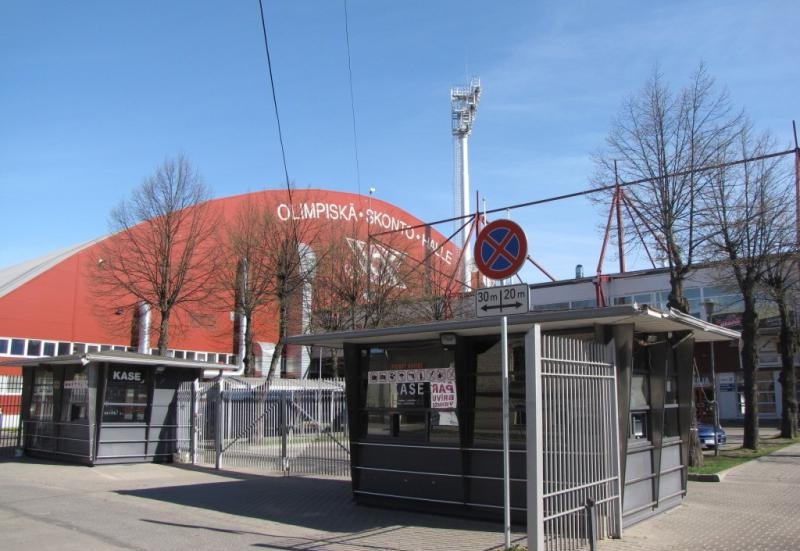
| venue | Skonto Hall |
| Riga, Latvia | |
| presenters | |
| director | Sven Stojanović |
| exproducer | Brigita Rozenbrika |
| organiser | European Broadcasting Union (EBU) |
| host | Latvian Television (LTV) |
| entries | 26 |
| debut | |
| return | |
| nonreturn | |
| vote | Each country awards 1–8, 10, and 12 points to their ten favourite songs |
| winner | |
| Map Relegation | Y |
Riga, Latvia
The Eurovision Song Contest 2003 was the 48th edition of the Eurovision Song Contest, held on 24 May 2003 at the Skonto Hall in Riga, Latvia, and presented by Marie N and Renārs Kaupers. It was organised by the European Broadcasting Union (EBU) and host broadcaster Latvian Television (LTV), who staged the event after winning the for with the song "I Wanna" by Marie N. Kaupers had also represented as a member of Brainstorm.
Broadcasters from twenty-six countries participated in the contest, beating the record of twenty-five first set in . It saw the return of , , the , , and after having been relegated from competing the previous year. also returned to the contest after being absent the previous year, while participated in the contest for the first time. , , , , and were relegated due to their poor results in 2002.
The winner was with the song "Everyway That I Can", performed by Sertab Erener who wrote it with Demir Demirkan. This was Turkey's first victory in the contest after 28 years of participation. , , , and rounded out the top five. Further down the table, the achieved their worst result to date, finishing twenty-sixth (last place) with no points. However, they avoided relegation due to being one of the "Big Four" countries at the time, as well as relegation being abolished the following year. The host country Latvia placed twenty-fourth (third from last) – this was the first time since that the host entry did not place in the top 10, and it was, overall, the worst result for a host entry since .
This was the last contest to take place on one evening. The EBU revealed that it would be adding a semi-final show to the competition in order to accommodate the growing number of interested countries wishing to take part in the contest. This was also the last contest in which a relegation system was used to determine which countries would participate in the following year's contest. As the Belgian entry was sung in an imaginary language, this was also the first time the contest featured a song with no parts performed in English or a language native to the country.
Location
On 22 August 2002, Latvian public broadcaster Latvian Television (LTV) announced that it had chosen the Skonto Hall in Riga as the host venue for the 2003 contest.
Latvia won the Eurovision Song Contest 2002 on 25 May 2002 in Tallinn, Estonia, with the song “I Wanna” performed by Marie N. This was Latvia's first victory in the contest, which also carried the right for LTV to organise the 2003 contest. LTV initially had budgetary concerns with staging the contest. The chairman of the National Radio and Television Council Ojārs Rubenis stated that if the government presented no budget guarantees, the council, which owns shares in LTV, would vote against organising the contest. Rubenis elaborated that LTV was prepared to cover the creative side and broadcasting of the contest, but additional funds would be needed for infrastructure, hotels and other financial issues.
The Government of Latvia allotted €5.3 million for the event with a further €1.1 million being provided by the Riga City Council – covering the anticipated organisational costs for the contest. A task force that included members from LTV, the National Radio and Television Council, and state secretaries was formed to explicitly work on organisation of the contest and report on the estimated expenses.
Bidding phase
Three cities were considered as host city of the contest: Riga, Ventspils, and Jūrmala. LTV requested proposals from the three cities concerning how they plan to organise the contest. Riga City Council offered the Mežaparks Open-air Stage, Skonto Hall, and the Ķīpsala International Exhibition Centre as potential venues for hosting the contest. Ventspils bid to host the contest in the halls of the Ventspils Olympic Center with a pledge of support from city mayor Aivars Lembergs, who added that Ventspils could also provide two cruise ferries that could be used to accommodate up to 8,000 guests. Jūrmala City Council offered the Dzintari Concert Hall with plans to expand and upgrade the facility and surrounding infrastructure.
LTV's organisational task force later decided to proceed with the bids from Riga and Ventspils, eliminating Jūrmala and the Mežaparks Open-air Stage in Riga. On 15 June 2002, the European Broadcasting Union (EBU) Reference Group decided in conjunction with the organisational task force in Latvia that Riga would host the 2003 contest with the venue option between the Skonto Hall and Ķīpsala International Exhibition Centre being decided upon by LTV. LTV ultimately chose the Skonto Hall as the venue to stage the contest.
Key Host venue Shortlisted
| City | Venue | Jūrmala | Riga | Ventspils |
|---|---|---|---|---|
| Dzintari Concert Hall | ||||
| Mežaparks Open-air Stage | ||||
| Skonto Hall | ||||
| Ķīpsala International Exhibition Centre ‡ | ||||
| Ventspils Olympic Center halls |
Participants
Per the rules of the contest, twenty-six countries were allowed to participate in the event, a new record number of competing entries in a single edition. Originally a total of twenty-five countries were scheduled to participate in the event, however was added to the line-up shortly before the publication of the competing countries in November 2002, making its début appearance in the contest. , , the , , , and returned after being absent from the previous year's event, and competed alongside Ukraine, the "Big Four" largest contributing participating countries, , , and the and the remaining fifteen highest-scoring participating countries from the . Having received the lowest scores in the 2002 contest, , , , , and were subsequently relegated and were prevented from participating in this year's event.
Twenty-four countries participated in the 2002 contest in Tallinn; of these, fourteen were expected to compete in 2003. The bottom ten in Tallinn would be relegated, to allow countries to compete for the first time. In reality, only five countries were relegatednineteen countries that entered in 2002 competed in Riga. Originally, , , and had planned 2003 debuts, but the EBU's late changes to the relegation procedure meant that they could not compete. The countries eventually made their debuts in 2004.
The 2003 contest was one of the few editions where no lead artists had previously competed as lead artists in past contests, although Slovenian representative Karmen had previously performed as a backing singer to Vili Resnik for .
| Country | Broadcaster | Artist | Song | Language | Songwriter(s) | ||
|---|---|---|---|---|---|---|---|
| ORF | Alf Poier | "Weil der Mensch zählt" | German | Alf Poier | |||
| RTBF | Urban Trad | "Sanomi" | Imaginary | ||||
| PBSBiH | Mija Martina | "Ne brini" | Croatian, English | ||||
| HRT | Claudia Beni | "Više nisam tvoja" | Croatian, English | ||||
| CyBC | "Feeling Alive" | English | Stelios Constantas | ||||
| ETV | Ruffus | "Eighties Coming Back" | English | Vaiko Eplik | |||
| France Télévisions | "Monts et merveilles" | French | Hocine Hallaf | ||||
| NDR | Lou | "Let's Get Happy" | English | ||||
| ERT | Mando | "Never Let You Go" | English | ||||
| RÚV | Birgitta | "Open Your Heart" | English | ||||
| RTÉ | Mickey Harte | "We've Got the World" | English | ||||
| IBA | Lior Narkis | "Words for Love" | Hebrew | ||||
| LTV | "Hello from Mars" | English | |||||
| PBS | {{ill | Lynn Chircop | de | it}} | "To Dream Again" | English | |
| NOS | Esther Hart | "One More Night" | English | ||||
| NRK | "I'm Not Afraid to Move On" | English | |||||
| TVP | Ich Troje | "Keine Grenzen – Żadnych granic" | German, Polish, Russian | ||||
| RTP | Rita Guerra | "Deixa-me sonhar" | Portuguese, English | Paulo Martins | |||
| TVR | Nicola | "Don't Break My Heart" | English | ||||
| C1R | t.A.T.u. | "Ne ver', ne boisia" (Не верь, не бойся) | Russian | ||||
| RTVSLO | Karmen | "Nanana" | English | ||||
| TVE | Beth | "Dime" | Spanish | ||||
| SVT | Fame | "Give Me Your Love" | English | ||||
| TRT | Sertab Erener | "Everyway That I Can" | English | ||||
| NTU | Olexandr | "Hasta la vista" | English | ||||
| BBC | Jemini | "Cry Baby" | English | Martin Isherwood |
Format
The EBU released the rules for the 2003 contest in November 2002, which detailed that twenty-six countries would participate, making it the largest number of participants to take part in the contest up to this point. The rules also modified the eligibility criteria for entries, changing the date of release cut-off point for songs from 1 January 2003 to 1 October 2002. There was also a change in the tie-break rule, which would now resolve such a case in favour of the nation that received points from a higher number of countries rather than taking into account the number of top scores (12 points) received. The draw for running order was held on 29 November 2002 in Riga, hosted by Marie N and Renārs Kaupers, with the results being revealed during a delayed broadcast of the proceedings later that day.
The official sponsors for the contest were Latvian mobile telecom provider Latvijas Mobilais Telefons and Latvian bank company Parex Banka. LTV selected Latvia Tours as its official partner to provide lodging, travel and recreation for the contest delegations and other guests. Riga City Council was also responsible for offering promotion and activities during the week preceding the contest.
Full preparations for the 2003 contest began on 18 May 2003 at the Skonto Hall. There were rehearsals, press conferences and participants were also involved in an internet chat. Two dress rehearsals were held on 23 May, in front of an estimated 12,000 people. The organisers of the contest held a press conference; one of the issues complained about was the lack of invitations for the after-party. The final dress rehearsal was held on 24 May, the day of the contest. A simulation of the voting procedure was also held, in which the presenters linked up with all twenty-six countries by satellite for the first time.
On the day of the contest, bookmaker William Hill's odds placed Russia as joint favourites to win the contest with Spain. Ireland, Slovenia, Estonia, Norway and Iceland were behind in third, fourth and joint fifth respectively. At the conclusion of the contest, favourites Russia placed third and Spain placed eighth, while outsiders Turkey (20–1) and Belgium (50–1) claimed the first and second places, respectively. Austria, at 100–1, were favourites to finish last, however, they scored their best result since 1989, placing sixth.
An official compilation album, featuring all twenty-six competing entries from the contest, was released for the first time on the EMI/CMC label.
Graphic design
The design of the contest was built around the theme "Magical rendez-vous", which represented the meeting of the various European nations coming to Latvia and encountering Latvia's versatile landscapes. LTV launched a competition in order to find the logo for the contest. At the close of the competition, high interest from the public translated into 204 logo submissions, which were ultimately judged by a jury panel consisting of Uldis-Ivars Grava (general director of LTV), Arvīds Babris (then executive producer of the contest), Ugis Brikmanis (director), Laimonis Šteinbergs (artist), Ingūna Rībena (architect), Arta Giga (LTV representative) and Juhan Paadam (EBU representative). On 16 November 2002, LTV and the EBU presented the logo for the contest which was designed by the director of the Computer Graphics Department of LTV, Maris Kalve with further elaboration by LTV's chief artist Kristaps Skulte. The logo was named upes, the Latvian word for rivers, and carried the slogan "All rivers flow toward the sea, all songs flow toward the Eurovision Song Contest".
The postcards shown between the entries were directed by Ugis Brikmanis and featured the artists competing at the contest interacting with Latvia's various landscapes: forests, rivers, lakes and towns. The postcards were recorded during the preceding week of the contest and ran behind schedule, leading to some postcards featuring only footage from the rehearsals and press conferences.
The stage design was created by Aigars Ozoliņš and based on the concept "Planet Latvia". The stage used several light and video effects and included an innovation new to the contest – a video screen stage floor that could be used to give each entry a unique look. For the first time, the scoreboard automatically rearranged itself in descending order as each point was awarded, making it easier for the audience and television viewers to follow the exact progress of the competitors throughout the voting process.
National host broadcaster
Initially, Arvīds Babris, head of the Latvian delegation at the 2002 contest, was appointed as executive producer for the contest, however, after production fell behind schedule and the EBU applied pressure upon LTV, he was dismissed and Brigita Rozenbrika took over the position, receiving additional support from the Swedish broadcaster Sveriges Television (SVT) and Estonian broadcaster Eesti Televisioon (ETV). SVT was also the technical producer of the contest for the second year running with Sven Stojanović as director and the Swedish lighting company Spectra+ contracted for the contest.
Voting system
The EBU reintroduced televoting as an obligatory voting mode in all participating countries, which awarded 1, 2, 3, 4, 5, 6, 7, 8, 10 and 12 points to their ten favourite songs, in ascending order. Countries voted in the same order as they had performed. Bosnia and Herzegovina and Russia were granted an exception to holding a televote as they cited that their telecommunications penetration was less than 80%. Polish broadcaster Telewizja Polska opted to use only SMS-voting. In televoting and SMS voting, a household shall not be permitted to vote more than three times. All other participating broadcasters planned to use a televote. Due to a technical issue, Ireland used results from their back-up jury instead of televoting. This contest was also the first to introduce a computer-generated scoreboard which rearranged itself in order as the points were awarded. Participating broadcasters were required to assemble back-up juries that consisted of eight voting members, with age and gender equally distributed, in the case of televote failure on the night of the competition. Four members of the jury had to be members of the general public and the other four members had to be music professionals.
Future changes in contest format
With the increased number of potential participating countries, the EBU began to review the format of the contest with potential changes being considered such as adding extra evenings for the show, holding a regional pre-selection, or putting a limit to number of participating countries by increasing the entrance fee. On 29 January 2003, the EBU unveiled a two-night system for the contest in 2004: a semi-final would be held before a grand final. The "Big Four", along with the top ten from the 2003 contest, would automatically qualify for the 2004 final. The format change eliminated the relegation system, allowing all countries to send an artist and song to the contest. The fourteen eventual countries from the 2003 contest that qualified to compete directly in the 2004 final were Turkey, Belgium, Russia, Norway, Sweden, Austria, Poland, Spain, Iceland, Romania, Ireland, Germany, France, and the United Kingdom. All other countries would have to compete in the semi-final for ten remaining spots in the final.
Contest overview
The contest was held on 24 May 2003 at 22:00 EEST (21:00 CEST) and was won by Turkey.
The contest featured special guests that communicated with the hosts via satellite: Lys Assia, winner of the 1956 contest greeted the hosts and spectators from Nicosia, Elton John spoke to the presenters live from the Life Ball in Vienna and one astronaut and one cosmonaut—Ed Lu and Yuri Malenchenko—gave their greetings from the International Space Station. The interval act for the contest was a short film directed by Anna Viduleja that featured a sequence of performances by Latvian post-folklore group Iļģi, Renārs Kaupers' band Brainstorm, Marie N and piano player Raimonds Pauls.
Turkey won with 167 points. Belgium came second with 165 points, with Russia, Norway, Sweden, Austria, Poland, Iceland, Spain and Romania completing the top ten. Portugal, Slovenia, Latvia, Malta and United Kingdom occupied the bottom five positions.
The UK's result was their worst-ever at Eurovision; by contrast, Turkey's win was their first. Alf Poier's sixth place was Austria's best result for fourteen years, Poland's seventh place was their best in nine, and Romania's tenth place was one place behind their best-ever. Belgium's second place was their first top-five finish in seventeen years, while Spain's eighth place (tied with Iceland's, which had its best result since 1999) was their third top-ten finish in a row, but Latvia's third-from-bottom finish was their worst result in four attempts; it was also the worst placing for a host country since 1992, until 2015 when host country Austria received 'nul points' and came second to last (Germany also received 'nul points' but because of the running order Austria placed ahead of them).
| R/O | Country | Artist | Song | Points | Place | 1 | 2 | 3 | 4 | 5 | 6 | 7 | 8 | 9 | 10 | 11 | 12 | 13 | 14 | 15 | 16 | 17 | 18 | 19 | 20 | 21 | 22 | 23 | 24 | 25 | 26 |
|---|---|---|---|---|---|---|---|---|---|---|---|---|---|---|---|---|---|---|---|---|---|---|---|---|---|---|---|---|---|---|---|
| Birgitta | "Open Your Heart" | 81 | 8 | ||||||||||||||||||||||||||||
| "Weil der Mensch zählt" | 101 | 6 | |||||||||||||||||||||||||||||
| "We've Got the World" | 53 | 11 | |||||||||||||||||||||||||||||
| "Everyway That I Can" | 167 | 1 | |||||||||||||||||||||||||||||
| "To Dream Again" | 4 | 25 | |||||||||||||||||||||||||||||
| "Ne brini" | 27 | 16 | |||||||||||||||||||||||||||||
| "Deixa-me sonhar" | 13 | 22 | |||||||||||||||||||||||||||||
| "Više nisam tvoja" | 29 | 15 | |||||||||||||||||||||||||||||
| "Feeling Alive" | 15 | 20 | |||||||||||||||||||||||||||||
| Lou | "Let's Get Happy" | 53 | 11 | ||||||||||||||||||||||||||||
| t.A.T.u. | "Ne ver', ne boisia" | 164 | 3 | ||||||||||||||||||||||||||||
| Beth | "Dime" | 81 | 8 | ||||||||||||||||||||||||||||
| "Words for Love" | 17 | 19 | |||||||||||||||||||||||||||||
| "One More Night" | 45 | 13 | |||||||||||||||||||||||||||||
| Jemini | "Cry Baby" | 0 | 26 | ||||||||||||||||||||||||||||
| Olexandr | "Hasta la vista" | 30 | 14 | ||||||||||||||||||||||||||||
| Mando | "Never Let You Go" | 25 | 17 | ||||||||||||||||||||||||||||
| "I'm Not Afraid to Move On" | 123 | 4 | |||||||||||||||||||||||||||||
| "Monts et merveilles" | 19 | 18 | |||||||||||||||||||||||||||||
| Ich Troje | "Keine Grenzen – Żadnych granic" | 90 | 7 | ||||||||||||||||||||||||||||
| F.L.Y. | "Hello from Mars" | 5 | 24 | ||||||||||||||||||||||||||||
| Urban Trad | "Sanomi" | 165 | 2 | ||||||||||||||||||||||||||||
| Ruffus | "Eighties Coming Back" | 14 | 21 | ||||||||||||||||||||||||||||
| Nicola | "Don't Break My Heart" | 73 | 10 | ||||||||||||||||||||||||||||
| Fame | "Give Me Your Love" | 107 | 5 | ||||||||||||||||||||||||||||
| Karmen | "Nanana" | 7 | 23 |
Spokespersons
Each participating broadcaster appointed a spokesperson who was responsible for announcing, in English or French, the votes for its respective country. The voting order in the 2003 contest was the order in which the countries had been drawn to perform. The spokespersons for each country were:
- IcelandEva María Jónsdóttir
- Austria
- IrelandPamela Flood
- TurkeyMeltem Ersan Yazgan
- MaltaSharon Borg
- Bosnia and Herzegovina
- Portugal
- Croatia
- CyprusLoukas Hamatsos
- GermanyAxel Bulthaupt
- RussiaYana Churikova
- SpainAnne Igartiburu
- Israel
- NetherlandsMarlayne
- United KingdomLorraine Kelly
- UkraineLyudmyla Hariv
- Greece
- NorwayRoald Øyen
- FranceSandrine François
- Poland
- Latvia
- Belgium
- EstoniaInes
- RomaniaLeonard Miron
- SwedenKattis Ahlström
- SloveniaPeter Poles
Detailed voting results
| nb=1 | Total score | cellstyle=border-bottom:1px solid transparent;}} | nb=1 | Iceland}} | nb=1 | Austria}} | nb=1 | Ireland}} | nb=1 | Turkey}} | nb=1 | Malta}} | nb=1 | Bosnia and Herzegovina}} | nb=1 | Portugal}} | nb=1 | Croatia}} | nb=1 | Cyprus}} | nb=1 | Germany}} | nb=1 | Russia}} | nb=1 | Spain}} | nb=1 | Israel}} | nb=1 | Netherlands}} | nb=1 | United Kingdom}} | nb=1 | Ukraine}} | nb=1 | Greece}} | nb=1 | Norway}} | nb=1 | France}} | nb=1 | Poland}} | nb=1 | Latvia}} | nb=1 | Belgium}} | nb=1 | Estonia}} | nb=1 | Romania}} | nb=1 | Sweden}} | nb=1 | Slovenia}} | va=middle | Contestants}} | Iceland | Austria | Ireland | Turkey | Malta | Bosnia and Herzegovina | Portugal | Croatia | Cyprus | Germany | Russia | Spain | Israel | Netherlands | United Kingdom | Ukraine | Greece | Norway | France | Poland | Latvia | Belgium | Estonia | Romania | Sweden | Slovenia |
|---|---|---|---|---|---|---|---|---|---|---|---|---|---|---|---|---|---|---|---|---|---|---|---|---|---|---|---|---|---|---|---|---|---|---|---|---|---|---|---|---|---|---|---|---|---|---|---|---|---|---|---|---|---|---|---|---|---|---|---|---|---|---|---|---|---|---|---|---|---|---|---|---|---|---|---|---|---|---|---|---|---|---|
| Voting procedure used: | ||||||||||||||||||||||||||||||||||||||||||||||||||||||||||||||||||||||||||||||||||
| 81 | 7 | 8 | 12 | 6 | 5 | 1 | 6 | 4 | 12 | 1 | 1 | 3 | 3 | 1 | 7 | 4 | ||||||||||||||||||||||||||||||||||||||||||||||||||||||||||||||||||
| 101 | 10 | 6 | 5 | 10 | 5 | 4 | 2 | 8 | 8 | 8 | 2 | 8 | 4 | 2 | 6 | 6 | 7 | |||||||||||||||||||||||||||||||||||||||||||||||||||||||||||||||||
| 53 | 2 | 5 | 5 | 7 | 4 | 7 | 12 | 1 | 6 | 1 | 1 | 2 | ||||||||||||||||||||||||||||||||||||||||||||||||||||||||||||||||||||||
| 167 | 3 | 12 | 4 | 12 | 8 | 10 | 8 | 10 | 3 | 7 | 12 | 7 | 2 | 7 | 10 | 10 | 2 | 12 | 10 | 8 | 10 | |||||||||||||||||||||||||||||||||||||||||||||||||||||||||||||
| 4 | 3 | 1 | ||||||||||||||||||||||||||||||||||||||||||||||||||||||||||||||||||||||||||||||||
| 27 | 7 | 12 | 8 | |||||||||||||||||||||||||||||||||||||||||||||||||||||||||||||||||||||||||||||||
| 13 | 2 | 2 | 3 | 6 | ||||||||||||||||||||||||||||||||||||||||||||||||||||||||||||||||||||||||||||||
| 29 | 5 | 6 | 3 | 6 | 1 | 8 | ||||||||||||||||||||||||||||||||||||||||||||||||||||||||||||||||||||||||||||
| 15 | 2 | 1 | 12 | |||||||||||||||||||||||||||||||||||||||||||||||||||||||||||||||||||||||||||||||
| 53 | 8 | 1 | 4 | 3 | 7 | 4 | 2 | 4 | 5 | 2 | 2 | 1 | 10 | |||||||||||||||||||||||||||||||||||||||||||||||||||||||||||||||||||||
| 164 | 4 | 8 | 10 | 1 | 3 | 4 | 12 | 10 | 8 | 6 | 10 | 1 | 12 | 10 | 2 | 7 | 4 | 12 | 7 | 12 | 7 | 2 | 12 | |||||||||||||||||||||||||||||||||||||||||||||||||||||||||||
| 81 | 6 | 2 | 12 | 7 | 6 | 6 | 12 | 5 | 5 | 10 | 5 | 4 | 1 | |||||||||||||||||||||||||||||||||||||||||||||||||||||||||||||||||||||
| 17 | 5 | 1 | 3 | 8 | ||||||||||||||||||||||||||||||||||||||||||||||||||||||||||||||||||||||||||||||
| 45 | 5 | 7 | 2 | 10 | 2 | 1 | 5 | 8 | 5 | |||||||||||||||||||||||||||||||||||||||||||||||||||||||||||||||||||||||||
| 0 | ||||||||||||||||||||||||||||||||||||||||||||||||||||||||||||||||||||||||||||||||||
| 30 | 8 | 4 | 10 | 5 | 3 | |||||||||||||||||||||||||||||||||||||||||||||||||||||||||||||||||||||||||||||
| 25 | 1 | 4 | 12 | 5 | 1 | 2 | ||||||||||||||||||||||||||||||||||||||||||||||||||||||||||||||||||||||||||||
| 123 | 12 | 2 | 12 | 6 | 5 | 7 | 4 | 3 | 7 | 6 | 7 | 3 | 6 | 7 | 6 | 10 | 3 | 12 | 5 | |||||||||||||||||||||||||||||||||||||||||||||||||||||||||||||||
| 19 | 8 | 2 | 3 | 6 | ||||||||||||||||||||||||||||||||||||||||||||||||||||||||||||||||||||||||||||||
| 90 | 10 | 10 | 12 | 5 | 4 | 2 | 8 | 6 | 4 | 5 | 8 | 5 | 4 | 4 | 3 | |||||||||||||||||||||||||||||||||||||||||||||||||||||||||||||||||||
| 5 | 5 | |||||||||||||||||||||||||||||||||||||||||||||||||||||||||||||||||||||||||||||||||
| 165 | 7 | 4 | 10 | 7 | 10 | 6 | 3 | 6 | 3 | 12 | 8 | 10 | 5 | 10 | 8 | 3 | 12 | 12 | 10 | 8 | 8 | 3 | ||||||||||||||||||||||||||||||||||||||||||||||||||||||||||||
| 14 | 1 | 8 | 2 | 3 | ||||||||||||||||||||||||||||||||||||||||||||||||||||||||||||||||||||||||||||||
| 73 | 6 | 1 | 7 | 1 | 2 | 4 | 12 | 10 | 6 | 6 | 4 | 1 | 4 | 8 | 1 | |||||||||||||||||||||||||||||||||||||||||||||||||||||||||||||||||||
| 107 | 5 | 3 | 8 | 1 | 3 | 2 | 1 | 3 | 7 | 5 | 3 | 10 | 5 | 7 | 2 | 7 | 6 | 4 | 7 | 12 | 6 | |||||||||||||||||||||||||||||||||||||||||||||||||||||||||||||
| 7 | 4 | 3 |
12 points
Below is a summary of all 12 points in the final:
| N. | Contestant | Nation(s) giving 12 points | 5 | 4 | 3 | 2 | 1 |
|---|---|---|---|---|---|---|---|
| , , , , | |||||||
| **** | , , , | ||||||
| , , | |||||||
| , , | |||||||
| , | |||||||
| , |
Broadcasts
Each participating broadcaster was required to relay live and in full the contest via television. Non-participating EBU member broadcasters were also able to relay the contest as "passive participants"; any passive countries wishing to participate in the following year's event were also required to provide a live broadcast of the contest or a deferred broadcast within 24 hours. Broadcasters were able to send commentators to provide coverage of the contest in their own native language and to relay information about the artists and songs to their viewers. Known details on the broadcasts in each country, including the specific broadcasting stations and commentators, are shown in the tables below. Broadcasters in 42 countries were reported to have broadcast the event live or deferred, including broadcasters in Albania, Armenia, Australia, Belarus, Puerto Rico, Serbia and Montenegro, and the United States.
| Country | Broadcaster | Channel(s) | Commentator(s) | Ref(s) | Austria | Belgium | Croatia | Cyprus | Estonia | France | Germany | Greece | Iceland | Ireland | Latvia | Malta | Netherlands | Norway | Poland | Portugal | Romania | Russia | Slovenia | Spain | Sweden | Turkey | Ukraine | United Kingdom |
|---|---|---|---|---|---|---|---|---|---|---|---|---|---|---|---|---|---|---|---|---|---|---|---|---|---|---|---|---|
| ORF | ORF 1 | Andi Knoll | ||||||||||||||||||||||||||
| RTBF | La Une | Jean-Pierre Hautier | ||||||||||||||||||||||||||
| VRT | TV1 | André Vermeulen and Anja Daems | ||||||||||||||||||||||||||
| HRT | HRT 1 | |||||||||||||||||||||||||||
| CyBC | RIK Ena | |||||||||||||||||||||||||||
| ETV | Marko Reikop | |||||||||||||||||||||||||||
| France Télévisions | France 3 | Laurent Ruquier and Isabelle Mergault | ||||||||||||||||||||||||||
| ARD | Das Erste | Peter Urban | ||||||||||||||||||||||||||
| ERT | ET1 | Dafni Bokota | ||||||||||||||||||||||||||
| ERA 1 | Nikos Triboulidis | |||||||||||||||||||||||||||
| RÚV | Sjónvarpið | Gísli Marteinn Baldursson | ||||||||||||||||||||||||||
| Rás 2 | ||||||||||||||||||||||||||||
| RTÉ | RTÉ One | Marty Whelan and Phil Coulter | ||||||||||||||||||||||||||
| LTV | LTV1 | |||||||||||||||||||||||||||
| PBS | TVM | John Bundy | ||||||||||||||||||||||||||
| PO | Nederland 2 | Willem van Beusekom | ||||||||||||||||||||||||||
| Radio 2 | ||||||||||||||||||||||||||||
| NRK | NRK1 | Jostein Pedersen | ||||||||||||||||||||||||||
| NRK P1 | ||||||||||||||||||||||||||||
| TVP | TVP1 | Artur Orzech | ||||||||||||||||||||||||||
| RTP | RTP1 | |||||||||||||||||||||||||||
| TVR | România 1 | |||||||||||||||||||||||||||
| Channel One | Channel One | and | ||||||||||||||||||||||||||
| RTVSLO | SLO 2 | Andrea F | ||||||||||||||||||||||||||
| TVE | La Primera | José Luis Uribarri | ||||||||||||||||||||||||||
| SVT | SVT1 | Pekka Heino | ||||||||||||||||||||||||||
| SR | SR P4 | Carolina Norén and Björn Kjellman | ||||||||||||||||||||||||||
| TRT | TRT 1 | Bülend Özveren | ||||||||||||||||||||||||||
| NTU | Pershyi Natsionalnyi | Dmytro Kryzhanivskyi | ||||||||||||||||||||||||||
| BBC | BBC One | Terry Wogan | ||||||||||||||||||||||||||
| BBC Radio 2 | Ken Bruce |
| Country | Broadcaster | Channel(s) | Commentator(s) | Ref(s) | Andorra | Australia | Belarus | Denmark | Falkland Islands | Finland | Italy | Lithuania | Serbia and Montenegro | Switzerland |
|---|---|---|---|---|---|---|---|---|---|---|---|---|---|---|
| RTVA | ATV | and Albert Roig | ||||||||||||
| SBS | SBS TV | Des Mangan | ||||||||||||
| BTRC | Belarus-1 | Ales Kruglyakov and Tatyana Yakusheva | ||||||||||||
| DR | DR1 | Jørgen de Mylius | ||||||||||||
| BFBS | BFBS 1, BFBS Radio 2 | |||||||||||||
| YLE | YLE TV2 | Maria Guzenina and | ||||||||||||
| YLE FST | ||||||||||||||
| YLE Radio Suomi | ||||||||||||||
| YLE Radio Vega | ||||||||||||||
| GAY.tv | and Paolo Quilici | |||||||||||||
| LRT | LTV | |||||||||||||
| RTS | RTS 2 | |||||||||||||
| SRG SSR | SF 2 | |||||||||||||
| TSR 1 | Jean-Marc Richard and Alain Morisod | |||||||||||||
| TSI 1 | Daniele Rauseo |
Incidents
Organisational issues
In January 2003, German news magazine Der Spiegel reported that Riga was suffering from serious financial problems that could have led to a breach of contract and the contest needing to be moved to another city. Ilona Bērziņa, spokesperson of LTV, denied that potential financial issues the city council of Riga may be facing would interrupt the organisation of the contest. In February 2003, The Baltic Times reported that a Riga municipality committee rejected the proposal to withdraw the funds it pledged in support of organising the contest.
In March 2003, Danish newspaper B.T. published an article based on accusations that the EBU television director Bjørn Erichsen made in reference to LTV suffering from organisational chaos which could have resulted in the removal of Latvia's hosting duties since they were running behind schedule. The general director of LTV, Uldis-Ivars Grava, replied, saying: "A few weeks ago, the EBU's legal director, Werner Rumphorst, was in Riga, and I spent an entire day with him and with the former general director of the Danish broadcaster DR, Bjørn Erichsen. We talked about co-operation and about programme exchanges, and neither of them said a single word that would indicate any doubts, lack of trust or accusation." Ingrida Smite, head of press for the Eurovision Song Contest 2003, reaffirmed that the contest would take place in Riga despite reports to the contrary.
Controversies surrounding Russian band t.A.T.u.
Upon the selection of the Russian artists t.A.T.u., the duo gave an interview to German tabloid Bild in March 2003 where they claimed that they would win the contest without a doubt and criticised the German entrant Lou calling her a witch with duo member Julia Volkova (also referring to Germany's 2002 entrant) stating, "In Russia we nurse blind and old people, but we don't send them to the Grand Prix. This must be different in Germany." Lou later responded to the comments stating, "I don't know whether bitching, fighting and boozing kids are the right representatives for such a beautiful country as Russia."
t.A.T.u.'s first rehearsal dominated proceedings on 20 May—the band were supposed to rehearse the day before, but had turned up a day late, claiming that Julia Volkova was suffering from a sore throat. The group were booed by journalists during their press conference where they complained about the production's poor lighting and stage. EBU supervisor Sarah Yuen said "They are the bad girls of pop… we shouldn’t have expected them to come here and be nice and pleasant." The EBU had originally planned to have a pre-recorded performance of the Russian entry ready to substitute during the live broadcast in case the duo performed a lesbian publicity stunt on stage, which they deemed inappropriate for a family entertainment show. The EBU later stated that the performance would be broadcast live without any interruption.
Ireland's use of its back-up jury
After the contest, Russian broadcaster Channel One complained that Irish broadcaster RTÉ had used a back-up jury, and that it had cost them victory. A statement by Channel One said "Considering [the] insignificant difference in points between the first and third places, there are grounds to believe that the contest results could be much different for Russia." On the night of the competition, the voting polls operated by Irish telecommunications company Eircom suffered a delay in delivering the results on time, which prompted RTÉ to use the votes of the back-up jury instead. The EBU cleared RTÉ of any potential wrongdoing after an investigation on the matter and stated that the rules concerning substituting the back-up jury in place of the televote were correctly applied.
Marcel Bezençon Awards

The Marcel Bezençon Awards, a series of awards held concurrently to the main contest, honour and celebrate the participants of the final of that year's Eurovision Song Contest. Named after one of the people influential in the creation of the contest, and created by two former Swedish Eurovision participants, Christer Björkman () and Richard Herrey ( as a member of the winning group Herreys), the inaugural awards were presented at part of the . Three awards were presented as part of the second edition of the awards in 2003, with the winner of each award determined by the collective votes of a different group of individuals:
- The Press Award for the best competing song, as determined by the accredited press and media, was awarded to the , "Everyway That I Can" performed by Sertab Erener
- The Artistic Award for the best artistic performance, as determined by previous Eurovision winners, was awarded to the , "One More Night" performed by Esther Hart
- The Fan Award, as determined by members of the international Eurovision fan club OGAE, was awarded to the , "Dime" performed by Beth
The winners each received a hand-blown glass trophy designed by Karin Hammar and created at the , which were handed out backstage prior to the contest proper.
Official album

Eurovision Song Contest: Riga 2003 was the official compilation album of the 2003 contest, put together by the European Broadcasting Union and released by CMC International on 19 May 2003. The album featured all 26 songs that entered in the 2003 contest.
Charts
| Chart (2003) | Peak |
|---|---|
| position |
Notes
References
References
- Bakker, Sietse. (1 December 2002). "Renars Kaupers and Marie N hosts 2003 show". ESCToday.com.
- Bakker, Sietse. (27 November 2002). "EBU released list of participant for 2003". ESCToday.com.
- (25 May 2003). "UK act hits Eurovision low". [[BBC News]].
- Barak, Itamar. (22 May 2003). "EBU press conference about the contest's future". ESCToday.com.
- (31 January 2003). "Vēstulē noliedz Eirovīzijas finansu problēmas". [[Delfi (web portal).
- (6 June 2002). "Dzintaru koncertzāles pārbūve Eirovīzijas rīkošanai izmaksātu trīs miljonus latu". TVNET.
- Lēvalde, Vēsma. (3 June 2002). "Ventspils dome vēlas Eirovīzijas rīkošanu Ventspilī (papildināts)". db.lv.
- (2 July 2002). "Eirovīzija izmaksās 4,7 vai 5,5 miljonus latu". TVNET.
- "Rules of the 48th Eurovision Song Contest (2003)". European Broadcasting Union.
- (18 November 2002). "Record 26 countries to compete in 2003 Song Contest". European Broadcasting Union.
- (24 December 2009). "The end of a decade: Riga 2003". European Broadcasting Union.
- (24 May 2014). "Remember the three way thriller of 2003?". European Broadcasting Union.
- (9 August 2003). "From 'Pump-Pump' to 'Cha Cha Cha': Finland's vibrant Eurovision history". European Broadcasting Union.
- Andžej. (10 October 2017). "A brief history of Lithuania in Eurovision Song Contest {{!}} Eurodiena.lt – Eurovizija. Konkurso dienoraštis".
- (14 October 2022). "Се огласи МРТ: Македонија нема да учествува на Евровизија 2023". Muzika24.
- (27 May 2002). "Swiss dropped from Eurovision line-up". [[SWI swissinfo]].
- Sietse Bakker (25 May 2002). [https://web.archive.org/web/20090628180628/http://www.esctoday.com/news/read/689 Latvia won the 47th Eurovision Song Contest]. ESCToday. Retrieved on 23 March 2008.
- Sietse Bakker. [https://web.archive.org/web/20090524051134/http://www.esctoday.com/news/read/780 EBU released list of participant for 2003]. ESCToday. Retrieved on 23 March 2008.
- Sietse Bakker. [https://web.archive.org/web/20070515112113/http://www.esctoday.com/news/read/747 No new countries at next Eurovision Song Contest]. ESCToday. Retrieved on 23 March 2008.
- (30 January 2009). "Slovenia : Karmen Stavec talks to Eurovision.tv". European Broadcasting Union.
- "Riga 2003 – Participants". European Broadcasting Union.
- "Alle deutschen ESC-Acts und ihre Titel". ARD.
- Bakker, Sietse. (28 November 2002). "Draw to be made public Friday 17:00 CET". ESCToday.com.
- Sietse Bakker (1 December 2002). [https://web.archive.org/web/20081011153301/http://www.esctoday.com/news/read/997 Draw of running order finally available]. ESCToday. Retrieved on 23 March 2008.
- Bakker, Sietse. (30 November 2002). "Latvijas Mobilais and Parex sponsor 2003 contest". ESCToday.com.
- Bakker, Sietse. (27 November 2002). "Latvia Tours selected as cooperation partner". ESCToday.com.
- Medinika, Aija. (25 March 2002). "The preparation for Eurovision Song Contest 2003". ESCToday.com.
- "Event".
- Bakker, Sietse. (24 May 2003). "William Hill: update of the betting figures!". ESCToday.com.
- "Eurovision Song Contest Riga 2003: CD available now". [[European Broadcasting Union]].
- Bakker, Sietse. (26 November 2002). "Eurovision 2003 theme will be rendez-vous". ESCToday.com.
- Medinika, Aija. (27 November 2002). "204 logo propositions for ESC 2003". ESCToday.com.
- Bakker, Sietse. (27 November 2002). "Logo for Eurovision 2003 selected". ESCToday.com.
- Jordan, Paul. (11 January 2013). "What's Another Year? Ten Years On From Riga". ESCInsight.
- Bakker, Sietse. (27 March 2003). "Eurovision Song Contest 2003 on Planet Latvia". ESCToday.com.
- Barak, Itamar. (7 May 2003). "Magical encounter on the Eurovision stage". ESCToday.com.
- Kübar, Remi. (7 February 2003). "Details revealed about the stage in May". ESCToday.com.
- Bakker, Sietse. (28 November 2002). "Arvids Babris will produce the contest in Latvia". ESCToday.com.
- Barak, Itamar. (18 March 2003). "Riga 2003: A new executive producer". ESCToday.com.
- Opheim, Bjørn Erik. (13 December 2002). "SVT to produce 2003 Eurovision Song Contest". ESCToday.com.
- (17 April 2003). "Spectra+ lands third Eurovision contract". Live Design.
- (24 May 2003). "Turkish delight at Eurovision win". [[BBC News]].
- Medinika, Aija. (24 May 2003). "Poland will use SMS-voting only". ESCToday.com.
- Bakker, Sietse. (29 January 2003). "EBU confirms new Eurovision Song Contest format". ESCToday.com.
- Bakker, Sietse. (1 December 2008). "Artists and fan sites campaign on World AIDS Day". Eurovision.tv.
- Bakker, Sietse. (21 May 2008). "1956 winner Lys Assia: "It will go on!"". Eurovision.tv.
- Tarm, Michael. (2003). "Turks beat back Russia and Belgium to win; Baltics and Britain bomb.". City Paper.
- (6 May 2003). "Eirovīzijas veidotāji pārcēlušies uz 'Skonto' halli". [[Delfi (web portal).
- "Riga 2003 – Scoreboard". European Broadcasting Union.
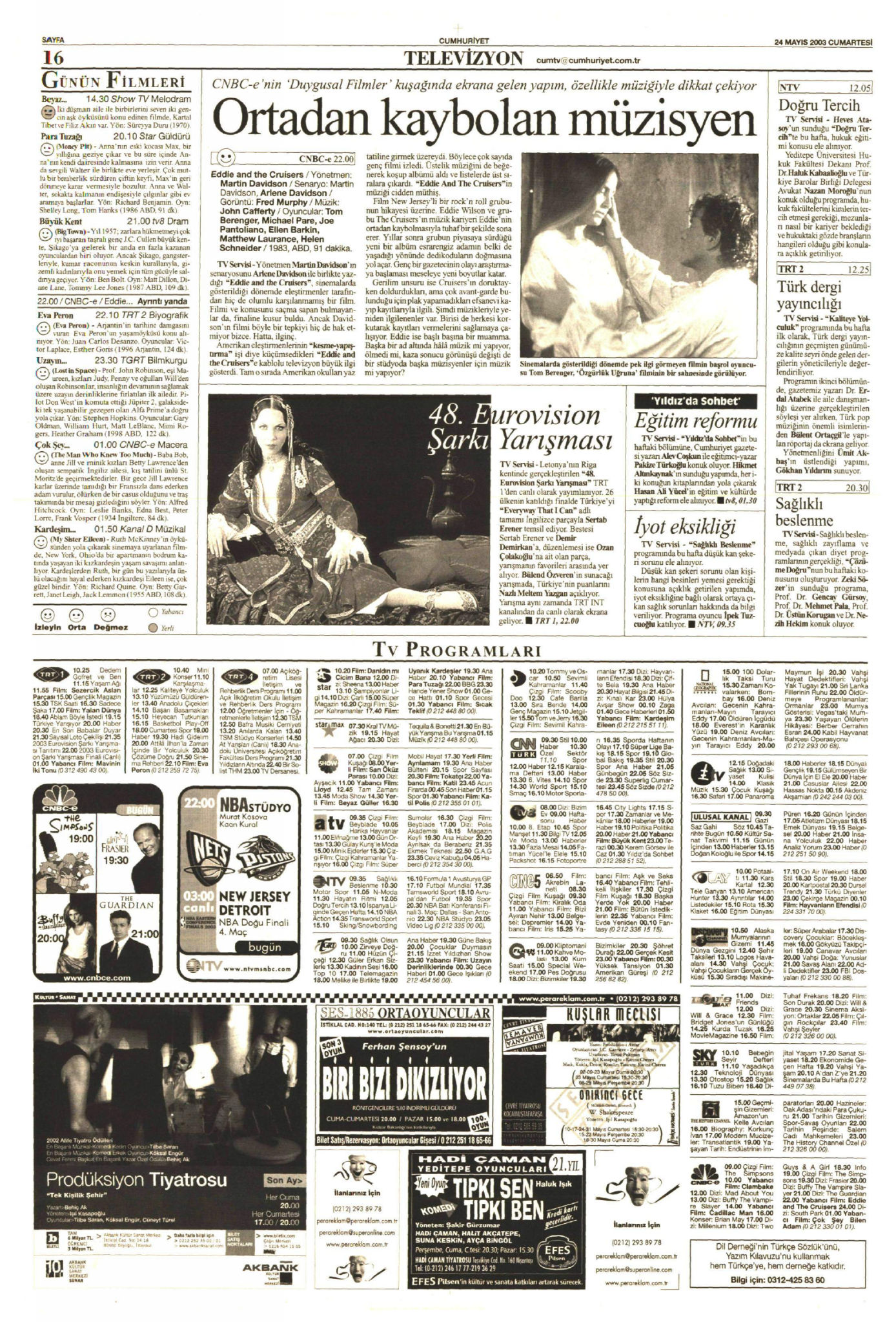
- (24 May 2003). "48. Eurovision Şarkı Yarışması". [[Cumhuriyet]].
- link. (January 24, 2016)
- (19 February 2010). "Αλέξης Κωστάλας: Δείτε πού τον εντοπίσαμε μετά από καιρό!".
- Bakker, Sietse. (22 May 2003). "Girts Licis: press conferences and Latvian votes". ESCToday.
- (2006). "Melodifestivalen genom tiderna : de svenska uttagningarna och internationella finalerna". Premium Publishing.
- "Riga 2003 – Detailed voting results". European Broadcasting Union.
- "Eurovision Song Contest 2003 – Scoreboard". European Broadcasting Union.
- (10 April 2003). "Eurovision Song Contest 2003". European Broadcasting Union.
- Opheim, Bjørn Erik. (22 February 2003). "50th Anniversary won't affect annual Eurovision". ESCToday.
- Barak, Itamar. (22 May 2003). "EBU press conference about the contest's future". ESCToday.
- "Andreas Knoll". [[ORF (broadcaster).
- Van Roey, Laurent. (24 May 2003). "L'acteur t.A.T.u.". [[Le Soir]].
- (10 May 2005). "Eén and La Une present Eurovision coverage - ESCToday.com". ESCToday.
- (23 May 2003). "TV program". Glas Podravine.
- (31 May 2003). "Pjesmice eurovizije". [[Feral Tribune]].
- (24 May 2003). "Τηλεορασεις". {{lang.
- (31 December 2009). "ETV 2003 {{!}} ajalugu {{!}} Ülevaade Eesti Televisiooni tegemistest aastal 2003.". [[Eesti Televisioon]].
- "Τετάρτη 26 Φεβρουαρίου ο ελληνικός διαγωνισμός". [[Hellenic Broadcasting Corporation]].
- (24 May 2003). "Laugardagur 24. maí". [[DV (newspaper).
- (23 May 2003). "Count-down to Eurovision in Latvia". [[RTÉ]].
- Šaitere, Tekla. (22 May 2003). "www.eurovision.tv". [[Diena]].
- Massa, Adriana. (23 May 2003). "Lynn's dress rehearsal goes well". [[Times of Malta]].
- (24 May 2003). "Radio & Televisie Zaterdag". [[Leidsch Dagblad]].
- De Vos, Ronald. (31 May 2003). "Toch trots op 'onze' Esther Hart". [[Leidsch Dagblad]].
- (24 May 2003). "Radio & TV". [[Telemarksavisa]].
- (24–25 May 2003). "Programy TV sobota". [[Dziennik Bałtycki]].
- (25 May 2003). "Turcja, nie Polska zwycięzcą Eurowizji 2003". [[Onet.pl]].
- (22 May 2003). "Television & Radio Programmes". [[Anglo-Portuguese News]].
- (19 May 2003). "Eurovisão: Concorrência de leste". [[Correio da Manhã (Portugal).
- (24 May 2003). "Sâmbătă, 24 mai 2003". {{ill.
- (15 May 2003). "TV. Воскресенье, 25. мая". [[Sovetskaya Sibir]].
- (24 May 2003). "Организаторы конкурса «Евровидение-2003» обещают незабываемое шоу". [[Channel One Russia]].
- "Суббота, 24 мая". [[Argumenty i Fakty]].
- Šinik, Gorazd. (23 May 2003). "Prosim, ne zaspite pred televizorjem". Gorenjski Glas.
- (24 May 2003). "Televisión". [[La Vanguardia]].
- (24 May 2003). "TV & Radio i dag". [[Dagens Nyheter]].
- (24 May 2003). "Radioprogram 24 maj 2003". [[Dagens Nyheter]].
- Polishchuk, Tetyana. (21 May 2003). "«Євробачення» — готовність № 1". [[The Day (Kyiv).
- (17 May 2003). "Субота, 24 травня". Nove Zhyttia.
- (24 May 2003). "The Eurovision Song Contest – BBC One".
- (24 May 2003). "Eurovision Song Contest – BBC Radio 2".
- (9 October 2003). "ATV Eurovisio". [[Ràdio i Televisió d'Andorra]].
- (23 May 2003). "TV Torres News". [[Torres News]].
- (24 May 2003). "Lesbian kiss could be Russia's Waterloo". [[The Sydney Morning Herald]].
- (16 May 2003). "Телепрограмма на 19.05 – 25.05". [[Belorusskaya Delovaya Gazeta]].
- (24 May 2003). "БТ покажет нам «Евровидение-2003»". [[Komsomolskaya Pravda]].
- "Alle tiders programoversigter – Lørdag den 24. maj 2003". [[DR (broadcaster).
- (24–30 May 2003). "Your BFBS Television programmes". [[Penguin News.
- (24–30 May 2003). "BFBS Radio 2". [[Penguin News.
- (24 May 2003). "TV2". [[Helsingin Sanomat]].
- "Ohjelman tiedot : RITVA-tietokanta".
- (24 May 2003). "Radio Suomi". Helsingin Sanomat.
- (24 May 2003). "Radio Vega". Helsingin Sanomat.
- (23 May 2003). "L'Eurofestival più gay". [[GAY.tv]].
- (23–25 May 2000). "Sobota 24. V". [[Kurier Wileński]].
- Meškinytė, Adelė. "'Eurovizijos' balsas D.Užkuraitis: smagi atsiradimo konkurse istorija ir atsakymas, ką išties mano apie šou". [[15min]].
- (24 May 2003). "24. мај – Субота". {{ill.
- (24 May 2003). "TV/Radio Samstag". {{ill.
- (22 May 2003). "Samedi 24 mai".
- Rau, Oliver. (28 January 2003). "Financial problems in Riga". ESCToday.com.
- Bakker, Sietse. (29 January 2003). "LTV: 'Eurovision Song Contest not in danger'". ESCToday.com.
- Barak, Itamar. (2 February 2003). "Riga municipality won't cut Eurovision budget". ESCToday.com.
- Ringby, Daniel. (15 March 2003). "Danish newspaper writes about LTV's chaos". ESCToday.com.
- Bakker, Sietse. (16 March 2003). "LTV: "Eurovision will take place in Riga!"". ESCToday.com.
- (19 March 2003). "Grand-Prix sensation: t.A.T.u. participate against Lou*. ("Blind" - Germany)".
- (21 May 2003). "Eurovision row over Tatu". [[BBC News]].
- (23 May 2003). "tATu plan to take Eurovision by storm". BreakingNews.ie.
- (22 May 2003). "Tatu Lesbian Stunt Feared (SkyNews)".
- Rau, Oliver. (24 May 2003). "t.A.T.u.'s performance will not be interrupted". ESCToday.com.
- (25 May 2003). "Eurovision to Brave All with Live t.A.T.u. Show (Reuters)".
- Walsh, Nick Paton. (30 May 2003). "Vote switch 'stole Tatu's Eurovision win'". [[The Guardian]].
- (29 May 2003). "Russia launches Eurovision appeal". [[BBC News]].
- Rodrigues, André. (20 June 2003). "EBU approves use back-up jury of Irish television". ESCToday.com.
- Bakker, Sietse. (27 June 2003). "Irish televoting results finally announced". ESCToday.com.
- (27 May 2019). "The Origins of Eurovision". [[European Broadcasting Union]] (EBU).
- (1 July 2019). "Marcel Bezençon Awards {{!}} Eurovision Song Contest". [[European Broadcasting Union]] (EBU).
- "Marcel Bezençon Award". Marcel Bezençon Award.
- (2017). "La saga Eurovision". Favre.
- "Eurovision Song Contest: Riga 2003". Amazon.

This article was imported from Wikipedia and is available under the Creative Commons Attribution-ShareAlike 4.0 License. Content has been adapted to SurfDoc format. Original contributors can be found on the article history page.
Ask Mako anything about Eurovision Song Contest 2003 — get instant answers, deeper analysis, and related topics.
Research with MakoFree with your Surf account
Create a free account to save articles, ask Mako questions, and organize your research.
Sign up freeThis content may have been generated or modified by AI. CloudSurf Software LLC is not responsible for the accuracy, completeness, or reliability of AI-generated content. Always verify important information from primary sources.
Report