From Surf Wiki (app.surf) — the open knowledge base
Eurovision Song Contest 1996
International song competition

International song competition
| Field | Value |
|---|---|
| name | Eurovision Song Contest |
| year | 1996 |
| logo | ESC 1996 logo.svg |
| final | |
| presenters | |
| musdirector | Frode Thingnæs |
| director | Pål Veiglum |
| scrutineer | Christine Marchal-Ortiz |
| exproducer | Odd Arvid Strømstad |
| organiser | European Broadcasting Union (EBU) |
| host | Norsk rikskringkasting (NRK) |
| venue | Oslo Spektrum |
| Oslo, Norway | |
| winner | |
| vote | Each country awarded 12, 10, 8–1 points to their ten favourite songs |
| entries | 23 |
| return | |
| nonreturn | |
| Map Final | Y |
| qualification_show | the qualifying round |
Oslo, Norway
The Eurovision Song Contest 1996 was the 41st edition of the Eurovision Song Contest, held on 18 May 1996 at the Oslo Spektrum in Oslo, Norway, and presented by Ingvild Bryn and Morten Harket. It was organised by the European Broadcasting Union (EBU) and host broadcaster Norsk rikskringkasting (NRK), who staged the event after winning the for with the song "Nocturne" by Secret Garden.
Broadcasters from thirty countries submitted entries to the contest, with a non-public, audio-only qualifying round held two months before the final to reduce the number of participants from 30 to 23. The entries from , , , , , , and were subsequently eliminated, which resulted in Germany being absent from the contest for the first and to date only time.
The winner was with the song "The Voice", written by Brendan Graham and performed by Eimear Quinn. This gave the nation a record-extending seventh contest win, its fourth win in five years, with Graham also recording his second win as a songwriter in three years after having written the winning song at the . , , , and took the remaining places in the top five, with Croatia, Estonia, and , which placed sixth, achieving their best results to date. This was the final contest where the results were determined solely by jury voting, with a trial use of televoting in the leading to widespread adoption from onwards.
Location
The 1996 contest took place in Oslo, Norway, following the country's victory at the with the song "Nocturne", performed by Secret Garden. It was the second time that Norway had hosted the contest, following the staged in Bergen. The chosen venue was the Oslo Spektrum, an indoor arena opened in 1990 and located in the Sentrum district of the city, which has hosted music concerts, ice hockey matches, and the annual Nobel Peace Prize Concert. Around 6,000 spectators were present in the venue during the contest.
Participants
A total of thirty countries submitted entries for the 1996 contest, however per the rules of the event only twenty-three countries would be allowed to participate. Norway, by virtue of being the host country, was guaranteed a place, with all remaining countries competing in the qualifying round in order to gain a spot in the event. Initially broadcasters from thirty-three countries expressed an interest in participating, however planned entries from , , and failed to materialise; these nations would eventually make their contest debuts in the 2000s.
Three representatives who had performed as lead artists in previous contests featured among the performers at this event. Marianna Efstratiou had represented , while Elisabeth Andreassen made her fourth appearance, having competed for as a member of the band Chips, as well as representing Norway twice, winning the contest in as a member of Bobbysocks! and performing with Jan Werner Danielsen in . Additionally, Georgina Abela, who had represented with Paul Giordimaina, returned as a backing singer for the Maltese entrant Miriam Christine.
| Country | Broadcaster | Artist | Song | Language | Songwriter(s) | Conductor |
|---|---|---|---|---|---|---|
| ORF | "Weil's dr guat got" | German | Mischa Krausz | |||
| BRTN | Lisa del Bo | "Liefde is een kaartspel" | Dutch | Bob Porter | ||
| RTVBiH | Amila Glamočak | "Za našu ljubav" | Bosnian | Sinan Alimanović | ||
| HRT | Maja Blagdan | "Sveta ljubav" | Croatian | Alan Bjelinski | ||
| CyBC | Constantinos | "Mono gia mas" (Μόνο για μας) | Greek | Stavros Lantsias | ||
| ETV | Maarja-Liis Ilus and Ivo Linna | "Kaelakee hääl" | Estonian | Tarmo Leinatamm | ||
| YLE | Jasmine | "Niin kaunis on taivas" | Finnish | Timo Niemi | Olli Ahvenlahti | |
| France Télévision | Dan Ar Braz and l'Héritage des Celtes | "Diwanit bugale" | Breton | Dan Ar Braz | Fiachra Trench | |
| ERT | Marianna Efstratiou | "Emis forame to himona anixiatika" | ||||
| (Εμείς φοράμε το χειμώνα ανοιξιάτικα) | Greek | |||||
| RÚV | Anna Mjöll | "Sjúbídú" | Icelandic | Ólafur Gaukur Þórhallsson | ||
| RTÉ | Eimear Quinn | "The Voice" | English | Brendan Graham | Noel Kelehan | |
| PBS | Miriam Christine | "In a Woman's Heart" | English | Paul Abela | ||
| NOS | Maxine and Franklin Brown | "De eerste keer" | Dutch | Dick Bakker | ||
| NRK | Elisabeth Andreassen | "I evighet" | Norwegian | Frode Thingnæs | ||
| TVP | Kasia Kowalska | "Chcę znać swój grzech" | Polish | |||
| RTP | Lúcia Moniz | "O meu coração não tem cor" | Portuguese | Pedro Osório | ||
| STV | Marcel Palonder | "Kým nás máš" | Slovak | Juraj Burian | ||
| RTVSLO | Regina | "Dan najlepših sanj" | Slovene | Aleksander Kogoj | Jože Privšek | |
| TVE | Antonio Carbonell | "Ay, qué deseo" | Spanish | |||
| SVT | One More Time | "Den vilda" | Swedish | Anders Berglund | ||
| SRG SSR | "Mon cœur l'aime" | French | Régis Mounir | Rui dos Reis | ||
| TRT | Şebnem Paker | "Beşinci Mevsim" | Turkish | |||
| BBC | Gina G | "Ooh Aah... Just a Little Bit" | English | Ernie Dunstall |
| Country | Broadcaster | Artist | Song | Language | Songwriter(s) |
|---|---|---|---|---|---|
| DR | and | "Kun med dig" | Danish | ||
| NDR | "Planet of Blue" | German | |||
| MTV | Gjon Delhusa | "Fortuna" | Hungarian | Gjon Delhusa | |
| IBA | "Shalom Olam" (שלום עולם) | Hebrew | |||
| MRT | Kaliopi | "Samo ti" (Само ти) | Macedonian | Kaliopi | |
| TVR | Monica Anghel and | "Rugă pentru pacea lumii" | Romanian | ||
| RTR | "Ya eto ya" (Я это я) | Russian |
Production


The Eurovision Song Contest 1996 was produced by the Norwegian public broadcaster Norsk rikskringkasting (NRK). Odd Arvid Strømstad served as executive producer, Pål Veiglum served as director, Bjarte Ulfstein served as designer, and Frode Thingnæs served as musical director, leading the Norwegian Radio Orchestra. A separate musical director could be nominated by each participating delegation to lead the orchestra during its country's performance, with the host musical director also available to conduct for those countries which did not nominate their own conductor. On behalf of the European Broadcasting Union (EBU), the event was overseen by Christine Marchal-Ortiz as scrutineer.
The show was presented by the Norwegian journalist and television presenter Ingvild Bryn and the Norwegian singer Morten Harket, lead vocalist of the Norwegian band a-ha. The contest underwent a re-brand for this edition, as NRK set out to improve the image of the competition and broaden its audience appeal. The event was referred to by the hosts and through on-screen captions as Eurosong '96, the only occasion in which this contraction was officially used to refer to the event.
Rehearsals in the contest venue for the competing acts began on 13 May 1996. Each country had two technical rehearsals in the week approaching the contest, with countries rehearsing in the order in which they would perform. The first rehearsals took place on 13 and 14 May, with each country allowed 40 minutes total on stage, followed by 20 minutes to review recordings with producers and to consult on suggested changes, and then a 20-minute press conference. Each country's second rehearsals took place on 15 and 16 May, with 30 minutes total on stage followed by another 20 minute press conference. A full technical rehearsal with all artists took place on the afternoon of 17 May, followed by two dress rehearsals with an audience on the evening of 17 May and the following afternoon. The competing delegations were invited to a welcome reception during the week in the build-up to the event, hosted by the Mayor of Oslo at Oslo City Hall on the evening of 13 May, as well as to events during the rehearsal week including a sailing trip on the Oslofjord and a trip to the Norsk Folkemuseum in Bygdøy where a special Eurovision-themed exhibition had been installed.
NRK introduced visual effects to the contest for the first time. Computer-generated imagery (CGI) was featured as overlays during the broadcast of the competing entries, and the voting segment was conducted via chroma key technology built by Silicon Graphics; during this segment host Ingvild Bryn was situated in the "blue room", a special area to the side of the stage with a blue-coloured background, which allowed the contest scoreboard to be rendered virtually using CGI. The chroma key virtual display also included live footage of the artists in the green room backstage, as well as the video feeds of each country's spokespersons as they delivered their country's points.
Format
Each participating broadcaster submitted one song, which was required to be no longer than three minutes in duration and performed in the language, or one of the languages, of the country which it represented. A maximum of six performers were allowed on stage during each country's performance, and all participants were required to have reached the age of 16 in the year of the contest. Each entry could utilise all or part of the live orchestra and could use instrumental-only backing tracks, however any backing tracks used could only include the sound of instruments featured on stage being mimed by the performers.
For the 1996 contest a trial qualification process replaced the relegation system used from 1993 to 1995, whereby the lowest-ranked countries in each final were eliminated from the following year's contest. Under the new procedure, an audio preselection was organised for all participating countries, apart from the host country Norway, which received an automatic right to compete in the final, to be joined by an additional 22 countries. National juries in all competing countries, including Norway, listened to the submitted entries on audio tape, with juries required to listen to all songs three times before voting. Each of the eight members on each country's jury awarded their favourite song twelve points, their second-favourite ten points, their third-favourite eight points, with subsequent points being awarded consecutively down to each juror's tenth-favourite song being awarded one point, with the points awarded by all jurors being totalled to determine each country's top ten songs which were awarded points in the same manner. Although never officially confirmed, it has been rumoured that this system was introduced in an attempt to appease Germany, one of Eurovision's biggest markets and financial contributors, which would have otherwise been relegated under the previous system.
The EBU required all entries to be submitted by 20March 1996. Jury voting was held on 20 and 21 March, with the qualifying countries publicly revealed on 22 March as part of the running order draw for the final conducted by Christian Borch. The full results of how individual juries had voted was not intended to be revealed publicly, but the full breakdown has since become available.
Voting procedure
The results of the 1996 contest were determined using the scoring system introduced in : each country awarded twelve points to its favourite entry, followed by ten points to its second favourite, and then awarded points in decreasing value from eight to one for the remaining songs which featured in the country's top ten, with countries unable to vote for their own entry. The points awarded by each country were determined by an assembled jury of sixteen individuals, which was required to be split evenly between members of the public and music professionals, between men and women, and by age. Each jury member voted in secret and awarded between one and ten votes to each participating song, excluding that from their own country and with no abstentions permitted. The votes of each member were collected following the country's performance and then tallied by the non-voting jury chairperson to determine the points to be awarded. In any cases where two or more songs in the top ten received the same number of votes, a show of hands by all jury members was used to determine the final placing. Individuals who had sat on a jury for the qualifying round were barred from sitting on a jury for the final. This was the last occasion that juries alone decided the result of the contest, as five nations introduced public televoting as a trial in , and almost all other countries followed suit the .
Postcards
The "postcards" were 70-second video introductions shown on television whilst the stage is being prepared for the next contestant to perform their entry; the postcards for each country at the 1996 contest was made up of three segments. In the first segment the participating country was highlighted geographically on a map of Europe, followed by video footage of that country's competing artist or artists in their home country during their day-to-day lives, which also featured each artist packing a branded backpack with important items which they would take with them to Oslo. The second segment featured footage of nature scenes in Norway as well as Norwegian people in everyday life, often accompanied by music from Norwegian electronic group Subgud. The final segment consisted of a pre-recorded good luck message from a governmental representative from each respective country in the language of that country. The seniority of these figures varied between the different countries; among the contributors were then-President of Turkey Süleyman Demirel, who survived an assassination attempt on the day of the contest, and then-Prime Minister of Portugal António Guterres, who would later become the Secretary-General of the United Nations in 2017. The individuals who provided messages for each country are shown below, alongside the position which they held at the time of the contest and the language in which they provided their message.
- TurkeySüleyman Demirel, President of Turkey (Turkish)
- United KingdomVirginia Bottomley, Secretary of State for National Heritage (English)
- SpainAlberto Escudero Claramunt, Spanish Ambassador to Norway (Spanish)
- PortugalAntónio Guterres, Prime Minister of Portugal (Portuguese)
- CyprusGlafcos Clerides, President of Cyprus (Greek)
- MaltaEdoardo Fenech Adami, Prime Minister of Malta (Maltese)
- CroatiaZlatko Mateša, Prime Minister of Croatia (Croatian)
- AustriaElisabeth Gehrer, Federal Minister for Education and Cultural Affairs (German)
- SwitzerlandMichel Coquoz, Swiss chargé d'affaires in Norway (French)
- GreeceCaterína Dimaki, Greek chargé d'affaires in Norway (Greek)
- EstoniaTiit Vähi, Prime Minister of Estonia (Estonian)
- NorwayGro Harlem Brundtland, Prime Minister of Norway (Norwegian)
- FrancePhilippe Douste-Blazy, Minister of Culture (French)
- SloveniaMilan Kučan, President of Slovenia (Slovene)
- NetherlandsAad Nuis, State Secretary of Education, Culture and Science (Dutch)
- BelgiumLuc Van den Brande, Minister-President of Flanders (Dutch)
- IrelandJohn Bruton, Taoiseach (English)
- FinlandRiitta Uosukainen, Speaker of the Parliament of Finland (Finnish)
- IcelandDavíð Oddsson, Prime Minister of Iceland (Icelandic)
- PolandAleksander Kwaśniewski, President of Poland (Polish)
- Bosnia and HerzegovinaAlija Izetbegović, President of the Presidency of Bosnia and Herzegovina (Bosnian)
- SlovakiaVladimír Mečiar, Prime Minister of Slovakia (Slovak)
- SwedenGöran Persson, Prime Minister of Sweden (Swedish)
Contest overview
Qualifying round
The qualifying round took place on 20 and 21 March 1996, and the results were announced on 22 March. The table below outlines the participating countries, the order in which the juries listened to the entries, the competing artists and songs, and the results of the voting. Countries were ordered alphabetically by ISO two-letter country code.
The entries from , , , , , , and were eliminated following the qualifying round. This marked the first time that Germany was absent from the contest and remains the only occasion to date where the nation has not participated in the contest final. Additionally Macedonia's first attempt to compete in the contest is not considered a debut entry by the EBU, with the nation eventually going on to make its official televised debut in .
Hungary and tied on the same score for the final qualification place, however Finland qualified for the contest due to them having received the highest individual score (8 points) compared to Hungary (7 points).
| R/O | Country | Artist | Song | Points | Place | 1 | 2 | 3 | 4 | 5 | 6 | 7 | 8 | 9 | 10 | 11 | 12 | 13 | 14 | 15 | 16 | 17 | 18 | 19 | 20 | 21 | 22 | 23 | 24 | 25 | 26 | 27 | 28 | 29 |
|---|---|---|---|---|---|---|---|---|---|---|---|---|---|---|---|---|---|---|---|---|---|---|---|---|---|---|---|---|---|---|---|---|---|---|
| "Weil's dr guat got" | 80 | 6 | ||||||||||||||||||||||||||||||||
| "Za našu ljubav" | 29 | 21 | ||||||||||||||||||||||||||||||||
| "Liefde is een kaartspel" | 45 | 12 | ||||||||||||||||||||||||||||||||
| "Mon cœur l'aime" | 67 | 8 | ||||||||||||||||||||||||||||||||
| Constantinos | "Mono gia mas" | 42 | 15 | |||||||||||||||||||||||||||||||
| Leon | "Planet of Blue" | 24 | 24 | |||||||||||||||||||||||||||||||
| and Martin Loft | "Kun med dig" | 22 | 25 | |||||||||||||||||||||||||||||||
| and Ivo Linna | "Kaelakee hääl" | 106 | 5 | |||||||||||||||||||||||||||||||
| "Ay, qué deseo" | 43 | 14 | ||||||||||||||||||||||||||||||||
| Jasmine | "Niin kaunis on taivas" | 26 | 22 | |||||||||||||||||||||||||||||||
| and l'Héritage des Celtes | "Diwanit bugale" | 55 | 11 | |||||||||||||||||||||||||||||||
| "Ooh Aah... Just a Little Bit" | 153 | 3 | ||||||||||||||||||||||||||||||||
| "Emis forame to himona anixiatika" | 45 | 12 | ||||||||||||||||||||||||||||||||
| "Sveta ljubav" | 30 | 19 | ||||||||||||||||||||||||||||||||
| "Fortuna" | 26 | 23 | ||||||||||||||||||||||||||||||||
| "The Voice" | 198 | 2 | ||||||||||||||||||||||||||||||||
| "Shalom Olam" | 12 | 28 | ||||||||||||||||||||||||||||||||
| "Sjúbídú" | 59 | 10 | ||||||||||||||||||||||||||||||||
| Kaliopi | "Samo ti" | 14 | 26 | |||||||||||||||||||||||||||||||
| Miriam Christine | "In a Woman's Heart" | 138 | 4 | |||||||||||||||||||||||||||||||
| Maxine and Franklin Brown | "De eerste keer" | 63 | 9 | |||||||||||||||||||||||||||||||
| "Chcę znać swój grzech" | 42 | 15 | ||||||||||||||||||||||||||||||||
| "O meu coração não tem cor" | 32 | 18 | ||||||||||||||||||||||||||||||||
| and Sincron | "Rugă pentru pacea lumii" | 11 | 29 | |||||||||||||||||||||||||||||||
| "Ya eto ya" | 14 | 26 | ||||||||||||||||||||||||||||||||
| One More Time | "Den vilda" | 227 | 1 | |||||||||||||||||||||||||||||||
| Regina | "Dan najlepših sanj" | 30 | 19 | |||||||||||||||||||||||||||||||
| "Kým nás máš" | 38 | 17 | ||||||||||||||||||||||||||||||||
| "Beşinci Mevsim" | 69 | 7 |
Final

The contest took place on 18 May 1996 at 21:00 (CEST) and lasted 3 hours and 7 minutes. In addition to his role as host, Harket also performed the song "Heaven's Not for Saints" as the show's opening act. The interval act, entitled "Vardebrenning" or "Beacon Burning", was created by Petter Skavlan. The act featured a film montage created by Nils Gaup which combined stev, jazz, and Norwegian folk music as part of a musical tour of Norway, followed by a dance number performed live in the Oslo Spektrum by the Oslo Danse Ensemble, composed by Egil Monn-Iversen and choreographed by Runar Borge. The film section featured performances by Torbjørg Aamlid Paus, Bukkene Bruse, Bendik Hofseth, Håvard Gimse, Helge Kjekshus, the Brazz Brothers, Mari Boine and Terje Rypdal.
The winner was , represented by the song "The Voice", written by Brendan Graham and performed by Eimear Quinn. This was Ireland's seventh contest win, extending its record achieved in 1994, as well as its fourth contest win in five years following victories in the , and 1994 contests. Graham recorded his second contest win in three years as a songwriter, having written the winning song of the 1994 contest "Rock 'n' Roll Kids", and thus became one of five individuals to have won the contest more than once as an artist or songwriter up to that point in time, alongside Willy van Hemert, Yves Dessca, Johnny Logan and Rolf Løvland. , and achieved their highest placings to date by finishing fourth, fifth and sixth respectively, while finished in last place for the eighth time.
During the announcement of the Spanish votes, the Spanish spokesperson Belén Fernández de Henestrosa referred to the Netherlands as "Holland", which was misheard by Ingvild Bryn as "Poland" and which resulted in the Spanish six points being incorrectly attributed to the latter country. The results of the contest were amended after the event to correct this error, and the tables in this article present the corrected results as published by the EBU.
| R/O | Country | Artist | Song | Points | Place | 1 | 2 | 3 | 4 | 5 | 6 | 7 | 8 | 9 | 10 | 11 | 12 | 13 | 14 | 15 | 16 | 17 | 18 | 19 | 20 | 21 | 22 | 23 |
|---|---|---|---|---|---|---|---|---|---|---|---|---|---|---|---|---|---|---|---|---|---|---|---|---|---|---|---|---|
| "Beşinci Mevsim" | 57 | 12 | ||||||||||||||||||||||||||
| "Ooh Aah... Just a Little Bit" | 77 | 8 | ||||||||||||||||||||||||||
| "Ay, qué deseo" | 17 | 20 | ||||||||||||||||||||||||||
| "O meu coração não tem cor" | 92 | 6 | ||||||||||||||||||||||||||
| Constantinos | "Mono gia mas" | 72 | 9 | |||||||||||||||||||||||||
| Miriam Christine | "In a Woman's Heart" | 68 | 10 | |||||||||||||||||||||||||
| "Sveta ljubav" | 98 | 4 | ||||||||||||||||||||||||||
| "Weil's dr guat got" | 68 | 10 | ||||||||||||||||||||||||||
| "Mon cœur l'aime" | 22 | 16 | ||||||||||||||||||||||||||
| "Emis forame to himona anixiatika" | 36 | 14 | ||||||||||||||||||||||||||
| and Ivo Linna | "Kaelakee hääl" | 94 | 5 | |||||||||||||||||||||||||
| "I evighet" | 114 | 2 | ||||||||||||||||||||||||||
| and l'Héritage des Celtes | "Diwanit bugale" | 18 | 19 | |||||||||||||||||||||||||
| Regina | "Dan najlepših sanj" | 16 | 21 | |||||||||||||||||||||||||
| Maxine and Franklin Brown | "De eerste keer" | 78 | 7 | |||||||||||||||||||||||||
| "Liefde is een kaartspel" | 22 | 16 | ||||||||||||||||||||||||||
| "The Voice" | 162 | 1 | ||||||||||||||||||||||||||
| Jasmine | "Niin kaunis on taivas" | 9 | 23 | |||||||||||||||||||||||||
| "Sjúbídú" | 51 | 13 | ||||||||||||||||||||||||||
| "Chcę znać swój grzech" | 31 | 15 | ||||||||||||||||||||||||||
| "Za našu ljubav" | 13 | 22 | ||||||||||||||||||||||||||
| "Kým nás máš" | 19 | 18 | ||||||||||||||||||||||||||
| One More Time | "Den vilda" | 100 | 3 |
Spokespersons

Each participating broadcaster appointed a spokesperson who was responsible for announcing, in English or French, the votes for its respective country. As had been the case since the , the spokespersons were connected via satellite and appeared in vision during the broadcast, with the exception of the Norwegian spokesperson, Ragnhild Sælthun Fjørtoft, who appeared in person in the Oslo Spektrum. Spokespersons at the 1996 contest are listed below.
- Turkey
- United KingdomColin Berry
- SpainBelén Fernández de Henestrosa
- PortugalCristina Rocha
- CyprusMarios Skordis
- MaltaRuth Amaira
- Croatia
- Austria
- SwitzerlandYves Ménestrier
- GreeceNiki Venega
- EstoniaAnnika Talvik
- NorwayRagnhild Sælthun Fjørtoft
- FranceLaurent Broomhead
- Slovenia
- NetherlandsMarcha
- BelgiumAn Ploegaerts
- IrelandEileen Dunne
- FinlandSolveig Herlin
- IcelandSvanhildur Konráðsdóttir
- Poland
- Bosnia and HerzegovinaSegmedina Srna
- Slovakia
- SwedenUlla Rundqvist
Detailed voting results
Jury voting was used to determine the points awarded by all countries. The announcement of the results from each country was conducted in the order in which they performed, with the spokespersons announcing their country's points in English or French in ascending order. The detailed breakdown of the points awarded by each country is listed in the tables below.
Qualifying round
| nb=1 | Total score}} | nb=1 | Austria}} | nb=1 | Bosnia and Herzegovina}} | nb=1 | Belgium}} | nb=1 | Switzerland}} | nb=1 | Cyprus}} | nb=1 | Germany}} | nb=1 | Denmark}} | nb=1 | Estonia}} | nb=1 | Spain}} | nb=1 | Finland}} | nb=1 | France}} | nb=1 | United Kingdom}} | nb=1 | Greece}} | nb=1 | Croatia}} | nb=1 | Hungary}} | nb=1 | Ireland}} | nb=1 | Israel}} | nb=1 | Iceland}} | nb=1 | Macedonia}} | nb=1 | Malta}} | nb=1 | Netherlands}} | nb=1 | Norway}} | nb=1 | Poland}} | nb=1 | Portugal}} | nb=1 | Romania}} | nb=1 | Russia}} | nb=1 | Sweden}} | nb=1 | Slovenia}} | nb=1 | Slovakia}} | nb=1 | Turkey}} | va=middle | Contestants}} | Austria | Bosnia and Herzegovina | Belgium | Switzerland | Cyprus | Germany | Denmark | Estonia | Spain | Finland | France | United Kingdom | Greece | Croatia | Hungary | Ireland | Israel | Iceland | Macedonia | Malta | Netherlands | Poland | Portugal | Romania | Russia | Sweden | Slovenia | Slovakia | Turkey |
|---|---|---|---|---|---|---|---|---|---|---|---|---|---|---|---|---|---|---|---|---|---|---|---|---|---|---|---|---|---|---|---|---|---|---|---|---|---|---|---|---|---|---|---|---|---|---|---|---|---|---|---|---|---|---|---|---|---|---|---|---|---|---|---|---|---|---|---|---|---|---|---|---|---|---|---|---|---|---|---|---|---|---|---|---|---|---|---|---|---|---|---|---|
| 80 | 6 | 1 | 6 | 1 | 2 | 5 | 2 | 12 | 6 | 3 | 10 | 12 | 5 | 2 | 7 | |||||||||||||||||||||||||||||||||||||||||||||||||||||||||||||||||||||||||||||
| 29 | 2 | 3 | 3 | 1 | 6 | 2 | 12 | |||||||||||||||||||||||||||||||||||||||||||||||||||||||||||||||||||||||||||||||||||||
| 45 | 8 | 4 | 7 | 4 | 6 | 2 | 4 | 6 | 2 | 2 | ||||||||||||||||||||||||||||||||||||||||||||||||||||||||||||||||||||||||||||||||||
| 67 | 3 | 3 | 3 | 7 | 5 | 7 | 8 | 5 | 6 | 3 | 7 | 4 | 6 | |||||||||||||||||||||||||||||||||||||||||||||||||||||||||||||||||||||||||||||||
| 42 | 4 | 2 | 12 | 5 | 5 | 4 | 4 | 6 | ||||||||||||||||||||||||||||||||||||||||||||||||||||||||||||||||||||||||||||||||||||
| 24 | 5 | 5 | 10 | 3 | 1 | |||||||||||||||||||||||||||||||||||||||||||||||||||||||||||||||||||||||||||||||||||||||
| 22 | 4 | 3 | 1 | 2 | 2 | 1 | 4 | 5 | ||||||||||||||||||||||||||||||||||||||||||||||||||||||||||||||||||||||||||||||||||||
| 106 | 5 | 5 | 4 | 8 | 8 | 8 | 1 | 6 | 5 | 1 | 10 | 10 | 5 | 5 | 3 | 12 | 7 | 3 | ||||||||||||||||||||||||||||||||||||||||||||||||||||||||||||||||||||||||||
| 43 | 2 | 4 | 4 | 8 | 8 | 1 | 4 | 8 | 4 | |||||||||||||||||||||||||||||||||||||||||||||||||||||||||||||||||||||||||||||||||||
| 26 | 6 | 8 | 5 | 7 | ||||||||||||||||||||||||||||||||||||||||||||||||||||||||||||||||||||||||||||||||||||||||
| 55 | 6 | 8 | 3 | 5 | 6 | 10 | 6 | 4 | 4 | 3 | ||||||||||||||||||||||||||||||||||||||||||||||||||||||||||||||||||||||||||||||||||
| 153 | 10 | 7 | 10 | 5 | 7 | 2 | 7 | 10 | 1 | 7 | 8 | 12 | 3 | 7 | 8 | 1 | 10 | 8 | 12 | 1 | 5 | 12 | ||||||||||||||||||||||||||||||||||||||||||||||||||||||||||||||||||||||
| 45 | 12 | 7 | 7 | 2 | 5 | 5 | 7 | |||||||||||||||||||||||||||||||||||||||||||||||||||||||||||||||||||||||||||||||||||||
| 30 | 1 | 7 | 2 | 1 | 3 | 1 | 1 | 8 | 6 | |||||||||||||||||||||||||||||||||||||||||||||||||||||||||||||||||||||||||||||||||||
| 26 | 1 | 2 | 1 | 6 | 2 | 3 | 3 | 7 | 1 | |||||||||||||||||||||||||||||||||||||||||||||||||||||||||||||||||||||||||||||||||||
| 198 | 12 | 12 | 8 | 7 | 8 | 3 | 10 | 2 | 10 | 8 | 12 | 10 | 2 | 10 | 12 | 6 | 6 | 10 | 3 | 7 | 10 | 10 | 10 | 10 | ||||||||||||||||||||||||||||||||||||||||||||||||||||||||||||||||||||
| 12 | 3 | 4 | 5 | |||||||||||||||||||||||||||||||||||||||||||||||||||||||||||||||||||||||||||||||||||||||||
| 59 | 5 | 7 | 5 | 6 | 7 | 12 | 6 | 8 | 3 | |||||||||||||||||||||||||||||||||||||||||||||||||||||||||||||||||||||||||||||||||||
| 14 | 2 | 4 | 2 | 1 | 5 | |||||||||||||||||||||||||||||||||||||||||||||||||||||||||||||||||||||||||||||||||||||||
| 138 | 6 | 10 | 8 | 7 | 6 | 1 | 12 | 4 | 7 | 10 | 8 | 6 | 4 | 7 | 2 | 12 | 3 | 6 | 12 | 7 | ||||||||||||||||||||||||||||||||||||||||||||||||||||||||||||||||||||||||
| 63 | 4 | 3 | 10 | 2 | 12 | 3 | 3 | 7 | 12 | 5 | 2 | |||||||||||||||||||||||||||||||||||||||||||||||||||||||||||||||||||||||||||||||||
| 42 | 7 | 10 | 3 | 1 | 1 | 8 | 10 | 2 | ||||||||||||||||||||||||||||||||||||||||||||||||||||||||||||||||||||||||||||||||||||
| 32 | 4 | 6 | 6 | 5 | 1 | 4 | 3 | 2 | 1 | |||||||||||||||||||||||||||||||||||||||||||||||||||||||||||||||||||||||||||||||||||
| 11 | 4 | 1 | 6 | |||||||||||||||||||||||||||||||||||||||||||||||||||||||||||||||||||||||||||||||||||||||||
| 14 | 5 | 4 | 5 | |||||||||||||||||||||||||||||||||||||||||||||||||||||||||||||||||||||||||||||||||||||||||
| 227 | 8 | 10 | 12 | 12 | 1 | 12 | 12 | 12 | 12 | 7 | 8 | 10 | 12 | 8 | 8 | 12 | 12 | 7 | 12 | 8 | 10 | 6 | 8 | 8 | ||||||||||||||||||||||||||||||||||||||||||||||||||||||||||||||||||||
| 30 | 2 | 1 | 4 | 3 | 5 | 10 | 1 | 2 | 2 | |||||||||||||||||||||||||||||||||||||||||||||||||||||||||||||||||||||||||||||||||||
| 38 | 2 | 5 | 6 | 3 | 12 | 10 | ||||||||||||||||||||||||||||||||||||||||||||||||||||||||||||||||||||||||||||||||||||||
| 69 | 8 | 10 | 10 | 6 | 4 | 4 | 4 | 4 | 7 | 8 | 1 | 3 |
12 points
The below table summarises how the maximum 12 points were awarded from one country to another in the qualifying round.
| N. | Contestant | Nation(s) giving 12 points | 10 | 4 | 3 | 2 | 1 |
|---|---|---|---|---|---|---|---|
| , , , , , , , , , | |||||||
| , , , | |||||||
| , , | |||||||
| , , | |||||||
| , | |||||||
| , |
Final
| nb=1 | Total score}} | nb=1 | Turkey}} | nb=1 | United Kingdom}} | nb=1 | Spain}} | nb=1 | Portugal}} | nb=1 | Cyprus}} | nb=1 | Malta}} | nb=1 | Croatia}} | nb=1 | Austria}} | nb=1 | Switzerland}} | nb=1 | Greece}} | nb=1 | Estonia}} | nb=1 | Norway}} | nb=1 | France}} | nb=1 | Slovenia}} | nb=1 | Netherlands}} | nb=1 | Belgium}} | nb=1 | Ireland}} | nb=1 | Finland}} | nb=1 | Iceland}} | nb=1 | Poland}} | nb=1 | Bosnia and Herzegovina}} | nb=1 | Slovakia}} | nb=1 | Sweden}} | va=middle | Contestants}} | Turkey | United Kingdom | Spain | Portugal | Cyprus | Malta | Croatia | Austria | Switzerland | Greece | Estonia | Norway | France | Slovenia | Netherlands | Belgium | Ireland | Finland | Iceland | Poland | Bosnia and Herzegovina | Slovakia | Sweden |
|---|---|---|---|---|---|---|---|---|---|---|---|---|---|---|---|---|---|---|---|---|---|---|---|---|---|---|---|---|---|---|---|---|---|---|---|---|---|---|---|---|---|---|---|---|---|---|---|---|---|---|---|---|---|---|---|---|---|---|---|---|---|---|---|---|---|---|---|---|---|---|---|---|
| 57 | 6 | 8 | 10 | 1 | 6 | 4 | 7 | 5 | 5 | 5 | ||||||||||||||||||||||||||||||||||||||||||||||||||||||||||||||
| 77 | 3 | 12 | 1 | 6 | 7 | 3 | 4 | 2 | 8 | 12 | 3 | 4 | 6 | 6 | ||||||||||||||||||||||||||||||||||||||||||||||||||||||||||
| 17 | 2 | 5 | 4 | 6 | ||||||||||||||||||||||||||||||||||||||||||||||||||||||||||||||||||||
| 92 | 5 | 2 | 12 | 10 | 1 | 10 | 5 | 12 | 5 | 6 | 6 | 3 | 10 | 1 | 4 | |||||||||||||||||||||||||||||||||||||||||||||||||||||||||
| 72 | 12 | 7 | 3 | 2 | 8 | 2 | 5 | 12 | 2 | 1 | 6 | 10 | 2 | |||||||||||||||||||||||||||||||||||||||||||||||||||||||||||
| 68 | 10 | 10 | 12 | 8 | 1 | 4 | 6 | 12 | 5 | |||||||||||||||||||||||||||||||||||||||||||||||||||||||||||||||
| 98 | 8 | 4 | 5 | 10 | 8 | 7 | 1 | 1 | 6 | 7 | 3 | 5 | 4 | 6 | 5 | 2 | 10 | 5 | 1 | |||||||||||||||||||||||||||||||||||||||||||||||||||||
| 68 | 4 | 5 | 12 | 2 | 7 | 12 | 1 | 8 | 8 | 6 | 3 | |||||||||||||||||||||||||||||||||||||||||||||||||||||||||||||
| 22 | 3 | 2 | 4 | 2 | 4 | 4 | 3 | |||||||||||||||||||||||||||||||||||||||||||||||||||||||||||||||||
| 36 | 7 | 10 | 1 | 2 | 3 | 1 | 1 | 8 | 3 | |||||||||||||||||||||||||||||||||||||||||||||||||||||||||||||||
| 94 | 10 | 4 | 7 | 5 | 8 | 1 | 8 | 3 | 2 | 12 | 12 | 10 | 12 | |||||||||||||||||||||||||||||||||||||||||||||||||||||||||||
| 114 | 2 | 8 | 2 | 3 | 5 | 8 | 7 | 5 | 7 | 10 | 10 | 8 | 7 | 7 | 8 | 4 | 3 | 10 | ||||||||||||||||||||||||||||||||||||||||||||||||||||||
| 18 | 1 | 1 | 3 | 4 | 7 | 2 | ||||||||||||||||||||||||||||||||||||||||||||||||||||||||||||||||||
| 16 | 1 | 6 | 1 | 8 | ||||||||||||||||||||||||||||||||||||||||||||||||||||||||||||||||||||
| 78 | 1 | 6 | 7 | 5 | 12 | 3 | 4 | 10 | 5 | 1 | 5 | 2 | 7 | 2 | 8 | |||||||||||||||||||||||||||||||||||||||||||||||||||||||||
| 22 | 5 | 12 | 2 | 1 | 2 | |||||||||||||||||||||||||||||||||||||||||||||||||||||||||||||||||||
| 162 | 12 | 8 | 6 | 4 | 7 | 12 | 10 | 12 | 10 | 6 | 12 | 12 | 3 | 10 | 12 | 12 | 7 | 7 | ||||||||||||||||||||||||||||||||||||||||||||||||||||||
| 9 | 2 | 7 | ||||||||||||||||||||||||||||||||||||||||||||||||||||||||||||||||||||||
| 51 | 3 | 6 | 6 | 3 | 8 | 5 | 6 | 10 | 3 | 1 | ||||||||||||||||||||||||||||||||||||||||||||||||||||||||||||||
| 31 | 7 | 4 | 4 | 7 | 7 | 2 | ||||||||||||||||||||||||||||||||||||||||||||||||||||||||||||||||||
| 13 | 6 | 3 | 3 | 1 | ||||||||||||||||||||||||||||||||||||||||||||||||||||||||||||||||||||
| 19 | 2 | 8 | 4 | 5 | ||||||||||||||||||||||||||||||||||||||||||||||||||||||||||||||||||||
| 100 | 4 | 10 | 8 | 10 | 6 | 3 | 7 | 8 | 10 | 12 | 8 | 6 | 4 | 4 |
12 points
The below table summarises how the maximum 12 points were awarded from one country to another in the final. The winning country is shown in bold.
| N. | Contestant | Nation(s) giving 12 points | 7 | 3 | 2 | 1 |
|---|---|---|---|---|---|---|
| **** | , , , , , , | |||||
| , , | ||||||
| , | ||||||
| , | ||||||
| , | ||||||
| , | ||||||
| , |
Broadcasts
Each participating broadcaster was required to relay the contest via its networks. Non-participating EBU member broadcasters were also able to relay the contest as "passive participants". Broadcasters were able to send commentators to provide coverage of the contest in their own native language and to relay information about the artists and songs to their television viewers. These commentators were typically sent to the venue to report on the event, and were able to provide commentary from small booths constructed at the back of the venue. Known details on the broadcasts in each country, including the specific broadcasting stations and commentators are shown in the tables below.
| Country | Broadcaster | Channel(s) | Commentator(s) | Austria | Belgium | Croatia | Cyprus | Estonia | Finland | France | Iceland | Ireland | Malta | Netherlands | Norway | Poland | Portugal | Slovakia | Slovenia | Spain | Sweden | Switzerland | Turkey | United Kingdom |
|---|---|---|---|---|---|---|---|---|---|---|---|---|---|---|---|---|---|---|---|---|---|---|---|---|
| ORF | ORF 1 | Ernst Grissemann | ||||||||||||||||||||||
| FM4 | Stermann & Grissemann | |||||||||||||||||||||||
| BRTN | TV1 | Michel Follet and Johan Verstreken | ||||||||||||||||||||||
| Radio 2 | and Bart Pieters | |||||||||||||||||||||||
| RTBF | RTBF1 | Jean-Pierre Hautier and Sandra Kim | ||||||||||||||||||||||
| HRT | HRT1 | Aleksandar Kostadinov | ||||||||||||||||||||||
| CyBC | RIK 1 | Evi Papamichail | ||||||||||||||||||||||
| ETV | ||||||||||||||||||||||||
| YLE | TV1 | Erkki Pohjanheimo, Sanna Kojo and Minna Pentti | ||||||||||||||||||||||
| Radio Suomi | Iris Mattila and Pasi Hiihtola | |||||||||||||||||||||||
| France Télévision | France 2 | Olivier Minne | ||||||||||||||||||||||
| RÚV | Sjónvarpið, Rás 2 | Jakob Frímann Magnússon | ||||||||||||||||||||||
| RTÉ | RTÉ One | Pat Kenny | ||||||||||||||||||||||
| RTÉ Radio 1 | Larry Gogan | |||||||||||||||||||||||
| PBS | TVM | Charles Saliba | ||||||||||||||||||||||
| NOS | TV2 | Willem van Beusekom | ||||||||||||||||||||||
| Radio 2 | Hijlco Span | |||||||||||||||||||||||
| NRK | NRK Fjernsynet | Jostein Pedersen | ||||||||||||||||||||||
| NRK P1 | and Anita Skorgan | |||||||||||||||||||||||
| TVP | TVP1 | Dorota Osman | ||||||||||||||||||||||
| PR | Polskie Radio Bis | Artur Orzech and Dariusz Michalski | ||||||||||||||||||||||
| RTP | RTP1 | |||||||||||||||||||||||
| STV | STV2 | |||||||||||||||||||||||
| RTVSLO | SLO 1 | Miša Molk | ||||||||||||||||||||||
| Val 202 | ||||||||||||||||||||||||
| TVE | La Primera | José Luis Uribarri | ||||||||||||||||||||||
| SVT | SVT2 | Björn Kjellman | ||||||||||||||||||||||
| SR | SR P3 | Claes-Johan Larsson and Lisa Syrén | ||||||||||||||||||||||
| SRG SSR | Schweiz 4 | Sandra Studer | ||||||||||||||||||||||
| TSR | Pierre Grandjean | |||||||||||||||||||||||
| TRT | TRT 1 | |||||||||||||||||||||||
| BBC | BBC1 | Terry Wogan | ||||||||||||||||||||||
| BBC Radio 2 | Ken Bruce |
| Country | Broadcaster | Channel(s) | Commentator(s) | Australia | Denmark | Faroe Islands | Germany | Greenland | Hungary | Israel | Jordan | Lithuania | Romania | FR Yugoslavia Yugoslavia |
|---|---|---|---|---|---|---|---|---|---|---|---|---|---|---|
| SBS | SBS TV | |||||||||||||
| DR | DR TV | Jørgen de Mylius | ||||||||||||
| DR P3 | Katrine Nyland Sørensen, Martin Loft and Marianne Dinesen | |||||||||||||
| SvF | ||||||||||||||
| MDR | MDR Fernsehen | |||||||||||||
| NDR/RB | N3 | |||||||||||||
| SFB | B1 | |||||||||||||
| WDR | WDR Fernsehen | |||||||||||||
| KNR | KNR | Jørgen de Mylius | ||||||||||||
| MTV | MTV 2 | István Vágó | ||||||||||||
| IBA | Channel 1 | |||||||||||||
| JRTV | JTV2 | |||||||||||||
| LRT | LTV | |||||||||||||
| TVR | TVR 1 | Doina Caramzulescu and Costin Grigore | ||||||||||||
| RTS | RTS 2 |
References
- "Norway – Participation history". European Broadcasting Union (EBU).
- "Om oss – Oslo Spektrum Arena". Oslo Spektrum Arena.
- (5 November 2011). "Overview {{!}} Nobel Peace Prize Concert". [[Nobel Peace Prize Concert]].
- (23 April 2023). "Tagħlaq Żmienha L-Kantanta Popolari Georgina Abela". Gwida.
- "Oslo 1996 – Participants". European Broadcasting Union (EBU).
- "Alle deutschen ESC-Acts und ihre Titel". [[ARD (broadcaster).
- "Oslo 1996". European Broadcasting Union (EBU).
- (27 March 2019). "The Organisers behind the Eurovision Song Contest". European Broadcasting Union (EBU).
- (10 October 2017). "Christine Marchal-Ortiz: 'I feel so nostalgic about Eurovision'". European Broadcasting Union (EBU).
- (18 May 2014). "Recalling Ireland's record seventh win in 1996". European Broadcasting Union (EBU).
- "Programlederne i Euro Song 96: Ingvild Bryn og Morten Harket". NRK.
- Marlowe, Chris. (11 May 1996). "Norway Shapes a New-style Eurovision".
- (14 May 1996). "EuroSong skal skaffe solid Norges-reklame". [[Moss Avis]].
- (23 March 1996). "Grand Prix-sirkus på museum". [[Østlands-Posten]].
- "EuroSong '96". NRK.
- Fox, David. (May 12, 1996). "Network: The scores on the virtual doors". [[The Independent]].
- Hughes, David. (1996). "Virtual studio technology – The 1996 Eurovision Song Contest". European Broadcasting Union (EBU).
- (18 May 2019). "How it works". European Broadcasting Union (EBU).
- "Jerusalem 1999". European Broadcasting Union (EBU).
- (31 October 2018). "The Rules of the Contest". European Broadcasting Union (EBU).
- (18 April 2020). "#EurovisionAgain travels back to Dublin 1997". European Broadcasting Union (EBU).
- (23 March 1996). "Israel og Tyskland ute av Grand Prix". [[Haugesunds Avis]].
- (23 May 1996). "Suomen Jasmine mukaan euroviisuihin". [[Helsingin Sanomat]].
- (31 March 2017). "In a Nutshell". European Broadcasting Union (EBU).
- (25 September 2013). "Demirel'e suikast girişiminde bulunan eczacı öldü". [[Hürriyet]].
- "Germany – Participation history". European Broadcasting Union (EBU).
- "North Macedonia – Participation history". European Broadcasting Union (EBU).
- (18 May 1996). "Eurosong Oslo '96: Eurovision Song Contest 1996". {{lang.
- "Oslo 1996 – Eimear Quinn". European Broadcasting Union (EBU).
- "Ireland – Participation history". European Broadcasting Union (EBU).
- (20 May 2021). "Wouter Hardy met Zwitserland op weg naar nieuw songfestivalsucces". Ditjes en Datjes.
- "Croatia – Participation history". European Broadcasting Union (EBU).
- "Estonia – Participation history". European Broadcasting Union (EBU).
- "Portugal – Participation history". European Broadcasting Union (EBU).
- "Finland – Participation history". European Broadcasting Union (EBU).
- "Oslo 1996 – Scoreboard". European Broadcasting Union (EBU).
- "Dublin 1994". European Broadcasting Union (EBU).
- (14 May 2022). "Eesti žürii punktid edastab Eurovisioonil Tanel Padar". Muusika Planeet.
- (8 June 2021). "RTE Eileen Dunne's marriage to soap star Macdara O'Fatharta, their wedding day and grown up son Cormac". RSVP Live.
- "Oslo 1996 – Detailed voting results". European Broadcasting Union (EBU).
- "Eurovision Song Contest 1996 – Scoreboard". European Broadcasting Union (EBU).
- (15 May 2011). "Commentator's guide to the commentators". European Broadcasting Union (EBU).
- (14 May 2017). "Commentators: The national hosts of Eurovision". European Broadcasting Union (EBU).
- (22 May 2015). "Ein virtueller Disput der ESC-Kommentatoren". [[Kurier]].
- (1 May 2012). "Song Contest mit Stermann & Grissemann". {{lang.
- (9 April 2014). "VRT schuift 'professor Eurosong' André Vermeulen opzij". [[De Morgen]].
- (30 January 1996). "Jaaroverzicht 1996". [[VRT (broadcaster).
- (22 May 1996). "Comment exister, après ?". [[Le Soir]].
- (16 May 1996). "HRT". Koprivničke novine.
- (18 May 1996). "41ος Διαγωνισμός Τραγουδιού Γιουροβίζιον '96". {{lang.
- (18 May 1996). "Televisioon". Post.
- (18 May 1996). "Televisio & Radio". Helsingin Sanomat.
- (18 May 1996). "Norjalaiset haluavat euroviisuille uutta ilmettä Euroviisuissa tutut suosikit: Iso-Britannia, Irlanti ja Ruotsi". [[Helsingin Sanomat]].
- (18 May 1996). "les programmes TV". {{ill.
- (18 May 1996). "Útvarp/Sjónvarp". [[Morgunblaðið]].
- (18 May 1996). "Saturday: Television and Radio". [[The Irish Times.
- (18 April 2012). "Larry Gogan loses his Eurovision ticket". [[Irish Independent]].
- (18 May 1996). "1996 Eurovision Song Contest". [[Times of Malta]].
- (18 May 1996). "Radio & Televisie Zaterdag". [[Leidsch Dagblad]].
- (18 May 1996). "Songfestival na jaren op radio". [[Leidsch Dagblad]].
- (18 May 1996). "Radio- og TV-Programmene – Lørdag 18. mai 1996". [[Moss Dagblad]].
- (18 May 1996). "Grand Prix-los fra nord". [[Nordlys]].
- (18 May 1996). "Norgeskanalen NRK P1 – Kjøreplan lørdag 18. mai 1996". [[NRK]].
- (18–19 May 1996). "Program". [[Echo Dnia.
- (18 May 2021). "Artur Orzech – Eurowizja, żona, dzieci, wiek, wzrost, komentarze". [[Radio Eska]].
- (30 April 1997). "Programy radiowe". [[Życie Warszawy]].
- (16 May 1996). "Samedi 18 mai".
- (16 May 1996). "Programa da televisão". A Comarca de Arganil.
- (18 May 1996). "Mi? Hol? Mikor? – szombat". [[Új Szó]].
- (17 May 1996). "Panorama – sobota, 18. maja 1996". Gorenjski Glas.
- (18 May 1996). "Televizija+Radio". [[Delo (newspaper).
- (18 May 1996). "⬩Ràdio i televisió⬩". [[Avui]].
- (18 May 1996). "TV–programmen". [[Svenska Dagbladet]].
- (18 May 1996). "Radioprogrammen". [[Svenska Dagbladet]].
- (18 May 1996). "Radio / TV Samstag". {{ill.
- (18 May 1996). "La télé aujourd'hui". [[Le Matin (Switzerland).
- (18–19 May 1996). "Radio". [[Neue Zürcher Zeitung]].
- (18 May 1996). "TV Programları". [[Cumhuriyet]].
- (16 May 1996). "Eurovision Song Contest – BBC One".
- (16 May 1996). "Eurovision Song Contest – BBC Radio 2".
- (15 May 1996). "Midweek television guide". [[Hills Valley Weekly.
- "Alle tiders programoversigter – Lørdag den 18. maj 1996". [[DR (broadcaster).
- (17 May 1996). "Sjónvarp". [[Oyggjatíðindi]].
- (15 May 1996). "Samstag 18. Mai {{!}} Samedi 18 mai".
- (4 August 2016). "1996 bringt ESC-Neuanfang für Deutschland". [[Norddeutscher Rundfunk.
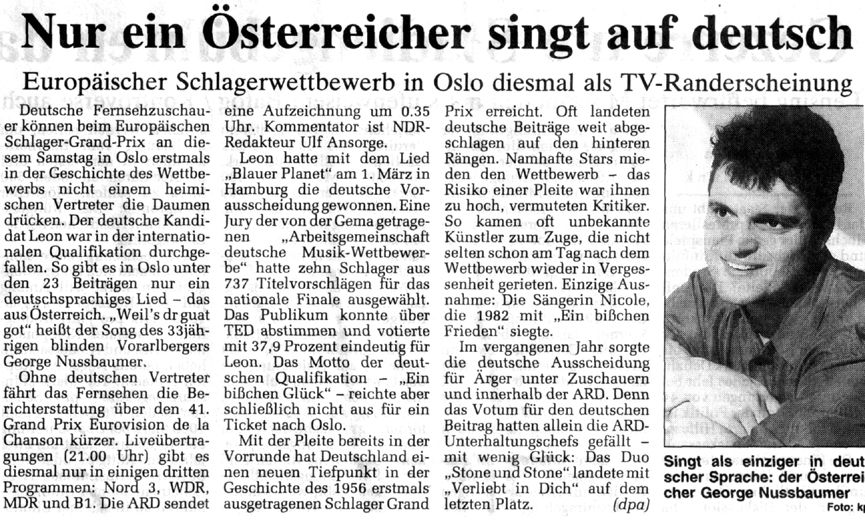
- (18 May 1996). "Nur ein Österreicher singt auf deutsch". {{ill.
- (16 May 1996). "KNR Aallakaatitassat/Programmer". [[Atuagagdliutit/Grønlandsposten.
- (13 May 1996). "Szombat május 18. {{!}} Televízió".
- (17 May 1996). "السبت: ١٨\٥\٩٦". [[Al-Ittihad (Israeli newspaper).
- (18 May 1996). "Jordan Times Daily Guide and Calendar". [[The Jordan Times]].
- (18 May 1996). "Sobota, 18 maja". [[Kurier Wileński]].
- (18 May 1996). "Programe TV". {{ill.
- "Televiziune – sâmbătă 18 mai 1996".
- (18–19 May 1996). "ТВ Субота". [[Borba (newspaper).
This article was imported from Wikipedia and is available under the Creative Commons Attribution-ShareAlike 4.0 License. Content has been adapted to SurfDoc format. Original contributors can be found on the article history page.
Ask Mako anything about Eurovision Song Contest 1996 — get instant answers, deeper analysis, and related topics.
Research with MakoFree with your Surf account
Create a free account to save articles, ask Mako questions, and organize your research.
Sign up freeThis content may have been generated or modified by AI. CloudSurf Software LLC is not responsible for the accuracy, completeness, or reliability of AI-generated content. Always verify important information from primary sources.
Report