From Surf Wiki (app.surf) — the open knowledge base
Eurovision Song Contest 1995
International song competition

International song competition
| Field | Value |
|---|---|
| name | Eurovision Song Contest |
| year | 1995 |
| logo | ESC 1995 logo.svg |
| final | |
| presenter | Mary Kennedy |
| musdirector | Noel Kelehan |
| director | John Comiskey |
| scrutineer | Christian Clausen |
| exproducer | John McHugh |
| organiser | European Broadcasting Union (EBU) |
| host | Radio Telefís Éireann (RTÉ) |
| venue | Point Theatre |
| Dublin, Ireland | |
| winner | |
| vote | Each country awarded 12, 10, 8-1 point(s) to their 10 favourite songs |
| entries | 23 |
| return | |
| nonreturn | |
| Map Relegation | Y |
Dublin, Ireland
The Eurovision Song Contest 1995 was the 40th edition of the Eurovision Song Contest, held on 13 May 1995 at the Point Theatre in Dublin, Ireland, and presented by Mary Kennedy. It was organised by the European Broadcasting Union (EBU) and host broadcaster Radio Telefís Éireann (RTÉ), who staged the event after winning the for with the song "Rock 'n' Roll Kids" by Paul Harrington and Charlie McGettigan. It was the third consecutive contest to be held in Ireland – the first and only time in the history of the event that a country has hosted three editions in a row – and the second consecutive edition to be held in the Point Theatre in Dublin.
Broadcasters from twenty-three countries participated in the contest; , , , the , , , and were relegated as the lowest-scoring countries in the previous edition, getting replaced by , , , , and , returning after being relegated following the .
The winner was with the song "Nocturne", composed by Rolf Løvland, written by Petter Skavlan and performed by Secret Garden. , , , and rounded out the top five, with Spain achieving its best result since . and also achieved their best results so far, placing sixth and seventh respectively, while finished in last place for the fourth time.
Location
The 1995 contest took place in Dublin, Ireland, following the country's victory at the with the song "Rock 'n' Roll Kids", performed by Paul Harrington and Charlie McGettigan. It was the sixth time that Ireland had hosted the contest, having previously staged the event in , , , and , with all previous events held in Dublin except the 1993 contest which was held in Millstreet. Ireland thus became the first, and only country to have hosted three successive contests.
The selected venue was the Point Theatre, a concert and events venue located amongst the Dublin Docklands which had originally been built as a train depot to serve the nearby port. Opened as a music venue in 1988, it was closed for redevelopment and expansion in 2008 and is now known as the 3Arena. Having previously hosted the 1994 contest, Dublin became the first city to host two consecutive Eurovision Song Contests, with the Point Theatre also serving as the host venue for the second year in a row.
Alternative venues in Galway and Limerick were considered by RTÉ, however Dublin was chosen to stage the contest again as it was judged to have been the more cost-effective location. Proposals by the British broadcaster BBC to host the contest, either by themselves or as a joint production hosted in Belfast, the capital city of Northern Ireland, were also rejected by RTÉ as the Irish broadcaster chose to produce the contest on its own. However, RTÉ did request a rule change to relieve them of the responsibility of producing the contest again should Ireland produce a fourth consecutive winner, which was accepted by the EBU.
Participants
Twenty-three countries were permitted to participate in the contest, which was to comprise the sixteen highest-scoring countries in the 1994 contest and returning countries that had been relegated and prevented from participating in the previous year's event. The total line-up was reduced from the twenty-five countries which participated in the 1994 contest to ensure that the event would not last longer than three hours. Of the seven countries which did not participate in 1994, , , , , and returned to the contest, while and declined the invitation, which resulted in and , which were originally relegated, being allowed back into the line-up. , , , the , , , and , as the lowest-scoring countries from the previous year's event, were thus ultimately relegated and were required to miss this event. Switzerland did not participate in the contest for the first time, leaving as the sole country to have participated in every edition of the contest to that point.
The contest featured two representatives who had previously performed in the contest. Arzu Ece had previously represented as a member of the group Pan, and Alexandros Panayi had provided backing vocals for and . Additionally, several artists who had previously participated in the event as main vocalists returned as backing vocalists at this year's event: Stefán Hilmarsson and returned to the contest as backing singers for the Icelandic entrant Bo Halldórsson, with Stefán having previously represented as a member of Beathoven and both Stefán and Eyjólfur having represented as a duo; Gary Lux, who had previously represented , as a member of the group Westend, and as a solo artist and , supported Stella Jones at this year's event; and José María Guzmán, who represented as part of the group Cadillac, was among Anabel Conde's backing singers.
| Country | Broadcaster | Artist | Song | Language | Songwriter(s) | Conductor | ||
|---|---|---|---|---|---|---|---|---|
| ORF | Stella Jones | "Die Welt dreht sich verkehrt" | German | Michael Kienzl | ||||
| RTBF | "La voix est libre" | French | ||||||
| RTVBiH | Davor Popović | "Dvadeset prvi vijek" | Bosnian | Sinan Alimanović | ||||
| HRT | Magazin and Lidija | "Nostalgija" | Croatian | |||||
| CyBC | Alexandros Panayi | "Sti fotia" (Στη φωτιά) | Greek | Alexandros Panayi | George Theofanous | |||
| DR | Aud Wilken | "Fra Mols til Skagen" | Danish | Frede Ewert | ||||
| France Télévision | "Il me donne rendez-vous" | French | Michel Bernholc | |||||
| MDR | "Verliebt in Dich" | German | Cheyenne Stone | |||||
| ERT | Elina Konstantopoulou | "Pia prosefhi" (Ποιά προσευχή) | Greek | Haris Andreadis | ||||
| MTV | "Új név egy régi ház falán" | Hungarian | Miklós Malek | |||||
| RÚV | Bo Halldórsson | "Núna" | Icelandic | Frank McNamara | ||||
| RTÉ | {{ill | Eddie Friel | de | fr}} | "Dreamin' | English | Noel Kelehan | |
| IBA | Liora | "Amen" (אמן) | Hebrew | {{hlist | Moshe Datz}} | Gadi Goldman | ||
| PBS | "Keep Me in Mind" | English | Ray Agius | |||||
| NRK | Secret Garden | "Nocturne" | Norwegian | Geir Langslet | ||||
| TVP | Justyna | "Sama" | Polish | Noel Kelehan | ||||
| RTP | Tó Cruz | "Baunilha e chocolate" | Portuguese | |||||
| ORT | Philipp Kirkorov | "Kolybelnaya dlya vulkana" (Колыбельная для вулкана) | Russian | |||||
| RTVSLO | Darja Švajger | "Prisluhni mi" | Slovene | Jože Privšek | ||||
| TVE | Anabel Conde | "Vuelve conmigo" | Spanish | |||||
| SVT | Jan Johansen | "Se på mej" | Swedish | Anders Berglund | ||||
| TRT | Arzu Ece | "Sev!" | Turkish | Melih Kibar | ||||
| BBC | Love City Groove | "Love City Groove" | English | Mike Dixon |
Production and format
The Eurovision Song Contest 1995 was produced by the Irish public broadcaster Radio Telefís Éireann (RTÉ). John McHugh served as executive producer, John Comiskey served as director, Alan Farquharson served as designer, and Noel Kelehan served as musical director, leading the RTÉ Concert Orchestra. A separate musical director could be nominated by each participating delegation to lead the orchestra during its country's performance, with the host musical director also available to conduct for those countries which did not nominate their own conductor. On behalf of the contest organisers, the European Broadcasting Union (EBU), the event was overseen by Christian Clausen as scrutineer. RTÉ was reported to have spent IR£2.3 million on staging the contest, with the Northern Ireland Tourist Board and the National Lottery among the contest's sponsors. Through the partnership with the National Lottery, around 1,000 places in the audience were filled by members of the public who had won tickets by playing scratchcards.
Each participating broadcaster submitted one song, which was required to be no longer than three minutes in duration and performed in the language, or one of the languages, of the country which it represented. A maximum of six performers were allowed on stage during each country's performance, and all participants were required to have reached the age of 16 in the year of the contest. Each entry could utilise all or part of the live orchestra and could use instrumental-only backing tracks, however any backing tracks used could only include the sound of instruments featured on stage being mimed by the performers.
Following the confirmation of the twenty-three competing countries, the draw to determine the running order was held on 9 December 1994.
The results of the 1995 contest were determined through the same scoring system as had first been introduced in : each country awarded twelve points to its favourite entry, followed by ten points to its second favourite, and then awarded points in decreasing value from eight to one for the remaining songs which featured in the country's top ten, with countries unable to vote for their own entry. The points awarded by each country were determined by an assembled jury of sixteen individuals, which was required to be split evenly between members of the public and music professionals, between men and women, and by age. Each jury member voted in secret and awarded between one and ten votes to each participating song, excluding that from their own country and with no abstentions permitted. The votes of each member were collected following the country's performance and then tallied by the non-voting jury chairperson to determine the points to be awarded. In any cases where two or more songs in the top ten received the same number of votes, a show of hands by all jury members was used to determine the final placing.
Rehearsals in the contest venue for the competing acts began on 8 May 1995. Each country had two technical rehearsals in the week approaching the contest, with countries rehearsing in the order in which they would perform. The first rehearsals took place on 8 and 9 May, with each country allowed 40 minutes total on stage, with an opportunity to review recordings with producers and to consult on suggested changes afterwards, followed by a 20 minute press conference. Each country's second rehearsals took place on 10 and 11 May, with 30 minutes total on stage. Three dress rehearsals were held with all artists, two held in the afternoon and evening of 12 May and one final rehearsal in the afternoon of 13 May. An audience was present for the second dress rehearsal in the evening of 12 May, with this rehearsal also recorded for use as a production stand-by in case of problems during the live contest. The competing delegations were additionally invited to a welcome reception during the week in the build-up to the event, organised by Irish Ferries and hosted at the Royal Hospital Kilmainham on the evening of 8 May.
Contest overview

The contest took place on 13 May 1995 at 20:00 (IST) and lasted 2 hours and 51 minutes. The show was presented by the Irish journalist and television presenter Mary Kennedy. Kennedy had previously served as the stand-by presenter at the , understudying for Doireann Ní Bhriain.
To celebrate the contest's fortieth anniversary, the show opened with a four-minute sequence, directed by Pat Cowap, containing clips and performances from previous contests; Cowap had previously served as director of the 1994 contest. The contest's interval act, entitled "Lumen", was an original piece composed by Mícheál Ó Súilleabháin and which combined Gregorian chant and sean-nós singing with contemporary music. Among the performers of "Lumen" were Súilleabháin on piano, Scottish percussionist Evelyn Glennie, Irish singers Brian Kennedy and Nóirín Ní Riain, members of the Irish folk band Clannad, the Benedictine monks of Glenstal Abbey, and the RTÉ Concert Orchestra conducted by Proinnsías Ó Duinn. Kennedy would go on to perform at Eurovision again as a contestant, representing Ireland in the . The trophy awarded to the winners was designed by Kevin O'Dwyer, and was presented by the previous year's winning artists Paul Harrington and Charlie McGettigan.
The winner was represented by the song "Nocturne", composed by Rolf Løvland, written by Petter Skavlan and performed by Secret Garden. This was Norway's second contest win, following the victory by Bobbysocks! ten years previously at the with "La det swinge", which was also written by Rolf Løvland; Løvland thus became one of four individuals to have won the contest more than once as an artist or songwriter up to that point in time, alongside Willy van Hemert, Yves Dessca and Johnny Logan. The group Secret Garden consisted principally of Norwegian composer and pianist Løvland and Irish violinist Fionnuala Sherry and was formed after the pair had met at the 1994 contest, where Sherry was a member of the RTÉ Concert Orchestra and Løvland was in attendance as composer of . For their performance during the contest they were joined by instrumentalists Hans Fredrik Jacobsen and Åsa Jinder and singer . "Nocturne" was a largely instrumental piece featuring only 24 words in total, with brief vocals only at the start and end of the song performed by Tvinnereim. The traditional winner's reprise performance featured English lyrics, also written by Skavlan, comprising 30 words in total.
Spain achieved its best result since by finishing as the contest's runner-up, and gained their highest placements to date by finishing in sixth and seventh place respectively, while conversely Germany finished in last place for the fourth time. The 1995 contest was the last edition of the contest where the top three songs were all performed in a language other than English until the .
| R/O | Country | Artist | Song | Points | Place | 1 | 2 | 3 | 4 | 5 | 6 | 7 | 8 | 9 | 10 | 11 | 12 | 13 | 14 | 15 | 16 | 17 | 18 | 19 | 20 | 21 | 22 | 23 |
|---|---|---|---|---|---|---|---|---|---|---|---|---|---|---|---|---|---|---|---|---|---|---|---|---|---|---|---|---|
| Justyna | "Sama" | 15 | 18 | |||||||||||||||||||||||||
| "Dreamin' | 44 | 14 | ||||||||||||||||||||||||||
| Stone & Stone | "Verliebt in Dich" | 1 | 23 | |||||||||||||||||||||||||
| "Dvadeset prvi vijek" | 14 | 19 | ||||||||||||||||||||||||||
| Secret Garden | "Nocturne" | 148 | 1 | |||||||||||||||||||||||||
| "Kolybelnaya dlya vulkana" | 17 | 17 | ||||||||||||||||||||||||||
| "Núna" | 31 | 15 | ||||||||||||||||||||||||||
| "Die Welt dreht sich verkehrt" | 67 | 13 | ||||||||||||||||||||||||||
| "Vuelve conmigo" | 119 | 2 | ||||||||||||||||||||||||||
| "Sev!" | 21 | 16 | ||||||||||||||||||||||||||
| Magazin and Lidija | "Nostalgija" | 91 | 6 | |||||||||||||||||||||||||
| "Il me donne rendez-vous" | 94 | 4 | ||||||||||||||||||||||||||
| "Új név egy régi ház falán" | 3 | 22 | ||||||||||||||||||||||||||
| "La voix est libre" | 8 | 20 | ||||||||||||||||||||||||||
| Love City Groove | "Love City Groove" | 76 | 10 | |||||||||||||||||||||||||
| "Baunilha e chocolate" | 5 | 21 | ||||||||||||||||||||||||||
| "Sti fotia" | 79 | 9 | ||||||||||||||||||||||||||
| "Se på mej" | 100 | 3 | ||||||||||||||||||||||||||
| "Fra Mols til Skagen" | 92 | 5 | ||||||||||||||||||||||||||
| "Prisluhni mi" | 84 | 7 | ||||||||||||||||||||||||||
| Liora | "Amen" | 81 | 8 | |||||||||||||||||||||||||
| "Keep Me in Mind" | 76 | 10 | ||||||||||||||||||||||||||
| "Pia prosefhi" | 68 | 12 |
Spokespersons
Each participating broadcaster appointed a spokesperson who was responsible for announcing, in English or French, the votes for its respective country. As had been the case in the , the spokespersons were connected via satellite and appeared in vision during the broadcast. Spokespersons at the 1995 contest are listed below.
- Poland
- IrelandEileen Dunne
- GermanyCarmen Nebel
- Bosnia and HerzegovinaDiana Grković-Foretić
- Norway
- RussiaMarina Danielian
- IcelandÁslaug Dóra Eyjólfsdóttir
- Austria
- SpainBelén Fernández de Henestrosa
- Turkey
- Croatia
- FranceThierry Beccaro
- HungaryKatalin Bogyay
- BelgiumMarie-Françoise Renson
- United KingdomColin Berry
- PortugalSerenella Andrade
- CyprusAndreas Iakovidis
- SwedenBjörn Hedman
- Denmark
- SloveniaMiša Molk
- IsraelDaniel Pe'er
- MaltaStephanie Farrugia
- GreeceFotini Giannoulatou
Detailed voting results
Jury voting was used to determine the points awarded by all countries. The announcement of the results from each country was conducted in the order in which they performed, with the spokespersons announcing their country's points in English or French in ascending order. The detailed breakdown of the points awarded by each country is listed in the tables below.
| nb=1 | Total score}} | nb=1 | Poland}} | nb=1 | Ireland}} | nb=1 | Germany}} | nb=1 | Bosnia and Herzegovina}} | nb=1 | Norway}} | nb=1 | Russia}} | nb=1 | Iceland}} | nb=1 | Austria}} | nb=1 | Spain}} | nb=1 | Turkey}} | nb=1 | Croatia}} | nb=1 | France}} | nb=1 | Hungary}} | nb=1 | Belgium}} | nb=1 | United Kingdom}} | nb=1 | Portugal}} | nb=1 | Cyprus}} | nb=1 | Sweden}} | nb=1 | Denmark}} | nb=1 | Slovenia}} | nb=1 | Israel}} | nb=1 | Malta}} | nb=1 | Greece}} | va=middle | Contestants}} | Poland | Ireland | Germany | Bosnia and Herzegovina | Norway | Russia | Iceland | Austria | Spain | Turkey | Croatia | France | Hungary | Belgium | United Kingdom | Portugal | Cyprus | Sweden | Denmark | Slovenia | Israel | Malta | Greece |
|---|---|---|---|---|---|---|---|---|---|---|---|---|---|---|---|---|---|---|---|---|---|---|---|---|---|---|---|---|---|---|---|---|---|---|---|---|---|---|---|---|---|---|---|---|---|---|---|---|---|---|---|---|---|---|---|---|---|---|---|---|---|---|---|---|---|---|---|---|---|---|---|---|
| 15 | 4 | 6 | 1 | 1 | 3 | |||||||||||||||||||||||||||||||||||||||||||||||||||||||||||||||||||
| 44 | 1 | 5 | 1 | 5 | 3 | 3 | 5 | 1 | 10 | 1 | 5 | 4 | ||||||||||||||||||||||||||||||||||||||||||||||||||||||||||||
| 1 | 1 | |||||||||||||||||||||||||||||||||||||||||||||||||||||||||||||||||||||||
| 14 | 3 | 8 | 3 | |||||||||||||||||||||||||||||||||||||||||||||||||||||||||||||||||||||
| 148 | 12 | 10 | 4 | 1 | 12 | 12 | 4 | 12 | 10 | 6 | 5 | 4 | 12 | 7 | 2 | 7 | 10 | 6 | 12 | |||||||||||||||||||||||||||||||||||||||||||||||||||||
| 17 | 10 | 6 | 1 | |||||||||||||||||||||||||||||||||||||||||||||||||||||||||||||||||||||
| 31 | 6 | 2 | 3 | 4 | 2 | 6 | 8 | |||||||||||||||||||||||||||||||||||||||||||||||||||||||||||||||||
| 67 | 2 | 3 | 6 | 4 | 8 | 4 | 10 | 5 | 2 | 4 | 10 | 2 | 7 | |||||||||||||||||||||||||||||||||||||||||||||||||||||||||||
| 119 | 8 | 2 | 6 | 8 | 5 | 8 | 10 | 7 | 2 | 12 | 8 | 7 | 10 | 12 | 8 | 6 | ||||||||||||||||||||||||||||||||||||||||||||||||||||||||
| 21 | 2 | 5 | 1 | 2 | 3 | 1 | 7 | |||||||||||||||||||||||||||||||||||||||||||||||||||||||||||||||||
| 91 | 3 | 10 | 7 | 10 | 12 | 7 | 4 | 5 | 12 | 4 | 12 | 5 | ||||||||||||||||||||||||||||||||||||||||||||||||||||||||||||
| 94 | 7 | 5 | 8 | 6 | 8 | 10 | 2 | 3 | 10 | 6 | 1 | 2 | 3 | 6 | 8 | 7 | 2 | |||||||||||||||||||||||||||||||||||||||||||||||||||||||
| 3 | 2 | 1 | ||||||||||||||||||||||||||||||||||||||||||||||||||||||||||||||||||||||
| 8 | 1 | 7 | ||||||||||||||||||||||||||||||||||||||||||||||||||||||||||||||||||||||
| 76 | 5 | 1 | 4 | 1 | 12 | 12 | 7 | 7 | 10 | 5 | 7 | 5 | ||||||||||||||||||||||||||||||||||||||||||||||||||||||||||||
| 5 | 4 | 1 | ||||||||||||||||||||||||||||||||||||||||||||||||||||||||||||||||||||||
| 79 | 1 | 3 | 5 | 4 | 2 | 5 | 1 | 12 | 8 | 3 | 8 | 5 | 4 | 6 | 4 | 8 | ||||||||||||||||||||||||||||||||||||||||||||||||||||||||
| 100 | 10 | 12 | 12 | 2 | 8 | 6 | 4 | 8 | 1 | 3 | 6 | 8 | 4 | 12 | 1 | 3 | ||||||||||||||||||||||||||||||||||||||||||||||||||||||||
| 92 | 3 | 7 | 7 | 3 | 12 | 10 | 7 | 7 | 6 | 3 | 3 | 6 | 12 | 6 | ||||||||||||||||||||||||||||||||||||||||||||||||||||||||||
| 84 | 4 | 8 | 5 | 6 | 7 | 1 | 3 | 2 | 8 | 10 | 5 | 3 | 7 | 3 | 2 | 10 | ||||||||||||||||||||||||||||||||||||||||||||||||||||||||
| 81 | 10 | 7 | 8 | 6 | 4 | 5 | 4 | 12 | 8 | 2 | 10 | 5 | ||||||||||||||||||||||||||||||||||||||||||||||||||||||||||||
| 76 | 4 | 2 | 12 | 2 | 10 | 10 | 12 | 6 | 7 | 6 | 1 | 4 | ||||||||||||||||||||||||||||||||||||||||||||||||||||||||||||
| 68 | 6 | 5 | 8 | 7 | 5 | 2 | 3 | 12 | 2 | 8 | 10 |
12 points
The below table summarises how the maximum 12 points were awarded from one country to another. The winning country is shown in bold. Norway received the maximum score of 12 points from six of the voting countries, with Croatia and Sweden each receiving three sets of 12 points, Denmark, Malta, Spain and the United Kingdom receiving two sets each, and Cyprus, Greece and Israel each receiving one maximum score.
| N. | Contestant | Nation(s) giving 12 points | 6 | 3 | 2 | 1 |
|---|---|---|---|---|---|---|
| **** | , , , , , | |||||
| , , | ||||||
| , , | ||||||
| , | ||||||
| , | ||||||
| , | ||||||
| , |
Broadcasts
Each participating broadcaster was required to relay the contest via its networks. Non-participating EBU member broadcasters were also able to relay the contest as "passive participants". Broadcasters were able to send commentators to provide coverage of the contest in their own native language and to relay information about the artists and songs to their television viewers. These commentators were typically sent to the venue to report on the event, and were able to provide commentary from small booths constructed at the back of the venue. Known details on the broadcasts in each country, including the specific broadcasting stations and commentators are shown in the tables below.
| Country | Broadcaster | Channel(s) | Commentator(s) | Austria | Belgium | Bosnia and Herzegovina | Croatia | Cyprus | Denmark | France | Germany | Hungary | Iceland | Ireland | Malta | Norway | Poland | Portugal | Russia | Slovenia | Spain | Sweden | Turkey | United Kingdom |
|---|---|---|---|---|---|---|---|---|---|---|---|---|---|---|---|---|---|---|---|---|---|---|---|---|
| ORF | ORF 1 | Ernst Grissemann | ||||||||||||||||||||||
| FM4 | Stermann & Grissemann | |||||||||||||||||||||||
| RTBF | RTBF1 | Jean-Pierre Hautier | ||||||||||||||||||||||
| BRTN | TV1 | André Vermeulen | ||||||||||||||||||||||
| RTVBiH | TVBiH | |||||||||||||||||||||||
| HRT | HRT 1 | Aleksandar Kostadinov | ||||||||||||||||||||||
| CyBC | RIK 1 | Neofytos Taliotis | ||||||||||||||||||||||
| DR | DR TV, DR P3 | Jørgen de Mylius | ||||||||||||||||||||||
| France Télévision | France 2 | Olivier Minne | ||||||||||||||||||||||
| ARD | Erstes Deutsches Fernsehen | Horst Senker | ||||||||||||||||||||||
| MTV | MTV2 | István Vágó | ||||||||||||||||||||||
| RÚV | Sjónvarpið | Jakob Frímann Magnússon | ||||||||||||||||||||||
| RTÉ | RTÉ 1 | Pat Kenny | ||||||||||||||||||||||
| RTÉ Radio 1 | Larry Gogan | |||||||||||||||||||||||
| PBS | TVM | |||||||||||||||||||||||
| NRK | NRK Fjernsynet | Annette Groth | ||||||||||||||||||||||
| NRK P1 | ||||||||||||||||||||||||
| TVP | TVP1 | Artur Orzech | ||||||||||||||||||||||
| RTP | RTP Canal 1 | Ana do Carmo | ||||||||||||||||||||||
| ORT | ||||||||||||||||||||||||
| Olesya Trifonova | ||||||||||||||||||||||||
| RTVSLO | SLO 1 | |||||||||||||||||||||||
| Val 202 | ||||||||||||||||||||||||
| TVE | La Primera | José Luis Uribarri | ||||||||||||||||||||||
| SVT | TV2 | Pernilla Månsson | ||||||||||||||||||||||
| SR | SR P3, SR P4 | Claes-Johan Larsson and Lisa Syrén | ||||||||||||||||||||||
| TRT | TRT 1 | |||||||||||||||||||||||
| BBC | BBC1 | Terry Wogan | ||||||||||||||||||||||
| BBC Radio 2 | Ken Bruce |
| Country | Broadcaster | Channel(s) | Commentator(s) | Australia | Estonia | Faroe Islands | Finland | Greenland | Netherlands | Netherlands Antilles | Romania | Switzerland | FR Yugoslavia Yugoslavia |
|---|---|---|---|---|---|---|---|---|---|---|---|---|---|
| SBS | SBS TV | ||||||||||||
| ETV | }} | ||||||||||||
| STV | STV4 | ||||||||||||
| SvF | |||||||||||||
| YLE | TV1 | Erkki Pohjanheimo and Olli Ahvenlahti | |||||||||||
| Radio Suomi | Iris Mattila and Ossi Runne | ||||||||||||
| KNR | KNR | ||||||||||||
| NOS | Nederland 3 | Paul de Leeuw | |||||||||||
| TeleCuraçao | |||||||||||||
| TVR | TVR 1 | ||||||||||||
| SRG SSR | Schweiz 4 | Heinz Margot | |||||||||||
| Suisse 4 | Jean-Marc Richard | ||||||||||||
| RTS | RTS 3K |
References
- "Ireland – Participation history". European Broadcasting Union (EBU).
- "Dublin 1995". European Broadcasting Union (EBU).
- "Eurovision Archives". European Broadcasting Union (EBU).
- "3Arena Dublin – About, History & Hotels Near". O'Callaghan Collection.
- (4 June 2020). "25 years ago – What has become of Eurovision's Top 10 from 1995?". EuroVisionary.
- "Cyprus – Participation history". European Broadcasting Union (EBU).
- (18 October 2017). "Upcycling At The Eurovision Song Contest: How To Get The Most Out Of Your Local Music Industry". ESC Insight.
- (11 March 2022). "Get to know the Söngvakeppnin finalists". ESCXtra.
- (16 May 2019). "Gary Lux über den Song Contest: 'Damals kannte mich wirklich jeder'". [[Kurier]].
- (4 October 2009). "IV Congreso OGAE {{!}} 'Cómo vas a salir con ese vestido, si estás gorda'". EurovisionSpain.
- (28 May 2019). "José María Guzmán, más allá de 'La Voz Senior': el 'trotamúsico' que fue a Eurovisión". [[El Español]].
- "Dublin 1995 – Participants". European Broadcasting Union (EBU).
- "Alle deutschen ESC-Acts und ihre Titel". [[ARD (broadcaster).
- "The Organisers behind the Eurovision Song Contest". European Broadcasting Union (EBU).
- (18 May 2019). "How it works". European Broadcasting Union (EBU).
- "Jerusalem 1999". European Broadcasting Union (EBU).
- (31 October 2018). "The Rules of the Contest". European Broadcasting Union (EBU).
- (18 April 2020). "#EurovisionAgain travels back to Dublin 1997". European Broadcasting Union (EBU).
- (31 March 2017). "In a Nutshell". European Broadcasting Union (EBU).
- Harding, Peter. (8 May 1995). "Eurovision reception (1995)".
- Harding, Peter. (12 May 1995). "Interval act during Eurovision dress rehearsal (1995)".
- (18 May 2021). "How Ireland became Eurovision royalty – and was showcased to the world". [[Daily Mirror.
- (14 November 2005). "Brian Kennedy to Athens for Ireland". ESCToday.
- "Athens 2006 – Brian Kennedy". European Broadcasting Union (EBU).
- Harding, Peter. (8 May 1995). "Michael D Higgins visits Point Theatre during Eurovision preparations (1995)".
- "Dublin 1995 – Secret Garden". European Broadcasting Union (EBU).
- "Norway – Participation history". European Broadcasting Union (EBU).
- "Gothenburg 1985 – Bobbysocks". European Broadcasting Union (EBU).
- (20 May 2021). "Wouter Hardy met Zwitserland op weg naar nieuw songfestivalsucces". Ditjes en Datjes.
- (13 July 1997). "Secret Garden's music blends two cultures". [[The Standard-Times (New Bedford).
- "Nocturne Wins for Norway". [[RTÉ Libraries and Archives]].
- "Spain – Participation history". European Broadcasting Union (EBU).
- "Croatia – Participation history". European Broadcasting Union (EBU).
- "Slovenia – Participation history". European Broadcasting Union (EBU).
- "Germany – Participation history". European Broadcasting Union (EBU).
- (27 May 2021). "Vital Statistics 2: The Results". European Broadcasting Union (EBU).
- "Dublin 1995 – Scoreboard". European Broadcasting Union (EBU).
- "Dublin 1994". European Broadcasting Union (EBU).
- (13 May 1995). "Program na Sobotę". [[Życie Warszawy]].
- (8 June 2021). "RTE Eileen Dunne's marriage to soap star Macdara O'Fatharta, their wedding day and grown up son Cormac". RSVP Live.
- (13 May 1995). "Eurovision Song Contest 1995". {{lang.
- "Dublin 1995 – Detailed voting results". European Broadcasting Union (EBU).
- "Eurovision Song Contest 1995 – Scoreboard". European Broadcasting Union (EBU).
- (15 May 2011). "Commentator's guide to the commentators". European Broadcasting Union (EBU).
- (14 May 2017). "Commentators: The national hosts of Eurovision". European Broadcasting Union (EBU).
- (22 May 2015). "Ein virtueller Disput der ESC-Kommentatoren". [[Kurier]].
- (1 May 2012). "Song Contest mit Stermann & Grissemann". {{lang.
- (15 October 2012). "Francophone Belgian Commentator Passes Away". European Broadcasting Union (EBU).
- (15 May 1995). "40e Concours Eurovision de la chanson: Les violons norvégiens gagnent en "Nocturne" à Dublin, la vingtième place pour la Belgique". [[Le Soir]].
- (8 April 2014). "VRT schuift André Vermeulen opzij bij Eurovisiesongfestival". [[De Morgen]].
- (13 May 1995). "Televizija – Bosne i Hercegovine". [[Oslobođenje]].
- (13 May 1995). "TV i vrijeme". [[Slobodna Dalmacija]].
- (13 May 1995). "Τηλεοραση". {{lang.
- Parpas, Lukas. (5 May 1995). "Με ελπίδες πάμε στη Γιουροβίζιον". {{lang.
- "Alle tiders programoversigter – Lørdag den 13. maj 1995". [[DR (broadcaster).
- (13 May 1995). "les programmes TV". {{ill.
- (18 December 2021). "Introducing Hosts: Carla, Élodie Gossuin and Olivier Minne". European Broadcasting Union (EBU).
- (13 May 1995). "Tysk TV Lørdag". [[Flensborg Avis]].
- (8 May 1995). "Szombat {{!}} Televízió – május 13.".
- (11 May 1995). "Laugurdagur 13/5". [[Morgunblaðið.
- (13 May 1995). "Saturday: Television and Radio". [[The Irish Times.
- (13 May 1995). "Television". [[Times of Malta]].
- (13 May 1995). "Radio- og TV-Programmene {{!}} Lørdag 13. mai 1995". [[Moss Dagblad]].
- (13 May 1995). "Norgeskanalen NRK P1 – Kjøreplan lørdag 13. mai 1995". [[NRK]].
- (13–14 May 1995). "Program". [[Echo Dnia.
- (18 May 2021). "Artur Orzech – Eurowizja, żona, dzieci, wiek, wzrost, komentarze". [[Radio Eska]].
- (11 May 1995). "Programa da televisão". A Comarca de Arganil.
- "🔴 1995 Eurovision Song Contest from Dublin (Portuguese commentary by Ana do Carmo)". ESC Stuff.
- (6 May 1995). "Программа телевидения и радио с 8 по 14 мая". [[Rossiyskaya Gazeta]].
- Nikolaeva, Elina. (18 May 1995). "Конкурс Евровидения". [[Moskovskij Komsomolets]].
- (13 May 1995). "TV spored". [[Primorski dnevnik]].
- (13 May 1995). "Televizija+Radio". [[Delo (newspaper).
- (13 May 1995). "Televisión". {{ill.
- (13 May 1995). "TV programmen". [[Svenska Dagbladet]].
- (13 May 1995). "Radioprogrammen". [[Svenska Dagbladet]].
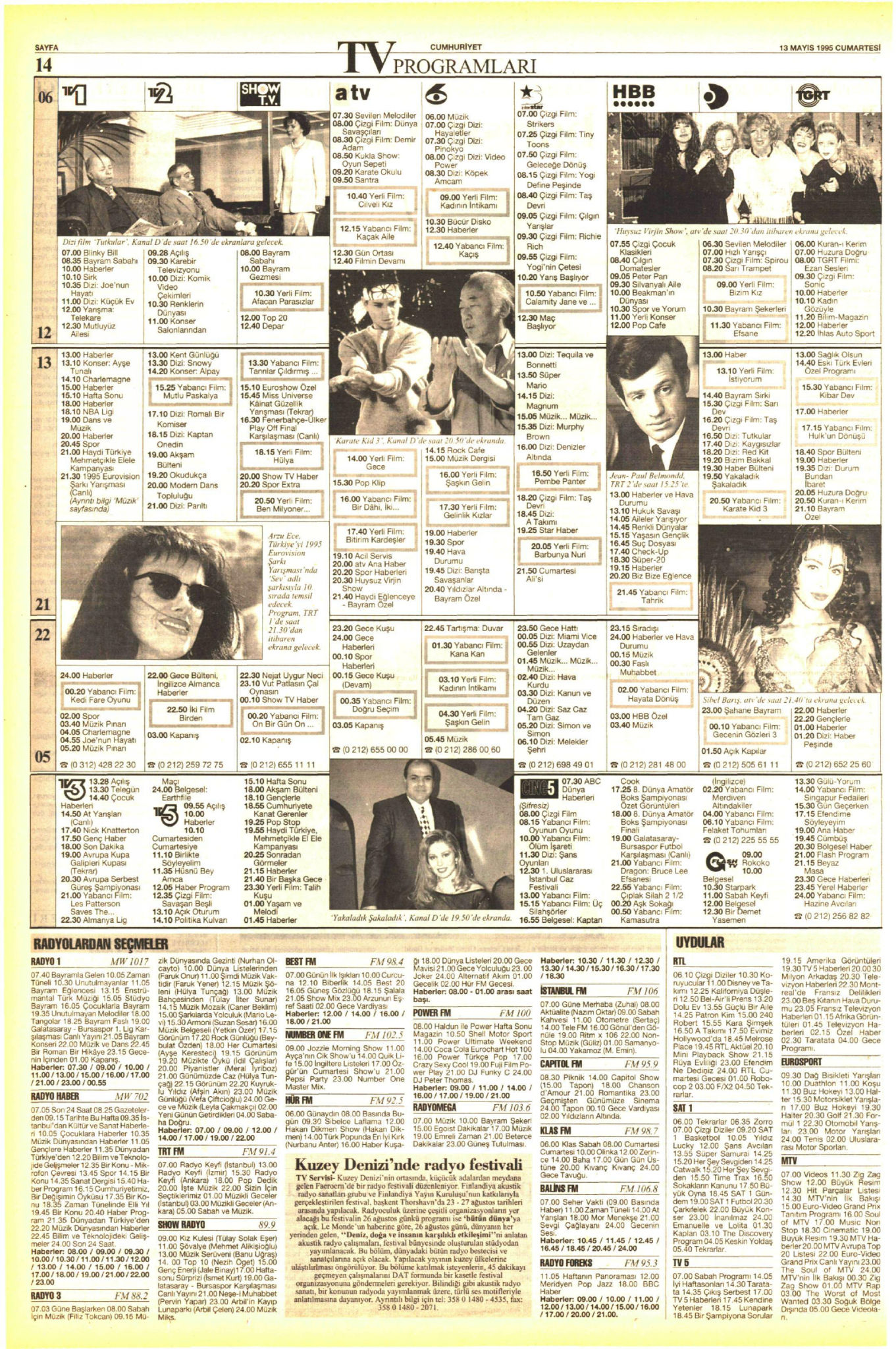
- (13 May 1995). "TV Programları". [[Cumhuriyet]].
- (13 May 1995). "Eurovision Song Contest – BBC One".
- (13 May 1995). "Eurovision Song Contest – BBC Radio 2".
- (14 May 1995). "Today's television". [[The Canberra Times]].
- (8–14 May 1995). "Laupäev – 13. mai".
- (12 May 1995). "SvF". {{ill.
- (13 May 1995). "Televisio & Radio". [[Helsingin Sanomat]].
- (11 May 1995). "KNR Aallakaatitassat/Programmer". [[Atuagagdliutit/Grønlandsposten.
- (13 May 1995). "Radio & Televisie Zaterdag". [[Leidsch Dagblad]].
- (3 June 1995). "TV". [[Amigoe]].
- (13 May 1995). "Programe TV-Radio". {{ill.
- (13 May 1995). "Radio / TV Samstag". Freiburger Nachrichten.
- (11 May 1995). "Samedi 13 mai".
- (13 May 1995). "Televizió". [[Magyar Szó]].
This article was imported from Wikipedia and is available under the Creative Commons Attribution-ShareAlike 4.0 License. Content has been adapted to SurfDoc format. Original contributors can be found on the article history page.
Ask Mako anything about Eurovision Song Contest 1995 — get instant answers, deeper analysis, and related topics.
Research with MakoFree with your Surf account
Create a free account to save articles, ask Mako questions, and organize your research.
Sign up freeThis content may have been generated or modified by AI. CloudSurf Software LLC is not responsible for the accuracy, completeness, or reliability of AI-generated content. Always verify important information from primary sources.
Report