From Surf Wiki (app.surf) — the open knowledge base
Eurovision Song Contest 1994
International song competition

International song competition
| Field | Value |
|---|---|
| name | Eurovision Song Contest |
| year | 1994 |
| logo | ESC 1994 logo.png |
| size | 151px |
| final | |
| presenters | Cynthia Ní Mhurchú |
| Gerry Ryan | |
| musdirector | Noel Kelehan |
| director | Patrick Cowap |
| scrutineer | Christian Clausen |
| exproducer | Moya Doherty |
| organiser | European Broadcasting Union (EBU) |
| host | Radio Telefís Éireann (RTÉ) |
| venue | Point Theatre |
| Dublin, Ireland | |
| winner | |
| "Rock 'n' Roll Kids" | |
| vote | Each country awarded 12, 10, 8-1 point(s) to their 10 favourite songs |
| entries | 25 |
| debut | |
| nonreturn | |
| Map Relegation | Y |
Gerry Ryan Dublin, Ireland "Rock 'n' Roll Kids"
The Eurovision Song Contest 1994 was the 39th edition of the Eurovision Song Contest, held on 30 April 1994 at the Point Theatre in Dublin, Ireland, and presented by Cynthia Ní Mhurchú and Gerry Ryan. It was organised by the European Broadcasting Union (EBU) and host broadcaster Radio Telefís Éireann (RTÉ), who staged the event after winning the for with the song "In Your Eyes" by Niamh Kavanagh. It was the first time that any country had hosted two successive editions of the contest, following the previous year's contest held in Millstreet.
Broadcasters from twenty-five countries participated in the contest, which for the first time featured a relegation system to reduce the number of interested participants. Seven new countries participated in the event, with entries from , , , , , and featuring for the first time. However, , , , , and were unable to compete due to the new relegation rules as the lowest-scoring countries at the previous event, whereas decided against participating by choice.
For the third time in a row, won the contest with the song "Rock 'n' Roll Kids", written by Brendan Graham and performed by Paul Harrington and Charlie McGettigan. Never before had a country won three times in a row in the history of the contest; at the same time, it was also a record sixth win, cementing Ireland as the country with the most wins in Eurovision history up till that point. , , , and rounded out the top five positions, with Poland achieving the most successful result for a début entry in the contest's history.
The 1994 contest also featured the first appearance of Riverdance. Originally a seven-minute performance of traditional Irish and modern music, choral singing and Irish dancing featured as part of the contest's interval act, it was subsequently developed into a full stage show which has since become a worldwide phenomenon and catapulted the careers of its lead dancers Jean Butler and Michael Flatley.
Location
The 1994 contest took place in Dublin, Ireland, following the country's victory at the with the song "In Your Eyes", performed by Niamh Kavanagh. It was the fifth time that Ireland had hosted the contest, following the , and events also held in Dublin, and the previous year's event held in Millstreet. Ireland thus became the first country to host two successive contests.
The selected venue was the Point Theatre, a concert and events venue located among the Dublin Docklands and originally built as a train depot and warehouse to serve the nearby port. Opened as a music venue in 1988, it was closed for redevelopment and expansion in 2008 and is now known as the 3Arena. At the time of the contest, the arena could seat around 3,200 audience members.
Participants
Twenty-five countries were permitted to participate in the contest. As the number of countries interested in participating in the contest grew, and following the use of a qualifying round in the previous year's event, a relegation system was introduced to the contest for the first time, which would prevent the lowest-scoring countries from the previous year's event from participating in the subsequent contest. In the summer of 1993 the European Broadcasting Union (EBU) confirmed that the seven lowest-scoring countries in the 1993 event would be barred from entering the 1994 contest, to make way for seven countries which would participate for the first time. As a result, , , , , , , and were unable to enter the contest, and in the contest's largest single expansion of new participating countries since the first edition in , , , , , , , and made their début appearances. Estonia, Hungary, Romania and Slovakia had all previously participated in the 1993 qualifying round Kvalifikacija za Millstreet. Belgium thus failed to participate in the contest for the first time, leaving and as the only countries to have competed in every edition of the contest so far. Later in 1993 's broadcaster RAI subsequently announced that it would not participate in the event, likely due to a lack of interest in the event among the Italian public and concerns within the broadcaster at the costs of staging the contest in the event that Italy won; this led to Cyprus being readmitted as the relegated country with the best result at the 1993 contest.
Four performers who had competed in previous editions of contests featured among the participating artists at this year's event: Marie Bergman, representing with Roger Pontare, had been a member of the group Family Four that had represented the country in the and ; Cyprus's Evridiki made a second appearance in the contest, following her entry at the ; Sigga returned to the contest for for a third time, having previously competed as part of Stjórnin in and Heart 2 Heart in 1992; and Elisabeth Andreasson, competing in this event with Jan Werner Danielsen for , also participated for the third time, having been a member of the group Chips, which represented Sweden in , and Bobbysocks!, which had represented Norway and were the winners of the . A number of artists which had previously competed in the contest also returned as backing performers: Rhonda Heath, who was a member of the group Silver Convention that had represented Germany in the , performed as a backing singer for the German entry Mekado; and , who represented Iceland at the alongside , returned as a backing singer for Sigga. Additionally, having supported 's William Mangion as backing performers in the previous year's event, Moira Stafrace and Christopher Scicluna returned to the Eurovision stage as the country's entrants at this year's contest.
| Country | Broadcaster | Artist | Song | Language | Songwriter(s) | Conductor |
|---|---|---|---|---|---|---|
| ORF | Petra Frey | "Für den Frieden der Welt" | German | |||
| RTVBiH | Alma and | "Ostani kraj mene" | Bosnian | Sinan Alimanović | ||
| HRT | Tony Cetinski | "Nek' ti bude ljubav sva" | Croatian | Miljenko Prohaska | ||
| CyBC | Evridiki | "Ime anthropos ki ego" (Είμαι άνθρωπος κι εγώ) | Greek | George Theofanous | George Theofanous | |
| ETV | Silvi Vrait | "Nagu merelaine" | Estonian | Urmas Lattikas | ||
| YLE | "Bye Bye Baby" | Finnish | Olli Ahvenlahti | |||
| France Télévision | Nina Morato | "Je suis un vrai garçon" | French | Alain Goraguer | ||
| MDR | "Wir geben 'ne Party" | German | Norbert Daum | |||
| ERT | Kostas Bigalis and | "To trehandiri (Diri Diri)" (Το τρεχαντήρι (Ντίρι Ντίρι)) | Greek | Kostas Bigalis | Noel Kelehan | |
| MTV | Friderika | "Kinek mondjam el vétkeimet?" | Hungarian | Szilveszter Jenei | ||
| RÚV | Sigga | "Nætur" | Icelandic | Frank McNamara | ||
| RTÉ | Paul Harrington and Charlie McGettigan | "Rock 'n' Roll Kids" | English | Brendan Graham | ||
| LRT | "Lopšinė mylimai" | Lithuanian | Tomas Leiburas | |||
| PBS | Moira Stafrace and Christopher Scicluna | "More Than Love" | English | Anthony Chircop | ||
| NOS | Willeke Alberti | "Waar is de zon" | Dutch | Harry van Hoof | ||
| NRK | Elisabeth Andreasson and Jan Werner Danielsen | "Duett" | Norwegian | |||
| TVP | Edyta Górniak | "To nie ja!" | Polish | Noel Kelehan | ||
| RTP | Sara | "Chamar a música" | Portuguese | |||
| TVR | Dan Bittman | "Dincolo de nori" | Romanian | Noel Kelehan | ||
| RTR | Youddiph | "Vechny strannik" (Вечный странник) | Russian | Lev Zemlinski | ||
| STV | Martin Ďurinda and Tublatanka | "Nekonečná pieseň" | Slovak | Vladimír Valovič | ||
| TVE | Alejandro Abad | "Ella no es ella" | Spanish | Alejandro Abad | Josep Llobell | |
| SVT | Marie Bergman and Roger Pontare | "Stjärnorna" | Swedish | Anders Berglund | ||
| SRG SSR | "Sto pregando" | Italian | Giuseppe Scaramella | |||
| BBC | Frances Ruffelle | "We Will Be Free (Lonely Symphony)" | English | Michael Reed |
Production and format
The Eurovision Song Contest 1994 was produced by the Irish public broadcaster Radio Telefís Éireann (RTÉ). Moya Doherty served as executive producer, Patrick Cowap served as director, Paula Farrell served as designer, and Noel Kelehan served as musical director, leading the RTÉ Concert Orchestra. A separate musical director could be nominated by each participating delegation to lead the orchestra during its country's performance, with the host musical director also available to conduct for those countries which did not nominate their own conductor. On behalf of the contest organisers, the European Broadcasting Union (EBU), the event was overseen by Christian Clausen as scrutineer.
Each participating broadcaster submitted one song, which was required to be no longer than three minutes in duration and performed in the language, or one of the languages, of the country which it represented. A maximum of six performers were allowed on stage during each country's performance, and all participants were required to have reached the age of 16 in the year of the contest. Each entry could utilise all or part of the live orchestra and could use instrumental-only backing tracks; however, any backing tracks used could only include the sound of instruments featured on stage being mimed by the performers.
Following the confirmation of the twenty-five competing countries, the draw to determine the running order was held on 16 November 1993 at the Point Theatre and was conducted by Niamh Kavanagh and Fionnuala Sweeney.
The results of the 1994 contest were determined through the same scoring system as had first been introduced in : each country awarded twelve points to its favourite entry, followed by ten points to its second favourite, and then awarded points in decreasing value from eight to one for the remaining songs which featured in the country's top ten, with countries unable to vote for their own entry. The points awarded by each country were determined by an assembled jury of sixteen individuals, which was required to be split evenly between members of the public and music professionals, between men and women, and by age. Each jury member voted in secret and awarded between one and ten votes to each participating song, excluding that from their own country and with no abstentions permitted. The votes of each member were collected following the country's performance and then tallied by the non-voting jury chairperson to determine the points to be awarded. In any cases where two or more songs in the top ten received the same number of votes, a show of hands by all jury members was used to determine the final placing.
With the Point Theatre situated on the banks of the River Liffey, rivers were an integral part of the overall creative vision for the show and were a key theme of the opening and interval acts as well as the stage design. Paula Farrell's design, which was four times the size of the stage constructed for the Millstreet contest, provided a scene of a futuristic Dublin at night, featuring representations of skyscrapers which incorporated video screens and lighting effects and underfloor lighting representing the Liffey and Dublin Bay. On either side of the stage podium-lined platforms were used by the presenters in-between songs and during the voting segment.
Rehearsals at the contest venue began on 25 April 1994. Each participating delegation took part in two technical rehearsals in the week approaching the contest, with countries rehearsing in the order in which they would perform. In each country's first rehearsal, held on 25 and 26 April, the delegations were provided with a 15-minute stage-call to prepare the stage and to brief the orchestra, followed by a 25-minute rehearsal. This was then followed by an opportunity to review footage of the rehearsal on video screens and to conduct a 20-minute press conference. The second rehearsals on 27 and 28 April consisted of a 10-minute stage-call and a 20-minute rehearsal. Three dress rehearsals were held with all artists, two in the afternoon and evening of 29 April and one final rehearsal in the afternoon of 30 April, with an audience present at the evening rehearsal on 29 April. The competing delegations were additionally invited to a welcome reception during the week of the event, held on the evening of 25 April in the Dining Hall of Trinity College Dublin.
During the final dress rehearsal on 30 April, the Polish entrant Edyta Górniak performed the second half of her song "To nie ja!" in English. As this rehearsal was also heard by the juries this constituted a break of the contest rules. Although discussions were held on whether to sanction or disqualify the country, Poland was ultimately allowed to compete.
Contest overview

The contest took place on 30 April 1994 at 20:00 (IST) and lasted 3 hours and 3 minutes. The show was presented by the Irish journalist and television presenter Cynthia Ní Mhurchú and the Irish radio and television presenter Gerry Ryan. Ní Mhurchú and Ryan had been considered as hosts for the 1993 event before the eventual choice of Fionnuala Sweeney.
The contest was opened with a segment by the Galway-based arts and theatre company Macnas, featuring a mixture of pre-recorded and live footage of a replica Viking longship on the river Liffey, and dancers, flag-bearers and performers in caricature masks of notable Irish personalities in various locations in central Dublin and in the Point Theatre. The interval act, "Riverdance", was a seven-minute composition by the Irish composer Bill Whelan, and took inspiration from "Timedance", the interval act from the also held in Dublin. "Riverdance" featured a mix of traditional Irish and modern music by the RTÉ Concert Orchestra, choral singing from the Celtic ensemble Anúna, and Irish dancing led by the Irish-American dancers Jean Butler and Michael Flatley. The trophy awarded to the winners, entitled "Wavelength", was designed by the Irish sculptor Grace Weir of the Temple Bar Gallery, and was presented by the previous year's winning artist Niamh Kavanagh.
The winner was represented by the song "Rock 'n' Roll Kids", written by Brendan Graham and performed by Paul Harrington and Charlie McGettigan. This marked Ireland's sixth contest wina new contest recordand also gave the country its third win in a rowthe first time a country had won three successive contests. "Rock 'n' Roll Kids" became the highest scoring winner in Eurovision history to date with 226 points, and was the first song to receive over 200 points. It was also the first time that a song had won without using the orchestra. Harrington and McGettigan additionally became the oldest winning performers and the first winning male duo. First-time participating countries Poland, Hungary and Russia all finished in the top ten, placing second, fourth and ninth respectively, while conversely the four other débuting countries all placed within the bottom seven entries, with Lithuania scoring nul points with its first ever entry. Poland achieved the most successful début performance of any country in the contest's history at the time, and its second-place finish in this event remains the country's best ever Eurovision placing.
| R/O | Country | Artist | Song | Points | Place | 1 | 2 | 3 | 4 | 5 | 6 | 7 | 8 | 9 | 10 | 11 | 12 | 13 | 14 | 15 | 16 | 17 | 18 | 19 | 20 | 21 | 22 | 23 | 24 | 25 |
|---|---|---|---|---|---|---|---|---|---|---|---|---|---|---|---|---|---|---|---|---|---|---|---|---|---|---|---|---|---|---|
| and Roger Pontare | "Stjärnorna" | 48 | 13 | |||||||||||||||||||||||||||
| CatCat | "Bye Bye Baby" | 11 | 22 | |||||||||||||||||||||||||||
| and Charlie McGettigan | "Rock 'n' Roll Kids" | 226 | 1 | |||||||||||||||||||||||||||
| Evridiki | "Ime anthropos ki ego" | 51 | 11 | |||||||||||||||||||||||||||
| Sigga | "Nætur" | 49 | 12 | |||||||||||||||||||||||||||
| "We Will Be Free (Lonely Symphony)" | 63 | 10 | ||||||||||||||||||||||||||||
| "Nek' ti bude ljubav sva" | 27 | 16 | ||||||||||||||||||||||||||||
| Sara | "Chamar a música" | 73 | 8 | |||||||||||||||||||||||||||
| Duilio | "Sto pregando" | 15 | 19 | |||||||||||||||||||||||||||
| "Nagu merelaine" | 2 | 24 | ||||||||||||||||||||||||||||
| "Dincolo de nori" | 14 | 21 | ||||||||||||||||||||||||||||
| and Christopher Scicluna | "More than Love" | 97 | 5 | |||||||||||||||||||||||||||
| "Waar is de zon" | 4 | 23 | ||||||||||||||||||||||||||||
| Mekado | "Wir geben 'ne Party" | 128 | 3 | |||||||||||||||||||||||||||
| and Tublatanka | "Nekonečná pieseň" | 15 | 19 | |||||||||||||||||||||||||||
| "Lopšinė mylimai" | 0 | 25 | ||||||||||||||||||||||||||||
| and Jan Werner Danielsen | "Duett" | 76 | 6 | |||||||||||||||||||||||||||
| Alma and Dejan | "Ostani kraj mene" | 39 | 15 | |||||||||||||||||||||||||||
| and the Sea Lovers | "To trehandiri (Diri Diri)" | 44 | 14 | |||||||||||||||||||||||||||
| "Für den Frieden der Welt" | 19 | 17 | ||||||||||||||||||||||||||||
| "Ella no es ella" | 17 | 18 | ||||||||||||||||||||||||||||
| Friderika | "Kinek mondjam el vétkeimet?" | 122 | 4 | |||||||||||||||||||||||||||
| Youddiph | "Vechny strannik" | 70 | 9 | |||||||||||||||||||||||||||
| "To nie ja!" | 166 | 2 | ||||||||||||||||||||||||||||
| "Je suis un vrai garçon" | 74 | 7 |
Spokespersons
Each participating broadcaster appointed a spokesperson who was responsible for announcing, in English or French, the votes for its respective country. For the first time, the spokespersons were connected to the venue via satellite rather than through telephone lines, allowing them to appear in vision during the broadcast. Spokespersons at the 1994 contest are listed below.
- Sweden
- FinlandSolveig Herlin
- IrelandEileen Dunne
- CyprusAnna Partelidou
- IcelandSigríður Arnardóttir
- United KingdomColin Berry
- CroatiaHelga Vlahović
- PortugalIsabel Bahia
- SwitzerlandSandra Studer
- EstoniaUrve Tiidus
- Romania
- MaltaJohn Demanuele
- Netherlands
- GermanyCarmen Nebel
- SlovakiaJuraj Čurný
- LithuaniaGitana Lapinskaitė
- Norway
- Bosnia and HerzegovinaDiana Grković-Foretić
- GreeceFotini Giannoulatou
- Austria
- SpainMaría Ángeles Balañac
- Hungary
- RussiaIrina Klenskaya
- PolandJan Chojnacki
- FranceLaurent Romejko
Detailed voting results
Jury voting was used to determine the points awarded by all countries. The announcement of the results from each country was conducted in the order in which they performed, with the spokespersons announcing their country's points in English or French in ascending order. The detailed breakdown of the points awarded by each country is listed in the tables below.
| nb=1 | Total score}} | nb=1 | Sweden}} | nb=1 | Finland}} | nb=1 | Ireland}} | nb=1 | Cyprus}} | nb=1 | Iceland}} | nb=1 | United Kingdom}} | nb=1 | Croatia}} | nb=1 | Portugal}} | nb=1 | Switzerland}} | nb=1 | Estonia}} | nb=1 | Romania}} | nb=1 | Malta}} | nb=1 | Netherlands}} | nb=1 | Germany}} | nb=1 | Slovakia}} | nb=1 | Lithuania}} | nb=1 | Norway}} | nb=1 | Bosnia and Herzegovina}} | nb=1 | Greece}} | nb=1 | Austria}} | nb=1 | Spain}} | nb=1 | Hungary}} | nb=1 | Russia}} | nb=1 | Poland}} | nb=1 | France}} | va=middle | Contestants}} | Sweden | Finland | Ireland | Cyprus | Iceland | United Kingdom | Croatia | Portugal | Switzerland | Estonia | Romania | Malta | Netherlands | Germany | Slovakia | Lithuania | Norway | Bosnia and Herzegovina | Greece | Austria | Spain | Hungary | Russia | Poland | France |
|---|---|---|---|---|---|---|---|---|---|---|---|---|---|---|---|---|---|---|---|---|---|---|---|---|---|---|---|---|---|---|---|---|---|---|---|---|---|---|---|---|---|---|---|---|---|---|---|---|---|---|---|---|---|---|---|---|---|---|---|---|---|---|---|---|---|---|---|---|---|---|---|---|---|---|---|---|---|---|
| 48 | 2 | 7 | 2 | 3 | 6 | 5 | 5 | 10 | 5 | 1 | 2 | |||||||||||||||||||||||||||||||||||||||||||||||||||||||||||||||||||
| 11 | 1 | 10 | ||||||||||||||||||||||||||||||||||||||||||||||||||||||||||||||||||||||||||||
| 226 | 10 | 7 | 8 | 12 | 10 | 12 | 12 | 12 | 10 | 8 | 5 | 12 | 12 | 6 | 10 | 12 | 10 | 10 | 10 | 10 | 12 | 8 | 8 | |||||||||||||||||||||||||||||||||||||||||||||||||||||||
| 51 | 10 | 3 | 5 | 2 | 5 | 12 | 4 | 2 | 5 | 3 | ||||||||||||||||||||||||||||||||||||||||||||||||||||||||||||||||||||
| 49 | 8 | 1 | 6 | 6 | 3 | 3 | 1 | 3 | 3 | 6 | 1 | 4 | 4 | |||||||||||||||||||||||||||||||||||||||||||||||||||||||||||||||||
| 63 | 1 | 5 | 6 | 8 | 8 | 5 | 2 | 4 | 3 | 2 | 4 | 1 | 3 | 3 | 5 | 3 | ||||||||||||||||||||||||||||||||||||||||||||||||||||||||||||||
| 27 | 10 | 12 | 5 | |||||||||||||||||||||||||||||||||||||||||||||||||||||||||||||||||||||||||||
| 73 | 5 | 5 | 8 | 8 | 8 | 5 | 1 | 3 | 12 | 7 | 4 | 1 | 6 | |||||||||||||||||||||||||||||||||||||||||||||||||||||||||||||||||
| 15 | 8 | 2 | 5 | |||||||||||||||||||||||||||||||||||||||||||||||||||||||||||||||||||||||||||
| 2 | 2 | |||||||||||||||||||||||||||||||||||||||||||||||||||||||||||||||||||||||||||||
| 14 | 6 | 2 | 6 | |||||||||||||||||||||||||||||||||||||||||||||||||||||||||||||||||||||||||||
| 97 | 4 | 6 | 10 | 2 | 1 | 7 | 4 | 6 | 7 | 10 | 1 | 3 | 10 | 7 | 12 | 7 | ||||||||||||||||||||||||||||||||||||||||||||||||||||||||||||||
| 4 | 4 | |||||||||||||||||||||||||||||||||||||||||||||||||||||||||||||||||||||||||||||
| 128 | 6 | 3 | 5 | 6 | 7 | 7 | 10 | 10 | 3 | 12 | 4 | 7 | 4 | 1 | 7 | 2 | 8 | 12 | 7 | 7 | ||||||||||||||||||||||||||||||||||||||||||||||||||||||||||
| 15 | 12 | 3 | ||||||||||||||||||||||||||||||||||||||||||||||||||||||||||||||||||||||||||||
| 0 | ||||||||||||||||||||||||||||||||||||||||||||||||||||||||||||||||||||||||||||||
| 76 | 7 | 3 | 10 | 1 | 4 | 3 | 1 | 8 | 4 | 7 | 2 | 1 | 6 | 1 | 5 | 5 | 8 | |||||||||||||||||||||||||||||||||||||||||||||||||||||||||||||
| 39 | 2 | 4 | 7 | 8 | 7 | 1 | 10 | |||||||||||||||||||||||||||||||||||||||||||||||||||||||||||||||||||||||
| 44 | 2 | 4 | 12 | 6 | 4 | 1 | 5 | 4 | 4 | 2 | ||||||||||||||||||||||||||||||||||||||||||||||||||||||||||||||||||||
| 19 | 1 | 7 | 3 | 2 | 1 | 5 | ||||||||||||||||||||||||||||||||||||||||||||||||||||||||||||||||||||||||
| 17 | 5 | 2 | 8 | 2 | ||||||||||||||||||||||||||||||||||||||||||||||||||||||||||||||||||||||||||
| 122 | 12 | 12 | 12 | 10 | 2 | 5 | 1 | 4 | 4 | 2 | 10 | 7 | 8 | 3 | 8 | 3 | 12 | 7 | ||||||||||||||||||||||||||||||||||||||||||||||||||||||||||||
| 70 | 4 | 3 | 4 | 5 | 1 | 2 | 1 | 3 | 5 | 6 | 6 | 3 | 4 | 6 | 6 | 10 | 1 | |||||||||||||||||||||||||||||||||||||||||||||||||||||||||||||
| 166 | 8 | 7 | 1 | 6 | 12 | 8 | 7 | 10 | 12 | 7 | 2 | 8 | 10 | 4 | 12 | 6 | 8 | 12 | 8 | 6 | 12 | |||||||||||||||||||||||||||||||||||||||||||||||||||||||||
| 74 | 3 | 2 | 4 | 5 | 6 | 6 | 8 | 8 | 7 | 2 | 7 | 10 | 6 |
12 points
The below table summarises how the maximum 12 points were awarded from one country to another. The winning country is shown in bold. Ireland received the maximum score of 12 points from eight of the voting countries, with Poland receiving five sets of 12 points, Hungary receiving four sets, Germany two sets, and Croatia, Cyprus, Malta, Portugal and Slovakia each receiving one maximum score.
| N. | Contestant | Nation(s) giving 12 points | 8 | 5 | 4 | 2 | 1 |
|---|---|---|---|---|---|---|---|
| **** | , , , , , , , | ||||||
| , , , , | |||||||
| , , , | |||||||
| , |
Broadcasts
Each participating broadcaster was required to relay the contest via its networks. Non-participating EBU member broadcasters were also able to relay the contest as "passive participants". Broadcasters were able to send commentators to provide coverage of the contest in their own native language and to relay information about the artists and songs to their television viewers. These commentators were typically sent to the venue to report on the event, and were able to provide commentary from small booths constructed at the back of the venue. Known details on the broadcasts in each country, including the specific broadcasting stations and commentators are shown in the tables below.
| Country | Broadcaster | Channel(s) | Commentator(s) | Austria | Croatia | Cyprus | Estonia | Finland | France | Germany | Hungary | Iceland | Ireland | Lithuania | Malta | Netherlands | Norway | Poland | Portugal | Romania | Russia | Slovakia | Spain | Sweden | Switzerland | United Kingdom |
|---|---|---|---|---|---|---|---|---|---|---|---|---|---|---|---|---|---|---|---|---|---|---|---|---|---|---|
| ORF | ORF 1 | Ernst Grissemann | ||||||||||||||||||||||||
| HRT | HRT 1 | Aleksandar Kostadinov | ||||||||||||||||||||||||
| CyBC | RIK 2, Trito Programma | |||||||||||||||||||||||||
| ETV | Vello Rand | |||||||||||||||||||||||||
| STV | STV1 | |||||||||||||||||||||||||
| YLE | TV1 | Erkki Pohjanheimo and Kirsi-Maria Niemi | ||||||||||||||||||||||||
| Riksradion | ||||||||||||||||||||||||||
| France Télévision | France 2 | Patrice Laffont | ||||||||||||||||||||||||
| ARD | Erstes Deutsches Fernsehen | Jan Hofer | ||||||||||||||||||||||||
| MTV | MTV2 | István Vágó | ||||||||||||||||||||||||
| RÚV | Sjónvarpið, Rás 2 | Jakob Frímann Magnússon | ||||||||||||||||||||||||
| RTÉ | RTÉ 1 | Pat Kenny | ||||||||||||||||||||||||
| RTÉ Radio 1 | Larry Gogan | |||||||||||||||||||||||||
| LRT | LTV | |||||||||||||||||||||||||
| PBS | TVM | |||||||||||||||||||||||||
| NOS | Nederland 3 | Willem van Beusekom | ||||||||||||||||||||||||
| NRK | NRK Fjernsynet, NRK P1 | Jostein Pedersen | ||||||||||||||||||||||||
| TVP | TVP1 | Artur Orzech | ||||||||||||||||||||||||
| RTP | RTP Canal 1 | Eládio Clímaco | ||||||||||||||||||||||||
| TVR | TVR 1 | Gabriela Cristea | ||||||||||||||||||||||||
| RTR | RTR | |||||||||||||||||||||||||
| STV | STV2 | |||||||||||||||||||||||||
| TVE | La Primera | José Luis Uribarri | ||||||||||||||||||||||||
| SVT | Kanal 1 | Pekka Heino | ||||||||||||||||||||||||
| SR | SR P3, SR P4 | Claes-Johan Larsson and Lisa Syrén | ||||||||||||||||||||||||
| SRG SSR | SF DRS | |||||||||||||||||||||||||
| TSR Chaîne nationale | Jean-Marc Richard | |||||||||||||||||||||||||
| TSI Canale nazionale | ||||||||||||||||||||||||||
| BBC | BBC1 | Terry Wogan | ||||||||||||||||||||||||
| BBC Radio 2 | Ken Bruce |
| Country | Broadcaster | Channel(s) | Commentator(s) | Australia | Belgium | Denmark | Faroe Islands | Greenland | Israel | Jordan | Slovenia | South Korea | Turkey | FR Yugoslavia Yugoslavia |
|---|---|---|---|---|---|---|---|---|---|---|---|---|---|---|
| SBS | SBS TV | |||||||||||||
| BRTN | TV2 | André Vermeulen | ||||||||||||
| Radio 2 | and | |||||||||||||
| RTBF | RTBF1 | Jean-Pierre Hautier | ||||||||||||
| DR | DR TV | Jørgen de Mylius | ||||||||||||
| SvF | ||||||||||||||
| KNR | KNR | |||||||||||||
| IBA | Channel 1 | |||||||||||||
| JRTV | JTV2 | |||||||||||||
| RTVSLO | SLO 1 | |||||||||||||
| Val 202 | ||||||||||||||
| KBS | KBS2 | |||||||||||||
| TRT | TRT 1 | |||||||||||||
| RTS | RTS 3K |
Legacy
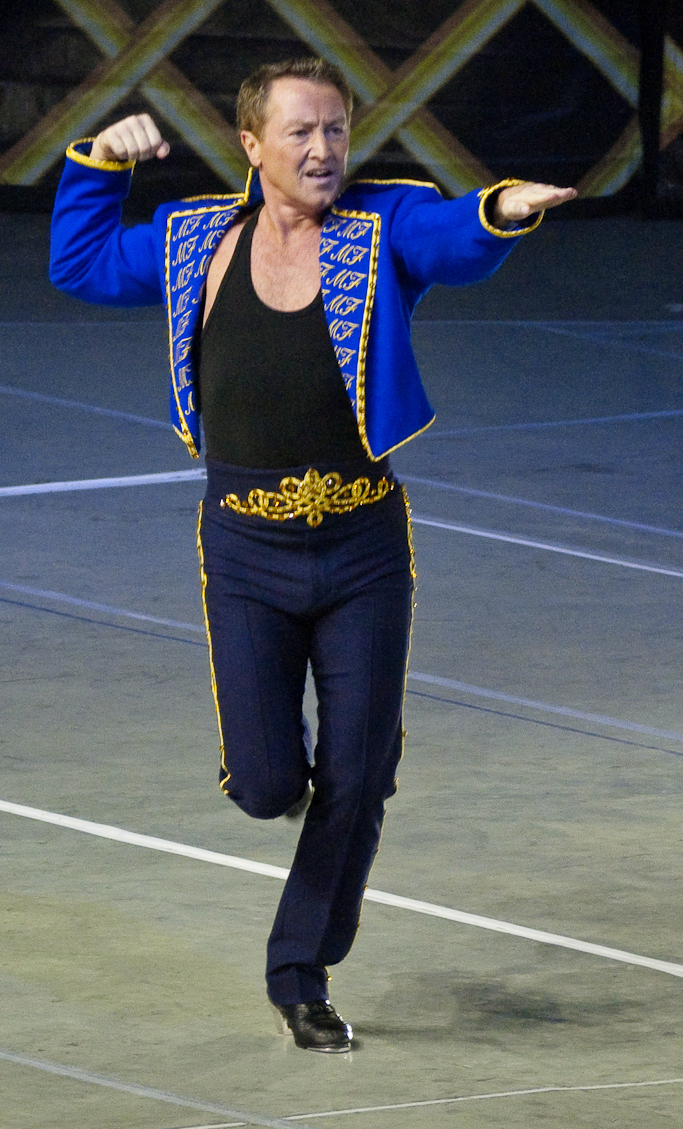
Although the winning song had modest success, peaking in the Irish Singles Chart at number two and also entering the Dutch and Flemish charts following the contest, it was largely overshadowed by the contest's interval act. The music to "Riverdance" was subsequently released as a single shortly after the contest and shot straight to number 1 on the Irish charts where it remained for 18 weeks. "Riverdance" remains the second best selling single in Ireland ever, behind Elton John's "Something About the Way You Look Tonight"/"Candle in the Wind 1997". An invite was subsequently given to feature the original seven-minute performance at the Royal Variety Performance in November 1994 at the Dominion Theatre in London, in the presence of then-Prince Charles. At the same time, preparations were underway to develop the seven-minute performance into a stage show, led by Moya Doherty, who had been the executive producer of Eurovision 1994, and her husband John McColgan. Opening in February 1995 at the Point Theatre and featuring original lead dancers Michael Flatley and Jean Butler, the full-length show ran for an initial run of five weeks, with tickets selling out within three days of going on sale, followed by another sold-out run at the Hammersmith Apollo in London, and in March 1996 came its first performance in the United States, at the Radio City Music Hall in New York City. It is estimated that Riverdance has been seen live by over 27.5 million people at performances worldwide, and that over ten million home video copies of Riverdance have been sold.
The relegation system introduced to the contest in this edition continued to be used in various forms for the next ten years and allowed even more new countries to join the event, with , and competing for the first time in , and respectively. However, as the contest continued to develop, and as even more countries began to express an interest in competing, the relegation system proved unable to meet the needs required to allow for an equitable solution for all countries. Ultimately this led to the introduction of a semi-final to the contest format in , allowing all interested countries to participate once again, which was eventually expanded to two semi-finals from .
References
- "Ireland – Participation history". European Broadcasting Union (EBU).
- (30 April 2012). "18 years ago today - Ireland makes it three in a row". European Broadcasting Union (EBU).
- "3Arena Dublin – About, History & Hotels Near". O'Callaghan Collection.
- (18 September 2016). "Milestone Moments: 1993/4 - The Eurovision Family expands". European Broadcasting Union (EBU).
- "Dublin 1994". European Broadcasting Union (EBU).
- (10 May 2016). "Tutto quello che c'è da sapere sull'Eurovision Song Contest 2016". [[La Stampa]].
- (5 September 2022). "L'Eurovision e l'Italia: tre vittorie, un ultimo posto, polemiche e curiosità". [[Corriere della Sera]].
- (11 May 2017). "Eurovision continues to unite states". European Broadcasting Union (EBU).
- (18 October 2017). "Upcycling At The Eurovision Song Contest: How To Get The Most Out Of Your Local Music Industry". ESC Insight.
- (18 February 2022). "Musician and singer, Chris Scicluna, passes away aged 62". Newsbook Malta.
- "Dublin 1994 – Participants". European Broadcasting Union (EBU).
- "Alle deutschen ESC-Acts und ihre Titel". [[ARD (broadcaster).
- "The Organisers behind the Eurovision Song Contest". European Broadcasting Union (EBU).
- (18 May 2019). "How it works". European Broadcasting Union (EBU).
- "Jerusalem 1999". European Broadcasting Union (EBU).
- (31 October 2018). "The Rules of the Contest". European Broadcasting Union (EBU).
- (18 April 2020). "#EurovisionAgain travels back to Dublin 1997". European Broadcasting Union (EBU).
- Harding, Peter. (November 1993). "The Point Depot, Dublin city (1993)".
- Harding, Peter. (April 1994). "Eurovision Song Contest draw (1993)".
- (31 March 2017). "In a Nutshell". European Broadcasting Union (EBU).
- (29 April 2019). "Riverdance at 25: How Eurovision gave birth to an Irish cultural phenomenon". [[The Independent]].
- Harding, Peter. (April 1994). "Eurovision Song Contest set (1994)".
- Harding, Peter. (April 1994). "Wide shot of Eurovision set (1994)".
- (30 April 1994). "Eurovision Song Contest 1994". {{lang.
- Gaffney, Des. (December 1992). "Macnas on stage at Eurovision (1994)".
- Harding, Peter. (December 1992). "Macnas perform at Eurovision (1994)".
- (19 May 2015). "Riverdance: an Irish success story".
- (30 April 1994). "Riverdance Debut at Eurovision in Dublin". [[RTÉ News]].
- "Riverdance First Performance". [[RTÉ]].
- Harding, Peter. (1994). "Eurovision Song Contest trophy (1994)".
- "Dublin 1994 – Paul Harrington and Charlie McGettigan". European Broadcasting Union (EBU).
- "Lithuania – Participation history". European Broadcasting Union (EBU).
- "Poland – Participation history". European Broadcasting Union (EBU).
- "Dublin 1994 – Scoreboard". European Broadcasting Union (EBU).
- (8 June 2021). "RTE Eileen Dunne's marriage to soap star Macdara O'Fatharta, their wedding day and grown up son Cormac". RSVP Live.
- (30 April 1994). "Απόψε ο διαγωνισμός της Γιουροβίζιον". {{lang.
- (27 February 2012). "Helga Vlahović: 1990 presenter has died". European Broadcasting Union (EBU).
- Seero, Tõnu. (15 April 1994). "ETV-s tutvustatakse Eurovisiooni lauluvõistlust". {{ill.
- (1 May 1994). "Malta fifth in Euro contest". [[Times of Malta]].
- Beerekamp, Hans. (2 May 1994). "Willeke laat Litouwen en Estland achter zich". [[NRC (newspaper).
- Jonušaitė, Neringa. (30 April 1994). "Vyras, kuris šiandien dainuos Airijos sostinėje". [[Lietuvos rytas]].
- "Dublin 1994 – Detailed voting results". European Broadcasting Union (EBU).
- "Eurovision Song Contest 1994 – Scoreboard". European Broadcasting Union (EBU).
- (15 May 2011). "Commentator's guide to the commentators". European Broadcasting Union (EBU).
- (14 May 2017). "Commentators: The national hosts of Eurovision". European Broadcasting Union (EBU).
- (22 May 2015). "Ein virtueller Disput der ESC-Kommentatoren". [[Kurier]].
- (29 April 1994). "Program HRT". Glas Podravine.
- (5 May 1994). "Eurosong seli u Belfast kao glazbeni zalog miru?". [[Slobodna Dalmacija]].
- (30 April 1994). "Ραδιοτηλεοραση". {{lang.
- (9 May 1992). "Ραδιοφωνο". {{lang.
- (30 April 1994). "Televisioon". Post.
- (30 April 1994). "Televisio & Radio". [[Helsingin Sanomat]].
- (30 April 1994). "les programmes TV". {{ill.
- (25 April 1994). "TV szombat {{!}} április 30.".
- (30 April 1994). "Laugurdagur 30. apríl". [[DV (newspaper).
- (25 April – 1 May 1994). "Laugardagur 30. apríl". [[Ríkisútvarpið]] (RÚV).
- (30 April 1994). "Saturday: Television and Radio". [[The Irish Times.
- (3 September 2017). "Pat Kenny: 'As Long As People Still Want Me I'll Keep Coming To Work'".
- (30 April 1994). "TV". [[Kurier Wileński]].
- (30 April 1994). "Television". [[Times of Malta]].
- (30 April 1994). "Programma's RTV Zaterdag". [[Leidsch Dagblad]].
- (30 April 1994). "TV – Lørdag 30. april". [[Moss Dagblad]].
- (30 April 1994). "Norgeskanalen P1 – Kjøreplan lørdag 30. april 1994". [[NRK]].
- (30 April – 3 May 1994). "TeleDziennik – Sobota". [[Dziennik Bałtycki]].
- (18 May 2021). "Artur Orzech – Eurowizja, żona, dzieci, wiek, wzrost, komentarze". [[Radio Eska]].
- (28 April 1994). "Programa da televisão". A Comarca de Arganil.
- (7 April 2018). "O número do dia. Quantos festivais comentou Eládio Clímaco na televisão portuguesa?". N-TV.
- (30 April 1994). "Programe TV". [[Libertatea]].
- Vacaru, Clara. (2 October 2015). "Abia o recunoşti! Cum arăta Gabi Cristea în urmă cu 20 de ani, la debutul în televiziune". [[Libertatea]].
- (23 April 1994). "Программы ТВ". [[Sovetskaya Sibir]].
- (22 April 1994). "Неделя телевизионного экрана". [[Rossiyskaya Gazeta]].
- (22 April 1994). "Лучшие певцы Европы". [[Rossiyskaya Gazeta]].
- (30 April 1994). "Mi? Hol? Mikor? – szombat". [[Új Szó]].
- (30 April 1994). "Ràdio i televisió". [[Avui]].
- HerGar, Paula. (28 March 2018). "Todos los comentaristas de la historia de España en Eurovisión (y una única mujer en solitario)". [[Los 40]].
- (30 April 1994). "TV program valborgsmässoafton". [[Svenska Dagbladet]].
- (30 April 1994). "Radio • valborgsmässoafton". [[Svenska Dagbladet]].
- (30 April 1994). "TV + Radio · Samstag". [[Bieler Tagblatt]].
- (28 April 1994). "Samedi 30 avril".
- (30 April 1994). "Eurovision Song Contest – BBC One".
- (30 April 1994). "Eurovision Song Contest – BBC Radio 2".
- (1 May 1994). "Today's television". [[The Canberra Times]].
- (29 April 1994). "Zaterdag 30 april". {{ill.
- (30 April 1994). "Televisie en radio zaterdag". [[Limburgs Dagblad]].
- (30 April 1994). "Heute abend im Fernsehen". [[Grenz-Echo]].
- "Alle tiders programoversigter – Lørdag den 30. april 1994". [[DR (broadcaster).
- (29 April 1994). "Sjónvarp". [[Oyggjatíðindi]].
- (28 April 1994). "KNR Aallakaatitassat/Programmer". [[Atuagagdliutit/Grønlandsposten.
- (29 April 1994). "على الشاشة الصغيرة". [[Al-Ittihad (Israeli newspaper).
- (30 April 1994). "Jordan Times Daily Guide and Calendar". [[The Jordan Times]].
- (30 April – 6 May 1994). "Sobota 30. april 1994". [[Delo (newspaper).
- (30 April 1994). "Spored za soboto". [[Delo (newspaper).
- (28 May 1994). "러시아·동구권 첫 참가". [[The Hankyoreh]].
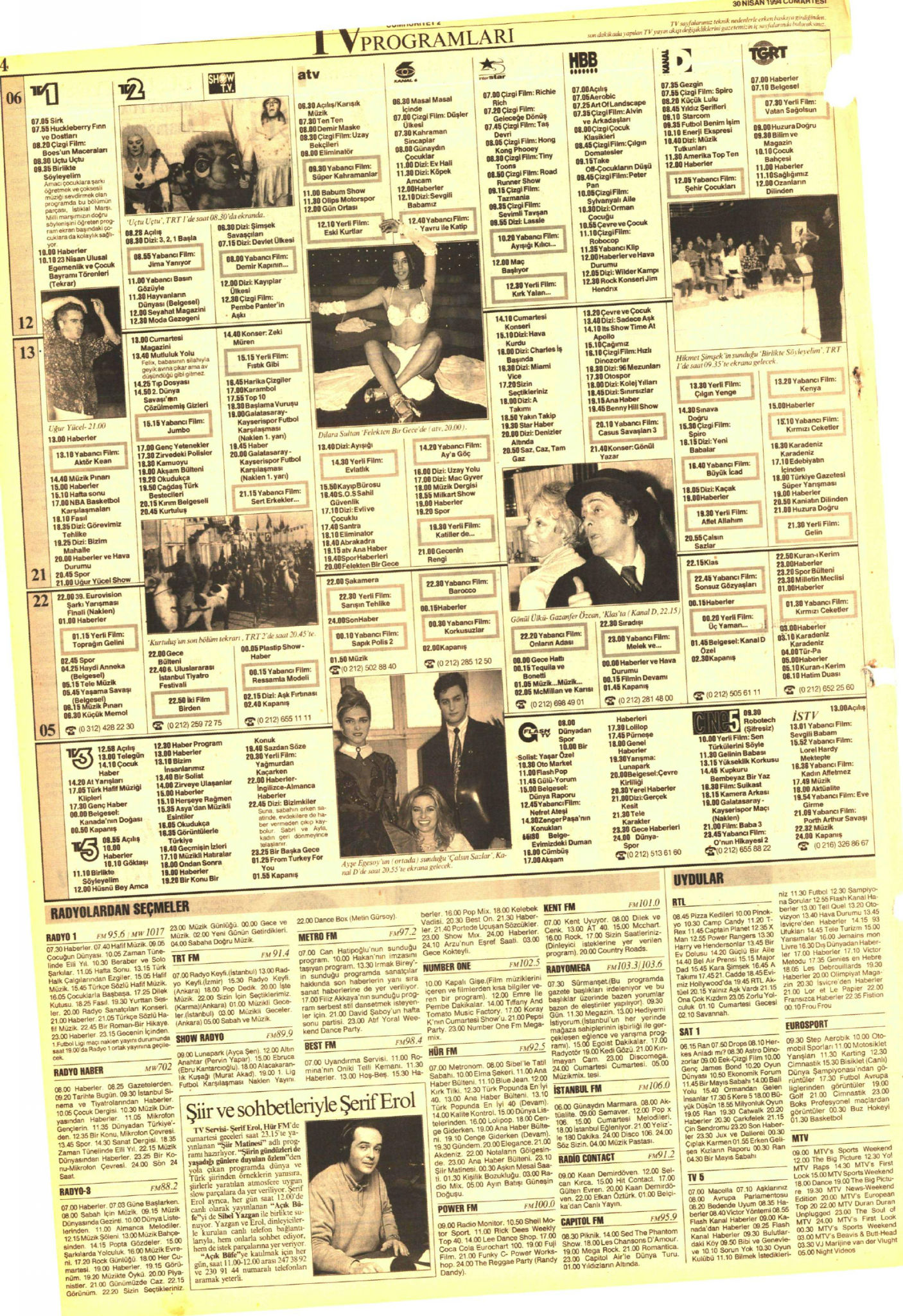
- (30 April 1994). "TV Programları". [[Cumhuriyet.
- (30 April 1994). "TV Subota". [[Borba (newspaper).
- "Paul Harrington and Charlie McGettigan – Rock 'n' Roll Kids". [[Irish Recorded Music Association]] (IRMA).
- "Paul Harrington & Charlie McGettigan – Rock 'n' Roll Kids". [[Dutch Charts]].
- "Bill Whelan – Riverdance". [[Irish Recorded Music Association]] (IRMA).
- (31 March 2010). "River Dance Facts". [[Irish Independent]].
- "The Irish Charts – Top 20 of all time". [[Irish Recorded Music Association]] (IRMA).
- (20 November 2014). "Riverdance at Royal Variety Performance 28 November 1994".
- (25 January 2020). "Riverdance: The couple behind seven minutes that shook the world". [[Belfast Telegraph]].
- "Meet The Team of Creatives".
- (25 March 2013). "MR riverdance steps up a gear". [[Irish Independent]].
- (8 October 2021). "Riverdance: 25th anniversary show coming to Hull". The Hull Story.
- "North Macedonia – Participation history". European Broadcasting Union (EBU).
- "Latvia – Participation history". European Broadcasting Union (EBU).
- "Ukraine – Participation history". European Broadcasting Union (EBU).
- (23 May 2003). "Eurovision Song Contest – New format". European Broadcasting Union (EBU).
- (1 October 2007). "Eurovision Song Contest: Two Semi-Finals in 2008". European Broadcasting Union (EBU).
This article was imported from Wikipedia and is available under the Creative Commons Attribution-ShareAlike 4.0 License. Content has been adapted to SurfDoc format. Original contributors can be found on the article history page.
Ask Mako anything about Eurovision Song Contest 1994 — get instant answers, deeper analysis, and related topics.
Research with MakoFree with your Surf account
Create a free account to save articles, ask Mako questions, and organize your research.
Sign up freeThis content may have been generated or modified by AI. CloudSurf Software LLC is not responsible for the accuracy, completeness, or reliability of AI-generated content. Always verify important information from primary sources.
Report