From Surf Wiki (app.surf) — the open knowledge base
Eurovision Song Contest 1992
International song competition

International song competition
| Field | Value |
|---|---|
| name | Eurovision Song Contest |
| year | 1992 |
| logo | ESC 1992 logo.png |
| final | |
| presenters | Lydia Capolicchio |
| Harald Treutiger | |
| musdirector | Anders Berglund |
| director | Kåge Gimtell |
| scrutineer | Frank Naef |
| exproducer | Ingvar Ernblad |
| organiser | European Broadcasting Union (EBU) |
| host | Sveriges Television (SVT) |
| venue | Malmö Isstadion |
| Malmö, Sweden | |
| winner | |
| "Why Me" | |
| vote | Each country awarded 12, 10, 8-1 point(s) to their 10 favourite songs |
| entries | 23 |
| return | |
| Map NoSemis | Y |
Harald Treutiger Malmö, Sweden "Why Me"
The Eurovision Song Contest 1992 was the 37th edition of the Eurovision Song Contest, held on 9 May 1992 at the Malmö Isstadion in Malmö, Sweden, and presented by Lydia Capolicchio and Harald Treutiger. It was organised by the European Broadcasting Union (EBU) and host broadcaster Sveriges Television (SVT), who staged the event after winning the for with the song "Fångad av en stormvind" by Carola.
Broadcasters from twenty-three countries participated in the contesta new record number of participantswith the returning to the contest following a one-year break to join the twenty-two countries which had participated in the previous year's event.
The winner was with the song "Why Me", written by Johnny Logan and performed by Linda Martin. This marked Ireland's fourth contest win, and brought songwriter Logan his third win overall, having previously won the contest in as singer and in as both singer and songwriter. The , , , and also placed in the top five, with the United Kingdom recording its thirteenth second-place position and Malta and Greece achieving their best ever results in the contest.
Location
The 1992 contest took place in Malmö, Sweden, following the country's victory at the with the song "Fångad av en stormvind", performed by Carola. It was the third time that Sweden had hosted the contest, following the and events held in Stockholm and Gothenburg respectively. The chosen venue was the Malmö Isstadion, normally used as an indoor ice hockey arena and up until 2008 the home stadium of the Malmö Redhawks ice hockey team. Constructed in 1970, the venue had also previously hosted concerts by Frank Sinatra and Julio Iglesias amongst others. With a typical capacity of 5,800 spectators for ice hockey matches, for the contest an audience of around 3,700 was present.
Participants

With the making a return to the contest after missing the previous year's contest, and continuing to participate following its return to the event in 1991, twenty-three countries in total competed in the 1992 contesta new contest record. Ahead of the 1991 event the Maltese broadcaster had been told by the contest organisers that they would only be allowed to remain in the competition if another nation dropped out of the event, however after placing sixth in the 1991 contest, the organisers instead decided to raise the maximum number of participating countries to twenty-three to make space for continued Maltese participation. The contest marked the final participation of , whose entry represented the Federal Republic of Yugoslavia for the first and only time, following the break-up of the Socialist Federal Republic of Yugoslavia in the past year which had been responsible for all previous Yugoslav entries; following the 1992 contest Yugoslavia was excluded from participating and the nation would not return to the contest until , when it competed under its new name . The 1992 contest was notable in the fact that only two countries which had previously participated in past editions of the event were absent from the contest, namely and .
Among the competing entries at this year's contest was the first entry to be performed in a French Creole language, and the first appearance of a song performed in Luxembourgish since .
The 1992 event featured a number of artists who had competed in previous editions for the same country: Sigríður Beinteinsdóttir and , two members of , had previously represented as Stjórnin; Rom Heck, a member of the group , had represented as a member of the group ; Linda Martin had represented ; Mia Martini had represented ; and the group Wind had represented and . Additionally, Evridiki participated as lead artist after previously performing backing vocals for , , and .
| Country | Broadcaster | Artist | Song | Language | Songwriter(s) | Conductor | FR Yugoslavia Yugoslavia | ||
|---|---|---|---|---|---|---|---|---|---|
| ORF | Tony Wegas | "Zusammen geh'n" | German | Leon Ives | |||||
| RTBF | "Nous on veut des violons" | French | Frank Fievez | ||||||
| CyBC | Evridiki | "Teriazoume" (Ταιριάζουμε) | Greek | George Theofanous | George Theofanous | ||||
| DR | and | "Alt det som ingen ser" | Danish | Carsten Warming | |||||
| YLE | Pave | "Yamma Yamma" | Finnish | Olli Ahvenlahti | |||||
| Antenne 2 | Kali | "Monté la riviè" | French, Antillean Creole | Magdi Vasco Noverraz | |||||
| MDR | Wind | "Träume sind für alle da" | German | Norbert Daum | |||||
| ERT | "Olou tou kosmou i elpida" (Όλου του κόσμου η ελπίδα) | Greek | Christos Lagos | Haris Andreadis | |||||
| RÚV | "Nei eða já" | Icelandic | Nigel Wright | ||||||
| RTÉ | Linda Martin | "Why Me" | English | Noel Kelehan | |||||
| IBA | Dafna | "Ze Rak Sport" (זה רק ספורט) | Hebrew | Kobi Oshrat | |||||
| RAI | Mia Martini | "Rapsodia" | Italian | ||||||
| CLT | and | "Sou fräi" | Luxembourgish | Christian Jacob | |||||
| PBS | Mary Spiteri | "Little Child" | English | ||||||
| NOS | Humphrey Campbell | "Wijs me de weg" | Dutch | Harry van Hoof | |||||
| NRK | Merethe Trøan | "Visjoner" | Norwegian | Rolf Løvland | |||||
| RTP | Dina | "Amor d'água fresca" | Portuguese | ||||||
| TVE | Serafín | "Todo esto es la música" | Spanish | Javier Losada | |||||
| SVT | Christer Björkman | "I morgon är en annan dag" | Swedish | Niklas Strömstedt | Anders Berglund | ||||
| SRG SSR | {{ill | Daisy Auvray | de | fr}} | "Mister Music Man" | French | Gordon Dent | ||
| TRT | "Yaz Bitti" | Turkish | Aydın Özarı | ||||||
| BBC | Michael Ball | "One Step Out of Time" | English | Ronnie Hazlehurst | |||||
| JRT | "Ljubim te pesmama" (Љубим те песмама) | Serbian | Anders Berglund |
Production and format
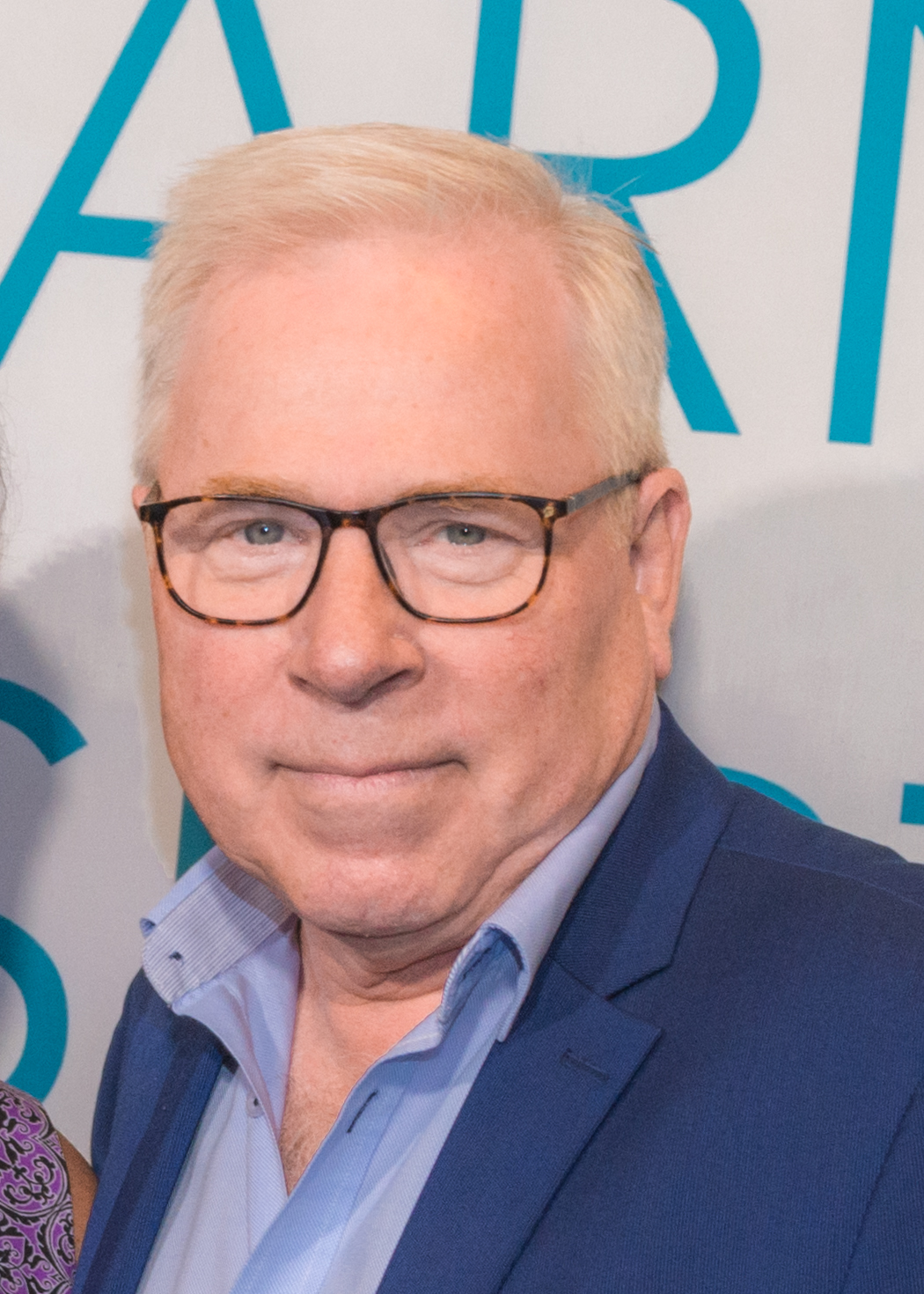
The Eurovision Song Contest 1992 was produced by the Swedish public broadcaster Sveriges Television (SVT). served as executive producer, served as producer and director, Göran Arfs served as designer, and Anders Berglund served as musical director leading an assembled orchestra of around 50 musicians. A separate musical director could be nominated by each participating delegation to lead the orchestra during its country's performance, with the host musical director also available to conduct for those countries which did not nominate their own conductor. On behalf of the European Broadcasting Union (EBU), the event was overseen by Frank Naef as scrutineer.
Each participating broadcaster submitted one song, which was required to be no longer than three minutes in duration and performed in the language, or one of the languages, of the country which it represented. A maximum of six performers were allowed on stage during each country's performance, and all participants were required to have reached the age of 16 in the year of the contest. Each entry could utilise all or part of the live orchestra and could use instrumental-only backing tracks, however any backing tracks used could only include the sound of instruments featured on stage being mimed by the performers.
Following the confirmation of the twenty-three competing countries, the draw to determine the running order was held on 3 December 1991 and was conducted by Carola.
The results of the 1992 contest were determined through the same scoring system as had first been introduced in : each country awarded twelve points to its favourite entry, followed by ten points to its second favourite, and then awarded points in decreasing value from eight to one for the remaining songs which featured in the country's top ten, with countries unable to vote for their own entry. The points awarded by each country were determined by an assembled jury of sixteen individuals, which was required to be split evenly between members of the public and music professionals, between men and women, and by age. Each jury member voted in secret and awarded between one and ten votes to each participating song, excluding that from their own country and with no abstentions permitted. The votes of each member were collected following the country's performance and then tallied by the non-voting jury chairperson to determine the points to be awarded. In any cases where two or more songs in the top ten received the same number of votes, a show of hands by all jury members was used to determine the final placing.
The stage design for the Malmö contest centred around a large representation of the bow of a Viking ship, flanked on either side by sets of stairs, while a hexagonal design was used for the floor area in front which was painted to resemble the Eurovision network logo. To the left of the stage as seen by the audience sat the orchestra, while to the right stood a large video wall and a smaller stage for use by the presenters to introduce each act and during the voting sequence. Behind the Viking ship the backdrop featured a representation using neon lighting of the span of the Öresund Bridge, the construction of which had yet to begin but which would connect Sweden and Denmark, and thus connecting Sweden with the bulk of the European mainland from 1999.
Rehearsals in the contest venue began on 3 May 1992, focussing on the opening performances and interval act. The participating artists began their rehearsals on 4 May, and each participating delegation was afforded two technical rehearsals in the week of the contest, with countries rehearsing in the order in which they would perform. The first rehearsals, held on 4 and 5 May, saw each country given a 40-minute slot on stage, followed by a press conference. Each delegation was then given a second slot to rehearse on stage, this time for 30 minutes, on 6 and 7 May. Three dress rehearsals were held with all artists, two held in the afternoon and evening of 8 May and one final rehearsal in the afternoon of 9 May. Audiences were present for the latter two dress rehearsals, and the final afternoon dress rehearsal was also recorded for use as a production stand-by. During the contest week the participating delegations were also invited to a welcome reception, which was held in . The Yugoslav representative had been given additional security in the form of bodyguards and a doctor due to the breakout of the Yugoslav Wars.
This year's contest featured a mascot: the "Eurobird", an anthropomorphic bird, featured as a computer animated character during the transition between the competing songs.
Contest overview
.jpg)
The contest took place on 9 May 1992 at 21:00 (CEST) with a duration of 3 hours. The show was presented by the Swedish journalists and television presenters Lydia Capolicchio and Harald Treutiger.
The opening sequence featured a computer-generated animation showing the journey from the previous year's host city Rome to Malmö, including oversized models placed on the European continent representing the Colosseum, the Leaning Tower of Pisa, the Alps, the Eiffel Tower, and structures in Malmö including Malmö Castle, Kronprinsen and the Hyllie Water Tower. This was followed by performances within the venue by the rhythmic gymnastics troupe, involving ribbon choreography to an instrumental version of "Fångad av en stormvind", and the previous year's winning artist Carola who sang the song "All the Reasons to Live". The interval act, entitled "A Century of Dance", featured David Johnson, Teresa Ibrahim, the Crazy Feat dance troupe and dancers from the , in a performance that showed the evolution of dance in Sweden and worldwide over the previous century; among the music pieces featured during the performance was "It Must Have Been Love" originally recorded by the Swedish duo Roxette. The trophy awarded to the winners was presented at the end of the broadcast by Carola.
The winner was represented by the song "Why Me?", written by Johnny Logan and performed by Linda Martin. This was the fourth time that Ireland had won the contest, following victories , , and . Having come second , Martin became the third artist to have placed both first and second in the contest, alongside Lys Assia and Gigliola Cinquetti, and songwriter Logan, who had already won the contest twice as a performer in 1980 and 1987the latter win additionally as the songwriterbecame the third individual to record two songwriting wins, alongside Willy van Hemert and Yves Dessca, and became the first, and only, individual to record three wins as either singer or songwriter. The finished in second place for a record-extending thirteenth time, while and recorded their best ever results to date with third- and fifth-place finishes respectively. Conversely host country recorded one of its worst ever results, finishing 22nd and second-to-last, and picked up its seventh last-place finish. With Ireland, the United Kingdom and Malta taking the top three places, all entries which were performed in English reached the top positions.
| R/O | Country | Artist | Song | Points | Place | 1 | 2 | 3 | 4 | 5 | 6 | 7 | 8 | 9 | 10 | 11 | 12 | 13 | 14 | 15 | 16 | 17 | 18 | 19 | 20 | 21 | 22 | 23 |
|---|---|---|---|---|---|---|---|---|---|---|---|---|---|---|---|---|---|---|---|---|---|---|---|---|---|---|---|---|
| Serafín | "Todo esto es la música" | 37 | 14 | |||||||||||||||||||||||||
| Morgane | "Nous on veut des violons" | 11 | 20 | |||||||||||||||||||||||||
| Dafna | "Ze Rak Sport" | 85 | 6 | |||||||||||||||||||||||||
| "Yaz Bitti" | 17 | 19 | ||||||||||||||||||||||||||
| Cleopatra | "Olou tou kosmou i elpida" | 94 | 5 | |||||||||||||||||||||||||
| Kali | "Monte la riviè" | 73 | 8 | |||||||||||||||||||||||||
| "I morgon är en annan dag" | 9 | 22 | ||||||||||||||||||||||||||
| Dina | "Amor d'água fresca" | 26 | 17 | |||||||||||||||||||||||||
| Evridiki | "Teriazoume" | 57 | 11 | |||||||||||||||||||||||||
| "Little Child" | 123 | 3 | ||||||||||||||||||||||||||
| Heart 2 Heart | "Nei eða já" | 80 | 7 | |||||||||||||||||||||||||
| Pave | "Yamma Yamma" | 4 | 23 | |||||||||||||||||||||||||
| "Mister Music Man" | 32 | 15 | ||||||||||||||||||||||||||
| and Kontinent | "Sou fräi" | 10 | 21 | |||||||||||||||||||||||||
| "Zusammen geh'n" | 63 | 10 | ||||||||||||||||||||||||||
| "One Step Out of Time" | 139 | 2 | ||||||||||||||||||||||||||
| "Why Me" | 155 | 1 | ||||||||||||||||||||||||||
| and Kenny Lübcke | "Alt det som ingen ser" | 47 | 12 | |||||||||||||||||||||||||
| "Rapsodia" | 111 | 4 | ||||||||||||||||||||||||||
| FR Yugoslavia Yugoslavia | "Ljubim te pesmama" | 44 | 13 | |||||||||||||||||||||||||
| "Visjoner" | 23 | 18 | ||||||||||||||||||||||||||
| Wind | "Träume sind für alle da" | 27 | 16 | |||||||||||||||||||||||||
| "Wijs me de weg" | 67 | 9 |
Spokespersons
Each participating broadcaster appointed a spokesperson, connected to the contest venue via telephone lines and responsible for announcing, in English or French, the votes for its respective country. Known spokespersons at the 1992 contest are listed below.
- FinlandSolveig Herlin
- FranceOlivier Minne
- IrelandEileen Dunne
- MaltaJoanna Drake
- Sweden
- United KingdomColin Berry
Detailed voting results
Jury voting was used to determine the points awarded by all countries. The announcement of the results from each country was conducted in the order in which they performed, with the spokespersons announcing their country's points in English or French in ascending order. The detailed breakdown of the points awarded by each country is listed in the tables below.
| nb=1 | Total score}} | nb=1 | Spain}} | nb=1 | Belgium}} | nb=1 | Israel}} | nb=1 | Turkey}} | nb=1 | Greece}} | nb=1 | France}} | nb=1 | Sweden}} | nb=1 | Portugal}} | nb=1 | Cyprus}} | nb=1 | Malta}} | nb=1 | Iceland}} | nb=1 | Finland}} | nb=1 | Switzerland}} | nb=1 | Luxembourg}} | nb=1 | Austria}} | nb=1 | United Kingdom}} | nb=1 | Ireland}} | nb=1 | Denmark}} | nb=1 | Italy}} | nb=1 | Yugoslavia}} | nb=1 | Norway}} | nb=1 | Germany}} | nb=1 | Netherlands}} | va=middle | Contestants}} | Spain | Belgium | Israel | Turkey | Greece | France | Sweden | Portugal | Cyprus | Malta | Iceland | Finland | Switzerland | Luxembourg | Austria | United Kingdom | Ireland | Denmark | Italy | Yugoslavia | Norway | Germany | Netherlands |
|---|---|---|---|---|---|---|---|---|---|---|---|---|---|---|---|---|---|---|---|---|---|---|---|---|---|---|---|---|---|---|---|---|---|---|---|---|---|---|---|---|---|---|---|---|---|---|---|---|---|---|---|---|---|---|---|---|---|---|---|---|---|---|---|---|---|---|---|---|---|---|---|---|
| 37 | 1 | 1 | 4 | 6 | 2 | 3 | 3 | 2 | 1 | 1 | 7 | 5 | 1 | |||||||||||||||||||||||||||||||||||||||||||||||||||||||||||
| 11 | 3 | 4 | 3 | 1 | ||||||||||||||||||||||||||||||||||||||||||||||||||||||||||||||||||||
| 85 | 10 | 2 | 8 | 4 | 7 | 4 | 7 | 4 | 8 | 1 | 7 | 2 | 12 | 2 | 4 | 3 | ||||||||||||||||||||||||||||||||||||||||||||||||||||||||
| 17 | 8 | 3 | 6 | |||||||||||||||||||||||||||||||||||||||||||||||||||||||||||||||||||||
| 94 | 7 | 8 | 7 | 3 | 5 | 12 | 2 | 5 | 10 | 4 | 12 | 7 | 8 | 4 | ||||||||||||||||||||||||||||||||||||||||||||||||||||||||||
| 73 | 6 | 12 | 3 | 3 | 7 | 12 | 5 | 6 | 10 | 3 | 6 | |||||||||||||||||||||||||||||||||||||||||||||||||||||||||||||
| 9 | 1 | 4 | 4 | |||||||||||||||||||||||||||||||||||||||||||||||||||||||||||||||||||||
| 26 | 8 | 2 | 2 | 1 | 5 | 8 | ||||||||||||||||||||||||||||||||||||||||||||||||||||||||||||||||||
| 57 | 3 | 10 | 2 | 2 | 1 | 8 | 2 | 6 | 4 | 8 | 3 | 8 | ||||||||||||||||||||||||||||||||||||||||||||||||||||||||||||
| 123 | 12 | 10 | 7 | 12 | 12 | 1 | 8 | 5 | 12 | 8 | 10 | 8 | 3 | 10 | 5 | |||||||||||||||||||||||||||||||||||||||||||||||||||||||||
| 80 | 8 | 4 | 4 | 6 | 6 | 6 | 3 | 5 | 7 | 12 | 5 | 5 | 1 | 6 | 2 | |||||||||||||||||||||||||||||||||||||||||||||||||||||||||
| 4 | 1 | 3 | ||||||||||||||||||||||||||||||||||||||||||||||||||||||||||||||||||||||
| 32 | 5 | 12 | 4 | 1 | 10 | |||||||||||||||||||||||||||||||||||||||||||||||||||||||||||||||||||
| 10 | 10 | |||||||||||||||||||||||||||||||||||||||||||||||||||||||||||||||||||||||
| 63 | 2 | 8 | 8 | 1 | 3 | 8 | 4 | 10 | 12 | 7 | ||||||||||||||||||||||||||||||||||||||||||||||||||||||||||||||
| 139 | 5 | 12 | 2 | 10 | 10 | 5 | 6 | 6 | 4 | 6 | 8 | 7 | 12 | 7 | 12 | 8 | 12 | 7 | ||||||||||||||||||||||||||||||||||||||||||||||||||||||
| 155 | 1 | 7 | 12 | 12 | 10 | 4 | 5 | 12 | 7 | 10 | 6 | 10 | 10 | 8 | 10 | 2 | 2 | 7 | 10 | 10 | ||||||||||||||||||||||||||||||||||||||||||||||||||||
| 47 | 4 | 6 | 7 | 1 | 6 | 6 | 3 | 3 | 6 | 5 | ||||||||||||||||||||||||||||||||||||||||||||||||||||||||||||||
| 111 | 5 | 3 | 12 | 8 | 8 | 10 | 5 | 10 | 12 | 7 | 6 | 12 | 1 | 12 | ||||||||||||||||||||||||||||||||||||||||||||||||||||||||||
| 44 | 10 | 6 | 1 | 5 | 2 | 3 | 5 | 4 | 2 | 4 | 2 | |||||||||||||||||||||||||||||||||||||||||||||||||||||||||||||
| 23 | 3 | 2 | 1 | 1 | 4 | 5 | 6 | 1 | ||||||||||||||||||||||||||||||||||||||||||||||||||||||||||||||||
| 27 | 6 | 10 | 6 | 2 | 3 | |||||||||||||||||||||||||||||||||||||||||||||||||||||||||||||||||||
| 67 | 7 | 2 | 5 | 7 | 5 | 4 | 7 | 3 | 1 | 5 | 2 | 8 | 4 | 7 |
12 points
The below table summarises how the maximum 12 points were awarded from one country to another. The winning country is shown in bold. Italy, Malta and the United Kingdom each received the maximum score of 12 points from four of the voting countries, with Ireland receiving three sets of 12 points, France and Greece receiving two sets of maximum scores each, and Austria, Iceland, Israel and Switzerland each receiving one maximum score.
| N. | Contestant | Nation(s) giving 12 points | 4 | 3 | 2 | 1 |
|---|---|---|---|---|---|---|
| , , , | ||||||
| , , , | ||||||
| , , , | ||||||
| **** | , , | |||||
| , | ||||||
| , | ||||||
| FR Yugoslavia Yugoslavia |
Broadcasts
Each participating broadcaster was required to relay the contest via its networks. Non-participating broadcasters were also able to relay the contest as "passive participants". Broadcasters were able to send commentators to provide coverage of the contest in their own native language and to relay information about the artists and songs to their television viewers. These commentators were typically sent to the venue to report on the event, and were able to provide commentary from small booths constructed at the back of the venue.
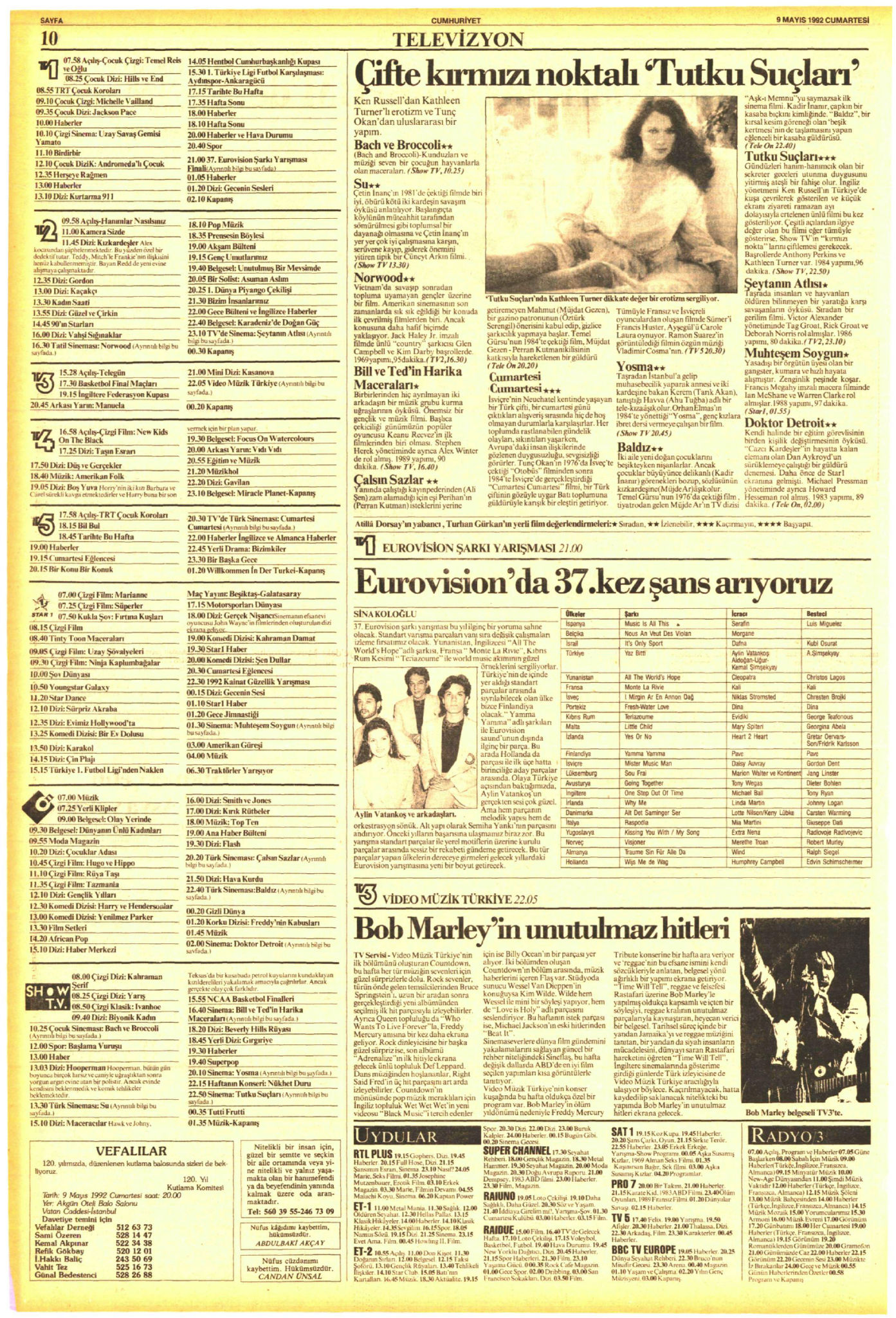
The contest was broadcast in 44 countries, including Australia, New Zealand and South Korea, with an estimated global audience of 150 to 250 million viewers. Known details on the broadcasts in each country, including the specific broadcasting stations and commentators are shown in the tables below.
| Country | Broadcaster | Channel(s) | Commentator(s) | Austria | Belgium | Cyprus | Denmark | Finland | France | Germany | Greece | Iceland | Ireland | Israel | Italy | Luxembourg | Malta | Netherlands | Norway | Portugal | Spain | Sweden | Switzerland | Turkey | United Kingdom | FR Yugoslavia Yugoslavia | |
|---|---|---|---|---|---|---|---|---|---|---|---|---|---|---|---|---|---|---|---|---|---|---|---|---|---|---|---|
| ORF | FS1 | Ernst Grissemann | |||||||||||||||||||||||||
| RTBF | RTBF1 | Claude Delacroix | |||||||||||||||||||||||||
| BRTN | TV1, TV2 | André Vermeulen | |||||||||||||||||||||||||
| Radio 2 | and | ||||||||||||||||||||||||||
| CyBC | RIK 1 | Evi Papamichail | |||||||||||||||||||||||||
| A Programma | |||||||||||||||||||||||||||
| align="left" | Various radio stations}} | ||||||||||||||||||||||||||
| DR | DR TV | Jørgen de Mylius | |||||||||||||||||||||||||
| DR P3 | Jesper Bæhrenz and | ||||||||||||||||||||||||||
| YLE | TV1 | Erkki Pohjanheimo and Kati Bergman | |||||||||||||||||||||||||
| Radiomafia | Pekka and Pätkä | ||||||||||||||||||||||||||
| Riksradion | Johan Finne, and | ||||||||||||||||||||||||||
| Antenne 2 | Thierry Beccaro | ||||||||||||||||||||||||||
| ARD | Erstes Deutsches Fernsehen | Jan Hofer | |||||||||||||||||||||||||
| SSVC | SSVC Television | ||||||||||||||||||||||||||
| ERT | ET1 | ||||||||||||||||||||||||||
| RÚV | Sjónvarpið, Rás 2 | Árni Snævarr | |||||||||||||||||||||||||
| RTÉ | RTÉ 1 | Pat Kenny | |||||||||||||||||||||||||
| 2FM | Larry Gogan | ||||||||||||||||||||||||||
| IBA | Israeli Television | ||||||||||||||||||||||||||
| RAI | Rai Due | ||||||||||||||||||||||||||
| CLT | RTL Hei Elei | ||||||||||||||||||||||||||
| PBS | TVM, Radio Malta 2 | Anna Bonanno | |||||||||||||||||||||||||
| NOS | Nederland 3 | Willem van Beusekom | |||||||||||||||||||||||||
| NRK | NRK Fjernsynet | John Andreassen | |||||||||||||||||||||||||
| NRK P2 | Leif Erik Forberg and Vidar Lønn-Arnesen | ||||||||||||||||||||||||||
| RTP | RTP Canal 1 | Eládio Clímaco | |||||||||||||||||||||||||
| TVE | La 2 | José Luis Uribarri | |||||||||||||||||||||||||
| SVT | TV2 | ||||||||||||||||||||||||||
| SR P3 | Lotta Engberg and Kalle Oldby | ||||||||||||||||||||||||||
| SRG SSR | TV DRS | ||||||||||||||||||||||||||
| TSR Chaîne nationale | |||||||||||||||||||||||||||
| TSI Canale nazionale | |||||||||||||||||||||||||||
| TRT | TV1 | ||||||||||||||||||||||||||
| BBC | BBC1 | Terry Wogan | |||||||||||||||||||||||||
| BBC Radio 2 | Ken Bruce | ||||||||||||||||||||||||||
| JRT | TV Beograd 1, TV Novi Sad 1 | ||||||||||||||||||||||||||
| Radio Beograd 202 |
| Country | Broadcaster | Channel(s) | Commentator(s) | Australia | Czechoslovakia | Estonia | Faroe Islands | Greenland | Hungary | Macedonia | Poland | Romania | Russia | Slovenia | South Korea |
|---|---|---|---|---|---|---|---|---|---|---|---|---|---|---|---|
| SBS | SBS TV | ||||||||||||||
| ČST | |||||||||||||||
| ETV | Ivo Linna and | ||||||||||||||
| SvF | |||||||||||||||
| KNR | KNR | ||||||||||||||
| MTV | MTV1 | István Vágó | |||||||||||||
| MRT | MTV 1 | ||||||||||||||
| TVP | TVP1 | Artur Orzech and | |||||||||||||
| TVR | TVR 1 | ||||||||||||||
| RTR | RTR | ||||||||||||||
| RTVSLO | SLO 1 | Miša Molk | |||||||||||||
| KBS | KBS1 | Kang In-gu and |
References
- "Sweden – Participation history". European Broadcasting Union (EBU).
- (19 March 2007). "Isstadion". [[Malmö Municipality.
- (21 July 2023). "Malmö Isstadion". [[Malmö Municipality.
- (21 August 2021). "Watch Now #EurovisionAgain: Malmö 1992". European Broadcasting Union (EBU).
- "Malmö 1992". European Broadcasting Union (EBU).
- (17 September 2017). "Rock me baby! Looking back at Yugoslavia at Eurovision". European Broadcasting Union (EBU).
- (14 April 2017). "RTS: "Evrosong" treba da bude mesto zajedništva naroda". [[Radio Television of Serbia]].
- "Marion Welter & Kontinent". EurovisionSpain.
- (26 January 2007). "Cyprus decided: Evridiki again". ESCToday.
- "Malmö 1992 – Participants". European Broadcasting Union (EBU).
- "Alle deutschen ESC-Acts und ihre Titel". [[ARD (broadcaster).
- "The Organisers behind the Eurovision Song Contest". European Broadcasting Union (EBU).
- (10 February 2017). "Former Eurovision scrutineer Frank Naef shares his backstage recollections". European Broadcasting Union (EBU).
- (18 May 2019). "How it works". European Broadcasting Union (EBU).
- "Jerusalem 1999". European Broadcasting Union (EBU).
- (31 October 2018). "The Rules of the Contest". European Broadcasting Union (EBU).
- (18 April 2020). "#EurovisionAgain travels back to Dublin 1997". European Broadcasting Union (EBU).
- Harding, Peter. (May 1992). "Swedish singer Carola during Eurovision dress rehearsal (1992)".
- Mitrović, Nemanja. (6 March 2022). "Jugoslavija i Pesma Evrovizije: Od socijalističkog autsajdera do festivalskog pobednika". {{lang.
- (9 May 1992). "Eurovision Song Contest 1992". {{lang.
- (30 November 2023). "Revisiting Malmö: How they did it in 1992". European Broadcasting Union (EBU).
- "Malmö 1992 – Linda Martin". European Broadcasting Union (EBU).
- "Ireland – Participation history". European Broadcasting Union (EBU).
- (14 September 2023). "Johnny Logan: What the original double winner did next". European Broadcasting Union (EBU).
- (20 May 2021). "Wouter Hardy met Zwitserland op weg naar nieuw songfestivalsucces". Ditjes en Datjes.
- "United Kingdom – Participation history". European Broadcasting Union (EBU).
- "Malta – Participation history". European Broadcasting Union (EBU).
- "Greece – Participation history". European Broadcasting Union (EBU).
- (7 September 2017). "#ThrowbackThursday to 20 years ago: Eurovision 1997". European Broadcasting Union (EBU).
- "Malmö 1992 – Scoreboard". European Broadcasting Union (EBU).
- (24 May 2021). "Lugano to Liverpool: Broadcasting Eurovision". [[National Science and Media Museum]].
- (18 December 2021). "Introducing Hosts: Carla, Élodie Gossuin and Olivier Minne". European Broadcasting Union (EBU).
- (8 June 2021). "RTE Eileen Dunne's marriage to soap star Macdara O'Fatharta, their wedding day and grown up son Cormac". RSVP Live.
- "Malmö 1992 – Detailed voting results". European Broadcasting Union (EBU).
- "Eurovision Song Contest 1992 – Scoreboard". European Broadcasting Union (EBU).
- (15 May 2011). "Commentator's guide to the commentators". European Broadcasting Union (EBU).
- (14 May 2017). "Commentators: The national hosts of Eurovision". European Broadcasting Union (EBU).
- Mattila, Ilkka. (9 May 1992). "Euroviisusirkus on entistä massiivisempi". [[Helsingin Sanomat]].
- (11 May 1992). "Η Ιρλανδία κέρδισε τις εντυπώσεις και τους βαθμούς". {{lang.
- (9 May 1992). "Fernsehen". [[Der Bund]].
- (22 May 2015). "Ein virtueller Disput der ESC-Kommentatoren". [[Kurier]].
- (8 May 1992). "Zaterdag 9 mei". {{ill.
- "Jaaroverzicht 1992". [[VRT (broadcaster).
- (9 May 1992). "Televisie en radio zaterdag". [[Limburgs Dagblad]].
- (9 May 1992). "Σασ προτεινουμε". {{lang.
- (9 May 1992). "Ραδιοφωνο". {{lang.
- (9 May 1992). "Με «μάτια και αυτιά» ΡΙΚ – ιδιωτικών ραδ/θμών στη Γιουροβίζιον". {{lang.
- "Alle tiders programoversigter – Lørdag den 9. maj 1992". [[DR (broadcaster).
- (9 May 1992). "Televisio & Radio". Helsingin Sanomat.
- (9 May 1992). "les programmes TV". {{ill.
- (9 May 1992). "Fernsehen". {{ill.
- (9 May 1992). "Το πρόγραμμα της τηλεόρασης". Imerisia.
- (8 May 1992). "Laugurdagur 9. maí". [[Morgunblaðið.
- (4–10 May 1992). "Laugardagur 9. maí". [[Ríkisútvarpið]] (RÚV).
- (9 May 1992). "Weekend TV Highlights". [[The Irish Times.
- (9 May 1992). "Radio". The Irish Times Weekend.
- (8 May 1992). "שבת 9.5 – טלוויזיה". [[Hadashot]].
- (3–9 May 1992). "Sabato 9 maggio".
- (6 May 1992). "Samstag 9. Mai {{!}} Samedi 9 mai".
- (9 May 1992). "'Great interest' in Malta's 'Little Child'". [[Times of Malta]].
- (9 May 1992). "Radio Television". Times of Malta.
- (9 May 1992). "Radio- en TV-Programma's Zaterdag". [[Leydse Courant.
- (9 May 1992). "Radio og TV". [[Oppland Arbeiderblad]].
- (9 May 1992). "P2 – Kjøreplan lørdag 9. mai 1992". [[NRK]].
- (7 May 1992). "Programa da televisão". A Comarca de Arganil.
- (7 April 2018). "O número do dia. Quantos festivais comentou Eládio Clímaco na televisão portuguesa?". N-TV.
- (9 May 1992). "Televisió". [[Diario de Barcelona.
- (9 May 1992). "TV – Lördagen den 9 maj". [[Dagens Nyheter]].
- (9 May 1992). "Radio – Lördagen den 9 maj". Dagens Nyheter.
- (9 May 1992). "TV + Radio – Samedi". [[Journal du Jura]].
- (9 May 1992). "Samedi 9 mai". [[Le Matin (Switzerland).
- (9 May 1992). "Televizyon". [[Cumhuriyet]].
- (9 May 1992). "Eurovision Song Contest – BBC One".
- (9 May 1992). "Eurovision Song Contest – BBC Radio 2".
- (9 May 1992). "Televizija". [[Borba (newspaper).
- (9 May 1992). "Televizió". [[Magyar Szó]].
- (9 May 1992). "Радио • Телевизија • Видео". [[Politika]].
- (10 May 1992). "Today's television". [[The Canberra Times]].
- (4 May 1992). "pátek 15. 5.".
- (4–10 May 1992). "Laupäev – 9. mai".
- (8 May 1992). "Sjónvarp". [[Oyggjatíðindi]].
- (13 May 1992). "TV". [[Atuagagdliutit/Grønlandsposten.
- (4 May 1992). "Szombat május 9.".
- (9–10 May 1992). "TV {{!}} 9 - 10.05..". [[Dziennik Bałtycki]].
- (30 April 2021). "Marek Sierocki i Aleksander Sikora skomentują Eurowizję! Co za duet!".
- (9–10 May 1992). "Televiziune". {{ill.
- (1 May 1992). "Программа телевидения". [[Sovetskaya Sibir]].
- (9 May 1992). "ТВ". [[Pravda]].
- (9–15 May 1992). "RTV programi • Sobota, 9. maja 1992". [[Delo (newspaper).
- (7 June 1992). "오늘의 TV 총정보". [[Kyunghyang Shinmun]].
This article was imported from Wikipedia and is available under the Creative Commons Attribution-ShareAlike 4.0 License. Content has been adapted to SurfDoc format. Original contributors can be found on the article history page.
Ask Mako anything about Eurovision Song Contest 1992 — get instant answers, deeper analysis, and related topics.
Research with MakoFree with your Surf account
Create a free account to save articles, ask Mako questions, and organize your research.
Sign up freeThis content may have been generated or modified by AI. CloudSurf Software LLC is not responsible for the accuracy, completeness, or reliability of AI-generated content. Always verify important information from primary sources.
Report