From Surf Wiki (app.surf) — the open knowledge base
Eurovision Song Contest 1991
International song competition

International song competition
| Field | Value |
|---|---|
| name | Eurovision Song Contest |
| year | 1991 |
| logo | ESC 1991 logo.png |
| final | |
| presenters | Gigliola Cinquetti |
| Toto Cutugno | |
| musdirector | Bruno Canfora |
| director | Riccardo Donna |
| scrutineer | Frank Naef |
| exproducer | Silvia Salvetti |
| organiser | European Broadcasting Union (EBU) |
| host | Radiotelevisione italiana (RAI) |
| venue | Stage 15 |
| Cinecittà Studios | |
| Rome, Italy | |
| winner | |
| "Fångad av en stormvind" | |
| vote | Each country awarded 12, 10, 8-1 point(s) to their 10 favourite songs |
| entries | 22 |
| return | |
| nonreturn | |
| Map NoSemis | Y |
Toto Cutugno Cinecittà Studios Rome, Italy "Fångad av en stormvind"
The Eurovision Song Contest 1991 was the 36th edition of the Eurovision Song Contest, held on 4 May 1991 at Stage 15 of the Cinecittà Studios in Rome, Italy, and presented by Gigliola Cinquetti and Toto Cutugno. It was organised by the European Broadcasting Union (EBU) and host broadcaster Radiotelevisione italiana (RAI), who staged the event after winning the for with the song "Insieme: 1992" by Cutugno. Cinquetti had also won the contest for .
Broadcasters from twenty-two countries participated in the contest, with making its first appearance in sixteen years, having last participated in , while the decided not to participate because the date of the event coincided with the country's Remembrance of the Dead commemorations. It was also the first time that was represented as a single state following the reunification of East and West Germany.
For the first time since , the contest resulted in a draw for first place, with both and being awarded the same number of points. The contest's tie-break procedure was implemented for the first time in its history, which resulted in Sweden being declared the winner because its entry, "Fångad av en stormvind", written by Stephan Berg and performed by Carola, had received a greater number of top scores from the other competing countries than the French entry; it was Sweden's third win in the contest overall. Alongside France, , and rounded out the top five.
Location
The 1991 contest took place in Rome, Italy, following the country's victory at the with the song "Insieme: 1992", performed by Toto Cutugno. It was the second time that Italy had hosted the contest, following the held in Naples. Prior to the conclusion of the 1990 contest, the EBU had considered the idea of only having the winner of the previous contest host an edition every second year, with the host broadcaster of odd numbered years being chosen through a bidding process. It is known that Belgrade and Amsterdam had shown interest in hosting the 1991 contest, but ultimately Italy was chosen to host after winning the contest. The chosen venue was Stage 15 of the Cinecittà Studios, the largest film studios in Europe which had previously been the filming location for several American and Italian blockbuster films, particularly during the 1950s and 1960s.
The Italian organisers had originally intended that the contest be held in the Teatro Ariston in Sanremo, where the annual Sanremo Music Festival is held. The Sanremo festival had been a major influence and inspiration for the formation of the Eurovision Song Contest, and RAI had wanted to pay tribute to the contest's origins by hosting the event in the town. The choice of Sanremo and Ariston as host of the event was initially rejected by the EBU, citing concerns regarding the size of the venue as well as organisational and security shortcomings. In an effort to address some of the concerns, the comune of Sanremo proposed hosting the event in three locations across the Ariston area, with the Teatro Ariston, Piazza Colombo and the old flower market on Corso Garibaldi being combined using temporary structures to form a single venue. Although plans to hold the contest in Sanremo continued to be developed as late as January 1991, by February doubts over the feasibility of holding the event in Sanremo became insurmountable, due to instability in the Middle East and the outbreak of the Gulf War, and ultimately the organisers opted to relocate the contest to a more secure location, eventually confirming on 18 February that the event would be held in Rome. Despite the relocation, Sanremo remained a partner of the 1991 contest and pre-recorded footage of the city was featured during the live broadcast.
Participants

A total of twenty-two countries participated in the 1991 contest. Of the countries that participated in 1990, the were the only country that failed to make a return, as the date of the contest clashed with the country's Remembrance of the Dead commemorations. which had last participated in the contest sixteen years before, in ultimately filled the vacant slot. The nation had for a number of years attempted to make a return to the contest, however was prevented from doing so due to the cap on participation numbers set by the EBU. This marked the first time that competed as a unified country, following the reunification of East and West Germany into a single state; until this point all German entrants in previous contests had represented the former West Germany.
Several artists that had previously competed in the contest returned to participate in this year's event: , who competed alongside for , was a member of Beathoven that had participated for the nation in ; Thomas Forstner made a second appearance for following the ; Carola also returned to the contest for the second time for after her participation in ; and the members of 's featured two previous participating artists, namely Eiríkur Hauksson, who had competed in the for Iceland as part of the group ICY, and Hanne Krogh, who had represented Norway twice before, in as a solo artist and in as a member of the group Bobbysocks!, the latter appearance ultimately winning the contest outright. Additionally, Kit Rolfe performed as backing vocalist for the 's Samantha Janus, having previously been lead vocalist of the group Belle and the Devotions that had represented the UK at the .
| Country | Broadcaster | Artist | Song | Language | Songwriter(s) | Conductor |
|---|---|---|---|---|---|---|
| ORF | Thomas Forstner | "Venedig im Regen" | German | Richard Oesterreicher | ||
| BRTN | Clouseau | "Geef het op" | Dutch | |||
| CyBC | "S.O.S." | Greek | Alexander Kirov Zografov | |||
| DR | Anders Frandsen | "Lige der hvor hjertet slår" | Danish | Michael Elo | ||
| YLE | Kaija | "Hullu yö" | Finnish | Olli Ahvenlahti | ||
| Antenne 2 | Amina | "C'est le dernier qui a parlé qui a raison" | French | Jérôme Pillement | ||
| SFB | "Dieser Traum darf niemals sterben" | German | ||||
| ERT | Sophia Vossou | "Anixi" (Άνοιξη) | Greek | Andreas Mikroutsikos | Haris Andreadis | |
| RÚV | and | "Nína" | Icelandic | Jón Ólafsson | ||
| RTÉ | "Could It Be That I'm in Love" | English | Liam Reilly | Noel Kelehan | ||
| IBA | Duo Datz | "Kan" (כאן) | Hebrew | Uzi Hitman | Kobi Oshrat | |
| RAI | Peppino di Capri | "Comme è ddoce 'o mare" | Neapolitan | Bruno Canfora | ||
| CLT | "Un baiser volé" | French | Francis Goya | |||
| PBS | and Georgina | "Could It Be" | English | Paul Abela | ||
| NRK | "Mrs. Thompson" | Norwegian | ||||
| RTP | Dulce | "Lusitana paixão" | Portuguese | Fernando Correia Martins | ||
| TVE | Sergio Dalma | "Bailar pegados" | Spanish | |||
| SVT | Carola | "Fångad av en stormvind" | Swedish | Stephan Berg | Anders Berglund | |
| SRG SSR | Sandra Simó | "Canzone per te" | Italian | Renato Mascetti | Flaviano Cuffari | |
| TRT | , İzel Çeliköz and Reyhan Karaca | "İki Dakika" | Turkish | Turhan Yükseler | ||
| BBC | Samantha Janus | "A Message to Your Heart" | English | Paul Curtis | Ronnie Hazlehurst | |
| JRT | Baby Doll | "Brazil" (Бразил) | Serbo-Croatian | Slobodan Marković |
Production
The Eurovision Song Contest 1991 was produced by the Italian public broadcaster Radiotelevisione italiana (RAI). Silvia Salvetti served as executive producer, served as director, Luciano Ricceri served as designer, and Bruno Canfora served as musical director leading an assembled orchestra of 57 musicians. A separate musical director could be nominated by each participating delegation to lead the orchestra during its country's performance, with the host musical director also available to conduct for those countries which did not nominate their own conductor. On behalf of the contest organisers, the European Broadcasting Union (EBU), the event was overseen by Frank Naef as scrutineer.
The running order draw, to determine in which position each country would perform, was held on 18 February 1991, the same date that Rome was confirmed as the host city of the contest and the announcement of the twenty-two competing countries.
Rehearsals for the participating artists began on 29 April 1991. Two technical rehearsals were conducted for each participating delegation in the week approaching the contest, with countries rehearsing in the order in which they would perform. The first rehearsals of 40 minutes' duration were held on 29 and 30 April, with the second rehearsals, each lasting 35 minutes, held on 1 and 2 May. Three dress rehearsals were held with all artists, two held in the afternoon and evening of 3 May and one final rehearsal in the afternoon of 4 May. An audience was present for the second dress rehearsal on the evening of 3 May. About 300 journalists covered the event.
The production value of the 1991 contest came in for much criticism during the build-up and following the event, which may be partly explained by the relatively late change in contest venue from Sanremo to Rome. Rehearsals in the contest venue regularly started late as the orchestra failed on many occasions to arrive at the venue on time, and during the live broadcast, a number of technical mishaps occurred, including lighting failure during several of the entries and the failure of the venue's sound system during the Swedish entry. The voting sequence was also notably haphazard and several mistakes required rectification during the show, with Naef regularly called upon by the presenters for clarification.
Format
Each participating broadcaster submitted one song, which was required to be no longer than three minutes in duration and performed in the language, or one of the languages, of the country which it represented. A maximum of six performers were allowed on stage during each country's performance, and all participants were required to have reached the age of 16 in the year of the contest. Each entry could utilise all or part of the live orchestra and could use instrumental-only backing tracks, however any backing tracks used could only include the sound of instruments featured on stage being mimed by the performers.
The results of the 1991 contest were determined through the same scoring system as had first been introduced in : each country awarded twelve points to its favourite entry, followed by ten points to its second favourite, and then awarded points in decreasing value from eight to one for the remaining songs which featured in the country's top ten, with countries unable to vote for their own entry. The points awarded by each country were determined by an assembled jury of sixteen individuals, which was required to be split evenly between men and women and by age. Each jury member voted in secret and awarded between one and ten votes to each participating song, excluding that from their own country and with no abstentions permitted. The votes of each member were collected following the country's performance and then tallied by the non-voting jury chairperson to determine the points to be awarded. In any cases where two or more songs in the top ten received the same number of votes, a show of hands by all jury members was used to determine the final placing. In a change to the rules compared to previous editions, half of the jury members in each country were now represented by music experts, comprising among other professions singers, composers, lyricists, musicians, conductors, music journalists, record company employees and radio or television producers. Only two members in each country were allowed to come from record companies, and no employees of the participating broadcasters themselves were allowed to sit on the juries.
Postcards
Each entry was preceded by a video postcard which served as an introduction to each country, as well as providing an opportunity for transition between entries and allow stage crew to make changes on stage. The postcards for the 1991 contest featured pre-recorded clips of the competing artists performing short sections from Italian songs, superimposed onto images of Italian landmarks and locations which were intended to represent the artists' personalities. The song each artist performed during their postcard is listed below by order of performance, alongside the originator of the song in brackets:
- Yugoslavia"Non ho l'età" (Gigliola Cinquetti)
- Iceland"Se bastasse una canzone" (Eros Ramazzotti)
- Malta"{{ill|Questo piccolo grande amore|it|Questo piccolo grande amore (brano musicale)}}" (Claudio Baglioni)
- Greece"Caruso" (Lucio Dalla)
- Switzerland"Un'estate italiana" (Edoardo Bennato and Gianna Nannini)
- Austria"Adesso tu" (Eros Ramazzotti)
- Luxembourg"Sarà perché ti amo" (Ricchi e Poveri)
- Sweden"Non voglio mica la luna" (Fiordaliso)
- France"La partita di pallone" (Rita Pavone)
- Turkey"Amore scusami" (John Foster)
- Ireland"Nel blu, dipinto di blu" (Domenico Modugno)
- Portugal"Dio, come ti amo" (Domenico Modugno / Gigliola Cinquetti)
- Denmark"Nessun dorma" (from Giacomo Puccini's opera Turandot)
- Norway"Santa Lucia" (traditional)
- Israel"{{ill|Lontano dagli occhi|it|Lontano dagli occhi/San Firmino}}" (Sergio Endrigo / Mary Hopkin)
- Finland"" (Renato Carosone)
- Germany"L'Italiano" (Toto Cutugno)
- Belgium"Musica è" (Eros Ramazzotti)
- Spain"Sono tremendo" (Rocky Roberts)
- United Kingdom"Ricordati di me" (Antonello Venditti)
- Cyprus"Io che amo solo te" (Sergio Endrigo)
- Italy"Champagne" (Peppino di Capri)
Contest overview

The contest took place on 4 May 1991 at 21:00 (CEST) with a duration of 3 hours and 13 minutes. The show was presented by the Italian singers Gigliola Cinquetti and Toto Cutugno, the two artists which up until this point had won the contest for and respectively. Unlike the majority of previous contest presenters, who had conducted the events in English and French, for the majority of the 1991 contest the two presenters spoke solely in Italian, with only the voting sequence being conducted in Italian, English, and French.
The opening of the contest featured a pre-recorded music video of the American singer Sara Carlson performing "Celebration", which was followed by live performances from the contest hosts of their Eurovision winning songs, Cutugno's "Insieme: 1992" and Cinquetti's "Non ho l'età". The interval act comprised a performance by the Italian quick-change artist and illusionist Arturo Brachetti. The trophy awarded to the winners was presented at the end of the broadcast by Albert Scharf as the President of the European Broadcasting Union.
The winner was represented by the song "Fångad av en stormvind", written by Stephan Berg and performed by Carola. It was Sweden's third contest victory, following wins in and . For the first time since , and for only the second time ever in the contest's history, the voting sequence resulted in a draw for first place, with both and Sweden finishing with 146 points each. The tie-break rules introduced for the were thus enacted: for any ties for first place the country which received the most 12 points would be declared the winner; if a tie still remained after examining the 12 points, each country's 10 points would then be compared to determine a winner. Both France and Sweden had scored four 12 point scores, however as Sweden had scored five 10 points compared to France's two they were declared the winners. During the traditional winner's reprise performance, Carola performed part of the winning song in English, with lyrics written by Richard Hampton.
| R/O | Country | Artist | Song | Points | Place | 1 | 2 | 3 | 4 | 5 | 6 | 7 | 8 | 9 | 10 | 11 | 12 | 13 | 14 | 15 | 16 | 17 | 18 | 19 | 20 | 21 | 22 |
|---|---|---|---|---|---|---|---|---|---|---|---|---|---|---|---|---|---|---|---|---|---|---|---|---|---|---|---|
| Baby Doll | "Brazil" | 1 | 21 | ||||||||||||||||||||||||
| Stefán and Eyfi | "Nína" | 26 | 15 | ||||||||||||||||||||||||
| and Georgina | "Could It Be" | 106 | 6 | ||||||||||||||||||||||||
| "Anixi" | 36 | 13 | |||||||||||||||||||||||||
| "Canzone per te" | 118 | 5 | |||||||||||||||||||||||||
| "Venedig im Regen" | 0 | 22 | |||||||||||||||||||||||||
| "Un baiser volé" | 29 | 14 | |||||||||||||||||||||||||
| Carola | "Fångad av en stormvind" | 146 | 1 | ||||||||||||||||||||||||
| Amina | "C'est le dernier qui a parlé qui a raison" | 146 | 2 | ||||||||||||||||||||||||
| , İzel Çeliköz and Reyhan Karaca | "İki Dakika" | 44 | 12 | ||||||||||||||||||||||||
| "Could It Be That I'm in Love" | 47 | 10 | |||||||||||||||||||||||||
| Dulce | "Lusitana paixão" | 62 | 8 | ||||||||||||||||||||||||
| "Lige der hvor hjertet slår" | 8 | 19 | |||||||||||||||||||||||||
| Just 4 Fun | "Mrs. Thompson" | 14 | 17 | ||||||||||||||||||||||||
| "Kan" | 139 | 3 | |||||||||||||||||||||||||
| Kaija | "Hullu yö" | 6 | 20 | ||||||||||||||||||||||||
| Atlantis 2000 | "Dieser Traum darf niemals sterben" | 10 | 18 | ||||||||||||||||||||||||
| Clouseau | "Geef het op" | 23 | 16 | ||||||||||||||||||||||||
| "Bailar pegados" | 119 | 4 | |||||||||||||||||||||||||
| "A Message to Your Heart" | 47 | 10 | |||||||||||||||||||||||||
| "S.O.S." | 60 | 9 | |||||||||||||||||||||||||
| "Comme è ddoce 'o mare" | 89 | 7 |
Spokespersons
Each participating broadcaster appointed a spokesperson, connected to the contest venue via telephone lines and responsible for announcing, in English or French, the votes for its respective country. Known spokespersons at the 1991 contest are listed below.
- FinlandHeidi Kokki
- IrelandEileen Dunne
- ItalyRosanna Vaudetti
- MaltaDominic Micallef
- Sweden
- TurkeyCanan Kumbasar
- United KingdomColin Berry
Detailed voting results
Jury voting was used to determine the points awarded by all countries. The announcement of the results from each country was conducted in the order in which they performed, with the spokespersons announcing their country's points in English or French in ascending order. The detailed breakdown of the points awarded by each country is listed in the tables below.
| nb=1 | Total score}} | nb=1 | Yugoslavia}} | nb=1 | Iceland}} | nb=1 | Malta}} | nb=1 | Greece}} | nb=1 | Switzerland}} | nb=1 | Austria}} | nb=1 | Luxembourg}} | nb=1 | Sweden}} | nb=1 | France}} | nb=1 | Turkey}} | nb=1 | Ireland}} | nb=1 | Portugal}} | nb=1 | Denmark}} | nb=1 | Norway}} | nb=1 | Israel}} | nb=1 | Finland}} | nb=1 | Germany}} | nb=1 | Belgium}} | nb=1 | Spain}} | nb=1 | United Kingdom}} | nb=1 | Cyprus}} | nb=1 | Italy}} | va=middle | Contestants}} | Yugoslavia | Iceland | Malta | Greece | Switzerland | Austria | Luxembourg | Sweden | France | Turkey | Ireland | Portugal | Denmark | Norway | Israel | Finland | Germany | Belgium | Spain | United Kingdom | Cyprus | Italy |
|---|---|---|---|---|---|---|---|---|---|---|---|---|---|---|---|---|---|---|---|---|---|---|---|---|---|---|---|---|---|---|---|---|---|---|---|---|---|---|---|---|---|---|---|---|---|---|---|---|---|---|---|---|---|---|---|---|---|---|---|---|---|---|---|---|---|---|---|---|---|
| 1 | 1 | ||||||||||||||||||||||||||||||||||||||||||||||||||||||||||||||||||||
| 26 | 4 | 10 | 5 | 7 | |||||||||||||||||||||||||||||||||||||||||||||||||||||||||||||||||
| 106 | 1 | 2 | 6 | 4 | 10 | 12 | 2 | 7 | 12 | 7 | 6 | 10 | 4 | 6 | 7 | 10 | |||||||||||||||||||||||||||||||||||||||||||||||||||||
| 36 | 4 | 5 | 2 | 1 | 1 | 4 | 1 | 1 | 5 | 10 | 2 | ||||||||||||||||||||||||||||||||||||||||||||||||||||||||||
| 118 | 5 | 5 | 7 | 8 | 12 | 8 | 4 | 2 | 2 | 6 | 5 | 3 | 8 | 5 | 6 | 12 | 8 | 8 | 4 | ||||||||||||||||||||||||||||||||||||||||||||||||||
| 0 | |||||||||||||||||||||||||||||||||||||||||||||||||||||||||||||||||||||
| 29 | 4 | 5 | 1 | 3 | 2 | 4 | 3 | 2 | 3 | 2 | |||||||||||||||||||||||||||||||||||||||||||||||||||||||||||
| 146 | 6 | 12 | 10 | 10 | 7 | 6 | 3 | 10 | 12 | 8 | 10 | 8 | 12 | 10 | 4 | 12 | 6 | ||||||||||||||||||||||||||||||||||||||||||||||||||||
| 146 | 10 | 7 | 3 | 8 | 7 | 12 | 5 | 7 | 5 | 12 | 12 | 10 | 8 | 7 | 8 | 6 | 7 | 12 | |||||||||||||||||||||||||||||||||||||||||||||||||||
| 44 | 7 | 7 | 8 | 7 | 2 | 5 | 8 | ||||||||||||||||||||||||||||||||||||||||||||||||||||||||||||||
| 47 | 3 | 4 | 3 | 1 | 8 | 4 | 7 | 1 | 2 | 2 | 5 | 4 | 3 | ||||||||||||||||||||||||||||||||||||||||||||||||||||||||
| 62 | 8 | 4 | 1 | 2 | 7 | 10 | 5 | 1 | 2 | 7 | 10 | 4 | 1 | ||||||||||||||||||||||||||||||||||||||||||||||||||||||||
| 8 | 3 | 5 | |||||||||||||||||||||||||||||||||||||||||||||||||||||||||||||||||||
| 14 | 6 | 1 | 1 | 2 | 4 | ||||||||||||||||||||||||||||||||||||||||||||||||||||||||||||||||
| 139 | 12 | 10 | 8 | 5 | 8 | 5 | 6 | 3 | 12 | 8 | 4 | 10 | 7 | 6 | 8 | 12 | 10 | 5 | |||||||||||||||||||||||||||||||||||||||||||||||||||
| 6 | 1 | 1 | 4 | ||||||||||||||||||||||||||||||||||||||||||||||||||||||||||||||||||
| 10 | 6 | 1 | 3 | ||||||||||||||||||||||||||||||||||||||||||||||||||||||||||||||||||
| 23 | 3 | 2 | 5 | 3 | 3 | 2 | 5 | ||||||||||||||||||||||||||||||||||||||||||||||||||||||||||||||
| 119 | 8 | 2 | 6 | 10 | 12 | 7 | 6 | 4 | 6 | 8 | 6 | 8 | 4 | 2 | 4 | 7 | 6 | 1 | 12 | ||||||||||||||||||||||||||||||||||||||||||||||||||
| 47 | 10 | 3 | 5 | 6 | 3 | 1 | 1 | 3 | 5 | 3 | 1 | 6 | |||||||||||||||||||||||||||||||||||||||||||||||||||||||||
| 60 | 2 | 3 | 12 | 12 | 4 | 12 | 5 | 3 | 6 | 1 | |||||||||||||||||||||||||||||||||||||||||||||||||||||||||||
| 89 | 7 | 2 | 6 | 2 | 8 | 10 | 10 | 12 | 10 | 3 | 12 | 7 |
12 points
The below table summarises how the maximum 12 points were awarded from one country to another. The winning country is shown in bold. France and Sweden each received the maximum score of 12 points from four of the voting countries, with Cyprus and Israel receiving three sets of 12 points each, and Italy, Malta, Spain and Switzerland each receiving two sets of maximum scores.
| N. | Contestant | Nation(s) giving 12 points | 4 | 3 | 2 |
|---|---|---|---|---|---|
| , , , | |||||
| **** | , , , | ||||
| , , | |||||
| , , | |||||
| , | |||||
| , | |||||
| , | |||||
| , |
Broadcasts
Each participating broadcaster was required to relay the contest via its networks. Non-participating member broadcasters were also able to relay the contest as "passive participants". Broadcasters were able to send commentators to provide coverage of the contest in their own native language and to relay information about the artists and songs to their television viewers. These commentators were typically sent to the venue to report on the event, and were able to provide commentary from small booths constructed at the back of the venue.
In addition to the participating countries, the contest was also reportedly broadcast in Bulgaria, Czechoslovakia, Hungary, Poland, Romania and the Soviet Union via Intervision, and in Australia, Cape Verde, Guinea-Bissau, Mozambique, South Africa and South Korea, with an estimated global audience of up to 800 million viewers.
Known details on the broadcasts in each country, including the specific broadcasting stations and commentators are shown in the tables below.
| Country | Broadcaster | Channel(s) | Commentator(s) | Austria | Belgium | Cyprus | Denmark | Finland | France | Germany | Greece | Iceland | Ireland | Israel | Italy | Luxembourg | Malta | Norway | Portugal | Spain | Sweden | Switzerland | Turkey | United Kingdom | Yugoslavia |
|---|---|---|---|---|---|---|---|---|---|---|---|---|---|---|---|---|---|---|---|---|---|---|---|---|---|
| ORF | FS1 | ||||||||||||||||||||||||
| BRTN | TV1, TV2 | André Vermeulen | |||||||||||||||||||||||
| Radio 2 | |||||||||||||||||||||||||
| RTBF | RTBF1 | Claude Delacroix | |||||||||||||||||||||||
| CyBC | RIK, A Programma | Evi Papamichail | |||||||||||||||||||||||
| DR | DR TV | ||||||||||||||||||||||||
| DR P3 | Jesper Bæhrenz and | ||||||||||||||||||||||||
| YLE | TV1 | Erkki Pohjanheimo | |||||||||||||||||||||||
| Radiomafia | Kai Ristola | ||||||||||||||||||||||||
| Riksradion | Johan Finne, and | ||||||||||||||||||||||||
| Antenne 2 | Léon Zitrone | ||||||||||||||||||||||||
| ARD | Erstes Deutsches Fernsehen | Max Schautzer | |||||||||||||||||||||||
| SSVC | SSVC Television | ||||||||||||||||||||||||
| ERT | ET1 | ||||||||||||||||||||||||
| RÚV | Sjónvarpið, Rás 2 | Arthúr Björgvin Bollason | |||||||||||||||||||||||
| RTÉ | RTÉ 1 | Pat Kenny | |||||||||||||||||||||||
| RTÉ Radio 1 | Larry Gogan | ||||||||||||||||||||||||
| IBA | Israeli Television, | ||||||||||||||||||||||||
| RAI | Rai Uno | ||||||||||||||||||||||||
| CLT | RTL TV, RTL Lorraine | ||||||||||||||||||||||||
| PBS | TVM | ||||||||||||||||||||||||
| NRK | NRK Fjernsynet, NRK P2 | John Andreassen and Jahn Teigen | |||||||||||||||||||||||
| RTP | RTP Canal 1 | ||||||||||||||||||||||||
| TVE | TVE 2 | ||||||||||||||||||||||||
| SVT | TV2 | Harald Treutiger | |||||||||||||||||||||||
| SR P3 | and Kalle Oldby | ||||||||||||||||||||||||
| SRG SSR | TV DRS | ||||||||||||||||||||||||
| TSR Chaîne nationale | Lolita Morena | ||||||||||||||||||||||||
| TSI Canale nationale | |||||||||||||||||||||||||
| TRT | TV1 | ||||||||||||||||||||||||
| BBC | BBC1 | Terry Wogan | |||||||||||||||||||||||
| BBC Radio 2 | Ken Bruce | ||||||||||||||||||||||||
| JRT | TV Beograd 1, TVCG 1, TV Novi Sad, TV Prishtina | ||||||||||||||||||||||||
| HTV 1, TV Sarajevo 1, TV Slovenija 1, TV Skopje 1 | Ksenija Urličić |
| Country | Broadcaster | Channel(s) | Commentator(s) | Australia | Czechoslovakia | Faroe Islands | Greenland | Hungary | Poland | Romania | South Korea | Soviet Union |
|---|---|---|---|---|---|---|---|---|---|---|---|---|
| SBS | SBS TV | |||||||||||
| ČST | ČTV, | |||||||||||
| SvF | ||||||||||||
| KNR | KNR | |||||||||||
| MTV | MTV1 | István Vágó | ||||||||||
| TP | TP1 | |||||||||||
| TVR | TVR 1 | |||||||||||
| KBS | KBS2 | |||||||||||
| CT USSR | Programme One | |||||||||||
| ETV |
References
- "Italy – Participation history". European Broadcasting Union (EBU).
- T., B. O.. (5 April 1990). "JRT u Evronjusu". Politika novine i magazini d.o.o..
- Pasquini, Mattia. (30 December 2021). "Cinecittà, c'è l'accordo per espandere gli Studios italiani".
- (28 April 2014). "Cinecittà studios: Famous films shot in Italy's most iconic studios". [[The Independent]].
- (27 May 2019). "The Origins of Eurovision". European Broadcasting Union (EBU).
- (6 January 1991). "Eurofestival, Sanremo rilancia". [[La Stampa.
- Basso, Roberto. (29 December 1990). "Sanremo perderà l'Eurofestival?". [[La Stampa.
- (23 July 2015). "Eurovision Rewind/1991: nel caos di Roma vince la svedese Carola". Eurofestival News.
- Basso, Roberto. (6 February 1991). "Sanremo perde l'Eurofestival". [[La Stampa.
- Basso, Roberto. (4 May 1991). "Sanremo nelle tv d'Europa". [[La Stampa.
- "Rome 1991". European Broadcasting Union (EBU).
- (21 November 2020). "#EurovisionAgain 1990: Eurovision unites Europe". European Broadcasting Union (EBU).
- "Rome 1991 – Participants". European Broadcasting Union (EBU).
- "Alle deutschen ESC-Acts und ihre Titel". [[ARD (broadcaster).
- "The Organisers behind the Eurovision Song Contest". European Broadcasting Union (EBU).
- (10 February 2017). "Former Eurovision scrutineer Frank Naef shares his backstage recollections". European Broadcasting Union (EBU).
- (19 February 1991). "Eurofestival: ma l'Italia canta ultima". [[Corriere della Sera]].
- Zafferi, Paolo. (4 May 1991). "Stanotte l'Europa avrà una regina". [[Corriere della Sera]].
- Paternó, Cristiana. (25 April 1991). "Tutte le voci dell'Eurofestival". [[l'Unità]].
- (18 May 2019). "How it works". European Broadcasting Union (EBU).
- "Jerusalem 1999". European Broadcasting Union (EBU).
- (31 October 2018). "The Rules of the Contest". European Broadcasting Union (EBU).
- (18 April 2020). "#EurovisionAgain travels back to Dublin 1997". European Broadcasting Union (EBU).
- (31 March 2017). "In a Nutshell". European Broadcasting Union (EBU).
- (22 May 2015). "All Kinds of Everything: a history of Eurovision Postcards". ESC Insight.
- (1 May 2022). "Eurovision 2022: The theme of this year's Eurovision postcards". ESC Plus.
- (4 May 1991). "36° Concorso Eurovisione della Canzone: Roma 1991". {{lang.
- (17 April 2023). "ESC 2023, Mahmood ospite nella serata finale alla Liverpool Arena". [[RAI]].
- (8 January 2001). "The IOC Awards the Olympic Order to Prof. Albert Scharf". [[International Olympic Committee]] (IOC).
- "Rome 1991 – Carola". European Broadcasting Union (EBU).
- "Sweden – Participation history". European Broadcasting Union (EBU).
- "Rome 1991 – Scoreboard". European Broadcasting Union (EBU).
- (24 May 2021). "Lugano to Liverpool: Broadcasting Eurovision". [[National Science and Media Museum]].
- (8 June 2021). "RTE Eileen Dunne's marriage to soap star Macdara O'Fatharta, their wedding day and grown up son Cormac". RSVP Live.
- (11 December 2022). "Junior Eurovision: anche Gigliola Cinquetti, Rosanna Vaudetti ed Eugenio in Via di Gioia tifano per Chanel". L'Opinionista.
- (5 May 1991). "The Maltese Panel". [[Times of Malta]].
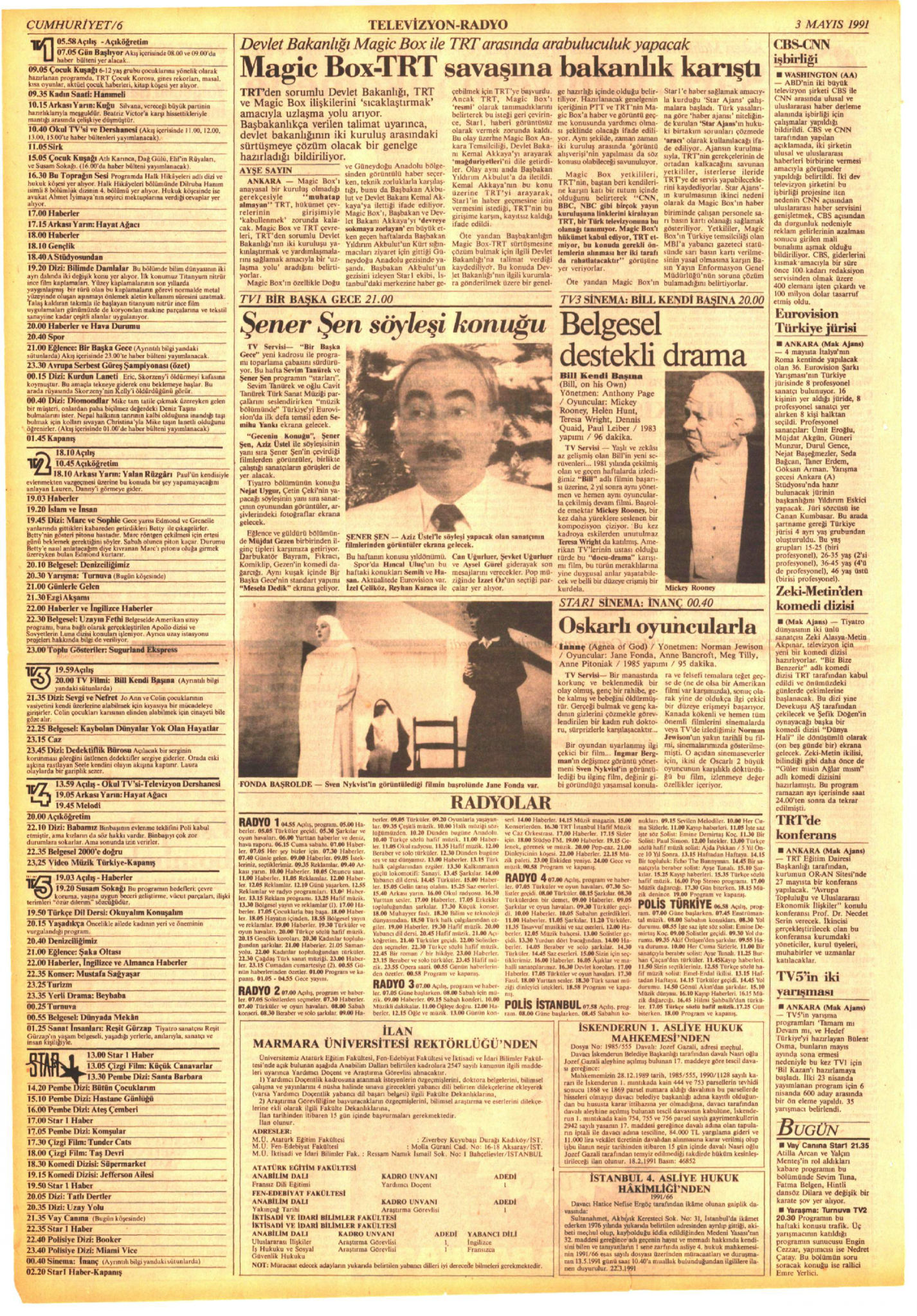
- Ajans, Mak. (3 May 1991). "Eurovision Türkiye jürisi". [[Cumhuriyet]].
- "Rome 1991 – Detailed voting results". European Broadcasting Union (EBU).
- "Eurovision Song Contest 1991 – Scoreboard". European Broadcasting Union (EBU).
- (15 May 2011). "Commentator's guide to the commentators". European Broadcasting Union (EBU).
- (14 May 2017). "Commentators: The national hosts of Eurovision". European Broadcasting Union (EBU).
- (30 April 1991). "Eurofestival, il ritorno". [[l'Unità]].
- (4 May 1991). "Cinecittà waardig toneel songfestival". [[Leydse Courant.
- (2 May 1991). "So 4.5..". Slovenski vestnik.
- (4 May 1991). "Televisie buitenland". [[De Telegraaf.
- (4 May 1991). "RTV–Programma's Zaterdag". [[Leydse Courant.
- (4 May 1991). "Τηλεοραση". {{lang.
- (4 May 1991). "Ραδιοφωνο". {{lang.
- (18 April 1991). "Στην τελική ευθεία το SOS". {{lang.
- "Alle tiders programoversigter – Lørdag den 4. maj 1991". [[DR (broadcaster).
- (4 May 1991). "Televisio & Radio". [[Helsingin Sanomat]].
- (4 May 1991). "Radio-télévision". [[Le Monde]].
- (25 April 1991). "Samedi 4 mai". [[TV8 (magazine).
- (4 May 1991). "Radio en televisie zaterdag". [[Limburgs Dagblad]].
- (4 May 1991). "Το πρόγραμμα της τηλεόρασης". Imerisia.
- (4 May 1991). "Útvarp/Sjónvarp". [[Morgunblaðið]].
- (29 April – 5 May 1991). "Laugardagur 4. maí". [[Ríkisútvarpið]] (RÚV).
- Harding, Peter. (4 May 1991). "RTÉ commentators during Eurovision rehearsals (1991)".
- (4 May 1991). "Saturday's Television". [[The Irish Times.
- (4 May 1991). "Radio". [[The Irish Times.
- (3 May 1991). "יום שבת 4.5.91 – טלוויזיה". [[Maariv (newspaper).
- (28 April – 4 May 1991). "Sabato 4 maggio".
- (1 May 1991). "Samstag, 4. Mai {{!}} Samedi, 4 mai".
- (1 May 1991). "TV-tips der woche".
- (4 May 1991). "Television". [[Times of Malta]].
- (4 May 1991). "Radio/TV". [[Finnmark Dagblad]].
- (4 May 1991). "P2 – Kjøreplan lørdag 4. mai 1991". [[NRK]].
- (2 May 1991). "Your Complete Entertainment Guide". [[Anglo-Portuguese News]].
- (4 May 1991). "Ràdio i televisió". [[Avui]].
- (28 March 2018). "Todos los comentaristas de la historia de España en Eurovisión (y una única mujer en solitario)". [[Los 40]].
- (4 May 1991). "TV–programmen • Lördag". [[Svenska Dagbladet]].
- (4 May 1991). "Radioprogrammen • Lördag". [[Svenska Dagbladet]].
- (4 May 1991). "Fernsehen und Radio am Samstag". [[Der Bund]].
- (4 May 1991). "Samedi 4 mai 1991". [[Le Matin (Switzerland).
- (4 May 1991). "Programmi TV". Popolo e Libertà.
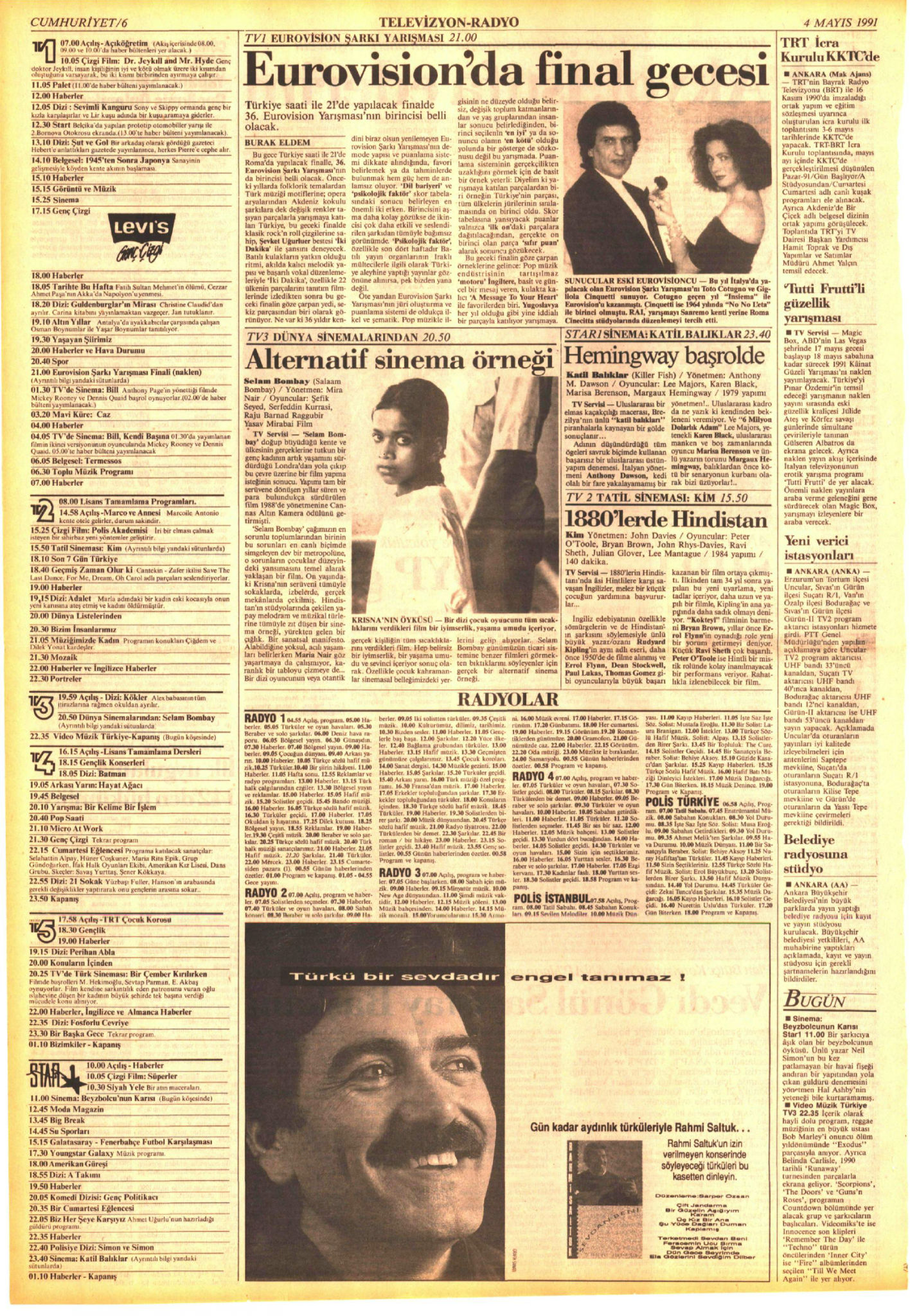
- (4 May 1991). "Televizyon-Radyo". [[Cumhuriyet]].
- (4 May 1991). "Eurovision Song Contest – BBC One".
- (4 May 1991). "Eurovision Song Contest – BBC Radio 2".
- (4 May 1991). "Televizija". [[Borba (newspaper).
- (4 May 1991). "Televizió". [[Magyar Szó]].
- V. Đorđević. (6 May 1991). "Хрватска жали погинуле полицајце". [[Borba (newspaper).
- (4 May 1991). "Spored za soboto". [[Delo (newspaper).
- (5 May 1991). "Television today". [[The Canberra Times]].
- (22 July 1991). "sobota 27. 7.".
- (3 May 1991). "Sjónvarp". [[Oyggjatíðindi]].
- (3 May 1991). "TV KNR". [[Atuagagdliutit/Grønlandsposten.
- (29 April 1991). "TV1 – szombat május 4.". Rádió– és Televízióújság.
- (30 April 1991). "Program tygnhniomy TV od 30 kwietnia do 7 maja". Nowiny.
- (4–5 May 1991). "Televiziune". {{ill.
- (11 May 1991). "「유러비전 송 콘테스트」". [[Kyunghyang Shinmun]].
- (27 April 1991). "Программа телевидения". [[Sovetskaya Sibir]].
- (27 April 1991). "Телевидение". [[Pravda]].
- (29 April – 5 May 1991). "4 V – Laupäev".
This article was imported from Wikipedia and is available under the Creative Commons Attribution-ShareAlike 4.0 License. Content has been adapted to SurfDoc format. Original contributors can be found on the article history page.
Ask Mako anything about Eurovision Song Contest 1991 — get instant answers, deeper analysis, and related topics.
Research with MakoFree with your Surf account
Create a free account to save articles, ask Mako questions, and organize your research.
Sign up freeThis content may have been generated or modified by AI. CloudSurf Software LLC is not responsible for the accuracy, completeness, or reliability of AI-generated content. Always verify important information from primary sources.
Report