From Surf Wiki (app.surf) — the open knowledge base
Eurovision Song Contest 1989
International song competition
.jpg)
International song competition
| Field | Value |
|---|---|
| name | Eurovision Song Contest |
| year | 1989 |
| logo | ESC 1989 logo.png |
| final | |
| venue | Palais de Beaulieu |
| Lausanne, Switzerland | |
| presenters | |
| musdirector | Benoît Kaufman |
| director | Alain Bloch |
| Charles-André Grivet | |
| scrutineer | Frank Naef |
| exproducer | Raymond Zumsteg |
| organiser | European Broadcasting Union (EBU) |
| host | Swiss Broadcasting Corporation (SRG SSR) |
| Télévision suisse romande (TSR) | |
| entries | 22 |
| return | |
| vote | Each country awarded 12, 10, 8–1 point(s) to their 10 favourite songs |
| winner | |
| "Rock Me" | |
| Map NoSemis | Y |
Lausanne, Switzerland Charles-André Grivet Télévision suisse romande (TSR) "Rock Me"
The Eurovision Song Contest 1989 was the 34th edition of the Eurovision Song Contest, held on 6 May 1989 at the Palais de Beaulieu in Lausanne, Switzerland, and presented by Jacques Deschenaux and Lolita Morena. It was organised by the European Broadcasting Union (EBU) and host broadcaster Télévision suisse romande (TSR) on behalf of the Swiss Broadcasting Corporation (SRG SSR), who staged the event after winning the for with the song "Ne partez pas sans moi" by Céline Dion.
Broadcasters from twenty-two countries participated in the contest, with returning after a one-year absence. Among the participating artists were the two youngest artists to have ever participated in the contest, 12-year-old Gili Netanel and 11-year-old Nathalie Pâque representing and , respectively; the inclusion of the young performers led to some controversy in the run-up to the event, including calls for their exclusion from the contest, and although no action was taken by the organisers of this event it did result in a rule change for the .
The winner was with the song "Rock Me", composed by Rajko Dujmić, written by Stevo Cvikić and performed by the group Riva. This was Yugoslavia's first contest victory in twenty-four attempts. The , , , and rounded out the top five positions; the United Kingdom and Denmark placed second and third respectively for a second consecutive year, and Austria finished in the top five for the first time since . gained its best result since , while and achieved its worst ever placings to date, placing eighteenth and twenty-second respectively, with Iceland ultimately earning nul points and coming last for the first time.
Location
The 1989 contest took place in Lausanne, Switzerland, following the country's victory at the with the song "Ne partez pas sans moi" performed by Céline Dion. It was the second time that Switzerland had hosted the event, following the of the contest held in 1956 in Lugano.
The chosen venue was the Palais de Beaulieu, a convention and exhibition centre. The contest took place in the Hall 7 of the Palais, also known as the Halle des Fêtes, which was temporarily renamed Salle Lys Assia in honour of Switzerland's first Eurovision winning artist. An audience of around 1,600 people could occupy the Salle Lys Assia during the contest. Over a dozen cities were reported to have applied to host the contest, with Lausanne winning out due to its combination of a suitable production venue, logistical infrastructure availability, and proximity to an international airport.
Participants
Twenty-two countries participated in the 1989 contest, with the twenty-one countries from the previous year's event being joined by , returning after a one-year absence.
For the first time, Switzerland sent an entry in Romansh, the smallest of Switzerland's four national languages.
No artists competing in the 1989 contest had previously taken part as lead artists in previous events, however, two of the artists had previously performed in the contest in past editions for the same country: Justine Pelmelay had been one of the backing vocalists supporting the , and Marianna had also performed as a backing vocalist for . Additionally, Søren Bundgaard who had represented , , and , as a member of the duo Hot Eyes, was one of Birthe Kjær's backing performers in this year's event.
For the first time since , the event featured two participating songs written by the same songwriters: both the and entries were written by Dieter Bohlen and Joachim Horn-Bernges.
The 1989 contest featured the youngest ever lead performers, in the form of 12-year-old and 11-year-old Nathalie Pâque representing and respectively. Their inclusion in the contest led to controversy and protest from some of the other competitors, who felt their young age should preclude them from the contest. As there were no existing rules regarding the age of performers, the two artists were allowed to compete, however, the controversy led to the introduction of an age restriction on performing artists for the .
| Country | Broadcaster | Artist | Song | Language | Songwriter(s) | Conductor |
|---|---|---|---|---|---|---|
| ORF | Thomas Forstner | "Nur ein Lied" | German | |||
| BRT | Ingeborg | "Door de wind" | Dutch | Stef Bos | ||
| CyBC | and | "Apopse as vrethoume" (Απόψε ας βρεθούμε) | Greek | Haris Andreadis | ||
| DR | Birthe Kjær | "Vi maler byen rød" | Danish | |||
| YLE | Anneli Saaristo | "La dolce vita" | Finnish | Ossi Runne | ||
| Antenne 2 | Nathalie Pâque | "J'ai volé la vie" | French | Guy Mattéoni | ||
| BR | Nino de Angelo | "Flieger" | German | |||
| ERT | Marianna | "To diko sou asteri" (Το δικό σου αστέρι) | Greek | Giorgos Niarchos | ||
| RÚV | Daníel | "Það sem enginn sér" | Icelandic | |||
| RTÉ | Kiev Connolly and | "The Real Me" | English | Kiev Connolly | Noel Kelehan | |
| IBA | and | "Derekh Hamelekh" (דרך המלך) | Hebrew | Shaike Paikov | ||
| RAI | Anna Oxa and Fausto Leali | "Avrei voluto" | Italian | Mario Natale | ||
| CLT | "Monsieur" | French | Benoît Kaufman | |||
| NOS | Justine Pelmelay | "Blijf zoals je bent" | Dutch | Harry van Hoof | ||
| NRK | Britt Synnøve Johansen | "Venners nærhet" | Norwegian | |||
| RTP | Da Vinci | "Conquistador" | Portuguese | Luís Duarte | ||
| TVE | Nina | "Nacida para amar" | Spanish | Juan Carlos Calderón | Juan Carlos Calderón | |
| SVT | Tommy Nilsson | "En dag" | Swedish | Anders Berglund | ||
| SRG SSR | Furbaz | "Viver senza tei" | Romansh | Marie Louise Werth | Benoît Kaufman | |
| TRT | "Bana Bana" | Turkish | Timur Selçuk | Timur Selçuk | ||
| BBC | Live Report | "Why Do I Always Get It Wrong" | English | Ronnie Hazlehurst | ||
| JRT | Riva | "Rock Me" | Serbo-Croatian |
Production
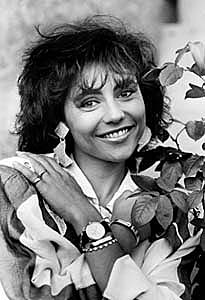
The Eurovision Song Contest 1989 was produced by the Swiss public broadcaster Télévision suisse romande (TSR) on behalf of the Swiss Broadcasting Corporation (; ; SRG SSR). Raymond Zumsteg served as executive producer, Alain Bloch served as producer and director, Charles-André Grivet served as director, Paul Waelti served as designer, and Benoît Kaufman served as musical director leading an assembled orchestra of 55 musicians. A separate musical director could be nominated by each participating delegation to lead the orchestra during its country's performance, with the host musical director also available to conduct for those countries which did not nominate their own conductor. On behalf of the contest organisers, the European Broadcasting Union (EBU), the event was overseen by Frank Naef as scrutineer.
Following the confirmation of the twenty-two competing countries, the draw to determine the running order of the contest was held on 23 November 1988. Production details related to the contest were also shared on this date, including the contest's mascot and logo. The mascot, Cindy Aeschbach, an 11-year old girl from Morges, was chosen from among two hundred girls from schools in the Swiss region of La Côte to embody the character of Heidi in the contest's opening sequence. The logo, designed by Fritz Aeschbach, is a representation of the Matterhorn created with computer graphics, constructed using contour lines to represent the strings of a guitar, and featuring a silhouette outline of Lausanne Cathedral at the base. The presenters of the contest were publicly revealed on 17 January 1989: the sports journalist and television presenter Jacques Deschenaux and the television presenter and Miss Switzerland 1982 Lolita Morena were chosen from among several candidates considered by TSR.
Rehearsals for the participating artists began on 1 May 1989. Two technical rehearsals were conducted for each participating delegation in the week approaching the contest, with countries rehearsing in the order in which they would perform. The first rehearsals of 50 minutes were held on 1 and 2 May, followed by a press conference for each delegation and the accredited press. Each country's second rehearsals were held on 3 and 4 May and lasted 35 minutes total. Three dress rehearsals were held with all artists, held in the afternoon and evening of 5 May and in the afternoon of 6 May; all dress rehearsals were held in front of an audience, although for the afternoon rehearsal on 5 May, the acts were not required to be in their performance costumes.
During the contest week each delegation also took part in recording sessions for the postcards, short films which served as an introduction to each country's entry, as well as providing an opportunity for transition between entries and allow stage crew to make changes on stage. Footage for the postcards were filmed between 1 and 4 May for the delegations, with the exception of the Swiss delegation which filmed for its postcard in the weeks leading up to the contest; delegations recorded for their postcards on one of the days in which they were not required to be present at the contest venue. Delegations were also invited to a number of special events during the contest week: on 1 May a welcome reception was hosted by the Council of States of the canton of Vaud and the municipality of Lausanne in the ballroom of the Palais de Beaulieu; on 2 May, Céline Dion performed her first show on Swiss soil as part of her Incognito Tour at the Théâtre de Beaulieu; a dinner cruise on Lake Geneva was organised for 3 May; and a reception on 5 May was organised by the tourist office of the canton of Grisons.
Format
Each participating broadcaster submitted one song, which was required to be no longer than three minutes in duration and performed in the language, or one of the languages, of the country which it represented. A maximum of six performers were allowed on stage during each country's performance. Each entry could utilise all or part of the live orchestra and could use instrumental-only backing tracks, however any backing tracks used could only include the sound of instruments featured on stage being mimed by the performers.
The results of the 1989 contest were determined through the same scoring system as had first been introduced in : each country awarded twelve points to its favourite entry, followed by ten points to its second favourite, and then awarded points in decreasing value from eight to one for the remaining songs which featured in the country's top ten, with countries unable to vote for their own entry. The points awarded by each country were determined by an assembled jury of sixteen individuals, who were all required to be members of the public with no connection to the music industry, split evenly between men and women and by age. Each jury member voted in secret and awarded between one and ten votes to each participating song, excluding that from their own country and with no abstentions permitted. The votes of each member were collected following the country's performance and then tallied by the non-voting jury chairperson to determine the points to be awarded. In any cases where two or more songs in the top ten received the same number of votes, a show of hands by all jury members was used to determine the final placing.
Partly due to the close result at the previous year's event, the tie-break procedure, to determine a single winner should two or more countries finish in first place with the same number of points, was modified. For the 1989 event and for future contents, an analysis of the tied countries' top marks would be conducted, with the country that received the most 12-point scores being declared the winner. If a tie for first place remained then the country with the most 10 points would be crowned the winner. Should two or more countries still remain tied for first place after analysing both 12- and 10-point scores then the tying countries would be declared joint winners.
Contest overview

The contest took place on 6 May 1989 at 21:00 (CEST) with a duration of 3 hours and 10 minutes and was presented by Jacques Deschenaux and Lolita Morena.
The contest opened with a seven minute film, directed by Jean-Marc Panchaud, highlighting modern Swiss landscapes and themes in juxtaposition with paintings by celebrated Swiss artists and starring Sylvie Aeschbach as Heidi. This was followed by performances in the contest venue by the reigning Eurovision winner Céline Dion, who performed both her winning song from the 1988 contest "Ne partez pas sans moi" and the premiere of her first English language single "Where Does My Heart Beat Now". The interval act was the stunt artist Guy Tell; modelling himself after the Swiss folk hero William Tell, Guy Tell used high-powered crossbows to pierce various targets with precision at distance. The climax of the performance featured sixteen crossbows being positioned to set off a chain reaction in sequence, with the arrow from the first crossbow hitting a target which set off the next crossbow, culminating in an arrow piercing an apple set above the head of the performer. Ultimately however, on the night of the contest itself, the final arrow missed the apple slightly by a few centimetres. The trophy awarded to the winners was presented at the end of the broadcast by Céline Dion and Sylvie Aeschbach.
The winner was represented by the song "Rock Me", composed by Rajko Dujmić, written by Stevo Cvikić and performed by the band Riva. It was Yugoslavia's first Eurovision win on its twenty-fourth contest appearance, becoming the seventeenth nation to win the contest. It would also prove to be the country's only win, as the nation would begin to break into separate states two years later and would eventually participate for the last time in . It was the sixth time that the song which was performed last ended up winning the contest. The and placed second and third respectively for the second consecutive year, with the United Kingdom finishing in second place for the twelfth time in total. finished in the top five for the first time since , while achieved its best result since . achieved its worst result to date, and for the third consecutive year one of the participating countries failed to receive any points, on this occasion became the newest country to receive nul points, its worst result in four years of participation. During the traditional winner's reprise performance, Riva sung the winning song entirely in English.
| R/O | Country | Artist | Song | Points | Place | 1 | 2 | 3 | 4 | 5 | 6 | 7 | 8 | 9 | 10 | 11 | 12 | 13 | 14 | 15 | 16 | 17 | 18 | 19 | 20 | 21 | 22 |
|---|---|---|---|---|---|---|---|---|---|---|---|---|---|---|---|---|---|---|---|---|---|---|---|---|---|---|---|
| and Fausto Leali | "Avrei voluto" | 56 | 9 | ||||||||||||||||||||||||
| Gili and Galit | "Derekh Hamelekh" | 50 | 12 | ||||||||||||||||||||||||
| and the Missing Passengers | "The Real Me" | 21 | 18 | ||||||||||||||||||||||||
| "Blijf zoals je bent" | 45 | 15 | |||||||||||||||||||||||||
| Pan | "Bana Bana" | 5 | 21 | ||||||||||||||||||||||||
| Ingeborg | "Door de wind" | 13 | 19 | ||||||||||||||||||||||||
| Live Report | "Why Do I Always Get It Wrong" | 130 | 2 | ||||||||||||||||||||||||
| "Venners nærhet" | 30 | 17 | |||||||||||||||||||||||||
| Da Vinci | "Conquistador" | 39 | 16 | ||||||||||||||||||||||||
| "En dag" | 110 | 4 | |||||||||||||||||||||||||
| Park Café | "Monsieur" | 8 | 20 | ||||||||||||||||||||||||
| "Vi maler byen rød" | 111 | 3 | |||||||||||||||||||||||||
| "Nur ein Lied" | 97 | 5 | |||||||||||||||||||||||||
| "La dolce vita" | 76 | 7 | |||||||||||||||||||||||||
| "J'ai volé la vie" | 60 | 8 | |||||||||||||||||||||||||
| Nina | "Nacida para amar" | 88 | 6 | ||||||||||||||||||||||||
| and Yiannis Savvidakis | "Apopse as vrethoume" | 51 | 11 | ||||||||||||||||||||||||
| Furbaz | "Viver senza tei" | 47 | 13 | ||||||||||||||||||||||||
| Marianna | "To diko sou asteri" | 56 | 9 | ||||||||||||||||||||||||
| Daníel | "Það sem enginn sér" | 0 | 22 | ||||||||||||||||||||||||
| "Flieger" | 46 | 14 | |||||||||||||||||||||||||
| Riva | "Rock Me" | 137 | 1 |
Spokespersons
Each participating broadcaster appointed a spokesperson, connected to the contest venue via telephone lines and responsible for announcing, in English or French, the votes for its respective country. Known spokespersons at the 1989 contest are listed below.
- FinlandSolveig Herlin
- IcelandErla Björk Skúladóttir
- IrelandEileen Dunne
- SwedenAgneta Bolme Börjefors
- United KingdomColin Berry
Detailed voting results
Jury voting was used to determine the points awarded by all countries. The announcement of the results from each country was conducted in the order in which they performed, with the spokespersons announcing their country's points in English or French in ascending order. The detailed breakdown of the points awarded by each country is listed in the tables below.
| nb=1 | Total score}} | nb=1 | Italy}} | nb=1 | Israel}} | nb=1 | Ireland}} | nb=1 | Netherlands}} | nb=1 | Turkey}} | nb=1 | Belgium}} | nb=1 | United Kingdom}} | nb=1 | Norway}} | nb=1 | Portugal}} | nb=1 | Sweden}} | nb=1 | Luxembourg}} | nb=1 | Denmark}} | nb=1 | Austria}} | nb=1 | Finland}} | nb=1 | France}} | nb=1 | Spain}} | nb=1 | Cyprus}} | nb=1 | Switzerland}} | nb=1 | Greece}} | nb=1 | Iceland}} | nb=1 | Germany}} | nb=1 | Yugoslavia}} | va=middle | Contestants}} | Italy | Israel | Ireland | Netherlands | Turkey | Belgium | United Kingdom | Norway | Portugal | Sweden | Luxembourg | Denmark | Austria | Finland | France | Spain | Cyprus | Switzerland | Greece | Iceland | Germany | Yugoslavia |
|---|---|---|---|---|---|---|---|---|---|---|---|---|---|---|---|---|---|---|---|---|---|---|---|---|---|---|---|---|---|---|---|---|---|---|---|---|---|---|---|---|---|---|---|---|---|---|---|---|---|---|---|---|---|---|---|---|---|---|---|---|---|---|---|---|---|---|---|---|---|
| 56 | 7 | 10 | 12 | 6 | 2 | 4 | 7 | 8 | |||||||||||||||||||||||||||||||||||||||||||||||||||||||||||||
| 50 | 1 | 7 | 3 | 2 | 5 | 5 | 5 | 7 | 5 | 3 | 7 | ||||||||||||||||||||||||||||||||||||||||||||||||||||||||||
| 21 | 7 | 3 | 3 | 2 | 4 | 2 | |||||||||||||||||||||||||||||||||||||||||||||||||||||||||||||||
| 45 | 10 | 3 | 3 | 1 | 4 | 4 | 7 | 6 | 1 | 6 | |||||||||||||||||||||||||||||||||||||||||||||||||||||||||||
| 5 | 1 | 4 | |||||||||||||||||||||||||||||||||||||||||||||||||||||||||||||||||||
| 13 | 5 | 5 | 2 | 1 | |||||||||||||||||||||||||||||||||||||||||||||||||||||||||||||||||
| 130 | 6 | 7 | 4 | 7 | 1 | 12 | 12 | 10 | 12 | 1 | 8 | 6 | 12 | 10 | 2 | 2 | 12 | 6 | |||||||||||||||||||||||||||||||||||||||||||||||||||
| 30 | 2 | 2 | 5 | 8 | 2 | 6 | 4 | 1 | |||||||||||||||||||||||||||||||||||||||||||||||||||||||||||||
| 39 | 4 | 2 | 1 | 3 | 7 | 6 | 2 | 8 | 6 | ||||||||||||||||||||||||||||||||||||||||||||||||||||||||||||
| 110 | 6 | 6 | 4 | 8 | 8 | 6 | 12 | 12 | 2 | 5 | 8 | 3 | 8 | 2 | 8 | 12 | |||||||||||||||||||||||||||||||||||||||||||||||||||||
| 8 | 5 | 3 | |||||||||||||||||||||||||||||||||||||||||||||||||||||||||||||||||||
| 111 | 5 | 1 | 10 | 12 | 6 | 4 | 10 | 10 | 2 | 12 | 3 | 7 | 12 | 6 | 10 | 1 | |||||||||||||||||||||||||||||||||||||||||||||||||||||
| 97 | 12 | 8 | 3 | 12 | 7 | 4 | 1 | 2 | 10 | 8 | 12 | 8 | 5 | 5 | |||||||||||||||||||||||||||||||||||||||||||||||||||||||
| 76 | 10 | 8 | 6 | 10 | 1 | 4 | 4 | 3 | 10 | 7 | 3 | 10 | |||||||||||||||||||||||||||||||||||||||||||||||||||||||||
| 60 | 3 | 5 | 6 | 4 | 5 | 1 | 8 | 3 | 5 | 3 | 7 | 5 | 2 | 3 | |||||||||||||||||||||||||||||||||||||||||||||||||||||||
| 88 | 8 | 2 | 7 | 7 | 4 | 10 | 8 | 8 | 4 | 10 | 10 | 10 | |||||||||||||||||||||||||||||||||||||||||||||||||||||||||
| 51 | 2 | 3 | 1 | 6 | 6 | 8 | 2 | 4 | 7 | 12 | |||||||||||||||||||||||||||||||||||||||||||||||||||||||||||
| 47 | 4 | 4 | 10 | 8 | 8 | 3 | 2 | 1 | 7 | ||||||||||||||||||||||||||||||||||||||||||||||||||||||||||||
| 56 | 1 | 1 | 5 | 6 | 10 | 1 | 4 | 12 | 12 | 4 | |||||||||||||||||||||||||||||||||||||||||||||||||||||||||||
| 0 | |||||||||||||||||||||||||||||||||||||||||||||||||||||||||||||||||||||
| 46 | 7 | 2 | 5 | 1 | 5 | 6 | 7 | 1 | 6 | 3 | 3 | ||||||||||||||||||||||||||||||||||||||||||||||||||||||||||
| 137 | 12 | 12 | 8 | 12 | 10 | 12 | 7 | 4 | 8 | 5 | 10 | 10 | 7 | 3 | 5 | 5 | 6 | 1 |
12 points
The below table summarises how the maximum 12 points were awarded from one country to another. The winning country is shown in bold. The United Kingdom received the maximum score of 12 points from five of the voting countries, with Yugoslavia receiving four sets of 12 points, Austria, Denmark and Sweden each receiving three sets of maximum scores, Greece receiving two sets of 12 points, and Cyprus and Italy receiving one maximum score each.
| N. | Contestant | Nation(s) giving 12 points | 5 | 4 | 3 | 2 | 1 |
|---|---|---|---|---|---|---|---|
| , , , , | |||||||
| **** | , , , | ||||||
| , , | |||||||
| , , | |||||||
| , , | |||||||
| , |
Broadcasts
Each participating broadcaster was required to relay the contest via its networks. Non-participating member broadcasters were also able to relay the contest as "passive participants". Broadcasters were able to send commentators to provide coverage of the contest in their own native language and to relay information about the artists and songs to their television viewers. These commentators were typically sent to the venue to report on the event, and were able to provide commentary from small booths constructed at the back of the venue.
The contest had an estimated total audience of over 500 to 600 million viewers and listeners, with the contest reportedly broadcast on 35 channels in 30 countries. Known details on the broadcasts in each country, including the specific broadcasting stations and commentators are shown in the tables below.
| Country | Broadcaster | Channel(s) | Commentator(s) | Austria | Belgium | Cyprus | Denmark | Finland | France | Germany | Greece | Iceland | Ireland | Israel | Italy | Luxembourg | Netherlands | Norway | Portugal | Spain | Sweden | Switzerland | Turkey | United Kingdom | Yugoslavia |
|---|---|---|---|---|---|---|---|---|---|---|---|---|---|---|---|---|---|---|---|---|---|---|---|---|---|
| ORF | FS1 | Ernst Grissemann | |||||||||||||||||||||||
| BRT | TV1 | Luc Appermont | |||||||||||||||||||||||
| BRT 2 | Ann Lepère | ||||||||||||||||||||||||
| RTBF | RTBF1 | Jacques Mercier | |||||||||||||||||||||||
| CyBC | RIK, A Programma | Neofytos Taliotis | |||||||||||||||||||||||
| DR | DR TV | Jørgen de Mylius | |||||||||||||||||||||||
| DR P3 | Kurt Helge Andersen | ||||||||||||||||||||||||
| YLE | TV1, | Heikki Harma | |||||||||||||||||||||||
| Antenne 2 | |||||||||||||||||||||||||
| ARD | Erstes Deutsches Fernsehen | Thomas Gottschalk | |||||||||||||||||||||||
| SSVC | SSVC Television | ||||||||||||||||||||||||
| ERT | ET1 | ||||||||||||||||||||||||
| RÚV | Sjónvarpið, Rás 1 | Arthúr Björgvin Bollason | |||||||||||||||||||||||
| RTÉ | RTÉ 1 | Ronan Collins and Michelle Rocca | |||||||||||||||||||||||
| RTÉ Radio 1 | Larry Gogan | ||||||||||||||||||||||||
| IBA | Israeli Television, | ||||||||||||||||||||||||
| RAI | Rai Uno | Gabriella Carlucci | |||||||||||||||||||||||
| CLT | RTL Télévision | ||||||||||||||||||||||||
| NOS | Nederland 3 | Willem van Beusekom | |||||||||||||||||||||||
| NRK | NRK Fjernsynet, NRK P2 | John Andreassen | |||||||||||||||||||||||
| RTP | RTP Canal 1 | Ana Zanatti | |||||||||||||||||||||||
| TVE | TVE 2 | ||||||||||||||||||||||||
| SVT | Kanal 1 | Jacob Dahlin | |||||||||||||||||||||||
| SR P3 | Kent Finell and Janeric Sundquist | ||||||||||||||||||||||||
| SRG SSR | TV DRS | ||||||||||||||||||||||||
| TSR | Thierry Masselot | ||||||||||||||||||||||||
| TSI | Giovanni Bertini | ||||||||||||||||||||||||
| La Première | |||||||||||||||||||||||||
| Radio Zürisee | |||||||||||||||||||||||||
| TRT | TV1 | Bülend Özveren | |||||||||||||||||||||||
| BBC | BBC1 | Terry Wogan | |||||||||||||||||||||||
| BBC Radio 2 | Ken Bruce | ||||||||||||||||||||||||
| JRT | TV Beograd 1, TV Novi Sad, TV Zagreb 1 | Oliver Mlakar | |||||||||||||||||||||||
| TV Prishtina | |||||||||||||||||||||||||
| TV Ljubljana 1 |
| Country | Broadcaster | Channel(s) | Commentator(s) | Australia | Bulgaria | Canada | Czechoslovakia | Faroe Islands | Greenland | Hungary | Poland | South Korea | Soviet Union |
|---|---|---|---|---|---|---|---|---|---|---|---|---|---|
| SBS | SBS TV | ||||||||||||
| BT | BT 1 | ||||||||||||
| TV5 | TV5 Québec Canada | ||||||||||||
| ČST | |||||||||||||
| SvF | |||||||||||||
| KNR | KNR | ||||||||||||
| MTV | MTV2 | István Vágó | |||||||||||
| TP | TP1 | ||||||||||||
| KBS | KBS1 | ||||||||||||
| CT USSR | Programme One | Grigory Shestakov | |||||||||||
| ETV |
References
- "Switzerland – Participation history". European Broadcasting Union (EBU).
- (24 November 1988). "Finale 1989 du concours Eurovision de la chanson à Lausanne: Une opération délicate". [[Le Nouvelliste (Valais).
- (18 January 1989). "Le couple Eurovision". [[Journal du Jura]].
- (2 July 1988). "Concours Eurovision am 6. Mai 1989 in Lausanne". [[Walliser Bote]].
- (2 July 1988). "SRG wählte Lausanne". [[Bieler Tagblatt]].
- (16 August 2023). "Indonesia's Eurovision connections". Aussievision.
- (4 August 2021). "Μαριάννα Ευστρατίου: Η Μις Γιουροβίζιον που πλήρωσε η ίδια τη συμμετοχή της και οι μεγάλες συνεργασίες". Enimerotiko.
- (4 March 2014). "Eurovision legends to perform at Danish final". European Broadcasting Union (EBU).
- (20 January 2009). "Hele Danmarks Birthe Kjær". [[DR (broadcaster).
- "Lausanne 1989 – Participants". European Broadcasting Union (EBU).
- "Alle deutschen ESC-Acts und ihre Titel". [[ARD (broadcaster).
- "Le Concours Eurovision de la chanson à Lausanne". [[Radio Télévision Suisse]] (RTS).
- (24 November 1988). "Eurovision: cuvée 89".
- "Lausanne 1989". European Broadcasting Union (EBU).
- (24 November 1988). "Lausanne prépare le 34e Concours «Eurovision» de la chanson en 1989". Journal et Feuille d'Avis de Vevey-Riviera.
- "The Organisers behind the Eurovision Song Contest". European Broadcasting Union (EBU).
- (10 February 2017). "Former Eurovision scrutineer Frank Naef shares his backstage recollections". European Broadcasting Union (EBU).
- (6–12 May 1989). "'Park Café' mit 'Monsieur' in Lausanne".
- (24 November 1988). "Eine Nacht lang Schlager-Metropole". Freiburger Nachrichten.
- Krol, Pierre-André. (5 May 1989). "Cindy, notre princesse de l'Eurovision". {{lang.
- (18 January 1989). "Concours Eurovision de la Chanson: Jacques et Lolita comme présentateurs". {{lang.
- (22 May 2015). "All Kinds of Everything: a history of Eurovision Postcards". ESC Insight.
- (1 May 2022). "Eurovision 2022: The theme of this year's Eurovision postcards". ESC Plus.
- (2 May 1989). "La fièvre de samedi". [[L'Express (Neuchâtel).
- (12 April 1989). "Concert Céline Dion "Grand Prix Eurovision"". {{lang.
- (18 May 2019). "How it works". European Broadcasting Union (EBU).
- "Jerusalem 1999". European Broadcasting Union (EBU).
- (31 October 2018). "The Rules of the Contest". European Broadcasting Union (EBU).
- (18 April 2020). "#EurovisionAgain travels back to Dublin 1997". European Broadcasting Union (EBU).
- (31 March 2017). "In a Nutshell". European Broadcasting Union (EBU).
- Kahn, Olivier. (29 April 1989). "Céline Dion après et avant l'Eurovision: 'Pour gagner, il faut rester soi-même". {{lang.
- A.B.. (3 May 1989). "Le rêve américain". {{lang.
- Zufferey, Jean-Charles. (8 May 1989). "Grand Prix Eurovision de la Chanson à Lausanne". {{lang.
- "Lausanne 1989 – Riva". European Broadcasting Union (EBU).
- "Yugoslavia – Participation history". European Broadcasting Union (EBU).
- (17 September 2017). "Rock me baby! Looking back at Yugoslavia at Eurovision". European Broadcasting Union (EBU).
- "Austria – Participation history". European Broadcasting Union (EBU).
- "Finland – Participation history". European Broadcasting Union (EBU).
- "Iceland – Participation history". European Broadcasting Union (EBU).
- (14 May 2022). "Eurovision: All the nil point performances from the Eurovision Song Contest {{!}} indy100". [[Indy100]].
- "Lausanne 1989 – Scoreboard". European Broadcasting Union (EBU).
- (24 May 2021). "Lugano to Liverpool: Broadcasting Eurovision". [[National Science and Media Museum]].
- (12 April 1989). "Söngvakeppnin: Fjórir valdir til að syngja bakraddir". [[Morgunblaðið]].
- (8 June 2021). "RTE Eileen Dunne's marriage to soap star Macdara O'Fatharta, their wedding day and grown up son Cormac". RSVP Live.
- (6 May 1989). "Concours Eurovision de la Chanson: Lausanne 1989". {{lang.
- "Lausanne 1989 – Detailed voting results". European Broadcasting Union (EBU).
- "Eurovision Song Contest 1989 – Scoreboard". European Broadcasting Union (EBU).
- (15 May 2011). "Commentator's guide to the commentators". European Broadcasting Union (EBU).
- (14 May 2017). "Commentators: The national hosts of Eurovision". European Broadcasting Union (EBU).
- (8 May 1989). "Le sourire yugoslave". Journal du Nord vaudois.
- Zahnd, René. (8 May 1989). "Requiem pour une messe cathodique". [[Gazette de Lausanne]].
- E. Ćirić. (8 May 1989). "Pravi šlager za Evropu". [[Borba (newspaper).
- (3 May 1989). "So 6.5..". Slovenski vestnik.
- (6 May 1989). "TV–programma's". [[De Standaard]].
- (6 May 1989). "Τηλεόραση – Το πλήρες πρόγραμμα". {{lang.
- (6 May 1989). "Ραδιοφωνο". {{lang.
- (5 May 1989). "Ο Δ. Κυπριανού στη Λωζάνη για το διαγωνισμό Γιουροβίζιον". Mesimvrini.
- "Alle tiders programoversigter – Lørdag den 6. maj 1989". [[DR (broadcaster).
- (6 May 1989). "Radio · Televisio". [[Helsingin Sanomat]].
- (6 May 1989). "Marion Rung laulut ja Dolce Vita". [[Helsingin Sanomat]].
- (6 May 1989). "Radio-télévision". [[Le Monde]].
- (6 May 1989). "Fernsehen". {{ill.
- (6 May 1989). "Το πρόγραμμα της τηλεόρασης". Imerisia.
- (6 May 1989). "Útvarp/Sjónvarp". [[Morgunblaðið]].
- (1–7 May 1989). "Laugardagur 6. maí". [[Ríkisútvarpið]] (RÚV).
- (6 May 1989). "TV guide {{!}} Saturday". [[Evening Herald]].
- (6 May 1989). "Radio". [[Irish Independent]].
- (6 May 1989). "Radio". [[The Irish Times.
- (5 May 1989). "יום שבת 6.5.89 – טלוויזיה". [[Maariv (newspaper).
- (30 April – 6 May 1989). "Sabato 6 maggio".
- (3 May 1989). "Samstag, 6 Mai {{!}} Samedi, 6 mai".
- (6 May 1989). "Radio/Televisie". [[Leydse Courant.
- (6 May 1989). "Radio/TV". [[Ringerikes Blad]].
- (6 May 1989). "P2 – Kjøreplan lørdag 6. mai 1989". [[NRK]].
- (6 May 1989). "Televisão". [[Diário de Lisboa]].
- Castrim, Mario. (8 May 1989). "Festival ou estendal?". [[Diário de Lisboa]].
- (6 May 1989). "El Festival de Eurovisión, en directo por la Segunda Cadena". {{ill.
- (6 May 1989). "TV-programmen". [[Svenska Dagbladet]].
- (6 May 1989). "Radioprogrammen". [[Svenska Dagbladet]].
- (6 May 1989). "Fernsehen". [[Neue Zürcher Zeitung]].
- (27 April 1989). "Samedi 6 mai".
- (6 May 1989). "Programmi TV". Popolo e Libertà.
- (6 May 1989). "Mass Smedia". Eco di Locarno.
- (6 May 1989). "Radio–TV samedi". [[Journal de Genève]].
- (6 May 1989). "Radio". Neue Zürcher Zeitung.
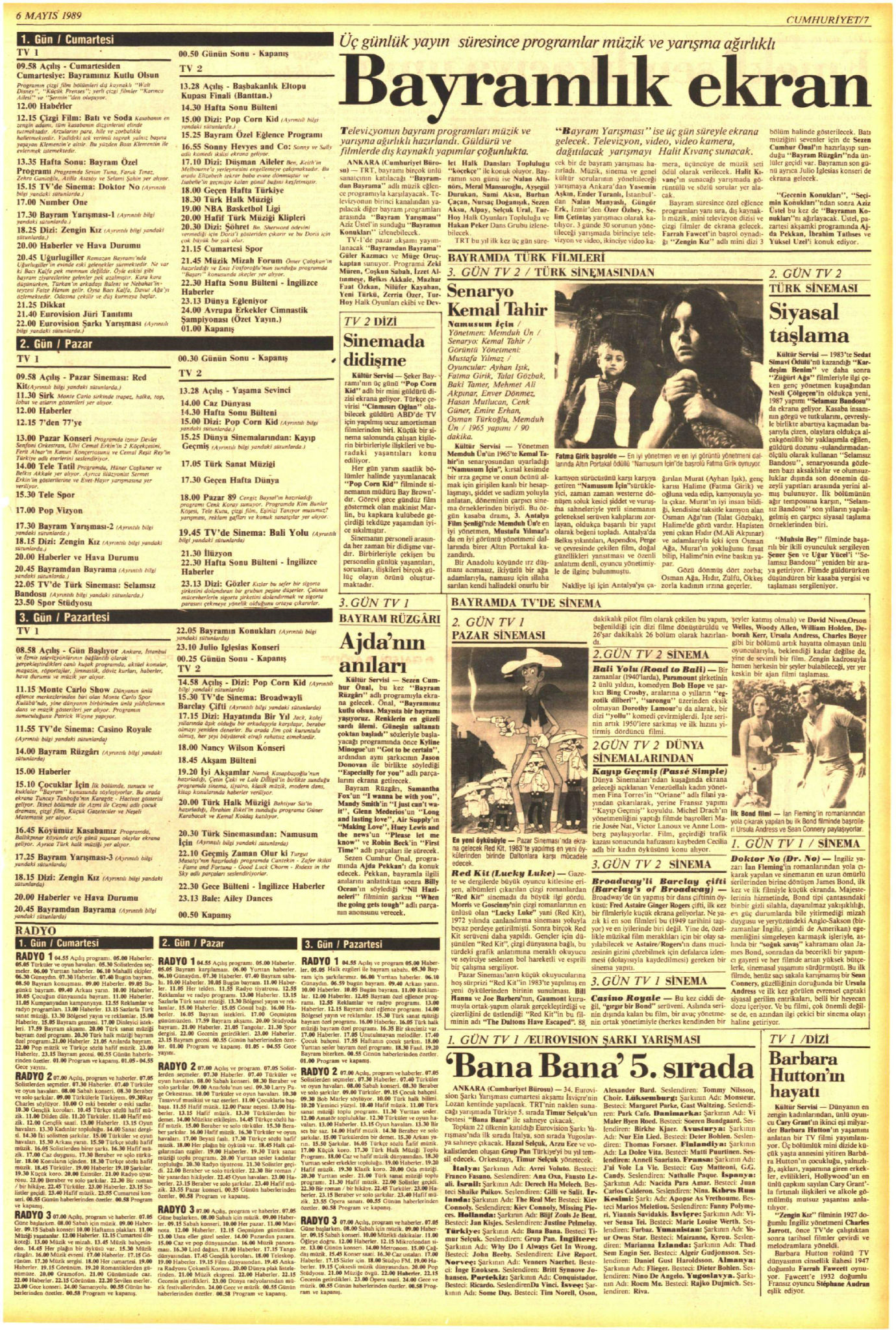
- (6 May 1989). "1. Gün / Cumartesi". [[Cumhuriyet]].
- (9 May 1989). "Eurovision'a tepki". [[Milliyet]].
- (6 May 1989). "Eurovision Song Contest – BBC One".
- (6 May 1989). "Television and radio". [[The Journal (Newcastle upon Tyne newspaper).
- (6 May 1989). "Weekend TV and radio". [[Torquay Herald Express.
- (6 May 1989). "Weekend television and radio". [[Gloucestershire Live.
- (6 May 1989). "Radio". [[Bournemouth Daily Echo.
- (6 May 1989). "Weekend radio". [[Liverpool Daily Post]].
- (6 May 1989). "The Eurovision Song Contest – BBC Radio 2".
- (6-7 May 1989). "Телевизија". [[Borba (newspaper).
- (29 April 1988). "Szombat". {{ill.
- (6 May 1989). "rtv". [[Slobodna Dalmacija]].
- (6 May 1989). "Spored za soboto". [[Delo (newspaper).
- (1 May 1989). "TV Guide – Sunday May 7". [[The Canberra Times]].
- (4 June 1989). "Телевизия". {{lang.
- (6 May 1989). "La télévision de samedi soir en un clin d'oeil". [[Le Devoir]].
- (29 April 1989). "sobota 13. 5.". {{ill.
- (6 May 1989). "Sjónvarp". [[Oyggjatíðindi]].
- (19 May 1989). "TV-KNR". [[Atuagagdliutit]].
- (19 May 1989). "Program telewizji". [[Dziennik Polski]].
- (9 June 1989). "유로비전 송 콘테스트 녹음". [[The Hankyoreh]].
- "Дома у экрана". {{ill.
- (6 May 1989). "Телевидение, программа на неделю". [[Pravda]].
- M. Yuryeva. (6 May 1989). "Анонс: Пока лишь зрители...". [[Izvestia]].
- (1–7 May 1989). "L. 6. V".

This article was imported from Wikipedia and is available under the Creative Commons Attribution-ShareAlike 4.0 License. Content has been adapted to SurfDoc format. Original contributors can be found on the article history page.
Ask Mako anything about Eurovision Song Contest 1989 — get instant answers, deeper analysis, and related topics.
Research with MakoFree with your Surf account
Create a free account to save articles, ask Mako questions, and organize your research.
Sign up freeThis content may have been generated or modified by AI. CloudSurf Software LLC is not responsible for the accuracy, completeness, or reliability of AI-generated content. Always verify important information from primary sources.
Report