From Surf Wiki (app.surf) — the open knowledge base
Eurovision Song Contest 1988
International song competition
International song competition
| Field | Value |
|---|---|
| name | Eurovision Song Contest |
| year | 1988 |
| logo | ESC 1988 logo.png |
| final | 30 April 1988 |
| presenters | |
| musdirector | Noel Kelehan |
| director | Declan Lowney |
| scrutineer | Frank Naef |
| exproducer | Liam Miller |
| organiser | European Broadcasting Union (EBU) |
| host | Radio Telefís Éireann (RTÉ) |
| venue | RDS Simmonscourt Pavilion |
| Dublin, Ireland | |
| winner | |
| "Ne partez pas sans moi" | |
| vote | Each country awarded 12, 10, 8-1 point(s) to their 10 favourite songs |
| entries | 21 |
| nonreturn | |
| Map NoSemis | Y |
Dublin, Ireland "Ne partez pas sans moi"
The Eurovision Song Contest 1988 was the 33rd edition of the Eurovision Song Contest, held on 30 April 1988 at the RDS Simmonscourt Pavilion in Dublin, Ireland, and presented by Pat Kenny and Michelle Rocca. It was organised by the European Broadcasting Union (EBU) and host broadcaster Radio Telefís Éireann (RTÉ), who staged the event after winning the for with the song "Hold Me Now" by Johnny Logan.
Broadcasters from 22 countries submitted entries, however, ultimately rescinded its entry after its selected song was determined to have been performed several years prior to the contest, breaking the contest rules. The winner was with the song "Ne partez pas sans moi", composed by Atilla Şereftuğ, with lyrics by Nella Martinetti, and performed by Céline Dion. It was Switzerland's second contest win, and remains the last winning song to be performed in French. The , , , and rounded out the top five positions, with the UK achieving its eleventh runner-up placing, while placed last for the sixth time, receiving nul points for the second time.
Location
The 1988 contest took place in Dublin, Ireland, following the country's victory at the with the song "Hold Me Now", performed by Johnny Logan. It was the third time that Ireland hosted the contest, following the and events also held in Dublin.
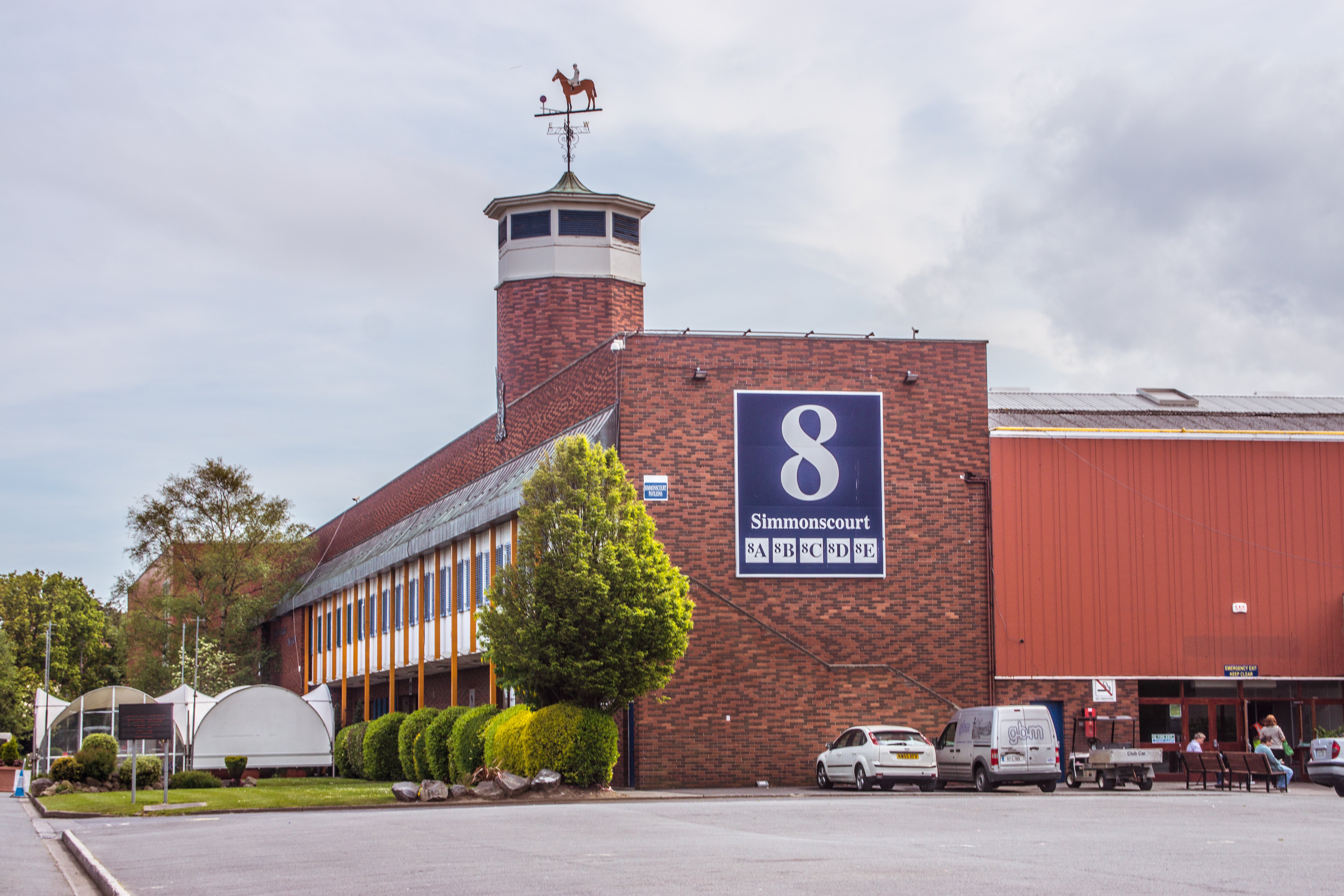
The selected venue was the Simmonscourt Pavilion of the Royal Dublin Society, a multi-purpose venue in the Ballsbridge area of the city and previous host of the contest in 1981. RDS Simmonscourt, following construction of the stage and other technical elements, was expected to accommodate approximately 1,500 audience members.
Participants
Broadcasters from the same 22 countries that participated the submitted entries for the 1988 contest, with the draw to determine the running order of the entries held on 11 December 1987. However, a number of weeks before the event, it was discovered that the song selected to represent , "Thimame", written by John Vickers and Aristos Moschovakis, and sung by Yiannis Dimitrou, previously competed in the under the title "San to rok-en-rol", and was therefore ineligible to compete at the contest. The Cyprus Broadcasting Corporation (CyBC) subsequently announced on 12 March 1988 that it nullified the selection of "Thimame" as its entry; as the rules of the national selection did not provide for a second-placed song to be declared, and as there was not enough time to stage a second selection process to determine a replacement entry, CyBC was ultimately unable to participate in the contest.
Several artists who competed in the 1988 edition of the contest participated in the previous editions for the same country. Tommy Körberg represented ; the duo Hot Eyes, also known as Kirsten and Søren, represented and ; the group MFÖ represented ; Dora represented ; and Yardena Arazi returned to compete as a solo artist, after representing as part of the group Chocolate Menta Mastik, and co-hosting the . Additionally, previously performed as the backing group for , and among Yardena Arazi's backing vocalists were Yehuda Tamir and , members of the Israeli group Milk and Honey that won the contest for .
Each participating delegation could nominate a separate musical director to lead the orchestra during its country's performance, with the host musical director also available to conduct for those countries that did not nominate their own conductor. All entries were accompanied by the orchestra, except for and , who were accompanied solely by backing track. In the case of the Italian entry, the backing track used featured the contest's first fade-out ending.
| Country | Broadcaster | Artist | Song | Language | Songwriter(s) | Conductor | ||
|---|---|---|---|---|---|---|---|---|
| ORF | Wilfried | "Lisa Mona Lisa" | German | Harald Neuwirth | ||||
| RTBF | Reynaert | "Laissez briller le soleil" | French | Dany Willem | ||||
| DR | Hot Eyes | "Ka' du se hva' jeg sa'" | Danish | |||||
| YLE | "Nauravat silmät muistetaan" | Finnish | Ossi Runne | |||||
| Antenne 2 | Gérard Lenorman | "Chanteur de charme" | French | Guy Mattéoni | ||||
| BR | "Lied für einen Freund" | German | Michael Thatcher | |||||
| ERT | "Clown" (Κλόουν) | Greek | Dimitris Sakislis | Haris Andreadis | ||||
| RÚV | "Sókrates" | Icelandic | Sverrir Stormsker | |||||
| RTÉ | Jump the Gun | "Take Him Home" | English | Peter Eades | Noel Kelehan | |||
| IBA | Yardena Arazi | "Ben Adam" (בן אדם) | Hebrew | |||||
| RAI | Luca Barbarossa | "Ti scrivo" | Italian | Luca Barbarossa | ||||
| CLT | Lara Fabian | "Croire" | French | Régis Dupré | ||||
| NOS | Gerard Joling | "Shangri-La" | Dutch | Harry van Hoof | ||||
| NRK | Karoline Krüger | "For vår jord" | Norwegian | |||||
| RTP | Dora | "Voltarei" | Portuguese | José Calvário | ||||
| TVE | La Década | "La chica que yo quiero (Made in Spain)" | Spanish | Javier de Juan | ||||
| SVT | Tommy Körberg | "Stad i ljus" | Swedish | Py Bäckman | Anders Berglund | |||
| SRG SSR | Céline Dion | "Ne partez pas sans moi" | French | Atilla Şereftuğ | ||||
| TRT | MFÖ | "Sufi (Hey Ya Hey)" | Turkish | Turhan Yükseler | ||||
| BBC | Scott Fitzgerald | "Go" | English | Julie Forsyth | Ronnie Hazlehurst | |||
| JRT | {{ill | Srebrna krila | hr}} | "Mangup" (Мангуп) | Serbo-Croatian |
Production
The Eurovision Song Contest 1988 was produced by the Irish public broadcaster Radio Telefís Éireann (RTÉ). Liam Miller served as executive producer, Declan Lowney served as director, Paula Farrell and Michael Grogan served as designers, and Noel Kelehan served as musical director, leading the RTÉ Concert Orchestra. On behalf of the contest organisers, the European Broadcasting Union (EBU), the event was overseen by Frank Naef as executive supervisor. The presenters of the contest were broadcaster Pat Kenny, and television announcer and Miss Ireland 1980 Michelle Rocca; the duo were announced by RTÉ in February 1988 following auditions held in the previous weeks. It was the first time since that more than one person presented the contest.
Several technical innovations and improvements were introduced with the 1988 contest, spearheaded by Miller and Lowney, whose goal was to increase the contest's appeal among a younger audience. The traditional physical scoreboard was replaced by a computer-generated version, displayed on two video walls provided by Philips and constructed on either side of the stage. These video walls also displayed the performances and footage of the artists in the green room during the voting sequence, allowing the audience in the arena to see the televised footage within the venue for the first time. Similar to the previous year's edition, the 1988 contest implemented a modern feel within both the stage design by Paula Farrell and Michael Grogan, and the graphic design by Maria Quigley. The stage, at over 40 m in length, was the largest ever built for the contest at that point, and took up almost a third of the 18000 m2 space within the Simmonscourt Pavilion. The stage design, which created an illusion of depth, alongside tight camera shots of the audience and creative lighting use, resulted in an overall impression that the contest was being held in a vast and packed arena, rather than the modest space of the Simmonscourt Pavilion.
Rehearsals for the participating artists began on 25 April 1988. Two technical rehearsals were conducted for each participating delegation in the week approaching the contest, with countries rehearsing in the order in which they would perform. The first rehearsals, comprising a 15-minute stage call and 35-minute performance, were held on 25 and 26 April, followed by a press conference for each delegation and the accredited press. Each country's second rehearsals were held on 27 and 28 April, with a 10-minute stage call and 25 minutes for performances. On 28 April, the contest venue received a visit from the Taoiseach Charles Haughey. Three dress rehearsals were held with all artists, held in the afternoon and evening of 29 April and in the afternoon of 30 April; the second rehearsal was filmed with a live audience present as a production stand-by in case the live event was disrupted. During the contest week, 's Tommy Körberg had been suffering from a throat infection; although he was able to perform during the event-proper, the songwriter of the Swedish entry, Py Bäckman, performed the entry in his stead at the 29 April evening dress rehearsal.
Format
Each participating country submitted one song limited to three minutes or less and performed in the language, or one of the languages, of the country which it represented. Up to six performers were allowed on stage during each entry, accompanied by the orchestra and/or a backing track; any backing tracks had to include all the instruments featured on stage being mimed by the performers and could not contain vocals of any kind.
The results of the 1988 contest were determined through the scoring system introduced in : each country awarded twelve points to its favourite entry, followed by ten points to its second favourite, and then awarded points in decreasing value from eight to one for the remaining eight songs in the country's top ten, with countries unable to vote for their own entry. The points awarded by each country were determined by an assembled jury of sixteen individuals, who were all required to be members of the public with no connection to the music industry, split evenly between men and women and across four age groups: 15–25, 26–35, 36–45, and 46–60. Each jury member voted in secret and awarded between one and ten votes to each participating song, excluding that from their own country and with no abstentions permitted; these votes were placed at the end of each country's performance and collected and tallied by the non-voting jury chairperson, who determined the points distribution after all countries performed. When two or more songs in the top ten received the same number of votes, a show of hands by all jury members was used to determine the final placing. The jury composition and voting process were modified slightly compared to the 1987 contest, due to the increase in the number of participating countries in recent years, expanding from eleven members who awarded between one and five votes for each song.
As established at the , in the event that two or more countries finished in first place with the same number of points after all countries awarded their points, the artists representing these countries would perform their entries again, and the juries in all countries not involved in the tie-break would determine the winner, with each country's jury selecting their favourite of the entries by a show of hands of all jurors. If after all countries determined their favourites and there was still a tie for first place, the countries involved in this tie would be declared joint winners.
Contest overview
The contest took place on 30 April 1988 at 20:00 (IST) with a duration of 2 hours and 50 minutes. Had Cyprus participated as planned, the country was drawn to perform in position number two.
The contest was opened by a video montage highlighting ancient Celtic structures, items and mythology pertaining to prehistoric Ireland, transitioning to footage of modern-day Ireland and Dublin. This was followed by a performance of the previous year's winning entry, "Hold Me Now", by Johnny Logan. The interval act was the Irish rock group Hothouse Flowers, with a music video of their song "Don't Go"; the group's lead singer Liam Ó Maonlaí also appeared on stage before the music video played to explain the meaning behind the songfirst in Irish, then in Englishwhile playing piano. The music video, featuring the Hothouse Flowers performing the song in eleven European countries, received funding from the European Economic Community as part of the organisation's goal of advancing European integration. The trophy awarded to the winners was presented at the end of the broadcast by Johnny Logan.
The winner was represented by the song "Ne partez pas sans moi", composed by Atilla Şereftuğ, written by Nella Martinetti and performed by Céline Dion. It was Switzerland's second Eurovision win, following its victory at the in 1956. It also remains, , the last time that a song in the French language has won. The finished in second place for the eleventh time, while finished in last place for the sixth time, and achieved its second nul points result.
| R/O | Country | Artist | Song | Points | Place | 1 | 2 | 3 | 4 | 5 | 6 | 7 | 8 | 9 | 10 | 11 | 12 | 13 | 14 | 15 | 16 | 17 | 18 | 19 | 20 | 21 |
|---|---|---|---|---|---|---|---|---|---|---|---|---|---|---|---|---|---|---|---|---|---|---|---|---|---|---|
| Beathoven | "Sókrates" | 20 | 16 | |||||||||||||||||||||||
| "Stad i ljus" | 52 | 12 | ||||||||||||||||||||||||
| Boulevard | "Nauravat silmät muistetaan" | 3 | 20 | |||||||||||||||||||||||
| "Go" | 136 | 2 | ||||||||||||||||||||||||
| MFÖ | "Sufi (Hey Ya Hey)" | 37 | 15 | |||||||||||||||||||||||
| "La chica que yo quiero (Made in Spain)" | 58 | 11 | ||||||||||||||||||||||||
| "Shangri-La" | 70 | 9 | ||||||||||||||||||||||||
| "Ben Adam" | 85 | 7 | ||||||||||||||||||||||||
| "Ne partez pas sans moi" | 137 | 1 | ||||||||||||||||||||||||
| Jump the Gun | "Take Him Home" | 79 | 8 | |||||||||||||||||||||||
| "Lied für einen Freund" | 48 | 14 | ||||||||||||||||||||||||
| Wilfried | "Lisa Mona Lisa" | 0 | 21 | |||||||||||||||||||||||
| Hot Eyes | "Ka' du se hva' jeg sa'" | 92 | 3 | |||||||||||||||||||||||
| "Clown" | 10 | 17 | ||||||||||||||||||||||||
| "For vår jord" | 88 | 5 | ||||||||||||||||||||||||
| Reynaert | "Laissez briller le soleil" | 5 | 18 | |||||||||||||||||||||||
| "Croire" | 90 | 4 | ||||||||||||||||||||||||
| "Ti scrivo" | 52 | 12 | ||||||||||||||||||||||||
| "Chanteur de charme" | 64 | 10 | ||||||||||||||||||||||||
| Dora | "Voltarei" | 5 | 18 | |||||||||||||||||||||||
| Srebrna krila | "Mangup" | 87 | 6 |
Spokespersons
Each participating broadcaster appointed a spokesperson, connected to the contest venue via telephone lines and responsible for announcing, in English or French, the votes for its respective country. Known spokespersons at the 1988 contest are listed below.
- FinlandSolveig Herlin
- IcelandGuðrún Skúladóttir
- IrelandJohn Skehan
- NorwayAndreas Diesen
- SwedenMaud Uppling
- United KingdomColin Berry
- YugoslaviaMiša Molk
Detailed voting results
Jury voting was used to determine the points awarded by all countries. The results were announced in the order of performance, with the spokespersons announcing their country's points in English or French in ascending order. The detailed breakdown of the points awarded by each country is listed in the tables below.
The 1988 contest has become notable for its tense voting sequence right until the final jury announced its points. With three countries left to vote, the United Kingdom had a fifteen-point lead over Switzerland, however, this gap was closed to only five points going into the final jury. When the Yugoslav jury awarded Switzerland 6 points, it appeared that victory was within reach for the UK as the camera cut to a crestfallen Céline Dion in the green room. However, the British entry received no points from Yugoslavia, leading Switzerland to win the contest by one point. It remains one of the closest margins of victory in the contest's history, and the closest result since , when there was a four-way tie for first place. It also marked the second time that the UK came in second place with only one point separating it from the winner, following the .
| nb=1 | Total score}} | nb=1 | Iceland}} | nb=1 | Sweden}} | nb=1 | Finland}} | nb=1 | United Kingdom}} | nb=1 | Turkey}} | nb=1 | Spain}} | nb=1 | Netherlands}} | nb=1 | Israel}} | nb=1 | Switzerland}} | nb=1 | Ireland}} | nb=1 | Germany}} | nb=1 | Austria}} | nb=1 | Denmark}} | nb=1 | Greece}} | nb=1 | Norway}} | nb=1 | Belgium}} | nb=1 | Luxembourg}} | nb=1 | Italy}} | nb=1 | France}} | nb=1 | Portugal}} | nb=1 | Yugoslavia}} | va=middle | Contestants}} | Iceland | Sweden | Finland | United Kingdom | Turkey | Spain | Netherlands | Israel | Switzerland | Ireland | Germany | Austria | Denmark | Greece | Norway | Belgium | Luxembourg | Italy | France | Portugal | Yugoslavia |
|---|---|---|---|---|---|---|---|---|---|---|---|---|---|---|---|---|---|---|---|---|---|---|---|---|---|---|---|---|---|---|---|---|---|---|---|---|---|---|---|---|---|---|---|---|---|---|---|---|---|---|---|---|---|---|---|---|---|---|---|---|---|---|---|---|---|---|
| 20 | 1 | 4 | 4 | 1 | 2 | 8 | ||||||||||||||||||||||||||||||||||||||||||||||||||||||||||||
| 52 | 3 | 2 | 8 | 5 | 8 | 12 | 1 | 3 | 10 | |||||||||||||||||||||||||||||||||||||||||||||||||||||||||
| 3 | 3 | |||||||||||||||||||||||||||||||||||||||||||||||||||||||||||||||||
| 136 | 1 | 5 | 10 | 12 | 10 | 10 | 5 | 7 | 10 | 10 | 10 | 6 | 5 | 12 | 8 | 12 | 3 | |||||||||||||||||||||||||||||||||||||||||||||||||
| 37 | 4 | 1 | 5 | 1 | 8 | 8 | 4 | 6 | ||||||||||||||||||||||||||||||||||||||||||||||||||||||||||
| 58 | 2 | 5 | 2 | 6 | 8 | 1 | 8 | 2 | 6 | 6 | 8 | 4 | ||||||||||||||||||||||||||||||||||||||||||||||||||||||
| 70 | 6 | 6 | 7 | 7 | 2 | 6 | 12 | 12 | 5 | 7 | ||||||||||||||||||||||||||||||||||||||||||||||||||||||||
| 85 | 6 | 6 | 4 | 6 | 3 | 10 | 1 | 5 | 2 | 3 | 10 | 5 | 3 | 10 | 10 | 1 | ||||||||||||||||||||||||||||||||||||||||||||||||||
| 137 | 7 | 12 | 5 | 10 | 10 | 8 | 10 | 4 | 10 | 12 | 10 | 8 | 4 | 1 | 7 | 1 | 12 | 6 | ||||||||||||||||||||||||||||||||||||||||||||||||
| 79 | 7 | 2 | 3 | 2 | 12 | 6 | 4 | 7 | 6 | 7 | 7 | 5 | 4 | 5 | 2 | |||||||||||||||||||||||||||||||||||||||||||||||||||
| 48 | 8 | 5 | 1 | 3 | 5 | 6 | 6 | 4 | 2 | 8 | ||||||||||||||||||||||||||||||||||||||||||||||||||||||||
| 0 | ||||||||||||||||||||||||||||||||||||||||||||||||||||||||||||||||||
| 92 | 10 | 3 | 4 | 1 | 12 | 6 | 1 | 4 | 4 | 12 | 10 | 7 | 12 | 6 | ||||||||||||||||||||||||||||||||||||||||||||||||||||
| 10 | 3 | 7 | ||||||||||||||||||||||||||||||||||||||||||||||||||||||||||||||||
| 88 | 5 | 8 | 7 | 12 | 7 | 1 | 8 | 1 | 3 | 5 | 7 | 3 | 4 | 7 | 10 | |||||||||||||||||||||||||||||||||||||||||||||||||||
| 5 | 5 | |||||||||||||||||||||||||||||||||||||||||||||||||||||||||||||||||
| 90 | 4 | 10 | 12 | 7 | 5 | 12 | 12 | 1 | 2 | 2 | 6 | 8 | 2 | 4 | 3 | |||||||||||||||||||||||||||||||||||||||||||||||||||
| 52 | 8 | 4 | 7 | 8 | 2 | 5 | 3 | 2 | 8 | 5 | ||||||||||||||||||||||||||||||||||||||||||||||||||||||||
| 64 | 2 | 3 | 8 | 2 | 2 | 3 | 3 | 7 | 3 | 5 | 1 | 2 | 10 | 1 | 12 | |||||||||||||||||||||||||||||||||||||||||||||||||||
| 5 | 4 | 1 | ||||||||||||||||||||||||||||||||||||||||||||||||||||||||||||||||
| 87 | 12 | 6 | 1 | 8 | 7 | 12 | 2 | 3 | 4 | 12 | 4 | 7 | 6 | 3 |
12 points
The below table summarises how the maximum 12 points were awarded from one country to another. The winning country is shown in bold. Denmark, Luxembourg, Switzerland, the United Kingdom and Yugoslavia received the maximum score of 12 points from three of the voting countries, the Netherlands received two sets of 12 points, and France, Ireland, Norway and Sweden each received one maximum score.
| N. | Contestant | Nation(s) giving 12 points | 3 | 2 | 1 |
|---|---|---|---|---|---|
| , , | |||||
| , , | |||||
| **** | , , | ||||
| , , | |||||
| , , | |||||
| , |
Broadcasts
Each participating broadcaster was required to relay the contest via its networks. Non-participating EBU member broadcasters could also relay the contest as "passive participants". Broadcasters were able to provide commentary, enabling coverage of the contest in their own native language and to relay information about the artists and songs to their viewers, with 33 booths constructed in the contest venue to accommodate commentators on-site in Dublin covering the event. Over 40 television and radio broadcasters were expected to relay the event, with an estimated audience of 600 million viewers. The contest was also reportedly broadcast in the countries of Eastern Europe via Intervision, and in Australia and South Korea.
Known details on the broadcasts in each country, including the specific broadcasting stations and commentators are shown in the tables below.
| Country | Broadcaster | Channel(s) | Commentator(s) | Austria | Belgium | Denmark | Finland | France | Germany | Greece | Iceland | Ireland | Israel | Italy | Luxembourg | Netherlands | Norway | Portugal | Spain | Sweden | Switzerland | Turkey | United Kingdom | Yugoslavia |
|---|---|---|---|---|---|---|---|---|---|---|---|---|---|---|---|---|---|---|---|---|---|---|---|---|
| ORF | FS1 | Ernst Grissemann | ||||||||||||||||||||||
| RTBF | RTBF1 | Pierre Collard-Bovy | ||||||||||||||||||||||
| BRT | TV1 | Luc Appermont | ||||||||||||||||||||||
| BRT 2 | ||||||||||||||||||||||||
| DR | DR TV, DR P2 | Jørgen de Mylius | ||||||||||||||||||||||
| YLE | TV1, | Erkki Pohjanheimo | ||||||||||||||||||||||
| Antenne 2 | ||||||||||||||||||||||||
| ARD | Erstes Deutsches Fernsehen | Nicole and Claus-Erich Boetzkes | ||||||||||||||||||||||
| ERT | ET1 | Dafni Bokota | ||||||||||||||||||||||
| RÚV | Sjónvarpið, Rás 1 | Hermann Gunnarsson | ||||||||||||||||||||||
| RTÉ | RTÉ 1 | Mike Murphy | ||||||||||||||||||||||
| RTÉ FM3 | Larry Gogan | |||||||||||||||||||||||
| IBA | Israeli Television, | |||||||||||||||||||||||
| RAI | Rai Tre | Daniele Piombi | ||||||||||||||||||||||
| CLT | RTL Télévision | |||||||||||||||||||||||
| RTL plus | ||||||||||||||||||||||||
| NOS | Nederland 3 | Willem van Beusekom | ||||||||||||||||||||||
| NRK | NRK Fjernsynet, NRK P2 | John Andreassen | ||||||||||||||||||||||
| RTP | RTP1 | |||||||||||||||||||||||
| TVE | TVE 2 | |||||||||||||||||||||||
| SVT | TV2 | Bengt Grafström | ||||||||||||||||||||||
| SR P3 | Kalle Oldby | |||||||||||||||||||||||
| SRG SSR | ||||||||||||||||||||||||
| Giovanni Bertini | ||||||||||||||||||||||||
| TRT | TV1 | |||||||||||||||||||||||
| BBC | BBC1 | Terry Wogan | ||||||||||||||||||||||
| BBC Radio 2 | Ken Bruce | |||||||||||||||||||||||
| JRT | TV Beograd 1, TV Novi Sad, TV Prishtina, TV Sarajevo 1, TV Zagreb 1 | Oliver Mlakar | {{unbulleted list citebundle | |||||||||||||||||||||
| TV Ljubljana 1 |
| Country | Broadcaster | Channel(s) | Commentator(s) | Australia | Bulgaria | Canada | Cyprus | Czechoslovakia | Faroe Islands | Greenland | Hungary | Jordan | Poland | South Korea | Soviet Union |
|---|---|---|---|---|---|---|---|---|---|---|---|---|---|---|---|
| SBS | SBS TV | ||||||||||||||
| BT | BT 1 | ||||||||||||||
| CBC | Radio-Canada | Céline Dion and René Angélil | |||||||||||||
| CyBC | RIK, A Programma | ||||||||||||||
| ČST | |||||||||||||||
| SvF | |||||||||||||||
| KNR | KNR | ||||||||||||||
| MTV | MTV2 | István Vágó | |||||||||||||
| JRTV | JTV2 | ||||||||||||||
| TP | TP1 | ||||||||||||||
| KBS | KBS2 | ||||||||||||||
| CT USSR | Programme One | ||||||||||||||
| ETV |
Legacy
The 1988 contest is considered to be the launchpad for Switzerland's winning artist Céline Dion and Luxembourg's Lara Fabian, contributing to their global notability and success.
Although Dion's winning song "Ne partez pas sans moi" was not a major commercial success in singles charts across Europe, winning the contest provided a sizeable boost to her global platform, and reportedly allowed her manager and future husband René Angélil to successfully negotiate a four-fold budget increase for her first English-language album, Unison. This album sold over four million copies upon its release in 1990 and has since been certified gold in France and the UK, platinum in the United States, and seven-times platinum in Canada. Dion performed the album's lead single, "Where Does My Heart Beat Now", as an opening act at the . It became her first global hit, peaking at number four on the Billboard Hot 100 in the US in addition to hitting the top 20 in Norway, Ireland and France. Dion has since become one of the world's best-selling music artists, with more than 200 million total global album sales.
Belgian-born Fabian moved to Quebec in the years following the contest, where she embarked on a career in French-speaking North America, gaining success with her self-titled debut album in 1991 and breaking through further with follow-up album Carpe diem in 1994. English-language success would soon follow, with the release of the album Lara Fabian and her first English-language single "I Will Love Again", which charted within the top 40 on the Billboard Hot 100 and topped the magazine's Dance Club Songs chart, in 2000. With over 20 million album sales worldwide, Fabian is considered the best-selling Belgian-born female artist of all time and among the best-selling Belgian-born artists in general.
"Ne partez pas sans moi" was subsequently nominated in 2005 to compete in Congratulations: 50 Years of the Eurovision Song Contest, a special broadcast organised as a part of the contest's anniversary celebrations to determine the contest's most popular entry of its first 50 year run. One of 14 entries chosen to compete, the song ultimately finished in tenth place.
In the UK, entertainer Bruce Forsyth, whose daughter Julie wrote "Go", nominated Yugoslavia on the TV show Room 101, where celebrities nominate things to be banished from the world. Forsyth said that Yugoslavia needed to give the UK one point in order to win the contest, but they gave them nothing, leading to Dion's victory. Dion later appeared on The National Lottery Live when Forsyth was hosting, during which Forsyth made reference to Dion beating his daughter, but blamed Yugoslavia for the loss.
References
- "Ireland – Participation history". European Broadcasting Union (EBU).
- "RDS Simmonscourt, Royal Dublin Society {{!}} Explore Hotels Nearby + Fairgrounds Info". Geta.
- (15 March 1988). "Το σκάνδαλο Γιουροβίζιον – Ποιος παραβίασε τους κανονισμούς;". {{lang.
- (28 February 1988). "Ξεκαθαρίζει σήμερα το θέμα με Γιουροβίζιον". Mesimvrini.
- (13 March 1988). "Η Κύπρος δεν μετέχει στη 'Γιουροβίζιον'". {{lang.
- (6 August 2012). "Third time lucky for Tommy Körberg?". EuroVisionary.
- (19 February 2011). "Da Kirsten Siggaard næsten fødte på scenen". [[DR (broadcaster).
- (11 July 2023). "Eurovision resmi hesabından Özkan Uğur paylaşımı". [[BirGün]].
- "Dora". [[Rádio e Televisão de Portugal]] (RTP).
- (23 April 2019). "1976: חלקנו יחד את המתח". [[Israel Hayom]].
- "Boulevard". Eurovision Spain.
- "Milk and Honey". Eurovision Spain.
- "Dublin 1988 – Participants". European Broadcasting Union (EBU).
- "Alle deutschen ESC-Acts und ihre Titel". [[ARD (broadcaster).
- "Dublin 1988". European Broadcasting Union (EBU).
- (27 March 2019). "The Organisers behind the Eurovision Song Contest". European Broadcasting Union (EBU).
- (10 February 2017). "Former Eurovision scrutineer Frank Naef shares his backstage recollections". European Broadcasting Union (EBU).
- Wynne-Jones, Vere. (17 February 1988). "RTÉ Eurovision Hosts". [[RTÉ.
- (19 June 2010). "Michelle -- the recluse who just can't keep herself out of the news". [[Irish Independent]].
- (13 November 2018). "Eurovision 2019: Who will host the contest? The search for the hosts kicks off". ESCToday.
- (26 April 1988). "Big screen treatment for Eurovision". [[The Herald (Ireland).
- Harding, Peter. (March 1988). "RTÉ set/graphic designers (1988)". Radio Telefís Éireann (RTÉ).
- Reynolds, Gerry. (28 April 1988). "Haughey Visits Eurovision Set". Radio Telefís Éireann (RTÉ).
- (17 April 2017). "Portugal: Luisa Sobral to take over first and second rehearsals in Kyiv". ESCToday.
- (18 May 2019). "How it works". European Broadcasting Union (EBU).
- "Jerusalem 1999". European Broadcasting Union (EBU).
- (31 October 2018). "The Rules of the Contest". European Broadcasting Union (EBU).
- (18 April 2020). "#EurovisionAgain travels back to Dublin 1997". European Broadcasting Union (EBU).
- (31 March 2017). "In a Nutshell". European Broadcasting Union (EBU).
- (29 April 2020). "Happy 50th Anniversary, Eurovision 1970!". European Broadcasting Union (EBU).
- (30 April 1988). "Eurovision Song Contest: Dublin 1988". Radio Telefís Éireann (RTÉ).
- (30 April 2011). "23 years ago today - Céline Dion wins for Switzerland". European Broadcasting Union (EBU).
- Reynolds, Gerry. (6 April 1988). "EEC To Support Eurovision". Radio Telefís Éireann (RTÉ).
- "Dublin 1988 – Céline Dion". European Broadcasting Union (EBU).
- "Switzerland – Participation history". European Broadcasting Union (EBU).
- (20 June 2024). "Following a Swiss Eurovision win: What Céline Dion did next". European Broadcasting Union (EBU).
- "History by Contest - Eurovision Song Contest". European Broadcasting Union (EBU).
- "Austria in Eurovision: Voting & Points". Eurovision World.
- (25 August 2012). "1966: Austria's finest hour". European Broadcasting Union (EBU).
- "Dublin 1988 – Scoreboard". European Broadcasting Union (EBU).
- (24 May 2021). "Lugano to Liverpool: Broadcasting Eurovision". [[National Science and Media Museum]].
- (3 May 1988). "Fór út með vinningsglampann í sólgleraugunum". [[Morgunblaðið]].
- (30 April 1988). "Dublin, can you hear me?". [[Dagbladet]].
- (24 February 2018). "Vas zanima, kakšno vlogo igra Miša Molk na letošnji Emi?". [[Elle (magazine).
- "Dublin 1988 – Detailed voting results". European Broadcasting Union (EBU).
- "Eurovision Song Contest 1988 – Scoreboard". European Broadcasting Union (EBU).
- (15 May 2011). "Commentator's guide to the commentators". European Broadcasting Union (EBU).
- (14 May 2017). "Commentators: The national hosts of Eurovision". European Broadcasting Union (EBU).
- Reynolds, Gerry. (29 April 1988). "Eurovision '88 Preview". Radio Telefís Éireann (RTÉ).
- (2 May 1988). "Eurovision: la Suisse l'emporte". [[Gazette de Lausanne]].
- de Cocq, René. (2 May 1989). "Zwitserland kiest voor dubbel-presentatie". [[Leydse Courant.
- (22 May 2015). "Ein virtueller Disput der ESC-Kommentatoren". [[Kurier]].
- (30 April 1988). "TV–programma's van zaterdag 30 april 1988". [[De Standaard]].
- (30 April 1988). "Radio". [[De Standaard]].
- "Alle tiders programoversigter – Lørdag den 30. april 1988". DR.
- (30 April 1988). "Radio · Televisio". [[Helsingin Sanomat]].
- (30 April 1988). "Euroviisut Dublinista". Helsingin Sanomat.
- (30 April 1988). "Radio-télévision". [[Le Monde]].
- "33ème Concours Eurovision de la chanson 1988 (catalog record)". {{lang.
- (30 April 1988). "Fernsehen / Hörfunk". [[Der Nordschleswiger]].
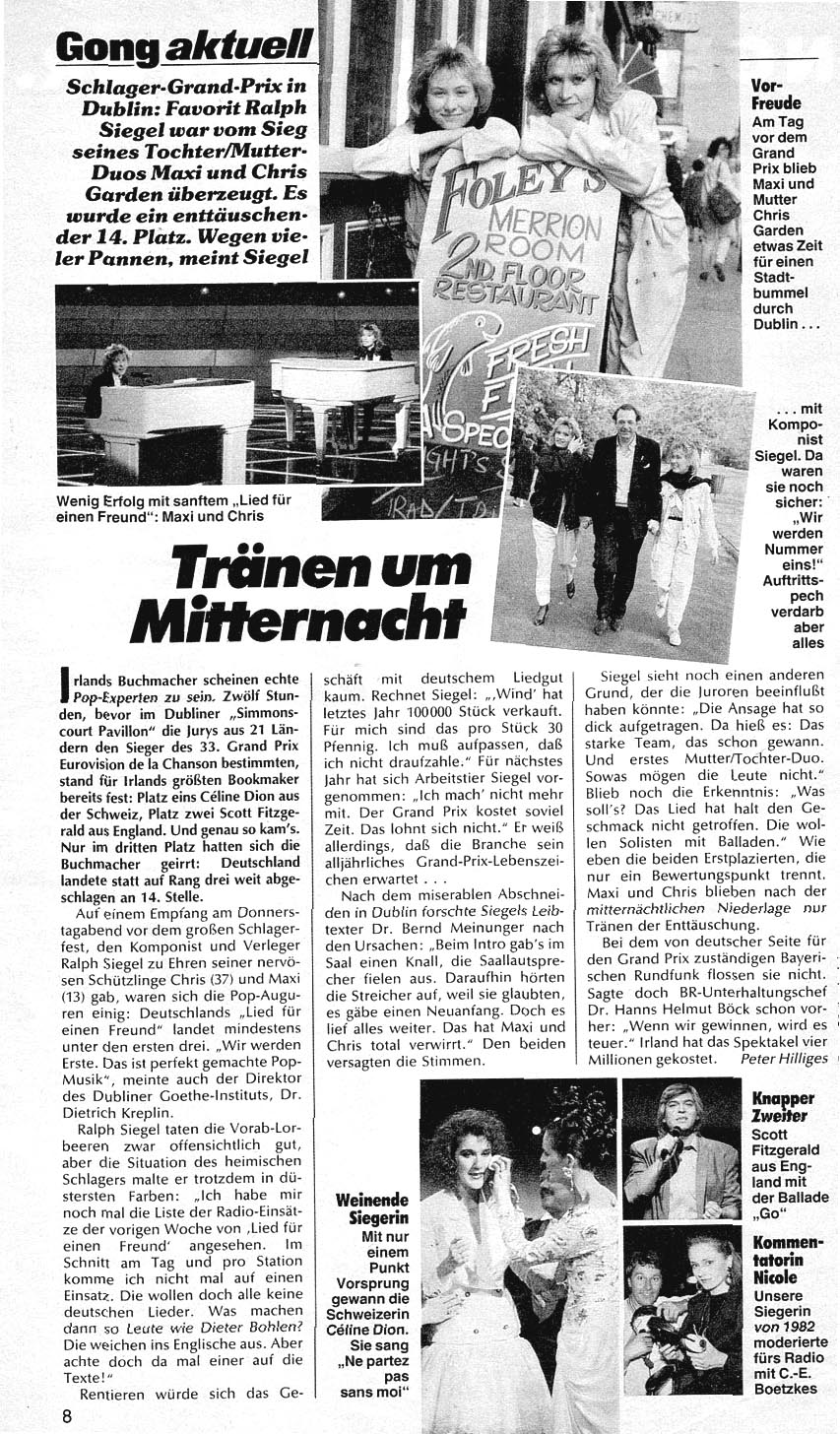
- "Tränen um Mitternacht".
- (30 April 1988). "Σάββατο". {{ill.
- Tüzecan, Temuçin. (30 April 1988). "TV'de Eurovision fırtınası". [[Milliyet]].
- (30 April 1988). "Útvarp/Sjónvarp". Morgunblaðið.
- (25 April – 5 May 1988). "Laugardagur 30. apríl". [[Ríkisútvarpið]] (RÚV).
- (30 April 1986). "Saturday's Television". [[The Irish Times.
- (30 July 2018). "Celebrities and public figures launch Irish campaign to boycott Eurovision 2019 in Israel". [[Boycott, Divestment and Sanctions]].
- (30 April 1986). "Radio". The Irish Times Weekend.
- (29 April 1988). "שבת 30.4.88 – טלוויזיה". [[Maariv (newspaper).
- (24–30 April 1988). "Sabato 30 aprile".
- (27 April 1988). "Samstag, 30. April {{!}} Samedi, 30 avril".
- (April 1988). "RTL Télévision Eurovision 1988 [[Promo (media)".
- (30 April 1988). "Televisie en radio". [[Limburgs Dagblad]].
- Langerak, Henk. (30 April 1988). "Een groot gezelschapsspel". [[Algemeen Dagblad.
- (30 April 1988). "TV lørdag". [[Sarpsborg Arbeiderblad]].
- (30 April 1988). "P2 – Kjøreplan lørdag 30. april 1988". [[NRK]].
- (30 April 1988). "Televisão". [[Diário de Lisboa]].
- (30 April 1988). "La programació". {{lang.
- (30 April 1988). "TV-programmen". [[Svenska Dagbladet]].
- (30 April 1988). "Radioprogrammen". [[Svenska Dagbladet]].
- (30 April 1988). "TV + Radio · Samstag". [[Bieler Tagblatt]].
- (21 April 1988). "Samedi TV – 30 avril".
- (30 April 1988). "Musica nazionale". Gazzetta Ticinese.
- (23 April 2025). "Eurosong amarcord: il trionfo di Céline Dion (e Nella Martinetti)". {{lang.
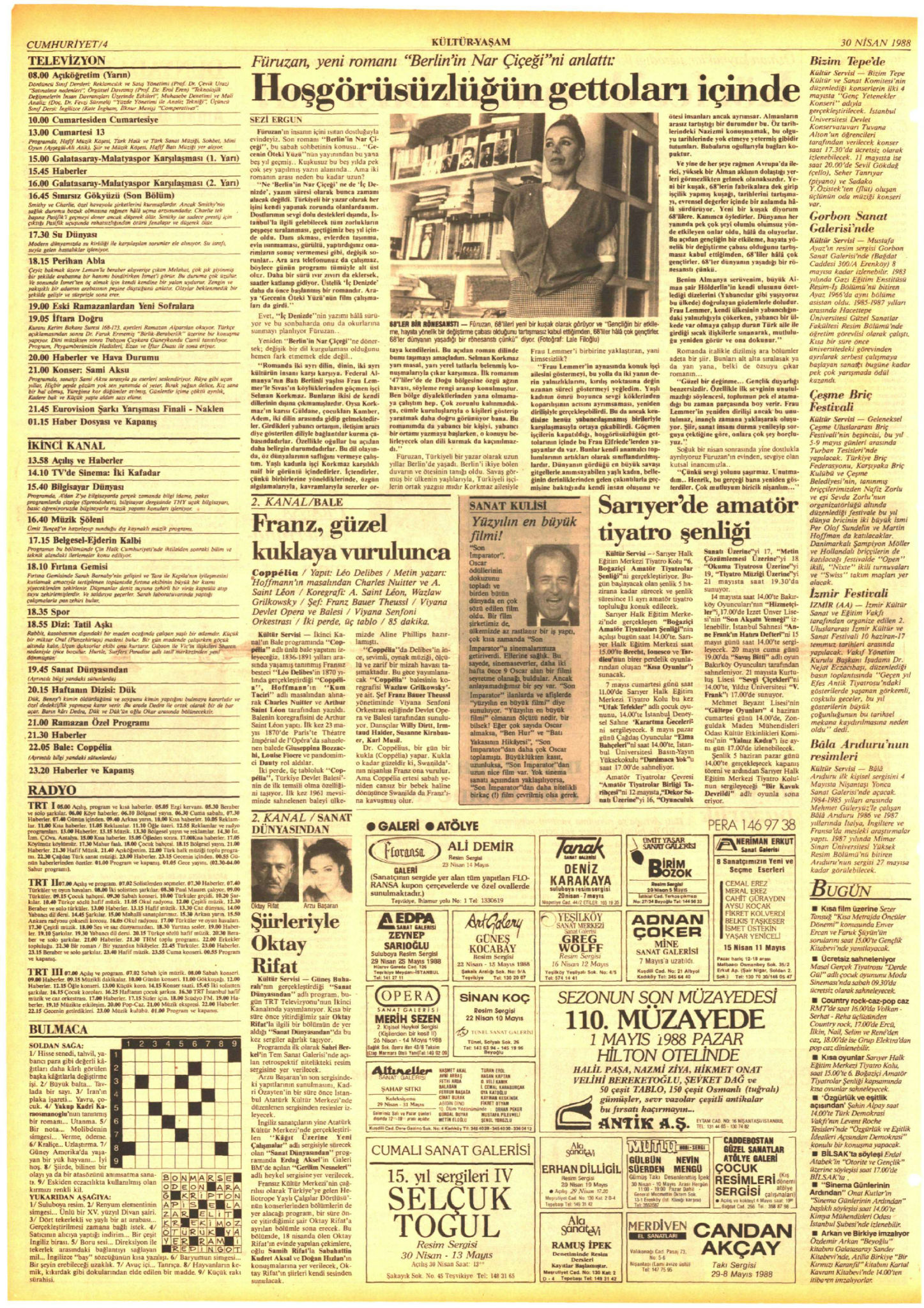
- (30 April 1988). "Televizyon". [[Cumhuriyet]].
- (30 April 1988). "Eurovision Song Contest – BBC1".
- (30 April 1988). "Bank holiday radio guide". [[Cambridge News.
- (30 April 1988). "Switch-on guide to the weekend's". [[The Journal (Newcastle upon Tyne newspaper).
- (30 April 1988). "Radio". [[Birmingham Post.
- (30 April 1988). "Saturday Radio". [[Western Daily Press]].
- (30 April 1988). "Radio". [[The Sentinel (Staffordshire).
- (30 April 1988). "Eurovision Song Contest – BBC Radio 2".
- (30 April – 2 May 1988). "Избор из телевизијског и радио-програма". [[Politika]].
- (30 April 1988). "Televizija". [[Delo (newspaper).
- (1 May 1988). "Sunday's TV Programs". [[The Canberra Times]].
- (28 May 1988). "Телевизия". {{lang.
- (28 May 1988). "Télé-spéciaux – dimanche". [[La Presse (Canadian newspaper).
- (26 May 1988). "Sunday evening". [[Aldergrove Star]].
- (30 April 1988). "Το αποψινο προγραμμα". {{lang.
- (30 April 1988). "Ραδιόφωνο". {{lang.
- (16 May 1988). "neděle 29.5.".
- (28 April 1988). "Útvarp ⬥ Sjónvarp". {{ill.
- (2 May 1988). "KNR-TV". [[Atuagagdliutit/Grønlandsposten.
- (29 April 1988). "Szombat".
- (30 April 1988). "TV & Radio". [[The Jordan Times]].
- (13 May 1988). "Telewizja – sobota – 14 V". [[Dziennik Polski]].
- (29 May 1988). "TV프로그램". [[The Chosun Ilbo]].
- "Дома у экрана". {{ill.
- (28 May 1988). "Телевидение, программа на неделю". [[Pravda]].
- (23–29 May 1988). "L. 28. V".
- "Céline Dion – Unisson". {{lang.
- "Celine Dion – Unison". [[British Phonographic Industry]] (BPI).
- "Celine Dion – Unison". [[Recording Industry Association of America]] (RIAA).
- "Gold & Platinum: Céline Dion – Unison". [[Music Canada]].
- "Chart History – Celine Dion".
- "Céline Dion – Where Does My Heart Beat Now". [[VG-lista]].
- "Celine Dion – Where Does My Heart Beat Now". [[Irish Recorded Music Association]] (IRMA).
- "Céline Dion – Where Does My Heart Beat Now". {{lang.
- (24 July 2024). "Will Celine Dion perform at the 2024 Olympics? What to know about her health condition". [[The Columbus Dispatch]].
- "Lara Fabian".
- "Chart History – Lara Fabian – ''Billboard'' Hot 100".
- "Chart History – Lara Fabian – Dance Club Songs".
- (2 March 2018). "Lara Fabian {{!}} Athens {{!}} May 19". [[Kathimerini]].
- (18 August 2015). "Lara Fabian Releases "Quand je ne chante pas"". Eurovoix.
- (16 June 2005). "'Congratulations' – 14 songs to compete". European Broadcasting Union (EBU).
- (24 October 2005). "Abba's 'Waterloo' is voted best song of 50 Eurovision years". [[The Independent]].
- "Results from the voting (Round 1 and 2)". European Broadcasting Union (EBU).
- (1 January 2004). "Bruce Forsyth".

This article was imported from Wikipedia and is available under the Creative Commons Attribution-ShareAlike 4.0 License. Content has been adapted to SurfDoc format. Original contributors can be found on the article history page.
Ask Mako anything about Eurovision Song Contest 1988 — get instant answers, deeper analysis, and related topics.
Research with MakoFree with your Surf account
Create a free account to save articles, ask Mako questions, and organize your research.
Sign up freeThis content may have been generated or modified by AI. CloudSurf Software LLC is not responsible for the accuracy, completeness, or reliability of AI-generated content. Always verify important information from primary sources.
Report