From Surf Wiki (app.surf) — the open knowledge base
Eurovision Song Contest 1986
International song competition

International song competition
| Field | Value |
|---|---|
| name | Eurovision Song Contest |
| year | 1986 |
| logo | ESC 1986 logo.png |
| final | 3 May 1986 |
| presenter | Åse Kleveland |
| musdirector | Egil Monn-Iversen |
| director | John Andreassen |
| scrutineer | Frank Naef |
| exproducer | Harald Tusberg |
| organiser | European Broadcasting Union (EBU) |
| host | Norsk rikskringkasting (NRK) |
| venue | Grieghallen |
| Bergen, Norway | |
| winner | |
| "J'aime la vie" | |
| vote | Each country awarded 12, 10, 8-1 point(s) to their 10 favourite songs |
| entries | 20 |
| debut | |
| return | |
| nonreturn | |
| Map NoSemis | Y |
Bergen, Norway "J'aime la vie"
The Eurovision Song Contest 1986 was the 31st edition of the Eurovision Song Contest, held on 3 May 1986 at Grieghallen in Bergen, Norway, and presented by Åse Kleveland. It was organised by the European Broadcasting Union (EBU) and host broadcaster Norsk rikskringkasting (NRK), who staged the event after winning the for with the song "La det swinge" by Bobbysocks!. Kleveland had also represented .
Broadcasters from twenty countries participated in the contest, with and deciding not to enter, and returning, and competing for the first time. Turkey achieved their best result in the contest up to this point.
The winner was with the song "J'aime la vie" by Sandra Kim. Belgium was the last of the original 7 countries that had competed in the first contest to win. Aged 13, Kim was the youngest ever Eurovision winner. Current rules require Eurovision Song Contest participants to be at least 16, so unless the rule is changed, Kim's record will never be broken. The lyrics of her song implied that Kim was 15 years of age, but after the contest, it was revealed that she was actually 13. , who finished second, appealed for her to be disqualified, but was not successful.
The 1986 contest was a first for Eurovision in that royalty were among the guests—Crown Prince Harald, Crown Princess Sonja, Princess Märtha Louise, and Prince Haakon Magnus were all in attendance.
Background
By 1985, Norway had received the unwanted distinction of being "the nul points country", receiving 0 points three times and coming in last six times. When they finally won the 1985 contest, it was a source of pride among the Norwegian population, and Norsk rikskringkasting (NRK) took full advantage of being able to showcase Norway and its achievements in front of over 500 million television viewers. By the autumn of 1985, NRK had decided to hold the next year's contest at the Grieghallen in Bergen, turning down other bids from capital Oslo, and main cities of Stavanger, Sandnes, and Trondheim. Bergen is the northernmost city to have ever hosted the Eurovision Song Contest. About 450 journalists have covered the event.
As this was the first time a Eurovision Song Contest was hosted in Norway, NRK commissioned a lavish budget for the event, turning Grieghallen into a Viking-esque "ice palace" for the live show, complete with white and pastel neon lights for the stage. In addition, NRK had a special diamond-encrusted dress made for presenter Åse Kleveland for her opening number. The prized dress, which weighed upwards of 15 lb, is still available for viewing at NRK's costuming department at Marienlyst in Oslo.
Åse Kleveland, a well-known music and celebrity at the host country, also was President of the Norwegian Association of Musicians at the time and had represented at Eurovision, sang the multilingual "Welcome to Music" as the opening act, incorporating English and French primarily, in addition to other European languages. BBC commentator Terry Wogan, at the close of Kleveland's number, dryly remarked, "Katie Boyle (a former Eurovision host for the UK) never sang, did she?"
During her opening remarks, Kleveland said of Norway's road in the contest, "For those of you who have followed Norway's course through the history of the Eurovision Song Contest, you will know that it has been quite thorny, in fact. So, imagine our joy when last year we finally won, and the pleasure we feel today, being able to welcome 700 million viewers to the top of Europe, to Norway, and to Bergen."
The intersong videos introducing each participant, traditionally named 'postcards' were for the only time, represented as actual picture postcards sent from the artists to your own nation. Each video began with clips of various scenic views of a part of Norway, which then 'flipped' to reveal a message of greeting, written in the language of the upcoming song, alongside details of the title, author and composer. The postage stamp on each card (a representation of a genuine Norwegian postage stamp) was linked to the theme of the video content. The postcard then 'flipped' back to the picture side, where the performing artist had been superimposed onto the image. After the video, Åse Kleveland gave details of the entry and introduced the conductors in a mix of English and French, reading from cards represented by the flag of the upcoming country.
The main interval act presented featured two Norwegian musicians: one was the previously unknown outside Norway 16 year-old Sissel Kyrkjebø and the musician Steinar Ofsdal, accompanied by the NRK radio orchestra, Kringkastingsorkesteret (KORK). They opened with the traditional song of the city of Bergen, Udsikter fra Ulriken (also known as "Nystemte'n"), and presented a number of familiar tunes while showing the sights and sounds of Bergen area. Ofsdal played a range of traditional Norwegian folk instruments such as accordion, recorder, and hardingfele. This was Kyrkjebø's first performance on an international event, which served as the starting point for a consolidated international career years later.
Participants
A record number of broadcasters submitted entries for the contest, and it was expected that twenty-two countries would participate in the event. This would have surpassed the previous record of twenty participating countries which competed in , , and . The and both returned after a one-year absence, and made its first ever entry. Of the countries which had participated in the only opted not to compete in this event. However, only twenty countries ultimately participated, as the Hellenic Broadcasting Corporation (ERT), which had already selected the song "Wagon-lit" performed by Polina to represent , made a late decision to not compete due to the event falling on Holy Saturday in the Eastern Orthodox calendar.
The contest featured one artist who had previously competed at Eurovision: Elpida representing had previously represented .
| Country | Broadcaster | Artist | Song | Language | Songwriter(s) | Conductor |
|---|---|---|---|---|---|---|
| ORF | Timna Brauer | "Die Zeit ist einsam" | German | Richard Oesterreicher | ||
| RTBF | Sandra Kim | "J'aime la vie" | French | |||
| CyBC | Elpida | "Tora zo" (Τώρα ζω) | Greek | Martyn Ford | ||
| DR | Lise Haavik | "Du er fuld af løgn" | Danish | Egil Monn-Iversen | ||
| YLE | Kari | "Never the End" | Finnish | Kari Kuivalainen | Ossi Runne | |
| Antenne 2 | Cocktail Chic | "Européennes" | French | Jean-Claude Petit | ||
| BR | Ingrid Peters | "Über die Brücke geh'n" | German | Hans Blum | Hans Blum | |
| RÚV | "Gleðibankinn" | Icelandic | ||||
| RTÉ | Luv Bug | "You Can Count On Me" | English | Kevin Sheerin | Noel Kelehan | |
| IBA | Moti Giladi and Sarai Tzuriel | "Yavo Yom" (יבוא יום) | Hebrew | Yoram Tzadok | ||
| CLT | Sherisse Laurence | "L'Amour de ma vie" | French | Rolf Soja | ||
| NOS | Frizzle Sizzle | "Alles heeft ritme" | Dutch | Harry van Hoof | ||
| NRK | Ketil Stokkan | "Romeo" | Norwegian | Ketil Stokkan | Egil Monn-Iversen | |
| RTP | Dora | "Não sejas mau p'ra mim" | Portuguese | Colin Frechter | ||
| TVE | Cadillac | "Valentino" | Spanish | José María Guzmán | ||
| SVT | Lasse Holm and Monica Törnell | "E' de' det här du kallar kärlek" | Swedish | Lasse Holm | Anders Berglund | |
| SRG SSR | Daniela Simons | "Pas pour moi" | French | Atilla Şereftuğ | ||
| TRT | Klips ve Onlar | "Halley" | Turkish | Melih Kibar | ||
| BBC | Ryder | "Runner in the Night" | English | |||
| JRT | Doris Dragović | "Željo moja" (Жељо моја) | Serbo-Croatian |
Production and format
About 450 journalists have covered the event. The trophy was made by Arne Valen at the Bergen Steinsenter.
Contest overview
The contest took place at 21:00 CEST, and was hosted by Åse Kleveland, who had represented .
| R/O | Country | Artist | Song | Points | Place | 1 | 2 | 3 | 4 | 5 | 6 | 7 | 8 | 9 | 10 | 11 | 12 | 13 | 14 | 15 | 16 | 17 | 18 | 19 | 20 |
|---|---|---|---|---|---|---|---|---|---|---|---|---|---|---|---|---|---|---|---|---|---|---|---|---|---|
| "L'Amour de ma vie" | 117 | 3 | |||||||||||||||||||||||
| "Željo moja" | 49 | 11 | |||||||||||||||||||||||
| Cocktail Chic | "Européennes" | 13 | 17 | ||||||||||||||||||||||
| "Romeo" | 44 | 12 | |||||||||||||||||||||||
| Ryder | "Runner in the Night" | 72 | 7 | ||||||||||||||||||||||
| ICY | "Gleðibankinn" | 19 | 16 | ||||||||||||||||||||||
| Frizzle Sizzle | "Alles heeft ritme" | 40 | 13 | ||||||||||||||||||||||
| Klips ve Onlar | "Halley" | 53 | 9 | ||||||||||||||||||||||
| Cadillac | "Valentino" | 51 | 10 | ||||||||||||||||||||||
| "Pas pour moi" | 140 | 2 | |||||||||||||||||||||||
| and Sarai Tzuriel | "Yavo Yom" | 7 | 19 | ||||||||||||||||||||||
| Luv Bug | "You Can Count On Me" | 96 | 4 | ||||||||||||||||||||||
| "J'aime la vie" | 176 | 1 | |||||||||||||||||||||||
| "Über die Brücke geh'n" | 62 | 8 | |||||||||||||||||||||||
| Elpida | "Tora zo" | 4 | 20 | ||||||||||||||||||||||
| "Die Zeit ist einsam" | 12 | 18 | |||||||||||||||||||||||
| and Monica Törnell | "E' de' det här du kallar kärlek" | 78 | 5 | ||||||||||||||||||||||
| "Du er fuld af løgn" | 77 | 6 | |||||||||||||||||||||||
| Kari | "Never the End" | 22 | 15 | ||||||||||||||||||||||
| Dora | "Não sejas mau p'ra mim" | 28 | 14 |
Spokespersons
Each participating broadcaster appointed a spokesperson who was responsible for announcing the votes for their respective country via telephone. Known spokespersons at the 1986 contest are listed below.
- FinlandSolveig Herlin
- IcelandGuðrún Skúladóttir
- SwedenAgneta Bolme Börjefors
- United KingdomColin Berry
Detailed voting results
The winning song, Belgium's "J'aime la vie", received points from every jury (Belgium received five sets of 12 points; every country awarded Belgium at least five points except for Germany, which gave them just one point). Belgium was the leader in the voting from the results of the second jury out of twenty, in the longest winning stretch during voting since 1974. Switzerland was behind Belgium in nearly every part of the voting, but Belgium had a commanding lead from the very beginning. Traditionally some juries give high points to the host country's entrant, but this did not happen this year; no jury gave Norway's song "Romeo" more than six points out of a possible 12.
Belgium scored an absolute record at the time, with Sandra Kim earning a never seen before number of 176 points (that record remained seven years until the 1993 contest, with Ireland scoring 187 points), an average of 9.26 points per voting nation. Kim received 77.2% of the maximum possible score, which, as of 2023, still ranks 8th among all Eurovision winners.
| nb=1 | Total score}} | nb=1 | Luxembourg}} | nb=1 | Yugoslavia}} | nb=1 | France}} | nb=1 | Norway}} | nb=1 | United Kingdom}} | nb=1 | Iceland}} | nb=1 | Netherlands}} | nb=1 | Turkey}} | nb=1 | Spain}} | nb=1 | Switzerland}} | nb=1 | Israel}} | nb=1 | Ireland}} | nb=1 | Belgium}} | nb=1 | Germany}} | nb=1 | Cyprus}} | nb=1 | Austria}} | nb=1 | Sweden}} | nb=1 | Denmark}} | nb=1 | Finland}} | nb=1 | Portugal}} | va=middle | Contestants}} | Luxembourg | Yugoslavia | France | Norway | United Kingdom | Iceland | Netherlands | Turkey | Spain | Switzerland | Israel | Ireland | Belgium | Germany | Cyprus | Austria | Sweden | Denmark | Finland | Portugal |
|---|---|---|---|---|---|---|---|---|---|---|---|---|---|---|---|---|---|---|---|---|---|---|---|---|---|---|---|---|---|---|---|---|---|---|---|---|---|---|---|---|---|---|---|---|---|---|---|---|---|---|---|---|---|---|---|---|---|---|---|---|---|---|---|
| 117 | 5 | 8 | 12 | 8 | 1 | 8 | 2 | 4 | 7 | 10 | 12 | 8 | 10 | 10 | 2 | 4 | 6 | ||||||||||||||||||||||||||||||||||||||||||||||
| 49 | 2 | 7 | 5 | 7 | 3 | 3 | 1 | 3 | 4 | 12 | 1 | 1 | |||||||||||||||||||||||||||||||||||||||||||||||||||
| 13 | 3 | 7 | 3 | ||||||||||||||||||||||||||||||||||||||||||||||||||||||||||||
| 44 | 4 | 4 | 2 | 6 | 6 | 5 | 6 | 6 | 5 | ||||||||||||||||||||||||||||||||||||||||||||||||||||||
| 72 | 4 | 10 | 6 | 6 | 2 | 4 | 2 | 5 | 2 | 3 | 8 | 8 | 10 | 2 | |||||||||||||||||||||||||||||||||||||||||||||||||
| 19 | 5 | 2 | 6 | 4 | 2 | ||||||||||||||||||||||||||||||||||||||||||||||||||||||||||
| 40 | 1 | 2 | 7 | 1 | 8 | 10 | 1 | 3 | 7 | ||||||||||||||||||||||||||||||||||||||||||||||||||||||
| 53 | 6 | 12 | 2 | 6 | 8 | 3 | 6 | 8 | 2 | ||||||||||||||||||||||||||||||||||||||||||||||||||||||
| 51 | 7 | 4 | 6 | 1 | 2 | 8 | 1 | 5 | 3 | 7 | 3 | 1 | 3 | ||||||||||||||||||||||||||||||||||||||||||||||||||
| 140 | 12 | 6 | 7 | 5 | 5 | 3 | 12 | 10 | 4 | 12 | 10 | 12 | 5 | 4 | 12 | 4 | 7 | 10 | |||||||||||||||||||||||||||||||||||||||||||||
| 7 | 1 | 1 | 5 | ||||||||||||||||||||||||||||||||||||||||||||||||||||||||||||
| 96 | 3 | 8 | 3 | 2 | 8 | 5 | 12 | 6 | 2 | 12 | 7 | 12 | 8 | 8 | |||||||||||||||||||||||||||||||||||||||||||||||||
| 176 | 10 | 10 | 12 | 8 | 10 | 10 | 10 | 12 | 10 | 10 | 5 | 12 | 1 | 10 | 6 | 6 | 10 | 12 | 12 | ||||||||||||||||||||||||||||||||||||||||||||
| 62 | 8 | 1 | 12 | 8 | 7 | 8 | 5 | 7 | 2 | 4 | |||||||||||||||||||||||||||||||||||||||||||||||||||||
| 4 | 3 | 1 | |||||||||||||||||||||||||||||||||||||||||||||||||||||||||||||
| 12 | 2 | 1 | 2 | 6 | 1 | ||||||||||||||||||||||||||||||||||||||||||||||||||||||||||
| 78 | 5 | 7 | 2 | 7 | 3 | 12 | 3 | 7 | 12 | 4 | 5 | 6 | 5 | ||||||||||||||||||||||||||||||||||||||||||||||||||
| 77 | 5 | 10 | 6 | 7 | 4 | 5 | 3 | 10 | 4 | 7 | 7 | 4 | 5 | ||||||||||||||||||||||||||||||||||||||||||||||||||
| 22 | 6 | 1 | 1 | 8 | 3 | 3 | |||||||||||||||||||||||||||||||||||||||||||||||||||||||||
| 28 | 4 | 4 | 4 | 8 | 7 | 1 |
12 points
Below is a summary of all 12 points in the final:
| N. | Contestant | Nation(s) giving 12 points | 5 | 3 | 2 | 1 |
|---|---|---|---|---|---|---|
| **** | , , , , | |||||
| , , , , | ||||||
| , , | ||||||
| , | ||||||
| , |
Broadcasts
Each participating broadcaster was required to relay the contest via its networks. Non-participating EBU member broadcasters were also able to relay the contest as "passive participants". Broadcasters were able to send commentators to provide coverage of the contest in their own native language and to relay information about the artists and songs to their television viewers.
The contest was reportedly broadcast in Greece and Jordan; in Bulgaria, Czechoslovakia, Hungary, Poland, Romania, and the Soviet Union via Intervision; and in Australia, Gibraltar, and South Korea, with an estimated maximum audience of 600 million viewers and listeners. 44 television and radio stations have reportedly broadcast the contest. Known details on the broadcasts in each country, including the specific broadcasting stations and commentators are shown in the tables below.
| Country | Broadcaster | Channel(s) | Commentator(s) | Austria | Belgium | Cyprus | Denmark | Finland | France | Germany | Iceland | Ireland | Israel | Luxembourg | Netherlands | Norway | Portugal | Spain | Sweden | Switzerland | Turkey | United Kingdom | Yugoslavia |
|---|---|---|---|---|---|---|---|---|---|---|---|---|---|---|---|---|---|---|---|---|---|---|---|
| ORF | FS1 | Ernst Grissemann | |||||||||||||||||||||
| RTBF | RTBF1, Télé 2 | ||||||||||||||||||||||
| BRT | TV1 | Luc Appermont | |||||||||||||||||||||
| BRT 2 | |||||||||||||||||||||||
| CyBC | RIK | ||||||||||||||||||||||
| DR | DR TV | Jørgen de Mylius | |||||||||||||||||||||
| YLE | TV1 | ||||||||||||||||||||||
| Antenne 2 | Patrice Laffont | ||||||||||||||||||||||
| RFO | |||||||||||||||||||||||
| ARD | Erstes Deutsches Fernsehen | ||||||||||||||||||||||
| RÚV | Sjónvarpið, Rás 1 | ||||||||||||||||||||||
| RTÉ | RTÉ 1 | Brendan Balfe | |||||||||||||||||||||
| RTÉ Radio 1 | Larry Gogan | ||||||||||||||||||||||
| IBA | Israeli Television, | ||||||||||||||||||||||
| CLT | RTL Télévision | ||||||||||||||||||||||
| RTL plus | |||||||||||||||||||||||
| NOS | Nederland 1 | ||||||||||||||||||||||
| NRK | NRK Fjernsynet, NRK P1, NRK P2 | Knut Bjørnsen | |||||||||||||||||||||
| RTP | RTP1 | ||||||||||||||||||||||
| TVE | TVE 2 | Antonio Gómez Mateo | |||||||||||||||||||||
| SVT | TV1 | Ulf Elfving | |||||||||||||||||||||
| SR P3 | Jacob Dahlin | ||||||||||||||||||||||
| SRG SSR | TV DRS | ||||||||||||||||||||||
| TSR | |||||||||||||||||||||||
| TSI | |||||||||||||||||||||||
| TRT | TRT Televizyon | Gülgün Baysal | |||||||||||||||||||||
| BBC | BBC1 | Terry Wogan | |||||||||||||||||||||
| BBC Radio 2 | Ray Moore | ||||||||||||||||||||||
| JRT | TV Beograd 1, TV Novi Sad, TV Sarajevo 1, TV Titograd 1, TV Zagreb 1 | Ksenija Urličić | |||||||||||||||||||||
| TV Koper-Capodistria | |||||||||||||||||||||||
| TV Ljubljana 1 | |||||||||||||||||||||||
| Val 202 | |||||||||||||||||||||||
| TV Prishtina | |||||||||||||||||||||||
| TV Skopje 1 |
| Country | Broadcaster | Channel(s) | Commentator(s) | Australia | Czechoslovakia | Greenland | Hungary | Italy | Jordan | Poland | South Korea | Soviet Union |
|---|---|---|---|---|---|---|---|---|---|---|---|---|
| SBS | SBS TV | |||||||||||
| ČST | ||||||||||||
| KNR | KNR | |||||||||||
| MTV | MTV1 | |||||||||||
| JRTV | JTV2 | |||||||||||
| TP | TP1 | |||||||||||
| KBS | 1TV | |||||||||||
| CT USSR | Programme One | |||||||||||
| ETV |
References
- (4 January 2018). "Κίνησε η Πωλίνα να πάει στη Eurovision και ήταν ημέρα Μεγάλο Σάββατο".
- "Bergen 1986 – Participants". European Broadcasting Union.
- "Alle deutschen ESC-Acts und ihre Titel". [[ARD (broadcaster).
- (2 May 1986). "Vidda-krystall til GP-vinneren". [[Laagendalsposten]].
- "Bergen 1986 – Scoreboard". European Broadcasting Union.
- (1 May 1986). "Íslenska dómnefndin". [[Þjóðviljinn]].
- "Bergen 1986 – Detailed voting results". European Broadcasting Union.
- "Eurovision Song Contest 1986 – Scoreboard". European Broadcasting Union.
- (31 October 2018). "The Rules of the Contest". European Broadcasting Union.
- de Sousa, Neves. (5 May 1986). "Costureiro de Dora foi mesmo mau para ela!". [[Diário de Lisboa]].
- Rafnar, Hallóry. (3 May 1986). "Úrslitin í Eurovisionkeppninni ráðast í kvöld". [[Morgunblaðið]].
- Versteeg, Dick. (3 May 1986). "Bergen trekt toeristisch profijt uit songfestival". [[Provinciale Zeeuwse Courant]].
- (3 May 1986). "Alt er stort i Grand Prix". [[Telemarksavisa.
- (2 May 1986). "Radio – Televizija". Slovenski vestnik.
- Halbhuber, Axel. (22 May 2015). "Ein virtueller Disput der ESC-Kommentatoren". [[Kurier]].
- (3 May 1986). "Τηλεοaραση". {{lang.
- "Alle tiders programoversigter – Lørdag den 3. maj 1986". [[DR (broadcaster).
- (3 May 1986). "Radio · Televisio". [[Helsingin Sanomat]].
- (3 May 1986). "Télévision". [[Le Monde.
- (3 July 1986). "Television : voir et entendre, entendre pour comprendre, mais comprendre pure critiquer". Le Progressiste.
- (3 May 1986). "Fernsehen". [[Die Welt]].
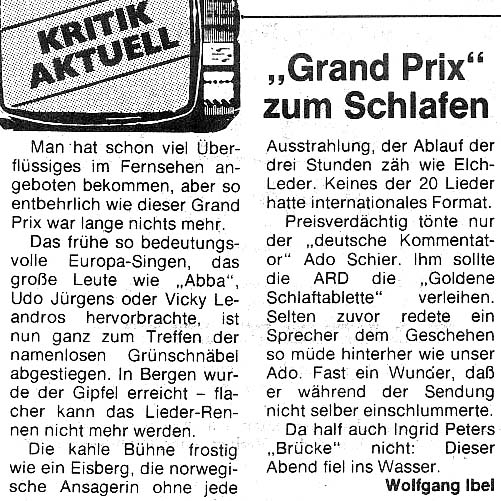
- Ibel, Wolfgang. "'Grand Prix' zum Schlafen". [[Neue Ruhr Zeitung]].
- (3 May 1986). "Útvarp/Sjónvarp". [[Morgunblaðið]].
- (28 April – 4 May 1986). "Laugardagur 3. maí". Dagskrá útvarpsins.
- (3 May 1986). "Tonight's TV". [[Evening Herald]].
- (3 May 1986). "Radio – Saturday". The Irish Times Weekend.
- (2 May 1986). "מישדרי הטלוויזיה והרדיו – יום שבת 3.5.86". [[Maariv (newspaper).
- (1 May 1986). "Samstag, 3. Mai".
- (3 May 1986). "Radio en televisie, programma's". [[Limburgs Dagblad]].
- (3 May 1986). "Radio/TV/Kino". [[Finnmark Dagblad]].
- (3 May 1986). "Televisão". Diário de Lisboa.
- (3 May 1986). "Programacion". {{ill.
- (28 March 2018). "Todos los comentaristas de la historia de España en Eurovisión (y una única mujer en solitario)". [[Los 40]].
- (3 May 1986). "tv-programmen". [[Svenska Dagbladet]].
- (3 May 1986). "Radioprogrammen". Svenska Dagbladet.
- (3–4 May 1986). "Fernsehen". [[Neue Zürcher Zeitung]].
- (1 May 1986). "TV – samedi 3 mai".
- (3 May 1986). "I programmi televisivi della fine settimana". Popolo e Libertà.
- (3 May 1986). "Bugünkü TV • Radio". [[Milliyet]].
- (3 May 1986). "Eurovision Song Contest – BBC1".
- (3 May 1986). "Weekend television and radio programmes". [[The Times]].
- (3 May 1986). "Saturday Radio". [[Western Daily Press]].
- (3 May 1986). "Radio". [[The Journal (Newcastle upon Tyne newspaper).
- (3 May 1986). "Radio". [[Birmingham Mail.
- (3 May 1986). "Radio". [[Hull Daily Mail]].
- (3 May 1986). "Radio". [[Huddersfield Daily Examiner.
- (3 May 1986). "Monday listening". [[Liverpool Echo]].
- (3 May 1986). "Radio". [[Bournemouth Daily Echo.
- (3 May 1986). "Eurovision Song Contest – BBC Radio 2".
- (3–4 May 1986). "Телевизија". [[Borba (newspaper).
- (3 May 1986). "Televizió". [[Magyar Szó]].
- (3 May 1986). "RTV program". [[Slobodna Dalmacija]].
- (3 May 1986). "Televizija". [[Delo (newspaper).
- (3 May 1986). "Radio danes". Delo.
- (4 May 1986). "SBS-28". [[The Canberra Times]].
- (26 May 1986). "Program televize v týdnu od 2. do 8. června 1986".
- (14 May 1986). "TV-Kkut Aallakaatitassat {{!}} TV-Program". [[Atuagagdliutit/Grønlandsposten.
- (28 April 1986). "Szombat május 3". Rádió– és Televízióújság.
- (3 May 1986). "Dai programmi tv e radio". [[Il Piccolo]].
- (3 May 1986). "TV & Radio". [[The Jordan Times]].
- (24–25 May 1986). "TV – 24 {{!}} 25. 05. – Sobota". [[Dziennik Bałtycki]].
- (20 May 1986). "텔레비전 프로". [[Kyunghyang Shinmun]].
- (24 May 1986). "Телевидение: Программа на неделю". [[Pravda]].
- (26 May – 1 June 1986). "R. 30. V".
This article was imported from Wikipedia and is available under the Creative Commons Attribution-ShareAlike 4.0 License. Content has been adapted to SurfDoc format. Original contributors can be found on the article history page.
Ask Mako anything about Eurovision Song Contest 1986 — get instant answers, deeper analysis, and related topics.
Research with MakoFree with your Surf account
Create a free account to save articles, ask Mako questions, and organize your research.
Sign up freeThis content may have been generated or modified by AI. CloudSurf Software LLC is not responsible for the accuracy, completeness, or reliability of AI-generated content. Always verify important information from primary sources.
Report