From Surf Wiki (app.surf) — the open knowledge base
Eurovision Song Contest 1985
International song competition

International song competition
| Field | Value |
|---|---|
| name | Eurovision Song Contest |
| year | 1985 |
| logo | ESC 1985 logo.png |
| final | |
| venue | Scandinavium |
| Gothenburg, Sweden | |
| presenter | Lill Lindfors |
| musdirector | Curt-Eric Holmquist |
| director | Steen Priwin |
| scrutineer | Frank Naef |
| exproducer | Steen Priwin |
| organiser | European Broadcasting Union (EBU) |
| host | Sveriges Television (SVT) |
| entries | 19 |
| return | |
| nonreturn | |
| vote | Each country awarded 12, 10, 8-1 point(s) to their 10 favourite songs |
| winner | |
| "La det swinge" | |
| Map NoSemis | Y |
Gothenburg, Sweden "La det swinge"
The Eurovision Song Contest 1985 was the 30th edition of the Eurovision Song Contest, held on 4 May 1985 at the Scandinavium in Gothenburg, Sweden, and presented by Lill Lindfors. It was organised by the European Broadcasting Union (EBU) and host broadcaster Sveriges Television (SVT), who staged the event after winning the for with the song "Diggi-Loo Diggi-Ley" by Herreys. Broadcasters from nineteen countries participated in the contest; and returned after a one-year absence, while the and , which had participated in the previous year's event, declined to enter due to separate memorial events in those countries coinciding with the date of the contest.
The winner was with the song "La det swinge", composed and written by Rolf Løvland and performed by the group Bobbysocks. This was Norway's first contest victory, and only the third top five placing for a country which had placed last on six previous occasions, including three times receiving nul points. With a total of 123 points, "La det swinge" remains the lowest scoring winner under the voting system used between and . , , the , and rounded out the top five positions.
Location
The 1985 contest took place in Gothenburg, Sweden, following the country's victory at the with the song "Diggi-Loo Diggi-Ley" performed by Herreys. It was the second time that Sweden had hosted the event, ten years after the was held in Stockholm. The chosen venue was the Scandinavium, an indoor arena inaugurated in 1971, home to the Frölunda HC ice hockey team and the Gothenburg Horse Show. The Scandinavium was chosen by host broadcaster Sveriges Television (SVT) from a number of bids submitted by various Swedish cities and venues; among those known to have been considered to stage the contest were the Berwald Hall in Stockholm and the in Jönköping. The stadium's maximum capacity of 14,000 people was reduced to 8,000 attendees for the contest, in order to provide space for the stage and technical equipment; this still made it the largest venue and the largest assembled audience in the history of the contest up to that point. During the week leading up to the rehearsals and the televised event, the European Broadcasting Union (EBU) and SVT held an official reception for the participating delegations, which was hosted on the evening of 1 May 1985 at Kronhuset.
Participants
.jpg)
Nineteen countries in total participated in the 1985 contest. and both returned following a one-year absence, however the and , which had competed in the previous year's contest, declined to enter in 1985 as the date of the contest coincided with memorial days in the countries, specifically the Remembrance of the Dead, and the anniversary of the death of Yugoslav president Josip Broz Tito, respectively. It was the first time in the contest's history that there was no entry from the Netherlands, with the nation having previously competed in every event since its .
Several of the participating artists in this year's event had previously competed in past editions of the contest. Izhar Cohen, who had previously won the contest for with the song "A-Ba-Ni-Bi" alongside the group Alphabeta, made a second appearance for his country at this event. The Danish group Hot Eyes had represented , while the Italian duo Al Bano and Romina Power also made a second appearance, having previously competed for . The two members of group Bobbysocks representing Norway, had competed in the event separately, with Hanne Krogh having represented , and Elisabeth Andreasson previously competing for as a member of the group Chips alongside Kikki Danielsson; Danielsson also competed in this event as a solo artist for Sweden. The Swiss duo Mariella Farré and had also previously competed in the contest for their country with separate entries, with Farré having competed in as a soloist, while Gasparini had been a member of the Pepe Lienhard Band in . Gary Lux representing Austria as a solo artist, had represented the country in as a member of the group Westend; and Ireen Sheer, who had already twice competed in Eurovision, for and for , represented Luxembourg again at this contest alongside five other artists. Additionally, Lia Vissi representing Cyprus, had previously participated as backing vocalist at the contest on two separate occasions for and , the latter as a member of the group the Epikouri; and Rhonda Heath, who was a member of the group Silver Convention that had represented , returned as a backing vocalist for Austria at this event.
| Country | Broadcaster | Artist | Song | Language | Songwriter(s) | Conductor |
|---|---|---|---|---|---|---|
| ORF | Gary Lux | "Kinder dieser Welt" | German | Richard Oesterreicher | ||
| BRT | Linda Lepomme | "Laat me nu gaan" | Dutch | Curt-Eric Holmquist | ||
| CyBC | Lia Vissi | "To katalava arga" (Το κατάλαβα αργά) | Greek | Lia Vissi | Haris Andreadis | |
| DR | Hot Eyes | "Sku' du spørg' fra no'en" | Danish | Wolfgang Käfer | ||
| YLE | Sonja Lumme | "Eläköön elämä" | Finnish | Ossi Runne | ||
| Antenne 2 | "Femme dans ses rêves aussi" | French | Didier Pascalis | Michel Bernholc | ||
| BR | Wind | "Für alle" | German | Hanne Haller | ||
| ERT | "Miazoume" (Μοιάζουμε) | Greek | Haris Andreadis | |||
| RTÉ | Maria Christian | "Wait Until the Weekend Comes" | English | Brendan Graham | Noel Kelehan | |
| IBA | Izhar Cohen | "Olé, Olé" (עולה, עולה) | Hebrew | Kobi Oshrat | ||
| RAI | Al Bano and Romina Power | "Magic, Oh Magic" | Italian | Fiorenzo Zanotti | ||
| CLT | , , Chris Roberts, Malcolm Roberts, Ireen Sheer and Diane Solomon | "Children, Kinder, Enfants" | French | Norbert Daum | ||
| NRK | Bobbysocks | "La det swinge" | Norwegian | Rolf Løvland | Terje Fjærn | |
| RTP | Adelaide | "Penso em ti, eu sei" | Portuguese | José Calvário | ||
| TVE | Paloma San Basilio | "La fiesta terminó" | Spanish | Juan Carlos Calderón | Juan Carlos Calderón | |
| SVT | Kikki Danielsson | "Bra vibrationer" | Swedish | Curt-Eric Holmquist | ||
| SRG SSR | Mariella Farré and | "Piano, piano" | German | Anita Kerr | ||
| TRT | MFÖ | "Didai didai dai" | Turkish | Garo Mafyan | ||
| BBC | Vikki | "Love Is" | English | John Coleman |
Production and format
The Eurovision Song Contest 1985 was produced by SVT. served as executive producer and director, served as designer, and Curt-Eric Holmquist served as musical director, leading the orchestra. A separate musical director could be nominated by each participating delegation to lead the orchestra during its country's performance, with the host musical director also available to conduct for those countries which did not nominate their own conductor. On behalf of the contest organisers, the EBU, the event was overseen by Frank Naef as scrutineer.
Each participating broadcaster submitted one song, which was required to be no longer than three minutes in duration and performed in the language, or one of the languages, of the country which it represented. A maximum of six performers were allowed on stage during each country's performance. Each entry could utilise all or part of the live orchestra and could use instrumental-only backing tracks, however any backing tracks used could only include the sound of instruments featured on stage being mimed by the performers.
The results of the 1985 contest were determined through the same scoring system as had first been introduced in 1975: each country awarded twelve points to its favourite entry, followed by ten points to its second favourite, and then awarded points in decreasing value from eight to one for the remaining songs which featured in the country's top ten, with countries unable to vote for their own entry. The points awarded by each country were determined by an assembled jury of eleven individuals, who were all required to be members of the public with no connection to the music industry, with a recommendation that there should be a balance between the sexes and that half should be under 25 years old. Each jury member voted in secret and awarded between one and five votes to each participating song, excluding that from their own country and with no abstentions permitted. The votes of each member were collected following the country's performance and then tallied by the non-voting jury chairperson to determine the points to be awarded. In any cases where two or more songs in the top ten received the same number of votes, a show of hands by all jury members was used to determine the final placing.
Rehearsals for the participating artists began on 28 April 1985. Two technical rehearsals were conducted for each participating delegation in the week approaching the contest, with countries rehearsing in the order in which they would perform. The first rehearsals of 40 minutes were held on 29 and 30 April, followed by a press conference for each delegation and the accredited press. Each country's second rehearsals were held on 1 and 2 May and lasted 25 minutes total. Three dress rehearsals were held with all artists, two held in the afternoon and evening of 3 May and one final rehearsal in the afternoon of 4 May, with an invited audience present for the second dress rehearsal.
Contest overview
.jpg)
The contest was held on 4 May 1985, beginning at 21:00 (CEST) and lasting 2 hours and 46 minutes. The event was presented by Swedish singer Lill Lindfors; Lindfors had represented alongside Svante Thuresson, placing second with the song "Nygammal vals". Following the confirmation of the nineteen participating countries, a draw was held in Gothenburg on 7 December 1984 to determine the running order (R/O) of the contest.
Lindfors opened the contest with a performance of "My Joy Is Building Bricks of Music", an English version of her song "Musik ska byggas utav glädje", becoming the first contest presenter to perform during the contest. To mark the thirtieth staging of the contest, among the invited audience present was Lys Assia, the contest's first winning artist and representative for in three consecutive contests, in , and . The interval act featured jazz guitarists Peter Almqvist and Ulf Wakenius, performing as Guitars Unlimited. Lindfors was also part of a memorable moment from the contest: when she returned to the stage following the interval act, the skirt of her outfit, designed by Christer Lindarw, got caught on the set and ripped off in an apparent wardrobe malfunction, before Lindfors unclipped the top portion of her outfit to reveal a dress; returning to the microphone, she remarked to the audience, "I just wanted you to wake up a little." The trophy awarded to the winning songwriter was presented by the previous year's winning artists Herreys.
The winner was represented by the song "La det swinge", composed and written by Rolf Løvland, and performed by Hanne Krogh and Elisabeth Andreasson as Bobbysocks. It was Norway's first contest win and marked a notable turnaround in fortune for the country, which had only placed in the top five on two previous occasions while having placed last six times, including three nul points, at the time of the event, a fact on which Lindfors commented as she interviewed Bobbysocks on stage following their victory. During the traditional winner's reprise performance, the group sung part of the winning song as its English version "Let It Swing", with the English lyrics also written by Løvland.
| R/O | Country | Artist | Song | Points | Place | 1 | 2 | 3 | 4 | 5 | 6 | 7 | 8 | 9 | 10 | 11 | 12 | 13 | 14 | 15 | 16 | 17 | 18 | 19 |
|---|---|---|---|---|---|---|---|---|---|---|---|---|---|---|---|---|---|---|---|---|---|---|---|---|
| "Wait Until the Weekend Comes" | 91 | 6 | ||||||||||||||||||||||
| "Eläköön elämä" | 58 | 9 | ||||||||||||||||||||||
| "To katalava arga" | 15 | 16 | ||||||||||||||||||||||
| Hot Eyes | "Sku' du spørg' fra no'en" | 41 | 11 | |||||||||||||||||||||
| "La fiesta terminó" | 36 | 14 | ||||||||||||||||||||||
| "Femme dans ses rêves aussi" | 56 | 10 | ||||||||||||||||||||||
| MFÖ | "Didai didai dai" | 36 | 14 | |||||||||||||||||||||
| "Laat me nu gaan" | 7 | 19 | ||||||||||||||||||||||
| Adelaide | "Penso em ti, eu sei" | 9 | 18 | |||||||||||||||||||||
| Wind | "Für alle" | 105 | 2 | |||||||||||||||||||||
| "Olé, Olé" | 93 | 5 | ||||||||||||||||||||||
| Al Bano and Romina Power | "Magic, Oh Magic" | 78 | 7 | |||||||||||||||||||||
| Bobbysocks | "La det swinge" | 123 | 1 | |||||||||||||||||||||
| Vikki | "Love Is" | 100 | 4 | |||||||||||||||||||||
| and Pino Gasparini | "Piano, piano" | 39 | 12 | |||||||||||||||||||||
| "Bra vibrationer" | 103 | 3 | ||||||||||||||||||||||
| "Kinder dieser Welt" | 60 | 8 | ||||||||||||||||||||||
| Margo, Franck Olivier, Chris Roberts, Malcolm Roberts, Ireen Sheer and Diane Solomon | "Children, Kinder, Enfants" | 37 | 13 | |||||||||||||||||||||
| "Miazoume" | 15 | 16 |
Spokespersons
Each participating broadcaster appointed a spokesperson, connected to the contest venue via telephone lines and responsible for announcing, in English or French, the votes for its respective country. Known spokespersons at the 1985 contest are listed below.
- FinlandAnnemi Genetz
- SwedenAgneta Bolme Börjefors
- United KingdomColin Berry
Detailed voting results
Jury voting was used to determine the points awarded by all countries. The announcement of the results from each country was conducted in the order in which they performed, with the spokespersons announcing their country's points in English or French in ascending order. The detailed breakdown of the points awarded by each country is listed in the tables below.
Norway's victory at this contest was achieved with the lowest winning score awarded under the voting system used between 1975 and . Although the Norwegian entry received the maximum score from eight of the voting countries, almost half of those eligible, the Norwegian entry also received only 27 points from the remaining ten countries which could vote for Norway.
| nb=1 | Total score}} | nb=1 | Ireland}} | nb=1 | Finland}} | nb=1 | Cyprus}} | nb=1 | Denmark}} | nb=1 | Spain}} | nb=1 | France}} | nb=1 | Turkey}} | nb=1 | Belgium}} | nb=1 | Portugal}} | nb=1 | Germany}} | nb=1 | Israel}} | nb=1 | Italy}} | nb=1 | Norway}} | nb=1 | United Kingdom}} | nb=1 | Switzerland}} | nb=1 | Sweden}} | nb=1 | Austria}} | nb=1 | Luxembourg}} | nb=1 | Greece}} | va=middle | Contestants}} | Ireland | Finland | Cyprus | Denmark | Spain | France | Turkey | Belgium | Portugal | Germany | Israel | Italy | Norway | United Kingdom | Switzerland | Sweden | Austria | Luxembourg | Greece |
|---|---|---|---|---|---|---|---|---|---|---|---|---|---|---|---|---|---|---|---|---|---|---|---|---|---|---|---|---|---|---|---|---|---|---|---|---|---|---|---|---|---|---|---|---|---|---|---|---|---|---|---|---|---|---|---|---|---|---|---|---|
| 91 | 1 | 7 | 3 | 4 | 3 | 5 | 8 | 8 | 4 | 8 | 12 | 3 | 3 | 5 | 7 | 10 | ||||||||||||||||||||||||||||||||||||||||||||
| 58 | 6 | 6 | 6 | 3 | 1 | 7 | 7 | 2 | 10 | 10 | ||||||||||||||||||||||||||||||||||||||||||||||||||
| 15 | 1 | 3 | 3 | 8 | ||||||||||||||||||||||||||||||||||||||||||||||||||||||||
| 41 | 3 | 10 | 3 | 1 | 6 | 2 | 6 | 5 | 5 | |||||||||||||||||||||||||||||||||||||||||||||||||||
| 36 | 2 | 8 | 1 | 12 | 2 | 4 | 1 | 6 | ||||||||||||||||||||||||||||||||||||||||||||||||||||
| 56 | 5 | 4 | 1 | 3 | 3 | 10 | 2 | 4 | 6 | 3 | 3 | 12 | ||||||||||||||||||||||||||||||||||||||||||||||||
| 36 | 7 | 2 | 3 | 1 | 2 | 1 | 8 | 12 | ||||||||||||||||||||||||||||||||||||||||||||||||||||
| 7 | 7 | |||||||||||||||||||||||||||||||||||||||||||||||||||||||||||
| 9 | 2 | 7 | ||||||||||||||||||||||||||||||||||||||||||||||||||||||||||
| 105 | 4 | 10 | 12 | 10 | 10 | 8 | 10 | 7 | 7 | 8 | 1 | 8 | 10 | |||||||||||||||||||||||||||||||||||||||||||||||
| 93 | 8 | 5 | 4 | 8 | 12 | 5 | 7 | 5 | 10 | 5 | 7 | 2 | 7 | 6 | 2 | |||||||||||||||||||||||||||||||||||||||||||||
| 78 | 6 | 10 | 1 | 12 | 5 | 8 | 2 | 12 | 4 | 6 | 12 | |||||||||||||||||||||||||||||||||||||||||||||||||
| 123 | 12 | 4 | 12 | 1 | 2 | 12 | 12 | 12 | 6 | 12 | 6 | 12 | 12 | 7 | 1 | |||||||||||||||||||||||||||||||||||||||||||||
| 100 | 5 | 7 | 5 | 5 | 6 | 10 | 6 | 6 | 5 | 2 | 8 | 7 | 10 | 4 | 2 | 8 | 4 | |||||||||||||||||||||||||||||||||||||||||||
| 39 | 3 | 2 | 6 | 6 | 5 | 4 | 1 | 5 | 1 | 1 | 2 | 3 | ||||||||||||||||||||||||||||||||||||||||||||||||
| 103 | 10 | 12 | 8 | 2 | 7 | 4 | 7 | 8 | 6 | 4 | 12 | 6 | 8 | 4 | 5 | |||||||||||||||||||||||||||||||||||||||||||||
| 60 | 3 | 7 | 1 | 4 | 10 | 10 | 2 | 10 | 1 | 3 | 4 | 5 | ||||||||||||||||||||||||||||||||||||||||||||||||
| 37 | 2 | 4 | 10 | 3 | 5 | 1 | 4 | 8 | ||||||||||||||||||||||||||||||||||||||||||||||||||||
| 15 | 8 | 7 |
12 points
The below table summarises how the maximum 12 points were awarded from one country to another. The winning country is shown in bold. Norway received the maximum score of 12 points from eight of the voting countries, with Italy receiving three sets of 12 points, Sweden receiving two sets, and France, Germany, Ireland, Israel, Spain and Turkey each receiving one maximum score.
| N. | Contestant | Nation(s) giving 12 points | 8 | 3 | 2 | 1 |
|---|---|---|---|---|---|---|
| **** | , , , , , , , | |||||
| , , | ||||||
| , |
Broadcasts
Each participating broadcaster was required to relay the contest via its networks. Non-participating member broadcasters were also able to relay the contest as "passive participants". Broadcasters were able to send commentators to provide coverage of the contest in their own native language and to relay information about the artists and songs to their television viewers. These commentators were typically sent to the venue to report on the event, and were able to provide commentary from small booths constructed at the back of the venue. The contest was reportedly broadcast in 30 countries, including the participating nations, Australia, and in the countries of South America, with an estimated global audience of 400 to 600 million. Known details on the broadcasts in each country, including the specific broadcasting stations and commentators are shown in the tables below.
| Country | Broadcaster | Channel(s) | Commentator(s) | Austria | Belgium | Cyprus | Denmark | Finland | France | Germany | Greece | Ireland | Israel | Italy | Luxembourg | Norway | Portugal | Spain | Sweden | Switzerland | Turkey | United Kingdom | ||
|---|---|---|---|---|---|---|---|---|---|---|---|---|---|---|---|---|---|---|---|---|---|---|---|---|
| ORF | FS1 | Ernst Grissemann | ||||||||||||||||||||||
| BRT | TV1, BRT 2 | Luc Appermont | ||||||||||||||||||||||
| RTBF | RTBF1 | Jacques Mercier | ||||||||||||||||||||||
| CyBC | RIK, A Programma | Themis Themistokleous | ||||||||||||||||||||||
| DR | DR TV | Jørgen de Mylius | ||||||||||||||||||||||
| YLE | TV1, {{ill | Rinnakkaisohjelma | fi}} | |||||||||||||||||||||
| Antenne 2 | Patrice Laffont | |||||||||||||||||||||||
| RFO | ||||||||||||||||||||||||
| ARD | Erstes Deutsches Fernsehen | |||||||||||||||||||||||
| ERT | ERT | |||||||||||||||||||||||
| RTÉ | RTÉ 1 | Linda Martin | ||||||||||||||||||||||
| RTÉ Radio 1 | Larry Gogan | |||||||||||||||||||||||
| IBA | Israeli Television, | |||||||||||||||||||||||
| RAI | Rai Due | Rosanna Vaudetti | ||||||||||||||||||||||
| {{ill | RaiStereoUno | it}} | ||||||||||||||||||||||
| CLT | RTL Télévision | |||||||||||||||||||||||
| RTL plus | ||||||||||||||||||||||||
| NRK | NRK Fjernsynet | |||||||||||||||||||||||
| NRK P1, NRK P2 | Jahn Teigen and | |||||||||||||||||||||||
| RTP | RTP1 | Eládio Clímaco | ||||||||||||||||||||||
| TVE | TVE 2 | Antonio Gómez Mateo | ||||||||||||||||||||||
| SVT | TV1 | Fredrik Belfrage | ||||||||||||||||||||||
| SR P3 | and | |||||||||||||||||||||||
| SRG SSR | TV DRS | |||||||||||||||||||||||
| TSR | ||||||||||||||||||||||||
| TSI | ||||||||||||||||||||||||
| TRT | TRT Televizyon | |||||||||||||||||||||||
| BBC | BBC1 | Terry Wogan | ||||||||||||||||||||||
| BFBS | BFBS Radio | Richard Nankivell |
| Country | Broadcaster | Channel(s) | Commentator(s) | Australia | Czechoslovakia | Faroe Islands | Greenland | Iceland | Malaysia | Netherlands | Poland | Romania | South Korea |
|---|---|---|---|---|---|---|---|---|---|---|---|---|---|
| SBS | SBS TV | ||||||||||||
| ČST | |||||||||||||
| SvF | Jørgen de Mylius | ||||||||||||
| KNR | KNR | ||||||||||||
| RÚV | Sjónvarpið | Hinrik Bjarnason | |||||||||||
| TV3 | |||||||||||||
| Olympus | Gerrit den Braber | ||||||||||||
| TP | TP1 | ||||||||||||
| TVR | Programul 1 | ||||||||||||
| KBS | 1TV |
References
- "Sweden – Participation history". [[European Broadcasting Union]] (EBU).
- "Arena facts about Scandinavium in Gothenburg". [[Got Event]].
- "Our History". [[Gothenburg Horse Show]].
- "Gothenburg 1985". European Broadcasting Union (EBU).
- "Netherlands – Participation history". European Broadcasting Union (EBU).
- (22 April 2011). "33 years ago today - Izhar Cohen & Alphabeta seal Israel's maiden win". European Broadcasting Union (EBU).
- (6 November 2016). "Top ten Danish delights". European Broadcasting Union (EBU).
- (29 January 2023). "Al Bano named Una Voce per San Marino jury president". ESCXtra.
- (1 August 2016). "Museum Monday Week Ten: Bobbysocks!". European Broadcasting Union (EBU).
- (5 February 2018). "Sweden: Kikki Danielsson Will Not Return to Melodifestivalen Again". Eurovoix.
- (23 April 2014). "Recalling the last win by Luxembourg in 1983". European Broadcasting Union (EBU).
- (21 September 2017). "#ThrowbackThursday to 40 years ago: Eurovision 1977". European Broadcasting Union (EBU).
- (16 May 2019). "Gary Lux über den Song Contest: 'Damals kannte mich wirklich jeder'". [[Kurier]].
- "Deutschland: Ireen Sheer". [[ARD (broadcaster).
- "Lia Vissi". EurovisionSpain.
- (11 May 2017). "Eurovision continues to unite states". European Broadcasting Union (EBU).
- "Gothenburg 1985 – Participants". European Broadcasting Union (EBU).
- "Alle deutschen ESC-Acts und ihre Titel". ARD.
- (27 March 2019). "The Organisers behind the Eurovision Song Contest". European Broadcasting Union (EBU).
- (10 February 2017). "Former Eurovision scrutineer Frank Naef shares his backstage recollections". European Broadcasting Union (EBU).
- (18 May 2019). "How it works". European Broadcasting Union (EBU).
- "Jerusalem 1999". European Broadcasting Union (EBU).
- (18 April 2020). "#EurovisionAgain travels back to Dublin 1997". European Broadcasting Union (EBU).
- (31 March 2017). "In a Nutshell". European Broadcasting Union (EBU).
- (16 October 2016). "Lill Lindfors voted the most popular presenter of the 1980s". European Broadcasting Union (EBU).
- (24 March 2018). "Lys Assia, First Lady of the Eurovision Song Contest, dies aged 94". European Broadcasting Union (EBU).
- (7 April 2015). "Musikern Peter Almqvist ur tiden". [[Hallands Nyheter]].
- (28 February 2020). "Lindarw om berömda Eurovision-pranket: 'Chefen blev jätteförbannad'". [[Sveriges Radio]] (SR).
- (5 May 1984). "Eurovision Song Contest 1985". [[Sveriges Television]] (SVT).
- "Gothenburg 1985 – Bobbysocks". European Broadcasting Union (EBU).
- "Facts & Figures {{!}} Eurovision Song Contest". European Broadcasting Union (EBU).
- "Norway – Participation history". European Broadcasting Union (EBU).
- "Gothenburg 1985 – Scoreboard". European Broadcasting Union (EBU).
- (24 May 2021). "Lugano to Liverpool: Broadcasting Eurovision". [[National Science and Media Museum]].
- "Gothenburg 1985 – Detailed voting results". European Broadcasting Union (EBU).
- "Eurovision Song Contest 1985 – Scoreboard". European Broadcasting Union (EBU).
- (31 October 2018). "The Rules of the Contest". European Broadcasting Union (EBU).
- (15 May 2011). "Commentator's guide to the commentators". European Broadcasting Union (EBU).
- (14 May 2017). "Commentators: The national hosts of Eurovision". European Broadcasting Union (EBU).
- (6 May 1985). "'La det swinge'". {{ill.
- (6 May 1985). "Noors duo wint in Gotenburg: Songfestival in 1986 weer in Scandinavië". [[Leeuwarder Courant]].
- (23 April 1985). "Programm – Folge 18 vom 28.4. bis 4.5. 1985 – Samstag 4. Mai". Erlafthal-Bote.
- (22 May 2015). "Ein virtueller Disput der ESC-Kommentatoren". [[Kurier]].
- (4 May 1985). "TV–programma's van zaterdag 4 mei 1985". [[De Standaard]].
- (4 May 1985). "Radio". [[De Standaard]].
- (4 May 1985). "TV". {{lang.
- (4 May 1985). "Ραδιόφωνο". {{lang.
- (4 May 1985). "Φαβορί τα τραγούδια Ιταλίας Ισραήλ, Γερμανίας, Ιρλανδίας". {{lang.
- "Alle tiders programoversigter – Lørdag den 4. maj 1985". [[DR (broadcaster).
- (4 May 1985). "Radio · TV". [[Helsingin Sanomat]].
- (4-5 May 1985). "Téléprevision". {{ill.
- (5 June 1985). "Television : voir et entendre, entendre pour comprendre, mais comprendre pour critiquer". Le Progressiste.
- (4 May 1985). "Fernsehen". [[Die Welt]].
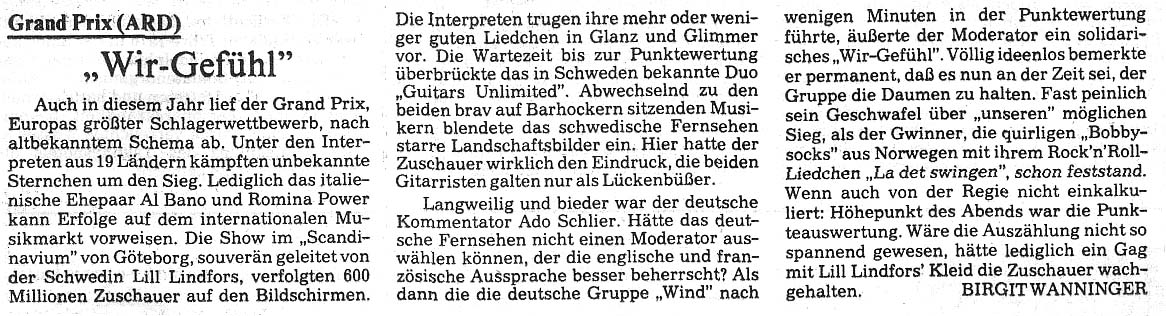
- Wanninger, Birgit. "'Wir-Gefühl'". [[Rheinische Post]].
- (4 May 1985). "Σάββατο". {{ill.
- (3 May 1985). "Saturday – Television".
- (3 May 1985). "Radio – Saturday".
- (3 May 1985). "מדריך טלוויזיה – שבת 4.5". [[Hadashot]].
- (3 May 1985). "מדריך רדיו – שבת 4.5". [[Hadashot]].
- (28 April – 4 May 1985). "TV {{!}} Sabato 4 maggio".
- (28 April – 4 May 1985). "Stereo {{!}} Sabato 4 maggio".
- (2 May 1985). "Samstag, 4. Mai".
- (3 May 1985). "Zaterdag 4 mei 1985". [[Limburgs Dagblad.
- (4 May 1985). "Dagens radio/TV". [[Moss Avis]].
- (4 May 1985). "Televisão". [[Diário de Lisboa]].
- (7 April 2018). "O número do dia. Quantos festivais comentou Eládio Clímaco na televisão portuguesa?". N-TV.
- (4 May 1985). "Espectaculos". {{ill.
- (28 March 2018). "Todos los comentaristas de la historia de España en Eurovisión (y una única mujer en solitario)". [[Los 40]].
- (4 May 1985). "TV.program". [[Dagens Nyheter]].
- (4 May 1985). "Radio.program". Dagens Nyheter.
- (4 May 1985). "TV + Radio · Samstag". [[Bieler Tagblatt]].
- (2 May 1985). "TV – samedi 4 mai".
- (4 May 1985). "Programmi tv". {{ill.
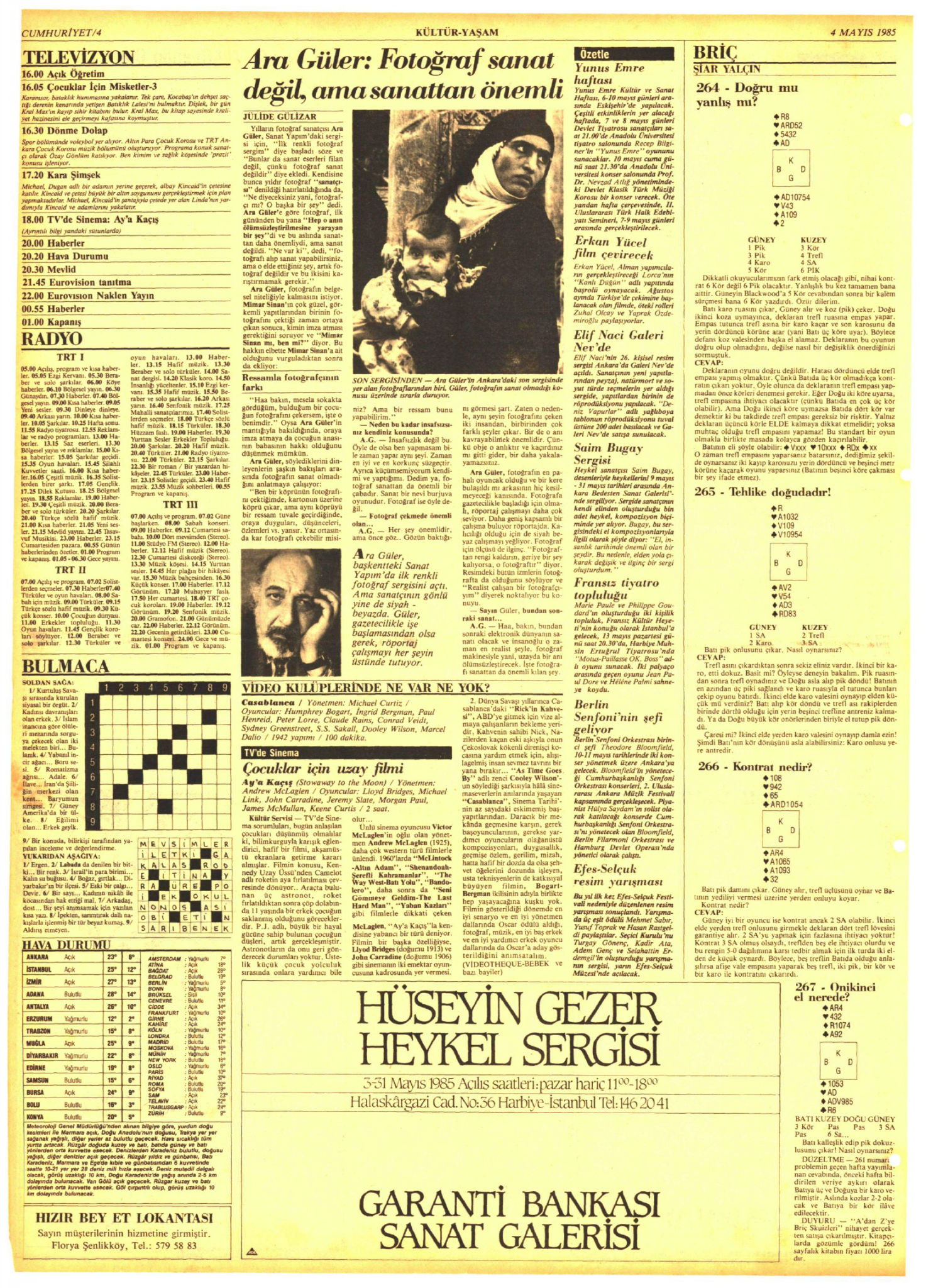
- (4 May 1985). "Televizyon". [[Cumhuriyet]].
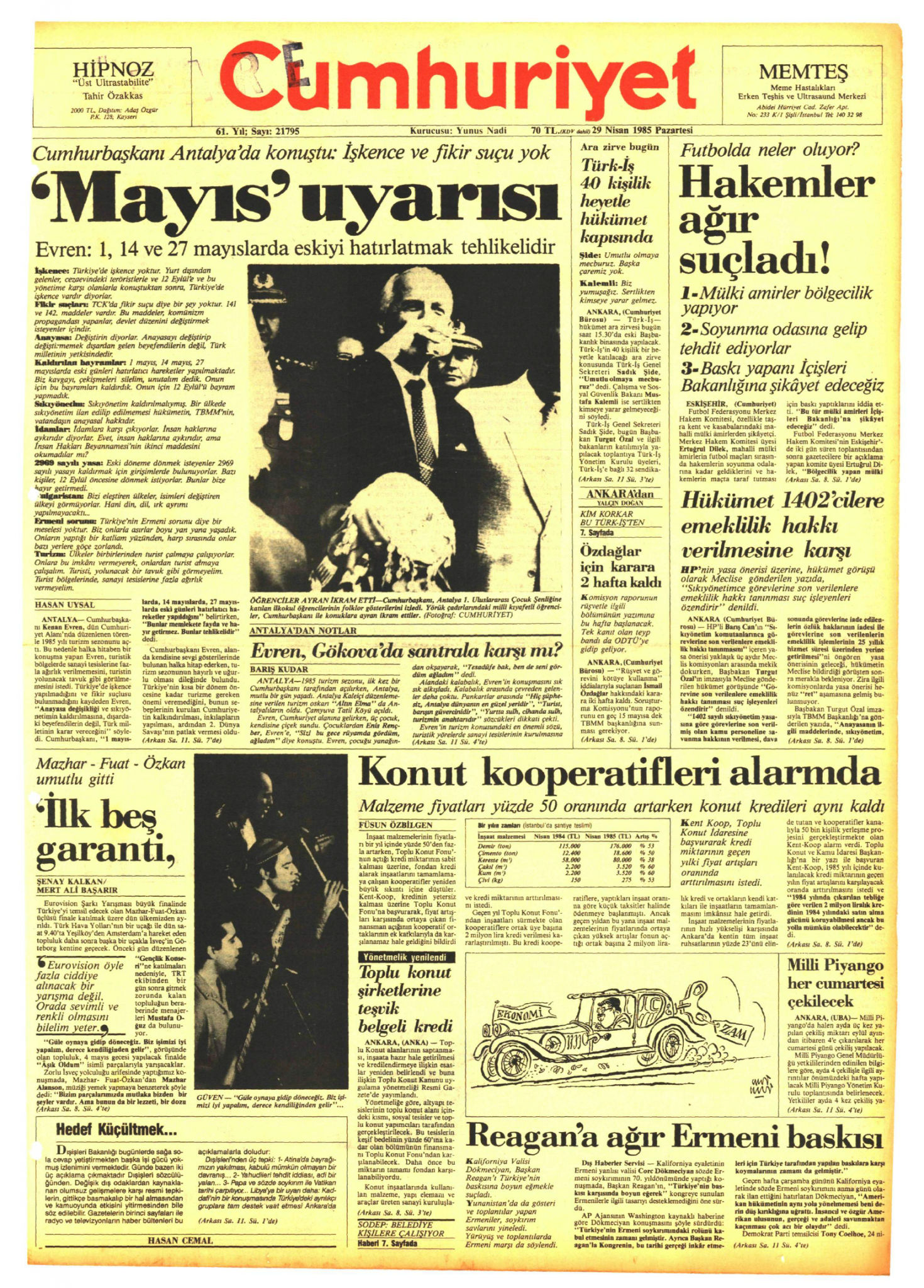
- (29 April 1985). "Mazhar - Fuat - Özkan umutlu gitti: 'İlk beş garanti'". [[Cumhuriyet]].
- (4 May 1985). "Eurovision Song Contest 1985 – BBC1".
- (5 May 1985). "Television". [[The Canberra Times]].
- (20 May 1985). "Program televize v týdnu od 27. května do 2. června 1985".
- (11 May 1985). "Sjónvarp". {{ill.
- (8 May 1985). "TV-kkut Aallakaatitassat {{!}} TV-Program". [[Atuagagdliutit/Grønlandsposten.
- (4 May 1985). "Laugardagur 4. maí". [[DV (newspaper).
- (1 June 1985). "TV3". [[New Straits Times.
- (4 May 1985). "Mededeling". [[Nieuwsblad van het Noorden]].
- (24 May 1985). "Telewizja". [[Dziennik Polski]].
- (25 May 1985). "Televiziune". Flacăra roșie.
- (20 May 1985). "유럽放送가요제 실황". [[Kyunghyang Shinmun]].
This article was imported from Wikipedia and is available under the Creative Commons Attribution-ShareAlike 4.0 License. Content has been adapted to SurfDoc format. Original contributors can be found on the article history page.
Ask Mako anything about Eurovision Song Contest 1985 — get instant answers, deeper analysis, and related topics.
Research with MakoFree with your Surf account
Create a free account to save articles, ask Mako questions, and organize your research.
Sign up freeThis content may have been generated or modified by AI. CloudSurf Software LLC is not responsible for the accuracy, completeness, or reliability of AI-generated content. Always verify important information from primary sources.
Report