From Surf Wiki (app.surf) — the open knowledge base
Eurovision Song Contest 1983
International song competition
International song competition
| Field | Value |
|---|---|
| name | Eurovision Song Contest |
| year | 1983 |
| logo | Eurovision Song Contest 1983 - logo.svg |
| final | 23 April 1983 |
| presenter | Marlene Charell |
| musdirector | Dieter Reith |
| director | Rainer Bertram |
| scrutineer | Frank Naef |
| exproducers | |
| organiser | European Broadcasting Union (EBU) |
| host | ARD – Bayerischer Rundfunk (BR) |
| venue | Rudi-Sedlmayer-Halle |
| Munich, West Germany | |
| winner | |
| "Si la vie est cadeau" | |
| vote | Each country awarded 12, 10, 8-1 point(s) to their 10 favourite songs |
| entries | 20 |
| return | |
| nonreturn | |
| Map NoSemis | Y |
Munich, West Germany "Si la vie est cadeau"
The Eurovision Song Contest 1983 was the 28th edition of the Eurovision Song Contest, held on 23 April 1983 at the Rudi-Sedlmayer-Halle in Munich, West Germany, and presented by Marlene Charell. It was organised by the European Broadcasting Union (EBU) and host broadcaster Bayerischer Rundfunk (BR) on behalf of ARD, who staged the event after winning the for with the song "Ein bißchen Frieden" by Nicole. Despite being that their first win at the contest, it was actually the second time that ARD had hosted the competition, having previously done so in in Frankfurt.
Broadcasters from twenty countries participated in the contest, with , , and all returning this year. Radio Telefís Éireann (RTÉ) decided not to participate citing industrial action, making this 's first absence since its debut in 1965.
The winner was with the song "Si la vie est cadeau" by Corinne Hermes, which equalled the record of five victories set by . This record would in turn be beaten by . It was also the second year in a row where the winning entry was performed last on the night and the second year in a row in which won 2nd place. For the third year in a row, at least one country ended up with nul points, and in this case, it happened to be two countries, and , neither of whom were able to get off the mark.
The 1983 contest was the first to be televised in Australia, via Channel 0/28 (now SBS) in Sydney and Melbourne. The contest went on to become popular in Australia, leading to at the in 2015.
Location
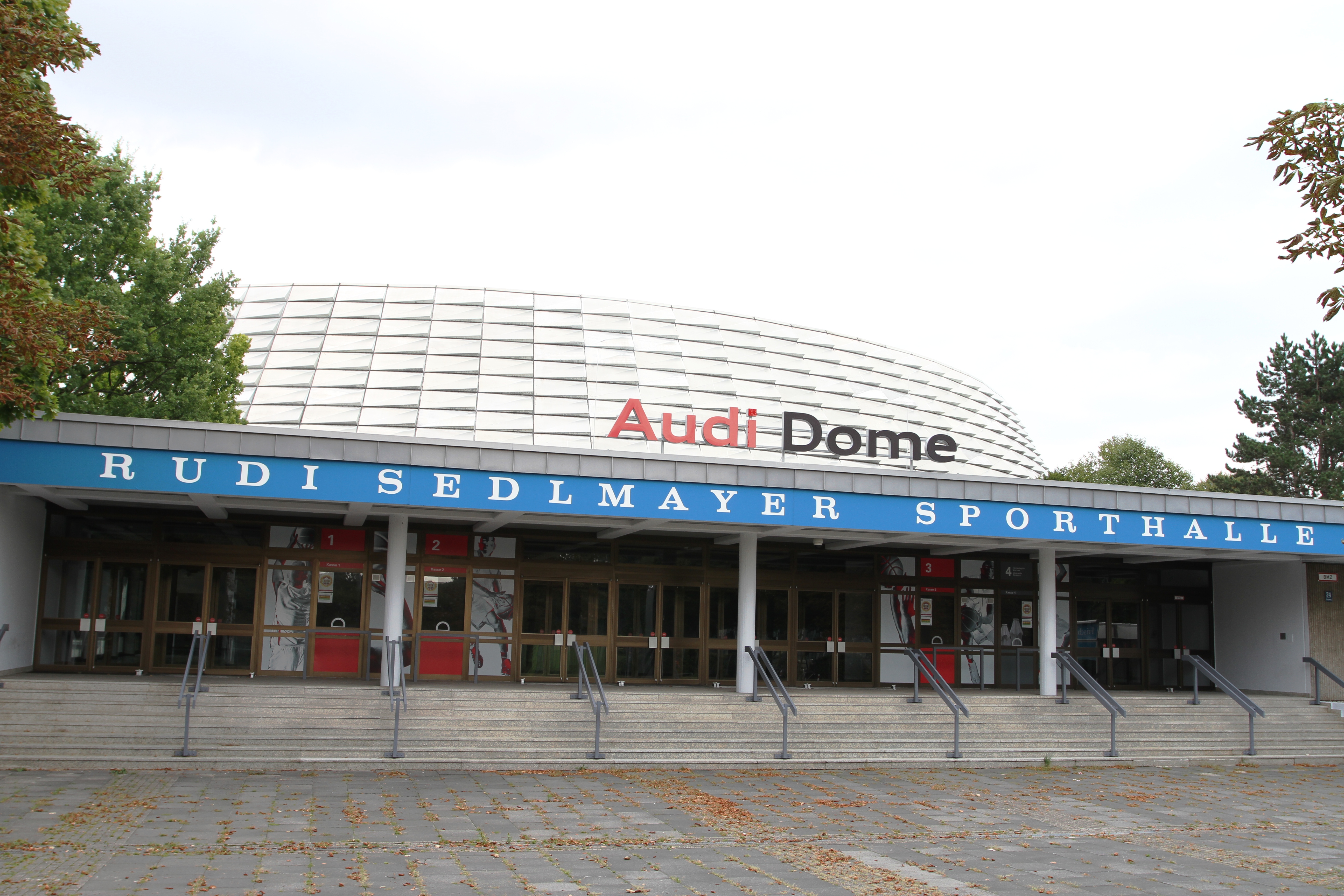
Munich is a German city and capital of the Bavarian state. Due to this, Munich houses the parliament and state government. Rudi-Sedlmayer-Halle was chosen to host the contest. It was initially named after the president of the Bavarian State Sport Association. The hall opened in 1972 to host basketball events for the 1972 Summer Olympics. Due to staging and production necessities, the 5,500 seats of the arena had to be reduced to 3,200 for the night of the final and until the , this was the largest arena to host the event. From this number, 2,000 seats were reserved for the delegations and journalists, and 1,200 tickets were on sale for the general public. The ticket prices ranged from 20 to 50 DM.
Participants
Twenty countries took part in the contest, with , , and returning to the competition. On the other hand, was absent this year for the first time since its debut in 1965 because of the financial difficulties of the national broadcaster, Radio Telefís Éireann (RTÉ).
Several of the performing artists had previously competed as lead artists representing the same country in past editions: Guy Bonnet had represented ; and Jahn Teigen had represented , and along Anita Skorgan. In addition, Sandra Reemer, who had represented the along with Andres Holten, , and ; Anita Skorgan who represented , , in 1982 along Jahn Teigen, and provided backing vocals ; and Izolda Barudžija, who represented as part of Aska; provided backing vocals for the same country in this contest.
| Country | Broadcaster | Artist | Song | Language | Songwriter(s) | Conductor |
|---|---|---|---|---|---|---|
| ORF | Westend | "Hurricane" | German | Richard Oesterreicher | ||
| BRT | Pas de Deux | "Rendez-vous" | Dutch | |||
| CyBC | and | "I agapi akoma zi" (Η αγάπη ακόμα ζει) | Greek | |||
| DR | Gry Johansen | "Kloden drejer" | Danish | Allan Botschinsky | ||
| YLE | Ami Aspelund | "Fantasiaa" | Finnish | Ossi Runne | ||
| Antenne 2 | Guy Bonnet | "Vivre" | French | François Rauber | ||
| BR | Hoffmann and Hoffmann | "Rücksicht" | German | Dieter Reith | ||
| ERT | Christie | "Mou les" (Μου λες) | Greek | Mimis Plessas | ||
| IBA | Ofra Haza | "Chai" (חי) | Hebrew | |||
| RAI | Riccardo Fogli | "Per Lucia" | Italian | Maurizio Fabrizio | ||
| CLT | Corinne Hermès | "Si la vie est cadeau" | French | Michel Bernholc | ||
| NOS | Bernadette | "Sing Me a Song" | Dutch | Piet Souer | ||
| NRK | Jahn Teigen | "Do Re Mi" | Norwegian | Sigurd Jansen | ||
| RTP | Armando Gama | "Esta balada que te dou" | Portuguese | Armando Gama | Mike Sergeant | |
| TVE | Remedios Amaya | "Quién maneja mi barca" | Spanish | José Miguel Évoras | ||
| SVT | Carola Häggkvist | "Främling" | Swedish | |||
| SRG SSR | Mariella Farré | "Io così non ci sto" | Italian | Robert Weber | ||
| TRT | Çetin Alp and the Short Wave | "Opera" | Turkish | Buğra Uğur | ||
| BBC | Sweet Dreams | "I'm Never Giving Up" | English | John Coleman | ||
| JRT | Daniel | "Džuli" (Џули) | Serbo-Croatian | Radovan Papović |
Production
The local production of the contest started in June 1982. The final was produced by Bayerischer Rundfunk (BR) on behalf of ARD, with production costs of 1.2 million DM, further 1.5 million DM for the organisation and broadcaster, making a total of 2.7 million DM. With the help of donations and other contributions, Bayerischer Rundfunk was able to reduce the costs at its own expense to about 1 million DM. The city of Munich had to contribute 60,000 DM to a reception for the participating delegations.
The contest was directed by . Dieter Reith served as the general musical director of the 60-piece orchestra. Christian Hayer and Günther Lebram served as the executive producers. Other leading figures in the production included Wolf Mittler, Sylvia de Bruycker, Christof Schmid and Joachim Krausz. Rehearsals started on 18 April 1983.
Stage design
The stage was designed by . The set was an arc-shaped stage surrounding the orchestra section and had a size of 4 x. A 26 m large and 7 m high steel construction with frames resembling giant electric heaters was used as the background. The 33 frames were equipped with three light panels each, at which hundreds of light bulbs were suspended. In total, 63,000 light bulbs, which could be controlled manually or by sound frequency, lit up and flashed in different sequences and combinations depending on the nature and rhythm of the songs.
Format
Various receptions and events were organised in the week leading up to the final. On 19 April 1983, a cruise on Lake Starnberg with several participants was held by the German National Tourist Board as a press event for 250 journalists. The Tourist Board also organised a bus tour for several participants to Linderhof Palace and Garmisch-Partenkirchen on 20 April 1983. On 19 April 1983, a reception for the participants was held at the Antiquarium in the Munich Residenz, on behalf of Franz Josef Strauss, minister-president of the state of Bavaria. Parties and receptions for the artists were also organised by the record labels Ariola, Polydor and Deutsche Grammophon. Ralph Siegel, composer of the winning entry for , and his own record label , held a party for 1,000 guests, including many artists, on 21 April 1983.
A press centre with television monitors, typewriters, telephones and paper notebooks was installed for the 600 journalists covering the event.
German Bundespost installed a post office from 18 to 23 April at the Rudi-Sedlmayr-Halle and stamped letters from there with a special Eurovision Song Contest postmark.
Presentation format
Instead of pre-filmed "postcards", the production team for this edition chose not to produce the postcards for technical reasons. During the change of the stage elements, the name of the next country was shown on screen accompanied by music from the orchestra, followed by a presentation of the upcoming entry by Marlene Charell.
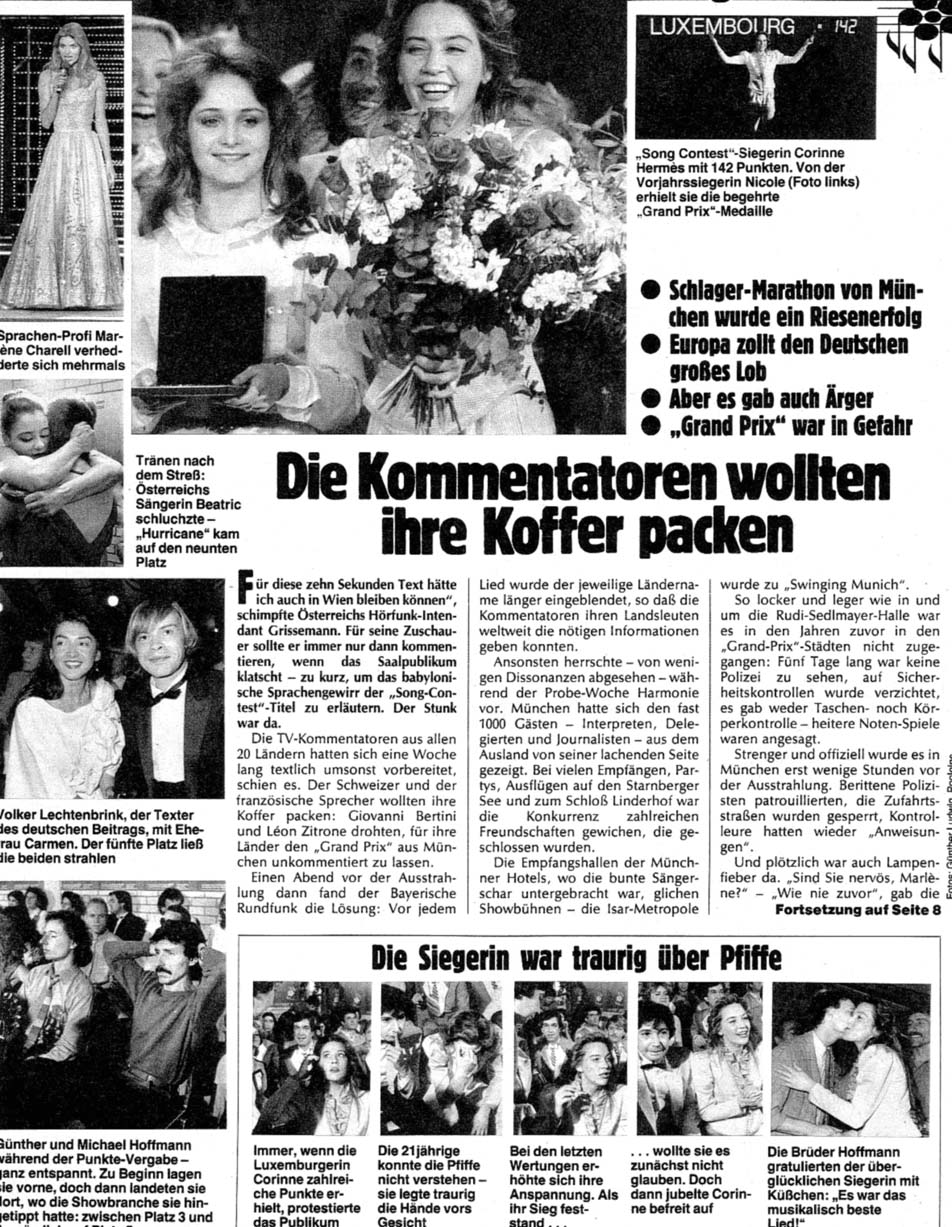
After the first rehearsals, the Austrian and British commentators complained that, since there were no postcards, they felt that there was not enough time to introduce the upcoming entry to their viewers, and subsequently threatened to withdraw from the contest. As a reaction, for the live show and latter rehearsals, the name of the upcoming country was shown on screen for a certain time so that commentators had enough time.
For the introduction of each entry, Charell stood in front of individual flower arrangements with flowers in the colours of the corresponding entry’s national flag. The floral arrangements were provided by the International Garden Expo 83 organization, as the event was also scheduled to start five days after the contest. Hostess Marlene Charell made all of her announcements in German before translating a repetition in both French and English. In all three languages, Charell named the country, song title, performing artist, author, composer and conductor. The decision not to use postcards apparently left Marlene lost during the event, as she would have to use three languages to introduce each of the participants.
Due to host Charell's use of three languages, the voting went on for nearly an hour, stretching the Eurovision contest past three hours for the second time ever, the first after 1979. In addition, Charell made 13 language mistakes throughout the night, some as innocuous as mixing up the words for "points" between the three languages, some as major as nearly awarding points to "Schweden" () that were meant for "Schweiz" ().
The language problems also occurred during the contest introductions, as Charell mispronounced the Finnish singer Ami Aspelund's surname as "Aspesund", Spanish singer Remedios Amaya's name as "Ramedios" and Portuguese singer Armando Gama's name as "Armendo". Furthermore, she introduced the Norwegian conductor Sigurd Jansen as "...Johannes...Skorgan...", and Yugoslavian conductor Radovan Papović as "Rodovan Popović" having been forced to make up a name on the spot after forgetting the conductor's name.
Contest overview
The contest took place on 23 April 1983, beginning at 21:00 CEST (19:00 UTC). At the start of the broadcast, a 7-minutes-long film with views of various sights of Germany and of the host city Munich was shown. As part of the introduction, a parade of nations was called by the presenter Marlene Charell. The interval act was a dance number set to a medley of German songs which had become internationally famous, including "Strangers in the Night". The host Marlene Charell was the lead dancer accompanied by her ballet with 20 dancers from her company.
Considered the big favourite of the night by the press, the Luxembourgish entry did not enjoy the same prestige among the local public who considered it a bad joke, and this was reflected in a series of hostilities from the public in Munich, to the point that the show director and Roger Kreischer, their counterpart at the Luxembourgish broadcaster RTL, openly criticized the mocking tone of the local media and the public present at the venue towards the Luxembourgish entry. It was famously seen during the broadcast that a good part of the public present at the contest site voluntarily left during the performance of Corinne Hermès, which according to the draw was the last of the 20 participating songs. Other embarrassing reactions towards the Luxembourgish participant were recorded during the voting. Each time the name Luxembourg was announced by the jury spokespeople from each country, laughters and some joking words were heard and when high scores appeared, boos and another low slangs ensued. When Corinne Hermès performed her reprise, a great part of the audience was already leaving.
After the show, a reception for 1,600 guests on behalf of the city of Munich took place in a tent of the International Garden Expo 83.
| R/O | Country | Artist | Song | Points | Place | 1 | 2 | 3 | 4 | 5 | 6 | 7 | 8 | 9 | 10 | 11 | 12 | 13 | 14 | 15 | 16 | 17 | 18 | 19 | 20 |
|---|---|---|---|---|---|---|---|---|---|---|---|---|---|---|---|---|---|---|---|---|---|---|---|---|---|
| "Vivre" | 56 | 8 | |||||||||||||||||||||||
| "Do Re Mi" | 53 | 9 | |||||||||||||||||||||||
| Sweet Dreams | "I'm Never Giving Up" | 79 | 6 | ||||||||||||||||||||||
| "Främling" | 126 | 3 | |||||||||||||||||||||||
| "Per Lucia" | 41 | 11 | |||||||||||||||||||||||
| and the Short Wave | "Opera" | 0 | 19 | ||||||||||||||||||||||
| "Quién maneja mi barca" | 0 | 19 | |||||||||||||||||||||||
| "Io così non ci sto" | 28 | 15 | |||||||||||||||||||||||
| "Fantasiaa" | 41 | 11 | |||||||||||||||||||||||
| Christie | "Mou les" | 32 | 14 | ||||||||||||||||||||||
| Bernadette | "Sing Me a Song" | 66 | 7 | ||||||||||||||||||||||
| Daniel | "Džuli" | 125 | 4 | ||||||||||||||||||||||
| Stavros and Constantina | "I agapi akoma zi" | 26 | 16 | ||||||||||||||||||||||
| Hoffmann and Hoffmann | "Rücksicht" | 94 | 5 | ||||||||||||||||||||||
| "Kloden drejer" | 16 | 17 | |||||||||||||||||||||||
| "Chai" | 136 | 2 | |||||||||||||||||||||||
| "Esta balada que te dou" | 33 | 13 | |||||||||||||||||||||||
| Westend | "Hurricane" | 53 | 9 | ||||||||||||||||||||||
| Pas de Deux | "Rendez-vous" | 13 | 18 | ||||||||||||||||||||||
| "Si la vie est cadeau" | 142 | 1 |
Spokespersons
Each participating broadcaster appointed a spokesperson who was responsible for announcing the votes for its respective country via telephone. Known spokespersons at the 1983 contest are listed below.
- DenmarkBent Evold
- FinlandSolveig Herlin
- NetherlandsFlip van der Schalie
- SpainRosa Campano
- SwedenAgneta Bolme Börjefors
- United KingdomColin Berry
Detailed voting results
Each participating broadcaster assembled a jury consisting of 11 non-professional jurors who awarded 12, 10, 8, 7, 6, 5, 4, 3, 2, 1 point(s) to their top ten songs.
| nb=1 | Total score}} | nb=1 | France}} | nb=1 | Norway}} | nb=1 | United Kingdom}} | nb=1 | Sweden}} | nb=1 | Italy}} | nb=1 | Turkey}} | nb=1 | Spain}} | nb=1 | Switzerland}} | nb=1 | Finland}} | nb=1 | Greece}} | nb=1 | Netherlands}} | nb=1 | Yugoslavia}} | nb=1 | Cyprus}} | nb=1 | Germany}} | nb=1 | Denmark}} | nb=1 | Israel}} | nb=1 | Portugal}} | nb=1 | Austria}} | nb=1 | Belgium}} | nb=1 | Luxembourg}} | va=middle | Contestants}} | France | Norway | United Kingdom | Sweden | Italy | Turkey | Spain | Switzerland | Finland | Greece | Netherlands | Yugoslavia | Cyprus | Germany | Denmark | Israel | Portugal | Austria | Belgium | Luxembourg |
|---|---|---|---|---|---|---|---|---|---|---|---|---|---|---|---|---|---|---|---|---|---|---|---|---|---|---|---|---|---|---|---|---|---|---|---|---|---|---|---|---|---|---|---|---|---|---|---|---|---|---|---|---|---|---|---|---|---|---|---|---|---|---|---|
| 56 | 3 | 10 | 10 | 6 | 7 | 2 | 3 | 4 | 4 | 1 | 3 | 3 | |||||||||||||||||||||||||||||||||||||||||||||||||||
| 53 | 5 | 3 | 6 | 8 | 1 | 8 | 4 | 6 | 3 | 7 | 2 | ||||||||||||||||||||||||||||||||||||||||||||||||||||
| 79 | 5 | 5 | 12 | 2 | 5 | 8 | 5 | 5 | 6 | 3 | 5 | 2 | 10 | 6 | |||||||||||||||||||||||||||||||||||||||||||||||||
| 126 | 6 | 12 | 8 | 8 | 7 | 2 | 5 | 10 | 10 | 3 | 1 | 7 | 12 | 10 | 8 | 4 | 8 | 5 | |||||||||||||||||||||||||||||||||||||||||||||
| 41 | 7 | 2 | 4 | 3 | 1 | 2 | 8 | 1 | 6 | 7 | |||||||||||||||||||||||||||||||||||||||||||||||||||||
| 0 | |||||||||||||||||||||||||||||||||||||||||||||||||||||||||||||||
| 0 | |||||||||||||||||||||||||||||||||||||||||||||||||||||||||||||||
| 28 | 1 | 7 | 1 | 7 | 6 | 1 | 5 | ||||||||||||||||||||||||||||||||||||||||||||||||||||||||
| 41 | 1 | 2 | 6 | 3 | 4 | 8 | 7 | 7 | 2 | 1 | |||||||||||||||||||||||||||||||||||||||||||||||||||||
| 32 | 3 | 12 | 5 | 12 | |||||||||||||||||||||||||||||||||||||||||||||||||||||||||||
| 66 | 2 | 7 | 1 | 6 | 4 | 2 | 12 | 3 | 5 | 5 | 2 | 4 | 3 | 4 | 2 | 4 | |||||||||||||||||||||||||||||||||||||||||||||||
| 125 | 8 | 12 | 1 | 12 | 10 | 12 | 6 | 7 | 8 | 6 | 12 | 10 | 1 | 12 | 8 | ||||||||||||||||||||||||||||||||||||||||||||||||
| 26 | 4 | 1 | 6 | 5 | 1 | 5 | 4 | ||||||||||||||||||||||||||||||||||||||||||||||||||||||||
| 94 | 10 | 10 | 7 | 8 | 6 | 2 | 4 | 1 | 10 | 3 | 8 | 7 | 6 | 12 | |||||||||||||||||||||||||||||||||||||||||||||||||
| 16 | 2 | 7 | 1 | 4 | 2 | ||||||||||||||||||||||||||||||||||||||||||||||||||||||||||
| 136 | 8 | 6 | 10 | 5 | 3 | 6 | 7 | 7 | 3 | 12 | 10 | 10 | 7 | 10 | 12 | 10 | 10 | ||||||||||||||||||||||||||||||||||||||||||||||
| 33 | 4 | 1 | 5 | 6 | 2 | 6 | 2 | 7 | |||||||||||||||||||||||||||||||||||||||||||||||||||||||
| 53 | 3 | 4 | 5 | 10 | 4 | 4 | 4 | 3 | 6 | 2 | 5 | 3 | |||||||||||||||||||||||||||||||||||||||||||||||||||
| 13 | 4 | 8 | 1 | ||||||||||||||||||||||||||||||||||||||||||||||||||||||||||||
| 142 | 12 | 10 | 12 | 8 | 7 | 3 | 8 | 12 | 1 | 12 | 10 | 8 | 2 | 12 | 12 | 5 | 8 |
12 points
Below is a summary of all 12 points in the final:
| N. | Contestant | Nation(s) giving 12 points | 6 | 5 | 2 | 1 |
|---|---|---|---|---|---|---|
| **** | , , , , , | |||||
| , , , , | ||||||
| , | ||||||
| , | ||||||
| , |
Broadcasts
Each participating broadcaster was required to relay the contest via its networks. Non-participating EBU member broadcasters were also able to relay the contest as "passive participants". Broadcasters were able to send commentators to provide coverage of the contest in their own native language and to relay information about the artists and songs to their television viewers. Host broadcaster BR provided 30 commentator boxes for this purpose.
The contest was reportedly broadcast in 30 countries, including the Eastern Bloc countries, Jordan and Hong Kong. No official accounts of the global viewing figures are known to exist, with estimates given in the press at the time ranging from 300 to 600 million viewers. Known details on the broadcasts in each country, including the specific broadcasting stations and commentators are shown in the tables below.
| Country | Broadcaster | Channel(s) | Commentator(s) | Austria | Belgium | Cyprus | Denmark | Finland | France | Germany | Greece | Israel | Italy | Luxembourg | Netherlands | Norway | Portugal | Spain | Sweden | Switzerland | Turkey | United Kingdom | Yugoslavia | ||
|---|---|---|---|---|---|---|---|---|---|---|---|---|---|---|---|---|---|---|---|---|---|---|---|---|---|
| ORF | FS2 | Ernst Grissemann | |||||||||||||||||||||||
| BRT | TV1 | Luc Appermont | |||||||||||||||||||||||
| BRT 2 | |||||||||||||||||||||||||
| RTBF | Télé 2 | Jacques Mercier | |||||||||||||||||||||||
| RTBF Radio 1 | |||||||||||||||||||||||||
| CyBC | RIK | ||||||||||||||||||||||||
| DR | DR TV | Jørgen de Mylius | |||||||||||||||||||||||
| YLE | TV1 | Erkki Pohjanheimo | |||||||||||||||||||||||
| {{ill | Rinnakkaisohjelma | fi}} | |||||||||||||||||||||||
| Antenne 2 | Léon Zitrone | ||||||||||||||||||||||||
| RFO | |||||||||||||||||||||||||
| ARD | Deutsches Fernsehen | ||||||||||||||||||||||||
| BR | Bayern 1 | ||||||||||||||||||||||||
| HR | Frankfurt 1 | ||||||||||||||||||||||||
| NDR | |||||||||||||||||||||||||
| RIAS | RIAS 1 | ||||||||||||||||||||||||
| ERT | ERT1, B Programma | ||||||||||||||||||||||||
| IBA | Israeli Television, | ||||||||||||||||||||||||
| RAI | Rete Uno | ||||||||||||||||||||||||
| CLT | RTL Télévision | ||||||||||||||||||||||||
| NOS | Nederland 1 | Willem Duys | |||||||||||||||||||||||
| NRK | NRK Fjernsynet | ||||||||||||||||||||||||
| NRK | |||||||||||||||||||||||||
| RTP | RTP1 | Eládio Clímaco | |||||||||||||||||||||||
| RDP | Antena 1 | ||||||||||||||||||||||||
| TVE | TVE 1 | José-Miguel Ullán | |||||||||||||||||||||||
| SVT | TV1 | Ulf Elfving | |||||||||||||||||||||||
| SR P3 | Kent Finell | ||||||||||||||||||||||||
| SRG SSR | TV DRS | ||||||||||||||||||||||||
| TSR | |||||||||||||||||||||||||
| TSI | Giovanni Bertini | ||||||||||||||||||||||||
| TRT | TRT Televizyon | ||||||||||||||||||||||||
| BBC | BBC1 | Terry Wogan | |||||||||||||||||||||||
| BFBS | BFBS Radio | Richard Nankivell | |||||||||||||||||||||||
| JRT | TV Beograd 1, TV Novi Sad, TV Prishtina, TV Zagreb 1 | Oliver Mlakar | |||||||||||||||||||||||
| TV Ljubljana 1 |
| Country | Broadcaster | Channel(s) | Commentator(s) | Australia | Czechoslovakia | Faroe Islands | Greenland | Iceland | Ireland | Poland | Romania | South Africa |
|---|---|---|---|---|---|---|---|---|---|---|---|---|
| SBS | Channel 0/28 | Terry Wogan | ||||||||||
| ČST | ||||||||||||
| SvF | ||||||||||||
| KNR | KNR | |||||||||||
| RÚV | Sjónvarpið | |||||||||||
| RTÉ | RTÉ 1 | Terry Wogan | ||||||||||
| RTÉ Radio 1 | Brendan Balfe | |||||||||||
| TP | TP1 | |||||||||||
| TVR | Programul 1 | |||||||||||
| SABC | Radio 5 |
Notes
References
References
- Wach, Gerlinde. (22 April 1983). "Arena für 500 Millionen Zuschauer". [[Süddeutsche Zeitung]].
- Utermöhle, Elna. (25 April 1983). "Warum hielt OB Kiesl keine Begrüßungsrede?". [[Münchner Merkur]].
- (28 February 1983). "Ireland not in song contest". Cork Examiner.
- "Munich 1983 – Participants". European Broadcasting Union.
- "Alle deutschen ESC-Acts und ihre Titel". ARD.
- Wolf, Oswald. (21 April 1983). "Auch ohne Strom gibt's 'Saft' beim Grand Prix". [[Tz (newspaper).
- Goslich, Lorenz. (23 April 1983). "Nicole wurde ein teures Mädchen für das Fernsehen". [[Frankfurter Allgemeine Zeitung]].
- (25 April 1983). "Meinung aller Teilnehmer: Ein 'Grand Prix' für Bayerns Gastfreundschaft". [[Tz (newspaper).
- Fischer, Otto. (8 October 1982). "Stadt bei Selbstdarstellung zu großzügig". [[Süddeutsche Zeitung]].
- Jalowy, Stefan. (19 April 1983). "Ein "Fremder" ist in München heißer Favorit". [[Abendzeitung]].
- Heller, Erich. (25 April 1983). "Langeweile vor dem Grill". [[Tz (newspaper).
- Eckert, Christian. (19 April 1983). "30 Kilometer Kabel und 99 Lichtflächen". [[Münchner Merkur]].
- Seipel, Rainer-R.. (19 April 1983). "Countdown zum Grand Prix: 500 000 000 sind dabei". [[Tz (newspaper).
- (21 April 1983). "Sternchen im Fünfseenland". [[Süddeutsche Zeitung]]. Hauptausgabe München.
- (20 April 1983). "Dampfer voller Schlager-Stars". [[Tz (newspaper).
- Eckert, Christian. (22 April 1983). "Alle warten auf den Samstag". [[Münchner Merkur]].
- (21 April 1983). "Corinne war auf Ludwigs Spuren". [[Abendzeitung]].
- (20 April 1983). "Strauß über den Grand Prix". [[Abendzeitung]].
- Graeter, Michael. (21 April 1983). "'New Wave' im ehrwürdigen Antiquarium". [[Abendzeitung]].
- Graeter, Michael. (23 April 1983). "Siegel lud – und alle Tonangeber kamen". [[Abendzeitung]].
- (23 April 1983). "Rauschendes 'Erntedankfest' bei Ralph Siegel". [[Tz (newspaper).
- (25 April 1983). "Hinter den Kulissen". [[Tz (newspaper).
- Zur, Franziska. (23 April 1983). "600 Millionen wollen Marlene sehen". {{ill.
- (16 April 1983). "Münchner Notizbuch". [[Süddeutsche Zeitung]].
- (23 April 1983). "Eurovision Song Contest 1983". [[Bayerischer Rundfunk]].
- "Eurovision 1983 facts".
- Boom-Bang-a-Bang: Eurovision's Funniest Moments, BBC-TV, hosted by Terry Wogan
- (23 April 1983). "Fernsehen und Hörfunk". [[Süddeutsche Zeitung]].
- (23 April 1983). "Ein bißchen Hoffnung auf viel 'Rücksicht'". [[Abendzeitung]].
- (23 April 1983). "Eurovision Song Contest 1983". [[Münchner Merkur]].
- Heller, Erich. (22 April 1983). "Grand Prix: Marlene Charell tanzt mit". [[Tz (newspaper).
- Veszelits, Thomas. (25 April 1983). "Festival der Langeweile". [[Abendzeitung]].
- Utermöhle, Elna. (25 April 1983). "Peinliches Ende des Schlager-Festivals: Das Publikum lief vor dem Siegerlied davon". [[Münchner Merkur]].
- Wach, Gerlinde. (25 April 1983). "Der Sängerkrieg in der Basketballhalle". [[Süddeutsche Zeitung]]. Hauptausgabe München.
- (25 April 1983). "Oberbürgermeister Erich Kiesl lud nach dem Liederwettbewerb…". [[Münchner Merkur]].
- "Munich 1983 – Scoreboard". European Broadcasting Union.
- "Vendsyssel Tidende - Hjørring - 23/03 1983".
- Murtomäki, Asko. (2007). "Finland 12 points! Suomen Euroviisut". Teos.
- (23 April 1983). "televisietips". [[Het Vrije Volk]].
- (2006). "Melodifestivalen genom tiderna : de svenska uttagningarna och internationella finalerna". Premium Publishing.
- Jalowy, Stefan. (21 April 1983). "Ramersdorferin gehört zur 'Grand Prix'-Jury". [[Abendzeitung]].
- "Munich 1983 – Detailed voting results". European Broadcasting Union.
- "Eurovision Song Contest 1983 – Scoreboard". European Broadcasting Union.
- (31 October 2018). "The Rules of the Contest". European Broadcasting Union.
- (25 April 1983). "Une gagnante inattendue". [[Journal du Jura]].
- (18 April 1983). "Schlager für rund 300 Millionen Zuschauer". [[Neue Zürcher Zeitung]].
- (23 April 1983). "Alt om Melodi Grand Prix". [[Flensborg Avis]].
- Utermöhle, Elna. (19 April 1983). "Der erste Ärger...". [[Münchner Merkur]].
- (22 April 1983). "Radio – Televizija". Slovenski vestnik.
- (22 May 2015). "Ein virtueller Disput der ESC-Kommentatoren". [[Kurier]].
- (23 April 1983). "TV–programma's van zaterdag 23 april 1983". [[De Standaard]].
- (23 April 1983). "Radio". [[De Standaard]].
- (23–24 April 1983). "télévision {{!}} radio". {{ill.
- Ioannidi, Christiana. (23 April 1983). ""Γιουροβίζιον" απόψε στις 10 μ.μ.". {{lang.
- "Alle tiders programoversigter – Lørdag den 23. april 1983". [[DR (broadcaster).
- (23 April 1983). "Radio · TV". [[Helsingin Sanomat]].
- (23–24 April 1983). "Téléprevision". {{ill.
- (8 June 1983). "Television : voir et entendre, entendre pour comprendre, mais comprendre pure critiquer". Le Progressiste.
- (23 April 1983). "Fernsehen•Rundfunk". [[Die Welt]].
- (23 April 1983). "Radioprogramm".
- (23 April 1983). "Das bringt der Hörfunk". [[Der Nordschleswiger]].
- (23 April 1983). "TV ΕΡΤ". [[Rizospastis]].
- (23 April 1983). "Ραδιόφωνο". Rizospastis.
- (22 April 1983). "שבת – טלוויזיה". [[Davar]].
- (22 April 1983). "רדיו שבת – 23.4.83". Davar.
- (17–23 April 1983). "Sabato 23 aprile 1983".
- (21 April 1983). "Samstag, 23. April".
- (23 April 1983). "Radio televisie". [[Algemeen Dagblad]].
- (23 April 1983). "Radio & TV". [[Harstad Tidende]].
- (23 April 1983). "Hoje". [[Diário de Lisboa]].
- (7 April 2018). "O número do dia. Quantos festivais comentou Eládio Clímaco na televisão portuguesa?". N-TV.
- (23 April 1983). "Rádio". Diário de Lisboa.
- (23 April 1983). "radio/televisión". [[Pueblo (newspaper).
- (23 April 1983). "tv-programmen". [[Svenska Dagbladet]].
- (23 April 1983). "radioprogrammen". Svenska Dagbladet.
- (23–24 April 1983). "Fernsehen – Samstag". Neue Zürcher Zeitung.
- (21 April 1983). "TV – samedi 23 avril".
- (23 April 1983). "Oggi e domani sul video". Popolo e Libertà.
- (29 April 1983). "Die Kommentatoren wollten ihre Koffer packen". Gong Verlag.
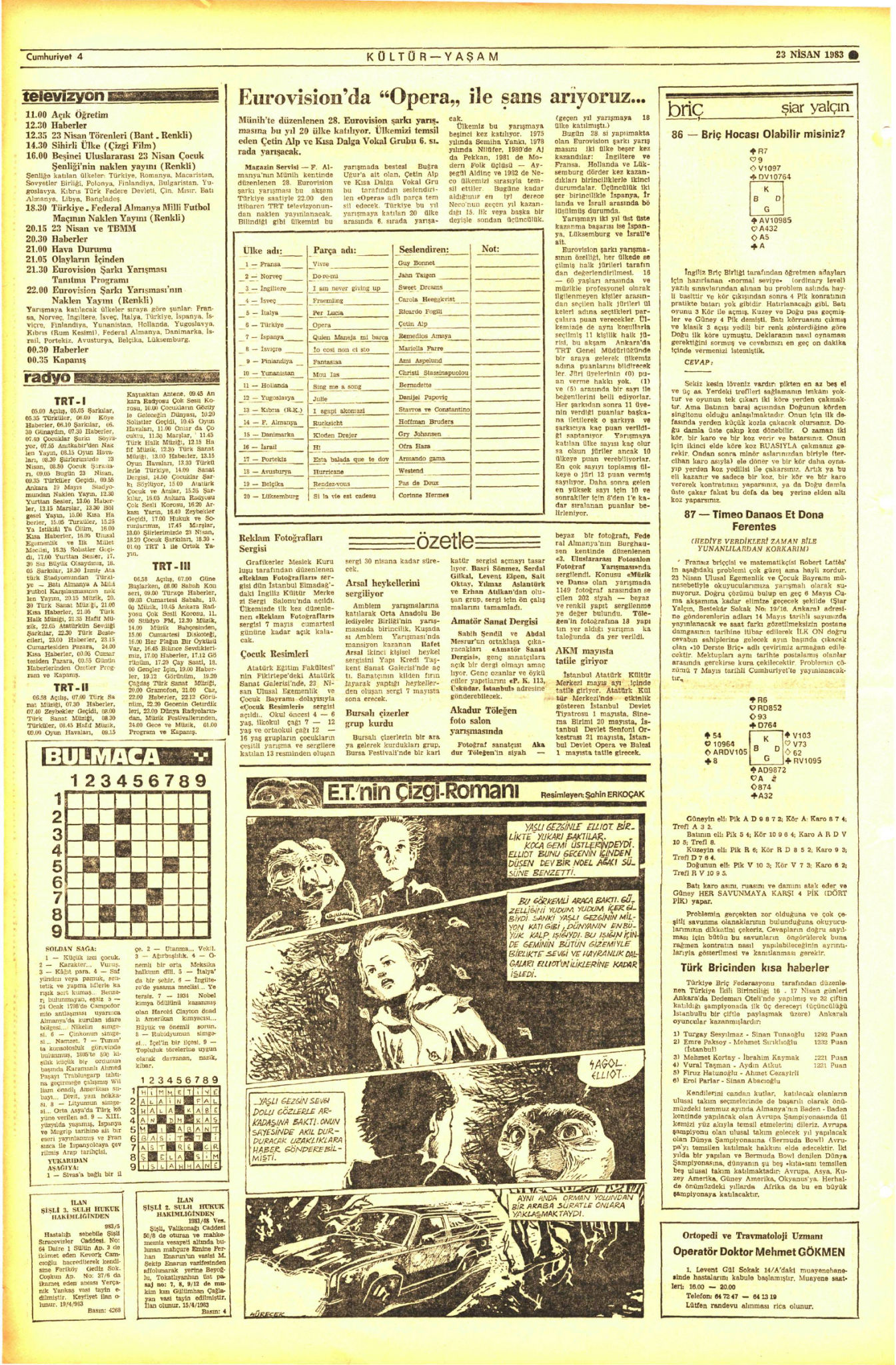
- (23 April 1983). "Televizyon". [[Cumhuriyet]].
- (23 April 1983). "Eurovision Song Contest 1983 – BBC1".
- Roxburgh, Gordon. (2017). "Songs For Europe - The United Kingdom at the Eurovision Song Contest". [[Telos Publishing]].
- (23 April 1983). "Телевизија". [[Politika]].
- (23–29 April 1983). "Szombat – Április 23.".
- (22 April 1983). "TVN Program {{!}} od 22. do 28. travnja". Glas Podravine.
- (23 April 1983). "RTV". [[Delo (newspaper).
- (24 April 1983). "Sunday's programs". [[The Sydney Morning Herald]].
- (9 May 1983). "pá 20. května". Rozhlasový týdeník.
- (30 April 1983). "TV/ÚF". 14. September.
- (20 April 1983). "KNR-TV". [[Atuagagdliutit/Grønlandsposten.
- (22 April 1983). "Sjónvarp". [[DV (newspaper).
- (22 April 1983). "Television Saturday".
- (22 April 1983). "Saturday Radio".
- (20 May 1983). "Program telewizji – sobota". [[Dziennik Polski]].
- (30 April 1983). "Televiziune". Drumul socialismului.
- (23 April 1983). "Sangfees oor Radio 5". [[Die Transvaler]].
This article was imported from Wikipedia and is available under the Creative Commons Attribution-ShareAlike 4.0 License. Content has been adapted to SurfDoc format. Original contributors can be found on the article history page.
Ask Mako anything about Eurovision Song Contest 1983 — get instant answers, deeper analysis, and related topics.
Research with MakoFree with your Surf account
Create a free account to save articles, ask Mako questions, and organize your research.
Sign up freeThis content may have been generated or modified by AI. CloudSurf Software LLC is not responsible for the accuracy, completeness, or reliability of AI-generated content. Always verify important information from primary sources.
Report