From Surf Wiki (app.surf) — the open knowledge base
Eurovision Song Contest 1982
International song competition

International song competition
| Field | Value |
|---|---|
| name | Eurovision Song Contest |
| year | 1982 |
| logo | Eurovision Song Contest 1982 - logo.svg |
| final | 24 April 1982 |
| presenter | Jan Leeming |
| musdirector | Ronnie Hazlehurst |
| director | Michael Hurll |
| scrutineer | Frank Naef |
| exproducer | Michael Hurll |
| organiser | European Broadcasting Union (EBU) |
| host | British Broadcasting Corporation (BBC) |
| venue | Harrogate International Centre |
| Harrogate, United Kingdom | |
| winner | |
| "Ein bißchen Frieden" | |
| vote | Each country awarded 12, 10, 8-1 point(s) to their 10 favourite songs |
| entries | 18 |
| nonreturn | |
| Map NoSemis | Y |
Harrogate, United Kingdom "Ein bißchen Frieden"
The Eurovision Song Contest 1982 was the 27th edition of the Eurovision Song Contest, held on 24 April 1982 at the Harrogate International Centre in Harrogate, United Kingdom, and presented by Jan Leeming. It was organised by the European Broadcasting Union (EBU) and host broadcaster the British Broadcasting Corporation (BBC), who staged the event after winning the for the with the song "Making Your Mind Up" by Bucks Fizz.
Broadcasters from eighteen countries participated in the contest with deciding not to enter this year. Due to internal issues regarding a reform of national telecommunications laws, there was no broadcaster that could participate representing for the first time in history.
The winner was with the song "Ein bißchen Frieden" by Nicole. This was the first time that Germany had won the contest after having competed every year since the contest's inception. Germany received 1.61 times as many points as runner-up , which was a record under the current scoring system until , when received 1.78 times as many points as . The song also cemented Ralph Siegel and Bernd Meinunger, the song's composers, into German Eurovision tradition, writing 18 Eurovision songs between them before and after "Ein bißchen Frieden", 13 of which were for Germany.
Location
Harrogate is a spa town in North Yorkshire, England. Historically in the West Riding of Yorkshire, the town is a tourist destination and its visitor attractions include its spa waters and RHS Harlow Carr gardens. Nearby is the Yorkshire Dales national park and the Nidderdale AONB. Harrogate grew out of two smaller settlements, High Harrogate and Low Harrogate, in the 17th century. The town became known as 'The English Spa' in the Georgian Era, after its waters were discovered in the 16th century. In the 17th and 18th centuries its 'chalybeate' waters (containing iron) were a popular health treatment, and the influx of wealthy but sickly visitors contributed significantly to the wealth of the town.
The Harrogate International Centre was chosen as the host venue for the contest. The grand convention and exhibition centre opened a short time prior to the contest, and was the first big event held in the main 2000-seat auditorium. Only 50 local people would see the contest in person, with most seats filled out with delegations and civic dignitaries.
Participants
With 18 participating countries, this was the last Eurovision contest to have such a low number of entries.
was due to participate in the contest with the song "Sarantapente kopelies" performed by Themis Adamantidis. Although drawn to perform in position number 2, Hellenic Broadcasting Corporation (ERT) withdrew a few weeks before the contest. According to press reports, Greek Minister of Culture and Sports Melina Mercouri had voiced her opposition to the chosen entry as being too low in quality.
In November 1981, the French participating broadcaster, Télévision Française 1 (TF1), declined to enter the Eurovision Song Contest 1982, with the head of entertainment, Pierre Bouteiller, saying, "The absence of talent and the mediocrity of the songs is where annoyance sets in. [Eurovision is] a monument to insanity [sometimes translated as "drivel"]." Antenne 2 became the new French participating broadcaster after public outcry, entering the contest for the first time in .
Several of the performing artists had previously competed as lead artists representing the same country in past editions: Anita Skorgan had represented and , and had provided backing vocals ; Jahn Teigen had represented ; Fatima Padinha and Teresa Miguel, members of Doce, had represented as part of Gemini; Sally Ann Triplett, a member of Bardo, had represented the as part of Prima Donna. In addition, Anna Vissi representing Cyprus, had represented along with the Epikouri; and Stella Maessen representing Belgium, had represented the as part of Hearts of Soul and as part of Dream Express. Olcayto Ahmet Tuğsuz, who represented as part of Nazar, provided backing vocals for Turkey.
| Country | Broadcaster | Artist | Song | Language | Songwriter(s) | Conductor |
|---|---|---|---|---|---|---|
| ORF | Mess | "Sonntag" | German | Richard Oesterreicher | ||
| RTBF | Stella | "Si tu aimes ma musique" | French | Jack Say | ||
| CyBC | Anna Vissi | "Mono i agapi" (Μόνο η αγάπη) | Greek | Anna Vissi | Martyn Ford | |
| DR | Brixx | "Video-Video" | Danish | Allan Botschinsky | ||
| YLE | Kojo | "Nuku pommiin" | Finnish | Ossi Runne | ||
| BR | Nicole | "Ein bißchen Frieden" | German | Norbert Daum | ||
| RTÉ | The Duskeys | "Here Today, Gone Tomorrow" | English | Sally Keating | Noel Kelehan | |
| IBA | Avi Toledano | "Hora" (הורה) | Hebrew | |||
| CLT | "Cours après le temps" | French | ||||
| NOS | Bill van Dijk | "Jij en ik" | Dutch | Rogier van Otterloo | ||
| NRK | Jahn Teigen and Anita Skorgan | "Adieu" | Norwegian | Sigurd Jansen | ||
| RTP | Doce | "Bem bom" | Portuguese | Luis Duarte | ||
| TVE | Lucía | "Él" | Spanish | Miguel Ángel Varona | ||
| SVT | Chips | "Dag efter dag" | Swedish | Anders Berglund | ||
| SRG SSR | Arlette Zola | "Amour on t'aime" | French | Joan Amils | ||
| TRT | "Hani?" | Turkish | Garo Mafyan | |||
| BBC | Bardo | "One Step Further" | English | Simon Jefferis | Ronnie Hazlehurst | |
| JRT | Aska | "Halo, halo" (Хало, хало) | Serbo-Croatian |
Format
The overall costs to organize the contest was £500,000.
The opening of the contest showed a map of Europe, with the translation "Where is Harrogate?" popping up on-screen from the languages of the participating countries. The question was always in the language in which the respective country's song was performed, with the exception of Ireland. The Irish entry was sung in English, but the translation of the question in the map was in Irish. Then the map zoomed into Harrogate's location in Yorkshire, followed by an introduction video spotlighting the town.
This year, before the postcard of a specific country (with the exceptions of Israel, who had no commentator, and Yugoslavia, whose commentators were in their own country), the camera would zoom into the commentary box of that country's broadcaster, where the commentator/s would give a hand gesture, e.g. wave. The postcard would start with the country's flag on the screen and an excerpt of the country's national anthem (though in the case of the host country, the UK, the song played was "Land of Hope and Glory" instead of "God Save the Queen", while the Israeli postcard began with an excerpt of "Hava Nagila" instead of "Hatikvah"). The postcards themselves, utilizing state-of-the-art video technology (for its time), were a montage of footage of the artist in Harrogate town or at the International Flower Festival. Some of the postcards also incorporated footage from the preview videos submitted by each participating broadcaster; only preview videos which did not consist of a performance of the song from a national final were used. Apart the national anthem, the postcards also used either a popular song or tune from the country being shown or a song performed at previous editions of Eurovision (i.e. for the Yugoslav entry, "Jedan dan" from 1968 was used, and for Israel, the winning song "Hallelujah" by Milk and Honey from 1979 was used). After the conclusion of the video clip, Jan Leeming introduced the conductor and then the artist for each nation.
Contest overview
After coming second in the Hague in 1980 and in Dublin in 1981, Ralph Siegel and Bernd Meinunger took the first win for Germany. The country led the voting process from start to finish, with no competing country threatening at any point. At the end of 204 available points, Germany had gained 161, with Israel finishing with 100 in second place. For the winning country, this moment was also historic because around 13 million people in West Germany were tuned in to their televisions at that exact moment.
Nicole went on to sing the reprise of her song in English, French and Dutch, as well as German. The English version (also produced by Siegel and ) of her Eurovision winner, "A Little Peace", subsequently shot to No. 1 in the UK Singles Chart.
| R/O | Country | Artist | Song | Points | Place | 1 | 2 | 3 | 4 | 5 | 6 | 7 | 8 | 9 | 10 | 11 | 12 | 13 | 14 | 15 | 16 | 17 | 18 |
|---|---|---|---|---|---|---|---|---|---|---|---|---|---|---|---|---|---|---|---|---|---|---|---|
| Doce | "Bem bom" | 32 | 13 | ||||||||||||||||||||
| Svetlana | "Cours après le temps" | 78 | 6 | ||||||||||||||||||||
| and Anita Skorgan | "Adieu" | 40 | 12 | ||||||||||||||||||||
| Bardo | "One Step Further" | 76 | 7 | ||||||||||||||||||||
| Neco | "Hani?" | 20 | 15 | ||||||||||||||||||||
| Kojo | "Nuku pommiin" | 0 | 18 | ||||||||||||||||||||
| "Amour on t'aime" | 97 | 3 | |||||||||||||||||||||
| "Mono i agapi" | 85 | 5 | |||||||||||||||||||||
| Chips | "Dag efter dag" | 67 | 8 | ||||||||||||||||||||
| Mess | "Sonntag" | 57 | 9 | ||||||||||||||||||||
| Stella | "Si tu aimes ma musique" | 96 | 4 | ||||||||||||||||||||
| Lucía | "Él" | 52 | 10 | ||||||||||||||||||||
| Brixx | "Video-Video" | 5 | 17 | ||||||||||||||||||||
| Aska | "Halo, halo" | 21 | 14 | ||||||||||||||||||||
| "Hora" | 100 | 2 | |||||||||||||||||||||
| "Jij en ik" | 8 | 16 | |||||||||||||||||||||
| "Here Today, Gone Tomorrow" | 49 | 11 | |||||||||||||||||||||
| Nicole | "Ein bißchen Frieden" | 161 | 1 |
Spokespersons
Each participating broadcaster appointed a spokesperson who was responsible for announcing the votes for its respective country via telephone. Known spokespersons at the 1982 contest are listed below.
- FinlandSolveig Herlin
- IrelandJohn Skehan
- SpainMarisa Medina
- SwedenArne Weise
- TurkeyBaşak Doğru
- United KingdomColin Berry
Detailed voting results
Each participating broadcaster assembled a jury who awarded 12, 10, 8, 7, 6, 5, 4, 3, 2, 1 point(s) for their top ten songs.
| nb=1 | Total score}} | nb=1 | Portugal}} | nb=1 | Luxembourg}} | nb=1 | Norway}} | nb=1 | United Kingdom}} | nb=1 | Turkey}} | nb=1 | Finland}} | nb=1 | Switzerland}} | nb=1 | Cyprus}} | nb=1 | Sweden}} | nb=1 | Austria}} | nb=1 | Belgium}} | nb=1 | Spain}} | nb=1 | Denmark}} | nb=1 | Yugoslavia}} | nb=1 | Israel}} | nb=1 | Netherlands}} | nb=1 | Ireland}} | nb=1 | Germany}} | va=middle | Contestants}} | Portugal | Luxembourg | Norway | United Kingdom | Turkey | Finland | Switzerland | Cyprus | Sweden | Austria | Belgium | Spain | Denmark | Yugoslavia | Israel | Netherlands | Ireland | Germany |
|---|---|---|---|---|---|---|---|---|---|---|---|---|---|---|---|---|---|---|---|---|---|---|---|---|---|---|---|---|---|---|---|---|---|---|---|---|---|---|---|---|---|---|---|---|---|---|---|---|---|---|---|---|---|---|---|---|---|
| 32 | 7 | 4 | 5 | 2 | 1 | 6 | 1 | 4 | 2 | ||||||||||||||||||||||||||||||||||||||||||||||||
| 78 | 6 | 7 | 6 | 3 | 7 | 2 | 8 | 5 | 4 | 5 | 7 | 10 | 8 | ||||||||||||||||||||||||||||||||||||||||||||
| 40 | 6 | 4 | 4 | 6 | 2 | 2 | 6 | 10 | |||||||||||||||||||||||||||||||||||||||||||||||||
| 76 | 4 | 12 | 6 | 10 | 4 | 5 | 3 | 12 | 1 | 2 | 6 | 2 | 1 | 7 | 1 | ||||||||||||||||||||||||||||||||||||||||||
| 20 | 8 | 3 | 1 | 3 | 3 | 2 | |||||||||||||||||||||||||||||||||||||||||||||||||||
| 0 | |||||||||||||||||||||||||||||||||||||||||||||||||||||||||
| 97 | 2 | 2 | 4 | 12 | 2 | 6 | 2 | 10 | 12 | 7 | 10 | 10 | 10 | 8 | |||||||||||||||||||||||||||||||||||||||||||
| 85 | 5 | 4 | 12 | 3 | 8 | 8 | 5 | 3 | 7 | 5 | 7 | 12 | 6 | ||||||||||||||||||||||||||||||||||||||||||||
| 67 | 7 | 3 | 8 | 5 | 3 | 4 | 8 | 5 | 4 | 8 | 2 | 5 | 3 | 2 | |||||||||||||||||||||||||||||||||||||||||||
| 57 | 10 | 7 | 7 | 6 | 8 | 6 | 4 | 4 | 5 | ||||||||||||||||||||||||||||||||||||||||||||||||
| 96 | 8 | 5 | 5 | 2 | 6 | 5 | 2 | 8 | 7 | 4 | 10 | 10 | 7 | 6 | 3 | 4 | 4 | ||||||||||||||||||||||||||||||||||||||||
| 52 | 1 | 8 | 6 | 7 | 10 | 4 | 1 | 8 | 7 | ||||||||||||||||||||||||||||||||||||||||||||||||
| 5 | 3 | 1 | 1 | ||||||||||||||||||||||||||||||||||||||||||||||||||||||
| 21 | 4 | 1 | 12 | 1 | 3 | ||||||||||||||||||||||||||||||||||||||||||||||||||||
| 100 | 10 | 10 | 1 | 1 | 12 | 10 | 2 | 10 | 7 | 7 | 6 | 1 | 3 | 8 | 12 | ||||||||||||||||||||||||||||||||||||||||||
| 8 | 3 | 5 | |||||||||||||||||||||||||||||||||||||||||||||||||||||||
| 49 | 1 | 2 | 7 | 1 | 6 | 5 | 5 | 3 | 5 | 8 | 3 | 3 | |||||||||||||||||||||||||||||||||||||||||||||
| 161 | 12 | 10 | 8 | 12 | 10 | 12 | 12 | 8 | 1 | 10 | 12 | 12 | 12 | 12 | 6 | 12 |
12 points
Below is a summary of all 12 points in the final:
| N. | Contestant | Nation(s) giving 12 points | 9 | 2 | 1 |
|---|---|---|---|---|---|
| **** | , , , , , , , , | ||||
| , | |||||
| , | |||||
| , | |||||
| , |
Broadcasts
Each participating broadcaster was required to relay the contest via its networks. Non-participating EBU member broadcasters were also able to relay the contest as "passive participants". Broadcasters were able to send commentators to provide coverage of the contest in their own native language and to relay information about the artists and songs to their television viewers.
The contest was reportedly broadcast in 31 countries, including the participating countries, Greece, Jordan, and Tunisia; and Bulgaria, Czechoslovakia, Hungary, Poland, Romania, and the Soviet Union via Intervision; with approximately 300 million television viewers and 200 million radio listeners following the contest. Known details on the broadcasts in each country, including the specific broadcasting stations and commentators are shown in the tables below.
| Country | Broadcaster | Channel(s) | Commentator(s) | Ref(s) | Austria | Belgium | Cyprus | Denmark | Finland | Germany | Ireland | Israel | Luxembourg | Netherlands | Norway | Portugal | Spain | Sweden | Switzerland | Turkey | United Kingdom | Yugoslavia |
|---|---|---|---|---|---|---|---|---|---|---|---|---|---|---|---|---|---|---|---|---|---|---|
| ORF | FS2 | Ernst Grissemann | ||||||||||||||||||||
| RTBF | RTBF1 | Jacques Mercier | ||||||||||||||||||||
| RTBF Radio 1, Bruxelles 21 | ||||||||||||||||||||||
| BRT | TV1 | Luc Appermont | ||||||||||||||||||||
| CyBC | RIK | Fryni Papadopoulou and John Vickers | ||||||||||||||||||||
| DR | DR TV | Jørgen de Mylius | ||||||||||||||||||||
| YLE | TV1 | Erkki Toivanen | ||||||||||||||||||||
| ARD | Deutsches Fernsehen | |||||||||||||||||||||
| RTÉ | RTÉ 1 | Larry Gogan | ||||||||||||||||||||
| RTÉ Radio 1 | Pat Kenny | |||||||||||||||||||||
| IBA | Israeli Television, | |||||||||||||||||||||
| CLT | RTL Télé-Luxembourg | Jacques Navadic and | ||||||||||||||||||||
| NOS | Nederland 2 | Pim Jacobs | ||||||||||||||||||||
| NRK | NRK Fjernsynet | Bjørn Scheele | ||||||||||||||||||||
| NRK | ||||||||||||||||||||||
| RTP | RTP1 | Fialho Gouveia | ||||||||||||||||||||
| TVE | TVE 1 | |||||||||||||||||||||
| SVT | TV1 | Ulf Elfving | ||||||||||||||||||||
| SR P3 | Kent Finell | |||||||||||||||||||||
| SRG SSR | TV DRS | |||||||||||||||||||||
| TSR | ||||||||||||||||||||||
| TSI | Giovanni Bertini | |||||||||||||||||||||
| TRT | TRT Televizyon | Ümit Tunçağ | ||||||||||||||||||||
| BBC | BBC1 | Terry Wogan | ||||||||||||||||||||
| BBC Radio 2 | Ray Moore | |||||||||||||||||||||
| JRT | TV Beograd 1, TV Novi Sad, TV Zagreb 1 | Oliver Mlakar | ||||||||||||||||||||
| TV Koper-Capodistria | ||||||||||||||||||||||
| TV Ljubljana 1 |
| Country | Broadcaster | Channel(s) | Commentator(s) | Ref(s) | Czechoslovakia | Hungary | Iceland | Jordan | Poland |
|---|---|---|---|---|---|---|---|---|---|
| ČST | |||||||||
| MTV | MTV1 | ||||||||
| RÚV | Sjónvarpið | Pálmi Jóhannesson | |||||||
| JTV | JTV2 | ||||||||
| TP | TP1 |
Notes
References
References
- (24 April 2022). "Harrogate calling: When Eurovision came to Yorkshire".
- Hobman, Steve. (12 March 1982). "Song its fans contest snubs". [[The Northern Echo]].
- (22 April 1983). "Christie singt für ihren Mann und Griechenland". [[Abendzeitung]].
- "Harrogate 1982 – Participants". European Broadcasting Union.
- "Alle deutschen ESC-Acts und ihre Titel". ARD.
- Wallace, Paul. (12 March 1982). "Has the Eurosong gone out of tune?". [[Coventry Telegraph.
- "Archived copy".
- "Robert Jung".
- "a little peace - full Official Chart History".
- "Harrogate 1982 – Scoreboard". European Broadcasting Union.
- Murtomäki, Asko. (2007). "Finland 12 points! Suomen Euroviisut". Teos.
- (24 April 1982). "TV". [[The Herald (Ireland).
- (2006). "Melodifestivalen genom tiderna : de svenska uttagningarna och internationella finalerna". Premium Publishing.
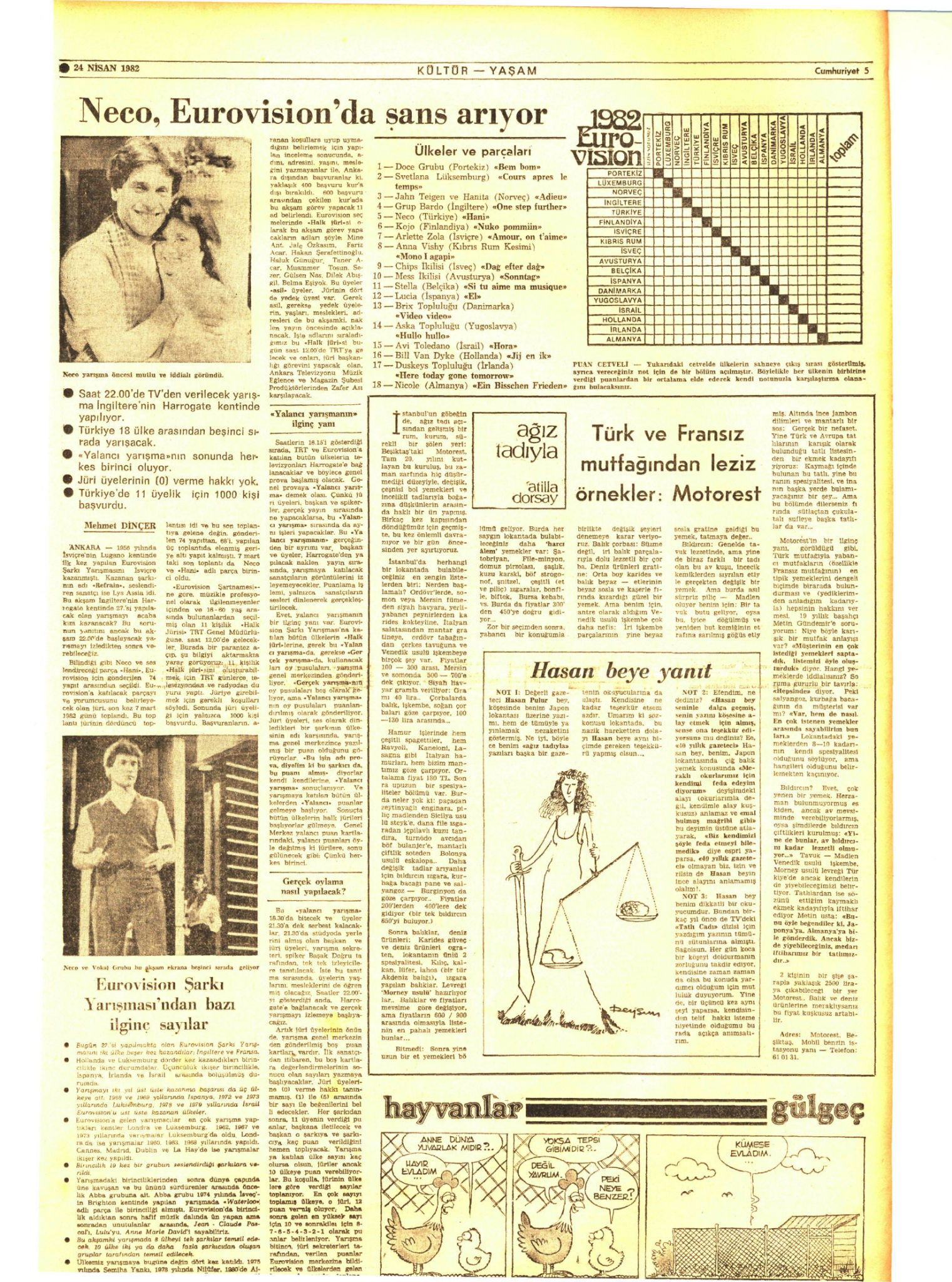
- Dinçer, Mehmet. (24 April 1982). "Neco, Eurovision'da şans arıyor". [[Cumhuriyet]].
- (2016). "Songs for Europe: The United Kingdom at the Eurovision Song Contest". [[Telos Publishing]].
- "Harrogate 1982 – Detailed voting results". European Broadcasting Union.
- "Eurovision Song Contest 1982 – Scoreboard". European Broadcasting Union.
- (31 October 2018). "The Rules of the Contest". European Broadcasting Union.
- (26 April 1982). "Platz eins für das Lied 'Ein bißchen Frieden'". [[Der Nordschleswiger]].
- (26 April 1982). "Η Κύπρος πήρε τήν 5η θέση στο διαγωνισμό Γιουροβίζιον". {{lang.
- (23 April 1982). "Radio – Televizija". Slovenski vestnik.
- (22 May 2015). "Ein virtueller Disput der ESC-Kommentatoren". [[Kurier]].
- (24–25 April 1982). "programmes TV {{!}} radio". {{ill.
- (24 April 1982). "Eurovision Song Contest 1982". British Broadcasting Corporation.
- (24 April 1982). "TV–programma's van zaterdag 24 april 1982". [[De Standaard]].
- (24 April 1982). "Τηλεόραση". {{lang.
- "TV – Lørdag 24. april 1982". Skagens Avis.
- (23 April 1982). "Viikon radio ja TV". [[Helsingin Sanomat]].
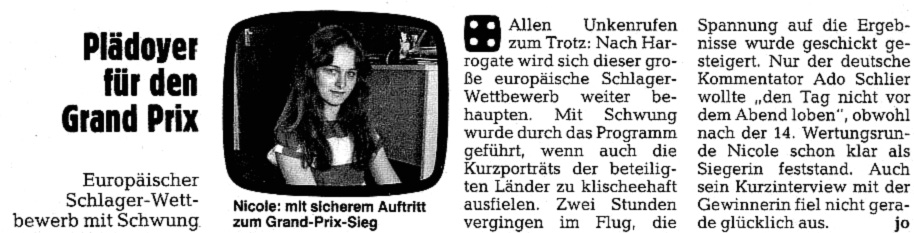
- "Plädoyer für den Grand Prix: Europäischer Schlager-Wettbewerb mit Schwung".
- (24 April 1982). "Entertainment – Saturday – RTÉ Radio 1". [[The Irish Times.
- (23 April 1982). "שבת – טלוויזיה". [[Davar]].
- (23 April 1982). "רדיו שבת – 24.4.82". [[Davar]].
- (24 April 1982). "Samstag, 24. April".
- (24 April 1982). "Radio televisie". [[Algemeen Dagblad]].
- (24 April 1982). "TV Radio programmene". [[Sandefjords Blad]].
- (24 April 1982). "Televisão – Hoje". [[Diário de Lisboa]].
- (24 April 1982). "1er programa – Programacion". [[Pueblo (newspaper).
- De Santiago, José P.. (24 April 1982). "El Eurofestival-82". [[Pueblo (newspaper).
- (24 April 1982). "tv-programmen". [[Svenska Dagbladet]].
- (24 April 1982). "radioprogrammen". [[Svenska Dagbladet]].
- (24 April 1982). "Tele-tip heute". [[Bieler Tagblatt]].
- (22 April 1982). "TV – samedi 24 avril".
- (24 April 1982). "Oggi e domani sul video". Popolo e Libertà.
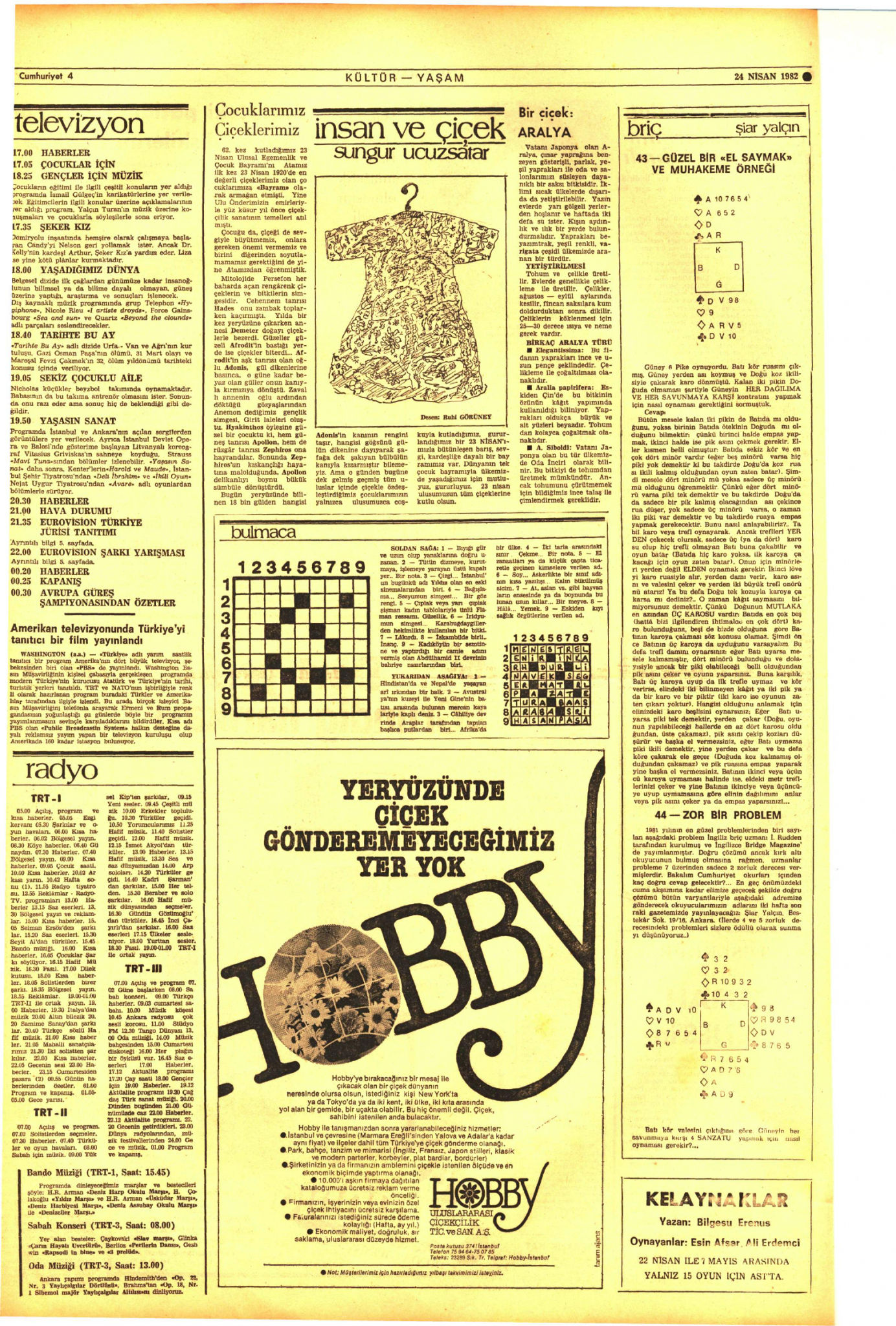
- (24 April 1982). "Televizyon". [[Cumhuriyet]].
- Öztürk, Ümran. (10 December 2017). "Ümit Tunçağ'la zamanda yolucuk". Vansesi Gazetesi.
- (24 April 1982). "Eurovision Song Contest 1982 – BBC1".
- (24 April 1982). "Your weekend viewing guide". [[Liverpool Echo]].
- (24 April 1982). "Saturday radio guide". [[The Journal (Newcastle upon Tyne newspaper).
- (24 April 1982). "Weekend radio". [[Leicester Mercury]].
- (24 April 1982). "Saturday's radio". [[Manchester Evening News]].
- (23 April 1982). "Weekend television". [[Evening Standard]].
- (24 April 1982). "TV and Radio Guide". [[Western Daily Press]].
- (24 April 1982). "Weekend TV and Radio". [[The Sentinel (Staffordshire).
- (24 April 1982). "Radio...your weekend guide". [[Birmingham Mail.
- (24 April 1982). "Eurovision Song Contest – BBC Radio 2".
- (24 April 1982). "Телевизија". [[Borba (newspaper).
- (24 April 1982). "Televizió". [[Magyar Szó]].
- (23 April 1982). "RTZ TV Program". Glas Podravine.
- Milenković, Branko. (May 1982). "Grlom u – bulu". Osmica.
- (24 April 1982). "RTV". [[Delo (newspaper).
- (10 May 1982). "pá 21. května". {{ill.
- (10 May 1982). "Szombat – május 15".
- (30 April 1982). "Á skjánum". [[Morgunblaðið]].
- (24 April 1982). "Jordan Times Daily Guide". [[The Jordan Times]].
- (21-23 May 1982). "Telewizja". [[Echo Dnia]].
This article was imported from Wikipedia and is available under the Creative Commons Attribution-ShareAlike 4.0 License. Content has been adapted to SurfDoc format. Original contributors can be found on the article history page.
Ask Mako anything about Eurovision Song Contest 1982 — get instant answers, deeper analysis, and related topics.
Research with MakoFree with your Surf account
Create a free account to save articles, ask Mako questions, and organize your research.
Sign up freeThis content may have been generated or modified by AI. CloudSurf Software LLC is not responsible for the accuracy, completeness, or reliability of AI-generated content. Always verify important information from primary sources.
Report