From Surf Wiki (app.surf) — the open knowledge base
Eurovision Song Contest 1976
International song competition

International song competition
| Field | Value |
|---|---|
| name | Eurovision Song Contest |
| year | 1976 |
| logo | Eurovision Song Contest 1976 - logo.svg |
| final | 3 April 1976 |
| presenter | Corry Brokken |
| musdirector | Jan Stulen |
| director | Theo Ordeman |
| scrutineer | Clifford Brown |
| exproducer | Fred Oster |
| winner | |
| "Save Your Kisses for Me" | |
| vote | Each country awarded 12, 10, 8-1 points to their 10 favourite songs |
| organiser | European Broadcasting Union (EBU) |
| host | Nederlandse Omroep Stichting (NOS) |
| venue | Nederlands Congresgebouw |
| The Hague, Netherlands | |
| entries | 18 |
| return | |
| nonreturn | |
| Map NoSemis | Y |
"Save Your Kisses for Me" The Hague, Netherlands
The Eurovision Song Contest 1976 was the 21st edition of the Eurovision Song Contest, held on 3 April 1976 at the Nederlands Congresgebouw in The Hague, Netherlands, and presented by Corry Brokken. It was organised by the European Broadcasting Union (EBU) and host broadcaster Nederlandse Omroep Stichting (NOS), who staged the event after winning the for the with the song "Ding-a-dong" by Teach-In. Brokken had also won the contest for the .
Broadcasters from eighteen countries participated in the contest with , , and opting not to return after participating the previous year. Malta would not return again until 1991. On the other hand, and returned to the competition, having been absent since 1972 and 1974 respectively.
The won the contest this year with the song "Save Your Kisses for Me" by Brotherhood of Man. The song went on to become the biggest selling winning single in the history of the contest and won with 80.39% of the possible maximum score and an average of 9.65 of 12; a record under the voting system introduced in 1975.
Location
The Hague is the seat of government of the Kingdom of the Netherlands and the capital city of the province of South Holland. It is also the third-largest city in the Netherlands, after Amsterdam and Rotterdam. Located in the west of the Netherlands, The Hague is in the centre of the Haaglanden conurbation and lies at the southwest corner of the larger Randstad conurbation. The contest took place at the Congresgebouw (presently known as the World Forum). The venue was constructed in 1969.
Participants
Sweden, Malta and, Turkey all decided not to participate this year, while Austria and Greece returned to the contest, making for eighteen participating countries.
After many controversies related to the previous year's contest, the Swedish broadcaster, Sveriges Radio (SR), decided not to participate, as they did not have enough money to host another contest if they won again. SR's withdrawal forced the introduction of a new rule in which from 1977 onwards, registration and maintenance fees would be introduced for each of the participating broadcasters, which was meant for financing future contests. These demands forced the Maltese broadcaster to withdraw, as it had a very small budget for 1976.
As the author and historian John Kennedy O'Connor notes in his book The Eurovision Song Contest – The Official History, "there had been public demonstrations in Sweden against the contest, which also played a part in SR's decision not to take part".
Several of the performing artists had previously competed as lead artists representing the same country in past editions: Fredi had represented ; Anneli Koivisto as part of "The Friends" had represented as part of Koivistolaiset; Peter, Sue and Marc had represented ; Sandra Reemer had represented the along Andres Holten; and Anne-Karine Strøm had represented as part of the Bendik Singers and .
's participation sparked controversy as it referred to the Turkish invasion of Cyprus. The previous year, Greece had withdrawn from the contest for the same reason, and in 1976, it was Turkey who withdrew.
The organizers informed Mariza Koch that they were not responsible for her physical integrity, as there were threats that armed Turks would be present at the venue and shoot her on stage. She signed a waiver stating that she would sing at her own risk. Rumors circulated that she was wearing a bulletproof vest when she went on stage.
| Country | Broadcaster | Artist | Song | Language | Songwriter(s) | Conductor |
|---|---|---|---|---|---|---|
| ORF | Waterloo and Robinson | "My Little World" | English | Gerhard Heinz | Erich Kleinschuster | |
| RTB | Pierre Rapsat | "Judy et Cie" | French | Michel Bernholc | ||
| YLE | Fredi and the Friends | "Pump-Pump" | English | Ossi Runne | ||
| TF1 | Catherine Ferry | "Un, deux, trois" | French | Tony Rallo | ||
| HR | Les Humphries Singers | "Sing, Sang, Song" | German, English | Les Humphries | ||
| ERT | Mariza Koch | "Panaghia mou, panaghia mou" (Παναγιά μου, παναγιά μου) | Greek | Mihalis Rozakis | ||
| RTÉ | Red Hurley | "When" | English | Brendan Graham | Noel Kelehan | |
| IBA | Chocolate, Menta, Mastik | "Emor Shalom" (אמור שלום) | Hebrew | Matti Caspi | ||
| RAI | Romina and Al Bano | "We'll Live It All Again" | English, Italian | Maurizio Fabrizio | ||
| CLT | Jürgen Marcus | "Chansons pour ceux qui s'aiment" | French | Jo Plée | ||
| TMC | Mary Christy | "Toi, la musique et moi" | French | Raymond Donnez | ||
| NOS | Sandra Reemer | "The Party Is Over Now" | English | Hans van Hemert | Harry van Hoof | |
| NRK | Anne-Karine Strøm | "Mata Hari" | English | Frode Thingnæs | ||
| RTP | Carlos do Carmo | "Uma flor de verde pinho" | Portuguese | |||
| TVE | Braulio | "Sobran las palabras" | Spanish | Braulio García Bautista | Joan Barcons | |
| SRG SSR | Peter, Sue and Marc | "Djambo Djambo" | English | Mario Robbiani | ||
| BBC | Brotherhood of Man | "Save Your Kisses for Me" | English | Alyn Ainsworth | ||
| JRT | Ambasadori | "Ne mogu skriti svoju bol" (Не могу скрити своју бол) | Serbo-Croatian |
Format
Following the confirmation of the eighteen competing countries, the draw to determine the running order of the contest was held on 8 January 1976.
As with the Dutch hosted contest of 1970, each song was introduced by a pre-recorded film of the performing artist on location in their home nation. Unlike the 1970 films, the Dutch broadcaster made all of the films themselves, sending a crew to each nation to capture the footage. Both the artists from Monaco and Luxembourg were filmed in their respective nations, despite again not being from the country they were representing. Each film was preceded by an animated insert featuring the flags of the eighteen participating nations and ended with a profile shot of the artists.
The interval act was The Dutch Swing College Band led by Peter Schilperoort, who performed live on the stage, intercut with brief interviews with the artists from France, Israel, Austria, Belgium and Spain backstage in the green room conducted by Hans van Willigenburg. Willigenburg asked each of the five artists which song they thought would win, but only French singer Catherine Ferry was willing to give a definite answer; correctly predicting the United Kingdom.
The Dutch broadcasters made the decision to use the same logo of the 1970 version held in the same country (in Amsterdam), but modified to be in black instead of the colors on the flag of the Netherlands. This logo was seen in promotions and in the introduction of the festival. This is one of the only times a Eurovision logo for the contest was used more than once.
The scoring system introduced in the previous year's competition returned in 1976. Each jury voted internally and awarded 12 points to the highest scoring song, 10 to the second highest, then 8 to the third, and then 7 to 1 (from fourth to tenth best song, according to the jury). Unlike today, the points were not given in order (from 1 up to 12), but in the order the songs were performed. The current procedure was not established until 1980 (also held in The Hague).
Contest overview
The following tables reflect the officially verified scores given by each jury, adjusted after the transmission. During the live broadcast, France failed to announce the 4 points they awarded to Yugoslavia, an error overlooked by the scrutineer, Clifford Brown. Thus in the live show, Norway were placed 17th and Yugoslavia 18th. After the broadcast, the scores were adjusted and the two nations swapped places, with Yugoslavia's score being adjusted from 6 to 10 points, moving Norway down to last place.
In terms of points gained as a percentage of maximum available, the winning UK entry from Brotherhood of Man is statistically the most successful winning Eurovision entry since the introduction of the 'douze points' scoring system inaugurated in 1975.
| R/O | Country | Artist | Song | Points | Place | 1 | 2 | 3 | 4 | 5 | 6 | 7 | 8 | 9 | 10 | 11 | 12 | 13 | 14 | 15 | 16 | 17 | 18 |
|---|---|---|---|---|---|---|---|---|---|---|---|---|---|---|---|---|---|---|---|---|---|---|---|
| Brotherhood of Man | "Save Your Kisses for Me" | 164 | 1 | ||||||||||||||||||||
| Peter, Sue and Marc | "Djambo Djambo" | 91 | 4 | ||||||||||||||||||||
| "Sing, Sang, Song" | 12 | 15 | |||||||||||||||||||||
| Chocolate, Menta, Mastik | "Emor Shalom" | 77 | 6 | ||||||||||||||||||||
| "Chansons pour ceux qui s'aiment" | 17 | 14 | |||||||||||||||||||||
| "Judy et Cie" | 68 | 8 | |||||||||||||||||||||
| "When" | 54 | 10 | |||||||||||||||||||||
| "The Party Is Over Now" | 56 | 9 | |||||||||||||||||||||
| "Mata Hari" | 7 | 18 | |||||||||||||||||||||
| "Panaghia mou, panaghia mou" | 20 | 13 | |||||||||||||||||||||
| Fredi and the Friends | "Pump-Pump" | 44 | 11 | ||||||||||||||||||||
| Braulio | "Sobran las palabras" | 11 | 16 | ||||||||||||||||||||
| Romina and Al Bano | "We'll Live It All Again" | 69 | 7 | ||||||||||||||||||||
| Waterloo and Robinson | "My Little World" | 80 | 5 | ||||||||||||||||||||
| "Uma flor de verde pinho" | 24 | 12 | |||||||||||||||||||||
| "Toi, la musique et moi" | 93 | 3 | |||||||||||||||||||||
| "Un, deux, trois" | 147 | 2 | |||||||||||||||||||||
| Ambasadori | "Ne mogu skriti svoju bol" | 10 | 17 |
Spokespersons
Each participating broadcaster appointed a spokesperson who was responsible for announcing the votes for its respective country via telephone. Known spokespersons at the 1976 contest are listed below.
- Finland
- LuxembourgJacques Harvey
- SpainJosé María Íñigo
- United KingdomRay Moore
Detailed voting results
| nb=1 | Total score}} | nb=1 | United Kingdom}} | nb=1 | Switzerland}} | nb=1 | Germany}} | nb=1 | Israel}} | nb=1 | Luxembourg}} | nb=1 | Belgium}} | nb=1 | Ireland}} | nb=1 | Netherlands}} | nb=1 | Norway}} | nb=1 | Greece}} | nb=1 | Finland}} | nb=1 | Spain}} | nb=1 | Italy}} | nb=1 | Austria}} | nb=1 | Portugal}} | nb=1 | Monaco}} | nb=1 | France}} | nb=1 | Yugoslavia}} | va=middle | Contestants}} | United Kingdom | Switzerland | Germany | Israel | Luxembourg | Belgium | Ireland | Netherlands | Norway | Greece | Finland | Spain | Italy | Austria | Portugal | Monaco | France | Yugoslavia |
|---|---|---|---|---|---|---|---|---|---|---|---|---|---|---|---|---|---|---|---|---|---|---|---|---|---|---|---|---|---|---|---|---|---|---|---|---|---|---|---|---|---|---|---|---|---|---|---|---|---|---|---|---|---|---|---|---|---|
| 164 | 12 | 8 | 12 | 8 | 12 | 3 | 10 | 12 | 12 | 10 | 12 | 4 | 10 | 12 | 10 | 7 | 10 | ||||||||||||||||||||||||||||||||||||||||
| 91 | 12 | 5 | 4 | 1 | 7 | 1 | 6 | 10 | 2 | 7 | 4 | 8 | 7 | 4 | 6 | 7 | |||||||||||||||||||||||||||||||||||||||||
| 12 | 2 | 2 | 1 | 2 | 2 | 3 | |||||||||||||||||||||||||||||||||||||||||||||||||||
| 77 | 6 | 7 | 3 | 7 | 5 | 4 | 2 | 7 | 8 | 1 | 10 | 6 | 2 | 1 | 8 | ||||||||||||||||||||||||||||||||||||||||||
| 17 | 6 | 6 | 5 | ||||||||||||||||||||||||||||||||||||||||||||||||||||||
| 68 | 7 | 6 | 1 | 4 | 6 | 12 | 8 | 3 | 8 | 8 | 5 | ||||||||||||||||||||||||||||||||||||||||||||||
| 54 | 10 | 1 | 3 | 3 | 8 | 5 | 12 | 2 | 6 | 3 | 1 | ||||||||||||||||||||||||||||||||||||||||||||||
| 56 | 4 | 4 | 8 | 4 | 4 | 2 | 1 | 7 | 3 | 2 | 4 | 6 | 2 | 5 | |||||||||||||||||||||||||||||||||||||||||||
| 7 | 3 | 4 | |||||||||||||||||||||||||||||||||||||||||||||||||||||||
| 20 | 2 | 4 | 5 | 1 | 8 | ||||||||||||||||||||||||||||||||||||||||||||||||||||
| 44 | 2 | 6 | 6 | 5 | 1 | 4 | 6 | 7 | 7 | ||||||||||||||||||||||||||||||||||||||||||||||||
| 11 | 3 | 1 | 3 | 3 | 1 | ||||||||||||||||||||||||||||||||||||||||||||||||||||
| 69 | 1 | 8 | 2 | 12 | 3 | 10 | 6 | 1 | 10 | 10 | 6 | ||||||||||||||||||||||||||||||||||||||||||||||
| 80 | 4 | 3 | 10 | 10 | 5 | 3 | 10 | 7 | 2 | 6 | 5 | 8 | 5 | 2 | |||||||||||||||||||||||||||||||||||||||||||
| 24 | 6 | 4 | 1 | 1 | 12 | ||||||||||||||||||||||||||||||||||||||||||||||||||||
| 93 | 5 | 5 | 7 | 7 | 12 | 8 | 8 | 8 | 5 | 2 | 7 | 7 | 5 | 3 | 4 | ||||||||||||||||||||||||||||||||||||||||||
| 147 | 8 | 10 | 12 | 5 | 10 | 10 | 7 | 12 | 8 | 5 | 3 | 10 | 6 | 12 | 5 | 12 | 12 | ||||||||||||||||||||||||||||||||||||||||
| 10 | 1 | 2 | 3 | 4 |
12 points
Below is a summary of all 12 points in the final:
| N. | Contestant | Nation(s) giving 12 points | 7 | 5 | 1 |
|---|---|---|---|---|---|
| **** | , , , , , , | ||||
| , , , , |
Broadcasts
Each participating broadcaster was required to relay the contest via its networks. Non-participating EBU member broadcasters were also able to relay the contest as "passive participants". Broadcasters were able to send commentators to provide coverage of the contest in their own native language and to relay information about the artists and songs to their television viewers.
The contest was reportedly broadcast in 33 countries, including the participating countries, EBU member broadcasters in Algeria, Morocco, Iceland, Tunisia, and Turkey; in Bulgaria, Czechoslovakia, Hungary, Poland, Romania, and the Soviet Union via Intervision; and in Hong Kong, Japan, and Mexico. There were also reportedly 27 television and 17 radio commentator teams present at the contest. At least 25 radio stations from eight countries were reported to have broadcast the contest. There was an estimated global audience of 450 to 500 million television viewers and 80 million listeners.
Known details on the broadcasts in each country, including the specific broadcasting stations and commentators are shown in the tables below.
| Country | Broadcaster | Channel(s) | Commentator(s) | Ref(s) | Austria | Belgium | Finland | France | Germany | Greece | Ireland | Israel | Italy | Luxembourg | Netherlands | Norway | Portugal | Spain | Switzerland | United Kingdom | Yugoslavia |
|---|---|---|---|---|---|---|---|---|---|---|---|---|---|---|---|---|---|---|---|---|---|
| ORF | FS2 | Ernst Grissemann | |||||||||||||||||||
| RTB | RTB | Paule Herreman | |||||||||||||||||||
| BRT | BRT, BRT 1 | ||||||||||||||||||||
| YLE | TV1 | ||||||||||||||||||||
| TF1 | |||||||||||||||||||||
| ARD | Deutsches Fernsehen | Werner Veigel | |||||||||||||||||||
| ERT | ERT, A Programma | ||||||||||||||||||||
| RTÉ | RTÉ | Mike Murphy | |||||||||||||||||||
| RTÉ Radio | |||||||||||||||||||||
| IBA | Israeli Television | ||||||||||||||||||||
| RAI | Rete Uno | Silvio Noto | |||||||||||||||||||
| CLT | RTL Télé-Luxembourg | Jacques Navadic | |||||||||||||||||||
| NOS | Nederland 2 | Willem Duys | |||||||||||||||||||
| Hilversum 3 | |||||||||||||||||||||
| NRK | NRK Fjernsynet | ||||||||||||||||||||
| NRK | |||||||||||||||||||||
| RTP | I Programa | ||||||||||||||||||||
| TVE | TVE 1 | José Luis Uribarri | |||||||||||||||||||
| SRG SSR | TV DRS | ||||||||||||||||||||
| TSR | |||||||||||||||||||||
| TSI | |||||||||||||||||||||
| RSI 1 | |||||||||||||||||||||
| BBC | BBC1 | Michael Aspel | |||||||||||||||||||
| BBC Radio 2 | Terry Wogan | ||||||||||||||||||||
| BFBS | BFBS Radio | Andrew Pastouna | |||||||||||||||||||
| JRT | TV Beograd 1, TV Zagreb 1 | Oliver Mlakar | |||||||||||||||||||
| TV Koper-Capodistria | |||||||||||||||||||||
| TV Ljubljana 1 |
| Country | Broadcaster | Channel(s) | Commentator(s) | Ref(s) | Czechoslovakia | Denmark | Hungary | Iceland | Jordan | Poland | Romania | Sweden | Turkey |
|---|---|---|---|---|---|---|---|---|---|---|---|---|---|
| ČST | |||||||||||||
| DR | DR TV | Per Møller Hansen | |||||||||||
| MR | Petőfi Rádió | ||||||||||||
| RÚV | Sjónvarpið | Jón Skaptason | |||||||||||
| JTV | JTV2 | ||||||||||||
| TP | TP1 | ||||||||||||
| TVR | Programul 1 | ||||||||||||
| SR | SR P3 | ||||||||||||
| TRT | TRT Televizyon |
Notes
References
References
- "The Hague 1976". [[European Broadcasting Union]].
- O'Connor, John Kennedy. (2007). "The Eurovision Song Contest: The Official History". Carlton Books.
- (12 September 1975). "Malta's Participation In Euro Song Festival". Times of Malta.
- (5 November 1975). "Malta out of Eurovision Song Contest". Times of Malta.
- O'Connor, John Kennedy. (2007). "The Eurovision Song Contest: The Official History". Carlton Books.
- (2006). "Melodifestivalen genom tiderna : de svenska uttagningarna och internationella finalerna". Premium Publishing.
- "The Hague 1976 – Participants". European Broadcasting Union.
- "Alle deutschen ESC-Acts und ihre Titel". ARD.
- (9 January 1976). "Aan songfestival in Den Haag doen achttien landen mee". [[Trouw.
- "The Hague 1976 – Scoreboard". European Broadcasting Union.
- Murtomäki, Asko. (2007). "Finland 12 points! Suomen Euroviisut". Teos.
- P. W.. (5 April 1976). "Eurovisionspreis erneut für Großbritannien". [[Luxemburger Wort]].
- Tobin, Robert. (2023). "The Eurovision Song Contest as a Cultural Phenomenon : From Concert Halls to the Halls of Academia". Routledge, Taylor & Francis Group.
- (2014). "Songs for Europe: The United Kingdom at the Eurovision Song Contest". [[Telos Publishing]].
- "The Hague 1976 – Detailed voting results". European Broadcasting Union.
- "Eurovision Song Contest 1976 – Scoreboard". European Broadcasting Union.
- (31 October 2018). "The Rules of the Contest". European Broadcasting Union.
- (2 April 1976). "Eurovisie Songfestival direct naar 26 landen". [[Leeuwarder Courant]].
- (5 April 1976). "Nederlandse Sandra negede Engeland wint Haagse songfestival". [[De Waarheid]].
- (30 March 1976). "Haags feestje door Eurovisie songfestival". [[Haarlems Dagblad]].
- (25 March 1976). "TV Avstrija". Naš tednik.
- (22 May 2015). "Ein virtueller Disput der ESC-Kommentatoren". [[Kurier]].
- (3 April 1976). "TV–programma's van zaterdag 3 april 1976". [[De Standaard]].
- (3 April 1976). "Radio ja TV". [[Helsingin Sanomat]].
- (3 April 1976). "Fredi ja Friends ja Pump Euroviisuissa tänä iltana". Helsingin Sanomat.
- (3 April 1976). "Sur votre ecran – samedi 3 avril". {{ill.
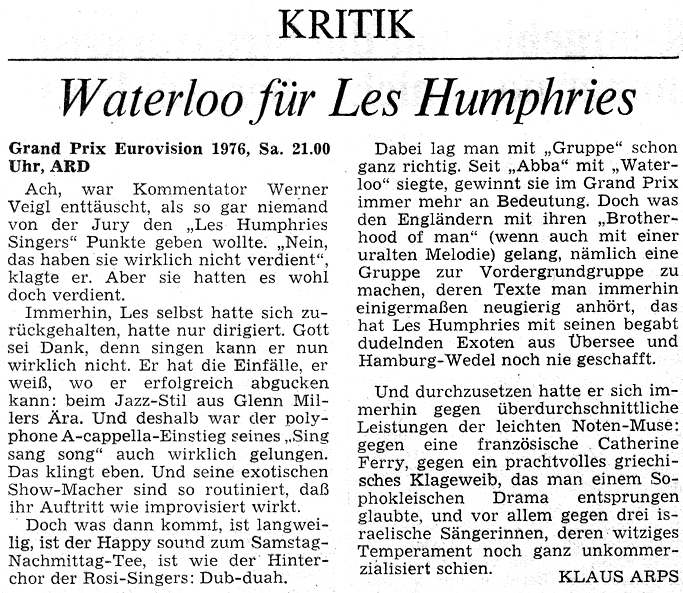
- Rudorf, Reginald. "Waterloo für Les Humphries". [[Die Welt]].
- (3 April 1976). "Τηλεόρασις". [[Makedonia (newspaper).
- (3 April 1976). "Τό ραδιόφωνον". Makedonia.
- (3 April 1976). "Television Today". [[The Irish Times]].
- (30 July 2018). "Celebrities and public figures launch Irish campaign to boycott Eurovision 2019 in Israel". [[Boycott, Divestment and Sanctions]].
- (3 April 1976). "Radio Today". [[The Irish Times]].
- (2 April 1976). "רדיו ∗ טלוויזיה". [[Maariv (newspaper).
- (28 March – 3 April 1976). "televisione – sabato 3 aprile".
- (2 April 1976). "Télé-programmes – samedi 3 avril". [[Luxemburger Wort]].
- (10 April 1976). "Grand Prix Eurovision 1976: Jürgen Marcus unter 'ferner liefen'".
- (3 April 1976). "Radio en televisie dit weekend". [[Limburgs Dagblad]].
- (3 April 1976). "TV-Radio programmene". [[Oppland Arbeiderblad]].
- (3 April 1976). "Televisão – Hoje". [[Diário de Lisboa]].
- (3 April 1976). "1er programa – Sábado".
- (2 April 1976). "fernsehen+radio". [[Thuner Tagblatt]].
- (1 April 1976). "TV – samedi 3 avril". [[TV8 (magazine).
- (3 April 1976). "Televisione". {{ill.
- (1 April 1976). "Radio – samedi 3 avril". [[TV8 (magazine).
- (3 April 1976). "Eurovision Song Contest – BBC1". [[Radio Times]].
- (3 April 1976). "as Radio 2 – BBC Radio 1".
- (3 April 1976). "Radio tune-in times". [[Birmingham Mail.
- (3 April 1976). "and Radio". [[Kent and Sussex Courier.
- (3 April 1976). "Weekend television guide". [[Hull Daily Mail]].
- (3 April 1976). "Weekend TV and radio guide". [[Leicester Mercury]].
- (3 April 1976). "Saturday ☆ radio". [[Daily Mirror]].
- (3 April 1976). "Tonight's radio". [[Manchester Evening News]].
- (3 April 1976). "Weekend TV guide". [[Liverpool Echo]].
- (3 April 1976). "TV and radio". [[Western Daily Press]].
- (3 April 1976). "Weekend TV guide". [[The Sentinel (Staffordshire).
- (3 April 1976). "Eurovisiong Contest 1976 – BBC Radio 2".
- (3 April 1976). "Телевизија". [[Borba (newspaper).
- (2 April 1976). "Tjedni televizijski program {{!}} TV Zagreb od 3. do 9. travnja". Glas Podravine.
- Glavan, Drako. (April 1976). "Pjesmice lažnog sjaja". Tina.
- (3 April 1976). "Danes, jutri na RTV". [[Delo (newspaper).
- (7 June 1976). "so 19. června".
- "Alle tiders programoversigter – Lørdag den 3. apr 1976". [[DR (broadcaster).
- (2 August 1976). "Vasárnap – augusztus 20".
- (24 April 1976). "Sjónvarp – Sunnudagur 25. apríl". [[Dagblaðið]].
- (17 April 1976). "Television – Channel 6". [[The Jordan Times]].
- (2–4 April 1976). "Telewizja – Sobota — 3. IV..". [[Trybuna Śląska.
- (24 April 1976). "Televiziune – Joi, 29 aprilie". Flacăra roșie.
- (3 April 1976). "radioprogrammen". [[Svenska Dagbladet]].
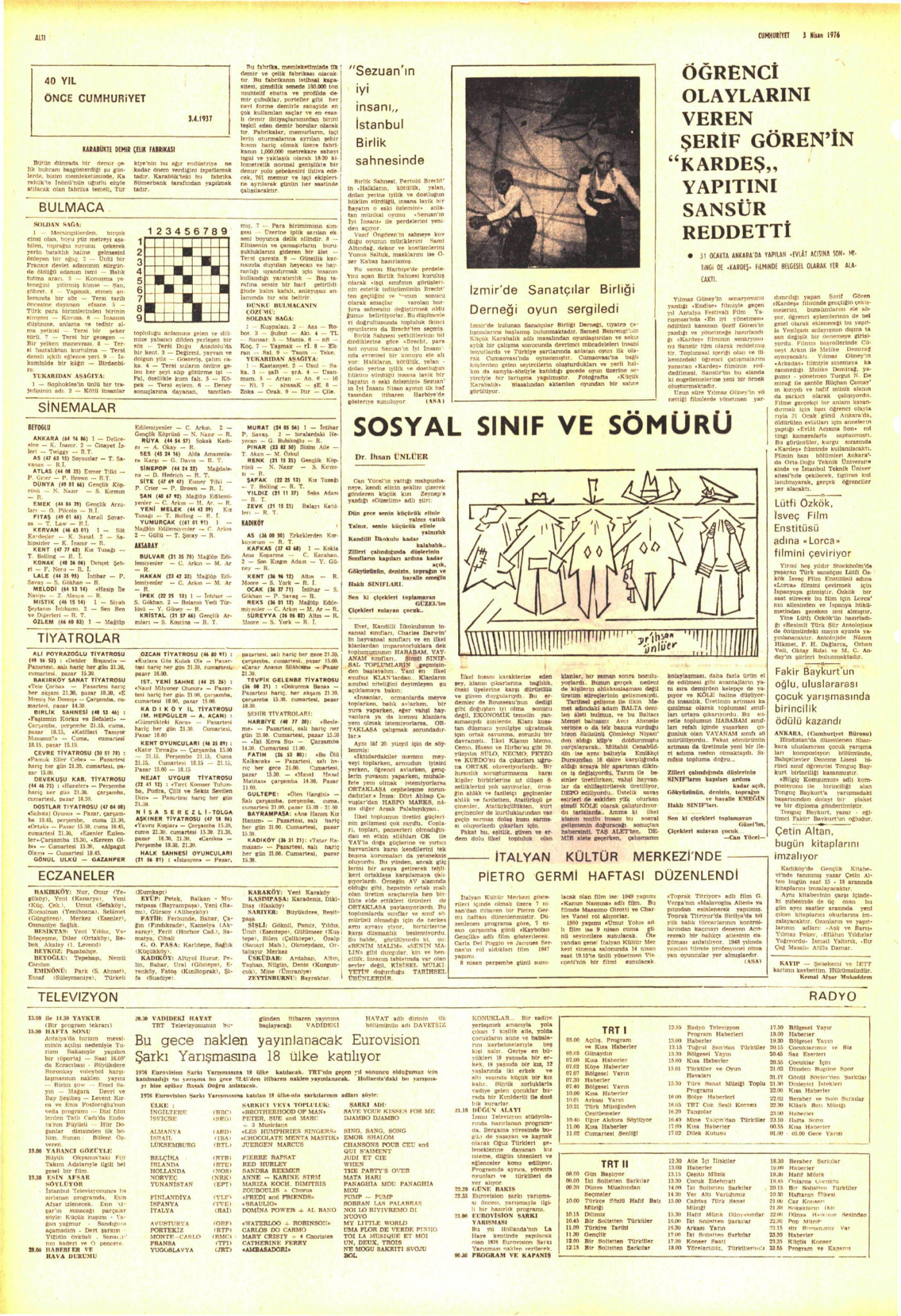
- (3 April 1976). "Televizyon". [[Cumhuriyet]].
This article was imported from Wikipedia and is available under the Creative Commons Attribution-ShareAlike 4.0 License. Content has been adapted to SurfDoc format. Original contributors can be found on the article history page.
Ask Mako anything about Eurovision Song Contest 1976 — get instant answers, deeper analysis, and related topics.
Research with MakoFree with your Surf account
Create a free account to save articles, ask Mako questions, and organize your research.
Sign up freeThis content may have been generated or modified by AI. CloudSurf Software LLC is not responsible for the accuracy, completeness, or reliability of AI-generated content. Always verify important information from primary sources.
Report