From Surf Wiki (app.surf) — the open knowledge base
Eurovision Song Contest 1975
International song competition

International song competition
| Field | Value |
|---|---|
| name | Eurovision Song Contest |
| year | 1975 |
| logo | Eurovision Song Contest 1975 logo.png |
| size | 250px |
| final | |
| venue | Stockholmsmässan |
| Stockholm, Sweden | |
| presenter | Karin Falck |
| musdirector | Mats Olsson |
| director | Bo Billtén |
| scrutineer | Clifford Brown |
| exproducer | Roland Eiworth |
| organiser | European Broadcasting Union (EBU) |
| host | Sveriges Radio (SR) |
| entries | 19 |
| debut | |
| return | |
| nonreturn | |
| vote | Each country awarded 12, 10, 8-1 points to their ten favourite songs |
| winner | |
| "Ding-a-dong" | |
| Map NoSemis | Y |
Stockholm, Sweden "Ding-a-dong"
The Eurovision Song Contest 1975 was the 20th edition of the Eurovision Song Contest, held on 22 March 1975 at the Stockholmsmässan in Stockholm, Sweden, and presented by Karin Falck. It was organised by the European Broadcasting Union (EBU) and host broadcaster Sveriges Radio (SR), who staged the event after winning the for with the song "Waterloo" by ABBA. Nineteen countries were represented at the contesta new record number of participants. made its first entry in the contest, and and returned after a one- and two-year absence, respectively. , after participating for the first time in the previous year's event, opted not to participate in 1975, due to the Turkish invasion of Cyprus in 1974.
The winner was the with the song "Ding-a-dong", composed by Dick Bakker, written by and Eddy Ouwens, and performed by the group Teach-In. This was the Netherlands' fourth contest victory, matching the record number of contest wins previously set by France and . Having been the opening song of the contest, it was also the first time that a country had won from first position in the running order. The , , , and rounded out the top five positions, with the UK achieving a record-extending ninth second-place finish. A new voting system was introduced at this contest; each country gave 12 points to its favourite, 10 points to its second favourite, and then 8 points to 1 point to other countries in descending order of preference. This numerical order of awarded points has since been used in every subsequent edition of the contest.
Location
The 1975 contest took place in Stockholm, Sweden, following the country's victory at the with the song "Waterloo" performed by ABBA. It was the first time that Sweden had hosted the event. The chosen venue was the Sankt Eriks-Mässan, an exhibition centre in the Älvsjö district of southern Stockholm opened in 1971; in 1976 the venue was renamed to Stockholmsmässan.
The Swedish broadcaster Sveriges Radio (SR) had initially been reluctant to stage the event, mainly due to the high costs that came with it which would have been placed on the organisation. There had also been considerable pressure and disquiet from left-wing groups in the country that initially opposed the amount of money being spent by the public broadcaster on a commercial event, which subsequently developed into a wider protest against the general commercialisation of music in Sweden; this led to street protests and a counter-festival, {{ill|Alternativfestivalen|sv}} (), being held during the week of Eurovision 1975.
SR had attempted to negotiate with the European Broadcasting Union (EBU) and other participating broadcasters to enact a form of cost-sharing to fund the event, however a solution failed to materialise prior to the contest and SR was ultimately faced with funding the contest alone. These discussions, however, did eventually lead to the introduction of a new financing system for and future events, with the running costs of the event being split across all participating countries. However, fears of the potential costs required to host the event should Sweden have won again, coupled with the pressure from left-wing groups, meant that SR ultimately decided not to participate in the 1976 event.
Participants
.jpg)
A total of 19 countries participated in the 1975 contesta new record number of participants. This included the first ever appearance of , and entries from and , which last participated in and , respectively. Broadcasters in , which participated for the first time in , and , last seen in the contest in 1972, had also considered participating in the contest, however no entries from these countries were ultimately submitted; Greece had reportedly decided against participating at a late stage, and may have opted to refuse to compete alongside Turkey following the Turkish invasion of Cyprus.
Ellen Nikolaysen competed in the contest for a second time, having previously participated for as a member of the Bendik Singers. Additionally, John Farrar, a member of the Shadows, had previously supported the as a backing vocalist.
| Country | Broadcaster | Artist | Song | Language | Songwriter(s) | Conductor | ||
|---|---|---|---|---|---|---|---|---|
| BRT | Ann Christy | "Gelukkig zijn" | Dutch, English | Francis Bay | ||||
| YLE | Pihasoittajat | "Old Man Fiddle" | English | Ossi Runne | ||||
| TF1 | Nicole | "Et bonjour à toi l'artiste" | French | |||||
| HR | Joy Fleming | "Ein Lied kann eine Brücke sein" | German, English | Rainer Pietsch | ||||
| RTÉ | The Swarbriggs | "That's What Friends Are For" | English | Colman Pearce | ||||
| IBA | Shlomo Artzi | "At Ve'Ani" (את ואני) | Hebrew | |||||
| RAI | Wess and Dori Ghezzi | "Era" | Italian | Natale Massara | ||||
| CLT | Géraldine | "Toi" | French | Phil Coulter | ||||
| MBA | Renato | "Singing This Song" | English | Vince Tempera | ||||
| TMC | Sophie | "Une chanson c'est une lettre" | French | André Popp | ||||
| NOS | Teach-In | "Ding-a-dong" | English | Harry van Hoof | ||||
| NRK | Ellen Nikolaysen | "Touch My Life with Summer" | English | Carsten Klouman | ||||
| RTP | Duarte Mendes | "Madrugada" | Portuguese | |||||
| TVE | Sergio and Estíbaliz | "Tú volverás" | Spanish | Juan Carlos Calderón | Juan Carlos Calderón | |||
| SR | Lars Berghagen | "Jennie, Jennie" | English | Lars Berghagen | Lars Samuelson | |||
| SRG SSR | Simone Drexel | "Mikado" | German | Simone Drexel | ||||
| TRT | Semiha Yankı | "Seninle Bir Dakika" | Turkish | Timur Selçuk | ||||
| BBC | The Shadows | "Let Me Be the One" | English | Paul Curtis | Alyn Ainsworth | |||
| JRT | {{ill | Pepel in kri | sl}} | "Dan ljubezni" | Slovene |
Production and format
The Eurovision Song Contest 1975 was produced by SR. served as executive producer, served as producer and director, served as production designer and Mats Olsson served as musical director, leading the orchestra. A separate musical director could be nominated by each participating delegation to lead the orchestra during its country's performance, with the host musical director also available to conduct for those countries which did not send their own conductor. On behalf of the contest organisers, the EBU, the event was overseen by Clifford Brown as scrutineer.
Each participating broadcaster submitted one song, which was required to be no longer than three minutes in duration. As in 1973 and 1974, artists were able to perform in any language, and not necessarily that of the country their represented. A maximum of six performers were allowed on stage during each country's performance. Each entry could utilise all or part of the live orchestra and could use instrumental-only backing tracks, however any backing tracks used could only include the sound of instruments featured on stage being mimed by the performers.
Rehearsals in the contest venue for the competing entries began on 19 March 1975, with each participating act having a 50-minute slot on stage to perform through its entry with the orchestra. The first full rehearsals for all entries were held over two days on 19 and 20 March and conducted without stage costumes. A second round of rehearsals, this time in full costume, was held for all acts on 21 March, with each country given 20 minutes on stage. This was followed that evening with a general dress rehearsal, including a dummy voting process. Technical rehearsals and a final dress rehearsal were held on the morning of 22 March. During the dress rehearsals some of the artists performed their songs in different languages to that which they would be presented during the live broadcast; specifically, the Yugoslav and Portuguese acts performed their entries in English in the dress rehearsal, and then in Slovene and Portuguese in the final, respectively. The Dutch entrants were given an additional rehearsal shortly before the live transmission; this was requested by Dick Bakker, the composer of the Dutch song. Bakker felt that during the general rehearsals the sound quality was noticeably poorer during their entry, the first to perform each time, and that the sound technicians needed time to fix their equipment, which was generally done during their rehearsal slot.
There was a tight security situation at the venue in the run-up to, and during, the event; the Swedish Security Service (SÄPO) had received intelligence reports that the contest may become a target of the West German far-left militant group the Red Army Faction (RAF). The threat to the contest did not ultimately materialise, however one month after the event the RAF targeted the West German embassy in Stockholm.
Voting procedure
Following the abandoned attempt at introducing a new voting system at the previous year's event, plans for a new system to replace both the system used between 1971 and 1973 and that used in 1974 came to fruition in autumn 1974. A sub-group, comprising individuals from Germany's ARD, Sweden's SR, and Finland's YLE, was set-up, and various new voting systems were proposed: ARD suggested that each country should identify its top nine entries and award points ranging between 1 and 10, while YLE proposed a scoring system to award points to eight countries, with the favourite of each country given 14 points, then 10, 7 and 5–1. The Finnish broadcaster also proposed as a compromise awarding to nine countries 10 and 8–1 points. Based on the above ideas, the UK's BBC proposed the 12, 10 and 8–1 pattern which was later adopted for this contest, and which had been used in all subsequent editions .
Each country had a jury of eleven members ranging from ages 16 to 60, with a recommendation that there should be a balance between the sexes and that half should be under 25 years old. Each jury member awarded all songs a score between one and five immediately after they had been performed, with no abstentions allowed and without voting for the country they represented. The song which gained the most votes received 12 points, followed by 10 points to the song which got the second highest number of votes, and then between 8 and 1 points for the third- to tenth-placed songs. Ties for any of the positions would be decided by a show of hands. The order of presenting the points by each country's spokesperson was done in performance order; it would not be until that the points would be awarded in ascending order, starting at 1 point and finishing with 12 points.
Contest overview
The contest was held on 22 March 1975, beginning at 21:00 (CET) and lasting 2 hours and 12 minutes. The contest was presented by the Swedish television presenter, producer and director Karin Falck. Following the confirmation of the 19 participating countries, a draw was held in Geneva on 24 January 1975 to determine the running order (R/O) of the contest.
The contest was opened by a film montage portraying various cultural stereotypes of Sweden and the Swedish people. Each entry was preceded by a video postcard, which served as an introduction to that country's entry and to create a transition between entries to allow stage crew to make changes on stage; the postcards showed each country's entrant backstage painting a portrait of themselves and the flag of their nation onto a blank canvas. The interval act was entitled "The World of John Bauer" (), comprising a montage of examples of the Swedish illustrator's work, particularly from his anthology Among Gnomes and Trolls, set to music from the orchestra. The medallions awarded to the winning songwriters were presented by the Secretary-General of the European Broadcasting Union .
The winner was the represented by the song "Ding-a-dong", composed by Bakker, written by and Eddy Ouwens, and performed by Teach-In. It was the Netherlands' fourth contest win, following victories in , and ; the Netherlands thus joined and as the countries with the most contest wins at that point. It was additionally the first time that the song which was performed first had gone on to win the contest. The UK came second for a record-extending ninth time, and Malta, which had come last in its two previous contest appearances, achieved its best result to date with a twelfth-place finish. Turkey, meanwhile, finished in last place on its debut appearance.
| R/O | Country | Artist | Song | Points | Place | 1 | 2 | 3 | 4 | 5 | 6 | 7 | 8 | 9 | 10 | 11 | 12 | 13 | 14 | 15 | 16 | 17 | 18 | 19 |
|---|---|---|---|---|---|---|---|---|---|---|---|---|---|---|---|---|---|---|---|---|---|---|---|---|
| Teach-In | "Ding-a-dong" | 152 | 1 | |||||||||||||||||||||
| "That's What Friends Are For" | 68 | 9 | ||||||||||||||||||||||
| Nicole | "Et bonjour à toi l'artiste" | 91 | 4 | |||||||||||||||||||||
| "Ein Lied kann eine Brücke sein" | 15 | 17 | ||||||||||||||||||||||
| Géraldine | "Toi" | 84 | 5 | |||||||||||||||||||||
| "Touch My Life with Summer" | 11 | 18 | ||||||||||||||||||||||
| "Mikado" | 77 | 6 | ||||||||||||||||||||||
| Pepel in kri | "Dan ljubezni" | 22 | 13 | |||||||||||||||||||||
| "Let Me Be the One" | 138 | 2 | ||||||||||||||||||||||
| Renato | "Singing This Song" | 32 | 12 | |||||||||||||||||||||
| "Gelukkig zijn" | 17 | 15 | ||||||||||||||||||||||
| "At Ve'Ani" | 40 | 11 | ||||||||||||||||||||||
| "Seninle Bir Dakika" | 3 | 19 | ||||||||||||||||||||||
| Sophie | "Une chanson c'est une lettre" | 22 | 13 | |||||||||||||||||||||
| Pihasoittajat | "Old Man Fiddle" | 74 | 7 | |||||||||||||||||||||
| "Madrugada" | 16 | 16 | ||||||||||||||||||||||
| Sergio and Estíbaliz | "Tú volverás" | 53 | 10 | |||||||||||||||||||||
| "Jennie, Jennie" | 72 | 8 | ||||||||||||||||||||||
| Wess and Dori Ghezzi | "Era" | 115 | 3 |
Spokespersons
Each participating broadcaster appointed a spokesperson, connected to the contest venue via telephone lines and responsible for announcing, in English or French, the votes for its respective country. Known spokespersons at the 1975 contest are listed below.
- FinlandKaarina Pönniö
- SpainJosé María Íñigo
- SwedenSven Lindahl
- United KingdomRay Moore
Detailed voting results
Jury voting was used to determine the points awarded by all countries. The announcement of the results from each country was conducted in the order in which they performed, with the spokespersons announcing their country's points in English or French in performance order. The detailed breakdown of the points awarded by each country is listed in the tables below, with voting countries listed in the order in which they presented their votes.
| nb=1 | Total score}} | nb=1 | Netherlands}} | nb=1 | Ireland}} | nb=1 | France}} | nb=1 | Germany}} | nb=1 | Luxembourg}} | nb=1 | Norway}} | nb=1 | Switzerland}} | nb=1 | Yugoslavia}} | nb=1 | United Kingdom}} | nb=1 | Malta}} | nb=1 | Belgium}} | nb=1 | Israel}} | nb=1 | Turkey}} | nb=1 | Monaco}} | nb=1 | Finland}} | nb=1 | Portugal}} | nb=1 | Spain}} | nb=1 | Sweden}} | nb=1 | Italy}} | va=middle | Contestants}} | Netherlands | Ireland | France | Germany | Luxembourg | Norway | Switzerland | Yugoslavia | United Kingdom | Malta | Belgium | Israel | Turkey | Monaco | Finland | Portugal | Spain | Sweden | Italy |
|---|---|---|---|---|---|---|---|---|---|---|---|---|---|---|---|---|---|---|---|---|---|---|---|---|---|---|---|---|---|---|---|---|---|---|---|---|---|---|---|---|---|---|---|---|---|---|---|---|---|---|---|---|---|---|---|---|---|---|---|---|
| 152 | 8 | 5 | 8 | 10 | 12 | 6 | 8 | 12 | 12 | 3 | 12 | 4 | 10 | 10 | 7 | 12 | 12 | 1 | ||||||||||||||||||||||||||||||||||||||||||
| 68 | 6 | 6 | 4 | 7 | 1 | 6 | 4 | 12 | 1 | 4 | 3 | 10 | 4 | |||||||||||||||||||||||||||||||||||||||||||||||
| 91 | 8 | 12 | 3 | 8 | 7 | 2 | 7 | 1 | 7 | 12 | 8 | 8 | 8 | |||||||||||||||||||||||||||||||||||||||||||||||
| 15 | 8 | 3 | 4 | |||||||||||||||||||||||||||||||||||||||||||||||||||||||||
| 84 | 12 | 10 | 3 | 7 | 3 | 5 | 6 | 5 | 5 | 8 | 6 | 4 | 10 | |||||||||||||||||||||||||||||||||||||||||||||||
| 11 | 2 | 2 | 7 | |||||||||||||||||||||||||||||||||||||||||||||||||||||||||
| 77 | 7 | 2 | 10 | 6 | 2 | 1 | 5 | 6 | 8 | 7 | 5 | 4 | 2 | 12 | ||||||||||||||||||||||||||||||||||||||||||||||
| 22 | 3 | 4 | 2 | 5 | 1 | 7 | ||||||||||||||||||||||||||||||||||||||||||||||||||||||
| 138 | 4 | 3 | 12 | 10 | 12 | 7 | 8 | 12 | 8 | 10 | 10 | 12 | 7 | 5 | 10 | 5 | 3 | |||||||||||||||||||||||||||||||||||||||||||
| 32 | 1 | 8 | 5 | 2 | 4 | 2 | 7 | 1 | 2 | |||||||||||||||||||||||||||||||||||||||||||||||||||
| 17 | 5 | 7 | 3 | 2 | ||||||||||||||||||||||||||||||||||||||||||||||||||||||||
| 40 | 10 | 1 | 1 | 1 | 1 | 5 | 2 | 1 | 1 | 6 | 3 | 6 | 2 | |||||||||||||||||||||||||||||||||||||||||||||||
| 3 | 3 | |||||||||||||||||||||||||||||||||||||||||||||||||||||||||||
| 22 | 3 | 4 | 2 | 1 | 2 | 2 | 3 | 5 | ||||||||||||||||||||||||||||||||||||||||||||||||||||
| 74 | 5 | 12 | 6 | 10 | 12 | 5 | 4 | 8 | 8 | 1 | 3 | |||||||||||||||||||||||||||||||||||||||||||||||||
| 16 | 2 | 12 | 2 | |||||||||||||||||||||||||||||||||||||||||||||||||||||||||
| 53 | 7 | 5 | 3 | 5 | 4 | 4 | 4 | 3 | 4 | 8 | 6 | |||||||||||||||||||||||||||||||||||||||||||||||||
| 72 | 7 | 7 | 8 | 1 | 6 | 7 | 2 | 3 | 8 | 6 | 6 | 6 | 5 | |||||||||||||||||||||||||||||||||||||||||||||||
| 115 | 6 | 4 | 4 | 3 | 6 | 10 | 10 | 10 | 10 | 6 | 5 | 10 | 1 | 12 | 10 | 7 | 1 |
12 points
The below table summarises how the maximum 12 points were awarded from one country to another. The winning country is shown in bold. The Netherlands received the maximum score of 12 points from six of the voting countries, with the UK receiving four sets of 12 points, Finland and France each receiving two sets of maximum scores, and Ireland, Italy, Luxembourg, Portugal and Switzerland receiving one maximum score each.
| N. | Contestant | Nation(s) giving 12 points | 6 | 4 | 2 | 1 |
|---|---|---|---|---|---|---|
| **** | , , , , , | |||||
| , , , | ||||||
| , | ||||||
| , |
Broadcasts
Broadcasters competing in the event were required to relay the contest via its networks; non-participating EBU member broadcasters were also able to relay the contest. Broadcasters were able to send commentators to provide coverage of the contest in their own native language and to relay information about the artists and songs to their television viewers.
In addition to the participating nations, the contest was also reportedly aired, live or deferred, by broadcasters in Eastern European countries via Intervision, and in Australia, Denmark, Greece, Hong Kong, Iceland, Japan, Jordan, Morocco and South Korea. The contest was reported to have had a possible maximum audience of over 700 million people.
A planned broadcast in Chile by its public broadcaster Televisión Nacional de Chile was prevented by SR, following pressure from the Swedish Musicians' Union in opposition to the Chilean military dictatorship. Rolf Rembe, spokesman for the union, said that broadcasting the festival to Chile "would give the impression that relations between Chile and world artists are normal".
Known details on the broadcasts in each country, including the specific broadcasting stations and commentators are shown in the tables below.
| Country | Broadcaster | Channel(s) | Commentator(s) | Belgium | Finland | France | Germany | Ireland | Israel | Italy | Luxembourg | Malta | Netherlands | Norway | Portugal | Spain | Sweden | Switzerland | Turkey | United Kingdom | Yugoslavia | |||||||
|---|---|---|---|---|---|---|---|---|---|---|---|---|---|---|---|---|---|---|---|---|---|---|---|---|---|---|---|---|
| BRT | BRT, BRT 1 | and Robrecht Willaert | ||||||||||||||||||||||||||
| RTB | RTB | |||||||||||||||||||||||||||
| YLE | TV1 | |||||||||||||||||||||||||||
| TF1 | Georges de Caunes | |||||||||||||||||||||||||||
| ARD | Deutsches Fernsehen | Werner Veigel | ||||||||||||||||||||||||||
| RTÉ | RTÉ | Mike Murphy | ||||||||||||||||||||||||||
| RTÉ Radio | Liam Devally | |||||||||||||||||||||||||||
| IBA | Israeli Television | |||||||||||||||||||||||||||
| RAI | Programma Nazionale TV, Secondo Programma | Silvio Noto | ||||||||||||||||||||||||||
| CLT | RTL Télé-Luxembourg | |||||||||||||||||||||||||||
| MBA | TVM, Radio Malta | Norman Hamilton | ||||||||||||||||||||||||||
| NOS | Nederland 2 | Willem Duys | ||||||||||||||||||||||||||
| NRK | NRK Fjernsynet, NRK | John Andreassen | ||||||||||||||||||||||||||
| RTP | I Programa | |||||||||||||||||||||||||||
| TVE | TVE 1 | José Luis Uribarri | ||||||||||||||||||||||||||
| RNE | RNE Canarias | |||||||||||||||||||||||||||
| Cadena SER{{efn | Simulcast on , , Radio Huesca,{{cite news | title=Agenda | access-date=3 February 2025 | work= | date=22 March 1975 | page=2 | location=Huesca, Spain | language=es}} Radio San Sebastián, , , and Radio Zaragoza.}} | Joaquín Prat | |||||||||||||||||||
| SR | TV1 | Åke Strömmer | ||||||||||||||||||||||||||
| SR P3 | ||||||||||||||||||||||||||||
| SRG SSR | TV DRS | |||||||||||||||||||||||||||
| TSR | ||||||||||||||||||||||||||||
| TSI | ||||||||||||||||||||||||||||
| RSR 1 | Robert Burnier | |||||||||||||||||||||||||||
| TRT | TRT Televizyon | |||||||||||||||||||||||||||
| BBC | BBC1 | Pete Murray | ||||||||||||||||||||||||||
| BBC Radio 2 | Terry Wogan | |||||||||||||||||||||||||||
| BFBS | BFBS Radio | |||||||||||||||||||||||||||
| JRT | TV Beograd 1 | |||||||||||||||||||||||||||
| TV Koper-Capodistria | ||||||||||||||||||||||||||||
| TV Ljubljana 1 | ||||||||||||||||||||||||||||
| TV Sarajevo | ||||||||||||||||||||||||||||
| TV Skopje | ||||||||||||||||||||||||||||
| TV Zagreb 1 |
| Country | Broadcaster | Channel(s) | Commentator(s) | Austria | Denmark | Greece | Hungary | Iceland | Poland | Romania | South Korea |
|---|---|---|---|---|---|---|---|---|---|---|---|
| ORF | FS2 | Ernst Grissemann | |||||||||
| DR | DR TV | Per Møller Hansen | |||||||||
| EIRT | EIRT | ||||||||||
| MTV | MTV1 | ||||||||||
| RÚV | Sjónvarpið | Dóra Hafsteinsdóttir | |||||||||
| TP | TP1 | ||||||||||
| TVR | Programul 1 | ||||||||||
| KBS | KBS |
References
- "Sweden – Participation history". European Broadcasting Union (EBU).
- (January 2025). "Stockholmsmässan – Our history". [[Stockholm International Fairs.
- (4 January 2016). "All eyes on Stockholm". European Broadcasting Union (EBU).
- (1 July 2015). "Swedish protests against hosting Eurovision Song Contest". {{lang.
- "Alternativfestivalen". [[Sveriges Television]] (SVT).
- (22 March 2013). "Recalling Sweden's first staging of the contest in 1975". European Broadcasting Union (EBU).
- "Stockholm 1975". European Broadcasting Union (EBU).
- (12 May 2023). "When The Shadows represented the UK at Eurovision without Cliff Richard". [[Gold (British radio network).
- "Stockholm 1975 – Participants". European Broadcasting Union (EBU).
- "Alle deutschen ESC-Acts und ihre Titel". [[ARD (broadcaster).
- (27 March 2019). "The Organisers behind the Eurovision Song Contest". European Broadcasting Union (EBU).
- (18 May 2019). "How it works". European Broadcasting Union (EBU).
- (31 October 2018). "The Rules of the Contest". European Broadcasting Union (EBU).
- "Luxembourg 1973". European Broadcasting Union (EBU).
- "Dublin 1971". European Broadcasting Union (EBU).
- "Karin Falck". [[Sveriges Television]] (SVT).
- (22 May 2015). "All Kinds of Everything: a history of Eurovision Postcards". ESC Insight.
- (1 May 2022). "Eurovision 2022: The theme of this year's Eurovision postcards". ESC Plus.
- (22 March 1975). "Eurovision Song Contest 1975". [[Sveriges Radio]] (SR).
- "Stockholm 1975 – Teach-In". European Broadcasting Union (EBU).
- "Netherlands – Participation history". European Broadcasting Union (EBU).
- "Malta – Participation history". European Broadcasting Union (EBU).
- "Türkiye – Participation history". European Broadcasting Union (EBU).
- "Stockholm 1975 – Scoreboard". European Broadcasting Union (EBU).
- (24 May 2021). "Lugano to Liverpool: Broadcasting Eurovision". [[National Science and Media Museum]].
- "Stockholm 1975 – Detailed voting results". European Broadcasting Union (EBU).
- "Eurovision Song Contest 1975 – Scoreboard". European Broadcasting Union (EBU).
- (21 March 1975). "Grandes medidas de seguridad". Aragón expres.
- Van Dijk, Ale. (22 March 1975). "Songfestival-vesting". [[Het Vrije Volk]].
- Van Dijk, Ale. (22 March 1975). "Zweedse tv: geen beelden van songfestival naar Chili". [[Het Vrije Volk]].
- (22 March 1975). "'Affaire' Eurovisión probó solidaridad de la TV chilena". [[El Mercurio]].
- (5 May 2015). "Geopolitics of Eurovision: Chile Edition". CommoditiesControl.
- (23 March 1975). "El certamen de Eurovisión no llegará a Chile". [[La Opinión]].
- (22 March 1975). "TV–programma's van zaterdag 22 maart 1975". [[De Standaard]].
- (22 March 1975). "Geen uitschieters op Stockholm-festival: Europa moet uit 'grijze poel' een hit kiezen". [[De Standaard]].
- (22 March 1975). "Viulu-ukko loppusuoralla". [[Helsingin Sanomat]].
- (22 March 1975). "Radio ja TV". [[Helsingin Sanomat]].
- (22 March 1975). "Radio-Télévision {{!}} Les programmes". [[Le Monde diplomatique]].
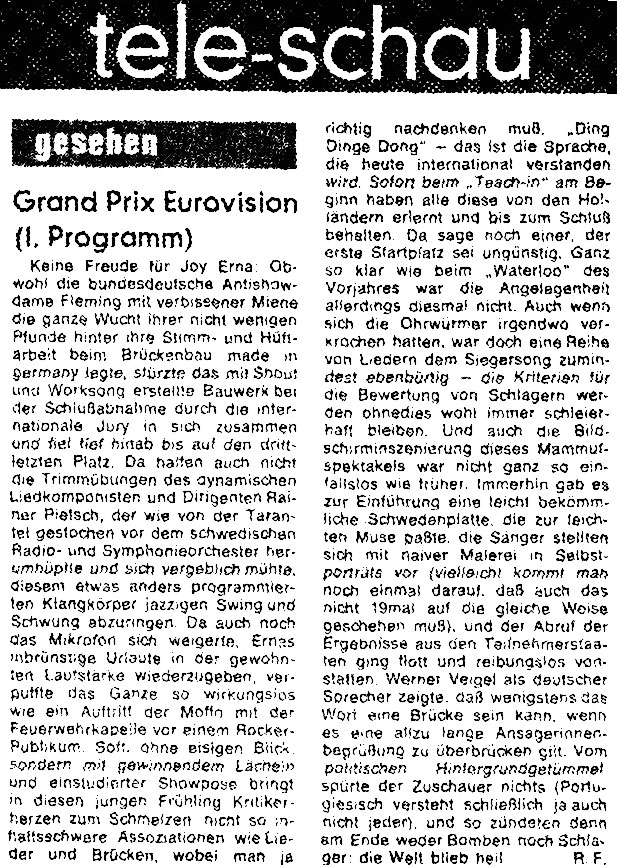
- "Tele-schau: Gesehen – Grand Prix Eurovision (I. Programm)". {{ill.
- (22 March 1975). "Television Today". [[The Irish Times]].
- (19 March 1975). "The Swabriggs quietly confident". [[Irish Examiner]].
- (22 March 1975). "Radio Today". [[The Irish Times]].
- (21 March 1975). "רדיו ∗ טלוויזיה". [[Maariv (newspaper).
- (16–22 March 1975). "TV {{!}} 22 marzo {{!}} sabato".
- (16–22 March 1975). "radio {{!}} sabato 22 marzo".
- (21 March 1975). "Télé-programmes – samedi 22 mars". [[Luxemburger Wort]].
- (22 March 1975). "Sound and Vision". [[Times of Malta]].
- Barry, Fred. (22 March 1975). "Eurovision Song Contest Today". [[Times of Malta]].
- (22 March 1975). "Strips/Radio▪TV". [[Algemeen Dagblad]].
- (22 March 1975). "Radio og TV". {{ill.
- (22 March 1975). "Televisão – Hoje". [[Diário de Lisboa]].
- (22 March 1975). "1a Cadena – Sábado".
- (22 March 1975). "El sábado – Eurofestival 75".
- (22 March 1975). "Programas de radio". {{ill.
- (22 March 1975). "Programa de las emisoras castellonenses". {{ill.
- (22 March 1975). "Programas de Televisión y Radio". {{ill.
- (22 March 1975). "Programas de Radio". {{ill.
- (22 March 1975). "Programa de radio para hoy". [[ABC (newspaper).
- (22 March 1975). "Programas de radio". [[Libertad (newspaper).
- (22 March 1975). "Programas de radio para hoy". {{ill.
- (22 March 1975). "Informe urgente SER – La S.E.R. ofrece hoy la retransmisión del Festival de Eurovisión".
- (22 March 1975). "tv programmen". [[Svenska Dagbladet]].
- (22 March 1975). "radioprogrammen". [[Svenska Dagbladet]].
- (22–23 March 1975). "Fernsehen – Samstag". [[Neue Zürcher Zeitung]].
- (20 March 1975). "TV – samedi 22 mars".
- (22 March 1975). "Televisione". {{ill.
- (20 March 1975). "Radio – samedi 22 mars".
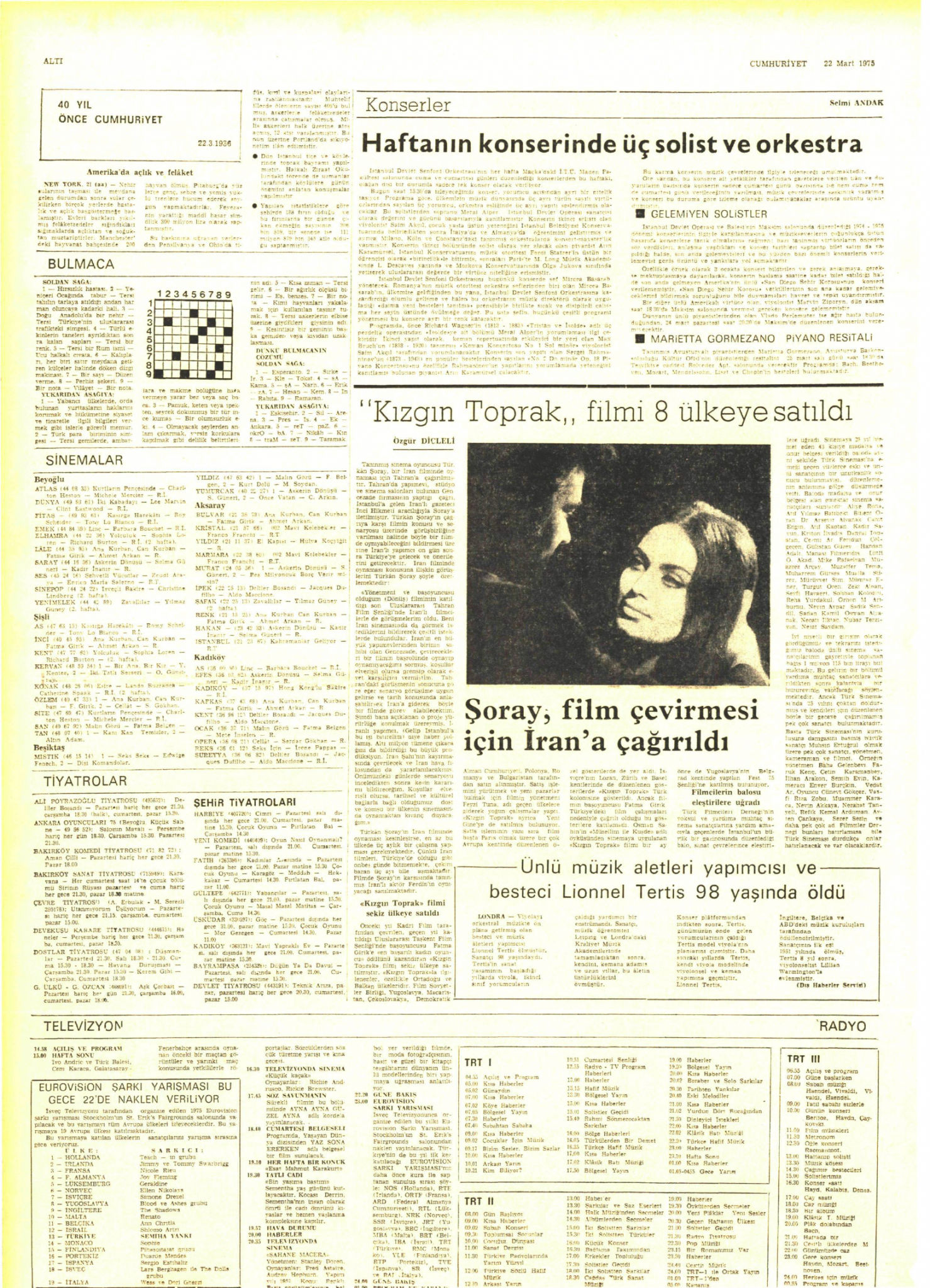
- (22 March 1975). "Televizyon". [[Cumhuriyet]].
- (22 March 1975). "Eurovision Song Contest 1975 – BBC1".
- (22 March 1975). "Eurovision Song Contest 1975 – BBC Radio 2".
- (22 March 1975). "Saturday radio". [[Birmingham Post.
- (22 March 1975). "...and Radio". [[Kent and Sussex Courier.
- (22 March 1975). "Saturday radio". [[The Journal (Newcastle upon Tyne newspaper).
- (22 March 1975). "Today's radio". [[The Northern Echo]].
- (22 March 1975). "Radio". [[Huddersfield Daily Examiner]].
- (21 March 1975). "to your weekend viewing and listening". [[Evening Standard]].
- (22 March 1975). "as Radio 2 – BBC Radio 1".
- (22 March 1975). "Телевизија". [[Borba (newspaper).
- (22 March 1975). "Radio televizija". [[Primorski dnevnik]].
- (22 March 1975). "Danes, jutri na RTV". [[Delo (newspaper).
- (21 March 1975). "Tjedni televizijski program {{!}} TV Zagreb od 22. ožujka do 28. ožujka". Glas Podravine.
- (21 March 1975). "TV Avstrija 2". Slovenski vestnik.
- (22 May 2015). "Ein virtueller Disput der ESC-Kommentatoren". [[Kurier]].
- "Fjernsynet – Lørdag 22. marts 1975". [[DR (broadcaster).
- (23 March 1975). "Τηλεόραση – Το πρόγραμμα τῆς ἑβδομάδας". [[Rizospastis]].
- (14 April 1975). "Vasárnap – április 20".
- (13 April 1975). "Sjónvarp um helgina". [[Þjóðviljinn]].
- (25–27 April 1975). "Tygodniowy program telewizji od 25. IV do 2 V 1975 r.". [[Dziennik Polski]].
- (5 April 1975). "tv". [[Scînteia]].
- (25 April 1975). "「유럽 放送 가요제」". [[The Chosun Ilbo]].
This article was imported from Wikipedia and is available under the Creative Commons Attribution-ShareAlike 4.0 License. Content has been adapted to SurfDoc format. Original contributors can be found on the article history page.
Ask Mako anything about Eurovision Song Contest 1975 — get instant answers, deeper analysis, and related topics.
Research with MakoFree with your Surf account
Create a free account to save articles, ask Mako questions, and organize your research.
Sign up freeThis content may have been generated or modified by AI. CloudSurf Software LLC is not responsible for the accuracy, completeness, or reliability of AI-generated content. Always verify important information from primary sources.
Report