From Surf Wiki (app.surf) — the open knowledge base
European Union Emissions Trading System
First large greenhouse gas emissions trading scheme in the world

First large greenhouse gas emissions trading scheme in the world
The European Union Emissions Trading System (EU ETS) is a carbon emission trading scheme (or cap and trade scheme) that began in 2005 and is intended to lower greenhouse gas emissions in the EU. Cap and trade schemes limit emissions of specified pollutants over an area and make polluters pay for their pollutiuon, requiring them to buy allowances to emit enough to cover their emissions, from the EU or from other companies. The money is channeled to environmental and social goals. As of 2026 the ETS covers around 40% of the EU's greenhouse gas emissions.
As from 2027 road transport, buildings and industrial installation that fell out of EU ETS will be covered by a new EU ETS2. The "old" ETS and the new EU ETS2 allowances will be traded independently. A major difference to the ETS is that ETS2 will cover the CO2 emissions upstream - fuel suppliers rather than consumers will be obliged to cover emissions with ETS2 emission allowances. The 2 systems will cover 75% of the GHG emissions of the European Union.
Compared to 2005, when the EU ETS was first implemented, the proposed caps for 2020 represent a 21% reduction in greenhouse gases. This target was achieved six years early as emissions in the ETS fell to 1.812 billion (109) tonnes in 2014. The cap decline gradually and should reach zero by 2039. After this year no more allowances will be distributed and when the unused allowances will end, no more emissions will be permitted.
During the years 2005–2025, GHG emissions in the sectors covered by the ETS declined by around 50%, declining only by 20% in the not covered sectors. A 2020 study showed that between 2008 and 2016 the ETS reduced CO2 emissions by 11.5% in covered sectors despite low carbon price. A 2024 study estimate the emission reduction effect at 7%. According to a 2023 study the ETS, reduced emissions by 10% between 2005 and 2012 with no impacts on profits or employment for regulated firms. A 2024 study demonstrated that the ETS has contributed to reduce atmospheric levels of air pollutants in the EU including sulfur dioxide, fine particulate matter, and nitrogen oxide. This reduction has translated in local health co-benefits, alongside the system's primary goal of mitigating climate change. EU countries view the emissions trading scheme as necessary for meeting climate goals. A strong carbon market guides investors and industry in their transition from fossil fuels.
Setup
The EU Emission Trading System follows the cap and trade model where one allowance permits the holder to emit 1 ton of (t). Under this scheme, a maximum (cap) is set on the total amount of greenhouse gases that can be emitted by all participating installations. EU Allowances for emissions are then auctioned off or allocated for free, and can subsequently be traded. Installations must monitor and report their emissions, ensuring they hand in enough allowances to the authorities to cover their emissions. To exceed its emissions allowance, an installation must purchase allowances from others. Conversely, if an installation emits less than its allowance, it can sell its leftover credits. This allows the system to find the most cost-effective ways of reducing emissions without significant government intervention.
The scheme was said to cover energy and heat generation industries and around 11,186 plants participated in the first stage. These plants only accounted for 45% of all European emissions at the time. More than 90% of all these allowances were free of cost in both periods to build a strong base of reductions for the future phases. This free allocation resulted in the volume and value of allowances growing three-fold over 2006 with the price moving from €19/t in 2005 to its peak of €30/t which revealed a new problem. The overallocation of allowances caused the price to drop to €1/t in the first few months of 2007 which created market price instabilities for businesses to reinvest in low carbon-technologies.
The European Union Emission Trading Scheme (or EU-ETS) is the largest multi-national, greenhouse gas emissions trading scheme in the world. After voluntary trials in the UK and Denmark, Phase I began operation in January 2005 with all 15 member states of the European Union participating. The program caps the amount of carbon dioxide that can be emitted from large installations with a net heat supply over 20 MW, such as power plants and carbon intensive factories, and covers almost half (46%) of the EU's Carbon Dioxide emissions. Phase I permits participants to trade among themselves and in validated credits from the developing world through Kyoto's Clean Development Mechanism. Credits are gained by investing in clean technologies and low-carbon solutions, and by certain types of emission-saving projects around the world to cover a proportion of their emissions.
History
The EU-ETS was the first large greenhouse gas emissions trading scheme in the world.{{cite journal |last1= Ellerman, A. |first1=Denny |last2=Buchner |first2= Barbara K.
The EU ETS has seen a number of significant changes, with the first trading period described as a "learning by doing" phase. Phase III saw a turn to auctioning more permits rather than allocating freely (in 2013, over 40% of the allowances were auctioned); harmonisation of rules for the remaining allocations; and the inclusion of other greenhouse gases, such as nitrous oxide and perfluorocarbons. In 2012, the EU ETS was also extended to the airline industry, though this only applies within the EEA. The price of EU ETS carbon credits has been lower than intended, with a large surplus of allowances, in part because of the impact of the recent economic crisis on demand. In 2012, the Commission said it would delay the auctioning of some allowances. In 2015, Decision (EU) 2015/1814 was approved to establish a Market Stability Reserve that adjusts the annual supply of permits based on the permits in circulation in the previous year. In 2018, the Market Stability Reserve was amended by Directive (EU) 2018/410 so that a certain amount of permits inside the reserve would be cancelled from 2023 onwards.
In January 2008, Norway, Iceland, and Liechtenstein joined the European Union Emissions Trading System (EU-ETS). The Norwegian Ministry of the Environment has also released its draft National Allocation Plan which provides a carbon cap-and-trade of 15 million tonnes of CO2, 8 million of which are set to be auctioned. According to the OECD Economic Survey of Norway 2010, the nation "has announced a target for 2008–12 10% below its commitment under the Kyoto Protocol and a 30% cut compared with 1990 by 2020." In 2012, EU-15 emissions was 15.1% below their base year level. Based on figures for 2012 by the European Environment Agency, EU-15 emissions averaged 11.8% below base-year levels during the 2008–2012 period. This means the EU-15 over-achieved its first Kyoto target by a wide margin.
Mechanisms
The first phase of EU ETS was created to operate apart from international climate change treaties such as the pre-existing United Nations Framework Convention on Climate Change (UNFCCC, 1992) or the Kyoto Protocol that was subsequently (1997) established under it. When the Kyoto Protocol came into force on 16 February 2005, Phase I of the EU ETS had already become operational. The EU later agreed to incorporate Kyoto flexible mechanism certificates as compliance tools within the EU ETS. The "Linking Directive" allows operators to use a certain amount of Kyoto certificates from flexible mechanism projects to cover their emissions.
The Kyoto flexible mechanisms are:
- Joint Implementation projects (JI) defined by Article 6 of the Kyoto Protocol, which produce Emission Reduction Units (ERUs). One ERU represents the successful emissions reduction equivalent to one tonne of carbon dioxide equivalent (te).
- The Clean Development Mechanism (CDM) defined by Article 12, which produces Certified Emission Reductions (CERs). One CER represents the successful emissions reduction equivalent to one tonne of carbon dioxide equivalent (te).
- International Emissions Trading (IET) is defined by Article 17.
IET is relevant as the reductions achieved through CDM projects are a compliance tool for EU ETS operators. These Certified Emission Reductions (CERs) can be obtained by implementing emission reduction projects in developing countries, outside the EU, that have ratified (or acceded to) the Kyoto Protocol. The implementation of Clean Development Projects is largely specified by the Marrakech Accords, a follow-on set of agreements by the Conference of the Parties to the Kyoto Protocol. The legislators of the EU ETS drew up the scheme independently but called on the experiences gained during the running of the voluntary UK Emissions Trading Scheme in the previous years, and collaborated with other parties to ensure its units and mechanisms were compatible with the design agreed through the UNFCCC.
Under the EU ETS, the governments of the EU Member States agree on national emission caps which have to be approved by the EU Commission. Those countries then allocate allowances to their industrial operators and track and validate the actual emissions per the relevant assigned amount. They require the allowances to be retired after the end of each year.
The operators within the ETS may reassign or trade their allowances by several means:
- privately, moving allowances between operators within a company and across national borders
- over the counter, using a broker to privately match buyers and sellers
- trading on the spot market of one of Europe's climate exchanges
Like any other financial instrument, trading consists of matching buyers and sellers between members of the exchange and then settling by depositing a valid allowance in exchange for the agreed financial consideration. Much like a stock market, companies and private individuals can trade through brokers who are listed on the exchange, and need not be regulated operators.
When each change of ownership of an allowance is proposed, the National Emissions Trading Registry and the European Commission are informed so they can validate the transaction. During Phase II of the EU ETS, the UNFCCC also validates the allowance and any change that alters the distribution within each National allocation plan.
Like the Kyoto trading scheme, EU ETS allows a regulated operator to use carbon credits in the form of Emission Reduction Units (ERU) to comply with its obligations. A Kyoto Certified Emission Reduction unit (CER), produced by a carbon project that has been certified by the UNFCCC Clean Development Mechanism Executive Board, or Emission Reduction Unit (ERU) certified by the Joint Implementation project's host country or by the Joint Implementation Supervisory Committee, are accepted by the EU as equivalent.
Thus one EU Allowance Unit of one tonne of , or "EUA", was designed to be identical ("fungible") with the equivalent "assigned amount units" (AAU) of defined under Kyoto. Hence, because the EU decided to accept Kyoto-CERs as equivalent to EU-EUAs, it is possible to trade EUAs and UNFCCC-validated CERs on a one-to-one basis within the same system. (However, the EU was not able to link trades from all its countries until 2008-9 because of its technical problems connecting to the UN systems).
During Phase II of the EU ETS, the operators within each Member State must surrender their allowances for inspection by the EU before they can be "retired" by the UNFCCC.
Allocation
The total number of permits issued (either auctioned or allocated) determines the supply of the allowances. The actual price is determined by the market. Too many allowances compared to demand will result in a low carbon price, and reduced emission abatement efforts. Too few allowances will result in a high carbon price.{{cite journal |year = 2006 |title = Regulating by prices, quantities or both: an update and an overview |author = Hepburn, C. |journal = Oxford Review of Economic Policy
For each EU ETS Phase, the total quantity to be allocated by each Member State is defined in the National Allocation Plan (equivalent to its UNFCCC-defined carbon account). The European Commission has oversight of the NAP process and decides if the NAP satisfies the twelve criteria set out in Annex III of the Emission Trading Directive (EU Directive 2003/87/EC). The first and foremost criterion is that the proposed total quantity is in line with a Member State's Kyoto target.
Of course, the Member State's plan can, and should, also take account of emission levels in other sectors not covered by the EU ETS, and address these within its domestic policies. For instance, transport is responsible for 21% of EU greenhouse gas emissions, households, and small businesses for 17% and agriculture for 10%.
During Phase I, most allowances in all countries were given freely (known as grandfathering). This approach has been criticized{{cite journal |access-date = 6 June 2012 |archive-url = https://web.archive.org/web/20170825052419/http://www.carbontradewatch.org/publications/carbon-trading-how-it-works-and-why-it-fails.html |archive-date = 25 August 2017 |url-status = dead |access-date = 6 June 2012 |archive-date = 28 September 2011 |archive-url = https://web.archive.org/web/20110928092743/http://assets.panda.org/downloads/171envteffectivenessaexecsummaryv60.pdf |url-status = live |access-date= 6 June 2012 |isbn= 978-90-810372-1-1 |archive-url= https://web.archive.org/web/20120304133543/http://www.climnet.org/component/docman/doc_download/1147-0506napreport.html |archive-date= 4 March 2012 |url-status= dead |access-date = 1 May 2010 |archive-date = 24 April 2010 |archive-url = https://web.archive.org/web/20100424202417/http://www.publications.parliament.uk/pa/cm200910/cmselect/cmenvaud/290/290we22.htm |url-status = live |access-date=30 April 2010 |archive-date=24 April 2010 |archive-url=https://web.archive.org/web/20100424202423/http://www.publications.parliament.uk/pa/cm200910/cmselect/cmenvaud/290/9042105.htm |url-status=live
To address these problems, the European Commission proposed various changes in a January 2008 package, including the abolishment of NAPs in 2013 and auctioning a far greater share (ca. 60% in 2013, growing afterwards) of emission permits.
From the start of Phase III (January 2013) there will be a centralized allocation of permits, not National Allocation Plans, with a greater share of auctioning of permits.
Allocation of EU ETS II credits
Unlike ETS there is no free allocation for the ETS II emission permits. Instead, all ETS II permits will be sold by the EU through auction.
Competitiveness
Allocation can act as a means of addressing concerns over loss of competitiveness, and possible "leakage" (carbon leakage) of emissions outside the EU. Leakage is the effect of emissions increasing in countries or sectors that have weaker regulation of emissions than the regulation in another country or sector.{{Citation |section-url=http://www.ipcc.ch/publications_and_data/ar4/wg3/en/ch11s11-7-2.html |display-authors=etal |display-editors=etal |access-date=1 May 2010 |archive-date=3 May 2010 |archive-url=https://web.archive.org/web/20100503032254/http://www.ipcc.ch/publications_and_data/ar4/wg3/en/ch11s11-7-2.html |url-status=dead Such concerns affect the following sectors: cement, steel, aluminium, pulp and paper, basic inorganic chemicals and fertilisers/ammonia. Leakage from these sectors was thought to be under 1% of total EU emissions. Correcting for leakage by allocating permits acts as a temporary subsidy for affected industries, but does not fix the underlying problem. Border adjustments would be the economically efficient choice, where imports are taxed according to their carbon content. One problem with border adjustments is that they might be used as a disguise for trade protectionism.{{cite web |access-date=28 June 2010 |display-authors=etal |archive-date=26 October 2011 |archive-url=https://web.archive.org/web/20111026202341/http://www.climatestrategies.org/component/reports/category/61/204.html |url-status=live
Banking and borrowing
Within a certain trading period, banking and borrowing are allowed. For example, a 2006 EUA can be used in 2007 (banking) or in 2005 (borrowing). Interperiod borrowing is not allowed. Member states had the discretion to decide whether banking EUAs from Phase I to Phase II was allowed.
Members
The EU ETS operates in 30 countries: the 27 EU member states plus Iceland, Liechtenstein and Norway.
The United Kingdom left the EU on 31 January 2020 but remained subject to EU rules until 31 December 2020. The UK Emissions Trading Scheme (UK ETS) replaced the UK's participation in the EU ETS on 1 January 2021, but the UK government required organisations to continue to comply with their existing obligations under the 2020 scheme year, which ended on 30 April 2021.
Linking
The EU ETS is linked to the since 1 January 2020. Linking systems creates a larger carbon market, which can reduce overall compliance costs, increase market liquidity and generate a more stable carbon market. Linking systems can also be politically symbolic as it shows willingness to undertake a common effort to reduce GHG emissions. Some scholars have argued that linking may provide a starting point for developing a new, bottom-up international climate policy architecture whereby multiple unique systems successively link their various systems.
Phase I 2005–2007
In the first phase (2005–2007), the EU ETS included some 12,000 installations, representing approximately 40% of EU emissions, covering energy activities (combustion installations with a rated thermal input exceeding 20 MW, mineral oil refineries, coke ovens), production and processing of ferrous metals, mineral industry (cement clinker, glass and ceramic bricks) and pulp, paper and board activities.
Launch and operation
The ETS, in which all 15 Member States that were then members of the European Union participated, nominally commenced operation on 1 January 2005, although national registries were unable to settle transactions for the first few months. However, the prior existence of the UK Emissions Trading Scheme meant that market participants were already in place and ready. In its first year, 362 million tonnes of were traded on the market for a sum of €7.2 billion, and a large number of futures and options.
Prices
The price of allowances increased more or less steadily to a peak level in April 2006 of about €30 per tonne . In late April 2006, several EU countries (the Netherlands, the Czech Republic, Belgium, France, and Spain) announced that their verified (or actual) emissions were less than the number of allowances allocated to installations. The spot price for EU allowances dropped 54% from €29.20 to €13.35 in the last week of April 2006. In May 2006, the European Commission confirmed that verified emissions were about 80 million tonnes or 4% lower than the number of allowances distributed to installations for 2005 emissions. In May 2006, prices fell to under €10/tonne. Lack of scarcity under the first phase of the system continued through 2006 resulting in a trading price of €1.2 per tonne in March 2007, declining to €0.10 in September 2007. In 2007, carbon prices for the trial phase dropped to near zero for most of the year. Meanwhile, prices for Phase II remained significantly higher throughout, reflecting the fact that allowances for the trial phase were set to expire by 31 December 2007.{{cite journal |access-date = 26 April 2012 |archive-url = https://web.archive.org/web/20130606021458/http://www.cccep.ac.uk/Publications/Working-papers/Papers/50-59/WP59_carbon-trading-caney-hepburn.pdf |archive-date = 6 June 2013 |url-status = dead
Verified emissions
Verified emissions showed a net increase over the first phase of the scheme. For the countries for which data was available, emissions increased by 1.9% between 2005 and 2007 (at the time all 27 member states minus Romania, Bulgaria, and Malta).
| Country | Verified emissions | Change | 2005 | 2006 | 2007 | 2005–2007 | Total | 2,012,043,453 | 2,033,636,557 | 2,049,927,884 | 1.9% | |||||||
|---|---|---|---|---|---|---|---|---|---|---|---|---|---|---|---|---|---|---|
| 33,372,826 | 32,382,804 | 31,751,165 | −4.9% | |||||||||||||||
| 55,363,223 | 54,775,314 | 52,795,318 | −4.6% | |||||||||||||||
| 5,078,877 | 5,259,273 | 5,396,164 | 6.2% | |||||||||||||||
| 82,454,618 | 83,624,953 | 87,834,758 | 6.5% | |||||||||||||||
| Germany | 474,990,760 | 478,016,581 | 487,004,055 | 2.5% | ||||||||||||||
| 26,475,718 | 34,199,588 | 29,407,355 | 11.1% | |||||||||||||||
| 12,621,817 | 12,109,278 | 15,329,931 | 21.5% | |||||||||||||||
| Spain | 183,626,981 | 179,711,225 | 186,495,894 | 1.6% | ||||||||||||||
| 33,099,625 | 44,621,411 | 42,541,327 | 28.5% | |||||||||||||||
| France | 131,263,787 | 126,979,048 | 126,634,806 | −3.5% | ||||||||||||||
| 71,267,736 | 69,965,145 | 72,717,006 | 2.0% | |||||||||||||||
| 26,161,627 | 25,845,891 | 26,835,478 | 2.6% | |||||||||||||||
| 22,441,000 | 21,705,328 | 21,246,117 | −5.3% | |||||||||||||||
| Italy | 225,989,357 | 227,439,408 | 226,368,773 | 0.2% | ||||||||||||||
| 6,603,869 | 6,516,911 | 5,998,744 | −9.2% | |||||||||||||||
| 2,603,349 | 2,712,972 | 2,567,231 | −1.4% | |||||||||||||||
| 2,854,481 | 2,940,680 | 2,849,203 | −0.2% | |||||||||||||||
| 80,351,288 | 76,701,184 | 79,874,658 | −0.6% | |||||||||||||||
| 203,149,562 | 209,616,285 | 209,601,993 | 3.2% | |||||||||||||||
| 36,425,915 | 33,083,871 | 31,183,076 | −14.4% | |||||||||||||||
| 19,381,623 | 19,884,147 | 15,348,209 | −20.8% | |||||||||||||||
| 8,720,548 | 8,842,181 | 9,048,633 | 3.8% | |||||||||||||||
| 25,231,767 | 25,543,239 | 24,516,830 | −2.8% | |||||||||||||||
| United Kingdom | 242,513,099 | 251,159,840 | 256,581,160 | 5.8% |
:*Figures are in tonnes of :*Source: European Commission Press Release 23 May 2008
Consequently, observers accused national governments of abusing the system under industry pressure, and urged far stricter caps in the second phase (2008–2012). This led to a stricter regime in the second phase.
Phase II 2008–12
Scope
The second phase (2008–12) expanded the scope of the scheme significantly. In 2007, three non-EU members, Norway, Iceland, and Liechtenstein joined the scheme. The EU's "Linking Directive" introduced the CDM and JI credits. Although this was a theoretical possibility in phase I, the over-allocation of permits combined with the inability to bank them for use in the second phase meant it was not taken up.{{cite web |access-date=10 August 2011 |archive-date=5 April 2012 |archive-url=https://web.archive.org/web/20120405214714/http://www.iisd.ca/sd/euets/ymbvol115num1e.html |url-status=live
During Phases I and II, allowances for emissions have typically been given free to firms, which has resulted in them getting windfall profits. Ellerman and Buchner (2008) suggested that during its first two years in operation, the EU-ETS turned an expected increase in emissions of 1–2% per year into a small absolute decline. Grubb et al. (2009) suggested that a reasonable estimate for the emissions cut achieved during its first two years of operation was 50–100 MtCO2 per year, or 2.5–5%.
On 27 April 2012, the European Commission announced the full activation of the EU Emissions Trading System single registry. The full activation process included the migration of over 30,000 EU ETS accounts from national registries. The European Commission further stated that the single registry to be activated in June will not contain all the required functionalities for phase III of the EU ETS.
Phase II saw some tightening, but the use of JI and CDM offsets was allowed, with the result that no reductions in the EU will be required to meet the Phase II cap. For Phase II, the cap is expected to result in an emissions reduction in 2010 of about 2.4% compared to expected emissions without the cap (business-as-usual emissions).
Aviation emissions
Aviation emissions were to be included from 2012. The inclusion of aviation was considered important by the EU.{{cite web |access-date=10 February 2012 |archive-date=23 February 2012 |archive-url=https://web.archive.org/web/20120223224728/http://ec.europa.eu/clima/policies/transport/aviation/faq_en.htm |url-status=live |url-status=dead |archive-url=https://web.archive.org/web/20060215004933/http://www.defra.gov.uk/environment/climatechange/trading/eu/pdf/including-aviation-icf.pdf |archive-date=15 February 2006 }}
The airline industry and other countries including China, India, Russia, and the United States reacted adversely to the inclusion of the aviation sector.{{cite news |access-date=10 February 2012 |archive-date=9 February 2012 |archive-url=https://web.archive.org/web/20120209185018/https://www.economist.com/node/21547283 |url-status=live
The EU insisted that the regulation should be applied equally to all carriers and that it did not contravene international regulations. In the absence of a global agreement on airline emissions, the EU argued that it was forced to go ahead with its scheme. But only flights within the EEA are covered; international flights are not.
Other
Ultimately, the Commission intended that the third trading period should cover all greenhouse gases and all sectors, including aviation, maritime transport, and forestry. For the transport sector, the large number of individual users adds complexities but might be implemented either as a cap-and-trade system for fuel suppliers or a baseline-and-credit system for car manufacturers.
The National Allocation Plans for Phase II, the first of which were announced on 29 November 2006, provided for an average reduction of nearly 7% below the 2005 emission levels. However, the use of offsets such as Emission Reduction Units from JI and Certified Emission Reductions from CDM projects was allowed, with the result that the EU would be able to meet the Phase II cap by importing units instead of reducing emissions (CCC, 2008, pp. 145, 149).{{cite book |chapter-url=http://archive.theccc.org.uk/archive/pdf/7980-TSO%20Book%20Chap%204.pdf |access-date=26 April 2010 |archive-date=25 May 2010 |archive-url=https://web.archive.org/web/20100525004110/http://www.theccc.org.uk/reports/building-a-low-carbon-economy |url-status=live
According to verified EU data from 2008, the ETS resulted in an emissions reduction of 3%, or 50 million tons. At least 80 million tons of "carbon offsets" were bought for compliance with the scheme.
In late 2006, the European Commission started infringement proceedings against Austria, Czech Republic, Denmark, Hungary, Italy and Spain, for failure to submit their proposed National Allocation Plans on time.{{cite web |access-date=14 October 2007 |archive-date=17 December 2008 |archive-url=https://web.archive.org/web/20081217185612/http://www.europarl.europa.eu/comparl/envi/pdf/implementation/is20061127.pdf |url-status=live
In July 2020, The Environment Committee of the European Parliament voted to include emissions from the maritime sector in the European Union (EU) Emissions Trading System (ETS), starting in January 2024, with ships over 5,000 GT required to pay for emissions.
The European Union has set specific decarbonization goals starting in 2024. The revised Renewable Energy Directive (RED III) aims to reduce the greenhouse gas emission intensity of transport by 14.5% or increase the share of renewable energy in final energy consumption to at least 29% (e.g., through e-mobility) by 2030. RED III also sets blending quotas for advanced biofuels, impacting the demand for sustainable liquid fuels.
The ReFuelEU Aviation initiative requires the aviation industry to blend sustainable fuels into their operations, starting at 6% by 2030 and increasing to 70% by 2050, with a notable emphasis on e-fuels, which should constitute 35% by 2050. In the maritime sector, the FuelEU Maritime regulation mandates shipping companies to decrease their greenhouse gas emission intensity by up to 6% by 2030 and by 80% by 2050.
State allocation plans
The annual Member State allowances in million tonnes are shown in the table:
| Member State | 1st period | |||||||||
|---|---|---|---|---|---|---|---|---|---|---|
| cap | 2005 verified | |||||||||
| emissions | 2008–2012 cap | State request | Cap allowed | Totals | 2298.5 | 2122.16 | 2325.34 | 2080.93 | ||
| 33.0 | 33.4 | 32.8 | 30.7 | |||||||
| 62.1 | 55.58 | 63.33 | 58.5 | |||||||
| 42.3 | 40.6 | 67.6 | 42.3 | |||||||
| 5.7 | 5.1 | 7.12 | 5.48 | |||||||
| 97.6 | 82.5 | 101.9 | 86.8 | |||||||
| 33.5 | 26.5 | 24.5 | 24.5 | |||||||
| 19 | 12.62 | 24.38 | 12.72 | |||||||
| 45.5 | 33.1 | 39.6 | 37.6 | |||||||
| France | 156.5 | 131.3 | 132.8 | 132.8 | ||||||
| 31.3 | 26.0 | 30.7 | 26.9 | |||||||
| Germany | 499 | 474 | 482 | 453.1 | ||||||
| 74.4 | 71.3 | 75.5 | 69.1 | |||||||
| 22.3 | 22.4 | 22.6 | 21.15 | |||||||
| Italy | 223.1 | 222.5 | 209 | 195.8 | ||||||
| 4.6 | 2.9 | 7.7 | 3.3 | |||||||
| 12.3 | 6.6 | 16.6 | 8.8 | |||||||
| 3.4 | 2.6 | 3.95 | 2.7 | |||||||
| 2.9 | 1.98 | 2.96 | 2.1 | |||||||
| 95.3 | 80.35 | 90.4 | 85.8 | |||||||
| 239.1 | 203.1 | 284.6 | 208.5 | |||||||
| 38.9 | 36.4 | 35.9 | 34.8 | |||||||
| 74.8 | 70.8 | 95.7 | 75.9 | |||||||
| 30.5 | 25.2 | 41.3 | 30.9 | |||||||
| 8.8 | 8.7 | 8.3 | 8.3 | |||||||
| Spain | 174.4 | 182.9 | 152.7 | 152.3 | ||||||
| 22.9 | 19.3 | 25.2 | 22.8 | |||||||
| United Kingdom | 245.3 | 242.4 | 246.2 | 246.2 |
Carbon price
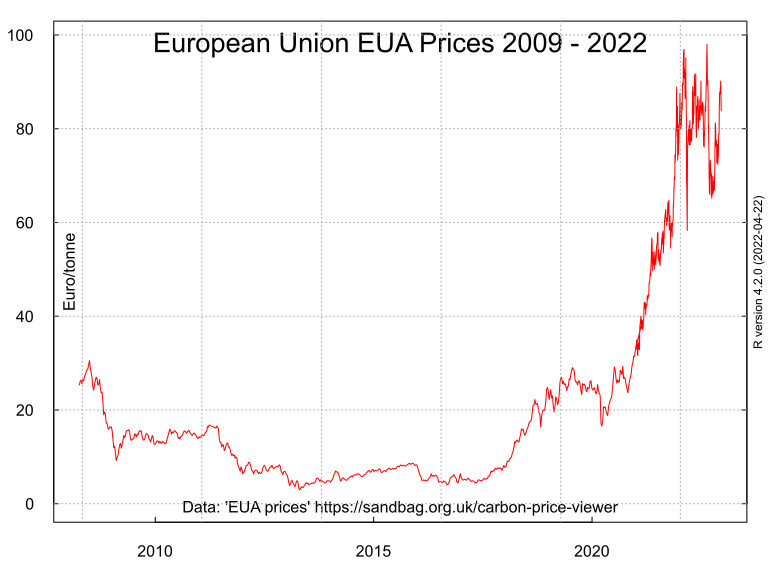
The carbon price within Phase II increased to over €20/t in the first half of 2008 (CCC, 2008, p. 149). The average price was €22/t in the second half of 2008, and €13/t in the first half of 2009. CCC (2009, p. 67) gave two reasons for this fall in prices:{{Cite book |access-date=1 May 2010 |archive-date=2 March 2011 |archive-url=https://web.archive.org/web/20110302205333/http://www.official-documents.gov.uk/document/other/9789999100076/9789999100076.pdf |url-status=live
- Reduced output in energy-intensive sectors as a result of the recession. This means that less abatement will be required to meet the cap, lowering the carbon price.
- The market perception of future fossil fuel prices may have been revised downwards.
Projections made in 2009 indicate that like Phase I, Phase II would see a surplus in allowances and that 2009 carbon prices were being sustained by the need to "bank" allowances to surrender them in the tougher third phase. In December 2009, carbon prices dropped to a six-month low after the Copenhagen climate summit outcome disappointed traders. Prices for EU allowances for December 2010 delivery dropped 8.7% to 12.40 euros a tonne.{{cite news |access-date= 27 January 2013 |archive-date= 27 January 2013 |archive-url= https://web.archive.org/web/20130127104834/http://news.bbc.co.uk/2/hi/business/8425293.stm |url-status= live
In March 2012, according to the Periodical Economist, the EUA permit price under the EU ETS had "tanked" and was too low to provide incentives for firms to reduce emissions. The permit price had been persistently under €10 per tonne compared to nearly €30 per tonne in 2008. The market had been oversupplied with permits.{{cite news |access-date = 3 April 2012 |archive-date = 1 April 2012 |archive-url = https://web.archive.org/web/20120401203227/http://www.economist.com/node/21548962 |url-status = live In June 2012, EU allowances for delivery in December 2012 traded at 6.76 euros each on the Intercontinental Exchange Futures Europe exchange, a 61% decline compared with a year previously.{{cite news |access-date = 6 January 2013 |archive-date = 20 May 2013 |archive-url = https://web.archive.org/web/20130520023212/http://www.bloomberg.com/news/2012-06-11/eu-risks-12-years-of-oversupply-in-co2-market-report.html |url-status = live
In July 2012, Thomson Reuters Point Carbon stated that it considered that without intervention to reduce the supply of allowances, the price of allowances would fall to four Euros.{{cite web |access-date=6 August 2012 |archive-date=3 August 2012 |archive-url=https://web.archive.org/web/20120803011837/http://www.pointcarbon.com/news/1.1946676 |url-status=live |access-date = 14 January 2013 |archive-date = 5 January 2013 |archive-url = https://web.archive.org/web/20130105033903/http://www.theage.com.au/business/carbon-economy/european-carbon-permit-prices-cap-another-losing-year-20130101-2c3s9.html |url-status = live |access-date = 27 January 2013 |archive-date = 9 December 2013 |archive-url = https://web.archive.org/web/20131209035153/http://www.theguardian.com/environment/2013/jan/24/eu-carbon-price-crash-record-low |url-status = live
Phase III 2013–2020
For Phase III (2013–2020), the European Commission implemented many changes, including (CCC, 2008, p. 149):
- the setting of an overall EU cap, with allowances then allocated to EU members;
- tighter limits on the use of offsets;
- limiting banking of allowances between Phases II and III;
- a move from allowances to auctioning;
- and the inclusion of more sectors and gases.
Also, millions of allowances set aside in the New Entrants Reserve (NER) to fund the deployment of innovative renewable energy technologies and carbon capture and storage through the NER 300 programme, one of the world's largest funding programmes for innovative low-carbon energy demonstration projects. The programme is conceived as a catalyst for the demonstration of environmentally safe carbon capture and storage (CCS) and innovative renewable energy (RES) technologies on a commercial scale within the European Union.
Ahead of its accession to the EU, Croatia joined the ETS at the start of Phase III on 1 January 2013.{{cite web |access-date = 18 February 2013 |archive-date = 3 April 2015 |archive-url = https://web.archive.org/web/20150403221422/http://www.climate-policy-watcher.org/?q=node%2F243 |url-status = live
On 4 January 2013, European Union allowances for 2013 traded on London's ICE Futures Europe exchange for between 6.22 euros and 6.40 euros.{{cite news |access-date = 6 January 2013
The number of excess allowances carried over ("banked") from Phase II to Phase III was 1.7 billion.
Phase IV 2021–2030
Phase IV commenced on 1 January 2021 and will finish on 31 December 2030. The European Commission plans a full review of the Directive by 2026. Since 2018, prices have continuously increased, reaching €57/t ( $) in July 2021. This results in additional costs of about €0.04/kWh for coal and €0.02/kWh for gas combustion for electricity.
Reform of the EU-ETS and introduction of the Market Stability Reserve (MSR)
On 22 January 2014, the European Commission proposed two structural reform amendments to the ETS directive (2003/87/EC) of the 2008 Climate Package to be agreed on in the Council Conclusions on 20–21 March 2014 by the Heads of EU Member States at the meeting of the European Council:
- The linear reduction factor, at which the overall emissions cap is reduced, from 1.74% (2013–2020) to 2.2% each year from 2021 to 2030, thus reducing EU emissions in the ETS sector by 43% compared to 2005
- The creation of a 12% "automatic set-aside" reserve mechanism of verified annual emissions (at least a 100 million permit reserve) in the fourth ETS period from 2021 to 2030
Connie Hedegaard, the EU Commissioner for Climate Change, hoped "to link up the ETS with compatible systems around the world to form the backbone of a global carbon market" with Australia cited as an example. However, as the COP 19 Climate Conference again ended with no binding new international agreement in 2013, and after the election of the Liberal-National government, Australia dismantled its ETS system.
Before the European Council summit on 20 March 2014, the European Commission decided to propose a change in the functioning of the carbon market ( permits). The submitted legislation on the Market Stability Reserve system (MSR) would change the amount of annually auctioned permits based on the amount of permits in circulation. On 24 October 2014, at the meeting of the European Council, the Heads of Governments of EU Member States provided legal certainty to the proposed Market Stability Reserve (MSR) by sanctioning the political project in the text of the Council Conclusions. This would address imbalances in supply and demand in the European carbon market by adjusting volumes for auction. The reserve would operate on predefined rules with no discretion for the commission or Member States.
The European Parliament and the European Council informally agreed on an adapted version of this proposal, which sets the starting date of the MSR to 2019 (so already in Phase III), puts the 900 million backloaded allowances in the reserve and reduces the reaction time of the MSR to one year. The adopted proposal was passed as Decision (EU) 2015/1814 by the European Parliament and the Council of Ministers in 2015.
In 2023, carbon prices fell to around 70 euros per ton, down from over 100 euros, affecting funding for the EU Innovation Fund and highlighting the MSR's critical role in stabilizing the market.
Reform of the Market Stability Reserve (MSR)
In the years 2014–2017, the back-loading of auction volumes and the legislation on introducing the MSR had neither substantially decreased the surplus of allowances nor substantially increased allowance prices in the EU-ETS, with EUA prices remaining below €10/t. In 2018, the MSR was reformed again with Directive (EU) 2018/410, primarily to reduce the surplus of emissions allowances and create additional scarcity:
- For the period from 2019 to 2023, the share of allowances put into the MSR was increased from 12% to 24%
- From 2023 onwards, all allowances in the MSR above the total number of allowances auctioned during the previous year will become invalid.
- Unilateral invalidation of allowances by member states that take additional policy measures leading to reduced demand for EUAs.
This reform led to a strong increase in EUA prices in 2018, with prices staying mostly in a range of €18-30/t from August 2018 to March 2020. A scientific study analyzing the effect of the reform found that the substantial price increase could not be explained by the changes to the ETS/MSR alone, but that there also needed to be a change in the foresight of market actors: Through the reform, policymakers increased commitment to the EU ETS, making a long-term survival of the EU-ETS more credible. Thus, firms started acting with more foresight, taking expected future certificate scarcity into account.
"Fit for 55" package
The change in the overall EU emissions target to a –55% reduction versus 1990 in the European Green Deal necessitated tightening of the EU ETS reduction target for 2030 of –43% concerning 2005. The EU Commission proposed in its "Fit for 55" package to increase the EU ETS reduction target for 2030 to –61% compared to 2005. Such a tighter EU ETS target could increase the scarcity of EUAs and thus raise EUA prices higher, with modelling studies estimating carbon prices in the range of €90-€130/t for 2030.
The EU Commission also proposed to include emissions from maritime transport in the EU ETS.
Russian invasion of Ukraine 2022
The 24 February 2022 invasion sent carbon prices plunging from €97 in early February down to below €70.
ETS 2
As part of the 2023 revisions of the ETS Directive, a new emissions trading system named ETS2 was created. It will address the CO2 emissions in buildings, road transport and more sectors not covered by the existing ETS. So far, emission reductions in those sectors have been insufficient to achieve climate neutrality by 2050.
It will cover emissions upstream - fuel suppliers, rather than end consumers will need to report, pay for and reduce emissions. The cap is planned to be set on a level sufficient for reducing emissions by 42% by 2030 compared to 2005 levels. The revenues will be used for climate action and social measures, including through the Social Climate Fund, which main purpose is to support vulnerable groups. The European Commission has published a study showing how to decarbonise sectors covered by ETS2, in a just way.
ETS2 has been designed to start in a smooth manner. Monitoring and reporting of emissions will begin in 2025 and in 2027 the system will become operational. During 2027, 30% more allowances will be provided. ETS2 will operate with a market stability reserve to address insufficient or excessive supply of allowances. During the first 3 years, if the price of allowances exceeds €45, more allowances can be released. If the prices of oil or gas will be very high in 2026, the start of the ETS2 could be delayed to 2028.
After the ETS2 will be introduced, 75% of the emissions of the European Union will be covered by a cap and trade system.
In 2025 the activation of ETS2 was delayed to 2028 under political pressure from "Member States concerned about inflation and energy affordability" significantly hurting the environmental and social targets of the EU. The decision reflect "growing tension between political feasibility and climate urgency."
Reaching net zero
After 2039 no more allowances will be distributed. After the unused allowances will end also, no more emissions will be permitted.
Costs
Emissions in the EU have been reduced at costs that are significantly lower than projected, Overall, the estimated cost was a fraction of 1% of GDP. It was suggested that if permits were auctioned, and the revenues used effectively, e.g., to reduce distortionary taxes and fund low-carbon technologies, costs could be eliminated, or even create a positive economic impact.
Carbon Border Adjustment Mechanism (CBAM)
Main article: EU Carbon Border Adjustment Mechanism
From 2026, the European Union is activating a carbon border tax called Carbon Border Adjustment Mechanism (CBAM). The aim is to stop the problem of carbon leakage: the cost imposed by the European emission trading system making the European companies less competitive in comparison to foreign companies which do not make similar efforts for decarbonisation. As a result, instead of buying European products, the consumers in the European Union are buying imported products with high emissions, so instead of declining the emissions just travel to other countries and the European industry suffer losses. Therefore, with the help of this tax the European Union will force companies from other countries to pay similar price for carbon. This will permit to stop allocating allowances for free to hard-to-decarbonize sectors of the economy, which was done until now to prevent carbon leakage.
If countries outside the European Union have or will create their own carbon pricing policies, "they will avoid the EU's carbon border tax and keep the revenues for their own decarbonization projects". A similar UK CBAM will be implemented by 2027. It has been suggested that the mechanism will help reduce emissions not only by making companies reduce emissions but also by incentivising other countries (like the United States, which lacks federal carbon pricing) to create similar mechanisms. Some authors even argue that the CBAM constitutes the beginning of a climate club, as proposed by Nobel Memorial Prize winner William Nordhaus. Japan, China and South Korea will pay high fees, and they already began to improve their emissions trading systems.
China expanded its ETS to new sectors and will put an absolute cap on emissions instead of intensity based, among other because of CBAM. The carbon market in India and Turkish Emissions Trading System aim to keep the revenues for their own budgets. Other countries installing their own carbon pricing mechanisms due to CBAM include Brazil, Indonesia, Taiwan, Vietnam, Malaysia and Serbia. Partially due to CBAM the Open Coalition on Compliance Carbon Markets was created during the 2025 United Nations Climate Change Conference with the aim of creating a global carbon market.
Overall emission reductions
According to the European Commission, greenhouse gas emissions from big emitters covered by the EU ETS had decreased by an average of more than 17,000 tonnes per installation between 2005 and 2010, a decrease of more than 8%.{{cite web |access-date= 8 August 2012 |archive-date= 17 May 2012 |archive-url= https://web.archive.org/web/20120517001725/http://ec.europa.eu/clima/publications/docs/factsheet_ets_emissions_en.pdf |url-status= live
A 2020 study found that the European Union Emissions Trading System successfully reduced CO2 emissions even though the prices for carbon were set at low prices. A review of 13 studies on the EU ETS quantifies the emission reduction effect at about 7%.
A 2023 study on the effects of the EU ETS identified a reduction in carbon emissions in the order of a 10% decrease between 2005 and 2012. The study compared regulated and unregulated companies, concluding that the EU ETS had no significant impact on profits and employment and led to an increase in revenues and fixed assets for regulated companies.
According to the site of the European parliament "Between 2005 and 2023, emissions from power plants and factories covered by the EU emissions trading system fell by 47%".
Inclusion of sinks
Currently, the EU does not allow credits under ETS to be obtained from sinks (e.g. reducing by planting trees). However, some governments and industry representatives lobby for their inclusion. The inclusion is currently opposed by NGOs as well as the EU commission itself, arguing that sinks are surrounded by too many scientific uncertainties over their permanence and that they have an inferior long-term contribution to climate change compared to reducing emissions from industrial sources.
Views on the EU ETS
People and organizations responded differently to the EU ETS. Mr. Anne Theo Seinen, of the EC's Directorate-General for the Environment, described Phase I as a "learning phase", where, for example, the infrastructure and institutions for the ETS were set up (UK Parliament, 2009).{{cite web |access-date=1 May 2010 |archive-date=24 April 2010 |archive-url=https://web.archive.org/web/20100424202404/http://www.publications.parliament.uk/pa/cm200910/cmselect/cmenvaud/290/9051205.htm |url-status=live
In 2009 the World Wildlife Fund commented that there was no indication that the EU ETS had influenced longer-term investment decisions.{{cite web |access-date=1 May 2010 |archive-date=24 April 2010 |archive-url=https://web.archive.org/web/20100424202401/http://www.publications.parliament.uk/pa/cm200910/cmselect/cmenvaud/290/9033103.htm |url-status=live |access-date=21 April 2010 |display-authors=etal |archive-date=31 August 2009 |archive-url=https://web.archive.org/web/20090831121049/http://www.imf.org/external/pubs/ft/weo/2008/01/index.htm |url-status=live
A 2016 survey of German companies participating in the EUETS found that under current trading conditions, the EUETS has generated weak incentives for participating firms to adopt carbon abatement measures. | access-date = 15 September 2016 | access-date = 15 September 2016 | archive-date = 17 April 2020 | archive-url = https://web.archive.org/web/20200417134744/https://www.kfw.de/PDF/Download-Center/Konzernthemen/Research/PDF-Dokumente-CO2-Barometer/CO2-Barometer-2016-Carbon-Edition.pdf | url-status = live
Criticisms
The EU ETS has been criticized for several points including: over-allocation, windfall profits, price volatility, and in general failure to meet its goals. Proponents maintain, however, that Phase I of the EU ETS (2005–2007) was a "learning phase" designed primarily to establish baselines and create the infrastructure for a carbon market, not to achieve significant reductions.
Some design flaws have limited the effectiveness of the scheme. In the initial 2005–07 period, emission caps were not tight enough to drive a significant reduction in emissions. The total allocation of allowances turned out to exceed actual emissions. This drove the carbon price down to zero in 2007. This oversupply was caused because the allocation of allowances by the EU was based on emissions data from the European Environmental Agency in Copenhagen, which uses a horizontal activity-based emissions definition similar to the United Nations, the EU-ETS Transaction log in Brussels, but a vertical installation-based emissions measurement system. This caused an oversupply of 200 million tonnes (10% of the market) in the EU-ETS in the first phase and collapsing prices.
In addition, the EU ETS has been criticized as having caused a disruptive spike in energy prices. Defenders of the scheme say that this spike did not correlate with the price of permits, and the largest price increase occurred at a time (Mar–Dec 2007) when the cost of permits was negligible.
Researchers Preston Teeter and Jorgen Sandberg have argued that it is largely the uncertainty behind the EU's scheme that has resulted in such a tepid and informal response by regulated organizations. Their research has revealed a similar outcome in Australia, where organizations saw little incentive to innovate and even comply with cap and trade regulations.
Some critics in the EU blamed the EU ETS for contributing to the 2021 global energy crisis.
Over-allocation
There was an oversupply of emissions allowances for EU ETS Phase I. This drove the carbon price down to zero in 2007 (CCC, 2008, p. 140). This oversupply reflects the difficulty in predicting future emissions which is necessary for setting a cap. Given poor data about emissions baselines, the inherent uncertainty of emissions forecasts, and the very modest reduction goals of the Phase I cap (1–2% across the EU), it was entirely expected that the cap might be set too high.
This problem naturally diminishes as the cap tightens. The EU's Phase II cap is more than 6% below 2005 levels, much stronger than Phase I, and readily distinguishable from business-as-usual emissions levels.
Over-allocation does not imply that no abatement occurred. Even with over-allocation, there was theoretically a price on carbon (except for installations that received hundreds of thousands of free allowances). For some installations, the price had some effect on emitters' behaviour. Verified emissions in 2005 were 3–4% below projected emissions, and analysis suggests that at least part of that reduction was due to the EU ETS.
In September 2012, Thomson Reuters Point Carbon calculated that the first Kyoto Protocol commitment period had been oversupplied by about 13 billion tonnes (13.1 Gt) of and that the second commitment period (2013–2020) was likely to start with a surplus of Assigned Amount Units (AAUs).
Windfall profits
According to Newbery (2009), the price of EUAs was included in the final price of electricity. This would avoid possible windfall profits in all sectors.
Price volatility
The price of emissions permits tripled in the first six months of Phase I, collapsed by half in a one week in 2006 and declined to zero over the next twelve months. Such movements and the implied volatility raised questions about the viability of the Phase I system to provide stable incentives to emitters.
In future phases, measures such as banking of allowances, auctioning, and price floors were considered to mitigate volatility. However, it is important to note that considerable volatility is expected of this type of market, and the volatility seen is quite in line with that of energy commodities generally. Nonetheless, producers and consumers in those markets respond rationally and effectively to price signals.
Newbery (2009) commented that Phase I of the EU ETS was not delivering the stable carbon price necessary for long-term, low-carbon investment decisions. He suggested that efforts should be made to stabilize carbon prices, e.g., by having a price ceiling and a price floor. This led to the reforms outlined above in Phases II and III.
Main article: European Union Emission Trading Scheme#Carbon price
Offsetting
Project based offsetting
The EU ETS is "linked" to the Joint Implementation and Clean Development Mechanism projects as it allows the limited use of "offset credits" from them. Participating firms were allowed to use some Certified Emission Reduction units (CERs) from 2005 and Emission Reduction Units (ERUs) from 2008. Each Member State's National Allocation Plan must specify a percentage of the national allocation that will be the cap on the CERs and ERUs that may be used. CERs and ERUs from nuclear facilities and Land Use, Land-Use Change and Forestry may not be used.
The main theoretical advantage of allowing free trading of credits is that it allows mitigation to be done at least cost (CCC, 2008, p. 160). This is because the marginal costs (that is to say, the incremental costs of preventing the emission of one extra ton of e into the atmosphere) of abatement differs among countries. In terms of the UK's climate change policy, CCC (2008), noted three arguments against too great a reliance on credits:
- Rich countries need to demonstrate that a low-carbon economy is possible and compatible with economic prosperity. This is to convince developing countries to lower their emissions. Additionally, domestic action by rich countries drives investment towards a low-carbon economy.
- An ambitious long-term target to reduce emissions, e.g., an 80% cut in UK emissions by 2050, requires significant domestic progress by 2020 and 2030 to reduce emissions.
- CDM credits are inherently less robust than a cap and trade system, where reductions are required in total emissions.
Due to the economic downturn, states have pushed successfully for a more generous approach towards the use of CDM/JI credits post-2012. The 2009 EU ETS Amending Directive states that credits can be used for up to 50% of the EU-wide reductions below the 2005 levels of existing sectors over the period 2008–2020. Moreover, it has been argued that the volume of CDM/JI credits, if carried over from phase II (2008–2012 to phase III 2013–2020) in the EU ETS will undermine its environmental effectiveness, despite the requirement of supplementarity in the Kyoto Protocol.
In January 2011, the EU Climate Change Committee banned the use of CDM Certified Emission Reduction units from HFC-23 destruction in the European Union Emissions Trading Scheme from 1 May 2013. The ban includes nitrous oxide (N2O) from adipic acid production. The reasons given were the perverse incentives, the lack of additionality, the lack of environmental integrity, the undermining of the Montreal Protocol, costs and ineffectiveness and the distorting effect of a few projects in advanced developing countries getting too many CERs.
Buying and deleting emissions allowances
As an alternative to CDM and JI projects, emissions can be offset directly by buying and deleting emissions allowances inside the ETS. This is a way to avoid several problems of CDM and JI such as additionality, measurement, leakage, permanence, and verification. Buying and cancelling allowances allows you to include more emissions sources in the ETS (such as traffic). Furthermore, it reduces the available allowances in the cap-and-trade system, which means that it reduces the emissions that can be produced by covered sources.
References
References
- "About the EU ETS". The European Union.
- "EU emissions trading system for buildings, road transport and additional sectors (ETS2) Status and concerns".
- "Transform -".
- "When can we expect the end of EUA supply and will happen after?".
- (February 2025). "WHAT LIES AHEAD FOR THE EU ETS?". North European Energy Perspectives.
- "EU Emissions Trading System has reduced emissions in the sectors covered by 50% since 2005". The European Union.
- "Emissions trading 20 years – what's next?".
- (2020-04-02). "The European Union Emissions Trading System reduced CO2 emissions despite low prices". Proceedings of the National Academy of Sciences.
- (2024-05-16). "Systematic review and meta-analysis of ex-post evaluations on the effectiveness of carbon pricing". Nature Communications.
- (2023-03-01). "The joint impact of the European Union emissions trading system on carbon emissions and economic performance". Journal of Environmental Economics and Management.
- (2024-07-09). "The European Union Emissions Trading System might yield large co-benefits from pollution reduction". Proceedings of the National Academy of Sciences.
- (2023-02-21). "EU carbon hits 100 euros taking cost of polluting to record high". Reuters.
- (2014). "The European Union's Emissions Trading System". Cambridge Journal of Economics.
- (May 2008). "State and Trends of the Carbon Market 2008".
- [http://www.opencrs.com/document/RL33581 Climate Change: The European Union's Emissions Trading System (EU ETS)] {{webarchive. link. (August 30, 2006)
- (2006-07-31). "Britain, California to join forces on global warming". The Washington Times.
- Wagner, M. [https://www.leuphana.de/fileadmin/user_upload/Forschungseinrichtungen/csm/files/Arbeitsberichte_etc/47-4downloadversion.pdf ''Firms, the Framework Convention on Climate Change & the EU Emissions Trading System''] {{Webarchive. link. (2017-04-25. Lüneburg: Centre for Sustainability Management 2004, p. 12.)
- ""The EU Emissions Trading System (EU-ETS)"".
- European Commission Climate Action, [http://ec.europa.eu/clima/policies/ets/index_en.htm Emissions Trading System] {{Webarchive. link. (20 November 2016 .)
- (15 November 2010). "Emissions Trading System (EU ETS)". European Commission.
- Wagner, M.: Firms, the Framework Convention on Climate Change & the EU Emissions Trading System. Corporate Energy Management Strategies to Address Climate Change and GHG Emissions in the European Union. Lüneburg: Centre for Sustainability Management, 2004, p.12 [http://www2.leuphana.de/umanagement/csm/content/nama/downloads/download_publikationen/47-4downloadversion.pdf CSM Lüneburg] {{Webarchive. link. (26 February 2017)
- link. (30 May 2012 , MEMO/08/35, Brussels, 23 January 2008)
- (26 October 2021). "Trends and Projections in Europe 2021 — European Environment Agency".
- (2 April 2020). "The European Union Emissions Trading System reduced CO2 emissions despite low prices". Proceedings of the National Academy of Sciences.
- "The EU Emissions Trading System (EU ETS) - European Commission".
- Anonymous. (23 November 2016). "Auctioning – Climate Action – European Commission".
- Anonymous. (23 November 2016). "Reducing emissions from aviation – Climate Action – European Commission".
- [http://europa.eu/press_room/presspacks/energy/comm2007_02_en.pdf Limiting global climate change to 2 degrees Celsius – The way ahead for 2020 and beyond] {{Webarchive. link. (3 July 2007 , Communication from the Commission to the Council, the European Parliament, the European Economic and Social Committee and the Committee of the Regions, Brussels, 10 October 2007.)
- "European Commission – Press release – Stopping the clock of ETS and aviation emissions following last week's International Civil Aviation Organisation (ICAO) Council".
- Anonymous. (23 November 2016). "EU Emissions Trading System (EU ETS) – Climate Action – European Commission".
- {{CELEX
- (8 July 2015). "Parliament adopts CO2 market stability reserve – News – European Parliament".
- "Market Stability Reserve".
- {{CELEX
- (2007). "EU action against climate change". European Commission.
- Norwegian Ministry of the Environment. (2007). "The Norwegian Government accepts to include the EU Emissions Trading Directive in the EEA agreement". European Commission.
- (2010). "Economic Survey of Norway 2010: Sustainable development: climate change and fisheries policies". Organization for Economic Co-operation and Development.
- "EU greenhouse gas emissions and targets". European Commission.
- [http://www.decc.gov.uk/en/content/cms/what_we_do/change_energy/tackling_clima/ccas/uk_ets/uk_ets.aspx UK Emissions Trading Scheme] {{Webarchive. link. (21 November 2010 DECC)
- (2013-06-01). "Border Carbon Adjustment and International Trade: A Literature Review". OECD Trade and Environment Working Papers.
- Luke, Ryan. "Mercari Reviews [2021]: Our Experience – Arrest Your Debt".
- Newbery, D.. (26 February 2009). "Memorandum submitted by David Newbery, Research Director, Electric Policy Research Group University of Cambridge.". UK Parliament House of Commons Environmental Audit Select Committee.
- [http://ec.europa.eu/environment/climat/pdf/m06_452_en.pdf Questions and Answers on Emissions Trading and National Allocation Plans for 2008 to 2012] {{Webarchive. link. (10 August 2010 EU November 2006)
- link. (23 December 2008 EUROPA, Brussels 2008)
- Nancy Stauffer. (29 May 2008). "Carbon emissions trading in Europe: Lessons to be learned". Massachusetts Institute of Technology Energy Initiative.
- "EU Emissions Trading System (EU ETS)".
- {{OGL-attribution. Department of Business, Energy and Industrial Strategy, [https://www.gov.uk/government/publications/participating-in-the-uk-ets Participating in the UK Emissions Trading Scheme (UK ETS)], published 17 December 2021, accessed 15 January 2021
- Department of Business, Energy and Industrial Strategy, [https://www.gov.uk/government/publications/eu-ets-obligations-and-access-to-eu-registry-systems-in-2021 EU ETS obligations and access to EU registry systems in 2021] {{Webarchive. link. (19 January 2021 , published 31 December 2020, accessed 15 January 2021)
- FOEN, Federal Office for the Environment. "Linking the Swiss and EU emissions trading systems".
- Burtraw, D., Palmer, K. L., Munnings, C., Weber, P., & Woerman, M., 2013: Linking by Degrees: Incremental Alignment of Cap-and-Trade Markets. SSRN Electronic Journal. doi:10.2139/ssrn.2249955
- Flachsland, C., Marschinski, R., & Edenhofer, O., 2009: To link or not to link: benefits and disadvantages of linking cap-and-trade systems. Climate Policy, 9(4), 358–372. doi:10.3763/cpol.2009.0626
- (2020-12-17). "Linking the EU ETS with California's Cap-and-Trade Program". The Central European Review of Economics and Management.
- Ranson, M., & Stavins, R., 2013: Linkage of Greenhouse Gas Emissions Trading Systems – Learning from Experience. Discussion Paper Resources For The Future, No. 42
- The House of Commons Energy and Climate Committee, 2015: Linking emissions trading systems. London.
- (2020). "Carbon Trading with Blockchain". Springer International Publishing.
- (20 December 2006). "Q&A: Europe's carbon trading scheme". BBC News.
- (28 February 2006). "Carbon 2006 market survey". Point Carbon.
- (November 2007). "Analyse van de CO2-markt (in Dutch)". Emissierechten.
- (2008). "Over-Allocation or Abatement? A Preliminary Analysis of the EU ETS Based on the 2005–06 Emissions Data". Environmental and Resource Economics.
- (23 May 2006). "Emissions trading: 2007 verified emissions from EU ETS businesses". European Commission Press Release.
- [http://www.emissierechten.nl/marktanalyse.htm Emissierechten] {{webarchive. link. (11 April 2013 (in Dutch))
- AFP. (27 October 2007). "Iceland, Norway, Liechtenstein to join EU emissions trading system". EUbusiness Ltd.
- (December 2008). "Building a low-carbon economy – The UK's contribution to tackling climate change". Committee on Climate Change.
- Grubb, M.. (3 August 2009). "Climate Policy and Industrial Competitiveness: Ten Insights from Europe on the EU Emissions Trading System". Climate Strategies.
- (12 May 2012). "EU Emissions Trading System Single Registry: Timetable Announced". [[McDermott Will & Emery]].
- Jones, B.. (October 2007). "Appendix 1.2 Climate Change: Economic Impact and Policy Responses". IMF.
- (27 September 2005). "Questions & Answers on Aviation & Climate Change". EU Europa.
- (27 November 2012). "European Union Emissions Trading Scheme Prohibition Act of 2011". Government Printing Office.
- Elisabeth Rosenthal. (26 January 2013). "Your Biggest Carbon Sin May Be Air Travel". The New York Times.
- Lewis, Barbara. (10 December 2012). "Insight: U.S., China turned EU powers against airline pollution law". Reuters.
- (21 November 2005). "Stavros Dimas Speech to House of Commons London". EU Europa.
- (2006). "Dealing with transport emissions". The Swedish Environmental Protection Agency.
- (November 2006). "Emissions trading: Commission decides on first set of national allocation plans for the 2008–2012 trading period". EU Europa.
- (2009). "Carbon trading: how it works and why it fails". Dag Hammarskjöld Foundation.
- (14 July 2020). "EU to include ships in the ETS". Reuters.
- (23 January 2023). "Preliminary agreement to include shipping in the EU's Emission Trading System from 2024".
- Mehta, Amgeli. (May 15, 2023). "In the voyage to net-zero, which green shipping fuel will rule the seas?". Reuters.
- Bank, European Investment. (2024-05-14). "Financing sustainable liquid fuel projects in Europe: Identifying barriers and overcoming them". European Investment Bank.
- "Renewable energy targets - European Commission".
- "RefuelEU aviation initiative: Council adopts new law to decarbonise the aviation sector".
- Antonio. (2023-09-14). "REDIII, ReFuel EU Aviation, and FuelEU Maritime Formally Adopted by the European Parliament".
- (26 October 2007). "IP/07/1614: Emissions trading: EU-wide cap for 2008–2012 set at 2.08 billion allowances after assessment of national plans for Bulgaria". EU.
- Kanen, Joost. (31 December 2006). "Carbon Trading & Pricing".
- Anonymous. (23 November 2016). "EU Emissions Trading System (EU ETS) – Climate Action – European Commission".
- Anonymous. (23 November 2016). "NER 300 programme – Climate Action – European Commission".
- "Benchmarks for free allocation - Policies - Climate Action - European Commission".
- "Archived copy".
- Anonymous. (23 November 2016). "EU Emissions Trading System (EU ETS)".
- "Carbon Price Viewer". EMBER.
- "European Council - Conclusions".
- "Archived copy".
- {{CELEX
- {{CELEX
- (9 December 2020). "Department of the Environment and Energy".
- "Consilium - Council focuses on climate, energy and GMOs".
- "COM/2014/0020 – Document details page".
- "Archived copy".
- (April 18, 2024). "Carbon price fall deprives Europe's green funds of billions".
- (2020-01-02). "How to avoid history repeating itself: the case for an EU Emissions Trading System (EU ETS) price floor revisited". Climate Policy.
- (2024-05-30). "EU carbon prices signal high policy credibility and farsighted actors". Nature Energy.
- European Commission. (14 July 2021). "Delivering the European Green Deal".
- Simon, Frédéric. (2021-07-19). "Analyst: EU carbon price on track to reach €90 by 2030".
- (2021-07-01). "Tightening EU ETS targets in line with the European Green Deal: Impacts on the decarbonization of the EU power sector". Applied Energy.
- [https://www.theguardian.com/environment/2022/mar/02/eu-carbon-permit-prices-crash-after-russian-invasion-of-ukraine EU carbon permit prices crash after Russian invasion of Ukraine] The Guardian. 2020.
- "ETS2 Buildings, road transport and additional sectors". The European Union.
- "EU emissions trading system for buildings, road transport and additional sectors (ETS2) Status and concerns".
- (24 January 2025). "U-turn on EU's Emissions Trading System for road transport and buildings carries huge environmental, social and economic price tag".
- "EU Pushes ETS2 Launch to 2028, Weakening Climate Momentum".
- Vela, Alberto. "Carbon pricing delay jeopardises EU support for vulnerable households and climate goals".
- (February 2025). "WHAT LIES AHEAD FOR THE EU ETS?". North European Energy Perspectives.
- link. (12 December 2013 . Discussion Paper No. 12-021. Centre for European Economic Research, 2012)
- (30 July 2024). "FAQ: The EU Carbon Border Adjustment Mechanism (CBAM)".
- (23 May 2023). "As CBAM carbon border tax looms, EU wants to help Western Balkans to adapt".
- "Factsheet: UK Carbon Border Adjustment Mechanism".
- (7 October 2021). "Why the US should establish a carbon price either through reconciliation or other legislation".
- (17 May 2023). "How a European law might get companies around the world to cut climate pollution". NPR.
- (2023-07-05). "The EU's CBAM and Its 'Significant Others': Three Perspectives on the Political Fallout from Europe's Unilateral Climate Policy Initiative". JCMS: Journal of Common Market Studies.
- (September 2022). "Climate clubs and carbon border adjustments: a review". Environmental Research Letters.
- (2022). "The European Union's CBAM as a de facto Climate Club: The Governance Challenges". Frontiers in Climate.
- (2022-09-01). "Climate clubs and carbon border adjustments: a review". Environmental Research Letters.
- Nordhaus, William. (2015-04-01). "Climate Clubs: Overcoming Free-riding in International Climate Policy". American Economic Review.
- (16 October 2025). "EU's CBAM will help Asian economies step up their carbon market ambitions, simulation reveals".
- "China's emissions trading system (ETS) reforms: On track, but needs robust enforcement".
- Dhoot, Vikas. (2023-11-02). "CBAM will kill EU manufacturing, India will have its own carbon taxes: Goyal". The Hindu.
- (16 October 2025). "Pragmatism vs principle: Carbon markets as a response to the EU's CBAM".
- "Carbon Market Coalition Welcomes 18 Member Countries at COP30".
- (7 October 2018). "What progress has the EU made against climate change? (infographics)".
- Kirsten Macey, [http://www.climnet.org/hotspot/Hotspot%2041.pdf No Sinks in the EU ETS] {{Webarchive. link. (17 June 2006 , Hotspot newsletter 41, Climate Action Network, March 2006, retrieved 4 October 2009.)
- Carney, Sean. (28 January 2011). "EU Carbon Market Suffers Further Setback". The Wall Street Journal.
- (29 January 2011). "Greek police trace EU carbon rights thieves". Reuters.
- [http://euobserver.com/885/29403 Cyber-scam artists disrupt emissions trading across EU] {{Webarchive. link. (22 November 2010 EU Observer (2010))
- [http://www.euractiv.com/en/climate-environment/eu-approves-revised-ets-rules-combat-cyber-crime-news-260461 EU approves revised ETS rules to combat cyber crime] {{Webarchive. link. (9 June 2011 Euractive (2010))
- Leigh Phillips. (10 December 2009). "EU emissions trading an 'open door' for crime, Europol says". EUobserver.
- [http://www.carbontradewatch.org/publications/carbon-trading-how-it-works-and-why-it-fails.html Carbon trading – How it works and why it fails] {{Webarchive. link. (25 August 2017 Carbon Trade Watch Critical Currents no. 7, November 2009)
- [http://www.corporateeurope.org/climate-and-energy/content/2011/04/eu-ets-failing-third-attempt EU Emissions Trading System: Failing at the third attempt] {{Webarchive. link. (26 May 2011 , Corporate Europe Observatory/Carbon Trade Watch, April 2011)
- [http://web.mit.edu/mitei/research/spotlights/europe-carbon.html Carbon emissions trading in Europe: Lessons to be learned] {{Webarchive. link. (11 May 2012 MIT Energy Initiative, 2008)
- [http://ncseonline.org/NLE/CRSreports/08Mar/RL34150.pdf Climate Change and the EU Emissions Trading Scheme (ETS): Kyoto and Beyond] {{Webarchive. link. (7 August 2011 [[U.S. Congressional Research Service]] (2008))
- [http://www.c2es.org/eu-ets The European Union's Emissions Trading System in Perspective] {{Webarchive. link. (23 February 2012 MIT/Pew Center 2008)
- Kanen, J.L.M. "Carbon Trading & Prcing". Fulton Publishing (December 2006), pp. 68–69.
- [https://www.washingtonpost.com/wp-dyn/content/article/2007/04/08/AR2007040800758_pf.html Europe’s Problems Color U.S. Plans to Curb Carbon Gases] {{Webarchive. link. (18 January 2017 , Steven Mufson, The Washington Post, 9 April 2007)
- (2016). "Constraining or Enabling Green Capability Development? How Policy Uncertainty Affects Organizational Responses to Flexible Environmental Regulations". British Journal of Management.
- (6 October 2021). "European Energy Crisis Fuels Carbon Trading Expansion Concerns". Bloomberg.
- (20 October 2021). "The Green Brief: East-West EU split again over climate". [[Euractiv]].
- [http://www.bepress.com/feem/paper90/ Over-Allocation or Abatement? A Preliminary Analysis of the EU ETS Based on the 2005 Emissions Data] {{Webarchive. link. (23 May 2013 Fondazione Eni Enrico Mattei Working Papers (2007))
- (13 September 2012). "Kyoto's first commitment period oversupplied by 13 billion tonnes of CO2 Point Carbon". Thomson Reuters Point Carbon.
- (3 March 2009). "Memorandum submitted by the Cambridge Centre for Climate Change Mitigation Research (4CMR)". UK Parliament House of Commons Environmental Audit Select Committee..
- [http://www.econ.cam.ac.uk/eprg/TSEC/2/betz.pdf Emissions trading: lessons learnt from the 1st phase of the EU ETS and prospects for the 2nd phase] {{Webarchive. link. (6 August 2009 Climate Policy (2006))
- {{CELEX
- Pohlmann, "The European Union Emissions Trading Scheme" (p.362), in Legal Aspects of Carbon Trading, Ed. Freestone (2009)
- {{CELEX
- [http://www.thaieurope.net/ftp/project09/ETS_final.pdf The EU ETS, CDM and the Carbon Market] {{Webarchive. link. (3 March 2016 Mission of Thailand to the EC (2009))
- Hedegaard, Connie. (21 January 2011). "Emissions trading: Commission welcomes vote to ban certain industrial gas credits". European Commission.
- (2010-08-04). "Buying and Cancelling Allowances as an Alternative to Offsets for the Voluntary Market: A Preliminary Review of Issues and Options".
- [http://www.epa.gov/airmarkt/trading/buying.html Buying Allowances] {{Webarchive. link. (19 February 2015 U.S. Environmental Protection Agency (2011))
This article was imported from Wikipedia and is available under the Creative Commons Attribution-ShareAlike 4.0 License. Content has been adapted to SurfDoc format. Original contributors can be found on the article history page.
Ask Mako anything about European Union Emissions Trading System — get instant answers, deeper analysis, and related topics.
Research with MakoFree with your Surf account
Create a free account to save articles, ask Mako questions, and organize your research.
Sign up freeThis content may have been generated or modified by AI. CloudSurf Software LLC is not responsible for the accuracy, completeness, or reliability of AI-generated content. Always verify important information from primary sources.
Report