From Surf Wiki (app.surf) — the open knowledge base
European route E751
Road in trans-European E-road network

Road in trans-European E-road network
| Field | Value | ||||
|---|---|---|---|---|---|
| country | EUR | ||||
| type | E | ||||
| route | 751 | ||||
| length_km | 160 | ||||
| length_ref | |||||
| map | E751-overview-map.svg | ||||
| map_alt | E751 runs through Istria and Slovenian Littoral | ||||
| map_notes | E751 constituents: [[File:Color icon Cornflower blue.svg | 10px | alt=Map key – blue]] A8 (Croatia) [[File:Rosemadder.jpg | 10px | alt=Map key – red]] A9 (Croatia) |
| [[File:Colorc1.png | 10px | alt=Map key – green]] G11 (Slovenia) | |||
| direction_a | East | ||||
| terminus_a | in Rijeka | ||||
| junction | in Kanfanar | ||||
| in Pula | |||||
| direction_b | West | ||||
| terminus_b | [[File:Hitra cesta 5.svg | 40px | alt=Slovenian H5 expressway shield]] H5 in Koper | ||
| countries | Croatia, Slovenia | ||||
| previous_type | E | ||||
| previous_route | 717 | ||||
| next_type | E | ||||
| next_route | 761 |
in Pula
The European route E751, or E751, as defined by the Declaration on the Construction of Main International Traffic Arteries of 1975, and subsequent documents which amended the treaty, is an east–west Class-B branching European road route. Originating in Rijeka, Croatia, where it diverges from European route E61 before passing through the Kanfanar interchange, the route connects Pula, Rovinj, Poreč and Umag in Croatia with Koper in Slovenia. The route provides a high-performance road link in Istria and Slovenian Littoral. Unlike most routes, the E751 centers on the Kanfanar interchange and has three arms, each extending to Rijeka, Pula and Koper. The total length of the route, including all the route arms, is 160 km.
The E751 mostly consists of motorways, but considerable sections are either expressways or two-lane roads with at-grade intersections. All motorway sections of the E751 are tolled, using the electronic toll collection (ETC) and ticket systems. Since the 1980s, the E751 has gradually been upgraded from a regular two-lane road to motorway standards, and further upgrades are still being carried out or planned in some areas, particularly in the Rijeka–Kanfanar section and in the section located in Slovenia. The bulk of the E751 consists of the Istrian Y roads operated by BINA Istra. The part of the route in Slovenia is managed by the Slovenian Roads Agency, part of the Government of Slovenia.
The E751 is considered to be of great importance for the economy and tourist industry of the region, as it links many resorts to motorway systems in Slovenia and Croatia, providing a significant access route for thousands of motoring tourists. Furthermore, two endpoints of the E751 are located in the vicinity of the two major Adriatic seaports of Rijeka and Koper.
Route description
The 160 km long E751, part of the International E-road network, connects Croatian and Slovenian Adriatic coastal areas in the vicinity of the city of Rijeka, Istria and Slovenian Littoral. This European route is a Class B branch road, consisting mostly of motorways and expressways along with two-lane roads that have at-grade intersections. It diverges from European route E61 at the Matulji interchange of the Croatian A7 and the A8 motorways, and follows the A8 motorway route. Since sections of the A8 east of Rogovići interchange are still incomplete and lack the second carriageway, those comprise two-lane, limited access roads with grade-separated interchanges (except the Opatija junction) with the D8 state road and is at-grade and regulated by traffic lights. As the A8 terminates at the Kanfanar interchange, the E751 switches to the six-lane A9 motorway. At this junction, the E751 is signposted in both directions, following an approximately 30 km long arm of the Istrian Y system, consisting of the A9 and the A8 roads, to Pula and a considerably longer northward arm to Umag. The A8 and the A9 are the longest segments of the E751, being 141 km long combined. Following the northern terminus of the A9 motorway in the Umag interchange, the E751 switches to the 0.6 km D510 connector and the northernmost section of the D21 state road running to the Kaštel/Dragonja border crossing to Slovenia. Beyond the border, the E751 follows the G11 road to the city of Koper, where the E751 terminates. Thus, unlike most routes, the E751 centers on a central interchange, Kanfanar, and has three arms, each extending to Rijeka, Pula and Koper.
The E751 route is of great importance for economy and tourist industry of Istria and Slovenian Littoral, as it links many resorts to motorway systems in Slovenia and Croatia, providing a significant access route for thousands of motoring tourists. These resorts include Brijuni National Park, Fažana, Rovinj, Poreč, Novigrad, Umag, Piran and Portorož on either side of the Croatian–Slovenian border. Furthermore, two endpoints of the E751 are located in vicinity of two major Adriatic seaports: the Port of Rijeka and the Port of Koper.
Tolls

Since June 2011, the E751 comprises the Croatian A8 and A9 tolled motorways of the Istrian Y. The tolls there are based on the vehicle classification in Croatia using a closed-toll system. Tolls charged along the A9 motorway toll plazas vary depending on the length of route traveled and range from 3.00 kuna (€0.40) to 26.00 kuna (€3.51) for passenger cars and 15.00 kuna (€2.02) to 185.00 kuna (€25.00) for semi-trailer trucks. Although A8 also employs a ticket system, usage of the road is free except for vehicles traversing the Učka Tunnel and the Kanfanar–Rogovići section. A user of the entire length of the A8 is charged 36.00 kuna (€4.86) for passenger cars or up to 205.00 kuna (€27.70) for semi-trailers, depending on vehicle classification in Croatia. Ticket systems employed by the A9 and the A8 are unified; tolls are not charged when switching between the two roads. The toll is payable in either Croatian kuna or euros using major credit cards, debit cards and a number of prepaid toll collection systems. The latter includes various types of smart cards issued by the motorway operator and ENC, an electronic toll collection (ETC) system which is used by most motorways in Croatia and provides drivers with discounted toll rates for dedicated lanes at toll plazas.
The operator of the A9 and the A8 routes, BINA Istra, reported a 65.8 million kuna (€8.9 million) VAT-free toll income in the first half of 2011; this represents an increase of 30.8 percent compared to the same period of the previous year. The figure includes the entire Istrian Y system: the A9 motorway and the A8 motorway. A major part of the increase is attributed to introduction of the closed-toll system, which replaced an open toll system where the toll was charged at the Mirna Bridge and the Učka Tunnel only. The part of the E751 in Slovenia, maintained by the Slovenian Roads Agency of the Government of Slovenia, is not tolled, nor is a short part of the E751 consisting of less than 2 km Croatian state roads. The state roads in Croatia are maintained by Hrvatske ceste.
History

The United Nations Economic Commission for Europe was formed in 1947, and their first major act to improve transportation was the joint UN declaration numbered 1264. Signed in Geneva on 16 September 1950, it was named the Declaration on the Construction of Main International Traffic Arteries, which defined the first E-road network. This declaration was amended several times before 15 November 1975, when it was replaced by the European Agreement on Main International Traffic Arteries (AGR), which established a route-numbering system and improved standards for roads on the list. The AGR went through several changes, the last one of which, as of 2011, occurred 2008. Reorganization of the E-roads network of 1975 and 1983 defined the E751 road and assigned it to Rijeka–Pula–Koper route.
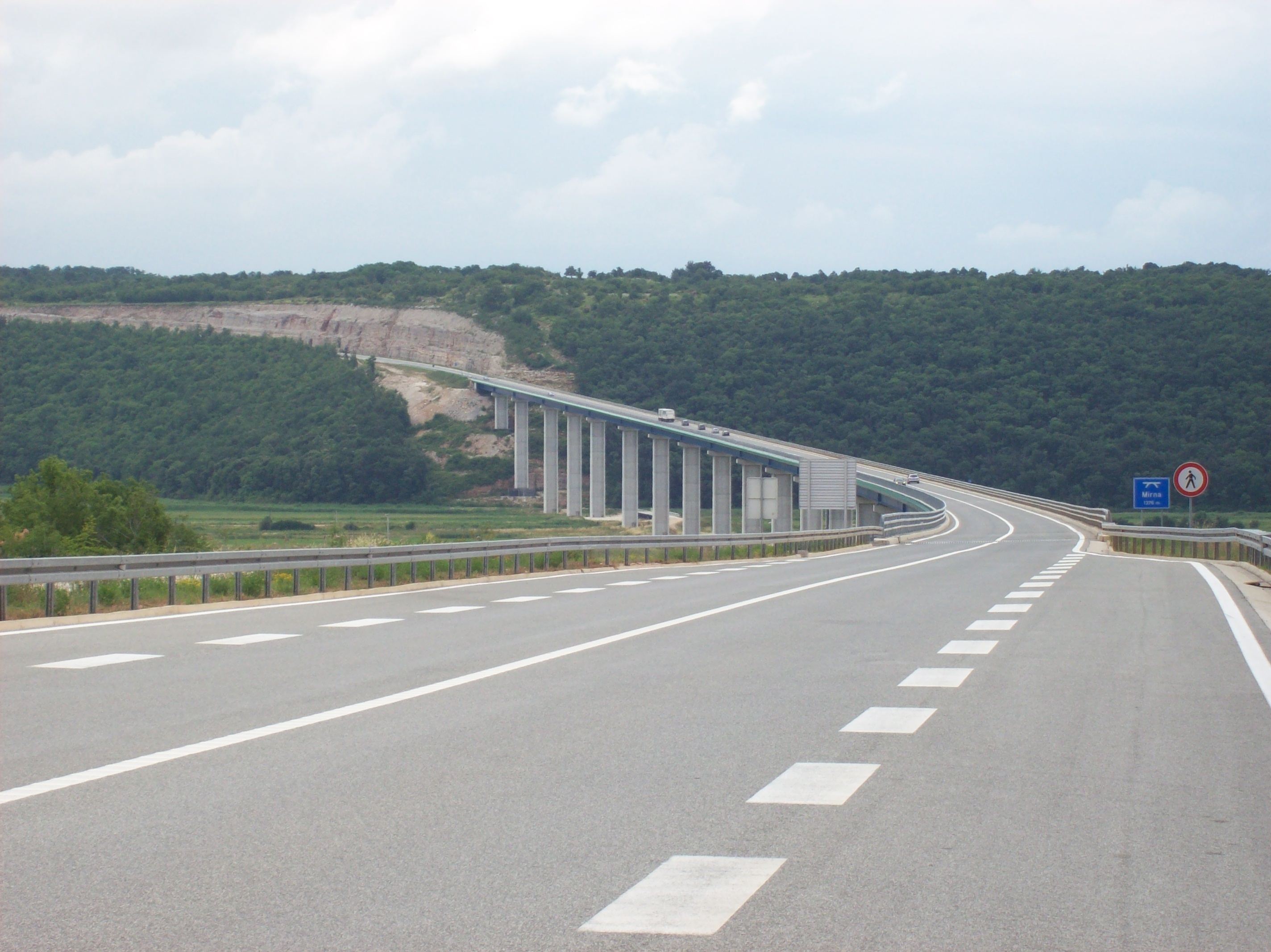
Since the first section of the Istrian Y, which constitutes the bulk of the E751 route, started in 1976, with the first section opening in 1981, there were no high-performance road routes in Istria. Instead, the E751 was signposted along state roads, specifically the D66 spanning Rijeka and Pula, and then switched to the D21 in Pula all the way to the Kaštel border crossing. As the Istrian Y system was being developed, the E751 designation was gradually transferred to the new route, with consistent signposting of the E751 along the A9 and the A8, just as the D3 state road designation west of Rijeka was transferred to the B8 and B9 (later replaced by the A8 and A9 respectively).
Planned development
As of September 2011, there were several plans aimed at the upgrading of the E751 constituent roads in various stages of design or implementation. The A8 route is planned to be upgraded to six-lane motorway standards by its concessionaire, BINA Istra. The upgrade construction works are completed along a 18 km section of the route west of Rogovići, while the remainder was scheduled to be upgraded by late 2014 or early 2015. The A9 motorway is largely complete, and the missing structures required to achieve a full six-lane cross-section of the motorway at the Mirna Bridge and the Limska Draga Viaduct are planned to be completed by 2014. The remaining unbuilt section of the motorway is a short connection to the Slovenian border and planned H5 expressway. The expressway was scheduled to be built after 2013, carrying the E751 to its terminus in Koper.
As of January 2021, the A8's second roadway was complete from Kanfanar to Cerovlje, and works were in progress on the section between Cerovlje and Učka Tunnel, including the construction of a second tube for the Učka Tunnel. The tunnel is scheduled to be completed in 2024. Limska Draga and Mirna viaducts were still two-lane expressways, and construction on the H5 section concurrent with E751 had not yet begun.
Junction list
References
- "Overview map of the E751". [[Google Maps]].
- (29 October 2011). "Kosor otvorila dionicu Istarskog ipsilona, dva mjeseca prije roka". [[Večernji list]].
- Darko Pajić. (June 10, 2011). "Gradnja druge cijevi tunela Učka 2012.". [[Novi list]].
- (May 6, 2003). "Pravilnik o označavanju autocesta, njihove stacionaže, brojeva izlaza i prometnih čvorišta te naziva izlaza, prometnih čvorišta i odmorišta". [[Narodne novine]].
- "Cestovna mreža Istarskog ipsilona". [[BINA Istra]].
- (February 17, 2010). "Odluka o razvrstavanju javnih cesta u državne ceste, županijske ceste i lokalne ceste". Narodne Novine.
- A. Pokrajac. (March 10, 2010). "Lakše i brže do slovenske granice". [[Glas Istre]].
- T. Kocijančić. (June 28, 2011). "Lakše i brže od Umaga do granice". Glas Istre.
- "Travel information". Embassy of the Republic of Slovenia in Helsinki.
- (2010). "Istarski Y". BINA Istra.
- Jelena Lončar. (December 14, 2007). "Međuovisnost prometa i turizma u Hrvatskoj". geografija.hr.
- "Cestarina na Ipsilonu". [[BINA Istra]].
- "Cjenik dionica na karti". BINA Istra.
- "Statistički podaci". HUKA.
- (August 17, 2011). "Rast prihoda od naplate cestarine". [[Privredni vjesnik]].
- (20 December 2004). "Zakon o javnim cestama". [[Narodne novine]].
- (September 2017). "Declaration on the Construction of Main International Traffic Arteries, signed at Geneva". United Nations.
- (March 28, 2008). "EUROPEAN {{sic". [[United Nations Economic Commission for Europe]].
- "European Agreement on main international traffic arteries (AGR) (with annexes and list of roads). Concluded at Geneva on 15 November 1975". United Nations.
- "Granični prijelazi i područja nadležnosti carinarnica". Customs Administration of the Republic of Croatia.
- Darko Pajić. (June 14, 2011). "Ipsilon postaje autocesta". limun.hr.
- Branko Nadilo. (2010). "Druga faza Istarskog ipsilona". Croatian Association of Civil Engineers.
- (2007). "Izmjene i dopune Prostornog plana Istarske županije". [[Istria County]].
- "H5 Koper – Dragonja". [[Motorway Company in the Republic of Slovenia]] (DARS).
- Darko Mlinarić. (October 2010). "Europske i regionalne prometne poveznice Hrvatske i Slovenije". Road and Transportation Research Association of Slovenia.
- (August 10, 2020). "Drugu cijev tunela Učka gradit će više od tisuću radnika, donosimo i druge detalje posla desetljeća".
This article was imported from Wikipedia and is available under the Creative Commons Attribution-ShareAlike 4.0 License. Content has been adapted to SurfDoc format. Original contributors can be found on the article history page.
Ask Mako anything about European route E751 — get instant answers, deeper analysis, and related topics.
Research with MakoFree with your Surf account
Create a free account to save articles, ask Mako questions, and organize your research.
Sign up freeThis content may have been generated or modified by AI. CloudSurf Software LLC is not responsible for the accuracy, completeness, or reliability of AI-generated content. Always verify important information from primary sources.
Report