From Surf Wiki (app.surf) — the open knowledge base
European Men's Handball Championship
International handball competition in Europe for men's national teams

International handball competition in Europe for men's national teams
| Field | Value |
|---|---|
| sport | Handball |
| last_season | 2024 European Men's Handball Championship |
| current_season | 2026 European Men's Handball Championship |
| founded | |
| teams | 24 (finals) |
| continent | Europe (EHF) |
| champion | (4th title) |
| most_champs | (5 titles) |
- 1994
- 1996
- 1998
- 2000
- 2002
- 2004
- 2006
- 2008
- 2010
- 2012
- 2014
- 2016
- 2018
- 2020
- 2022
- 2024
- 2026
- 2028
- 2030
- 2032 The European Men's Handball Championship is the official competition for senior men's national handball teams of Europe and takes place every two years since 1994, in the even-numbered year between the World Championship. In addition to crowning the European champions, the tournament also serves as a qualifying tournament for the Olympic Games and World Championship. The most successful team is Sweden who have won five titles. Spain, however, have won most medals.
History
In 1946, the International Handball Federation was founded by eight European nations, and though non-European nations competed at the World Championships, the medals had always been taken by European nations. European Handball Federation is founded in 1991. At the same time (1995), the World Championship was changed from a quadrennial to a biannual event, and the European Handball Federation now began its own championship – which also acted as a regional qualifier for the World Championship.
1990-2000: Sweden domination
Main article: 1994 European Men's Handball Championship, 1996 European Men's Handball Championship, 1998 European Men's Handball Championship
The first championship was held in Portugal in June 1994. The host nation had not managed to qualify for any World Championship thus far, and they finished 12th and last after losing all six games, including 21–38 to Romania in the 11th-place play-off. Sweden became the first European champion after defeating Russia by 34–21 in the final, Russia's heaviest loss in their international history. Both teams had gone through the tournament without loss, but Sweden's fast breaks became the key in the final; they scored 14 of their 34 goals on fast breaks. Swedish middle back Magnus Andersson was named the event's best player and Russian left back Vasily Kudinov was top scorer with 50 goals.
Two years later, the championship moved to Spain, with the same format. This time, no team went through the group stage without giving up points, but Russia and Sweden were to face off once again; this time in the semi-final, and Russia got revenge with a 24–21 win in front of 650 spectators. In the other semi-final, the hosts beat Yugoslavia 27–23, before 7,500 spectators littered the arena in Sevilla to watch the hosts go down by one goal despite the efforts of Talant Dujshebaev, a Kyrgyz-born back player who had played for Russia in 1994 but who now turned out for Spain..
In 1998 the Championship was held in Italy, whose appearance at the 1997 World Championship was their first at the top level of international handball..
2000-2010: Shared dominance between France and Denmark
Main article: 2000 European Men's Handball Championship, 2002 European Men's Handball Championship, 2004 European Men's Handball Championship, 2006 European Men's Handball Championship, 2008 European Men's Handball Championship
Two years later, the Championship was held in the Croatian cities of Zagreb and Rijeka. By now, the Championship had been moved back to January in the middle of the European handball season. The Championship acted as an Olympic qualifier, and hosts Croatia, who had won the 1996 Olympics, needed to finish in the top five to qualify. They lost to Spain and drew with France in the group stage, which sent them into a fifth-place play-off with neighbours Slovenia. 10,000 spectators watched as Slovenia prevailed by one goal and qualified for the Sydney Games. The two teams who had won European Championships before, Sweden and Russia, qualified for the final – Sweden had won the group stage match 28–25,

Three-time champions Sweden were the next to host the European Championship, in 2002. This was the first tournament with 16 teams, an expansion from 12 in the previous four instalments. The Swedes won their first seven matches, and had already qualified for the semi-finals when they lost 26–27 to Denmark, having led 17–11 at half time. In the other main round group, Iceland became the third Nordic team to qualify after defeating Germany in the final match, but both Denmark and Iceland were soundly beaten in the semi-finals – Denmark lost 23–28 to Germany, while Sweden defeated Iceland by 11 goals. Sweden thus qualified for their fourth final in five attempts, and in front of 14,300 spectators in Stockholm Globe, they came back from a one-goal deficit when Staffan Olsson equalised with five seconds to spare. Sweden had substituted their goalkeeper, and Florian Kehrmann replied with a goal in an empty net, but it was disallowed because the referees had not started play after the Swedish goal. In the extra time, Sweden held on, and could celebrate their fourth title.
Sweden's row of three successive Championships was broken in Slovenia in 2004, when Germany won despite not being touted as a medal candidate by news agency Deutsche Presse Agentur. Germany suffered an early defeat to Serbia and Montenegro, and qualified for the main round as the third and final team from their group, having drawn with France as well. However, as the favourites beat each other in Germany's main round group, Germany qualified for the semi-finals in first place from the six-team group. In the other group, Croatia, who won the other group, had not lost any of their first seven games, while Denmark also had four successive wins.

Croatia faced hosts Slovenia in the semi-final, and the clash of the two Balkan neighbours saw heightened security measures. 7,000 spectators in the Hall Tivoli saw that the hosts became the first team to beat Croatia in this tournament despite 12 goals from Croatian right winger Mirza Džomba who was reputed to be the best handball player in the world at the time. Denmark, who had reached their second successive semi-final, once again had to bow out at this stage, as they lost 20–22 to Germany in what was described as a "hard-fought victory."
The 2006 tournament was held in Switzerland, in the cities of Basel, Bern, Lucerne, St Gallen and Zürich. France won the tournament, going through with one solitary loss – a 26–29 defeat to Spain in the preliminary round (where France trailed by eight goals at half-time). Defending champions Germany was also in this preliminary group, and this time taking one point through from the group stage would not be enough for Germany. Despite winning all three main round games, so did France and Spain, and those two teams qualified for the semi-finals from Group I. From the other group, Croatia qualified in first place after a 34–30 victory over Serbia and Montenegro in the last match. Later that evening, Denmark beat Russia and qualified for their third successive semi-final, one point behind Croatia. However, the Group II teams were both defeated by Group I teams, causing France and Spain to meet again in the final. In the third-place play-off, Croatia surprisingly lost to Denmark, while the final saw France prevail by eight goals to win their first European Championship
Norway was the host country for the 2008 tournament. Matches were played in Bergen, Drammen, Lillehammer, Stavanger and Trondheim. Croatia, Norway, Hungary and France won their preliminary groups, but two of the teams failed to utilise their advantage; Norway drew with Poland and lost to Slovenia, and needed to beat Croatia in the final match of the group stage. Instead, Ivano Balić scored the 23–22 goal with twenty seconds to spare, and only a late equaliser gave Norway third place in the group. Hungary, Spain and Germany had all gone through with two points from Group C, and Germany sealed their qualification with a two-goal win over Sweden in a match where a draw would have been enough for the Swedes. In the first semifinal Croatia played France in a game dominated by strong defense by both teams, with the Croats achieving a three-goal lead twice, only to see France come back strong. Croatia goalkeeper Mirko Alilović saved a shot from Nikola Karabatic with six seconds to go as Croatia won 24–23. Denmark came back from 7–12 down to beat Germany, despite the Germans equalising within the final minute, as Lars Christiansen slotted home a penalty shot with three seconds remaining. Croatia started off well in the final, scoring the first four goals, but with eight saves more from Denmark's keeper, Kasper Hvidt, Denmark won 24–20 and took their first major trophy.
2010-2020: Spain, consistently among the top teams
_-_2010_European_Men's_Handball_Championship.jpg)
The 2010 European Championship, held in Austria, ended with an unprecedented treble by France, who had previously won the [[Handball at the 2008 Summer Olympics – Men's tournament |2008 Olympic Games]] and the 2009 World Championship. France experienced a difficult start to the tournament, recording two draws and a one-goal victory in the preliminary round. However, the team gradually improved and won all of its matches in the main round, finishing first in its group ahead of Poland. The other main round group, also closely contested, was won by Croatia, with Iceland finishing second. In the semi-finals, France defeated Iceland (36–28), while Croatia overcame Poland (24–21), a rematch of the 2009 World Championship. Croatia led 12–9 in the 27th minute of the final, but France produced an 8–1 run across half-time to secure a 25–21 victory and claim the title. In the third-place match, Iceland defeated Poland 29–26 to win the bronze medal. With this title, France held all three major gold medals – Olympic, World, and European.
_-_2010_European_Men's_Handball_Championship.jpg)
_-_2010_European_Men's_Handball_Championship.jpg)
The 2012 European Championship was notable for the performances of Serbia and France. Serbia, benefiting from home advantage, reached the final, while France, the defending champions, finished in 11th place. After two weeks of top-class handball, Denmark topped the podium of a Men's EHF EURO event for the second time, beating hosts Serbia 21:19. Denmark's first success had come in 2008 when they won the EHF EURO in Norway. Croatia won bronze with 31:27 win against Spain in the match for third place. In total, more than 300,000 spectators had been at the 47 matches of the EHF EURO in Serbia – a new all-time record for European Championships, including each 20,000 fans in Belgrade on the final and semi-final day. Denmark won its second European Championship title after defeating Spain in the semi-finals (25–24) and Serbia in the final (21–19). Serbia had eliminated neighbouring Croatia in the semi-finals in a match played in a heated atmosphere that included a serious incident in which a Croatian player was injured by a projectile. Croatia later won the bronze medal by defeating Spain 31–27.
.jpg)
The 2014 European Championship, hosted by Denmark for the first time, was expected to confirm the Danes—winners of two of the previous three European Championships and two-time reigning World Championship runners-up—as the leading team in Europe. Denmark won all of its group-stage matches and narrowly defeated Croatia in the semi-finals (29–27). Despite being in a transitional phase, France topped its main round group and also edged Spain in the semi-finals (30–27). In the final, France defeated Denmark 41–32. Denmark trailed by ten goals as early as the 21st minute, and the margin never fell below six goals. With this victory, France won its third European Championship title and became the first team to score more than 40 goals in an international final. Spain secured the bronze medal after defeating Croatia 29–28. French player Nikola Karabatić was named Most Valuable Player of the tournament for the second time at a European Championship, while Joan Cañellas of Spain finished as the tournament’s top scorer with 50 goals. The EHF EURO 2014 set a new attendance record, with 316,000 spectators flocking to the arenas in Herning, Aarhus, Aalborg and Brondby to follow the matches.
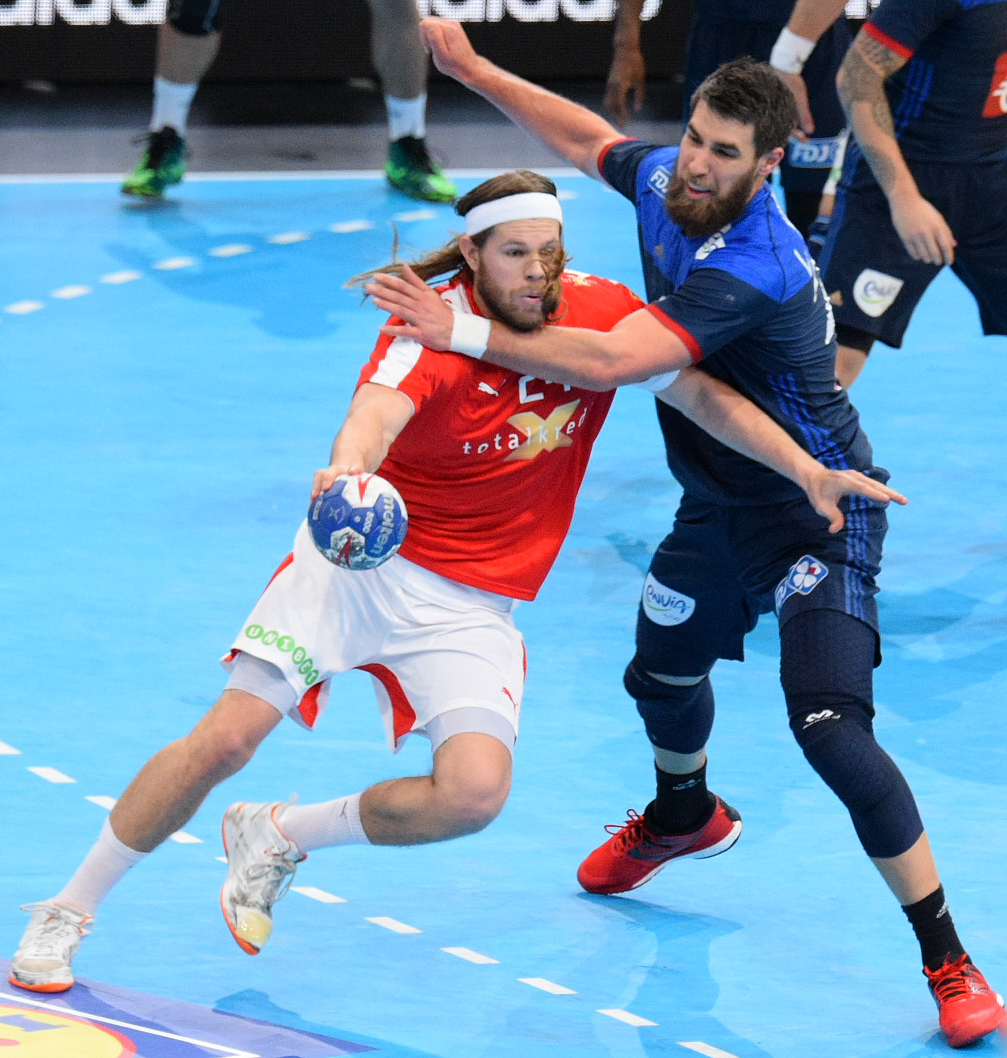
Poland had the honour to organise an EHF EURO for the first time in 2016. Spread over four venues, the 12th edition of the Men’s European Championship became an appealing event played in front of enthusiastic crowds. There was heartbreak for the hosts as Poland lost their decisive main round game against eventual bronze medallists Croatia and missed the semi-finals. Germany scraped through their semi-final against Norway, beating the Scandinavians only after extra time, but had a clear 24:17 win over Spain in the final to take the trophy back to Germany after 12 years.
Croatia returned as hosts of an EHF EURO after 18 years in 2018 for what would be the last Men’s European Championship with 16 nations participating. Led by iconic coach Lino Červar, the hosts had high hopes, especially after winning bronze in 2016, but came up just short to Sweden in the tense final standings of the main round.One of the standout players of the event was Czech Ondřej Zdráhala, who scored 14 times against Hungary and 13 against Croatia to finish on a tournament-leading 56 goals. In the end, however, it was all about Spain. They finally lifted the trophy for the first time after losing four previous finals. Coming from behind at half-time, Spain defeated Sweden 29:23 for European glory. France downed Denmark for bronze.
EHF EURO 2020 marked the beginning of a new era for Europe’s continental national team competition. For the first time, a total of 24 teams took part, eight more than under the previous format. Also for the first time, three nations were co-hosting the event: Sweden, Austria and Norway overcame the logistic challenges and turned the tournament into an overwhelming success story. While EHF EURO 2020 provided the many fans across Europe with lots of unexpected results - favourites like France and Denmark failed to advance from the preliminary round - the winners were no surprise, as Spain defended their title from two years earlier with a 22:20 final win over Croatia, while co-hosts Norway took bronze.
2020 - Present day

Although Euro 2022 was disrupted by a resurgence of the COVID-19 pandemic—around one hundred players and staff members were forced to isolate for several days after testing positive in daily tests—Spain reached the final of the competition once again but was this time defeated by Sweden. After 20 years without a title, Sweden won their fifth European Championship, following victories in 1994, 1998, 2000, and 2002. In the third-place match, Denmark, the two-time reigning World Champions, defeated France, who had won the Olympic title six months earlier. Swedish centre-back Jim Gottfridsson was named the tournament’s Most Valuable Player, while Iceland’s Ómar Ingi Magnússon finished as top scorer with 59 goals.
The EHF EURO 2024 was the 16th edition of the tournament. It took place from 10 to 28 January 2024 in Germany. The two opening games of the tournament were attended by 53,586 spectators, setting a world record for the largest audience at a handball event. Additionally, the tournament achieved a record for the highest total number of spectators in handball history, becoming the first to exceed one million attendees.
While France and Denmark have dominated world handball—winning 8 of 9 World Championship titles between 2009 and 2025 and all five Olympic titles from 2008 to 2024—neither team had reached a European Championship final since their encounter at Euro 2014. In this edition in Germany, both nations returned to the final, benefiting in particular from the early elimination of Spain during the preliminary round. As in previous international competitions, Sweden, the defending champions, were the main rivals of Denmark—who only won their main round match by one goal—and of France, who advanced to the final after a semi-final victory in overtime, secured at the last second of regulation by an exceptional free throw from Elohim Prandi.
Sweden later claimed the bronze medal two days later, defeating the host nation Germany 34–31, after Germany had been beaten by Denmark in the other semi-final (26–29). In the final, France trailed Denmark for much of the match, with the Danes particularly boosted by goalkeeper Emil Nielsen, who finished the game with nearly 40% saves (15 stops from 39 shots). Nevertheless, France forced overtime and then accelerated in the final 10 minutes to win 33–31, earning their fourth European Championship title in history. Denmark settled for the silver medal, adding to their two crowns from 2008 and 2012. French player Nedim Remili was named Most Valuable Player, while Martim Costa of Portugal and Mathias Gidsel of Denmark finished as the tournament’s top scorers with 54 goals each. Nikola Karabatić won his eleventh international title with this victory.
Tournaments
| Year | Host | Final | Third place match | Teams | Champions | Score | Runners-up | Third place | Score | Fourth place |
|---|---|---|---|---|---|---|---|---|---|---|
| 1994 | ||||||||||
| Details | POR | |||||||||
| Portugal | **** | 34–21 | 24–23 | 12 | ||||||
| 1996 | ||||||||||
| Details | ESP | |||||||||
| Spain | **** | 23–22 | 26–25 | 12 | ||||||
| 1998 | ||||||||||
| Details | ITA | |||||||||
| Italy | **** | 25–23 | 30–28 (ET) | 12 | ||||||
| 2000 | ||||||||||
| Details | CRO | |||||||||
| Croatia | **** | 32–31 (2ET) | 24–23 | 12 | ||||||
| 2002 | ||||||||||
| Details | SWE | |||||||||
| Sweden | **** | 33–31 (ET) | 29–22 | 16 | ||||||
| 2004 | ||||||||||
| Details | SLO | |||||||||
| Slovenia | **** | 30–25 | 31–27 | 16 | ||||||
| 2006 | ||||||||||
| Details | SUI | |||||||||
| Switzerland | **** | 31–23 | 32–27 | 16 | ||||||
| 2008 | ||||||||||
| Details | NOR | |||||||||
| Norway | **** | 24–20 | 36–26 | 16 | ||||||
| 2010 | ||||||||||
| Details | AUT | |||||||||
| Austria | **** | 25–21 | 29–26 | 16 | ||||||
| 2012 | ||||||||||
| Details | SER | |||||||||
| Serbia | **** | 21–19 | 31–27 | 16 | ||||||
| 2014 | ||||||||||
| Details | DEN | |||||||||
| Denmark | **** | 41–32 | 29–28 | 16 | ||||||
| 2016 | ||||||||||
| Details | POL | |||||||||
| Poland | **** | 24–17 | 31–24 | 16 | ||||||
| 2018 | ||||||||||
| Details | CRO | |||||||||
| Croatia | **** | 29–23 | 32–29 | 16 | ||||||
| 2020 | ||||||||||
| Details | AUT NOR SWE | |||||||||
| Austria / Norway / Sweden | **** | 22–20 | 28–20 | 24 | ||||||
| 2022 | ||||||||||
| Details | HUN SVK | |||||||||
| Hungary / Slovakia | **** | 27–26 | 35–32 (ET) | 24 | ||||||
| 2024 | ||||||||||
| Details | GER | |||||||||
| Germany | **** | 33–31 (ET) | 34–31 | 24 | ||||||
| 2026 | ||||||||||
| Details | DEN NOR SWE | |||||||||
| Denmark / Norway / Sweden | 24 | |||||||||
| 2028 | ||||||||||
| Details | POR ESP SUI | |||||||||
| Portugal / Spain / Switzerland | 24 | |||||||||
| 2030 | ||||||||||
| Details | CZE DEN POL | |||||||||
| Czech Republic / Denmark / Poland | 24 | |||||||||
| 2032 | ||||||||||
| Details | FRA GER | |||||||||
| France / Germany | 24 |
Medal table
Statistics
Summary (1994–2024)
Source (Table Section):
| Rank | width=15% | Team | width=5% | Part | width=7% | M | width=5% | W | width=5% | D | width=5% | L | width=5% | GF | width=5% | GA | width=5% | GD | width=7% | Points | ||||||||||
|---|---|---|---|---|---|---|---|---|---|---|---|---|---|---|---|---|---|---|---|---|---|---|---|---|---|---|---|---|---|---|
| 1 | ||||||||||||||||||||||||||||||
| 2 | ||||||||||||||||||||||||||||||
| 4 | ||||||||||||||||||||||||||||||
| 3 | ||||||||||||||||||||||||||||||
| 5 | ||||||||||||||||||||||||||||||
| 6 | ||||||||||||||||||||||||||||||
| 7 | ||||||||||||||||||||||||||||||
| 9 | ||||||||||||||||||||||||||||||
| 8 | ||||||||||||||||||||||||||||||
| 10 | ||||||||||||||||||||||||||||||
| 12 | ||||||||||||||||||||||||||||||
| 11 | ||||||||||||||||||||||||||||||
| 13 | ||||||||||||||||||||||||||||||
| 14 | ||||||||||||||||||||||||||||||
| 15 | ||||||||||||||||||||||||||||||
| 17 | ||||||||||||||||||||||||||||||
| 18 | ||||||||||||||||||||||||||||||
| 16 | ||||||||||||||||||||||||||||||
| 19 | ||||||||||||||||||||||||||||||
| 20 | ||||||||||||||||||||||||||||||
| 21 | ||||||||||||||||||||||||||||||
| 23 | ||||||||||||||||||||||||||||||
| 22 | ||||||||||||||||||||||||||||||
| 24 | ||||||||||||||||||||||||||||||
| 25 | ||||||||||||||||||||||||||||||
| 26 | ||||||||||||||||||||||||||||||
| 27 | ||||||||||||||||||||||||||||||
| 28 | ||||||||||||||||||||||||||||||
| 29 | ||||||||||||||||||||||||||||||
| 30 | ||||||||||||||||||||||||||||||
| 31 | ||||||||||||||||||||||||||||||
| 32 |
Total hosts
| Hosts | Nations (Year(s) |
|---|---|
| 3 | Denmark (2014, 2026, 2030) |
| Norway (2008, 2020, 2026) | |
| Sweden (2002, 2020, 2026) | |
| 2 | Austria (2010, 2020) |
| Croatia (2000, 2018) | |
| Germany (2024, 2032) | |
| Poland (2016, 2030) | |
| Portugal (1994, 2028) | |
| Spain (1996, 2028) | |
| Switzerland (2006, 2028) | |
| 1 | Czech Republic (2030) |
| France (2032) | |
| Hungary (2022) | |
| Italy (1998) | |
| Serbia (2012) | |
| Slovakia (2022) | |
| Slovenia (2004) |
Top scorers by tournament
The record-holder for scored goals in a single Euro Championship is Sander Sagosen. He scored 65 goals for Norway at the 2020 European Men's Handball Championship that took place in Austria, Sweden and Norway.

| Year | Player | Goals |
|---|---|---|
| 1994 | RUS Vasily Kudinov | 50 |
| 1996 | GER Thomas Knorr | 41 |
| 1998 | CZE Jan Filip | 48 |
| 2000 | UKR Oleg Velyky | 46 |
| 2002 | ISL Ólafur Stefánsson | 58 |
| 2004 | CRO Mirza Džomba | 46 |
| 2006 | SVN Siarhei Rutenka | 51 |
| 2008 | CRO Ivano Balić | |
| DEN Lars Christiansen | ||
| FRA Nikola Karabatić | 44 | |
| 2010 | CZE Filip Jícha | 53 |
| 2012 | MKD Kiril Lazarov | 61 |
| 2014 | ESP Joan Cañellas | 50 |
| 2016 | ESP Valero Rivera | 48 |
| 2018 | CZE Ondřej Zdráhala | 55 |
| 2020 | NOR Sander Sagosen | 65 |
| 2022 | ISL Ómar Ingi Magnússon | 59 |
| 2024 | POR Martim Costa | |
| DEN Mathias Gidsel | 54 |
MVPs by tournament
| Year | Player |
|---|---|
| 1994 | SWE Magnus Andersson |
| 1996 | ESP Talant Dujshebaev |
| 1998 | GER Daniel Stephan |
| 2000 | FRA Jackson Richardson |
| 2002 | SWE Magnus Wislander |
| 2004 | CRO Ivano Balić |
| 2006 | CRO Ivano Balić |
| 2008 | FRA Nikola Karabatić |
| 2010 | CZE Filip Jícha |
| 2012 | SRB Momir Ilić |
| 2014 | FRA Nikola Karabatić |
| 2016 | ESP Raúl Entrerríos |
| 2018 | SWE Jim Gottfridsson |
| 2020 | CRO Domagoj Duvnjak |
| 2022 | SWE Jim Gottfridsson |
| 2024 | FRA Nedim Remili |
Participating nations
Main article: National team appearances in the European Men's Handball Championship
Most successful players
The table shows the most successful players at the European Championships. Players marked with an asterisk (*) have the additional distinction of having been elected championship MVP.
| Rank | Player | Country | From | To | Gold | Silver | Bronze | Total |
|---|---|---|---|---|---|---|---|---|
| 1 | Nikola Karabatić ** | 2006 | 2024 | 4 | – | 2 | 6 | |
| 2 | Magnus Andersson * | 1994 | 2002 | 4 | – | – | 4 | |
| Martin Frändesjö | 1994 | 2002 | 4 | – | – | 4 | ||
| Ola Lindgren | 1994 | 2002 | 4 | – | – | 4 | ||
| Stefan Lövgren | 1994 | 2002 | 4 | – | – | 4 | ||
| Staffan Olsson | 1994 | 2002 | 4 | – | – | 4 | ||
| Magnus Wislander * | 1994 | 2002 | 4 | – | – | 4 | ||
| 8 | Luc Abalo | 2006 | 2018 | 3 | – | 2 | 5 | |
| 9 | Jérôme Fernandez | 2006 | 2014 | 3 | – | 1 | 4 | |
| Michaël Guigou | 2006 | 2018 | 3 | – | 1 | 4 | ||
| Daniel Narcisse | 2006 | 2014 | 3 | – | 1 | 4 | ||
| Thierry Omeyer | 2006 | 2014 | 3 | – | 1 | 4 |
References
References
- [https://web.archive.org/web/20040114085133/http://www.ihf.info/CDA/history,138,0,,en.html History of Handball] from ihf.info, retrieved 7 February 2006
- [https://web.archive.org/web/20060219140119/http://www.ihf.info/MEDIA/4528,0.pdf Medals Table – Ranking At Men's World Championships A 1938–1990] from ihf.info, retrieved 7 February 2006
- {{in lang. de [http://www.spiegel.de/sport/sonst/0,1518,398256,00.html Handball-Bundesliga diskutiert Reduzierung auf 16 Teams], by Erik Eggers, published by [[Der Spiegel]] online, 30 January 2006
- {{in lang. no (ed) Arvid Eriksen ''Sportsboken 1994'', p. 291, Schibsted. {{ISBN. 82-516-1543-7.
- {{in lang. de [http://www.handballworld.com/euro06-special/em-geschichte.htm Von Porto bis Ljubljana] {{Webarchive. link. (28 March 2007 , from Handballworld.com, retrieved 7 February 2006)
- (12 June 1994). "EHF EURO 1994 – All Star Team announced".
- "European Handball Federation - 1994 Men's European Championship / Finals".
- (August 2019)
- [http://handball.enourense.net/figuras/talent.htm Talant Dujshebaev]{{Dead link. (August 2019)
- "European Handball Federation - 1996 Men's European Championship / Finals".
- "European Handball Federation - 1998 Men's European Championship / Finals".
- (August 2019)
- link. (18 August 2006 , retrieved 27 February 2006)
- {{in lang. de [http://www.thw-provinzial.de/thw/02020302.htm Deutschland verpaßt Europameistertitel nur knapp – Schweden am Rande der Niederlage] {{Webarchive. link. (4 January 2006 from starpix.se, retrieved 27 February 2006)
- (August 2019)
- "European Handball Federation - 2002 Men's European Championship / Finals".
- {{in lang
- "Deutschland ist im Finale".
- {{in lang. de [http://www.thw-provinzial.de/thw/04013111.htm#CROSLO Slowenien erreicht nach 27:25-Sieg über Kroatien das Finale] {{Webarchive. link. (4 January 2006 , from thw-provinzial.de, retrieved 27 February 2006)
- Germany won the final more convincingly; a 16–10 lead at half time was never squandered, as Slovenia only got within three goals in the second half, and eventually lost 25–30.{{in lang. de[http://www.thw-provinzial.de/thw/04020111.htm Europameister! Deutschland gegen Gastgeber Slowenien ganz cool zum Titel] {{Webarchive. link. (7 November 2005 , from thw-provinzial.de, retrieved 27 February 2006)
- "European Handball Federation - 2006 Men's European Championship / Final Round".
- {{in lang. no [http://www.nrksport.no/handball/em_menn/1.4614916 Drama mot Kroatia], Webjørn Espeland, NRK, retrieved 19 July 2008
- {{in lang. sv [http://www.eurosport.se/handboll/euro/2008/em-over-os-en-mojlighet_sto1456244/story.shtml Tyskland stoppade Sverige], Martin Ahlin, Eurosport, retrieved 19 July 2008
- "European Handball Federation - 2008 Men's European Championship / Final Round".
- https://ehfeuro.eurohandball.com/media/cdkd513y/2008_toppl.pdf {{Bare URL PDF. (January 2026)
- "European Handball Federation - 2010 Men's European Championship / Final Round".
- "European Handball Federation - Denmark win Gold at EHF EURO 2012 / Article".
- "European Handball Federation - 2012 Men's European Championship / Final Tournament".
- "European Handball Federation - 2014 Men's European Championship / Final Tournament".
- "European Handball Federation - 2016 Men's European Championship / Final Tournament".
- "European Handball Federation - 2018 Men's EHF EURO / Final Tournament".
- "European Handball Federation - 2020 Men's EHF EURO / Final Tournament".
- "Standings".
- (10 January 2024). "World-record crowd witnesses Men's EHF EURO 2024 opening". eurohandball.com.
- "EHF EURO 2024 launches in front of record attendance".
- "France-Danemark : Revivez la victoire des Bleus en finale de l'Euro 2024 de handball". Le Monde.fr.
- "Handball-Europameisterschaften".
- "Men Handball European Championships Archive".
This article was imported from Wikipedia and is available under the Creative Commons Attribution-ShareAlike 4.0 License. Content has been adapted to SurfDoc format. Original contributors can be found on the article history page.
Ask Mako anything about European Men's Handball Championship — get instant answers, deeper analysis, and related topics.
Research with MakoFree with your Surf account
Create a free account to save articles, ask Mako questions, and organize your research.
Sign up freeThis content may have been generated or modified by AI. CloudSurf Software LLC is not responsible for the accuracy, completeness, or reliability of AI-generated content. Always verify important information from primary sources.
Report