From Surf Wiki (app.surf) — the open knowledge base
European cuisine
Cuisine indigenous to Europe

Cuisine indigenous to Europe
European cuisine (also known as Continental cuisine) comprises the cuisines originating from the various countries of Europe.
The cuisines of European countries are diverse, although some common characteristics distinguish them from those of other regions. Compared to traditional cooking of East Asia, meat holds a more prominent and substantial role in serving size. Many dairy products are utilised in cooking. There are hundreds of varieties of cheese and other fermented milk products. White wheat-flour bread has long been the prestige starch, but historically, most people ate bread, flatcakes, or porridge made from rye, spelt, barley, and oats. Those better off would also make pasta, dumplings and pastries. The potato has become a major starch plant in the diet of Europeans and their diaspora since the European colonisation of the Americas. Maize is much less common in most European diets than it is in the Americas; however, cornmeal (polenta or mămăligă) is a major part of the cuisines of Italy, the Balkans and the Caucasus. Although flatbreads (especially those with toppings, such as pizza or tarte flambée) and rice are eaten in Europe, they are only staple foods in limited areas, particularly in Southern Europe. Salads—cold dishes with uncooked or cooked vegetables, sometimes with a dressing—are an integral part of European cuisine.
Formal European dinners are served in distinct courses. European presentation evolved from service à la française, or bringing multiple dishes to the table at once, into service à la russe, where dishes are presented sequentially. Usually, cold, hot and savoury, and sweet dishes are served strictly separately in this order, as hors d'oeuvre (appetizer) or soup, as entrée and main course, and as dessert. Dishes that are both sweet and savoury were common earlier in Ancient Roman cuisine, but are today uncommon, with sweet dishes usually being served only as dessert. A service where the guests are free to take food by themselves is termed a buffet, and is usually restricted to parties or holidays.
Historically, European cuisine has been developed in the European royal and noble courts. European nobility was usually arms-bearing and lived in separate manors in the countryside. The knife was the primary eating implement (cutlery), and eating steaks and other foods that require cutting followed its adoption. This contrasted with East Asian cuisine, where the ruling class consisted of court officials, who had their food prepared in the kitchen, ready to be eaten with chopsticks. The knife was supplanted by the spoon for soups, while the fork was introduced later in the early modern period, in or around the 16th century. Today, most dishes are intended to be eaten with cutlery and only a few finger foods can be eaten with the hands in polite company.
History
Medieval
Main article: Medieval cuisine
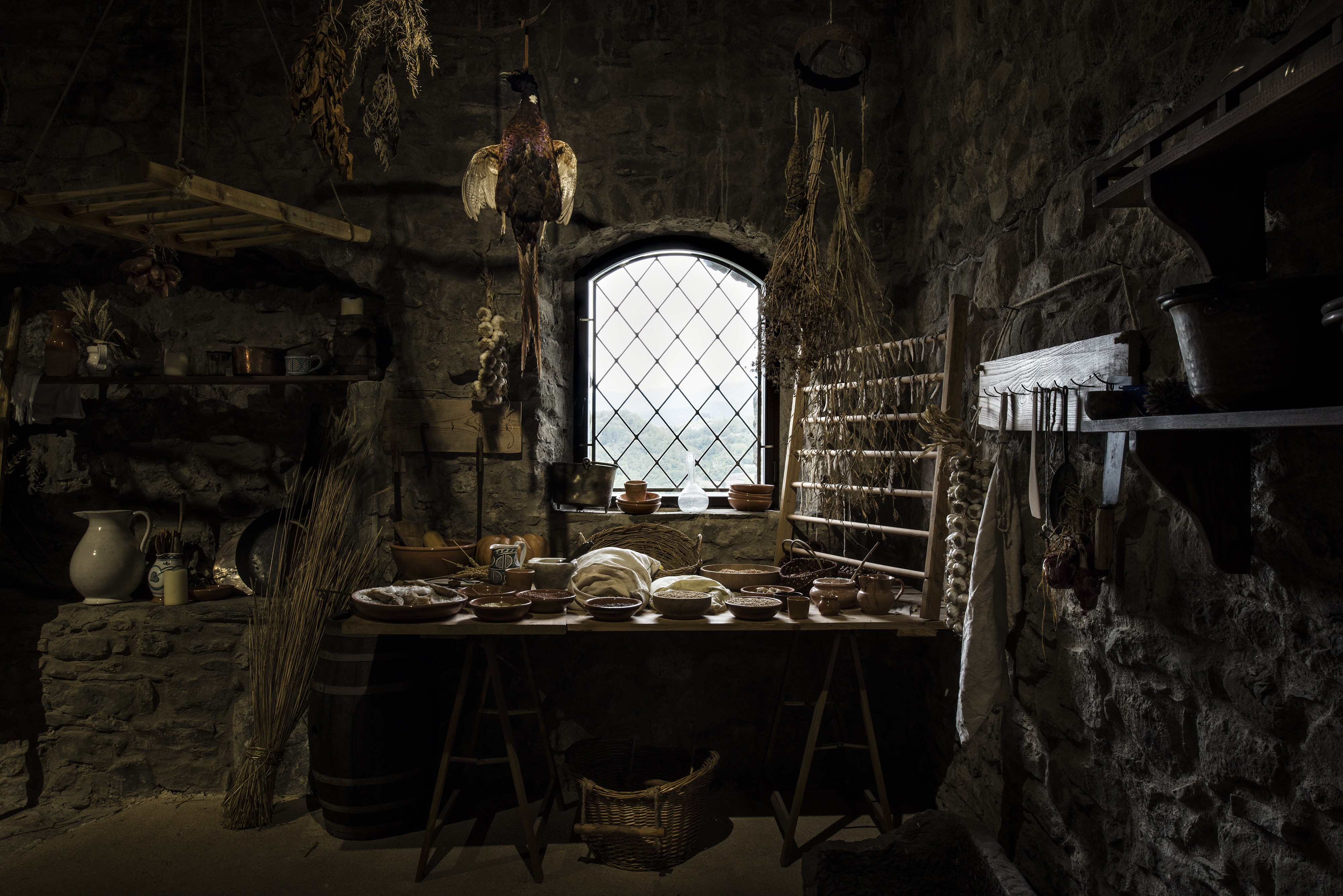
In medieval times, a person's diet varied depending on their social class. However, cereal grains made up a significant part of a medieval person's diet, regardless of social class. Bread was common to both classes; it was eaten for lunch by working men, and thick slices of it were used as plates called trenchers. People of the noble class had access to finely ground flours for their breads and other baked goods. Noblemen were allowed to hunt for deer, boar, rabbits, birds, and other animals, giving them access to fresh meat and fish for their meals. Dishes for people of these classes were often heavily spiced. Spices at that time were very expensive, and the more spices used in dishes, the more wealth the person needed to purchase such ingredients. Common spices used were cinnamon, ginger, nutmeg, pepper, cumin, cloves, turmeric, anise, and saffron. Other ingredients used in dishes for the nobility and clergy included sugar, almonds and dried fruits like raisins. These imported ingredients would have been very expensive and nearly impossible for commoners to obtain. When banquets were held, the dishes served would be spectacular, another way for the noblemen to show how rich they were. Sugar sculptures would be placed on the tables as decoration and to eat, and foods would be dyed vibrant colors with imported spices.
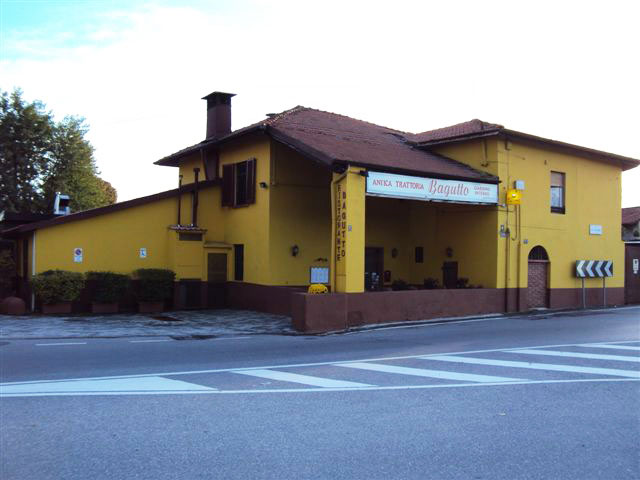
Milan is home to the oldest restaurant in Italy and the second oldest in Europe, the Antica trattoria Bagutto, which has existed since at least 1284. The diet of a commoner would have been much simpler. Strict poaching laws prevented them from hunting, and if they did hunt and were caught, they could have parts of their limbs cut off or they could be killed. Much of the commoners' food would have been preserved in some way, such as through pickling or salting. Breads would have been made using rye or barley, and any vegetables would likely have been grown by the commoners themselves. Peasants would have likely been able to keep cows, and so would have access to milk, which then allowed them to make butter or cheese. When meat was eaten, it would have been beef, pork, or lamb. Commoners also ate pottage, a thick stew of vegetables, grains, and meat.
Early modern era
Main article: Early modern European cuisine

The cuisine of early modern Europe during the 16th through 19th centuries consisted of a mix of dishes inherited from medieval cuisine combined with innovations that persisted in the modern era.
The discovery of the New World, the establishment of new trade routes with Asia, and increased foreign influences from sub-Saharan Africa and the Middle East meant that Europeans became familiarized with many new foodstuffs. Spices that had been prohibitively expensive luxuries, such as pepper, cinnamon, cloves, nutmeg, and ginger, soon became available to the majority of the population, and the introduction of new plants from the New World and India like maize, potato, sweet potato, chili pepper, cocoa, vanilla, tomato, coffee, and tea transformed European cuisine.
Though there was a great influx of new ideas, an increase in foreign trade, and a Scientific Revolution, preservation of foods remained traditional: drying, salting, smoking, or pickling in vinegar. Fare was naturally dependent on the season; a cookbook by Domenico Romoli called Panunto made a virtue of necessity by including a recipe for each day of the year. Both doctors and chefs continued to characterize foodstuffs by their effects on the four humours: foods and beverages were considered to be heating or cooling, and moistening or drying, to the constitution.
Prosperity increased in Europe during this period, gradually reaching all classes and areas, and considerably changed the patterns of eating. Nationalism was first conceived in the early modern period, but it was not until the 19th century that the notion of a national cuisine emerged. Class differences were more important dividing lines, and it was almost always upper-class food that was described in recipe collections and cookbooks.

Central European cuisines
- Ashkenazi Jewish cuisine
- Austria Austrian cuisine
- Vienna Viennese cuisine
- Czech Republic Czech cuisine
- Moravia Moravian cuisine
- Germany German cuisine
- Baden Baden cuisine
- Bavaria Bavarian cuisine
- Berlin Berliner cuisine
- Brandenburg Brandenburg cuisine
- Franconia Franconian cuisine
- Hamburg Hamburg cuisine
- Hesse Hessian cuisine
- Lower Saxony Lower Saxon cuisine
- Mecklenburg Mecklenburg cuisine
- Palatine cuisine
- Pomerania Pomeranian cuisine
- Saxony Saxon cuisine
- Ore Mountain cuisine
- Schleswig-Holstein Schleswig-Holstein cuisine
- Swabian cuisine
- Hungary Hungarian cuisine
- Liechtenstein Liechtensteiner cuisine
- Poland Polish cuisine
- Lublin Lublin cuisine
- Opole Voivodeship Opole cuisine
- Podlaskie Podlaskie cuisine
- Silesia Silesian cuisine
- Świętokrzyskie Świętokrzyskie cuisine
- Slovakia Slovak cuisine
- Slovenia Slovenian cuisine
- Switzerland Swiss cuisine
| Image:Challah Bread Six Braid 1.JPG|Ashkenazi Jewish challah | Image:Teiglach, Traditional Ashkenazi Holiday Dish.jpg|Ashkenazi Jewish teiglach | Image:Apple Strudel.png|Austrian strudel | Image:Wiener-Schnitzel02.jpg|Austrian Wiener Schnitzel | Image:SMAZENY_SYR_2020.jpg|Czech smažený sýr | Image:Svíčková na smetaně.JPG|Czech svíčková | Image:德國油煎香腸Bratwurst.jpg|German bratwurst | Image:Neujahrsbrezelmittel.JPG|German pretzel | Image:Sauerbraten with potato dumplings.jpg|German Sauerbraten | Image:Mađarski gulaš.jpg|Hungarian goulash | Image:Hortobagy palacsinta.JPG|Hungarian Hortobágyi palacsinta | Image:Rheintaler_Ribelmais_traditionell_zubereitet.jpg|Liechtensteiner Rheintaler Ribelmais | Image:Bagel-Plain-Alt.jpg|Polish bagel | Image:Bigos (1).jpg|Polish bigos | Image:Ruskie.jpg|Polish pierogi | Image:Bryndzové halušky so slaninou.jpg|Slovak bryndzové halušky | Image:Ajdovi zganci.JPG|Slovenian ajdovi žganci | Image:Zlikrofi_with_gulasch.jpg|Slovenian idrijski žlikrofi | Image:Cordon-bleu-2.jpg|Swiss cordon bleu | Image:Swiss fondue.jpg|Swiss fondue
Eastern European cuisines
- Armenia Armenian cuisine
- Azerbaijan Azerbaijani cuisine
- Belarus Belarusian cuisine
- Bulgaria Bulgarian cuisine
- Cossack cuisine
- Georgia Georgian cuisine
- Kazakhstan Kazakh cuisine
- Moldova Moldovan cuisine
- Gagauzia Gagauz cuisine
- Romania Romanian cuisine
- Flag of Transylvania Saxons.svg Transylvanian Saxon cuisine
- Russia Russian cuisine
- Bashkortostan Bashkir cuisine
- Chechnya Chechen cuisine
- Circassian flag.svg Circassian cuisine
- Kalmykia
- Komi Republic Komi cuisine
- Mordovia Mordovian cuisine
- Tatarstan Tatar cuisine
- Udmurtia Udmurt cuisine
- Ukraine Ukrainian cuisine
- Crimea Crimean Tatar cuisine
- Odesa Odesite cuisine
| Image:Barbecue Armenian.jpg|Armenian khorovats | Image:Гюрза.jpg|Azerbaijani Gürzə | Image:Echpochmak-wiki.jpg|Bashkir and Tatar Öçpoçmaq | Image:Th babka.jpg|Belarusian potato babka | Image:Banitsa borzo.jpg|Bulgarian banitsa | Image:Haleva.jpg|Circassian Haliva | Image:Ayran+Çibörek.jpg|Crimean Tatar chiburekki | Image:Old_Tbilisi,_Georgian_khachapuri,_Georgia.jpg|Georgian khachapuri | Image:Satsivi (2).jpg|Georgian satsivi | Image:Beshbarmak, national dish (3991850909).jpg|Kazakh beshbarmak | Image:Tochitura-moldoveneasca.jpg|Moldovan Tochitură | Image:MamaligaBranza.JPG|Romanian mămăligă | Image:Pastrami.jpg|Romanian pastrami | Image:Beef_Stroganoff-02_cropped.jpg|Russian beef Stroganoff | Image:Piroshki.JPG|Russian pirozhki | Image:Pelmeni Russian.jpg|Russian pelmeni | Image:Borscht served.jpg|Ukrainian borscht | Image:Pampushky-plain.jpg|Ukrainian pampushka | Image:Martiniouk Paska.JPG|Ukrainian paska
Northern European cuisines
- UK British cuisine
- Guernsey Jersey Channel Islands cuisine
- England English cuisine
- Cornwall Cornish cuisine
- Devon Devonian cuisine
- Dorset Dorset cuisine
- Victorian cuisine
- Northern Irish cuisine
- Scotland Scottish cuisine
- Wales Welsh cuisine
- Cuisine of Carmarthenshire
- Cuisine of Ceredigion
- Cuisine of Gower
- Cuisine of Monmouthshire
- Cuisine of Pembrokeshire
- Cuisine of the Vale of Glamorgan
- Denmark Danish cuisine
- Faroe Islands Faroese cuisine
- New Nordic Cuisine
- Estonia Estonian cuisine
- Finland Finnish cuisine
- Iceland Icelandic cuisine
- Ireland Irish cuisine
- Latvia Latvian cuisine
- Lithuania Lithuanian cuisine
- flag of Livonia.svg Livonian cuisine
- Norway Norwegian cuisine
- Sápmi Sami cuisine
- Sweden Swedish cuisine
| Image:Ålandspannkaka.jpg|Åland pancake | Image:A_plate_of_sausage_mash_onions_and_peas_Epping_Essex,England.jpg|British bangers and mash | Image:Full_English_breakfast.jpg|British full breakfast | Image:Sunday_roast-_roast_beef_1.jpg|British Sunday roast | Image:Danish_Beef_Sandwich.JPG|Danish bøfsandwich | Image:Stegt_flæsk_med_persillesovs_2.jpg|Danish Stegt flæsk | Image:Fish_and_chips_blackpool.jpg|English fish and chips | Image:Trifle-w.jpg|English trifle | Image:Kamadessert i Palmse.JPG|Estonian kama dessert | Image:Mulgikapsad.jpg|Estonian Mulgikapsad | Image:Tvost og spik.jpg|Faroese tvøst og spik | Image:Salmon_soup_at_Löyly,Helsinki(52890138067).jpg|Finnish Lohikeitto | Image:Guernsey_Bean_Jar.jpg|Guernsey Bean Jar | Image:Hákarl2.jpg|Icelandic hákarl | Image:Bacon_and_Cabbage_in_Ireland.jpg|Irish bacon and cabbage | Image:Breakfast_Roll.jpg|Irish breakfast roll | Image:Jersey_wonders.jpg|Jersey wonders | Image:19-07-09-Karjalanpaisti-IMG_20190709_180453.jpg|Karelian hot pot | Image:Līgo_pīrādziņi.jpg|Latvian speķrauši | Image:Cepelinai Sauce.JPG|Lithuanian cepelinai | Image:Får_i_kål.jpg|Norwegian fårikål | Image:Poronkäristys.jpg|Sami Sautéed reindeer | Image:Haggis with a CC license.jpg|Scottish haggis | Image:Familjepizza_med_kebab_i_Hillerstorp_4493.jpg|Swedish Kebab pizza | Image:Swedish buffet-Smörgåsbord-01 (cropped).jpg|Swedish smörgåsbord | Image:Surströmming.jpg|Swedish surströmming | Image:Cawl_Cymreig.jpg|Welsh cawl
Southern European cuisines
- Albania Albanian cuisine
- Aromanian flag.svg Aromanian cuisine
- Bosnia and Herzegovina Bosnian cuisine
- Croatia Croatian cuisine
- Cyprus Cypriot cuisine
- Gibraltar Gibraltarian cuisine
- Greece Greek cuisine
- Ancient Greek cuisine
- Byzantine Empire Byzantine cuisine
- Flag_of_Cretan_State.svg Cretan cuisine
- Epirotic cuisine
- Flag of Greek Macedonia.svg Greek Macedonian cuisine
- Flag_of_the_United_States_of_the_Ionian_Islands.svg Ionian cuisine
- Italy Italian cuisine
- Abruzzo Abruzzian cuisine
- Ancient Roman cuisine
- Apulia Apulian cuisine
- Arbëreshë cuisine
- Liguria Ligurian cuisine
- Lombardy Lombard cuisine
- Mantua Mantuan cuisine
- Basilicata Lucanian cuisine
- Campania Neapolitan cuisine
- Piedmont Piedmontese cuisine
- Rome Roman cuisine
- Sardinia Sardinian cuisine
- Sicily Sicilian cuisine
- Veneto Venetian cuisine
- Kosovo Kosovar cuisine
- North Macedonia Macedonian cuisine
- Malta Maltese cuisine
- Montenegro Montenegrin cuisine
- Ottoman Empire Ottoman cuisine
- Portugal Portuguese cuisine
- San Marino Sammarinese cuisine
- Sephardic Jewish cuisine
- Serbia Serbian cuisine
- Spain Spanish cuisine
- Andalusia Andalusian cuisine
- Aragon Aragonese cuisine
- Asturias Asturian cuisine
- Balearic Islands Balearic cuisine
- Menorca Menorcan cuisine
- Basque Country Basque cuisine
- Canary Islands Canarian cuisine
- Cantabria Cantabrian cuisine
- Castile and León Castilian-Leonese cuisine
- Valladolid Vallisoletano cuisine
- CataloniaAndorra Catalan cuisine
- Castile-La Mancha Castilian-Manchego cuisine
- Deconstructed cuisine
- Extremadura Extremaduran cuisine
- Galicia Galician cuisine
- Madrid Madrilenian cuisine
- Valencia Valencian cuisine
- Turkey Turkish cuisine
| Image:Elbasan_tavë_me_mish_qengji.jpg|Albanian Tavë kosi | Image:Μετσοβόνε 6304.jpg|Aromanian Metsovone | Image:Ensaimada_DSCN0885.jpg|Balearic ensaïmada | Image:Taloa.jpg|Basque talo | Image:Bosnian-cevapi-with-kajmak-and-onion.jpg|Bosnian ćevapi | Image:Papasarrugadas.jpg|Canarian Papas arrugadas | Image:Pan_tumaca_cortado.jpg|Catalan pa amb tomàquet | Image:Koukouvagia.jpg|Cretan Dakos | Image:Licitar1.jpg|Croatian Licitar | Image:Štrukli iz Okrugljaka.jpg|Croatian Zagorski štrukli | Image:Typical_Greek_Cypriot_plate,sheftalia(in_greek;%CF%83%CE%B5%CF%86%CF%84%CE%B1%CE%BB%CE%B9%CE%AC).jpg|Cypriot Sheftalia | Image:Bistecca_alla_fiorentina-01.jpg|Florentine bistecca alla fiorentina | Image:Japonesa_on_a_plate_2.jpg|Gibraltarian japonesa | Image:Pita giros.JPG|Greek gyros | Image:Spanakopita.jpg|Greek spanakopita | Image:Souvlaki in Athens.JPG|Greek souvlaki | Image:Jota_02.JPG|Istrian stew | Image:Gelato.jpg|Italian gelato | Image:Bucatini allamatriciana.jpg|Italian amatriciana | Image:Flickr-cyclonebill-Ravioli_med_skinke_og_asparges_i_mascarponecreme.jpg|Italian ravioli | Image:Redaktionsvortreffen EuT 2 ossobuco 16.04.2011 22-59-12.2011 22-59-12.jpg|Lombard Ossobuco served with risotto alla milanese | Image:Селско Месо.jpg|Macedonian selsko meso | Image:Грав во тава(тафче гравче) (3).jpg|Macedonian Tavče gravče | Image:Bocadillo_de_calamares_y_caña.jpg|Madrilenian squid sandwich | Image:Malta_Rabbit_fried_with_wine_and_garlic.JPG|Maltese Stuffat tal-Fenek | Image:Njeguški Pršut - Apparently Montenegrian Prust is the best - Budva (14810108030).jpg|Montenegrin njeguški pršut | Image:Bacalhoada.jpg|Portuguese bacalhau | Image:Cozido a portuguesa 1.JPG|Portuguese Cozido à portuguesa | Image:Espaguetis_carbonara.jpg|Roman carbonara | Image:Bustrengo.jpg|Sammarinese Bustrengo | image:PastaWithPesto.JPG|Liguarian Linguine with pesto | Image:Pleskavitsa.JPG|Serbian Pljeskavica | Image:Cannoli siciliani (7472226896).jpg|Sicilian cannoli | Image:Hot,Hot(15720034638).jpg|Spanish churro | Image:Tortilla_de_patatas.jpg|Spanish omelette | Image:TapasenBarcelona.JPG|Spanish tapas | Image:Baklava(1).png|Turkish baklava | Image:Döner_and_pide(+_parsley).jpg|Turkish doner kebab | Image:Paella_en_Segorbe.jpg|Valencian paella | Image:Carpaccio with cheese in Warsaw.jpg|Venetian carpaccio
Western European cuisines
- Belgium Belgian cuisine
- Netherlands Dutch cuisine
- France French cuisine
- Corsica Corsican cuisine
- Cuisine of Gascony
- Haute cuisine
- Cuisine classique
- Nouvelle cuisine
- Cuisine minceur
- Nord-Pas-de-Calais Cuisine and specialties of Nord-Pas-de-Calais
- Lyon Lyonnaise cuisine
- Picardy Picardy cuisine
- Interfrisian_Flag.svg Frisian cuisine
- Limburg (Belgium) Limburg (Netherlands) Limburgian cuisine
- Luxembourg Luxembourgian cuisine
- Mennonite cuisine
- Monaco Monégasque cuisine
- Flag of Occitania.svg Occitan cuisine
| Image:Moules Frites.jpg|Belgian moules-frites | Image:Gaufre_de_Brussel.001_-_Brussel.jpg|Belgian waffle | Image:Friteddi castagnini.jpg|Corsican fritelli | Image:2015-12-20_Spitzkohlsalat_mit_Möhren_anagoria.JPG|Dutch coleslaw | Image:Boerenkool stamppot.jpg|Dutch stamppot with rookworst | Image:2018_01_Croissant_IMG_0685.JPG|French croissant | Image:Restaurant Volga (Lyon) - pot au feu arménien.jpg|French pot-au-feu | Image:Quiche.jpg|French quiche | Image:Cheese_limburger_edit.jpg|Limburger cheese | Image:Judd mat Gaardebounen.jpg|Luxembourgian Judd mat Gaardebounen | Image:Barbaguiai.jpg|Monégasque Barbajuan | Image:Bol_d'aligot.jpg|Occitan aligot
References
References
- "Culinary Cultures of Europe: Identity, Diversity and Dialogue". Council of Europe.
- Kwan Shuk-yan (1988). ''Selected Occidental Cookeries and Delicacies'', p. 23. Hong Kong: Food Paradise Pub. Co.
- Lin Ch'ing (1977). ''First Steps to European Cooking'', p. 5. Hong Kong: Wan Li Pub. Co.
- Kwan Shuk-yan, pg 26
- Alfio Cortonesi, "Self-sufficiency and the Market: Rural and Urban Diet in the Middle Ages", in Jean-Louis Flandrin, Massimo Montanari, ''Food: A Culinary History from Antiquity to the Present'', 1999, {{isbn. 0231111541, p. 268ff
- Michel Morineau, "Growing without Knowing Why: Production, Demographics, and Diet", in Jean-Louis Flandrin, Massimo Montanari, ''Food: A Culinary History from Antiquity to the Present'', 1999, {{isbn. 0231111541, p. 380ff
- "British Library".
- "Middle Ages Food and Diet".
- "British Library".
- "Middle Ages Food and Diet".
- "British Library".
- "British Library".
- "Antica trattoria Bagutto".
- "Middle Ages Food and Diet".
- "British Library".
- "Middle Ages Food and Diet".
- "Middle Ages Food and Diet".
- "British Library".
- (2004). "The Renaissance : an encyclopedia for student". Charles Scribner's Sons.
- Romoli, ''La singolar dottrina'', Venice, 1560.
This article was imported from Wikipedia and is available under the Creative Commons Attribution-ShareAlike 4.0 License. Content has been adapted to SurfDoc format. Original contributors can be found on the article history page.
Ask Mako anything about European cuisine — get instant answers, deeper analysis, and related topics.
Research with MakoFree with your Surf account
Create a free account to save articles, ask Mako questions, and organize your research.
Sign up freeThis content may have been generated or modified by AI. CloudSurf Software LLC is not responsible for the accuracy, completeness, or reliability of AI-generated content. Always verify important information from primary sources.
Report