From Surf Wiki (app.surf) — the open knowledge base
European Broadcasting Union
Alliance of public service media entities

Alliance of public service media entities
| Field | Value |
|---|---|
| name | European Broadcasting Union |
| native_name | Union européenne de radio-télévision |
| native_name_lang | fr |
| logo | EBU 2026.svg |
| logo_size | 200px |
| logo_caption | Logo since 2026 |
| map | EBU Member Elliptic.svg |
| mcaption | Countries with one or more members are in dark blue. Associated members in light blue. Suspended members in yellow. |
| type | Union of broadcasting organisations |
| membership | |
| headquarters | Geneva, Switzerland |
| predecessor | International Broadcasting Union |
| formation | |
| leader_title | President |
| leader_name | Delphine Ernotte |
| leader_title2 | Director-General |
| leader_name2 | Noel Curran |
| language | English, French |
| website |
The European Broadcasting Union (EBU; , UER) is an alliance of public service media organisations in countries within the European Broadcasting Area (EBA) or who are members of the Council of Europe. , it is made up of 123 member organisations from 56 countries, and 31 associate members from a further 20 countries. It was established in 1950, and has its administrative headquarters in Geneva.
The EBU owns and operates the Eurovision and Euroradio telecommunications networks on which major television and radio broadcasts are distributed live to its members. It also operates the daily Eurovision news exchange in which members share breaking news footage. In 2017, the EBU launched the Eurovision Social Newswire, an eyewitness and video verification service. Led by Head of Eurovision Social Newswire, Derek Bowler, the service provides members of the EBU with verified and cleared-for-use newsworthy eyewitness media emerging on social media.
In April 2025, the EBU, in partnership with its Members, launched Eurovision News Spotlight, a collaborative network for fact-checking and open-source intelligence (OSINT) to actively combat online falsehoods and misinformation across Europe.
The EBU, in co-operation with its members, produces programmes and organises events in which its members can participate, such as the Eurovision Song Contest, its best known production, or the Eurovision Debates between candidates for president of the European Commission for the 2014, 2019 and 2024 parliamentary elections. Noel Curran has been director-general since 2017.
General description
.jpg)
EBU members are public service media (PSM) broadcasters established by law but are non-partisan, independent, and run for the benefit of society as a whole.
EBU members come from as far north as Iceland and as far south as Algeria, from Portugal in the west to Azerbaijan in the east, and almost every nation from geographical Europe in between. Associate members from the United States include ABC, CBS, NBC, CPB, NPR, APM, and the only individual station, Chicago-based classical music radio WFMT.
Membership is for media organisations in countries within the European Broadcasting Area (EBA), as defined by the International Telecommunication Union, or who are members of the Council of Europe.
Members benefit from:
- Access to content ranging from exclusive sports rights to exchanges for news, music, and children's programmes.
- Representatives in Brussels, and in other international arenas, lobbying for PSM and ensuring the optimal legal and technical framework for broadcasters.
- Opportunities for sharing, learning and collaborating through conferences, working groups, training, and dedicated advice and guidance.
- A centre for learning and sharing new technology and innovation with a team of experts providing strategic advice and guidance.
The EBU's highest-profile production is the Eurovision Song Contest. The EBU also organises the Junior Eurovision Song Contest, the Eurovision Young Musicians competition, and other competitions which are modeled along similar lines.
Radio collaborations include Euroclassic Notturno—an overnight classical music stream, produced by BBC Radio 3 and broadcast in the United Kingdom as Through the Night—and special theme days, such as the annual Christmas music relays from around Europe. The EBU is a member of the International Music Council.
Most EBU broadcasters have group deals to carry major sporting events including the FIFA World Cup and the inaugural European Championships. Another annually recurring event which is broadcast across Europe through the EBU is the Vienna New Year's Concert.
Eurovision Media Services is the business arm of the EBU and provides media services for many media organisations and sports federations around the world.
Ident
Marc-Antoine Charpentier's Prelude to Te Deum is the hymn played before and after broadcasts organised under the Eurovision network, including the Eurovision Song Contest.
History
.jpg)
The EBU was a successor to the International Broadcasting Union (IBU) that was founded in 1925 and had its administrative headquarters in Geneva and technical office in Brussels. It fostered programming exchanges between members and mediated technical disputes between members that were mostly concerned with frequency and interference issues. It was in effect taken over by Nazi Germany during the Second World War, and thereafter the Allies viewed it as a compromised organisation that they could not trust.
In the spring of 1946, representatives of the Soviet radio committee proposed forming a new organisation; however, at the same time preparations were being made for an inter-governmental "European Broadcasting Conference" in Copenhagen in 1948 to draw up a new plan for frequency use in the European Broadcasting Area. It was considered necessary to have an organisation that could implement the "Copenhagen Wavelength Plan" but there was disagreement among broadcasters and particularly a fear expressed by the BBC that a new association might be dominated by the USSR and its proposal to give each of its constituent states one vote. France proposed that it would have four votes with the inclusion of its North African colonies. The United Kingdom felt it would have little influence with just one vote.
On 27 June 1946, the alternative International Broadcasting Organisation (IBO) was founded with 26 members and without British participation. The following day the IBU met in General Assembly and an attempt was made to dissolve it but failed; though 18 of its 28 members left to join the IBO. For a period of time in the late 1940s both the IBU and IBO vied for the role of organising frequencies but Britain decided not to be involved in either. The BBC attempted but failed to find suitable working arrangements with them. However, for practical purposes, the IBO rented the IBU technical centre in Brussels and employed its staff. The BBC then proposed a new solution based on the IBO changing its constitution so there will be only one member per International Telecommunication Union (ITU) country, thus ensuring a Western majority over the USSR and its satellite states. In August 1949 a meeting took place in Stresa, Italy, but it resulted in disagreement between delegates on how to resolve the problems. One proposal was for the European Broadcasting Area to be replaced by one that would exclude Eastern Europe, the Levant, and North Africa.
After Stresa, a consensus emerged among the Western Europeans to form a new organisation and the BBC proposed it be based in London. Meetings in Paris on 31 October and 1 November 1949 sealed the fate of the IBU and IBO, but it was decided not to allow any broadcaster from West Germany to be a founder of the new organisation. On 13 February 1950 the European Broadcasting Union had its first meeting with 23 members from the ITU defined European Broadcasting Area at the Imperial Hotel in Torquay, United Kingdom. The first president was Ian Jacob of the BBC who remained at the helm for ten years while its operation was largely dominated by the BBC due to its financial, technical, and staff input. The most important difference between the EBU and its predecessors was that EBU membership was for broadcasters and not governments. Early delegates said EBU meetings were cordial and professional and very different from the abrupt tone of its predecessors. Broadcasters from West Germany were admitted since 1951 and a working relationship forged with its Eastern counterpart, the International Radio and Television Organisation (OIRT), which existed in parallel with the EBU until its merger on 1 January 1993.
In 1967, the first concert in the International Concert Season of the European Broadcasting Union was broadcast from the Queen Elizabeth Hall in London.
Technical activities
The objective of the EBU's technical activities is simply to assist EBU Members (see below) in this period of unprecedented technological changes. This includes the provision of technical information to Members via conferences and workshops, as well as in written form (such as the EBU Technical Review, and the EBU tech-i magazine).
The EBU also encourages active collaboration between its Members on the basis that they can freely share their knowledge and experience, thus achieving considerably more than individual Members could achieve by themselves. Much of this collaboration is achieved through Project Groups which study specific technical issues of common interest: for example, EBU Members have long been preparing for the revision of the 1961 Stockholm Plan.
The EBU places great emphasis on the use of open standards. Widespread use of open standards (such as MPEG-2, DAB, DVB, etc.) ensures interoperability between products from different vendors, as well as facilitating the exchange of programme material between EBU Members and promoting "horizontal markets" for the benefit of all consumers.
EBU Members and the EBU Technical Department have long played an important role in the development of many systems used in radio and television broadcasting, such as:
- The AES/EBU digital audio interface, formally known as AES3;
- Serial and parallel interfaces for digital video (ITU-R Recommendations 601 and 656);
- RDS – the radio data system used on FM broadcasting.
- The EBU Loudness Recommendation R 128 and 'EBU Mode' meters (EBU Tech 3341)
The EBU has also actively encouraged the development and implementation of:
- Digital radio (DAB) through Eureka Project 147 and the WorldDAB Forum.
- DVB (Digital Video Broadcasting) through the DVB Project and DigiTAG.
- Digital radio in the bands currently used for AM broadcasting through Digital Radio Mondiale (DRM).
- Standardisation of PVR systems through the TV-Anytime Forum.
- Development of other content distribution networks on the internet through P2PTV; EBU Project Group D/P2P, from November 2007 to April 2008, with a trial of selected member channels, thanks to Octoshape's distribution platform. The EBU is also part of the European P2P-Next project.
Controversies
Greek state broadcaster (2013)
On 11 June 2013, the Greek government shut down the state broadcaster Hellenic Broadcasting Corporation (ERT) on short notice, citing government spending concerns related to the Euro area crisis. In response, the EBU set up a makeshift studio the same day near the former ERT offices in Athens in order to continue providing EBU members with the news-gathering and broadcast relay services which had formerly been provided by ERT. The EBU put out a statement expressing its "profound dismay" at the shutdown, urging the Greek Prime Minister "to use all his powers to immediately reverse this decision" and offered the "advice, assistance and expertise necessary for ERT to be preserved". Starting on 4 May 2014, the new state broadcaster New Hellenic Radio, Internet and Television (NERIT) began nationwide transmissions, taking over ERT's vacant active membership slot in the EBU. On 11 June 2015, two years after ERT's closure, NERIT was renamed as Hellenic Broadcasting Corporation (ERT), which reopened with a comprehensive program in all radio stations (with nineteen regional, two world-range and five pan-Hellenic range radio stations) and three TV channels ERT1, ERT2 and ERT3.
Belarusian and Russian state broadcasters (2021–22)
The Belarusian Television and Radio Company (BTRC) has been accused of repressing its own employees, having fired more than 100 people since a wave of anti-Lukashenko protests in 2020 following alleged election fraud. Many of them have also been jailed. Many voices have been raised against the participation of BTRC in the Eurovision Song Contest 2021 representing Belarus, the argument being that the EBU would make a political statement if it did endorse BTRC by essentially and silently saying that democracy is unimportant and so are basic human rights such as freedom of speech.
On 28 May 2021, the EBU suspended the BTRC's membership as they had been "particularly alarmed by the broadcast of interviews apparently obtained under duress". BTRC was given two weeks to respond before the suspension came into effect, but did not do so publicly. The suspension of the broadcaster was made effective on 1 July 2021. Although initial reports mentioned that it would expire after three years, in April 2024 the EBU confirmed that the suspension had been made indefinite.
The three Russian members of the EBU, Channel One Russia, VGTRK, and Radio Dom Ostankino are all controlled by the Russian government. On 21 February 2022, the Russian government recognized the independence of the Donetsk and Luhansk People's Republics, disputed territories that are internationally recognized as part of Ukraine. Ukraine's public broadcaster Suspilne called on the EBU to terminate the membership of Channel One Russia and VGTRK, and to consider preventing them from participating in the Eurovision Song Contest 2022 representing Russia, citing the Russian government's use of both outlets to spread disinformation surrounding the Russo-Ukrainian war. Following the Russian invasion of Ukraine, several other public broadcasters joined UA:PBC in calling for Russia's exclusion from the 2022 Contest; Finland's Yle and Estonia's ERR stated that they would not send a representative if Russia was allowed to participate. After initially stating that both Russia and Ukraine would be allowed to compete, the EBU announced on 25 February 2022 that it would ban Russia from participating in the Contest.
The three Russian broadcasters announced, via a statement released by Russian state media, that they would withdraw from the EBU on 26 February, citing increased politicization of the organization. The EBU released a statement saying that it was aware of the reports, but that it had not received any formal confirmation. On 1 March, a further statement from the EBU announced that it had suspended its Russian members from its governance structures. On 26 May, the EBU made effective the suspension of its Russian members indefinitely.
In 2023, an extensive investigation by the EBU Investigative Journalism Network uncovered evidence of a Kremlin-sponsored initiative to take Ukrainian children from the war-torn country to Russia, a war crime under international law.
Israel in the Eurovision Song Contest
The Gaza war has led to calls for the EBU to exclude Israel and its broadcaster Kan from the Eurovision Song Contest, and demonstrations against its participation took place in and .
Members


Current members
, the list of EBU members comprises the following 75 broadcasting companies from 56 countries.
| Country | Broadcasting organisation | Abbr. | Year |
|---|---|---|---|
| Albania | Albanian Radio-Television (Radio Televizioni Shqiptar) | RTSH | 1999 |
| Algeria | Public Establishment of Television (المؤسّسة العمومية للتلفزيون, Établissement public de télévision) | EPTV | 1970 |
| National Sound Broadcasting Company (المؤسسة العمومية للبث الإذاعي, Entreprise nationale de radiodiffusion sonore) | ENRS | ||
| Algerian Broadcasting Company (البث الإذاعي والتلفزي الجزائري, Télédiffusion d'Algérie) | TDA | ||
| Andorra | Radio and Television of Andorra (Ràdio i Televisió d'Andorra) | RTVA | 2002 |
| Armenia | Public Television Company of Armenia (Հայաստանի Հանրային Հեռուստաընկերություն, Hayastani Hanrayin Herrustaynkerut'yun) | ARMTV | |
| ՀՀՀ | 2005 | ||
| Public Radio of Armenia (Հայաստանի Հանրային Ռադիո, Hayastani Hanrayin Radio) | ARMR | ||
| Austria | Österreichischer Rundfunk | ORF | 1953 |
| Azerbaijan | İctimai Televiziya və Radio Yayımları Şirkəti: | İCTI/İTV | 2007 |
| Belgium | Vlaamse Radio- en Televisieomroeporganisatie | VRT | 1950 |
| Radio-Télévision Belge de la Communauté Française | RTBF | ||
| Bosnia and Herzegovina | Radio and Television of Bosnia and Herzegovina (Bosanskohercegovačka radiotelevizija) | BHRT | 1993 |
| Bulgaria | Bulgarian National Radio (Българско национално радио, Bǎlgarsko nacionalno radio) | BNR | |
| БНР | 1993 | ||
| Bulgarian National Television (Българска национална телевизия, Balgarska natsionalna televizia) | BNT | ||
| БНТ | |||
| Croatia | Croatian Radiotelevision (Hrvatska radiotelevizija) | HRT | 1993 |
| Cyprus | Cyprus Broadcasting Corporation (Ραδιοφωνικό Ίδρυμα Κύπρου, Radiofonikó Ídryma Kýprou, Kıbrıs Radyo Yayın Kurumu) | CyBC | |
| ΡΊΚ | |||
| RKYK | 1969 | ||
| Czech Republic | Český rozhlas | ČRo | 1993 |
| Česká televize | ČT | ||
| Denmark | Danmarks Radio | DR | 1950 |
| TV2 Danmark | DK/TV2 | 1989 | |
| Egypt | National Media Authority (الهيئة الوطنية للإعلام) | NTU | 1985 |
| Estonia | Eesti Rahvusringhääling: | ERR | 1993 |
| Finland | Yleisradio (Rundradion) | Yle | 1950 |
| France | Groupe de Radiodiffusion Française: | GRF | 1950 |
| Arte | ARTE | 2024 | |
| Georgia (country) | Georgian Public Broadcaster (საქართველოს საზოგადოებრივი მაუწყებელი, sakartvelos sazogadoebrivi mauts'q'ebeli) | GPB | |
| სსმ | 2005 | ||
| Germany | Arbeitsgemeinschaft der öffentlich-rechtlichen Rundfunkanstalten der Bundesrepublik Deutschland | ||
| (The Working Group of Public Broadcasters in the Federal Republic of Germany, ARD): | ARD | 1952 | |
| Zweites Deutsches Fernsehen (Second German Television) | ZDF | 1963 | |
| Greece | Hellenic Broadcasting Corporation (Ελληνική Ραδιοφωνία Τηλεόραση, Ellinikí Radiofonía Tileórasi) | ERT | 1950–2013, |
| 2015 | |||
| Hungary | Médiaszolgáltatás-támogató és Vagyonkezelő Alap (Media Support and Asset Management Fund): | MTVA | 2014 |
| Iceland | Ríkisútvarpið | RÚV | 1956 |
| Republic of Ireland | Raidió Teilifís Éireann | RTÉ | 1950 |
| TG4 | TG4 | 2007 | |
| Israel | Israeli Public Broadcasting Corporation (תַּאֲגִיד הַשִׁיְדּוּר הַיִשְׂרָאֵלִי, Taʾăḡid HaŠidûr HaYiśrāʾēli) (هَيْئَة اَلْبَثّ اَلْإِسْرَائِيلي, Hayʾat al-Baṯṯ al-Isrāʾīlī) | KAN | 2017 |
| Italy | RAI – Radiotelevisione Italiana | RAI | 1950 |
| Jordan | Jordan Radio and Television Corporation (مؤسسة الإذاعة والتلفزيون الأردني) | JRTV | 1970 |
| Latvia | Public Broadcasting of Latvia (Latvijas Sabiedriskie mediji): | LSM | 1993 |
| Lebanon | Télé Liban (تلفزيون لبنان) | TL | 1950 |
| Libya | Libya National Channel (قناة ليبيا الوطنية) | LNC | 2011 |
| Lithuania | Lithuanian National Radio and Television (Lietuvos nacionalinis radijas ir televizija) | LRT | 1993 |
| Luxembourg | RTL Group | RTL | 1950 |
| Média de Service Public 100,7 (radio 100,7) | MSP | 2022 | |
| Malta | Public Broadcasting Services | PBS | 1970 |
| Moldova | Compania Națională "Teleradio-Moldova" | TRM | 1993 |
| Monaco | Monaco Media Diffusion | MMD | 1994 |
| TVMonaco | TVM | 2024 | |
| Montenegro | Radio i televizija Crne Gore (Радио и телевизија Црне Горе) | RTCG | |
| РТЦГ | 2006 | ||
| Morocco | Société Nationale de Radiodiffusion et de Télévision (الشَرِكَة الوَطَنِيَّة لِلْإِذَاعَة وَالتَلْفَزَة, ⵜⴰⵎⵙⵙⵓⵔⵜ ⵜⴰⵏⴰⵎⵓⵔⵜ ⵏ ⵓⵏⵣⵡⴰⵢ ⴷ ⵜⵉⵍⵉⴼⵉⵣⵢⵓⵏ) | SNRT | 1950 |
| Netherlands | Nederlandse Publieke Omroep (Dutch Public Broadcaster): | NPO | 1950 |
| North Macedonia | Makedonska radio-televizija (Македонска радио-телевизија) | MRT | |
| МРТ | 1993 | ||
| Norway | Norsk Rikskringkasting | NRK | 1950 |
| TV 2 Group (TV 2 Gruppen) | NO/TV2 | 1993 | |
| Poland | Telewizja Polska | TVP | 1993 |
| Polskie Radio | PR | ||
| Portugal | Rádio e Televisão de Portugal | RTP | 1950 |
| Romania | Societatea Română de Radiodifuziune | ROR | 1993 |
| Societatea Română de Televiziune | RO/TVR | ||
| San Marino | San Marino RTV | SMRTV | 1995 |
| Serbia | Radio-televizija Srbije (Радио-телевизија Србије) | RTS | |
| РТС | 2006 | ||
| Slovakia | Slovak Television and Radio (Slovenská televízia a rozhlas) | STVR | 2024 |
| Slovenia | Radiotelevizija Slovenija | RTVSLO | 1993 |
| Spain | Radiotelevisión Española | RTVE | 1955 |
| Sweden | Sveriges Rundradiotjänst: | SRT | 1950 |
| Switzerland | Swiss Broadcasting Corporation: | SRG SSR | 1950 |
| Tunisia | Établissement de la Radio Tunisienne (مؤسسة الإذاعة التونسية) | RTT | 2007 |
| Établissement de la Télévision Tunisienne (مؤسسة التلفزة التونسية) | |||
| Turkey | Türkiye Radyo ve Televizyon Kurumu | TRT | 1950 |
| Ukraine | National Public Broadcasting Company of Ukraine | ||
| (Національна суспільна телерадіокомпанія України, | |||
| Natsionalna Suspilna Teleradiokompaniya Ukrayiny) | SU | 1993 | |
| United Kingdom | British Broadcasting Corporation | BBC | 1950 |
| United Kingdom Independent Broadcasting: | UKIB | 1981 | |
| Vatican City | Vatican Radio (Radio Vaticana, Statio Radiophonica Vaticana) | VR | 1950 |
Suspended members
| Country | Broadcasting organisation | Abbr. | Year | Suspended |
|---|---|---|---|---|
| Belarus | National State TV and Radio Company of the Republic of Belarus | BTRC | 1993 | 2021 |
| Russia | Channel One Russia | C1R | 1996 | 2022 |
| All-Russia State Television and Radio Broadcasting Company | RTR | 1993 | ||
| Radio Dom Ostankino: | RDO | 1996 |
Past members
| Country | Broadcasting organisation | Abbr. | From | To |
|---|---|---|---|---|
| Belgium | National Institute of Radio Broadcasting (Institut national de radiodiffusion, INR; Nationaal Instituut voor de Radio-Omroep, NIR) | INR-NIR | 1950 | 1960 |
| Czechoslovakia | Czechoslovak Television (Československá televize) | ČST | 1991 | 1992 |
| Finland Finland | MTV3 | FI/MTV | 1993 | 2019 |
| France France | Radiodiffusion-Télévision Française | RTF | 1950 | 1964 |
| Office de Radiodiffusion Télévision Française | ORTF | 1964 | 1975 | |
| Télédiffusion de France | TDF | 1975 | 1982 | |
| TF1 | TF1 | 1975 | 2018 | |
| Europe 1 | E1 | 1978 | 2022 | |
| Organisme Français de Radiodiffusion et de Télévision | OFRT | 1983 | 1992 | |
| Canal+ | C+ | 1984 | 2018 | |
| Greece Greece | New Hellenic Radio, Internet and Television (Νέα Ελληνική Ραδιοφωνία, Ίντερνετ και Τηλεόραση, Néa Ellinikí Radiofonía, Ínternet kai Tileórasi) | NERIT | 2014 | 2015 |
| Hungary Hungary | Duna TV | Duna | 2013 | 2015 |
| Magyar Rádió | MR | 1993 | ||
| Magyar Televízió | MTV | |||
| Israel Israel | Israel Broadcasting Authority (רָשׁוּת השִּׁדּוּר, Rashút HaShidúr) | IBA | 1957 | 2017 |
| Libya | Libyan Jamahiriya Broadcasting Corporation (الجماهيرية اللّيبيّة) | LJBC | 1974 | 2011 |
| Luxembourg | Établissement de Radiodiffusion Socioculturelle du Grand-Duché de Luxembourg | ERSL | 1996 | 2022 |
| Malta | Maltese Broadcasting Authority | MBA | 1970 | 2003 |
| Monaco | Groupement de Radiodiffuseurs Monégasques: | GRMC | 1950 | 2021 |
| Telemontecarlo (now La7) | TMC | 1981 | 2001 | |
| Netherlands | Dutch Radio Union (Nederlandse Radio Unie) | NRU | 1947 | 1967 |
| Nederlandse Televisie Stichting (Dutch Television Foundation) | NTS | 1951 | ||
| TROS | TROS | 1964 | 2014 | |
| Russia | 1st channel Ostankino (Первый канал Останкино) | C1O | 1994 | 1995 |
| Serbia and Montenegro | Udruženje javnih radija i televizija (Alliance of Public Radios and Televisions) | UJRT | 2001 | 2006 |
| Slovakia Slovakia | Slovenský rozhlas | SRo | 1993 | 2011 |
| Slovenská televízia | STV | |||
| Radio and Television of Slovakia (Rozhlas a televízia Slovenska) | RTVS | 2011 | 2024 | |
| Spain Spain | Antena 3 Radio | A3R | 1986 | 1993 |
| Radio Popular SA COPE | COPE | 1998 | 2019 | |
| Sociedad Española de Radiodifusión | SER | 1982 | 2020 | |
| Sweden Sweden | TV4 | SE/TV4 | 2004 | 2019 |
| Tunisia Tunisia | Établissement de la radiodiffusion-télévision tunisienne (Tunisian Radio and Television Establishment) | ERTT | 1990 | 2007 |
| United Kingdom United Kingdom | Independent Television Authority | ITA | 1959 | 1972 |
| Independent Television Companies Association | ITCA | 1959 | 1981 | |
| Independent Broadcasting Authority | IBA | 1972 | 1981 | |
| Commercial Radio Companies Association (now Radiocentre) | CRCA | 1981 | 2006 | |
| Yugoslavia | Jugoslavenska radio-televizija / Jugoslovenska radio-televizija (Југославенска радио-телевизија / Југослoвенска радио-телевизија) | JRT | 1950 | 1992 |
Associate members
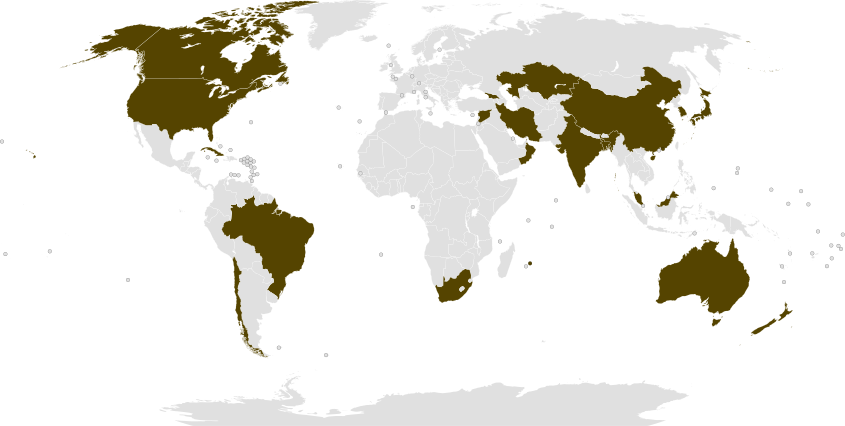
Any group or organisation from an International Telecommunication Union (ITU) member country, which provides a radio or television service outside of the European Broadcasting Area, is permitted to submit applications to the EBU for Associate Membership.
It is also noted by the EBU that any broadcaster that is granted Associate Member status does not gain access into Eurovision eventsnotable exceptions being those from Australia, who have participated in the Eurovision Song Contest since and the Junior Eurovision Song Contest between and ; Canada, who participated in the Eurovision Young Dancers between 1987 and 1989; and Kazakhstan, who participated in the Junior Eurovision Song Contest between and all of which were individually invited.
The list of Associate Members of EBU comprised the following 30 broadcasting companies from 20 countries .
| Country | Broadcasting organisation | Abbr. | Year |
|---|---|---|---|
| Australia | Australian Broadcasting Corporation | ABC | 1950 |
| Special Broadcasting Service | SBS | 1979 | |
| Bangladesh | Bangladesh Television | BTV | 1974 |
| Brazil | TV Cultura (Fundação Padre Anchieta) | FPA | 2012 |
| Canada | Canadian Broadcasting Corporation (Société Radio-Canada) | CBC | 1950 |
| Chile | Canal 13 | C13 | 1971 |
| China | China Media Group (中央广播电视总台) | CMG | 2010 |
| Shanghai Media Group (上海文化廣播影視集團有限公司) | SMG | 2016 | |
| Cuba | Cuban Institute of Radio and Television (Instituto Cubano de Radio y Televisión) | ICRT | 1992 |
| Georgia | Teleimedi | TEME | 2004 |
| Rustavi 2 (რუსთავი 2) | RB | 2003 | |
| Hong Kong | Radio Television Hong Kong (香港電台) | RTHK | 1983 |
| Iran | Islamic Republic of Iran Broadcasting (صدا و سيمای جمهوری اسلامی ايران) | IRIB | 1968 |
| Japan | Nippon Hōsō Kyōkai (日本放送協会) | NHK | 1951 |
| TBS Holdings (TBSホールディングス) | TBS | 2000 | |
| Kazakhstan | Khabar Agency ("Хабар" Агенттігі, Агентство «Хабар») | KA | 2016 |
| Malaysia | Radio Television of Malaysia (Radio Televisyen Malaysia, راديو تيليۏيشن مليسيا) | RTM | 1970 |
| Mauritius | Mauritius Broadcasting Corporation | MBC | 1980 |
| Nepal | Association of Community Radio Broadcasters Nepal | ACORAB | 2023 |
| New Zealand | Radio New Zealand (Te Reo Irirangi o Aotearoa) | RNZ | 1950 |
| Television New Zealand (Te Reo Tātaki o Aotearoa) | TVNZ | 1980 | |
| Oman | Public Authority for Radio and TV of Oman | PART | 1976 |
| South Korea | Korean Broadcasting System (한국방송공사) | KBS | 1974 |
| Syria | General Organization of Radio and TV | ||
| (Organisation de la Radio-Télévision Arabe Syrienne, الهيئة العامة للإذاعة والتلفزيون – سورية) | ORTAS | 1978 | |
| United States | American Broadcasting Company | ABC | 1959 |
| American Public Media | APM | 2004 | |
| Columbia Broadcasting System | CBS | 1956 | |
| National Public Radio | NPR | 1971 | |
| National Broadcasting Company | NBC | 1953 | |
| WFMT Radio Network | WFMT | 1980 |
Past associate members
The list of past associate members of EBU comprises the following 95 broadcasting companies from 55 countries and 1 autonomous territory.
| Country | Broadcasting organisation | Abbr. | From | To |
|---|---|---|---|---|
| Argentina | Canal 7 | C7 | 1970 | 1999 |
| El Trece | C13 | 1973 | 1999 | |
| Australia | Australian Fine Music Network | AFMN | 2008 | 2010 |
| FreeTV Australia | Free | 1962 | 2024 | |
| Bahamas | Broadcasting Corporation of The Bahamas | BCB | 1975 | 1999 |
| Barbados | Caribbean Broadcasting Corporation | BB/CBC | 1971 | 2005 |
| Benin | Radiodiffusion du Dahomey | RD | 1972 | 1975 |
| Brazil | Associação Brasileira das Emissoras de Rádio e Televisão | ABERT | 1962 | 1980 |
| Diários Associados | DA | 1950 | 1980 | |
| Emissoras Unidas de Rádio e Televisão | EURT | 1961 | 1969 | |
| TV Globo | GLOBO | 1970 | 1999 | |
| Network of Independent Broadcasters (Rede de Emissoras Independentes) | REI | 1974 | 1975 | |
| Rádio Nacional | RN | 1974 | 1975 | |
| Canada | CTV Television Network | CTV | 1969 | 1999 |
| Agency for Tele-Education in Canada | ATEC | 1975 | 1981 | |
| Chad | Chadian National Radio (Radiodiffusion Nationale Tchadienne) | RNT | 1955 | 1974 |
| Chile | Televisión Nacional de Chile | TVN | 1970 | 1999 |
| Colombia | Instituto Nacional de Radio y Televisión | IRV | 1970 | 1999 |
| Congo | Radiodiffusion Télévision Congolaise | RTC | 1974 | 2009 |
| Costa Rica | Telesistema Nacional S.R.L. | TSN | 1969 | 1971 |
| Ecuador | Teleamazonas | 4TA | 1975 | 1999 |
| Gabon | Radiodiffusion-Télévision Gabonaise | RTG | 1960 | 2009 |
| Gambia | Gambia Radio & Television Service | GRTS | 1962 | 2010 |
| Ghana | Ghana Broadcasting Corporation | GBC | 1953 | 1990 |
| Greenland | Kalaallit Nunaata Radioa (Greenlandic Broadcasting Corporation) | KNR | 1978 | 2011 |
| Guyana | Guyana Broadcasting Service | GBS | 1977 | 2009 |
| Haiti | Service des Télécommunications | 1950 | 1969 | |
| Honduras | Televisora de Honduras, S.A. | TH | 1969 | 1971 |
| Hong Kong | Asia Television (亞洲電視有限公司) | ATV | 1957 | 2010 |
| Television Broadcasts Limited | TVB | 1973 | 2012/2013 | |
| India | All India Radio | AIR | 1979 | 2021 |
| Indonesia | Radio Republik Indonesia | RRI | 1973 | 1981 |
| Televisi Republik Indonesia | TVRI | 1973 | 1981 | |
| Iraq | Iraqi Broadcasting and Television Establishment | IBTE | ||
| Ivory Coast | Radiodiffusion Television Ivoirienne | RTI | 1961 | 2010 |
| Jamaica | Jamaica Broadcasting Corporation | JBC | 1970 | 1981 |
| Japan | Mainichi Broadcasting System (株式会社毎日放送, Kabushiki-gaisha Mainichi Hōsō) | MBS | 1970 | 2009 |
| TV Asahi | ANB | 1960 | 2009 | |
| Fuji Television | FTN | 1969 | 2012/2013 | |
| National Association of Commercial Broadcasters in Japan | NACB | 1984 | 2012/2013 | |
| Nippon Television Network Corporation (日本テレビ放送網株式会社, Nihon Terebi Hōsōmō kabushiki gaisha) | NTV | 1953 | 2009 | |
| Tokyo FM | TFM | 1986 | 2021 | |
| Kenya | The Voice of Kenya | VK | 1964 | 2010 |
| Kuwait | Kuwait Broadcasting and Television Service | KBTS | 1970 | 2010 |
| Liberia | Liberian Broadcasting Corporation | LBC | 1964 | 1981 |
| Madagascar | Radiodiffusion-Télévision de Madagascar | RTM | 1971 | 2010 |
| Malawi | Malawi Broadcasting Corporation | MBC | 1964 | 2010 |
| Mauritania | Television of Mauritania | MR/TVM | 2003 | 2013 |
| Mexico | Telesistema Mexicano | TSM | 1960 | 1973 |
| Televisión Independiente de México (Mexican Independent Television) | TIM | 1969 | 1973 | |
| Tele-Cadena Mexicana | TCM | 1969 | 1973 | |
| Televisa SA de CV | TVA | 1973 | 2005 | |
| Corporación Mexicana de Radio y Televisión | CMRT | 1973 | 1999 | |
| Nepal | Nepal Television (नेपाल टेलिभिजन) | NTVC | 1985 | 2010 |
| Niger | Office de radiodiffusion et Télévision du Niger | ORTN | 1967 | 1981 |
| Nigeria | Nigerian Broadcasting Corporation | NBC | 1962 | 2010 |
| Pakistan | Radio Pakistan (ریڈیو پاکستان) | RP | 1950 | 1974 |
| Pakistan Television Corporation (پاکستان ٹیلی وژن نیٹ ورک) | PK/PTV | 1971 | 2010 | |
| Palestine | Palestinian Broadcasting Corporation (هيئة الإذاعة والتلفزيون الفلسطينية) | PBC | 2002 | 2014 |
| Papua New Guinea | National Broadcasting Corporation | NBC | 1977 | 2015 |
| Peru | Teledos | T2 | 1969 | 1971 |
| Compañía Peruana de Radiodifusión | AMÉRICA | 1969 | 1999 | |
| Panamericana Televisión | PANTEL | 1969 | 1999 | |
| Qatar | Qatar Television and Broadcasting Service | QTBC | 1973 | 2009 |
| Al Jazeera Children's Channel (قناة الجزيرة للأطفال) | JCC | 2008 | 2013 | |
| Qatar Radio (إذاعة قطر) | QR | 2009 | 2009 | |
| Saudi Arabia | Saudi Arabian Broadcasting and Television Service | SABTVS | 1962 | 2012 |
| Senegal | Radiodiffusion Télévision Sénégalaise | RTS | 1973 | 2006 |
| Sri Lanka | Ceylon Broadcasting Corporation | CBC | 1967 | 1973 |
| Sri Lanka Broadcasting Corporation (ශ්රී ලංකා ගුවන් විදුලි සංස්ථාව, Shrī Lankā Guvan Viduli Sansthāva) (இலங்கை ஒலிபரப்புக் கூட்டுத்தாபனம், Ilangkai Oliparappuk Kūṭṭuttāpaṉam) | SLBC | 2007 | 2010 | |
| South Africa | South African Broadcasting Corporation | SABC | 1951 | 2022 |
| South Korea | Munhwa Broadcasting Corporation (주식회사문화방송) | MBC | 1961 | 2009 |
| Sudan | Sudan Television Service | STS | 1976 | 2009 |
| Tanzania | Tanzania Broadcasting Corporation | TBC | 1960 | 2010 |
| United Arab Emirates | Emirates Media Inc. | EMI | 2006 | |
| United Arab Emirates Radio And Television – Dubai | UAERTVD | 2006 | ||
| United States | National Association of Educational Broadcasters | NAEB | 1981 | |
| Time Life Television | TIME | 1970 | ||
| United States Information Agency | USIA | |||
| National Educational Television | NET | 1970 | ||
| Educational Broadcasting Corporation | EBC | 1971 | ||
| Corporation for Public Broadcasting | CPB | 1972 | ||
| Cable News Network | CNN | |||
| International Broadcasting Bureau | IBB | 2007 | ||
| Minnesota Public Radio | MPR | 2004 | 2007 | |
| New York Public Radio | NYPR | 2012 | 2016 | |
| WGBH Educational Foundation | WGBH | 2014 | 2014 | |
| Upper Volta | Radiodiffusion-Télévision Voltaïque | RTV | 1963 | 1981 |
| Uruguay | Sociedad Televisora Larrañaga (Tele 12) | C12 | 1970 | 1976 |
| Venezuela | Teleinversiones S.A. | 1969 | 1970 | |
| Corporación Venezolana de Televisión | VV | 1973 | 1999 | |
| Radio Caracas Televisión | RCTV | 1953 | 2010 | |
| Radio Caracas Radio | RCR | 1960 | 2010 | |
| Zaire | La Voix du Zaïre | VZ | 1976 | 1997 |
| Zimbabwe | Zimbabwe Broadcasting Corporation | ZBC | 1980 | 2010 |
Approved participant members
Any groups or organisations from a country with International Telecommunication Union (ITU) membership, which does not qualify for either the EBU's Active or Associate memberships, but still provide a broadcasting activity for the EBU, are granted a unique Approved Participants membership, which lasts approximately five years. An application for this status may be submitted to the EBU at any given time, providing an annual fee is paid.
The following eight EBU broadcast members had status as Approved Participants in November 2024.
| Country | Broadcasting organisation | Abbr. |
|---|---|---|
| France | Euronews | EURONEWS |
| Institut national de l'audiovisuel | INA | |
| TV5Monde | TV5 | |
| North Macedonia | JP Makedonska Radiodifuzija | JP MRD |
| Serbia | Radio Television of Vojvodina | RTV |
| Spain | Catalunya Música | CAT |
| Cellnex | CELLNEX |
The following members previously had status as Approved Participants.
| Country/region | Broadcasting organisation | Abbr. |
|---|---|---|
| France | International Radio and Television Union (Université radiophonique et télévisuelle internationale) | URTI |
| Hungary | AH | |
| Israel | Israeli Educational Television | IETV |
| MENA | MBC Limited – Middle East Broadcasting Centre | MBC |
| Russia | Russian Television and Radio Broadcasting Network | RTRN |
| South Africa | Sentech | SNTC |
| Spain | Abertis Telecom S.A. | ABERTIS |
| Retevisión | RETE |
Organised events
The EBU in co-operation with the respective host broadcaster organises competitions and events in which its members can participate if they wish to do so. These include:
Eurovision Song Contest
Main article: Eurovision Song Contest

The Eurovision Song Contest () is an annual international song competition between EBU members, that was first held in Lugano, Switzerland, on 24 May 1956. Seven countries participatedeach submitting two songs, for a total of 14. This was the only contest in which more than one song per country was performed: since 1957, all contests have allowed one entry per country. The was won by the host nation, Switzerland. The winner of the , which took place in Basel, Switzerland, is Austria.
Let the Peoples Sing
Main article: Let the Peoples Sing
Let the Peoples Sing is a biennial choir competition, the participants of which are chosen from radio recordings entered by EBU radio members. The final, encompassing three categories and around ten choirs, is offered as a live broadcast to all EBU members. The overall winner is awarded the Silver Rose Bowl. The first winner was Glasgow Phoenix Choir, conducted by their Chorus Master Peter Mooney, from Scotland in the 1961 competition that was held in London. The most recent winner is Copenhagen Girls Choir from Denmark, conducted by Anne-Terese Sales, in the 2024 competition that was held in London.
Jeux sans frontières
Main article: Jeux sans frontières
Jeux sans frontières () was a Europe-wide television game show. In its original conception, it was broadcast from 1965 to 1999 under the auspices of the EBU. The original series' run ended in 1982, but was revived in 1988 with a different composition of nations and was hosted by smaller broadcasters.
Eurovision Young Musicians
Main article: Eurovision Young Musicians
Eurovision Young Musicians is a competition for European musicians that are between the ages of 12 and 21 years old. It is organised by the EBU and is a member of EMCY. The first competition was held in Manchester, United Kingdom on 11 May 1982. The televised competition is held every other year, with some countries holding national finals. Since its inaugural edition in 1982, it has become one of the most important music competitions on an international level. The winner of the most recent contest, which took place in Bodø Municipality, Norway, is Austria.
Eurovision Young Dancers
Main article: Eurovision Young Dancers
Eurovision Young Dancers was a biennial dance showcase broadcast on television throughout Europe. The inaugural competition was held in Reggio Emilia, Italy on 16 June 1985. It uses a format similar to the Eurovision Song Contest. Every participating country has the opportunity to send a dance act to compete for the title of Eurovision Young Dancer. The competition is for solo dancers, and all contestants must be between the ages of 16 and 21, and not professionally engaged. The winner of the most recent contest, which took place in Prague, Czech Republic, is Poland.
Euroclassic Notturno
Main article: Euroclassic Notturno
Euroclassic Notturno is a six-hour sequence of classical music recordings, assembled by BBC Radio from material supplied by EBU members and streamed back to those broadcasters by satellite for use in their overnight classical-music schedules. The recordings used are taken not from commercial CDs, but from earlier (usually live) radio broadcasts.
Junior Eurovision Song Contest
Main article: Junior Eurovision Song Contest
The Junior Eurovision Song Contest () is an annual international song competition that was first held in Copenhagen, Denmark, on 15 November 2003. Sixteen countries participated in the , with each submitting one song. The inaugural contest was won by Croatia. The winner of the most recent contest, which took place in Madrid, Spain, is Georgia.
Eurovision Dance Contest
Main article: Eurovision Dance Contest
The Eurovision Dance Contest (not to be confused with Eurovision Young Dancers) was an international dancing competition that was held for the first time in London, United Kingdom, on 1 September 2007. The inaugural contest was won by Finland. The competition was repeated in 2008 when it was held in Glasgow, United Kingdom, but has not been held since. The winner of the most recent contest is Poland.
Magic Circus Show
Main article: Magic Circus Show
The Magic Circus Show was an entertainment show organised by the EBU, which took place in 2010, 2011 and 2012 in Geneva, Switzerland. Children aged between 7–14 representing eight countries within the EBU membership area performed a variety of circus acts at the Geneva Christmas Circus (). The main show was also accompanied by the Magic Circus Show Orchestra.
Eurovision Choir
Main article: Eurovision Choir
The inaugural Eurovision Choir, featuring non-professional choirs selected by EBU members, took place on 22 July 2017 in Riga, Latvia, hosted by the Latvian broadcaster Latvijas Televīzija (LTV). Nine countries took part in the first edition. Carmen Manet from Slovenia was the first winner and the winner of the most recent contest, which took place in Gothenburg, Sweden, was Vocal Line from Denmark.
European Sports Championships
Main article: European Championships (multi-sport event)
The European Sports Championships is a multi-sport event involving some of the leading sports in Europe. The European Governing Bodies for athletics, aquatics, cycling, rowing, golf, gymnastics and triathlon, coordinated their individual championships as part of the first edition in the summer of 2018, hosted by the cities of Berlin, Germany (already chosen as the host for the 2018 European Athletics Championships) and Glasgow, United Kingdom (already chosen as the host for the 2018 European Aquatics Championships, and which concurrently also hosted the events of the other sports).
Olympic Games
The EBU first covered the Olympic Games in 1956, and has historically acquired broadcasting rights on behalf of its members. The amount paid by the EBU steadily increased over time, paying US$22 million for broadcasting rights for Los Angeles 1984, US$240 million for Atlanta 1996, US$394 million for Athens 2004 and US$746million for Vancouver 2010 and London 2012.
In 2008, the International Olympic Committee (IOC) decided to negotiate individually with broadcasters for rights to the 2014-2016 Olympic Games – as the EBU had not "offered enough money". The IOC subsequently signed individual deals with broadcasters in France, Germany, Italy, Spain, Turkey and the UK, selling the remainder of the broadcasting rights to Sportfive for US$315 million. Despite an attempt by the EBU to purchase broadcasting rights for the 2018-2024 Olympic Games, the IOC awarded a contract to Discovery Communications in June 2015. The EBU criticised the decision, stating that it shows a "shift in the IOC’s positioning of the Olympic Games as a free-to-air event that reached all of the European television audience – to a pay event with minimum free-to-air obligations".
In January 2023, the IOC announced that a joint bid from the EBU and Warner Bros. Discovery had been awarded rights for all Olympic Games from the 2026 Winter Olympics to the 2032 Summer Olympics. The joint bid follows criticism of the 2015 deal to award European television rights to Discovery. Each EBU member will broadcast at least 200 hours of coverage of the Summer Olympics and at least 100 hours of the Winter Olympics, whereas Warner Bros. Discovery will have unlimited rights.
Notes
References
References
- (4 December 2020). "EBU elects new Executive Board".
- "EBU Active Members". EBU.
- "EBU Associate Members". EBU.
- (27 November 2019). "The Eurovision News Exchange Social Newswire: the EBU'S First Line of Defence in Breaking News". EBU.
- (April 11, 2025). "EBU launches Spotlight fact-checking network to combat misinformation and support trusted news". European Broadcasting Union.
- (23 May 2024). "Eurovision Debate". EBU.
- "42 countries to take part in the 2018 Eurovision Song Contest". EBU.
- "Joy to the World: a guide to the European Broadcasting Union's Christmas broadcast". CBC Music.
- (1 January 2015). "Vienna Philharmonic Orchestra New Year's Concert". EBU.
- (2014-06-05). "60 Jahre Hymne der Eurovision".
- "Eurovision 2014: how much do you know about the Eurovision Song Contest?". The Telegraph.
- (2021-08-24). "History".
- "50 years of Eurovision (1954–2004)". EBU.
- "Euroradio: 50 years". EBU.
- (10 July 2008). "P2P Media Portal Trial". EBU.
- (11 June 2013). "Greek public broadcaster ERT to be shut down, reopened with fewer employees". [[Kathimerini]].
- O'Carroll, Lisa. (12 June 2013). "ERT shutdown: European Broadcasting Union sets up makeshift studio". The Guardian.
- Roverelli, Michelle. (11 June 2013). "EBU urges the Greek government to reverse decision on ERT". EBU.
- (13 January 2014). "Greece media guide". BBC News.
- (11 June 2015). "Greece's state broadcaster ERT back on air after two years". BBC News.
- (28 April 2015). "In symbolic move, Greece to reopen shuttered state broadcaster".
- (28 January 2021). "Belarus: Protestors Call for the EBU To Remove BTRC From Eurovision".
- Rainford, Claire. (28 May 2021). "EBU Executive Board agrees to suspension of Belarus Member BTRC". EBU.
- (30 June 2021). "Белтэлерадыёкампанію выключылі з Еўрапейскага вяшчальнага саюза".
- Granger, Anthony. (27 August 2021). "Belarus: BTRC Reveals EBU Suspension Scheduled to Expire in 2024".
- Farren, Neil. (23 April 2024). "Belarus: BTRC Indefinitely Suspended From EBU".
- (8 June 2021). "Russia media guide". BBC News.
- Chernotytsky, Mykola. "Суспільне вимагає припинити членство російських ЗМІ у ЄМС". Suspilne.
- "Yle calls upon the European Broadcasting Union to exclude Russia from the Eurovision Song Contest". [[Yle]]isradio.
- Kaldoja, Kerttu. (25 February 2022). "Eesti osalemine Eurovisioonil sõltub Venemaa osalusest". [[Eesti Rahvusringhääling.
- Gonzalez, Sandra. (24 February 2022). "Russia will be allowed to compete in Eurovision despite invasion, organizer says". CNN.
- (25 February 2022). "Russia banned from Eurovision song contest over invasion of Ukraine".
- (26 February 2022). "Rusijos televizijos traukiasi iš EBU".
- Rainford, Claire. (26 February 2022). "EBU Statement on RTR, Channel One and Radio House Ostankino membership". EBU.
- Rainford, Claire. (1 March 2022). "EBU Statement on Russian Members". EBU.
- Vidal, Fernando Nicolás. (26 May 2022). "La UER hace efectiva la suspensión indefinida a sus miembros rusos".
- "Європейська мовна спілка призупинила членство російських ЗМІ". [[Suspilne]].
- Waters, Jo. (14 February 2023). "Where are the missing children of Ukraine?". EBU.
- (11 May 2024). "Chaotic build-up to Eurovision as thousands protest". BBC News.
- Armstrong, Kathryn. (2024-05-09). "Thousands protest against Israel's entry for Eurovision in Malmo". BBC News.
- Loser, Philipp. (2025-05-29). "über den Krieg in Gaza: War es richtig, dass Israel am Eurovision Song Contest mitgemacht hat?".
- Mouriquand, David. (6 May 2025). "Former Eurovision contestants call for Israel and broadcaster KAN to be banned". [[Euronews]].
- Granger, Anthony. (29 May 2022). "European Broadcasting Union Formally Suspends Russian Broadcasters".
- (26 February 2022). "ВГТРК, Первый канал и Радиодом "Останкино" выходят из ЕВС".
- Potter, W.. (24 October 1994). "The implementation of satellite technology in the Eurovision network".
- Granger, Anthony. (13 November 2019). "Finland: MTV3 Leaves European Broadcasting Union".
- (15 August 2019). "Radio Cadena COPE abandona la UER".
- Granger, Anthony. (13 November 2019). "Sweden: TV4 Ends Membership of the European Broadcasting Union".
- (31 May 2015). "Facts – History". RadioCentre.
- "Admission". EBU.
- "Associate Members".
- "EBU.CH: Associate Members and Approved Participants".
- "EBU – Members".
- (1968). "The Europa Year Book 1968 A World Survey".
- (1970). "The Europa Year Book 1970 A World Survey".
- (1971). "The Europa Year Book 1971 A World Survey".
- (1972). "The Europa Year Book 1972 A World Survey".
- (1974). "The Europa Year Book 1974 A World Survey".
- (1978). "The Europa Year Book 1978 A World Survey".
- (1976). "EBU Review". Administrative Office of the European Broadcasting Union.
- (1984). "EBU Review". European Broadcasting Union.
- (1989). "EBU Review". European Broadcasting Union.
- (1977). "EBU Review". Administrative Office of the European Broadcasting Union.
- (1975). "EBU Review". Administrative Office of the European Broadcasting Union.
- "Approved Participants". European Broadcasting Union.
- (2016). "EBU Directory". European Broadcasting Union.
- (2003). "Winners of the Eurovision Song Contest". European Broadcasting Union.
- (2005). "Historical Milestones". European Broadcasting Union.
- "Euroradio Notturno". EBU.
- "Through the Night". BBC.
- (10 December 2007). "Official information page". European Broadcasting Union.
- (17 November 2024). "Andria Putkaradze has won Junior Eurovision 2024 for Georgia". European Broadcasting Union.
- (16 November 2012). "Eurovision Magic Circus Show". European Broadcasting Union.
- [https://www.europeanchampionships.com/ europeansportschampionships.com] {{Webarchive. link. (5 April 2019 ESC Press Release)
- "European Athletics – Leading sports bring together their European championships in 2018".
- "Rowing joins the innovative European Sports Championships – worldrowing.com".
- (2008-08-11). "EBU delivers Olympics Games to Europe".
- "Case Study: The European Broadcasting Union".
- (24 June 2000). "COMMISSION DECISION of 10 May 2000 relating to a proceeding pursuant to Article 81 of the EC Treaty (Case IV/32.150 — Eurovision) (notified under document number C(2000) 1171)".
- (21 August 2004). "EBU and IOC sign contract for TV rights for 2010/ 2012".
- (2008-12-04). "EBU says IOC rejects its 2014-16 TV rights bid".
- Holmwood, Leigh. (2008-12-02). "BBC facing battle to keep rights to Olympic Games after IOC snub". The Guardian.
- (7 June 2012). "IOC looks to UK to drive European broadcast income beyond $1 billion".
- (29 June 2015). "IOC awards all TV and multiplatform broadcast rights in Europe to Discovery and Eurosport for 2018-2024 Olympic Games".
- Gibson, Owen. (2015-06-29). "BBC dealt another blow after losing control of TV rights for Olympics". The Guardian.
- Avison, Ben. (30 June 2015). "Free-to-air Olympic broadcasting being minimised, says EBU - Host City News".
- Ziegler, Martyn. (30 July 2021). "BBC traded full Tokyo Olympics rights for future Games guarantee". [[The Times]].
- (16 January 2023). "IOC awards exclusive 2026-2032 Olympic Games media rights in Europe to European Broadcasting Union and Warner Bros. Discovery".
- Yossman, K. J.. (2023-01-16). "Olympic Games European Broadcasting Rights to Be Shared by EBU, Warner Bros. Discovery".
This article was imported from Wikipedia and is available under the Creative Commons Attribution-ShareAlike 4.0 License. Content has been adapted to SurfDoc format. Original contributors can be found on the article history page.
Ask Mako anything about European Broadcasting Union — get instant answers, deeper analysis, and related topics.
Research with MakoFree with your Surf account
Create a free account to save articles, ask Mako questions, and organize your research.
Sign up freeThis content may have been generated or modified by AI. CloudSurf Software LLC is not responsible for the accuracy, completeness, or reliability of AI-generated content. Always verify important information from primary sources.
Report