From Surf Wiki (app.surf) — the open knowledge base
Euclidean planes in three-dimensional space
Flat surface
Flat surface
In Euclidean geometry, a plane is a flat two-dimensional surface that extends indefinitely. Euclidean planes often arise as subspaces of three-dimensional space \mathbb{R}^3. A prototypical example is one of a room's walls, infinitely extended and assumed infinitesimally thin. While a pair of real numbers \mathbb{R}^2 suffices to describe points on a plane, the relationship with out-of-plane points requires special consideration for their embedding in the ambient space \mathbb{R}^3.
Derived concepts
A **** or **** (or simply "plane", in lay use) is a planar surface region; it is analogous to a line segment. A bivector is an oriented plane segment, analogous to directed line segments. A face is a plane segment bounding a solid object. A slab is a region bounded by two parallel planes. A parallelepiped is a region bounded by three pairs of parallel planes.
Background
Main article: Euclidean geometry
Euclid set forth the first great landmark of mathematical thought, an axiomatic treatment of geometry. He selected a small core of undefined terms (called common notions) and postulates (or axioms) which he then used to prove various geometrical statements. Although the plane in its modern sense is not directly given a definition anywhere in the Elements, it may be thought of as part of the common notions.{{Citation |access-date= 8 August 2009}} Euclid never used numbers to measure length, angle, or area. The Euclidean plane equipped with a chosen Cartesian coordinate system is called a Cartesian plane; a non-Cartesian Euclidean plane equipped with a polar coordinate system would be called a polar plane.
- three non-collinear points (i.e. not lying on the same line)
- a line and a point not on the line
- two distinct intersecting lines --

A plane is a ruled surface.
Euclidean plane
Representation
This section is solely concerned with planes embedded in three dimensions: specifically, in R3.
Determination by contained points and lines
In a Euclidean space of any number of dimensions, a plane is uniquely determined by any of the following:
- Three non-collinear points (points not on a single line).
- A line and a point not on that line.
- Two distinct but intersecting lines.
- Two distinct but parallel lines.
Properties
The following statements hold in three-dimensional Euclidean space but not in higher dimensions, though they have higher-dimensional analogues:
- Two distinct planes are either parallel or they intersect in a line.
- A line is either parallel to a plane, intersects it at a single point, or is contained in the plane.
- Two distinct lines perpendicular to the same plane must be parallel to each other.
- Two distinct planes perpendicular to the same line must be parallel to each other.
Point–normal form and general form of the equation of a plane{{anchor|Point–normal form}}
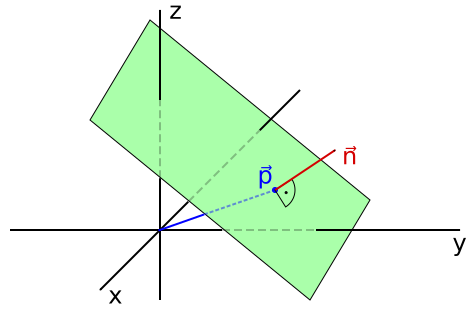
In a manner analogous to the way lines in a two-dimensional space are described using a point-slope form for their equations, planes in a three dimensional space have a natural description using a point in the plane and a vector orthogonal to it (the normal vector) to indicate its "inclination".
Specifically, let r0 be the position vector of some point , and let be a nonzero vector. The plane determined by the point P0 and the vector n consists of those points P, with position vector r, such that the vector drawn from P0 to P is perpendicular to n. Recalling that two vectors are perpendicular if and only if their dot product is zero, it follows that the desired plane can be described as the set of all points r such that \boldsymbol{n} \cdot (\boldsymbol{r}-\boldsymbol{r}_0)=0. The dot here means a dot (scalar) product.
Expanded this becomes a (x-x_0) + b(y-y_0) + c(z-z_0) = 0, which is the point–normal form of the equation of a plane. This is just a linear equation ax + by + cz + d = 0, where d = -(ax_0 + by_0 + cz_0), which is the expanded form of - \boldsymbol{n} \cdot \boldsymbol{r}_0.
In mathematics it is a common convention to express the normal as a unit vector, but the above argument holds for a normal vector of any non-zero length.
Conversely, it is easily shown that if a, b, c, and d are constants and a, b, and c are not all zero, then the graph of the equation ax + by + cz + d = 0, is a plane having the vector as a normal. This familiar equation for a plane is called the general form of the equation of the plane or just the plane equation.{{Citation |access-date= 2009-08-08
Thus for example a regression equation of the form (with ) establishes a best-fit plane in three-dimensional space when there are two explanatory variables.
Describing a plane with a point and two vectors lying on it
Alternatively, a plane may be described parametrically as the set of all points of the form \boldsymbol{r} = \boldsymbol{r}_0 + s \boldsymbol{v} + t \boldsymbol{w},

where s and t range over all real numbers, v and w are given linearly independent vectors defining the plane, and r0 is the vector representing the position of an arbitrary (but fixed) point on the plane. The vectors v and w can be visualized as vectors starting at r0 and pointing in different directions along the plane. The vectors v and w can be perpendicular, but cannot be parallel.
Describing a plane through three points
Let , , and be non-collinear points.
Method 1
The plane passing through p1, p2, and p3 can be described as the set of all points (x,y,z) that satisfy the following determinant equations: \begin{vmatrix} x - x_1 & y - y_1 & z - z_1 \ x_2 - x_1 & y_2 - y_1 & z_2 - z_1 \ x_3 - x_1 & y_3 - y_1 & z_3 - z_1 \end{vmatrix} = \begin{vmatrix} x - x_1 & y - y_1 & z - z_1 \ x - x_2 & y - y_2 & z - z_2 \ x - x_3 & y - y_3 & z - z_3 \end{vmatrix} = 0.
Method 2
To describe the plane by an equation of the form ax + by + cz + d = 0 , solve the following system of equations: ax_1 + by_1 + cz_1 + d = 0 ax_2 + by_2 + cz_2 + d = 0 ax_3 + by_3 + cz_3 + d = 0.
This system can be solved using Cramer's rule and basic matrix manipulations. Let D = \begin{vmatrix} x_1 & y_1 & z_1 \ x_2 & y_2 & z_2 \ x_3 & y_3 & z_3 \end{vmatrix}.
If D is non-zero (so for planes not through the origin) the values for a, b and c can be calculated as follows: a = \frac{-d}{D} \begin{vmatrix} 1 & y_1 & z_1 \ 1 & y_2 & z_2 \ 1 & y_3 & z_3 \end{vmatrix} b = \frac{-d}{D} \begin{vmatrix} x_1 & 1 & z_1 \ x_2 & 1 & z_2 \ x_3 & 1 & z_3 \end{vmatrix} c = \frac{-d}{D} \begin{vmatrix} x_1 & y_1 & 1 \ x_2 & y_2 & 1 \ x_3 & y_3 & 1 \end{vmatrix}.
These equations are parametric in d. Setting d equal to any non-zero number and substituting it into these equations will yield one solution set.
Method 3
This plane can also be described by the prescription above. A suitable normal vector is given by the cross product \boldsymbol n = ( \boldsymbol p_2 - \boldsymbol p_1 ) \times ( \boldsymbol p_3 - \boldsymbol p_1 ), and the point r0 can be taken to be any of the given points p1, p2 or p3{{citation |chapter-url= http://tutorial.math.lamar.edu/Classes/CalcIII/EqnsOfPlanes.aspx
Operations
Distance from a point to a plane
Line–plane intersection
Line of intersection between two planes
Sphere–plane intersection
Occurrence in nature

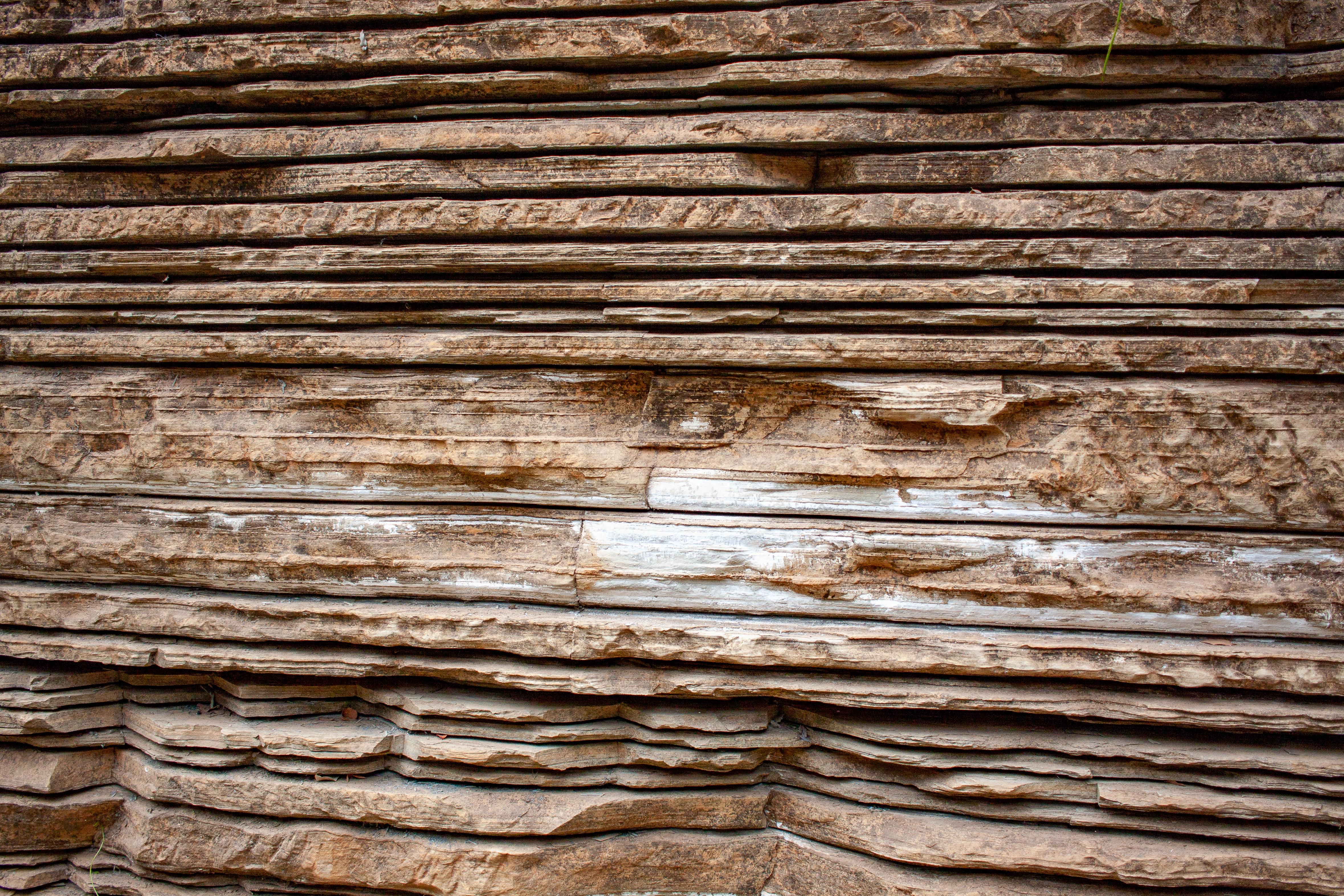
A plane serves as a mathematical model for many physical phenomena, such as specular reflection in a plane mirror or wavefronts in a traveling plane wave. The free surface of undisturbed liquids tends to be nearly flat (see flatness). The flattest surface ever manufactured is a quantum-stabilized atom mirror. In astronomy, various reference planes are used to define positions in orbit. Anatomical planes may be lateral ("sagittal"), frontal ("coronal") or transversal. In geology, beds (layers of sediments) often are planar. Planes are involved in different forms of imaging, such as the focal plane, picture plane, and image plane.
Miller indices
Main article: Miller index

The attitude of a lattice plane is the orientation of the line normal to the plane,
Strike and dip
Main article: Strike and dip

Many features observed in geology are planes or lines, and their orientation is commonly referred to as their attitude. These attitudes are specified with two angles.
For a line, these angles are called the trend and the plunge. The trend is the compass direction of the line, and the plunge is the downward angle it makes with a horizontal plane.
For a plane, the two angles are called its strike (angle) and its dip (angle). A strike line is the intersection of a horizontal plane with the observed planar feature (and therefore a horizontal line), and the strike angle is the bearing of this line (that is, relative to geographic north or from magnetic north). The dip is the angle between a horizontal plane and the observed planar feature as observed in a third vertical plane perpendicular to the strike line.
Notes
Explanatory notes
Citations
References
References
- (2004). "[[Merriam-Webster's Collegiate Dictionary]]". [[Merriam-Webster]].
- {{harvnb. Eves. 1963
- {{harvnb. Anton. 1994
- {{harvnb. Anton. 1994
- Evans, Jon. (2008-08-22). "Smoothest surface ever is a mirror for atoms".
This article was imported from Wikipedia and is available under the Creative Commons Attribution-ShareAlike 4.0 License. Content has been adapted to SurfDoc format. Original contributors can be found on the article history page.
Ask Mako anything about Euclidean planes in three-dimensional space — get instant answers, deeper analysis, and related topics.
Research with MakoFree with your Surf account
Create a free account to save articles, ask Mako questions, and organize your research.
Sign up freeThis content may have been generated or modified by AI. CloudSurf Software LLC is not responsible for the accuracy, completeness, or reliability of AI-generated content. Always verify important information from primary sources.
Report