From Surf Wiki (app.surf) — the open knowledge base
Eucalyptus globulus
Species of tree endemic to southeastern Australia
Species of tree endemic to southeastern Australia
- Eucalyptus gigantea Dehnh.
- Eucalyptus globulosus St.-Lag. nom. illeg.
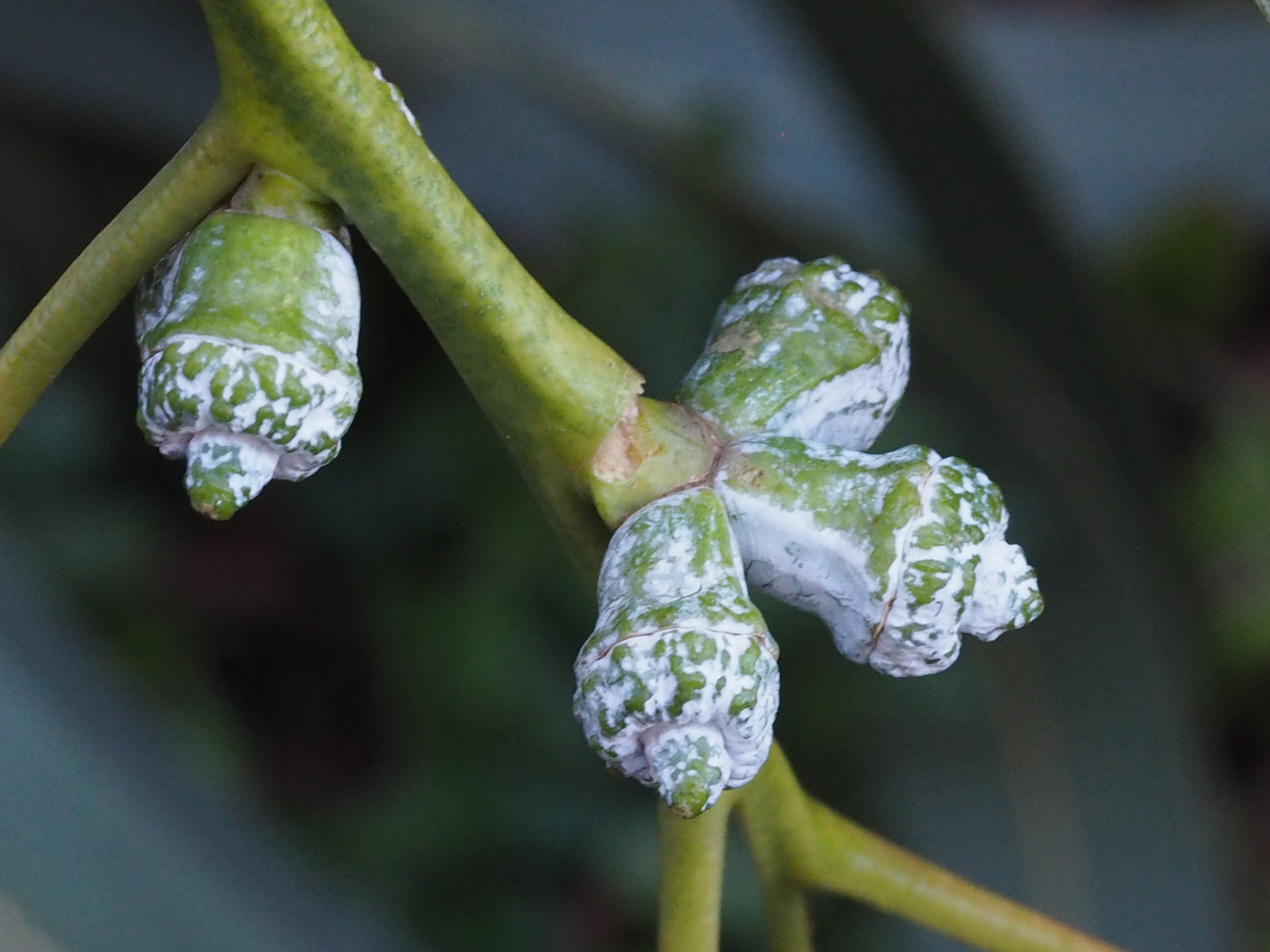
Eucalyptus globulus, commonly known as southern blue gum or blue gum, is a species of flowering plant in the family Myrtaceae. It is a tall, evergreen tree endemic to southeastern Australia. This Eucalyptus species has mostly smooth bark, juvenile leaves that are whitish and waxy on the lower surface, glossy green, lance-shaped adult leaves, glaucous, ribbed flower buds arranged singly or in groups of three or seven in leaf axils, white flowers and woody fruit.
There are four subspecies, each with a different distribution across Australia, occurring in New South Wales, Victoria and Tasmania. The subspecies are the Victorian blue gum, Tasmanian blue gum, Maiden's gum, and Victorian eurabbie.
Description
Eucalyptus globulus is a tree that typically grows to a height of 45 m but may sometimes only be a stunted shrub, or alternatively under ideal conditions can grow as tall as 90 m, and forms a lignotuber. The bark is usually smooth, white to cream-coloured but there are sometimes slabs of persistent, unshed bark at the base. Young plants, often several metres tall, and coppice regrowth have stems that are more or less square in cross-section with a prominent wing on each corner. Juvenile leaves are mostly arranged in opposite pairs, sessile, glaucous elliptic to egg-shaped, up to 150 mm long and 105 mm wide. Adult leaves are arranged alternately, the same glossy to dark green on both sides, lance-shaped or curved, 150-300 mm long and 17-30 mm wide on a petiole 1.5-6 mm long. The flower buds are arranged singly or in groups of three or seven in leaf axils, sometimes sessile or on a short thick peduncle. The individual buds are also usually sessile, sometimes on a pedicel up to 5 mm long. Mature buds are top-shaped to conical, glaucous or green, with a flattened hemispherical, warty operculum with a central knob. Flowering time varies with subspecies and distribution but the flowers are always white. The fruit is a woody conical or hemispherical capsule 2–3 cm diameter with the valves close to rim level.
Taxonomy and naming
Eucalyptus globulus was first formally described in 1800 by the French botanist Jacques Labillardière in his book, Relation du Voyage à la Recherche de la Pérouse. Labillardière collected specimens at Recherche Bay during the d'Entrecasteaux expedition in 1792.
The d'Entrecasteaux expedition made immediate use of the species when they discovered it, the timber being used to improve their oared boats. The Tasmanian blue gum was proclaimed as the floral emblem of Tasmania on 27 November 1962. The species name is from the Latin globulus, a little ball or small sphere, referring to the shape of the fruit.
In 1974, James Barrie Kirkpatrick described four subspecies and the names have been accepted by the Australian Plant Census. Each subspecies has a characteristic arrangement of its flower buds:
- Eucalyptus globulus subsp. bicostata (Maiden, Blakely & Simmonds) J.B.Kirkp. (formerly Eucalyptus bicostata), commonly known as Victorian blue gum or eurabbie, has sessile flower buds arranged in groups of three;
- Eucalyptus globulus Labill. subsp. globulus, commonly known as Tasmanian blue gum, has flower buds arranged singly in leaf axils;
- Eucalyptus globulus subsp. maidenii (F.Muell.) J.B.Kirkp. (formerly Eucalyptus maidenii), commonly known as Maiden's gum has flower buds arranged in groups of seven
- Eucalyptus globulus subsp. pseudoglobulus (Naudin) J.B.Kirkp. (formerly Eucalyptus globulus var. pseudoglobulus), commonly known as Victorian eurabbie has pedicellate flower buds arranged in groups of three.
Distribution and habitat
Blue gum grows in forests in New South Wales, Victoria and Tasmania, including some of the Bass Strait Islands. The nominate subspecies E. g. subsp. globulus is mainly found in lowland parts of Tasmania, but is also found on some Bass Strait islands including King Island, and in the extreme south-west of Victoria. Subspecies E. g. subsp. bicostata occurs in montane and tableland areas between the Carrai Plateau in northern New South Wales and the Pyrenees in Victoria. Subspecies E. g. subsp. maidenii occurs on near-coastal ranges of south-eastern New South Wales and eastern Victoria. Subspecies E. g. subsp. pseudoglobulus is mostly distributed in eastern Gippsland but there are isolated populations further inland and in the Nadgee Nature Reserve in south-eastern New South Wales.
There are naturalised non-native occurrences in Ireland (where self-sown saplings typically grow 2.5 m per year when young), Spain and Portugal, and other parts of southern Europe including Cyprus and Macaronesia, and in southern Africa, New Zealand, and the western United States (California, Hawaii). File:EucalyptusGlobulusPatra.jpg|In Patra, Greece. File:Eucalipto (talvez Eucalyptus globulus) na zona rural de Bagé.jpg|In southern Brazil
Unusual specimens
They typically grow from 30 - tall. There are historical claims of much taller trees, with Tasmanian D. W. Lewin claiming that the tallest was 101 m.
Plantations
Blue gum is one of the most extensively planted eucalypts. Its rapid growth and adaptability to a range of conditions is responsible for its popularity. It is especially well-suited to countries with a Mediterranean-type climate, but also grows well in high altitudes in the tropics.
It comprises 65% of all plantation hardwood in Australia with approximately 4,500 km² planted.
In about 1860 Francis Cook planted the tree on the Monserrate Palace, his property at Sintra in Portugal. By 1878 the tree "had spread from one end of Portugal to the other".
E. globulus began to be planted as plantations in Los Lagos and Los Ríos regions of Chile in the 1990s. However at these latitudes around the 40th parallel south the tree is at the southern border of the climatic conditions where it can grow, hence good growth in this part of southern Chile requires good site selection such as sunny north-facing slopes. Some of these plantations grow on red clay soil.
Uses
Timber
Blue gum timber is yellow-brown, fairly heavy, with an interlocked grain, and is difficult to season. It has poor timber quality due to growth stress problems, but can be used in construction, fence posts and poles.
Pulpwood
Main article: Eucalyptus#Pulpwood
Essential oil
The leaves are steam distilled to extract eucalyptus oil. E. globulus is the primary source of global eucalyptus oil production, with China being the largest commercial producer. Oil yield ranges from 1.0 to 2.4% (fresh weight), with cineole being the major isolate. E. globulus oil has established itself internationally because it is virtually phellandrene free, a necessary characteristic for internal pharmaceutical use. In 1870, Cloez identified and ascribed the name "eucalyptol" — now more often called cineole — to the dominant portion of E. globulus oil.
The European Medicines Agency Committee on Herbal Medicinal Products concluded that traditional medicines based on eucalyptus oil can be used for treating cough associated with the common cold, and to relieve symptoms of localized muscle pain. Eucalyptus products appear safe and somewhat effective in reducing cough symptoms from respiratory infections, but the clinical significance is unclear and more high-quality studies are needed.
Herb tea
Tasmanian blue gum leaves are used as a herbal tea.
Phenolics
E. globulus bark contains quinic, dihydroxyphenylacetic and caffeic acids, bis(hexahydroxydiphenoyl (HHDP))-glucose, galloyl-bis(HHDP)-glucose, galloyl-HHDP-glucose, isorhamentin-hexoside, quercetin-hexoside, methylellagic acid (EA)-pentose conjugate, myricetin-rhamnoside, isorhamnetin-rhamnoside, mearnsetin, phloridzin, mearnsetin-hexoside, luteolin and a proanthocyanidin B-type dimer, digalloylglucose and catechin. The hydrolyzable tannins tellimagrandin I, eucalbanin C, 2-O-digalloyl-1,3,4-tri-O-galloyl-β-D-glucose, 6-O-digalloyl-1,2,3-tri-O-galloyl-β-D-glucose, as well as gallic acid and (+)-catechin can also be isolated. Tricetin is a rare flavone aglycone found in the pollen of members of the Myrtaceae, subfamily Leptospermoideae, such as E. globulus.
References
References
- "''Eucalyptus globulus''". Australian Plant Census.
- "''Eucalyptus globulus''". Royal Botanic Gardens Victoria.
- "''Eucalyptus globulus'' subsp. ''globulus''". Euclid: Centre for Australian National Biodiversity Research.
- "''Eucalyptus globulus''". Australian Biological Resources Study, Department of the Environment and Energy, Canberra.
- "''Eucalyptus globulus''". Kew: Plants of the World online.
- "''Eucalyptus globulus''". APNI.
- (1800). "Relation du Voyage à la Recherche de la Pérouse". chez H. J. Jansen.
- (1800). "Relation du Voyage à la Recherche de la Pérouse". chez H. J. Jansen.
- Mulvaney, John. (c. 2006). "'The axe had never sounded': place, people and heritage of Recherche Bay, Tasmania". [[Australian National University]].
- (1956). "The Composition of Scientific Words". Smithsonian Institution Press.
- (September 1974). "The numerical intraspecific taxonomy of ''Eucalyptus globulus'' Labill. (Myrtaceae)". The Botanical Journal of the Linnean Society.
- "Key to the subspecies of ''Eucalyptus globulus''". Royal Botanic Gardens, Victoria.
- "''Eucalyptus globulus'' subsp. ''bicostata''". Australian Plant Census.
- "''Eucalyptus globulus'' subsp. ''bicostata''". Euclid: Centre for Australian National Biodiversity Research.
- "''Eucalyptus globulus'' subsp. ''bicostata''". Australian Plant Census.
- "''Eucalyptus globulus'' subsp. ''maidenii''". Australian Plant Census.
- "''Eucalyptus globulus'' subsp. ''maidenii''". Euclid: Centre for Australian National Biodiversdity Research.
- "''Eucalyptus globulus'' subsp. ''maidenii''". Australian Plant Census.
- "''Eucalyptus globulus'' subsp. ''pseudoglobulus''". Euclid: Centre for Australian National Biodiversity Research.
- Mitchell, Alan F.. (1982). "The Trees of Britain and Northern Europe". HarperCollins.
- {{GRIN
- Lewin, D. W.. (1906). "The Eucalypti Hardwood Timbers of Tasmania". Tasmania, Gray.
- Hillis, W.E., Brown, A.G., ''Eucalypts for Wood Production'', Academic Press, 1984, p20, {{ISBN. 0-12-348762-5
- "Australia's Plantations 2006". Bureau of Rural Sciences.
- (31 October 1878). "The Eucalyptus for the West of England". The Cornishman.
- (2004). "Crecimiento de las plantaciones de Eucalyptus globulussobre suelos rojo arcillosos de la provinciad Osorno, Décima Región". [[Bosque (journal).
- Cribb, A.B. & J.W., ''Useful Wild Plants in Australia'', Collins 1982, p25 {{ISBN. 0-00-636397-0
- "Index of Species Information, Eucalyptus globulus".
- Edited by Boland, D.J., Brophy, J.J., and A.P.N. House, ''Eucalyptus Leaf Oils - Use, Chemistry, Distillation and Marketing'', Inkata Press, 1991, p4.
- "Eucalyptus Oil, FAO Corporate Document Repository".
- Edited by Boland, D.J., Brophy, J.J., and A.P.N. House, ''Eucalyptus Leaf Oils - Use, Chemistry, Distillation and Marketing'', Inkata Press, 1991, p3., & pp78-82.
- Boland, D.J., Brophy, J.J., and A.P.N. House, ''Eucalyptus Leaf Oils'', 1991, p6 {{ISBN. 0-909605-69-6
- (12 May 2016). "''Eucalypti aetheroleum''". European Medicines Agency.
- (2022). "Efficacy and Safety of Eucalyptus for Relieving Cough: A Systematic Review and Meta-Analysis of Randomized Controlled Trials". Journal of Integrative and Complementary Medicine.
- [http://www.21food.com/showroom/24442/product/Eucalyptus-Globulus-Labill-Leaf-Pieces-Tea.html Eucalyptus Globulus Labill Leaf Pieces Tea]
- (2011). "Characterization of phenolic components in polar extracts of Eucalyptus globulus Labill. Bark by high-performance liquid chromatography-mass spectrometry". Journal of Agricultural and Food Chemistry.
- (2000). "Hydrolyzable Tannins and Related Polyphenols fromEucalyptus globulus". Journal of Asian Natural Products Research.
- The Unique Occurrence of the Flavone Aglycone Tricetin in Myrtaceae Pollen. Maria G. Campos, Rosemary F. Webby and Kenneth R. Markham, Z. Naturforsch, 2002, 57c, pages 944-946 ([http://www.znaturforsch.com/ac/v57c/s57c0944.pdf article])
This article was imported from Wikipedia and is available under the Creative Commons Attribution-ShareAlike 4.0 License. Content has been adapted to SurfDoc format. Original contributors can be found on the article history page.
Ask Mako anything about Eucalyptus globulus — get instant answers, deeper analysis, and related topics.
Research with MakoFree with your Surf account
Create a free account to save articles, ask Mako questions, and organize your research.
Sign up freeThis content may have been generated or modified by AI. CloudSurf Software LLC is not responsible for the accuracy, completeness, or reliability of AI-generated content. Always verify important information from primary sources.
Report