From Surf Wiki (app.surf) — the open knowledge base
Ethnic groups in Europe
none

none
Europeans are the focus of European ethnology, the field of anthropology related to the various ethnic groups that reside in the states of Europe. Groups may be defined by common ancestry, language, faith, historical continuity, etc. There are no universally accepted and precise definitions of the terms "ethnic group" and "nationality", but in the context of European ethnography in particular, the terms ethnic group, people, nationality and ethno-linguistic group are used as mostly synonymous. Preference may vary in usage with respect to the situation specific to the individual countries of Europe, and the context in which they may be classified by those terms.
The total number of national minority populations in Europe is estimated at 105 million people, or 14% of 770 million Europeans in 2002. The Russians are the most populous among Europeans, with a population of roughly 120 million.
Overview
In 2021, the number of non-EU nationals living in EU members states was 23.7 million (5.3% of the EU population). The countries with the largest population of non-nationals were Germany, Spain, France and Italy. These four Member States represented 70.3% of all non-EU nationals living in the EU Member States. The population of the European Union, with some 450 million residents, accounts for two thirds of the current European population.
Both Spain and the United Kingdom are special cases, in that the designation of nationality, Spanish and British, may controversially take ethnic aspects, subsuming various regional ethnic groups (see nationalisms and regionalisms of Spain and native populations of the United Kingdom). Switzerland is a similar case, but the linguistic subgroups of the Swiss are discussed in terms of both ethnicity and language affiliations.
Linguistic classifications
Of the total population of Europe of some 740 million (as of 2010), close to 90% (or some 650 million) fall within three large branches of Indo-European languages, these being:
- Germanic, including Danish, Dutch, English, Faroese, Frisian, German, Gutnish, Hunsrik, Icelandic, Limburgish, Low Saxon, Luxembourgish, Norwegian, Scots, Swedish, and Yiddish. Afrikaans, a daughter language of Dutch, is spoken by some South African and Namibian migrant populations.
- Romance, including Aromanian, Arpitan, Asturian, Catalan, Corsican, French and other Langues d'oïl, Lombard, Friulian, Galician, Istro-Romanian, Italian, Ligurian, Ladin, Ladino, Megleno-Romanian, Occitan, Portuguese, Romanian, Romansh, Sardinian, Spanish, Venetian and Sicilian.
- Slavic, including Belarusian, Bosnian, Bulgarian, Croatian, Czech, Kashubian, Macedonian, Polish, Russian, Rusyn, Serbian, Silesian, Slovak, Slovenian, Sorbian and Ukrainian.
Three stand-alone Indo-European languages do not fall within larger sub-groups and are not closely related to those larger language families, but are still languages that are used in areas considered part of the European continent:
- Greek (about 12 million)
- Albanian (about 9 million)
- Armenian (about 3.5 million)
In addition, there are also smaller sub-groups within the Indo-European languages of Europe, including:
- Baltic, including Latvian, Lithuanian, Samogitian and Latgalian.
- Celtic, including Breton, Cornish, Irish, Manx, Welsh, and Scottish Gaelic.
- Iranic, mainly Ossetian and Tats in the Caucasus.
- Indo-Aryan is represented by the Romani language spoken by Roma people of eastern Europe, and is at root related to the Indo-Aryan languages of the Indian subcontinent.
Besides the Indo-European languages, there are other language families on the European continent which are considered unrelated to Indo-European:
- Uralic languages, including Estonian, Finnish, Hungarian, Komi, Livonian, Mari, Mordvin, Sámi, Samoyedic, and Udmurt.
- Turkic languages, including Azerbaijani, Bashkir, Chuvash, Gagauz, Kazakh, Nogai, Tatar, Turkish, Crimean Tatar.
- Semitic languages, including: Maltese an arabic dialect spoken in Malta, Suret/Turoyo (dialects of Neo-Aramaic spoken in parts of eastern Turkey and the Caucasus by ethnic Assyrians), Hebrew (spoken by some Jewish populations).
- Kartvelian languages (also known as South Caucasian languages), including Georgian, Zan (Mingrelian and Laz), and Svan.
- Northwest Caucasian languages, including Abkhaz, Abaza, Circassian (Adyghe and Kabardian), and Ubykh.
- Northeast Caucasian languages, including Avar, Chechen, Dargin, Ingush, Lak, and Lezgian.
- Language isolates: Basque, spoken in the Basque regions of Spain and France, is an isolate language, the only one in Europe, and is believed to be unrelated to any other living language; though it is related to the extinct Aquitanian language.
- Mongolic languages exist in the form of Kalmyk, spoken in the South region of Russia.
History
Prehistoric populations
The Basques have been found to descend from the population of the late Neolithic or early Bronze Age directly. By contrast, Indo-European groups of Europe (the Centum, Balto-Slavic, and Albanian groups) migrated throughout most of Europe from the Pontic steppe. They are assumed to have developed in situ through admixture of earlier Mesolithic and Neolithic populations with Bronze Age, proto-Indo-Europeans. The Finnic peoples are assumed to also be descended from Proto-Uralic populations further to the east, nearer to the Ural Mountains, that had migrated to their historical homelands in Europe by about 3,000 years ago.
Reconstructed languages of Iron Age Europe include Proto-Celtic, Proto-Italic and Proto-Germanic, all of these Indo-European languages of the centum group, and Proto-Slavic and Proto-Baltic, of the satem group. A group of Tyrrhenian languages appears to have included Etruscan, Rhaetian, Lemnian, and perhaps Camunic. A pre-Roman stage of Proto-Basque can only be reconstructed with great uncertainty.
Regarding the European Bronze Age, the only relatively likely reconstruction is that of Proto-Greek (ca. 2000 BC). A Proto-Italo-Celtic ancestor of both Italic and Celtic (assumed for the Bell beaker period), and a Proto-Balto-Slavic language (assumed for roughly the Corded Ware horizon) has been postulated with less confidence. Old European hydronymy has been taken as indicating an early (Bronze Age) Indo-European predecessor of the later centum languages.
According to geneticist David Reich, based on ancient human genomes that his laboratory sequenced in 2016, Europeans descend from a mixture of four distinct ancestral components.
Historical populations

Iron Age (pre-Great Migrations) populations of Europe known from Greco-Roman historiography, notably Herodotus, Pliny, Ptolemy and Tacitus:
- Aegean: the Greek tribes, Pelasgians, and Anatolians.
- Balkans: the Illyrians (List of ancient tribes in Illyria), Dacians, and Thracians.
- Italian Peninsula: the Camunni, Rhaetians, Lepontii, Adriatic Veneti, Gauls, Ligurians, Etruscans, Italic peoples and Greek and Phoenician colonies in its neighboring Italian islands.
- Western/Central Europe: the Celts (list of peoples of Gaul, List of Celtic tribes), Rhaetians and Swabians, Vistula Veneti, Lugii and Balts.
- Iberian Peninsula and Pyrenees : the Pre-Roman peoples of the Iberian Peninsula (Iberians, Celts, Celtiberians, Lusitani, Basques, Turdetani), of the Pyrenean piedmont (Aquitani) between the Pyrenees and the Atlantic Ocean, and Greek and Phoenician coastal Mediterranean colonies.
- Sardinia and Corsica: the ancient Sardinians and Corsicans (also known as Nuragic and Torrean peoples), comprising the Corsi, Balares, Ilienses tribes and Phoenician colonies.
- British Isles: the Insular Celts.
- Northern Europe: the Baltic Finns, Germanic peoples (list of Germanic peoples) and Normans.
- Sicily: the Italic Sicels and Morgetes, the Sicani, Elymians and Greek and Phoenician colonies.
- Eastern Europe: the Veneti (Early Slavs), Scythians and Sarmatians.
- Armenian Highlands/Anatolia: the Armenians.
Historical immigration


Ethno-linguistic groups that arrived from outside Europe during historical times are:
- Phoenician colonies in the Mediterranean (including regions in Spain, Malta, Sicily, Sardinia, Cyprus and the Aegean), from about 1200 BC to the fall of Carthage after the Third Punic War in 146 BC.
- Assyrian conquest of Cyprus, Southern Caucasus (including parts of modern Armenia, Georgia and Azerbaijan) and Cilicia during the Neo-Assyrian Empire (911–605 BC).
- Iranian influence: Achaemenid control of Thrace (512–343 BC) and the Bosporan Kingdom, Cimmerians (possible Iranians), Scythians, Sarmatians, Alans, Ossetes, Tats, Talyshs.
- The Jewish diaspora reached Europe in the Roman Empire period, the Jewish community in Italy dating to around AD 70 and records of Jews settling Central Europe (Gaul) from the 5th century (see History of the Jews in Europe).
- The Hunnic Empire (5th century AD), converged with the Barbarian invasions, contributing to the formation of the First Bulgarian Empire.
- The Slavic migrations (6th century AD), and the subsequent split into Eastern Slavs, Western Slavs and Southern Slavs.
- Avar Khaganate (c. 560s–800).
- The Bulgars (or Proto-Bulgarians), a semi-nomadic Turkic people, originally from Central Asia, eventually absorbed by the Slavs.
- The Magyars (Hungarians), a Uralic-speaking people, and the Turkic Pechenegs and Khazars, arrived in Europe in about the 8th century (see Hungarian conquest of the Carpathian Basin).
- The Arabs conquered Cyprus, Crete, Sicily (establishing the Emirate of Sicily in 831, from which they would be expelled in 1224), some places along the coast of southern Italy, Malta, Greek Empire and most of Iberia (founding a polity known as Al-Andalus in 711, ruled also by Berber dynasties of the Almoravides and the Almohads, from whose domain they would be expelled in 1492).
- Exodus of Maghreb Christians, namely Berbers and African Romance speakers, from the 7th to the 12th centuries.
- The western Kipchaks known as Cumans entered the lands of present-day Ukraine in the 11th century.
- The Mongol/Tatar invasions (1223–1480), and Ottoman control of the Balkans (1389–1912). These medieval incursions account for the presence of European Turks and Tatars.
- The Romani people arrived during the Late Middle Ages.
- The Mongol Kalmyks arrived in Kalmykia in the 17th century.
History of European ethnography
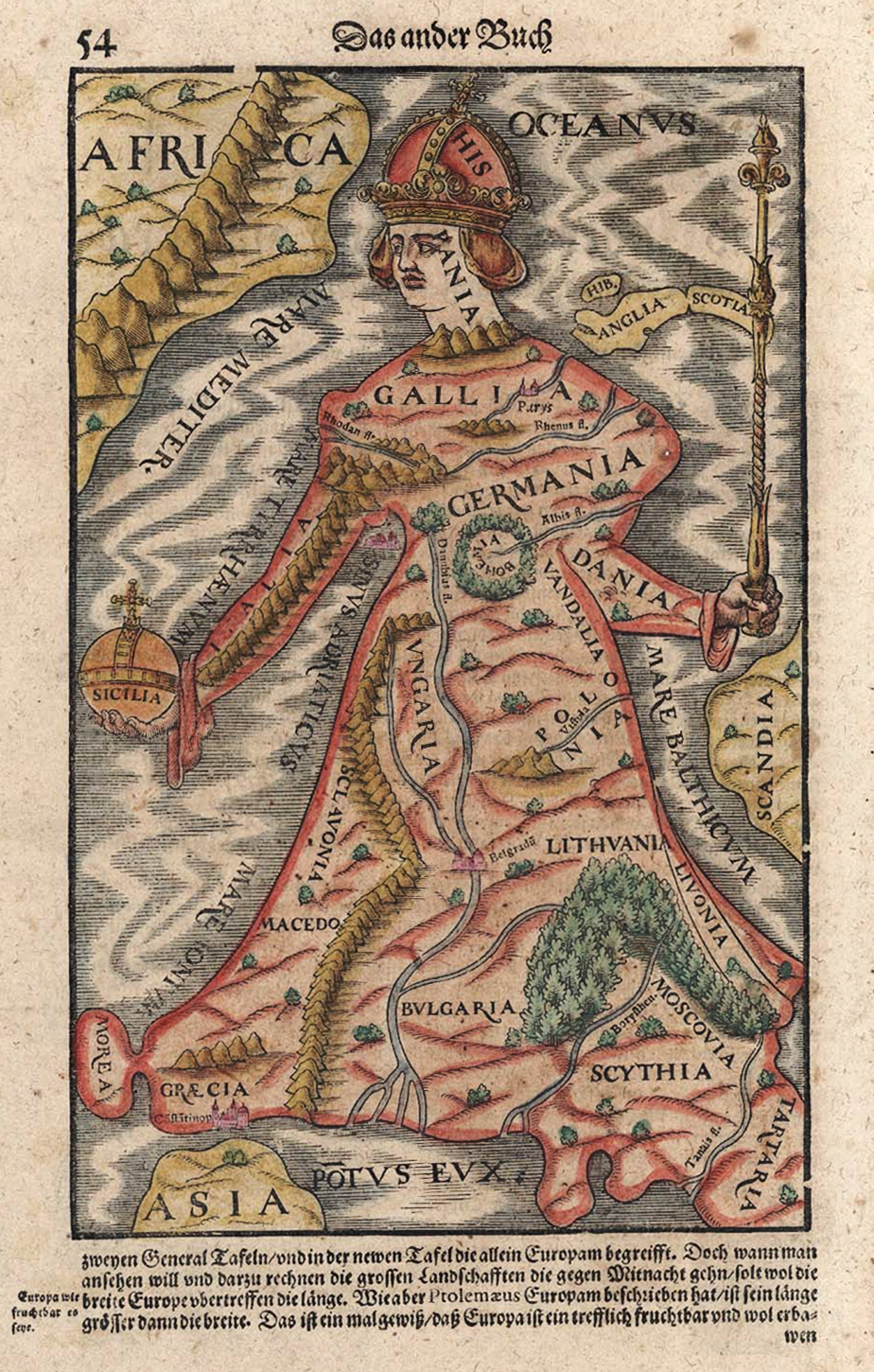

The earliest accounts of European ethnography date from Classical Antiquity. Herodotus described the Scythians and Thraco-Illyrians. Dicaearchus gave a description of Greece itself, besides accounts of western and northern Europe. His work survives only fragmentarily, but was received by Polybius and others.
Roman Empire period authors include Diodorus Siculus, Strabo and Tacitus. Julius Caesar gives an account of the Celtic tribes of Gaul, while Tacitus describes the Germanic tribes of Magna Germania. A number of authors like Diodorus Siculus, Pausanias and Sallust depict the ancient Sardinian and Corsican peoples.
The 4th century Tabula Peutingeriana records the names of numerous peoples and tribes. Ethnographers of Late Antiquity such as Agathias of Myrina, Ammianus Marcellinus, Jordanes, and Theophylact Simocatta give early accounts of the Slavs, the Franks, the Alamanni and the Goths.
Book IX of Isidore's Etymologiae (7th century) treats de linguis, gentibus, regnis, militia, civibus (concerning languages, peoples, realms, war and cities). Ahmad ibn Fadlan in the 10th century gives an account of the Bolghar and the Rus' peoples. William Rubruck, while most notable for his account of the Mongols, in his account of his journey to Asia also gives accounts of the Tatars and the Alans. Saxo Grammaticus and Adam of Bremen give an account of pre-Christian Scandinavia. The Chronicon Slavorum (12th century) gives an account of the northwestern Slavic tribes.
Gottfried Hensel in his 1741 Synopsis Universae Philologiae published one of the earliest ethno-linguistic map of Europe, showing the beginning of the pater noster in the various European languages and scripts. In the 19th century, ethnicity was discussed in terms of scientific racism, and the ethnic groups of Europe were grouped into a number of "races", Mediterranean, Alpine and Nordic, all part of a larger "Caucasian" group.
The beginnings of ethnic geography as an academic subdiscipline lie in the period following World War I, in the context of nationalism, and in the 1930s exploitation for the purposes of fascist and Nazi propaganda, so that it was only in the 1960s that ethnic geography began to thrive as a bona fide academic subdiscipline.
The origins of modern ethnography are often traced to the work of Bronisław Malinowski, who emphasized the importance of fieldwork. The emergence of population genetics further undermined the categorisation of Europeans into clearly defined racial groups. A 2007 study on the genetic history of Europe found that the most important genetic differentiation in Europe occurs on a line from the north to the south-east (northern Europe to the Balkans), with another east–west axis of differentiation across Europe, separating the indigenous Basques, Sardinians and Sami from other European populations. Despite these stratifications it noted the unusually high degree of European homogeneity: "there is low apparent diversity in Europe with the entire continent-wide samples only marginally more dispersed than single population samples elsewhere in the world."
Minorities


The total number of national minority populations in Europe is estimated at 105 million people, or 14% of Europeans.
The member states of the Council of Europe in 1995 signed the Framework Convention for the Protection of National Minorities. The broad aims of the convention are to ensure that the signatory states respect the rights of national minorities, undertaking to combat discrimination, promote equality, preserve and develop the culture and identity of national minorities, guarantee certain freedoms in relation to access to the media, minority languages and education and encourage the participation of national minorities in public life. The Framework Convention for the Protection of National Minorities defines a national minority implicitly to include minorities possessing a territorial identity and a distinct cultural heritage. By 2008, 39 member states had signed and ratified the convention, with the notable exception of France.
Indigenous minorities
The definitions that apply to who is considered an indigenous minority group in Europe can vary widely. One criterion is the so-called "time element", or how long the original inhabitants of a land occupied it before the arrival of later settlers. As there is no fixed time frame, considering a specific group to be indigenous is often context-dependent. A number of ethnic groups in Europe claim indigenous status and are spread throughout the continent.
In Russia, the Uralic Nenets and Komi peoples in the north are considered to be indigenous peoples; the Nenets are divided into three distinct groups based on their way of life, Tundra, Forest, and Yaran, and have two autonomous regions that mention them as the majority inhabitants (Nenets, Yamalo-Nenets). Similarly, the Komi are divided into two main groups, the Zyryans and the Permiaks, which are individually divided into their own unique subgroupings. The Komi primarily live in the Komi Republic, though much of the population of the Republic are ethnic Russians. The Nenets are one of the 40 groups in Russia that are recognized as indigenous small-numbered peoples, while the Komi are seeking this recognition. The Circassians of southern Russia and the North Caucasus are another indigenous people to the country, though following the Circassian genocide, more Adyghe live in Turkey than in their ancestral homeland.
In the Crimean Peninsula, the Turkic Crimean Tatars, Krymchaks and Crimean Karaites are indigenous peoples. The Crimean Tatars were the majority ethnic group of the Crimean Peninsula until the 19th century. Meanwhile, the Krymchaks and Karaites differ by their much smaller population size (around 1–2,000 each) and their adherence to Judaism, with more of both groups now residing in Israel. The Crimean Tatars were declared an indigenous peoples in the 1996 Constitution of Ukraine, while plans were declared in 2021 to grant Karaites and other groups the same status.
In Scandinavia, which comprises Norway, Finland, and Sweden, the Sámi people inhabit the cultural region of Sápmi (which also includes parts of Russia). Up to today, the people have experienced great discrimination as an indigenous group, with the Norwegian and Swedish governments having previously been accused of policies of Norwegianization and Swedification against them. While challenges regarding the rights of the Sámi remain, the Church of Sweden made a formal apology for its role in forced conversions, and outlined a one-year plan for reconciliation.
In southern France and the Iberian Peninsula, Catalans, Basques, and Galicians each have their own unique regions and are considered indigenous peoples (Galicia, Catalonia, and Basque Country). They also have their own unique languages that denote their ethnic origins. This also applies to the Gaels, a Celtic ethnic group originally from Ireland, the Scottish Highlands, and the Isle of Man.
Non-Indigenous minorities
Main article: Immigration to Europe

Many non-European ethnic groups and nationalities have migrated to Europe over the centuries. Although some groups arrived centuries ago, the vast majority of non-indigenous ethnic groups have arrived more recently, mostly in the 20th and 21st centuries. Often, they come from former colonies of the British, Dutch, French, Portuguese and Spanish empires.
- Western Asians
- Turks: There were 10 million Turks living in Western Europe and the Balkans in 1997 (excluding Northern Cyprus and Turkey). By 2010, there were up to 15 million Turks living in the European Union (i.e. excluding Turkish communities in Turkey as well as several Balkan countries and post-Soviet countries which are not in the EU). According to Dr Araks Pashayan, 10 million "Euro-Turks" alone were living in Germany, France, the Netherlands and Belgium in 2012. In addition, there are 500,000 Turks in the UK (2011 estimate), 500,000 in Austria (2011 estimate) 150,000 in Sweden, 120,000 in Switzerland, 70,000 in Denmark (2008 estimate), as well as growing communities in Italy, Liechtenstein, Finland and Spain. In addition, over one million Turks were living in the Balkans in 2019 (especially in Bulgaria, Greece, Kosovo, North Macedonia and Romania), and approximately 400,000 Meskhetian Turks were living in the Eastern European regions of the post-Soviet states (i.e. Azerbaijan, Georgia, Kazakhstan, Russia and Ukraine) in 2014.
- Jews: approximately 2 million, mostly in France, the UK, Russia and Germany. They are descended from the Israelites of the Middle East (Southwest Asia),* "In the broader sense of the term, a Jew is any person belonging to the worldwide group that constitutes, through descent or conversion, a continuation of the ancient Jewish people, who were themselves descendants of the Hebrews of the Old Testament."
- "The Jewish people as a whole, initially called Hebrews (ʿIvrim), were known as Israelites (Yisreʾelim) from the time of their entrance into the Holy Land to the end of the Babylonian Exile (538 BC)."
Jew at Encyclopædia Britannica"Israelite, in the broadest sense, a Jew, or a descendant of the Jewish patriarch Jacob"
Israelite at Encyclopædia Britannica originating from the historical kingdoms of Israel and Judah.
- Ashkenazi Jews: approximately 1.4 million, mostly in the United Kingdom, France, Russia, Germany and Ukraine. They are believed by scholars to have arrived from Israel via southern Europe in the Roman era and settled in France and Germany towards the end of the first millennium. The Nazi Holocaust wiped out the vast majority during World War II and forced most to flee, with many of them going back to Israel.
- Bukharan Jews: from Uzbekistan, approximately 320,000, now half in Israel, 12% in the United States (2/3 in the New York metropolitan area), 5% the United Kingdom, and 3% scattered in Austria, Germany, Uzbekistan, Canada, and Russia.
- Sephardi Jews: approximately 300,000, mostly in France. They arrived via Spain and Portugal in the pre-Roman and Roman eras, and were forcibly converted or expelled in the 15th and 16th centuries.
- Mizrahi Jews: approximately 300,000, mostly in France, via Islamic-majority countries of the Middle East.
- Italqim: approximately 50,000, mostly in Italy, since the 2nd century BC.
- Romaniotes: approximately 6,000, mostly in Greece, with communities dating at least from the 1st century AD.
- Crimean Karaites (Karaim): less than 4,000, mostly in Ukraine, Poland and Lithuania. They arrived in Crimea in the Middle Ages.
- Assyrians: In Sweden, Assyrians number of 150,000 people, and the city of Södertälje is considered the unofficial Assyrian capital of Europe. Other European countries that have a sizeable Assyrian population are Germany, France, the Netherlands, and in smaller numbers in Great Britain and Armenia. Depending on religious denomination, tribe, or country of origin, they may also identify as Syriac, Chaldean, or Aramean, and they have formed different organizations that aim to represent them under these labels.
- Kurds: approximately 2.5 million, mostly in the Germany, France and Sweden.
- Iraqi diaspora: mostly in the Germany, UK and Sweden, and can be of varying ethnic origin, including Arabs, Assyrians, Kurds, Armenians, Shabaks, Mandeans, Turks, Kawliya and Yezidis.
- Lebanese diaspora: especially in France, Germany, Sweden, and Denmark.
- Syrian diaspora: The largest number of Syrians live in Germany, Sweden and France and can be of varying ethnic origin, including; Arabs, Assyrians, Kurds, Armenians, Turks, Mhallami and Yezidis.
- Africans
- North Africans (North African Arabs, Egyptian Copts, and Berbers): approximately 5 million, mostly in France, Spain, Italy, the Netherlands and Sweden. The bulk of North African migrants are Moroccans, although France also has a large number of Algerians, and others may be from Egypt (including Copts), Libya and Tunisia.
- Horn Africans (Somalis, Ethiopians, Eritreans, Djiboutians, and the Northern Sudanese): approximately 700,000, mostly in Scandinavia, the UK, the Netherlands, Germany, Switzerland, Austria, Finland, and Italy. Majority arrived to Europe as refugees. Proportionally few live in Italy despite former colonial ties, most live in the Nordic countries.
- Sub-Saharan Africans (many ethnicities including Afro-Caribbeans, African-Americans, Afro-Latinos and others by descent): approximately 5 million in 2007, with large populations in France, the UK and Germany, with populations also in the Netherlands, Italy, Spain, Portugal and elsewhere.
- Latin Americans: approximately 2.2 million in 2007, mainly in Spain and to a lesser extent Italy and the UK. See also Latin American Britons (80,000 Latin American born in 2001).
- Brazilians: around 280,000 in Portugal, and 50,000 in Italy and Germany each (mainly German-Brazilians).
- Chilean refugees escaping the Augusto Pinochet regime of the 1970s formed communities in France, Sweden, the UK, former East Germany and the Netherlands.
- Mexicans: about 21,000 in Spain and 14,000 in Germany
- Venezuelans: around 520,000 mostly in Spain (200,000), Portugal (100,000), France (30,000), Germany (20,000), UK (15,000), Ireland (5,000), Italy (5,000) and the Netherlands (1,000).
- South Asians: approximately 3-4 million, mostly in the UK but also several hundred thousand in Germany and the Netherlands.[[File:Bihari Sándor Bíró előtt.jpg|thumb|A [[Romani people in Hungary|Roma]] makes a complaint to a local magistrate in [[Kingdom of Hungary|Hungary]]. By [[Sándor Bihari]], 1886.]]
- Romani (Gypsies): approximately 4 or 10 million (although estimates vary widely), dispersed throughout Europe but with large numbers concentrated in the Balkans area, they are of ancestral South Asian and European descent, originating from the northern regions of the Indian subcontinent.
- Indians: approximately 2 million, mostly in the UK, also in Netherlands, Italy, Germany, and France.
- Pakistanis: approximately 1 million, mostly in the UK, but also in France, Spain, Germany, and Italy.
- Bangladeshi residing in Europe estimated at over 500,000, mostly in the UK.
- Sri Lankans: Portugal, the Netherlands and, the UK.
- Nepalese: approximately 50,000 in the UK.
- Afghans, about 100,000 to 200,000, most happen to live in the UK, but Germany and Sweden have also been popular destinations for Afghan immigrants since the 1960s.
- Southeast Asians
- Filipinos: above 1 million, mostly in Italy, the UK, France, Germany, and Spain.
- Others of multiple nationalities, ca. total 1 million, such as Indonesians in the Netherlands, Thais in the UK, Germany, and Sweden, Vietnamese in France, former East Germany, Czechia, and to a lesser extent, Poland, the United Kingdom, and Russia, and Cambodians in France, together with smaller communities of Burmese, Malaysian, Singaporean, Timorese and Laotian migrants.
- East Asians
- Chinese: approximately 1.7 million, mostly in France, Russia, the UK, Spain, Italy and the Netherlands.
- Japanese: mostly in the UK, and sizable communities in Düsseldorf, Germany and in France.
- Koreans: 100,000 estimated (excluding a possible 100,000 more in the Asian section of Russia), mainly in the UK, France and Germany. See also Koryo-saram, although many Koryo-saram live in Central Asian countries such as Uzbekistan and Kazakhstan.
- Mongolians in Germany, and to a lesser extent, Czechia and the United Kingdom.
- North Americans
- U.S. and Canadian immigrants: American British and Canadian British, Canadiens and Acadians in France, as well as Americans/Canadians of European ancestry residing elsewhere in Europe.
- African Americans (i.e. African American British) who are Americans of black/African ancestry reside in other countries. In the 1920s, African-American entertainers established a colony in Paris (African American French) and descendants of World War II/Cold War-era black American soldiers stationed in France, Germany and Italy are well known.
- U.S. and Canadian immigrants: American British and Canadian British, Canadiens and Acadians in France, as well as Americans/Canadians of European ancestry residing elsewhere in Europe.
- Others
- European diaspora – Australians, New Zealanders, South Africans (mostly White South Africans of Afrikaner and British descent), and white Namibians, Zimbabweans, Kenyans, Malawians and Zambians mainly in the UK, together with white Angolans and Mozambicans, mainly of Portuguese descent.
- Pacific Islanders: A small population of Tahitians of Polynesian origin in mainland France, Fijians in the United Kingdom from Fiji and Māori in the United Kingdom of the Māori people of New Zealand, a small number of Tongans and Samoans, also in the United Kingdom.
- Indigenous peoples of the Americas, a scant few in the European continent of American Indian ancestry (often Latin Americans in Spain, France and the UK; Inuit in Denmark), but most may be children or grandchildren of U.S. soldiers from American Indian tribes by intermarriage with local European women.
European identity
Historical
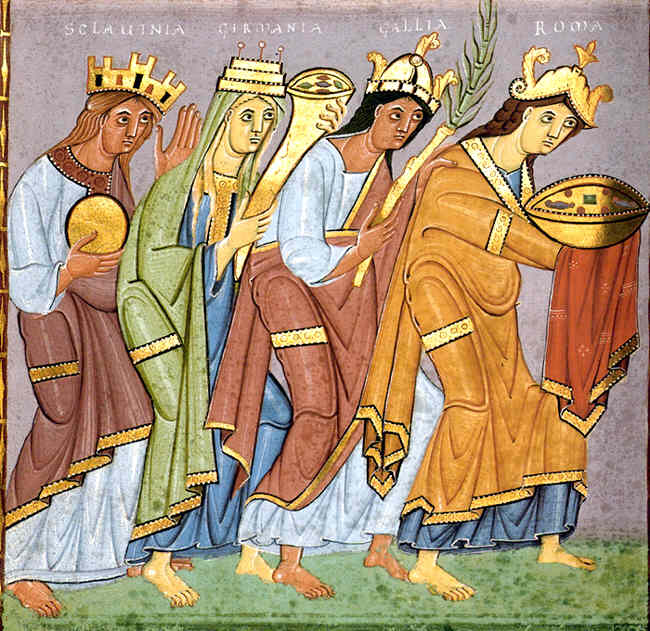
Medieval notions of a relation of the peoples of Europe are expressed in terms of genealogy of mythical founders of the individual groups. The Europeans were considered the descendants of Japheth from early times, corresponding to the division of the known world into three continents, the descendants of Shem peopling Asia and those of Ham peopling Africa. Identification of Europeans as "Japhetites" is also reflected in early suggestions for terming the Indo-European languages "Japhetic".
In this tradition, the Historia Brittonum (9th century) introduces a genealogy of the peoples of the Migration Period based on the sixth-century Frankish Table of Nations as follows:
From Hisicion arose four nations—the Franks, the Latins, the Germans, and Britons; from Armenon, the Gothi, Valagothi, Cibidi, Burgundi, and Longobardi; from Neugio, the Bogari, Vandali, Saxones, and Tarincgi. The whole of Europe was subdivided into these tribes.}}
The text goes then on to list the genealogy of Alanus, connecting him to Japheth via eighteen generations.
European culture
Main article: Culture of Europe, Western culture
European culture is largely rooted in what is often referred to as its "common cultural heritage". Due to the great number of perspectives which can be taken on the subject, it is impossible to form a single, all-embracing conception of European culture. Nonetheless, there are core elements which are generally agreed upon as forming the cultural foundation of modern Europe. One list of these elements given by K. Bochmann includes:
- A common cultural and spiritual heritage derived from Greco-Roman antiquity, Christianity, the Renaissance and its Humanism, the political thinking of the Enlightenment, and the French Revolution, and the developments of Modernity, including all types of socialism;
- A rich and dynamic material culture that has been extended to the other continents as the result of industrialization and colonialism during the "Great Divergence";
- A specific conception of the individual expressed by the existence of, and respect for, a legality that guarantees human rights and the liberty of the individual;
- A plurality of states with different political orders, which are condemned to live together in one way or another;
- Respect for peoples, states and nations outside Europe.
Berting says that these points fit with "Europe's most positive realisations". The concept of European culture is generally linked to the classical definition of the Western world. In this definition, Western culture is the set of literary, scientific, political, artistic and philosophical principles which set it apart from other civilizations. Much of this set of traditions and knowledge is collected in the Western canon. The term has come to apply to countries whose history has been strongly marked by European immigration or settlement during the 18th and 19th centuries, such as the Americas, and Australasia, and is not restricted to Europe.
Religion
Main article: Religion in Europe, Christendom
Since the High Middle Ages, most of Europe has been dominated by Christianity. There are three major denominations: Roman Catholic, Protestant and Eastern Orthodox, with Protestantism restricted mostly to Northern Europe, and Orthodoxy to East and South Slavic regions, Romania, Moldova, Greece, Cyprus, and Georgia. The Armenian Apostolic Church, part of the Oriental Church, is also in Europe – another branch of Christianity (world's oldest National Church). Catholicism, while typically centered in Western Europe, also has a very significant following in Central Europe (especially among the Germanic, Western Slavic, Slovenian and Hungarian peoples/regions) as well as parts of Northern Europe (Ireland, Lithuania, Latgale, along with some in Great Britain).
Christianity
Christianity has been the dominant religion shaping European culture for at least the last 1700 years. Modern philosophical thought has very much been influenced by Christian philosophers such as St Thomas Aquinas and Erasmus, and throughout most of its history, Europe has been nearly equivalent to Christian culture. The Christian culture was the predominant force in western civilization, guiding the course of philosophy, art, and science. The notion of "Europe" and the "Western World" has been intimately connected with the concept of "Christianity and Christendom" many even attribute Christianity for being the link that created a unified European identity.
Christianity is still the largest religion in Europe; according to a 2011 survey, 76.2% of Europeans considered themselves Christians. Also according to a study on Religiosity in the European Union in 2012, by Eurobarometer, Christianity is the largest religion in the European Union, accounting for 72% of the EU's population. As of 2010 Catholics were the largest Christian group in Europe, accounting for more than 48% of European Christians. The second-largest Christian group in Europe were the Orthodox, who made up 32% of European Christians. About 19% of European Christians were part of the Protestant tradition. Russia is the largest Christian country in Europe by population, followed by Germany and Italy. According to Scholars, in 2017, Europe's population was 77.8% Christian (up from 74.9% 1970), these changes were largely result of the collapse of Communism and switching to Christianity in the former Soviet Union and Eastern Bloc countries.
Islam
Islam has some tradition in the Balkans and the Caucasus due to conquest and colonization from the Ottoman Empire in the 16th to 19th centuries, as well as earlier though discontinued long-term presence in much of Iberia as well as Sicily. Muslims account for the majority of the populations in Albania, Azerbaijan, Kosovo, Northern Cyprus (controlled by Turks), and Bosnia and Herzegovina. Significant minorities are present in the rest of Europe. Russia also has one of the largest Muslim communities in Europe, including the Tatars of the Middle Volga and multiple groups in the Caucasus, including Chechens, Avars, Ingush and others. With 20th-century migrations, Muslims in Western Europe have become a noticeable minority. According to the Pew Forum, the total number of Muslims in Europe in 2010 was about 44 million (6%), while the total number of Muslims in the European Union in 2007 was about 16 million (3.2%).
Judaism
Judaism has a long history in Europe, but is a small minority religion, with France (1%) the only European country with a Jewish population in excess of 0.5%. The Jewish population of Europe is composed primarily of two groups, the Ashkenazi and the Sephardi. Ancestors of Ashkenazi Jews likely migrated to Central Europe at least as early as the 8th century, while Sephardi Jews established themselves in Spain and Portugal at least one thousand years before that. Jews originated in the Levant where they resided for thousands of years until the 2nd century AD, when they spread around the Mediterranean and into Europe, although small communities were known to exist in Greece as well as the Balkans since at least the 1st century BC. Jewish history was notably affected by the Holocaust and emigration (including Aliyah, as well as emigration to America) in the 20th century. The Jewish population of Europe in 2010 was estimated to be approximately 1.4 million (0.2% of European population) or 10% of the world's Jewish population. In the 21st century, France has the largest Jewish population in Europe, followed by the United Kingdom, Germany, Russia and Ukraine.
Secularisation
From the 20th century, there has been significant secularization, notably in secularist France, Estonia and the Czech Republic.
Theism
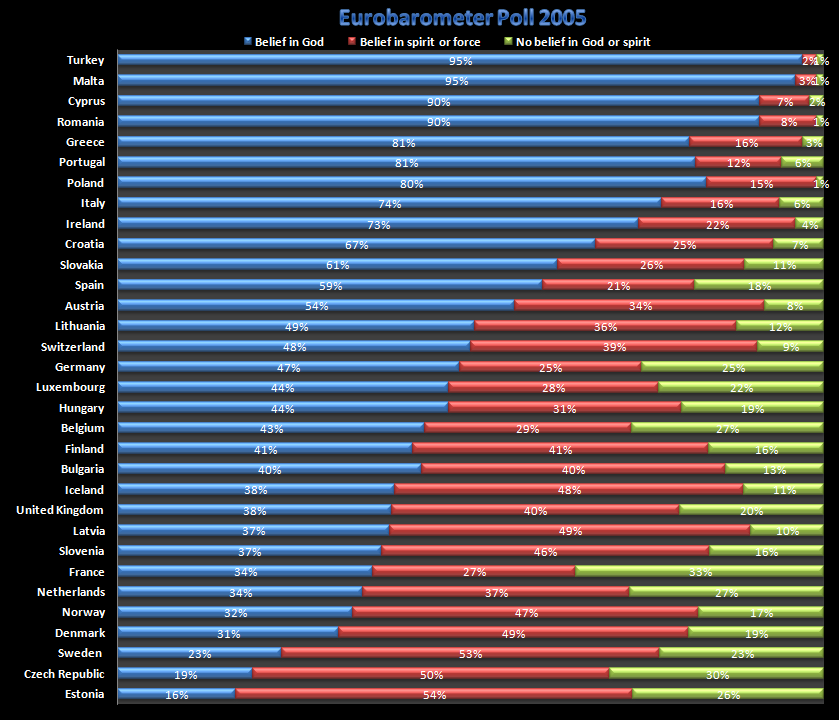
Currently, distribution of theism in Europe is very heterogeneous, with more than 95% in Poland, and less than 20% in the Czech Republic and Estonia. The 2005 Eurobarometer poll found that 52% of EU citizens believe in God. According to a Pew Research Center Survey in 2012 the Religiously Unaffiliated (Atheists and Agnostics) make up about 18.2% of the European population in 2010. According to the same Survey the Religiously Unaffiliated make up the majority of the population in only two European countries: Czech Republic (76%) and Estonia (60%).
Pan-European identity
Main article: Pan-European identity
"Pan-European identity" or "Europatriotism" is an emerging sense of personal identification with Europe, or the European Union as a result of the gradual process of European integration taking place over the last quarter of the 20th century, and especially in the period after the end of the Cold War, since the 1990s. The foundation of the OSCE following the 1990s Paris Charter has facilitated this process on a political level during the 1990s and 2000s.
From the later 20th century, 'Europe' has come to be widely used as a synonym for the European Union even though there are millions of people living on the European continent in non-EU member states. The prefix pan implies that the identity applies throughout Europe, and especially in an EU context, and 'pan-European' is often contrasted with national identity.
European ethnic groups by sovereign state
| Country | Majority | % | Regional majorities | Minorities | |||
|---|---|---|---|---|---|---|---|
| Albania Albania | Albanians | 97% | Greeks ≈3%, and other 2% (Aromanians, Romani, Macedonians, Montenegrins, Bulgarians, Bosniaks, Jews and Serbs). | ||||
| Armenia Armenia | Armenians | 98.1% | Russians, Yazidis, Assyrians, Kurds, Greeks, Jews, Loms, Ukrainians and Poles. | ||||
| Austria Austria | Austrians | 92% | |||||
| Azerbaijan Azerbaijan | Azerbaijanis | 91.6% | Lezgin 2%, Armenians 1.35% | Russians, Tats, Talysh, Kurds, Avars, Turks, and Tatars. | |||
| Belarus Belarus | Belarusians | 83.7% | Russians 8.3%, Poles 3.1%, Ukrainians 1.7%, and other 3.2%. (2009 census) | ||||
| Belgium Belgium | Flemings | 58% | Walloons 31%, Germans 1% | mixed or other (i.e. Luxembourgers, Eastern Europeans or Southern Europeans, Africans and Asians, and Latin Americans) 10%. | |||
| Bosnia Bosnia and Herzegovina | Bosniaks | 50.1% | Serbs 30.8%, Croats 15.4% | Albanians, Macedonians, Roma and Turks (2013 census) | |||
| Bulgaria Bulgaria | Bulgarians | 84% | Turks 8.8% | Roma 5%, Others 2% (including Russian, Armenian, Crimean Tatars, Sarakatsani, and "Vlach" [Romanians and Aromanians]). (2001 census) | |||
| Croatia Croatia | Croats | 91.6% | Serbs 3.2%, other 5.2% (including Bosniaks, Roma, Albanians, Italians, Hungarians and others). (2021 census) | ||||
| Czech Republic Czech Republic | Czechs | 90.4% | Moravians 3.7% | Slovaks 1.9%, and other 4%. (including Bulgarians, Croats, Germans, Poles, Roma and Vietnamese). (2001 census) | |||
| Denmark Denmark | Danes | 90% | Faroese, Greenlanders | other Scandinavians, Germans, Frisians, other European, Indigenous Greenlandic people and others. | |||
| Estonia Estonia | Estonians | 68.8% | Russians 24.2% , Ukrainians 2.0%, Belarusians 0.8%, Finns 0.6%. | ||||
| Finland Finland | Finns | 93.4% | Finland-Swedes 5.6%, Sami 0.1% | Russians 1.1%, Estonians 0.7%, Romani 0.1% and Latvians 0.5%. (2019) also Somalis, Germans, Macedonians and Iranians | |||
| Georgia Georgia | Georgians | 86.8% | Russians, Azerbaijanis, Kurds, Tats, Armenians, Ukrainians, Greeks, Ossetians | ||||
| Greece Greece | Greeks | 93% | includes linguistic minorities 3% | Albanians 4% and other (i.e. Aromanians, Megleno-Romanians, Cretan Turks and Macedonian/Greek Slavic 3%. (2001 census) | |||
| Hungary Hungary | Hungarians | 92.3% | Romani 1.9%, Germans 1.2%, other (i.e. Croats, Romanians, Bulgarians, Turks and Rusyns) or unknown 4.6%. (2001 census) | ||||
| Iceland Iceland | Icelanders | 91% | other (non-native/immigrants – mainly Polish, Lithuanians, Danes, Germans and Latvians) 9%. | ||||
| Ireland Ireland | Irish | 87.4% | Ulster Scots and Irish Travellers 1.6% | other white (large numbers of Lithuanian, Latvian, Polish and Ukrainian migration) 7.5%, Asian 1.3%, black 1.1%, mixed 1.1%. (2006 census) | |||
| Italy Italy | Italians | 91.7% | South Tyroleans in South Tyrol (South Tyroleans and Ladins), Franco-Provençal in Aosta Valley and (northwestern Apulia) | Historical ethno-linguistic minorities (Sardinian, French, Occitan, Arpitan, Croatian, Albanian, Catalan, Austrian, Greek, Ladin, Friulian, Slovene and Roma minorities), regional language native speakers (Gallo-Italic, Venetian, Neapolitan, Sicilian), other Europeans (mostly Romanians, Albanians, Ukrainians and Polish) 4%, North Africans 1% and others (i.e. Chinese, Filipino, Indian, Black African and Latin American) 2.5%. | |||
| Kazakhstan Kazakhstan | Kazakhs | 63.1% | Russians 23.7% | Uzbeks, Ukrainians, Uyghurs, Tatars, Kyrgyz, Tajiks, Germans, Poles and Koreans. | |||
| Kosovo Kosovo | Albanians | 92% | Serbs 4% | other 4% (Bosniaks, Gorani, Croats, Jews, Romani, Turks and Ashkali and Egyptians). | |||
| Latvia Latvia | Latvians | 62.1% | Livonians 0.1% | Russians 26.9%, Belarusian 3.3%, Ukrainian 2.2%, Polish 2.2%, Lithuanian 1.2%, and other 2.0%. (2011) | |||
| Lithuania Lithuania | Lithuanians | 84.61% | Poles 6.53% | Russians 5.02%, Belarusians 1.00%, Ukrainians 0.50%, other 2.34% (2021 census) | |||
| Malta Malta | Maltese | 95.3% | |||||
| Moldova Moldova | Moldovans | 75.1% | Gagauzs 4.6%, Bulgarians 1.9% | Romanians 7%, Ukrainians 6.6%, Russians 4.1%, and other 0.8% (2014 census). | |||
| Montenegro Montenegro | Montenegrins | 41.1% | Serbs 32.9% | Bosniaks 9.5%, Albanians 5%, and other (Croats, Russians (2.1%). (2023 census) | |||
| Netherlands Netherlands | Dutch | 72.8% | Frisians 2.6% | Turks 2.4%, Moroccans 2.4%, Surinamese 2.1%, Indonesians 2% | |||
| North Macedonia North Macedonia | Macedonians | 64% | Albanians 25.2%, Turks 4% | Romani 2.7%, Serbs 1.8%, and other (i.e. Aromanians, Greeks, Bulgarians, Megleno-Romanians, Gorani, and Croats) 2.2%. (2002 census) | |||
| Norway Norway | Norwegians | 85–87% | Sami 0.7% Kvens 0.2% | Poles 2.10%. A variety of other ethnicities with background from 219 countries that together make up approximately 15% (Swedes, Danes, Somalis, Syrians, Kurds, Vietnamese, Germans, Lithuanians, Russians and different South Asian ethnicities) (2020). | |||
| Poland Poland | Poles | 98.59% | Silesians 0.6%, Kashubians 0.04%, Lemkos 0.02% | Ukrainians 0.17%, Belarusians 0.11%, and Germans 0.11%, along with Romani, Lithuanians, Russians, Jews, Slovaks, Vietnamese, Czechs | |||
| Portugal Portugal | Portuguese | 95% | Portuguese Mirandese speakers 15.000~ (i.e. Mirandese-language speakers) | other 5% – other Europeans (British, German, French, Spanish, Romanians, Bulgarians, Hungarians, Croats, Ukrainians, Moldavians, Russians, Serbs, Kosovars and Albanians); Africans from Portuguese-speaking Africa, Brazilians, Chinese, Indians, Jews, Portuguese Gypsies and Latin Americans. | |||
| Romania Romania | Romanians | 83.4% | Hungarians 6.1% | Romani 3.0%, Germans 0.2%, Ukrainians 0.2%, Turks 0.2%, Russians 0.1% (2011 census) | |||
| Russia Russia | Russians | 81% | Tatars 3.9%, Chuvashes 1%, Chechens 1%, Ossetians 0.4%, Kabardin 0.4%, Ingushes 0.3%, Kalmyks 0.1% | Ukrainians 1.4%, Bashkir 1.2%, Armenians 0.9%, Avars 0.7%, Mordvins 0.5% and other. (2010 census, includes Asian Russia, excludes unspecified people (3.94% of population)). | |||
| Serbia Serbia | Serbs | 80.6% | Hungarians 2.7%, Bosniaks 2.3%, Roma 2%, Albanians 0.9%, Slovaks 0.6%, Croats 0.6%, Yugoslavs 0.4%, Romanians 0.3%, Vlachs 0.3%, Montenegrins 0.3%, Macedonians 0.2%, Bulgarians 0.2%, Rusyns 0.1% (2022 census). | ||||
| Slovakia Slovakia | Slovaks | 86% | Hungarians 9.7% | Romani 1.7%, Rusyn/Ukrainian 1%, other and unspecified 1.8% (2001 census) | |||
| Slovenia Slovenia | Slovenes | 83.1% | Serbs 2%, Croats 1.8%, Bosniaks 1.1%, other (Dalmatian Italians, ethnic Germans, Hungarians and Romanians) and/or unspecified 12% (2002 census). | ||||
| Sweden Sweden | Swedes | 88% | Finns (Tornedalians) | foreign-born or first-generation immigrants: Finns (Sweden-Finns), Yugoslavs (Serbs, Croats, and Bosniaks), Danes, Norwegians, Russians, Syrians, Lebanese, Syriacs, Greeks, Turks, Iranians, Iraqis, Pakistanis, Thais, Koreans, and Chileans. | |||
| Switzerland | Swiss Germans | title=Statistical information about Switzerland | url=https://www.about.ch/statistics/index.html | access-date=2022-09-29 | website=www.about.ch}} | French 18%, Italians 10% | Romansh people in Grisons |
| Turkey Turkey | Turks | 75% | Kurds 18% | Other 7%: Albanians, Syrians, Armenians (including Hemshin), Assyrians, Azerbaijanis, Bosniaks, Bulgarians (including Pomaks), Chechens, Circassians, Crimean Tatars, Georgians (including Laz), Greeks, Romani, Ossetians and Zaza. | |||
| Ukraine Ukraine | Ukrainians | 77.8% | Russians 17.3% | Belarusians 0.6%, Moldovans 0.5%, Crimean Tatars 0.5%, Bulgarians 0.4%, Hungarians 0.3%, Romanians 0.3%, Poles 0.3%, Jews 0.2%, Armenians 0.1%, Urums 0.1% and other 1.8% (2001 census). |
Notes
References
Bibliography
- {{citation|title=Ethnic Groups and Population Changes in Twentieth-century Central Eastern Europe|first1=Piotr|last1=Eberhardt
- {{citation|last=Gresham|first=D.|year=2001|title=Origins and divergence of the Roma (Gypsies)|journal=American Journal of Human Genetics
- {{citation|title=European Identity: Theoretical Perspectives and Empirical Insights|first1=Ireneusz Pawel|last1=Karolewski|first2=Viktoria|last2= Kaina
- Full text on google books
- {{citation|title=Culture and National Identity: "the East" and European Integration|first=David D.|last=Laitin|publisher=Robert Schuman Centre
- Online version
- part I: Europe, pp. 1–100.
- {{citation|title=One Europe, many nations: a historical dictionary of European national groups| first=James|last= Minahan|publisher=Greenwood Publishing Group|year= 2000|isbn=978-0-313-30984-7}}
- Panikos Panayi, Outsiders: A History of European Minorities (London: Hambledon Press, 1999)
- {{citation|title=An Ethnohistorical Dictionary of the Russian and Soviet Empire|first1=James Stuart|last1=Olson|first2=Lee Brigance |last2=Pappas
- {{citation|title=An Ethnic History of Europe Since 1945: Nations, States and Minorities|first=Panikos|last=Panayi
- {{citation|title=On European Identity: Nationalism, Culture & History|first=Csaba |last=Szaló|year=1998|publisher=Masaryk University
- {{citation|title=Understanding European Integration: History, Culture, and Politics of Identity|first=R. Pavananthi|last=Vembulu|year=2003
References
- Pan and Pfeil (2004), "Problems with Terminology", pp. xvii–xx.
- (2002). "Minderheitenrechte in Europa". Braumüller.
- (1993–2002). "Russische Federatie – feiten en cijfers". Microsoft Corporation/Het Spectrum.
- "Non-EU citizens make up 5.3% of the EU population".
- Total population of Yiddish estimated at 1.5 million as of 1991, of which c. 40% in Ukraine. {{e18. yid. Yiddish, {{e18. ydd. Eastern Yiddish, {{e18. yih. Western Yiddish
- (8 May 2014). "Population Genomic Analysis of Ancient and Modern Genomes Yields New Insights into the Genetic Ancestry of the Tyrolean Iceman and the Genetic Structure of Europe". PLOS Genetics.
- Günther, Torsten. (2015). "Ancient genomes link early farmers from Atapuerca in Spain to modern-day Basques". Proceedings of the National Academy of Sciences.
- (10 February 2015). "Massive migration from the steppe is a source for Indo-European languages in Europe". Nature.
- (7 June 2015). "Population genomics of Bronze Age Eurasia". Nature.
- (14 March 2015). "Eight thousand years of natural selection in Europe".
- Richard, Lewis. (24 August 2001). ["Finland, Cultural Lone Wolf"](https://books.google.com/books?id=K1elm0fRlfsC&q=%22early+indigenous&pg=PA13}}{{cite journal). Intercultural Press.
- (2016). "Genomic insights into the origin of farming in the ancient Near East". Nature.
- Phillips, Fr Andrew. "The Last Christians Of North-West Africa: Some Lessons For Orthodox Today".
- Hensel, Gottfried. (12 December 2017). "Synopsis vniversæ philologiæ in qua miranda vnitas et harmonia lingvarvm: Totivs orbis terrarvm occvlta, e literarvm, syllabarvm, vocvmqve natvra & recessibvs ervitvr; cum grammatica ... mappisqve geographico-polyglottis ...". In commissis apvd heredes Homannianos.
- Karl Friedrich Vollgraff, ''Erster Versuch einer Begründung sowohl der allgemeinen Ethnologie durch die Anthropologie, wie auch der Staats und Rechts-philosophie durch die Ethnologie oder Nationalität der Völker'' (1851), p. 257.
- A. Kumar, ''Encyclopaedia of Teaching of Geography'' (2002), p. 74 ff.; the tripartite subdivision of "Caucasians" into Nordic, Alpine and Mediterranean groups persisted among some scientists into the 1960s, notably in Carleton Coon's book ''[[The Origin of Races]]'' (1962).
- Andrew Barry, ''Political Machines'' (2001), p. 56
- Measuring European Population Stratification using Microarray Genotype Data, [http://vetinari.sitesled.com/euroaims.pdf Sitesled.com] {{webarchive. link. (18 December 2008)
- "DNA heritage".
- Dupanloup, Isabelle. (2004). "Estimating the Impact of Prehistoric Admixture on the Genome of Europeans". Molecular Biology and Evolution.
- (24 November 2022). "Majorities, Minorities, and the Future of Nationhood". Cambridge University Press.
- Marjorie Mandelstam Balzer, ''The Tenacity of Ethnicity: A Siberian Saga in Global Perspective'' ([[Princeton University Press]], 1999; {{ISBN. 0-691-00673-3), p. 238, n. 8.
- Official is attached to: Decree of the Russian Government Nr 255 "On the Unified Register of Indigenous Small-Numbered Peoples of the Russian Federation", 24 March 2000 (''Постановление Правительства РФ от 24 марта 2000 г. N 255 "О Едином перечне коренных малочисленных народов Российской Федерации'' {{in lang. ru) http://base.garant.ru/181870.htm
- "International Circassian Association".
- Illarionov, A.. (2014). "The ethnic composition of Crimea during three centuries". Institute of Economical Analysis.
- Humeniuk, Natalia. "Самоповернення в Крим". [[Ukrainska Pravda]].
- (21 March 2013). "Sami Parliamentary Council". Suingtheqevil.blogspot.ru.
- (2003). ""Lapps, Finns, Gypsies, Jews, and idiots"? Modernity and the use of statistical categories in Sweden". Annales de démographie historique.
- Last, John. (27 November 2021). "Church of Sweden apologizes, embarks on reconciliation with Indigenous Sámi people". CBC News.
- (1997). "The Utilization of Instructional Technology in Turkey". [[Springer Publishing.
- (2010). "52% of Europeans say no to Turkey's EU membership". [[Aysor]].
- Pashayan, Araks. (2012). "European Muslims, Civility and Public Life: Perspectives On and From the Gülen Movement". [[Continuum International Publishing Group]].
- Home Affairs Committee. (2011). "Implications for the Justice and Home Affairs area of the accession of Turkey to the European Union". The Stationery Office.
- [[The Guardian]]. (1 August 2011). "UK immigration analysis needed on Turkish legal migration, say MPs".
- [[Andreas Mölzer. "In Österreich leben geschätzte 500.000 Türken, aber kaum mehr als 10–12.000 Slowenen".
- Sayıner, Arda. (2018). "Ankara Historia". [[Daily Sabah]].
- (2017). "Türken in der Schweiz – Zahlen und Fakten zur Diaspora vom Bosporus". [[Aargauer Zeitung]].
- Larsen, Nick Aagaard. (2008). "Tyrkisk afstand fra Islamisk Trossamfund". [[DR (broadcaster).
- Dursun-Özkanca, Oya. (2019). "Turkey–West Relations: The Politics of Intra-alliance Opposition". [[Cambridge University Press]].
- Al Jazeera. (2014). "Ahıska Türklerinin 70 yıllık sürgünü". Al Jazeera.
- link. (26 February 2015)
- {{harvnb. Tubb. 1998
- Ann E. Killebrew, [https://books.google.com/books?id=VtAmmwapfVAC Biblical Peoples and Ethnicity. An Archaeological Study of Egyptians, Canaanites, Philistines and Early Israel 1300-1100 B.C.E. (Archaeology and Biblical Studies)], [[Society of Biblical Literature]], 2005
- Schama, Simon. (18 March 2014). "The Story of the Jews: Finding the Words 1000 BC-1492 AD". HarperCollins.
- "Hebrew, any member of an ancient northern Semitic people that were the ancestors of the Jews." [https://www.britannica.com/EBchecked/topic/259033/Hebrew Hebrew (People)] at [https://www.britannica.com/ Encyclopædia Britannica]
- Ostrer, Harry. (19 April 2012). "Legacy: A Genetic History of the Jewish People". Oxford University Press, USA.
- Brenner, Michael. (13 June 2010). "A Short History of the Jews". Princeton University Press.
- Scheindlin, Raymond P.. (1998). "A Short History of the Jewish People: From Legendary Times to Modern Statehood". Oxford University Press.
- Adams, Hannah. (1840). "The History of the Jews: From the Destruction of Jerusalem to the Present Time". Sold at the London Society House and by Duncan and Malcom, and Wertheim.
- Diamond, Jared. (1993). "Who are the Jews?".
- (2000). "Jewish and Middle Eastern non-Jewish populations share a common pool of Y-chromosome biallelic haplotypes". Proceedings of the National Academy of Sciences.
- Wade, Nicholas. (9 May 2000). "Y Chromosome Bears Witness to Story of the Jewish Diaspora". The New York Times.
- (2013). "No Evidence from Genome-Wide Data of a Khazar Origin for the Ashkenazi Jews". Human Biology Open Access Pre-Prints.
- (8 October 2013). "A substantial prehistoric European ancestry amongst Ashkenazi maternal lineages". Nature Communications.
- (2013). "Ancient human genomes suggest three ancestral populations for present-day Europeans". Nature.
- Gregory Cochran, Henry Harpending, [https://books.google.com/books?id=VrpUh0rRYvsC&pg=PA187 ''The 10,000 Year Explosion: How Civilization Accelerated Human Evolution''], Basic Books, 2009 pp. 195–196.
- Moses ben Machir, in ''Seder Ha-Yom'', p. 15a, Venice 1605 (Hebrew)
- Josephus Flavius, ''Antiquities'', xi.v.2
- Nyheter, S. V. T.. (May 9, 2018). "Statministerns folkmordsbesked kan avgöra kommunvalet: "Underskatta inte frågan"".
- (14 July 2012). "Petition for expatriate voting officially launched". [[The Daily Star (Lebanon).
- Sachs, Susan. (5 February 2007). "France's blacks stand up to be counted".
- (28 June 2007). "Latin American Immigration to Southern Europe".
- [http://news.bbc.co.uk/2/shared/spl/hi/uk/05/born_abroad/countries/html/overview.stm Born Abroad – Countries of birth], BBC News
- (14 September 2020). "Comunidade Brasileira no Exterior - Estimativas referentes ao ano de 2020". [[Ministry of External Relations (Brazil).
- "Brasiliani in Italia - statistiche e distribuzione per regione".
- "Población extranjera por Nacionalidad, comunidades, Sexo y Año.".
- "Archived copy".
- (2001). "Genetic studies of the Roma (Gypsies): a review". BMC Med. Genet..
- {{lang. la. Ab Hisitione autem ortae sunt quattuor gentes Franci, Latini, Albani et Britti. ab Armenone autem quinque: Gothi, Valagothi, Gebidi, Burgundi, Longobardi. a Neguio vero quattuor Boguarii, Vandali, Saxones et Turingi. Nennius (1848) [8th century]. [http://www.fordham.edu/halsall/basis/nennius-full.html ''Historia Brittonum'']. Translated by J. A. Giles. London: Henry G. Bohn. {{Webarchive. link. (2009-07-27 .)
- Cf. Berting (2006:51).
- Cederman (2001:2) remarks: "Given the absence of an explicit legal definition and the plethora of competing identities, it is indeed hard to avoid the conclusion that Europe is an essentially contested concept." Cf. also Davies (1996:15); Berting (2006:51).
- Cf. Jordan-Bychkov (2008:13), Davies (1996:15), Berting (2006:51–56).
- K. Bochmann (1990) ''L'idée d'Europe jusqu'au XXè siècle'', quoted in Berting (2006:52). Cf. Davies (1996:15): "No two lists of the main constituents of European civilization would ever coincide. But many items have always featured prominently: from the roots of the Christian world in Greece, Rome and Judaism to modern phenomena such as the Enlightenment, modernization, romanticism, nationalism, liberalism, imperialism, totalitarianism."
- {{harvnb. Berting. 2006
- {{harvnb. Berting. 2006
- Duran (1995:81)
- (2009). "The World Factbook: Field listing – Location". [[Central Intelligence Agency]].
- "Prebivalstvo in katoličani v Sloveniji (page 72)". katoliska-cerkev.si.
- "Population by religious community indicated, municipalities (2021)". [[Statistics Lithuania]].
- Iannaccaro, Gabriele. (2011). "Sociolinguistica: language and Religion".
- Peter Beyer, ''Religions in Global Society'', 2006, page 146
- Cambridge University Historical Series, ''An Essay on Western Civilization in Its Economic Aspects'', p. 40: Hebraism, like Hellenism, has been an all-important factor in the development of Western Civilization; Judaism, as the precursor of Christianity, has indirectly had had much to do with shaping the ideals and morality of western nations since the christian era.
- Caltron J.H. Hayas, ''Christianity and Western Civilization'' (1953), Stanford University Press, p. 2: That certain distinctive features of our Western civilization — the civilization of western Europe and of America— have been shaped chiefly by Judaeo – Graeco – Christianity, Catholic and Protestant.
- Horst Hutter, University of New York, ''Shaping the Future: Nietzsche's New Regime of the Soul And Its Ascetic Practices'' (2004), p. 111: three mighty founders of Western culture, namely Socrates, Jesus, and Plato.
- Fred Reinhard Dallmayr, ''Dialogue Among Civilizations: Some Exemplary Voices'' (2004), p. 22: Western civilization is also sometimes described as "Christian" or "Judaeo- Christian" civilization.
- Dawson, Christopher. (1961). "Crisis in Western Education". CUA Press.
- Koch, Carl. (1994). "The Catholic Church: Journey, Wisdom, and Mission". St. Mary's Press.
- Dawson, Christopher. (1961). "Crisis in Western Education". CUA Press.
- Dawson, Christopher. (1961). "Crisis in Western Education". CUA Press.
- (19 December 2011). "Regional Distribution of Christians".
- (2011). "Global Christianity: A Report on the Size and Distribution of the World's Christian Population". [[Pew Research Center]].
- (2012). "Discrimination in the EU in 2012". [[European Commission]].
- (19 December 2011). "Global Christianity – A Report on the Size and Distribution of the World's Christian Population".
- (2019). "Yearbook of International Religious Demography 2017". BRILL.
- (2017). "African Perspectives on Culture and World Christianity". Cambridge Scholars Publishing.
- (27 January 2011). "The Future of the Global Muslim Population".
- (27 January 2011). "Table: Muslim Population by Country".
- (8 May 2007). "In Europa leben gegenwärtig knapp 53 Millionen Muslime".
- Lipka, Michael. (9 February 2015). "The continuing decline of Europe's Jewish population".
- (December 18, 2012). "Jews".
- "EC.Europa.eu".
- (18 December 2012). "Religiously Unaffiliated". Pew Research Center's Religion & Public Life Project.
- This is particularly the case among proponents of the so-called [[confederation. confederalist]] or [[neofunctionalism. neo-functionalist]] position on European integration. Eder and Spohn (2005:3) note: "The evolutionary thesis of the making of a European identity often goes with the assumption of a simultaneous decline of national identities. This substitution thesis reiterates the well-known confederalist/neo-functionalist position in the debate on European integration, arguing for an increasing replacement of the nation-state by European institutions, against the intergovernmentalist/realist position, insisting on the continuing primacy of the nation-state."
- "Wayback Machine".
- (9 October 2017). "Population: Demographic Situation, Languages and Religions".
- 0-14-028899-6
- "CIA Factbook 2010".
- "Census 2001, Population by Districts and Ethnic Groups as of 01.03.2001". Nsi.bg.
- {{Croatian Census 2021
- Persons of Danish origin: 4 985 415. Total population: 5 511 451 [http://www.dst.dk/HomeUK/Statistics/focus_on/focus_on_show.aspx?sci=565 Statistics Denmark]
- https://www.un.org/depts/DGACM/RegionalGroups.shtml United Nations Regional Eastern European Group
- "Background – Hagstofa".
- "Legge 482".
- Refugees, United Nations High Commissioner for. "Refworld – World Directory of Minorities and Indigenous Peoples – Italy".
- (15 April 2011). "Endangered languages: the full list".
- (30 November 2014). "Indicatori demografici".
- "Cittadini Non Comunitari Regolarmente Soggiornanti: Anni 2013–2014".
- "Cittadini Stranieri. Popolazione residente per sesso e cittadinanza al 31 Dicembre 2012 Italia – Tutti i Paesi".
- link. 24 Chasa
- (18 January 2012). "On key provisional results of Population and Housing Census 2011 | Latvijas statistika". Csb.gov.lv.
- "Malta: general data".
- "Focus on Sámi in Norway".
- regionaldepartementet, Kommunal- og. (8 December 2000). "St.meld. nr. 15 (2000–2001)".
- [http://www.ssb.no/emner/02/01/10/innvbef/tab-2012-04-26-04.html Personer med innvandringsbakgrunn, etter innvandringskategori, landbakgrunn og kjønn. 1. januar 2012] ( {{webarchive. link. (18 September 2012 SSB (Statistics Norway), Retrieved 6 November 2012)
- GUS. "Tablice z ostatecznymi danymi w zakresie przynależności narodowo-etnicznej, języka używanego w domu oraz przynależności do wyznania religijnego".
- "Официальный сайт Всероссийской переписи населения 2010 года. Информационные материалы об окончательных итогах Всероссийской переписи населения 2010 года".
- "Всероссийская перепись населения 2010. Национальный состав населения РФ 2010".
- "SCB.se".
- "SCB.se".
- "Statistical information about Switzerland".
This article was imported from Wikipedia and is available under the Creative Commons Attribution-ShareAlike 4.0 License. Content has been adapted to SurfDoc format. Original contributors can be found on the article history page.
Ask Mako anything about Ethnic groups in Europe — get instant answers, deeper analysis, and related topics.
Research with MakoFree with your Surf account
Create a free account to save articles, ask Mako questions, and organize your research.
Sign up freeThis content may have been generated or modified by AI. CloudSurf Software LLC is not responsible for the accuracy, completeness, or reliability of AI-generated content. Always verify important information from primary sources.
Report