From Surf Wiki (app.surf) — the open knowledge base
Ethanol fuel in the United States
none

none
Main article: Biofuel in the United States, Ethanol fuel
]]

.png)

The United States became the world's largest producer of ethanol fuel in 2005. The U.S. produced 15.8 billion U.S. liquid gallons of ethanol fuel in 2019, up from 13.9 billion gallons (52.6 billion liters) in 2011, and from 1.62 billion gallons in 2000. The U.S. government subsidizes ethanol production.
The ethanol market share in the U.S. gasoline supply grew by volume from just over 1 percent in 2000 to more than 3 percent in 2006 to 10 percent in 2011. Domestic production capacity increased fifteen times after 1990, from 900 million US gallons to 1.63 billion US gal in 2000, to 13.5 billion US gallons in 2010. The Renewable Fuels Association reported 209 ethanol distilleries in operation located in 29 states in 2011.
By 2012 most cars on U.S. roads could run on blends of up to 10% ethanol(E10), and manufacturers had begun producing vehicles designed for much higher percentages. However, the fuel systems of cars, trucks, and motorcycles sold before the ethanol mandate may suffer substantial damage from the use of 10% ethanol blends. Flexible-fuel cars, trucks, and minivans use gasoline/ethanol blends ranging from pure gasoline up to 85% ethanol (E85). By early 2013 there were around 11 million E85-capable vehicles on U.S. roads. Regular use of E85 is low due to lack of fueling infrastructure, but is common in the Midwest. In January 2011 the U.S. Environmental Protection Agency (EPA) granted a waiver to allow up to 15% of ethanol blended with gasoline (E15) to be sold only for cars and light pickup trucks with a model year of 2001 or later. The EPA waiver authorizes, but does not require stations to offer E15. Like the limitations suffered by sales of E85, commercialization of E15 is constrained by the lack of infrastructure as most fuel stations do not have enough pumps to offer the new E15 blend, few existing pumps are certified to dispense E15, and no dedicated tanks are readily available to store E15.
Historically most U.S. ethanol has come from corn, and the required electricity for many distilleries came mainly from coal. There is a debate about ethanol's sustainability and environmental impact. The primary issues related to the large amount of arable land required for crops and ethanol production's impact on grain supply, indirect land use change (ILUC) effects, as well as issues regarding its energy balance and carbon intensity considering its full life cycle.
History

In 1826 Samuel Morey experimented with an internal combustion chemical mixture that used ethanol (combined with turpentine and ambient air then vaporized) as fuel. At the time, his discovery was overlooked, mostly due to the success of steam power. Ethanol fuel received little attention until 1860 when Nicholas Otto began experimenting with internal combustion engines. In 1859, oil was found in Pennsylvania, which decades later provided a new kind of fuel. Popular fuels in the U.S. before petroleum were a purified form of spirits of turpentine called camphene, and a blend of turpentine and alcohol known as burning fluid. The discovery of a ready supply of oil and Civil War taxation on burning fluid made kerosene a more popular fuel.
In 1896, Henry Ford designed his first car, the "Quadricycle" to run on pure ethanol. In 1908, the revolutionary Ford Model T was capable of running on gasoline, ethanol or a combination. Ford continued to advocate for ethanol fuel even during the prohibition, but lower prices caused gasoline to prevail.

Gasoline containing up to 10% ethanol began a decades-long growth in the United States in the late 1970s. The demand for ethanol produced from field corn was spurred by the discovery that methyl tertiary butyl ether (MTBE) was contaminating groundwater. MTBE's use as an oxygenate additive was widespread due to mandates in the Clean Air Act amendments of 1992 to reduce carbon monoxide emissions. MTBE in gasoline had been banned in almost 20 states by 2006. Suppliers were concerned about potential litigation and a 2005 court decision denying legal protection for MTBE. MTBE's fall from grace opened a new market for ethanol, its primary substitute. Corn prices at the time were around US$2 a bushel. Farmers saw a new market and increased production. This demand shift took place at a time when oil prices were rising.
The steep growth in twenty-first century ethanol consumption was driven by federal legislation aimed to reduce oil consumption and enhance energy security. The Energy Policy Act of 2005 required use of 7500000000 USgal of renewable fuel by 2012, and the Energy Independence and Security Act of 2007 raised the standard, to 36000000000 USgal of annual renewable fuel use by 2022. Of this requirement, 21000000000 USgal had to be advanced biofuels, defined as renewable fuels that reduce greenhouse gas emissions by at least 50%.
Recent trends
| U.S. fuel ethanol | |||||||
|---|---|---|---|---|---|---|---|
| production and imports | |||||||
| (2000–2011) | |||||||
| (Millions of U.S. liquid gallons) | Year | Production | Imports | Demand | |||
| 2000 | 1,630 | n/a | n/a | ||||
| 2001 | 1,770 | n/a | n/a | ||||
| 2002 | 2,130 | 46 | 2,085 | ||||
| 2003 | 2,800 | 61 | 2,900 | ||||
| 2004 | 3,400 | 161 | 3,530 | ||||
| 2005 | 3,904 | 135 | 4,049 | ||||
| 2006 | 4,855 | 653 | 5,377 | ||||
| 2007 | 6,500 | 450 | 6,847 | ||||
| 2008 | 9,000 | 556 | 9,637 | ||||
| 2009 | 10,600 | 193 | 10,940 | ||||
| 2010 | 13,298 | 10 | 13,184 | ||||
| 2011 | 13,929 | 160 | n/a(1) | ||||
| 2012 | 13,218 | ||||||
| 2013 | 13,293 | ||||||
| 2014 | 14,313 | ||||||
| 2015 | 14,807 | ||||||
| 2016 | 15,413 | ||||||
| 2017 | 15,936 | ||||||
| 2018 | 16,091 | ||||||
| 2019 | 15,776 | ||||||
| Note: Demand figures includes stocks change and | |||||||
| small exports in 2005. | |||||||
| (1) Exports in 2011 reached a record 1,100 billion gal. | |||||||
| [[File:Ethanol production and imports in the US.svg | thumb | 250px | Graph of monthly production and net imports of fuel ethanol in the U.S. 1993–2012. Data from [http://www.eia.gov/totalenergy/data/monthly/#renewable EIA]]] |
The world's top ethanol fuel producer in 2010 was the United States with 13.2 billion U.S. gallons (49.95 billion liters) representing 57.5% of global production, followed by Brazil with 6.92 billion U.S. gallons (26.19 billion liters), and together both countries accounted for 88% of the world production of 22.95 billion U.S. gallons (86.85 billion liters). By December 2010 the U.S. ethanol production industry consisted of 204 plants operating in 29 states, and 9 plants under construction or expansion, adding 560 million gallons of new capacity and bringing total U.S. installed capacity to 14.6 billion U.S. gallons (55.25 billion liters). At the end of 2010 over 90 percent of all gasoline sold in the U.S. was blended with ethanol.
Production

Beginning in late 2008 and early 2009, the industry came under financial stress due to that year's economic crisis. Motorists drove less and gasoline prices dropped sharply, while bank financing shrank. As a result, some plants operated below capacity, several firms closed plants, others laid off staff, some firms went bankrupt, plant projects were suspended and market prices declined.
As of 2011, most of the U.S. car fleet was able to run on blends of up to 10% ethanol, and motor vehicle manufacturers produced vehicles designed to run on more concentrated blends. As of 2015, seven states – Missouri, Minnesota, Louisiana, Montana, Oregon, Pennsylvania, and Washington – required ethanol to be blended with gasoline in motor fuels. These states, particularly Minnesota, had more ethanol usage, and according to a source at Washington University, these states accumulated substantial environmental and economic benefits as a result. Florida required ethanol blends as of the end of 2010, but has since repealed it. Many cities had separate ethanol requirements due to non-attainment of federal air quality standards. In 2007, Portland, Oregon, became the first U.S. city to require all gasoline sold within city limits to contain at least 10% ethanol. Chicago has proposed the idea of mandating E15 in the city limits, while some area gas stations have already begun offering it.
Expanding ethanol (and biodiesel) industries provided jobs in plant construction, operations, and maintenance, mostly in rural communities. According to RFA the ethanol industry created almost 154,000 U.S. jobs in 2005, boosting household income by $5.7 billion. It also contributed about $3.5 billion in federal, state and local tax revenues.
E85 vehicles


Ford, Chrysler, and GM are among many automobile companies that sell flexible-fuel vehicles that can run blends ranging from pure gasoline to 85% ethanol (E85), and beginning in 2008 almost any type of automobile and light duty vehicle was available with the flex-fuel option, including sedans, vans, SUVs and pickup trucks. By early 2013, about 11 million E85 flex-fuel cars and light trucks were in operation,
As of 2005, 68% of American flex-fuel car owners were not aware they owned an E85 flex. Flex and non-flex vehicles looked the same. There was no price difference. American automakers did not label these vehicles. In contrast, all Brazilian automakers clearly labeled FFVs with text that was some variant of the word Flex. Beginning in 2007 many new FFV models in the U.S. featured a yellow gas cap to remind drivers of the E85 capabilities. As of 2008, GM badged its vehicles with the text "Flexfuel/E85 Ethanol". Nevertheless, the U.S. Department of Energy (DOE) estimated that in 2009 only 504,297 flex-fuel vehicles were regularly fueled with E85, and these were primarily fleet-operated vehicles. As a result, only 712 million gallons were used for E85, representing just 1% of that year's ethanol consumption.
During the decade following 2000, E85 vehicles became increasingly common in the Midwest, where corn was a major crop.
Fueling infrastructure has been a major restriction hampering E85 sales. , there were 3,028 fueling stations selling E85 in the U.S. Most stations were in the Corn Belt states. As of 2008 the leading state was Minnesota with 353 stations, followed by Illinois with 181, and Wisconsin with 114. About another 200 stations that dispensed ethanol were restricted to city, state and federal government vehicles.
Chevrolet Impala FlexFuel 34 MIA 12 2008 with logo.jpg|E85 flexfuel Chevrolet Impala LT 2009. Chevrolet HRR FlexFuel 70 MIA 12 2008 with logo.jpg|E85 flexfuel Chevrolet HHR Van Ford E-250 Flex Fuel DCA 7547.jpg|E85 flexfuel Ford E-250. Ford Escape Flex 7893 VA 11 09 with badge.jpg|E85 flexfuel Ford Escape
E15 blend


In March 2009 Growth Energy, a lobbying group for the ethanol industry, formally requested the U.S. Environmental Protection Agency (EPA) to allow the ethanol content in gasoline to be increased to 15%, from 10%. In October 2010, the EPA granted a waiver to allow up to 15% blends to be sold for cars and trucks with a model year of 2007 or later, representing about 15% of vehicles on the roads.{{cite news|url=http://content.usatoday.com/communities/driveon/post/2010/10/epa-to-allow-15-ethanol-in-gasoline-up-from-10-now-/1?POE=click-refer|title=EPA allows 15% ethanol in gasoline, but only for late-model cars
Vehicle compatibility issues with E15 gasoline were prominent in 2012. A survey that year by the American Automobile Association (AAA) found that only about 12 million of the more than 240 million light-duty vehicles on U.S. roads at the time were manufacturer-approved for E15. The AAA, in a November 2012 report, also highlighted warranty concerns, stating that BMW, Chrysler, Nissan, Toyota, and Volkswagen warned against covering E15-related damage. Despite this initial caution and in response to EPA regulations, several automakers began certifying newer models for E15 use. General Motors approved its 2012 and 2013 model year vehicles for E15, advising owners of pre-2011 models to adhere to fuel specifications in their manuals. Ford Motor Company made its full 2013 lineup, including hybrid electric and Ecoboost vehicles, E15 compatible. Porsche, according to the late 2012 AAA report, had approved E15 for its models built since 2001. and Fiat Chrysler Automobiles announced in August 2015 that all its 2016 model year Chrysler/Fiat, Jeep, Dodge, and Ram vehicles would be compatible.
Despite EPA's waiver, there is a practical barrier to the commercialization of the higher blend due to the lack of infrastructure, similar to the limitations suffered by sales of E85, as most fuel stations do not have enough pumps to offer the new blend, few existing pumps are certified to dispense E15, and there are no dedicated tanks readily available to store E15. This station was followed by a Marathon fueling station in East Lansing, Michigan. , there are about 24 fueling stations selling E15 out of 180,000 stations operating across the U.S.
, sales of E15 are not authorized in California, and according to the California Air Resources Board (CARB), the blend is still awaiting approval, and in a public statement the agency said that "it would take several years to complete the vehicle testing and rule development necessary to introduce a new transportation fuel into California's market."
Legislation and regulations
.jpg)
The Energy Independence and Security Act of 2007, directed DOE to assess the feasibility of using intermediate ethanol blends in the existing vehicle fleet. The National Renewable Energy Laboratory (NREL) evaluated the potential impacts on legacy vehicles and other engines. In a preliminary report released in October 2008, NREL described the effects of E10, E15 and E20 on tailpipe and evaporative emissions, catalyst and engine durability, vehicle driveability, engine operability, and vehicle and engine materials. This preliminary report found that none of the vehicles displayed a malfunction indicator light; no fuel filter plugging symptoms were observed; no cold start problems were observed at 24 C and 10 C under laboratory conditions; and all test vehicles exhibited a loss in fuel economy proportional to ethanol's lower energy density. For example, E20 reduced average fuel economy by 7.7% when compared to gas-only (E0) test vehicles.
The Obama Administration set the goal of installing 10,000 blender pumps nationwide by 2015. These pumps can dispense multiple blends including E85, E50, E30 and E20 that can be used by E85 vehicles. The US Department of Agriculture (USDA) issued a rule in May 2011 to include flexible fuel pumps in the Rural Energy for America Program (REAP). This ruling provided financial assistance, via grants and loan guarantees, to fuel station owners to install E85 and blender pumps.
In May 2011 the Open Fuel Standard Act (OFS) was introduced to Congress with bipartisan support. The bill required that 50 percent of automobiles made in 2014, 80 percent in 2016, and 95 percent in 2017, be manufactured and warrantied to operate on non-petroleum-based fuels, which included existing technologies such as flex-fuel, natural gas, hydrogen, biodiesel, plug-in electric and fuel cell. Considering the rapid adoption of flexible-fuel vehicles in Brazil and the fact that the cost of making flex-fuel vehicles was approximately $100 per car, the bill's primary objective was to promote a massive adoption of flex-fuel vehicles capable of running on ethanol or methanol fuel.
In November 2013, the Environmental Protection Agency opened for public comment its proposal to reduce the amount of ethanol required in the U.S. gasoline supply as mandated by the Energy Independence and Security Act of 2007. The agency cited problems with increasing the blend of ethanol above 10%. This limit, known as the "blend wall", refers to the practical difficulty in incorporating increasing amounts of ethanol into the transportation fuel supply at volumes exceeding those achieved by the sale of nearly all gasoline as E10.{{cite news|url=http://www.epa.gov/otaq/fuels/renewablefuels/documents/420f13048.pdf|archive-url=https://web.archive.org/web/20131124225003/http://www.epa.gov/otaq/fuels/renewablefuels/documents/420f13048.pdf|archive-date=November 24, 2013|title=EPA Proposes 2014 Renewable Fuel Standards, 2015 Biomass-Based Diesel Volume|author=EPA|publisher=U.S. Environmental Protection Agency (EPA)|access-date=November 24, 2013
Contractual restrictions
Gasoline distribution contracts in the United States generally have provisions that make offering E15 and E85 difficult, expensive, or even impossible. Such provisions include requirements that no E85 be sold under the gas station canopy, labeling requirements, minimum sales volumes, and exclusivity provisions. Penalties for breach are severe and often allow immediate termination of the agreement, cutting off supplies to retailers. Repayment of franchise royalties and other incentives is often required.
Energy security

One rationale for ethanol production in the U.S. is increased energy security, from shifting supply from oil imports to domestic sources. Ethanol production requires significant energy, and current U.S. production derives most of that energy from domestic coal, natural gas and other non-oil sources. Because in 2006, 66% of U.S. oil consumption was imported, compared to a net surplus of coal and just 16% of natural gas (2006 figures), the displacement of oil-based fuels to ethanol produced a net shift from foreign to domestic U.S. energy sources.
Effect on gasoline prices
The effect of ethanol use on gasoline prices is the source of conflicting opinion from economic studies, further complicated by the non-market forces of tax credits, met and unmet government quotas, and the dramatic recent increase in domestic oil production. According to a 2012 Massachusetts Institute of Technology analysis, ethanol, and biofuel in general, does not materially influence the price of gasoline, while a runup in the price of government mandated Renewable Identification Number credits has driven up the price of gasoline.{{cite news|url=https://www.bloomberg.com/news/2013-03-21/gasoline-price-inflated-by-ethanol-in-oil-boom-energy-markets.html|title=Gasoline Price Inflated by Ethanol in Oil Boom: Energy Markets
The U.S. consumed 138.2 e9USgal of gasoline in 2008, blended with about 9.6 e9USgal of ethanol, representing a market share of almost 7% of supply by volume. Given its lower energy content, ethanol fuel displaced about 6.4 e9USgal of gasoline, representing 4.6 percent in equivalent energy units.
The EPA announced in November 2013, a reduction in mandated U.S. 2014 ethanol production, due to "market conditions".
Tariffs and tax credits
Since the 1980s until 2011, domestic ethanol producers were protected by a 54-cent per gallon import tariff, mainly intended to curb Brazilian sugarcane ethanol imports. Beginning in 2004 blenders of transportation fuel received a tax credit for each gallon of ethanol they mix with gasoline. Several countries in the Caribbean Basin imported and reprocessed Brazilian ethanol, usually converting hydrated ethanol into anhydrous ethanol, for re-export to the United States. They avoided the 2.5% duty and the tariff, thanks to the Caribbean Basin Initiative (CBI) and free trade agreements. This process was limited to 7% of U.S. ethanol consumption.
As of 2011, blenders received a per gallon tax credit, regardless of feedstock; small producers received an additional on the first 15 million US gallons; and producers of cellulosic ethanol received credits up to . Tax credits to promote the production and consumption of biofuels date to the 1970s. For 2011, credits were based on the Energy Policy Act of 2005, the Food, Conservation, and Energy Act of 2008, and the Energy Improvement and Extension Act of 2008.
A 2010 study by the Congressional Budget Office (CBO) found that in fiscal year 2009, biofuel tax credits reduced federal revenues by around billion, of which corn and cellulosic ethanol accounted for billion and million, respectively.
In 2010, CBO estimated that taxpayer costs to reduce gasoline consumption by one gallon were $1.78 for corn ethanol and $3.00 for cellulosic ethanol. In a similar way, and without considering potential indirect land use effects, the costs to taxpayers of reducing greenhouse gas emissions through tax credits were about $750 per metric ton of -equivalent for ethanol and around $275 per metric ton for cellulosic ethanol.
On June 16, 2011, the U.S. Congress approved an amendment to an economic development bill to repeal both the tax credit and the tariff, but this bill did not move forward. Nevertheless, the U.S. Congress did not extend the tariff and the tax credit, allowing both to end on December 31, 2011. Since 1980 the ethanol industry was awarded an estimated billion in subsidies.
Feedstocks
Corn
Main article: Corn ethanol
Corn is the main feedstock used for producing ethanol fuel in the United States. Most of the controversies surrounding U.S. ethanol fuel production and use is related to corn ethanol's energy balance and its social and environmental impacts.
Cellulose
Main article: Cellulosic ethanol
Cellulosic sources have the potential to produce a renewable, cleaner-burning, and carbon-neutral alternative to gasoline. In his State of the Union Address on January 31, 2006, President George W. Bush stated, "We'll also fund additional research in cutting-edge methods of producing ethanol, not just from corn, but from wood chips and stalks or switchgrass. Our goal is to make this new kind of ethanol practical and competitive within six years."
On July 7, 2006, DOE announced a new research agenda for cellulosic ethanol. The 200-page scientific roadmap cited recent advances in biotechnology that could aid use of cellulosic sources. The report outlined a detailed research plan for additional technologies to improve production efficiency. The roadmap acknowledged the need for substantial federal loan guarantees for biorefineries.
The 2007 federal budget earmarked $150 million for the research effort – more than doubling the 2006 budget. DOE invested in enzymatic, thermochemical, acid hydrolysis, hybrid hydrolysis/enzymatic, and other research approaches targeting more efficient and lower–cost conversion of cellulose to ethanol.
The first materials considered for cellulosic biofuel included plant matter from agricultural waste, yard waste, sawdust and paper. Professors R. Malcolm Brown Jr. and David Nobles, Jr. of the University of Texas at Austin developed cyanobacteria that had the potential to produce cellulose, glucose and sucrose, the latter two easily converted into ethanol. This offers the potential to create ethanol without plant matter.
Sugar
| fuel ethanol | ||||||
|---|---|---|---|---|---|---|
| imports by country (2002–2007) | ||||||
| (Millions of U.S. liquid gallons) | Country | 2007 | 2006 | 2005 | 2004 | 2003 |
| 188.8 | 433.7 | 31.2 | 90.3 | 0 | ||
| 75.2 | 66.8 | 36.3 | 36.6 | 39.3 | ||
| 73.3 | 38.5 | 23.7 | 5.7 | 6.9 | ||
| Trinidad and Tobago | 42.7 | 24.8 | 10.0 | 0 | 0 | |
| 39.3 | 35.9 | 33.4 | 25.4 | 14.7 |
Producing ethanol from sugar is simpler than converting corn into ethanol. Converting sugar requires only a yeast fermentation process. Converting corn requires additional cooking and the application of enzymes. The energy requirement for sugar conversion is about half that for corn. Sugarcane produces more than enough energy to do the conversion with energy left over. A 2006 U.S. Department of Agriculture report found that at market prices for ethanol, converting sugarcane, sugar beets and molasses to ethanol would be profitable. As of 2008 researchers were attempting to breed new varieties adapted to U.S. soil and weather conditions, as well as to take advantage of cellulosic ethanol technologies to also convert sugarcane bagasse.
U.S. sugarcane production occurs in Florida, Louisiana, Hawaii, and Texas. The first three plants to produce sugarcane-based ethanol went online in Louisiana in mid-2009. Sugar mills in Lacassine, St. James and Bunkie were converted to sugarcane ethanol production using Colombian technology to enable profitable ethanol production. These three plants planned to produce 100 e6USgal of ethanol per year within five years.
By 2009 two other sugarcane ethanol production projects were being developed in Kauai, Hawaii and Imperial Valley, California. The Hawaiian plant was projected to have a capacity of between 12 - a year and to supply local markets only, as shipping costs made competing in the continental US impractical. This plant went online in 2010. The California plant was expected to produce 60 e6USgal a year in 2011.

In March 2007, "ethanol diplomacy" was the focus of President George W. Bush's Latin American tour, in which he and Brazil's president, Luiz Inácio Lula da Silva, promoted the production and use of sugarcane ethanol throughout the Caribbean Basin. The two countries agreed to share technology and set international biofuel standards. Brazilian sugarcane technology transfer was intended to permit various Central American, such as Honduras, El Salvador, Nicaragua, Costa Rica and Panama, several Caribbean countries, and various Andean Countries tariff-free trade with the U.S., thanks to existing trade agreements. The expectation was that such countries would export to the United States in the short-term using Brazilian technology.
In 2007, combined exports from Jamaica, El Salvador, Trinidad and Tobago and Costa Rica to the U.S. reached a total of 230.5 e6USgal of sugarcane ethanol, representing 54.1% of imports. Brazil began exporting ethanol to the U.S. in 2004 and exported 188.8 e6USgal representing 44.3% of U.S. ethanol imports in 2007. The remaining imports that year came from Canada and China.
Other feedstocks
Cheese whey, barley, potato waste, beverage waste, and brewery and beer waste have been used as feedstocks for ethanol fuel, but at a far smaller scale than corn and sugarcane ethanol, as plants using these feedstocks have the capacity to produce only 3 to per year.
Comparison with Brazilian ethanol
Sugarcane ethanol has an energy balance seven times greater than corn ethanol. As of 2007, Brazilian distiller production costs were 22 cents per liter, compared with 30 cents per liter for corn-based ethanol.{{cite news
| Comparison of key characteristics between | ||||||||||||
|---|---|---|---|---|---|---|---|---|---|---|---|---|
| the ethanol industries in the United States and Brazil | ||||||||||||
| Characteristic | ||||||||||||
| Main feedstock | ||||||||||||
| Total ethanol fuel production (2011) | ||||||||||||
| url=http://veja.abril.com.br/300408/p_058.shtml | title=Ele é o falso vilão | author=Julia Duailibi | work=Veja | language=pt | date=April 27, 2008 | access-date=May 3, 2008 | archive-url=https://web.archive.org/web/20080506103110/http://veja.abril.com.br/300408/p_058.shtml | archive-date=May 6, 2008 }} | ||||
| Total area used for ethanol crop (2006) | ||||||||||||
| url=http://revistaepoca.globo.com/Revista/Epoca/0,,EMI5865-15273.html | title=Por que a cana é melhor que o milho | work=Época | author=Maria Helena Tachinardi | date=June 13, 2008 | language=pt | access-date=August 6, 2008 | archive-url=https://web.archive.org/web/20080707090818/http://revistaepoca.globo.com/Revista/Epoca/0%2C%2CEMI5865-15273.html | archive-date=July 7, 2008 }} Print edition pp. 73 | ||||
| url=http://www.eners.ch/plateforme/medias/macedo_2004.pdf | author= Macedo Isaias, M. Lima Verde Leal and J. Azevedo Ramos da Silva | title= Assessment of greenhouse gas emissions in the production and use of fuel ethanol in Brazil | publisher=Secretariat of the Environment, Government of the State of São Paulo | year=2004 | access-date=May 9, 2008 | archive-url = https://web.archive.org/web/20080528051443/http://www.eners.ch/plateforme/medias/macedo_2004.pdf | archive-date = May 28, 2008}} | |||||
| title=Use of U.S. Croplands for Biofuels Increases Greenhouse Gases Through Emissions from Land-Use Change | author=Timothy Searchinger | journal=Science | volume=319 | issue=5867 | pages=1238–1240 | doi=10.1126/science.1151861 | date=February 29, 2008 | pmid=18258860 | bibcode=2008Sci...319.1238S | s2cid=52810681 | display-authors=etal | doi-access=free}} Originally published online in Science Express on February 7, 2008. See Letters to Science by Wang and Haq. There are critics to these findings for assuming a worst-case scenario. |
| EPA's estimated 2022 GHG reduction for RFS2. | ||||||||||||
| CARB's full life-cycle carbon intensity | ||||||||||||
| url=http://www.oxfam.org/files/bp114-inconvenient-truth-biofuels-0806.pdf | title=Another Inconvenient Truth | publisher=Oxfam | date=June 28, 2008 | access-date=August 6, 2008 | archive-url=https://web.archive.org/web/20080819214631/http://www.oxfam.org/files/bp114-inconvenient-truth-biofuels-0806.pdf | archive-date=August 19, 2008 }}Oxfam Briefing Paper 114, figure 2 pp.8 | ||||||
| url=http://wheels.blogs.nytimes.com/2012/03/01/flex-fuel-amendment-makes-for-strange-bedfellows/?ref=automobiles | title=Flex-Fuel Amendment Makes for Strange Bedfellows | author=Jim Motavalli | work=The New York Times | date=March 1, 2012 | access-date=March 18, 2012}} | |||||||
| Ethanol fueling stations in the country | ||||||||||||
| url=http://br.invertia.com/noticias/noticia.aspx?idNoticia=200807152306_ABR_77211977 | title=ANP: consumo de álcool combustível é 50% maior em 2007 | author=Agência Brasil | date=July 15, 2008 | publisher=Invertia | access-date=August 9, 2008 | language=pt | archive-url=https://web.archive.org/web/20081226014527/http://br.invertia.com/noticias/noticia.aspx?idNoticia=200807152306_ABR_77211977 | archive-date=December 26, 2008 }} | ||||
| Cost of production (USD/US gallon) | ||||||||||||
| Notes: (1) Assuming no land use change. (2) Estimate is for U.S. consumption and sugarcane ethanol is imported from Brazil. Emissions from sea transport are included. Both estimates include land transport within the U.S. |
Environmental and social impact
Environmental effects
Energy balance and carbon intensity
Until 2008, several full life cycle ("Well to Wheels") studies had found that corn ethanol reduces greenhouse gas emissions as compared to gasoline. In 2007 a team led by Farrel from the University of California, Berkeley evaluated six previous studies and concluded corn ethanol reduces greenhouse gas emissions by only 13 percent. Both figures were estimated by Wang from Argonne National Laboratory, based on a comprehensive review of 22 studies conducted between 1979 and 2005, and simulations with Argonne's GREET model. All of these studies included direct land use changes. However, further research examining the actual effects of the Renewable Fuel Standard from 2008 to 2016 has concluded that corn ethanol produces more carbon emissions per unit of energy – likely more than 24% more – than gasoline, when factoring in fertilizer use and land use change.
The reduction estimates on carbon intensity for a given biofuel depend on the assumptions regarding several variables, including crop productivity, agricultural practices, and distillery power source and energy efficiency. None of these earlier studies considered the effects of indirect land-use changes, and though their impact was recognized, its estimation was considered too complex and more difficult to model than direct land use changes.
Effects of land use change
| Summary of Searchinger et al. (2008) |
|---|
| comparison of corn ethanol and gasoline GHG emissions |
| with and without land use change |
| (CO2 release rate (g/MJ)) |
| Gasoline |
| Corn ethanol |
| Cellulosic ethanol |
| Notes: Calculated using default assumptions for 2015 scenario for ethanol in E85. |
| Gasoline is a combination of conventional and reformulated gasoline. |
Two 2008 studies, both published in the same issue of Scienceexpress, questioned the previous assessments. A team led by Searchinger from Princeton University concluded that once direct and indirect effect of land use changes (ILUC) are considered, both corn and cellulosic ethanol increased carbon emissions as compared to gasoline by 93 and 50 percent respectively. The study limited the analysis to a 30-year time horizon, assuming that land conversion emitted 25 percent of the carbon stored in soils and all carbon in plants cleared for cultivation. Brazil, China and India were considered among the overseas locations where land use change would occur as a result of diverting U.S. corn cropland, and it was assumed that new cropland in each of these regions correspond to different types of forest, savanna or grassland based on the historical proportion of each natural land converted to cultivation in these countries during the 1990s.
A team led by Fargione from The Nature Conservancy found that clearing natural lands for use as agricultural land to produce biofuel feedstock creates a carbon debt. Therefore, this carbon debt applies to both direct and indirect land use changes. The study examined six scenarios of wilderness conversion, Brazilian Amazon to soybean biodiesel, Brazilian Cerrado to soybean biodiesel, Brazilian Cerrado to sugarcane ethanol, Indonesian or Malaysian lowland tropical rainforest to palm biodiesel, Indonesian or Malaysian peatland tropical rainforest to oil palm forest, and U.S. Central grassland to corn ethanol.
Growing corn to fuel internal combustion vehicles is a highly inefficient use of land. A solar farm generating electricity to power an electric vehicle would power around 85 times as much distance as corn ethanol grown on the same area.
Low-carbon fuel standards
Main article: Low-carbon fuel standard
On April 23, 2009, the California Air Resources Board approved specific rules and carbon intensity reference values for the California Low-Carbon Fuel Standard (LCFS) that was to go into effect on January 1, 2011. The consultation process produced controversy regarding the inclusion and modeling of indirect land use change effects. After the CARB's ruling, among other criticisms, representatives of the ethanol industry complained that the standard overstated the negative environmental effects of corn ethanol, and also criticized the inclusion of indirect effects of land-use changes as an unfair penalty to home-made corn ethanol because deforestation in the developing world had been tied to U.S. ethanol production. The emissions standard for 2011 for LCFS meant that Midwest corn ethanol would not meet the California standard unless current carbon intensity is reduced.
A similar controversy arose after the U.S. Environmental Protection Agency (EPA) published on May 5, 2009, its notice of proposed rulemaking for the new Renewable Fuel Standard (RFS). EPA's proposal included the carbon footprint from indirect land-use changes. On the same day, President Barack Obama signed a Presidential Directive with the aim to advance biofuel research and commercialization. The Directive asked a new Biofuels Interagency Working Group comprising the Department of Agriculture, EPA, and DOE, to develop a plan to increase flexible fuel vehicle use, assist in retail marketing and to coordinate infrastructure policies.
The group also was tasked to develop policy ideas for increasing investment in next-generation fuels, and for reducing biofuels' environmental footprint.
In December 2009 two lobbying groups, the Renewable Fuels Association (RFA) and Growth Energy, filed a lawsuit challenging LCFS's constitutionality. The two organizations argued that LCFS violates both the Supremacy Clause and the Commerce Clause of the US Constitution, and "jeopardizes the nationwide market for ethanol." In a press release the associations announced that "If the United States is going to have a low carbon fuel standard, it must be based on sound science and it must be consistent with the U.S. Constitution".
On February 3, 2010, EPA finalized the Renewable Fuel Standard Program (RFS2) for 2010 and beyond. EPA incorporated direct emissions and significant indirect emissions such as emissions from land use changes along with comments and data from new studies. Given average production conditions it expected for 2022, EPA estimated that corn ethanol would reduce GHGs an average of 21% compared to the 2005 gasoline baseline. A 95% confidence interval spans a 7-32% range reflecting uncertainty in the land use change assumptions.
The following table summarizes the mean GHG emissions for ethanol using different feedstocks estimated by EPA modelling and the range of variations considering that the main source of uncertainty in the life cycle analysis is the GHG emissions related to international land use change.
| U.S. Environmental Protection Agency | |||
|---|---|---|---|
| Life cycle year 2022 GHG emissions reduction results for RFS2 final rule | |||
| (includes direct and indirect land use change effects and a 30-year payback period at a 0% discount rate) | Renewable fuel pathway | ||
| (for U.S. consumption) | style="background:#cfc;" | Mean | |
| GHG emission | |||
| reduction(1) | style="background:#cfc;" | GHG emission | |
| reduction | |||
| 95% confidence | |||
| interval(2) | style="background:#cfc;" | Assumptions/comments | |
| Corn ethanol | |||
| Corn biobutanol | |||
| Cellulosic ethanol from switchgrass | |||
| Cellulosic ethanol from corn stover | |||
| Notes: (1) Percent reduction in lifecycle GHG emissions compared to the average lifecycle GHG for gasoline or diesel sold or distributed as transportation fuel in 2005. | |||
| (2) Confidence range accounts for uncertainty in the types of land use change assumptions and the magnitude of resulting GHG emissions. |
Water footprint
Water-related concerns relate to water supply and quality, and include availability and potential overuse, pollution, and possible contamination by fertilizers and pesticides. Several studies concluded that increased ethanol production was likely to result in a substantial increase in water pollution by fertilizers and pesticides, with the potential to exacerbate eutrophication and hypoxia, particularly in the Chesapeake Bay and the Gulf of Mexico.
Growing feedstocks consumes most of the water associated with ethanol production. Corn consumes from 500 - of water per liter of ethanol, mostly for evapotranspiration. In general terms, both corn and switchgrass require less irrigation than other fuel crops. Corn is grown mainly in regions with adequate rainfall. However, corn usually needs to be irrigated in the drier climates of Nebraska and eastern Colorado. Further, corn production for ethanol is increasingly taking place in areas requiring irrigation. A 2008 study by the National Research Council concluded that "in the longer term, the likely expansion of cellulosic biofuel production has the potential to further increase the demand for water resources in many parts of the United States. Biofuels expansion beyond current irrigated agriculture, especially in dry western areas, has the potential to greatly increase pressure on water resources in some areas."
A 2009 study estimated that irrigated corn ethanol implied water consumption at between 50 USgal/mi and 100 USgal/mi for U.S. vehicles. This figure increased to 90 USgal/mi for sorghum ethanol from Nebraska, and 115 USgal/mi for Texas sorghum. By contrast, an average U.S. car effectively consumes between 0.2 USgal/mi to 0.5 USgal/mi running on gasoline, including extraction and refining.
In 2010 RFA argued that more efficient water technologies and pre-treated water could reduce consumption. It further claimed that non-conventional oil "sources, such as tar sands and oil shale, require far more water than conventional petroleum extraction and refining."
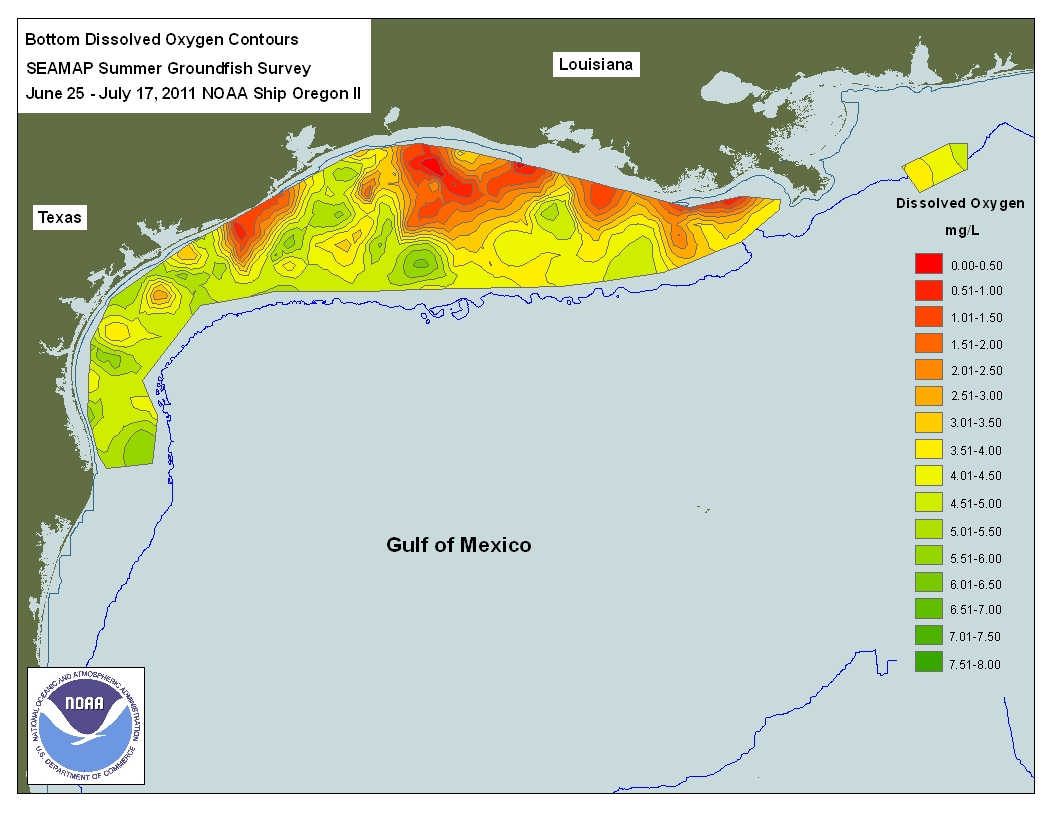
U.S. standard agricultural practices for most crops employ fertilizers that provide nitrogen and phosphorus along with herbicides, fungicides, insecticides, and other pesticides.
Some part of these chemicals leaves the field. Nitrogen in forms such as nitrate (NO3) is highly soluble, and along with some pesticides infiltrates downwards toward the water table, where it can migrate to water wells, rivers and streams. A 2008 National Research Council study found that regionally the highest stream concentrations occur where the rates of application were highest, and that these rates were highest in the Corn Belt. These flows mainly stem from corn, which as of 2010 was the major source of total nitrogen loading to the Mississippi River.
Several studies found that corn ethanol production contributed to the worsening of the Gulf of Mexico dead zone. The nitrogen leached into the Mississippi River and out into the Gulf, where it fed giant algae blooms. As the algae died, it settled to the ocean floor and decayed, consuming oxygen and suffocating marine life, causing hypoxia. This oxygen depletion killed shrimp, crabs, worms and anything else that could not escape, and affected important shrimp fishing grounds.
Social implications
Effect on food prices
Main article: Food vs fuel
Some environmentalists, such as George Monbiot, expressed fears that the marketplace would convert crops to fuel for the rich, while the poor starved and biofuels caused environmental problems. The food vs fuel debate grew in 2008 as a result of the international community's concerns regarding the steep increase in food prices. In April 2008, Jean Ziegler, back then United Nations Special Rapporteur on the Right to Food, repeated his claim that biofuels were a "crime against humanity",{{cite news|url=https://news.bbc.co.uk/1/hi/sci/tech/7351766.stm|title=Brazil president defends biofuels|author=Emilio San Pedro

A July 2008 World Bank report found that from June 2002 to June 2008 "biofuels and the related consequences of low grain stocks, large land use shifts, speculative activity and export bans" accounted for 70–75% of total price rises. The study found that higher oil prices and a weak dollar explain 25–30% of total price rise. The study said that "large increases in biofuels production in the United States and Europe are the main reason behind the steep rise in global food prices." The report argued that increased production of biofuels in these developed regions was supported by subsidies and tariffs, and claimed that without such policies, food price increases worldwide would have been smaller. It also concluded that Brazil's sugarcane ethanol had not raised sugar prices significantly, and recommended that both the U.S. and E.U. remove tariffs, including on many African countries.
An RFA rebuttal said that the World Bank analysis was highly subjective and that the author considered only "the impact of global food prices from the weak dollar and the direct and indirect effect of high petroleum prices and attribute[d] everything else to biofuels."
A 2010 World Bank study concluded that its previous study may have overestimated the impact, as "the effect of biofuels on food prices has not been as large as originally thought, but that the use of commodities by financial investors (the so-called 'financialization of commodities') may have been partly responsible for the 2007/08 spike."
A July 2008 OECD economic assessment agreed about the negative effects of subsidies and trade restrictions, but found that the impact of biofuels on food prices was much smaller. The OECD study found that existing biofuel support policies would reduce greenhouse gas emissions by no more than 0.8 percent by 2015. It called for more open markets in biofuels and feedstocks to improve efficiency and lower costs. The OECD study concluded that "current biofuel support measures alone are estimated to increase average wheat prices by about 5 percent, maize by around 7 percent and vegetable oil by about 19 percent over the next 10 years."
During the 2008 financial crisis corn prices, fell 50% from their July 2008 high by October 2008, in tandem with other commodities, including oil, while corn ethanol production continued unabated. "Analysts, including some in the ethanol sector, say ethanol demand adds about 75 cents to $1.00 per bushel to the price of corn, as a rule of thumb. Other analysts say it adds around 20 percent, or just under 80 cents per bushel at current prices. Those estimates hint that $4 per bushel corn might be priced at only $3 without demand for ethanol fuel."
Reviewing eight years of actual implementation of the Renewable Fuel Standard, researchers from the University of Wisconsin found the standard increased corn prices by 30% and prices of other crops by 20%.
References
References
- "Annual Ethanol Production".
- "Ethanol Market Penetration". Alternative Fuels and Advanced Vehicles Data Center, [[US DOE]].
- (2008). "Welfare Effects and Unintended Consequences of Ethanol Subsidies". Review of Agricultural Economics.
- (2018-05-01). "Who did the ethanol tax credit benefit? An event analysis of subsidy incidence". Journal of Public Economics.
- Renewable Fuels Association. (March 6, 2012). "Acelerating Industry Innovation - 2012 Ethanol Industry Outlook". [[Renewable Fuels Association]].
- (2011). "2011 Ethanol Industry Outlook: Building Bridges to a More Sustainable Future". Renewable Fuels Association.
- (April 10, 2010). "Bioenergy: Background – Ethanol". [[U.S. Department of Agriculture]].
- "Historic U.S. fuel Ethanol Production". Renewable Fuels Association.
- Hill, Jason. (2022-03-09). "The sobering truth about corn ethanol". Proceedings of the National Academy of Sciences.
- (2008). "Biofuels: The Promise and the Risks, in World Development Report 2008". The World Bank.
- Youngquist, W. [[Geodestinies]], National Book company, Portland, OR, 499p.
- (March 19, 1853). "Burning Fluid and Camphene". Scientific American.
- English, Andrew. (July 25, 2008). "Ford Model T reaches 100". [[The Daily Telegraph]].
- "Ethanol: Introduction". Journey to Forever.
- (2007). "Sustainable Ethanol: Biofuels, Biorefineries, Cellulosic Biomass, Flex-Fuel Vehicles, and Sustainable Farming for Energy Independence". Prairie Oak Publishing, Maryville, Missouri.
- (February 22, 2006). "Eliminating MTBE in Gasoline in 2006". Environmental Information Administration.
- Energy Information Administration. (June 4, 2010). "Question: How much ethanol is in gasoline and how does it affect fuel economy?". EIA.
- "Federal Biomass Policy: Federal Legislation". [[U.S. Department of Energy]].
- F.O. Lichts. "Industry Statistics: 2010 World Fuel Ethanol Production". Renewable Fuels Association.
- Clifford Krauss. (February 11, 2009). "Ethanol, Just Recently a Savior, Is Struggling". [[The New York Times]].
- (June 18, 2009). "Oil companies shop for discounted ethanol plants". MSN News}}{{dead link.
- Katie Fehrenbacher. (November 17, 2008). "Financial Crisis Puts Aventine Ethanol Plant On Hold". earth2tech.
- Timothy Gardner. (December 17, 2008). "U.S. will fail to meet biofuels mandate: EIA". Reuters.
- (July 17, 2015). "State Laws on Ethanol in Gasoline: Only Seven States Require E10 Blend".
- James W. Bixby. "The 2005 Energy Policy Act: Lessons on Getting Alternative Fuels to the Pump from Minnesota's Ethanol Regulations". [[Washington University Journal of Law & Policy]].
- (March 11, 2008). "Florida E85 Laws and Incentives". U.S. Department of Energy.
- [https://www.npr.org/templates/story/story.php?storyId=17720583 3 states, many cities]
- [http://www.cleanedge.com/book/Introduction_The_Clean_Tech_Revolution.pdf Introduction: The Clean Tech Opportunity] {{webarchive. link. (July 16, 2007 p. 3.)
- [http://postcarboncities.net/node/192 Portland requires stations to sell biofuels, giving farmers a boost. Post Carbon Cities] {{webarchive. link. (March 6, 2016)
- (June 29, 2016). "Thorntons gas stations introducing new ethanol fuel".
- (December 8, 2014). "Ald. Ed Burke on E15 gasoline proposal".
- Worldwatch Institute and Center for American Progress (2006).[http://images1.americanprogress.org/il80web20037/americanenergynow/AmericanEnergy.pdf ''American Energy: The Renewable Path to Energy Security''] {{webarchive. link. (June 3, 2016)
- Renewable Fuels Association. (March 28, 2013). "New Ethanol Video Released". DomesticFuel.com.
- National Ethanol Vehicle Coalition. (August 8, 2008). "New E85 Stations". NEVC FYI Newsletter (Vol 14 no. 13).
- National Renewable Energy Laboratory USDoE. (September 17, 2007). "Alternative and Advanced Vehicles: Flexible Fuel Vehicles". Alternative Fuels and Advanced Vehicles Data Center.
- (2007). "Sustainable Ethanol: Biofuels, Biorefineries, Cellulosic Biomass, Flex-Fuel Vehicles, and Sustainable Farming for Energy Independence". Prairie Oak Publishing, Maryville, Missouri.
- (2007). "Apollo's Fire". Island Press, Washington, D.C..
- Ken Thomas. (May 7, 2007). "'Flex-fuel' vehicles touted". USA Today.
- "Yellow E85 gas cap". About.com: Hybrid Cars & Alt Fuels.
- "2008 Chevrolet Silverado 1500 4WD LT2 flex-fuel truck test drive". About.com: Hybrid Cars & Alt Fuels.
- "2007 Chevrolet Suburban 4WD 1500 LT test drive". About.com: Hybrid Cars & Alt Fuels.
- (June 2011). "Transportation Energy Data Book: Edition 30". Office of Energy Efficiency and Renewable Energy, U.S. Department of Energy.
- Davis. (2011). "op. cit".
- "Ethanol Production Mandates". E85Prices.com.
- Jensen, Christopher. (June 18, 2010). "E.P.A. Delays Ruling on Increasing Ethanol Content in Gasoline". The New York Times.
- Matthew L. Wald. (October 13, 2010). "A Bit More Ethanol in the Gas Tank". The New York Times.
- Matthew L. Wald. (January 21, 2011). "E.P.A. Approves Use of More Ethanol in Gasoline". The New York Times.
- (January 21, 2011). "US EPA extends E15 fuel waiver to MY 2001–2006 light-duty vehicles". [[Green Car Congress]].
- Matthew L. Wald. (December 20, 2010). "Engine Makers Sue to Block E15 Fuel". The New York Times.
- David Shepardson. (August 17, 2012). "U.S. court rejects auto industry challenge to E15". [[The Detroit News]].
- Sara Forden. (August 17, 2012). "EPA Defeats Challenge To Higher Ethanol Levels In Fuel". Bloomberg News.
- David Sheparson. (June 24, 2013). "Court declines to hear challenge to EPA's stance on E15 gasoline". [[The Detroit News]].
- Michael Green. (November 30, 2012). "New E15 Gasoline May Damage Vehicles and Cause Consumer Confusion". [[American Automobile Association]].
- Susanne Retka Schill. (October 17, 2012). "GM, Ford announce E15 compatibility with new models". Ethanol Producer Magazine.
- VW US Media Room. (July 14, 2013). "Volkswagen of America bringing in downsized 1.8L EA888 engine to displace 2.5L; all vehicles E15 capable". [[Green Car Congress]].
- (August 18, 2015). "FCA approving use of E15 in MY 2016 vehicles". [[Green Car Congress]].
- Matthew L. Wald. (July 11, 2012). "In Kansas, Stronger Mix of Ethanol". The New York Times.
- Jon LeSage. (November 14, 2012). "CARB: It will take years for California to decide on E15". [[Autoblog Green]].
- (October 7, 2008). "Preliminary Test Report Shows No Significant Change in Vehicle Emissions from Intermediate Ethanol Blends". Green Car Congress.
- (2008). "Effects of Intermediate Ethanol Blends on Legacy Vehicles and Small Non-Road Engines, Report 1". [[Oak Ridge National Laboratory]] and National Renewable Energy Laboratory.
- (April 8, 2011). "USDA issues rule to provide incentives to install blender pumps". [[Green Car Congress]].
- Wendy Koch. (April 8, 2011). "USDA offers incentives to boost E-85 flex fuel use". [[USA Today]].
- Eric Loveday. (May 5, 2011). "House members introduce technology-neutral Open Fuel Standard Act". [[AutoblogGreen]].
- (May 4, 2011). "Bipartisan Group Introduces Open Fuel Standard Act". Biofuels Journal.
- Robert Zubrin. (July 2, 2010). "ZUBRIN: Open standards for auto fuel". [[The Washington Times]].
- Matthew L. Wald. (November 15, 2013). "For First Time, E.P.A. Proposes Reducing Ethanol Requirement for Gas Mix". The New York Times.
- "RFA report card offers failing grades to big oil fuel chains".
- "Home | American Coalition for Ethanol".
- "U.S. Energy Information Administration (EIA)".
- "U.S. Field Production of Crude Oil (Thousand Barrels)".
- (July 12, 2012). "Ethanol Fails to Lower Gas Prices, Study Finds".
- (May 15, 2012). "Ethanol Keeps Gasoline Prices $1.09 Cheaper".
- http://www.chadbourne.com/EthanolLosesSteamButOnlyinPart_projectfinance/ {{dead link. (December 2016)
- "EPA Succumbs to Pressure to Reduce Ethanol Mandate". AgWeb.
- (June 23, 2011). "Ethanol subsidies: Fiscal sobriety". [[The Economist]].
- Anna Austin. (September 2008). "Brazil launches campaign to remove ethanol tariff". Ethanol Producer Magazine.
- (January 13, 2012). "ITC Fixes 2012 CBI Fuel Ethanol Import Quota". agranet.com.
- (July 2010). "Using Biofuel Tax Credits to Achieve Energy and Environmental Policy Goals". [[Congressional Budget Office]].
- Clifford Krauss. (June 17, 2011). "Ethanol Industry Is Unruffled by Senate Vote Against Tax Breaks". The New York Times.
- Robert Pear. (January 1, 2012). "After Three Decades, Tax Credit for Ethanol Expires". The New York Times.
- David Shepardson. (December 24, 2011). "Congress ends corn ethanol subsidy". [[The Detroit News]].
- RFA, International Trade Commission, and Jim Jordan & Associates. "Industry Statistics: U.S. Fuel Ethanol Demand". Renewable Fuels Association.
- "Archived copy".
- Jan Suszkiw. (October 2008). "Research Helps Set the Stage for Ethanol ... Southern Style". [[USDA]] [[Agricultural Research Service]].
- Gerardo Reyes. (June 8, 2008). "Colombians in U.S. sugar mills to produce ethanol". Miami Herald.
- "LGF web page". Louisiana Green Fuels.
- Erin Voegele. (March 2009). "Sugarcane Economics". Ethanol Producer Magazine.
- Marcela Sanchez. (February 23, 2007). "Latin America – the 'Persian Gulf' of Biofuels?". The Washington Post.
- (March 3, 2007). "U.S. and Brazil Seek to Promote Ethanol in West". The New York Times.
- (April 2007). "Brazil Institute Special Report: The Global Dynamics of Biofuels". Brazil Institute of the Woodrow Wilson Center.
- Larry Rother. (April 10, 2006). "With Big Boost From Sugar Cane, Brazil Is Satisfying Its Fuel Needs". The New York Times.
- (August 2012). "Short-Term Energy Outlook". US Energy Information Administration.
- Julia Duailibi. (April 27, 2008). "Ele é o falso vilão". [[Veja (magazine).
- Maria Helena Tachinardi. (June 13, 2008). "Por que a cana é melhor que o milho". [[Época (Brazilian magazine).
- Macedo Isaias, M. Lima Verde Leal and J. Azevedo Ramos da Silva. (2004). "Assessment of greenhouse gas emissions in the production and use of fuel ethanol in Brazil". Secretariat of the Environment, Government of the State of São Paulo.
- Timothy Searchinger. (February 29, 2008). "Use of U.S. Croplands for Biofuels Increases Greenhouse Gases Through Emissions from Land-Use Change". [[Science (journal).
- (February 2010). "Renewable Fuel Standard Program (RFS2) Regulatory Impact Analysis". EPA.
- (March 5, 2009). "Proposed Regulation to Implement the Low Carbon Fuel Standard. Volume I: Staff Report: Initial Statement of Reasons". [[California Air Resources Board]].
- (April 23, 2003). "Draft Attachment B: Public Hearing to Consider Adoption of a Proposed Regulation to Implement the Low Carbon Fuel Standard – Staff's Suggested Modifications to the Original Proposal". CARB.
- (June 28, 2008). "Another Inconvenient Truth". [[Oxfam]].
- Fargione. (February 29, 2008). "Land Clearing and the Biofuel Carbon Debt". Science.
- Jim Motavalli. (March 1, 2012). "Flex-Fuel Amendment Makes for Strange Bedfellows". The New York Times.
- "Anúario da Industria Automobilistica Brasileira 2011: Tabela 2.3 Produção por combustível - 1957/2010". ANFAVEA - Associação Nacional dos Fabricantes de Veículos Automotores (Brasil).
- Renavam/Denatran. (January 2012). "Licenciamento total de automóveis e comerciais leves por combustível". ANFAVEA.
- Abraciclo. (January 27, 2010). "Motos flex foram as mais vendidas em 2009 na categoria 150cc". [[UNICA, Brazil.
- "Produção Motocicletas 2010". ABRACICLO.
- "Produção Motocicletas 2011". ABRACICLO.
- (2008). "Anuário Estatístico Brasileiro do Petróleo, Gás Natural e Biocombustíveis 2008". Agência Nacional do Petróleo, Gás Natural e Biocombustíveis.
- Agência Brasil. (July 15, 2008). "ANP: consumo de álcool combustível é 50% maior em 2007". Invertia.
- Gazeta Mercantil. (2008). "ANP estima que consumo de álcool supere gasolina". Agropecuária Brasil.
- D. Sean Shurtleff. (May 7, 2008). "Brazil's energy plan examined". The Washington Times.
- Empresa de Pesquisa Energética. (November 2008). "Balanço Energético Nacional 2008: Ano base 2007". Ministério de Minas e Energia do Brasil.
- Farrel. (January 27, 2006). "Ethanol Can Contribute to Energy and Environmental Goals". Science.
- (2007). "Sustainable Ethanol: Biofuels, Biorefineries, Cellulosic Biomass, Flex-Fuel Vehicles, and Sustainable Farming for Energy Independence". Prairie Oak Publishing, Maryville, Missouri.
- Michael Wang. "Updated Energy and Greenhouse Gas Emission Results of Fuel Ethanol". Center for Transportation Research, Argonne National Laboratory.
- Michael Wang. "Updated Energy and Greenhouse Gas Emission Results of Fuel Ethanol". Center for Transportation Research, Argonne National Laboratory.
- (2022). "Environmental outcomes of the US Renewable Fuel Standard". Proceedings of the National Academy of Sciences.
- (2009). "Two billion cars: driving toward sustainability". [[Oxford University Press]], New York.
- (March 14, 2008). "Letter to Science about Searchinger et al. article". Argonne National Laboratory.
- Searchinger. (2008). "Supporting Materials for Use of U.S. Croplands for Biofuels Increases Greenhouse Gases Through Emissions from Land Use Change". Princeton University.
- Michael Grunwald. (March 27, 2008). "The Clean Energy Scam".
- (January 19, 2023). "Corn Ethanol vs. Solar: Land Use Comparison".
- Wyatt Buchanan. (April 24, 2009). "Air Resources Board moves to cut carbon use". San Francisco Chronicle.
- (April 24, 2009). "Calif. Approves Nation's 1st Low-Carbon Fuel Rule". The New York Times.
- UNICA Press release. (April 24, 2009). "Sugarcane Ethanol Passes Critical Test in California". World-Wire.
- (October 23, 2008). "Leading Advanced Biofuel Companies, Researchers, Investors Call on Air Resources Board to Reconsider Draft Low Carbon Fuel Regulations". New Fuels Alliance.
- (October 24, 2008). "Biofuel Companies Question ARB's Inclusion of Indirect Effects in Low Carbon Fuel Standard". Green Car Congress.
- (April 21, 2009). "Public letter to Mary D. Nichols, Chairman California Air Resources Board". [[Union of Concerned Scientists]].
- (April 21, 2009). "Group of Scientists and Economists Urge Inclusion of Indirect Land Use Change Effects for Biofuels and All Transportation Fuels in California LCFS". Green Car Congress.
- Debra Kahn. (April 24, 2009). "California Adopts Low-Carbon Fuel Standard".
- David R. Baker. (April 22, 2009). "State readies stringent fuel standards". San Francisco Chronicle.
- Kate Galbraith. (April 24, 2009). "California Fuel Move Angers Ethanol Makers". The New York Times.
- Jim Lane. (February 24, 2009). "CARB votes 9–1 for California Low Carbon Fuel Standard; moves up indirect land use review to Jan 2011 in response to outcry on ILUC". BiofuelsDigest.
- Jeff St. John. (April 23, 2009). "California Adopts Low Carbon Fuel Standard". GreenMedia.
- Dale Kasler. (April 25, 2009). "California's low-carbon fuel standard has oil companies anxious". [[The Sacramento Bee]].
- (April 23, 2009). "California adopts first-ever low-carbon fuel rule". [[CNN News]].
- (May 5, 2009). "Renewable Fuel Standard Program (RFS2): Notice of Proposed Rulemaking". US Environmental Protection Agency.
- Jim Tankersley. (May 6, 2009). "New standards could cut tax breaks for corn-based ethanol". [[Los Angeles Times]].
- Suzanne Goldenberg. (May 6, 2009). "Barack Obama's $1.8bn vision of greener biofuel". The Guardian.
- Jennifer Kho. (May 5, 2009). "Corn Ethanol Crew Cries Foul Over EPA Emissions Ruling". earth2tech.com.
- UNICA Press Release. (May 5, 2009). "Sugarcane Ethanol Industry Eager to Implement U.S. Renewable Fuel Standard". National Press Release.
- (May 5, 2009). "President Obama Announces Steps to Support Sustainable Energy Options, Departments of Agriculture and Energy, Environmental Protection Agency to Lead Efforts". [[whitehouse.gov]].
- Matthew L. Wald. (May 5, 2009). "White House Steps Up Support for Biofuels". The New York Times.
- Ben Geman. (May 5, 2009). "Obama Administration Prepares to Push Biofuels".
- Power, Stephen. (December 24, 2009). "Ethanol Groups Sue California Over Low-Carbon Rule". The Wall Street Journal.
- (December 25, 2009). "Ethanol Groups File Suit Challenging Constitutionality of California Low Carbon Fuel Standard". Green Car Congress.
- (December 24, 2009). "Ethanol Groups Challenge Constitutionality of California LCFS". Renewable Fuels Association.
- (February 3, 2010). "Renewable Fuel Standard Program (RFS2): Final Rule". U.S. Environmental Protection Agency.
- (February 3, 2010). "Greenhouse Gas Reduction Thresholds". U.S. Environmental Protection Agency.
- (February 2010). "Renewable Fuel Standard Program(RFS2) Regulatory Impact Analysis". U.S. Environmental Protection Agency.
- (March 2010). "The water footprint of biofuel production in the USA". Biofuels.
- United States National Research Council, Committee on Water Implications of Biofuels Production in the United States. (2008). "Water Implications of Biofuels Production in the United States". [[The National Academy Press]], Washington, D.C..
- (2009). "The Water Footprint of Biofuels: A Drink or Drive Issue?". Environmental Science and Technology.
- (2010). "2010 Ethanol Industry Outlook: Climate of Opportunity". Renewable Fuels Association.
- Lochhead, Carolyn. (July 6, 2010). "Dead zone in gulf linked to ethanol production". San Francisco Chronicle.
- George Monbiot. (November 23, 2004). "Feeding Cars, Not People". Monbiot.com.
- European Environmental Bureau. (February 8, 2006). "Biofuels no panacea".
- Planet Ark. (September 26, 2005). "Food Security Worries Could Limit China Biofuels".
- Greenpeace UK. (May 9, 2007). "Biofuels: green dream or climate change nightmare".
- (April 14, 2008). "ONU diz que biocombustíveis são crime contra a humanidade". Folha de Sao Pãulo Online.
- Lederer, Edith. (October 27, 2007). "Production of biofuels 'is a crime'". [[The Independent]].
- (October 11, 2007). "UN rapporteur calls for biofuel moratorium".
- (April 11, 2008). "Poor go hungry while rich fill their tanks". The Guardian.
- Steven Mufson. (April 30, 2008). "Siphoning Off Corn to Fuel Our Cars". The Washington Post.
- (April 13, 2008). "FMI e Bird pedem ação urgente contra alta alimentar". Folha de Sao Pãulo Online.
- Donald Mitchell. (July 2008). "A note on Rising Food Crisis". The World Bank.
- (July 28, 2008). "Etanol não influenciou nos preços dos alimentos". Veja.
- (July 28, 2008). "Biofuels major driver of food price rise-World Bank".
- John M. Urbanchuk. (July 11, 2008). "Critique of World Bank Working Paper "A Note of Rising Food Prices"". Renewable Fuel Association.
- (July 2010). "Placing the 2006/08 Commodity Price Boom into Perspective". World Bank.
- (July 16, 2008). "Economic Assessment of Biofuel Support Policies". OECD.
- (July 16, 2008). "Biofuel policies in OECD countries costly and ineffective, says report". OECD.
- Sam Nelson. (October 23, 2008). "Ethanol no longer seen as big driver of food price". Reuters UK.
This article was imported from Wikipedia and is available under the Creative Commons Attribution-ShareAlike 4.0 License. Content has been adapted to SurfDoc format. Original contributors can be found on the article history page.
Ask Mako anything about Ethanol fuel in the United States — get instant answers, deeper analysis, and related topics.
Research with MakoFree with your Surf account
Create a free account to save articles, ask Mako questions, and organize your research.
Sign up freeThis content may have been generated or modified by AI. CloudSurf Software LLC is not responsible for the accuracy, completeness, or reliability of AI-generated content. Always verify important information from primary sources.
Report