From Surf Wiki (app.surf) — the open knowledge base
Etemenanki
Ziggurat in ancient Babylon
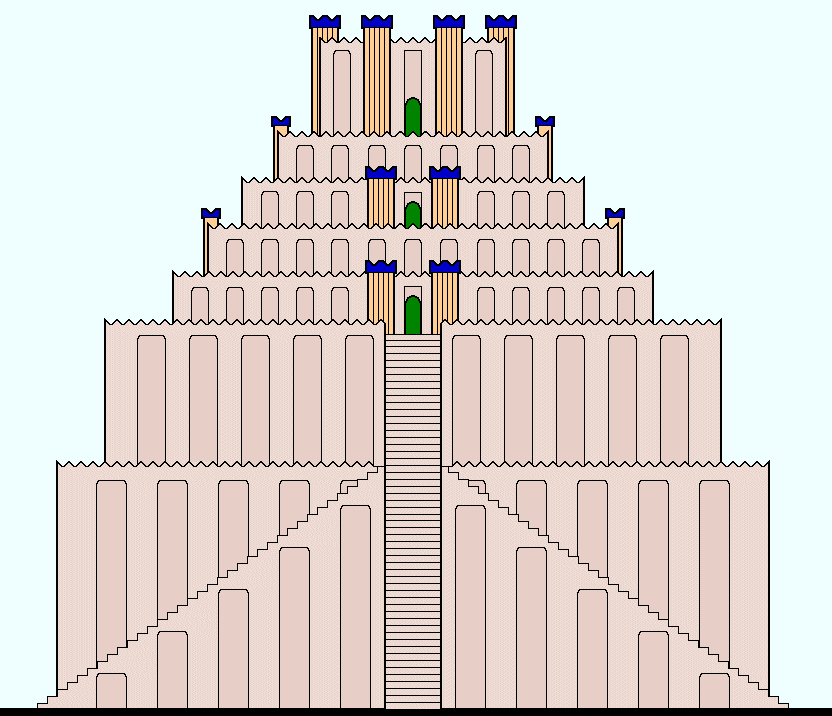
Ziggurat in ancient Babylon
In 2003 scholars discovered in the Schøyen Collection the oldest known representation of the Etemenanki. Carved on a black stone, the "Tower of Babel Stele", as it is known, dates to 604–562 BCE, the time of Nebuchadnezzar II.

The Etemenanki is described in a cuneiform tablet from Uruk from 229 BCE, a copy of an older text (now in the Louvre, Paris and referred to as the "Esagila" tablet). Translated in 1876 by Assyriologist George Smith, it gives the height of the tower as seven stocks (91 meters) with a square base of 91 meters on each side. This mudbrick structure was confirmed by excavations conducted by Robert Koldewey after 1913. Large stairs were discovered at the south side of the building, where a triple gate connected it with the Esagila. A larger gate to the east connected the Etemenanki with the sacred procession road (now reconstructed in the Pergamon Museum, Berlin).
Until the first translation of the "Esagila" tablet, details of Babylon's ziggurat were known only from the ancient Greek historian Herodotus, who wrote in the mid-5th century BCE:
The center of each division of the town was occupied by a fortress. In the one stood the palace of the kings, surrounded by a wall of great strength and size: in the other was the sacred precinct of [Belus (Babylonian)
Jupiter [Zeus] Belus]], a square enclosure two furlongs [402 m] each way, with gates of solid brass; which was also remaining in my time. In the middle of the precinct there was a tower of solid masonry, a furlong [201 m] in length and breadth, upon which was raised a second tower, and on that a third, and so on up to eight. The ascent to the top is on the outside, by a path which winds round all the towers. When one is about half-way up, one finds a resting-place and seats, where persons can sit for some time on their way to the summit. On the topmost tower there is a spacious temple, and inside the temple stands a couch of unusual size, richly adorned, with a golden table by its side. There is no statue of any kind set up in the place, nor is the chamber occupied of nights by any one but a single native woman, who, as the Chaldeans [i.e. the Babylonians], the priests of this god, affirm, is chosen for himself by the deity out of all the women of the land.
This Tower of Jupiter Belus is believed to refer to the Akkadian god [Bel, whose name has been Hellenised by Herodotus to Zeus Belus. It is likely that it corresponds to Etemenanki. Herodotus does not say that he visited Babylon or the ziggurat, however; the account contains multiple inaccuracies and is most likely second hand.
Final demolition
In 331 BCE, Alexander the Great captured Babylon and ordered repairs to the Etemenanki. When Alexander returned to the ancient city in 323 BCE, he noted that no progress had been made, and ordered his army to demolish the entire building in order to prepare a final rebuilding. His death, however, prevented the reconstruction. The Babylonian Chronicles and Astronomical Diaries record several attempts to rebuild the Etemenanki, which were always preceded by removing the last debris of the original ziggurat. The Ruin of Esagila Chronicle mentions that the Seleucid crown prince Antiochus I decided to rebuild it and made a sacrifice in preparation. However, while there, he stumbled on the rubble and fell. He then angrily ordered his elephant drivers to destroy the last of the remains. There are no later references to the Etemenanki from antiquity.
Modern hypotheses regarding height
Modern scholars dispute the claim by the ancient Babylonian source (the "Esagila" tablet) that the Etemenanki was 91 meters tall. "[The modern] interpretation of Esagil's text raises a serious technical problem: the excessive height of the first two terraces of the ziggurat and the total height of the building defy the laws of statics and compressive strength of a material such as raw earth brick." (Translated from the Italian). Even allowing variation in the design of a six-level terraced structure, at that height, the compression stress on the structure would be somewhere around two to three times as much as comparable structures of the same time period. Fenollós et al. propose that, assuming the structure did indeed use a six-level terrace design as depicted in the Tower of Babel stele, the ziggurat was probably closer to 54 meters tall. The temple at the top contributed another 12 meters in height, for a total height of 66 meters.
In popular culture
In the Portugal Pack of the video game Civilization VI, Etemenanki was introduced as one of the wonders in the game.
In the Lucasarts PC video game Indiana Jones and the Infernal Machine, Etemenanki is a key location, eventually revealed to have been both the biblical Tower of Babel and a temple to the god Marduk.
Image gallery
File:Etemenanki Berlin.jpg|Model at the Pergamon Museum of Berlin File:Remains of the foundations of the Etemnanki Zigurat.jpg|Remains of the foundations
Notes
References
- A. R. George, "E-sangil and E-temen-anki, the Archetypal Cult-centre?" in: J. Renger, Babylon: Focus mesopotamischer Geschichte, Wiege früher Gelehrsamkeit, Mythos in der Moderne (1999 Saarbrücken)
- Hans-Jörg Schmid, Der Tempelturm Etemenanki in Babylon (1995 Mainz)
- The Tower of Babel Stele, Schoyen Collection
- Fenollós, Juan Luis & Vegas, Fernando & Mileto, Camilla. (2005). Etemenanki: nuova ipotesi di ricostruzione dello ziggurat di Nabucodonosor II nella cittá di Babilonia. ISIMU: Revista sobre Oriente Próximo y Egipto en la antigüedad 8 (2005): 201-216.
References
- Harris, Stephen L.. (2002). "Understanding the Bible". [[McGraw-Hill]].
- Streck, Michael P.. (2006). "Die Stadt, an deren Freuden man nicht satt wird".
- [[Andrew R. George. George, Andrew]] (2007) "The Tower of Babel: Archaeology, history and cuneiform texts" ''Archiv für Orientforschung'', '''51''' (2005/2006). pp. 75–95. [http://eprints.soas.ac.uk/3858/2/TowerOfBabel.AfO.pdf pdf document].
- (January 2005). "''Etemenanki: nuova ipotesi di ricostruzione dello ziggurat di Nabucodonosor II nella cittá di Babilonia.''". ISIMU: Revista sobre Oriente Próximo y Egipto en la antigüedad.
- Koldewey had identified Etemenanki in November 1900; the vicissitudes of the archaeological enterprise, in which the enormous mass of debris covering it was shoveled away and shafts and tunnels pierced, were summarised in Friedrich Wetzel and F. H. Weissbach, ''Das Hauptheiligtum des Marduk in Babylon, Esagila und Etemenanki'' (Leipzig) 1938; the most recent monograph is Hans-Jörg Schmid, ''Der Tempelturm Etemenanki in Babylon'' (Mainz) 1995.
- The house, the foundation of heaven and earth". The stele was broken in Antiquity in three pieces, two of which are reunited in the [http://www.schoyencollection.com/babylonianhist.htm#2063 Schøyen collection, MS 2063]
- van de Mieroop, Marc. (2003). "Reading Babylon". American Journal of Archaeology.
- George, A. R.. (2011). "Cuneiform Royal Inscriptions and Related Texts in the Schøyen Collection". CDL Press.
- (604). "The "Esagila" tablet".
- Herodotus, [[Histories (Herodotus). ''Histories'']] 1.181
- [[Diodorus Siculus]], 2.9.9; [[Strabo]], ''Geography'', 16.1.5.
- R.J. van der Spek, "Darius III, Alexander the Great and Babylonian scholarship" in: Achaemenid History XIII (Leiden 2003), 289–346.
- Bert van der Spek. (2004). "BCHP 6 (Ruin of Esagila Chronicle)".
- (16 March 2021). "Civilization VI's final DLC for New Frontier Pass to feature zombies".
This article was imported from Wikipedia and is available under the Creative Commons Attribution-ShareAlike 4.0 License. Content has been adapted to SurfDoc format. Original contributors can be found on the article history page.
Ask Mako anything about Etemenanki — get instant answers, deeper analysis, and related topics.
Research with MakoFree with your Surf account
Create a free account to save articles, ask Mako questions, and organize your research.
Sign up freeThis content may have been generated or modified by AI. CloudSurf Software LLC is not responsible for the accuracy, completeness, or reliability of AI-generated content. Always verify important information from primary sources.
Report