From Surf Wiki (app.surf) — the open knowledge base
Etchmiadzin Cathedral
Mother church of Armenia
Mother church of Armenia
| Field | Value |
|---|---|
| name | Etchmiadzin Cathedral |
| native_name | Էջմիածնի Մայր Տաճար |
| image | Etchmiadzin 2025-3.jpg |
| image_upright | 1 |
| map_type | Armenia |
| location | Vagharshapat, Armavir Province, Armenia |
| coordinates | |
| religious_affiliation | Armenian Apostolic Church |
| rite | Armenian |
| functional_status | Active |
| leadership | Catholicos of All Armenians |
| architecture | yes |
| architecture_type | Cathedral |
| architecture_style | Armenian |
| founded_by | Gregory the Illuminator (original) |
| groundbreaking | 301 (original building; traditional date) |
| year_completed | 303 (original building; traditional date){{collapsible list |
| titlestyle | font-weight:normal;background:transparent;text-align:left; |
| title | 483/4–1868 (current building) |
| bullets | true |
| 483/4 (core)<ref name | "Hewsen" / |
| 17th century (dome)<ref name | "Melik-Bakhshyan" / |
| 1654–58 (belfry)<ref name | "Hewsen" / |
| 1682 (smaller belfries with turrets)<ref name | "Hewsen" / |
| 1868 (sacristy)<ref name | "Hewsen" / |
| length | 33 m |
| width | 30 m |
| dome_height_outer | 34 m |
| designation1 | WHS |
| designation1_offname | Cathedral and Churches of Echmiatsin and the Archaeological Site of Zvartnots |
| designation1_date | 2000 (24th session) |
| designation1_type | Cultural |
| designation1_criteria | (ii) (iii) |
| designation1_number | 1011-001 |
| designation1_free1name | Region |
| designation1_free1value | Western Asia |
|483/4 (core) |17th century (dome) |1654–58 (belfry) |1682 (smaller belfries with turrets) |1868 (sacristy)
Etchmiadzin Cathedral is the mother church of the Armenian Apostolic Church, located in the city dually known as Etchmiadzin (Ejmiatsin) and Vagharshapat, Armenia. It is usually considered the first cathedral built in ancient Armenia, and often regarded as the oldest cathedral in the world.
The original church was built in the early fourth century—between 301 and 303 according to tradition—by Armenia's patron saint Gregory the Illuminator, following the adoption of Christianity as a state religion by King Tiridates III. It was built over a pagan temple, symbolizing the conversion from paganism to Christianity. The core of the current building was built in 483/4 by Vahan Mamikonian after the cathedral was severely damaged in a Persian invasion. From its foundation until the second half of the fifth century, Etchmiadzin was the seat of the Catholicos, the supreme head of the Armenian Church.
Although never losing its significance, the cathedral subsequently suffered centuries of virtual neglect. In 1441 it was restored as catholicosate and remains as such to this day. Since then the Mother See of Holy Etchmiadzin has been the administrative headquarters of the Armenian Church. Etchmiadzin was plundered by Shah Abbas I of Persia in 1604, when relics and stones were taken out of the cathedral to New Julfa in an effort to undermine Armenians' attachment to their land. Since then the cathedral has undergone a number of renovations. Belfries were added in the latter half of the seventeenth century and in 1868 a sacristy (museum and room of relics) was constructed at the cathedral's east end. Today, it incorporates styles of different periods of Armenian architecture. Diminished during the early Soviet period, Etchmiadzin revived again in the second half of the twentieth century, and under independent Armenia.
As the center of Armenian Christianity, Etchmiadzin has been an important location in Armenia not only religiously, but also politically and culturally. A major pilgrimage site, it is one of the most visited places in the country. Along with several important early medieval churches located nearby, the cathedral was listed as a World Heritage Site by UNESCO in 2000.
Setting
The cathedral is located at the center of the Mother See of Holy Etchmiadzin, the administrative headquarters of the Armenian Apostolic Church, in the town dually known as Vagharshapat or Etchmiadzin (Ejmiatsin). The seventh century churches of St. Hripsime, St. Gayane, the ruined Zvartnots Cathedral, and the 17th century Shoghakat Church are all located in the same town, within short distances from the cathedral.
For much of its history, the complex around the cathedral, which includes the residence of the Catholicos (patriarch), has been known as the Monastery of Etchmiadzin (Էջմիածնի վանք). It was formerly surrounded by 30 ft high walls, made of brick or cob, and had eight circular towers (turrets). Its external appearance led 19th century visitors to widely compare it to a fortress. The walled monastery, a vast quadrangular enclosure, could have been accessed through four gates.
The cathedral stood—and continues to stand—at the center of a courtyard (a quadrangle), which by Lynch's measurements in the 1890s, was 106.53 x, making it larger than the Trinity Great Court in Cambridge, England. He suggested that it may have been at the time the largest quadrangle in the world.
File:Ejmaitsin cathedral aerial 2023.jpg|An aerial view of the cathedral and the Mother See complex surrounding it from a plane File:Ejmiatsin aerial 2023-2.jpg|A closer aerial view File:Ejmiatsin plan Alishan.jpg|A map of the town of Vagharshapat (brown) and Etchmiadzin monastery (red) in the late 19th century (by Ghevont Alishan). The cathedral is marked as 1. File:Etchmiadzin Cathedral Plan.jpg|A plan of the monastery H. F. B. Lynch
History
Foundation and etymology
In the early fourth century the Kingdom of Armenia, under Tiridates III, become the first country in the world to adopt Christianity as a state religion. Armenian church tradition places the cathedral's foundation between 301 and 303. It was built near the royal palace in what was then the Armenian capital of Vagharshapat, on the site of a pagan temple, which was dated by Alexander Sahinian to the Urartian period. Although no historical sources point to a pre-Christian place of worship in its place, a granite Urartian stele dated to the 8th-6th centuries BC was excavated under the main altar in the 1950s. Also excavated under the altar was an amphora, which has been interpreted to have been a part of a fire temple.
In his History of the Armenians, Agathangelos narrates the legend of the cathedral's foundation. Armenia's patron saint Gregory the Illuminator had a divine vision descending from heaven and striking the earth with a golden hammer to show where the cathedral should be built. Later tradition associated the figure with Jesus Christ, hence the name of Etchmiadzin (էջ ēĵ "descent" + մի mi "only" + -ա- -a- (linking element) + ծին tsin "begotten"), which translates to "the Descent of the Only-Begotten " or "Descended the Only Begotten". However, the name Etchmiadzin did not come into use until the 15th century, while earlier sources call it "Cathedral of Vagharshapat." The Feast of the Cathedral of Holy Etchmiadzin (Տոն Կաթողիկե Սբ. Էջմիածնի) is celebrated by the Armenian Church 64 days after Easter, during which a hymn, written by the 8th century Catholicos Sahak III, retelling St. Gregory's vision, is sung.
| [[File:Etchmiadzin Cathedral 4th century ground plan.png | 100px | ground plan]] | [[File:Etchmiadzin Cathedral 4th century cross section view.png | 190px | side cross section view]] |
|---|---|---|---|---|---|
| [[File:Etchmiadzin Cathedral 4th century façade cross section view.png | 200px | façade cross section view]] |
Malachia Ormanian suggested that the cathedral was built in 303 within seven months because the building was not huge and probably, partially made of wood. He also argued that the foundation of the preexisting temple could have been preserved. Vahagn Grigoryan dismisses these dates as implausible and states that at least several years were needed for its construction. He cites Agathangelos, who does not mention the cathedral in an episode that took place in 306 and suggests the usage of the span of 302 to 325—the reign of Gregory the Illuminator as Catholicos as the dates of the cathedral's construction.
Archaeological excavations in 1955–56 and 1959, led by Alexander Sahinian, uncovered the remains of the original fourth-century building, including two levels of pillar bases below the current ones and a narrower altar apse under the present one. Based on these findings, Sahinian asserted that the original church had been a three-naved vaulted basilica, similar to the basilicas of Tekor, Ashtarak and Aparan (Kasagh). However, other scholars, have rejected Sahinian's view. Among them, Suren Yeremian and Armen Khatchatrian held that the original church had been in the form of a rectangle with a dome supported by four pillars. Stepan Mnatsakanian suggested that the original building had been a "canopy erected on a cross [plan]," while Vahagn Grigoryan proposes what Mnatsakanian describes as an "extreme view," that the cathedral has been essentially in the same form as it is today.
Reconstruction and decline
According to Faustus of Byzantium, the cathedral and the city of Vagharshapat were almost completely destroyed during the invasion of Sasanian King Shapur II in the 360s (circa 363). Due to Armenia's unfavorable economic conditions, the cathedral was renovated only partially by Catholicoi Nerses the Great (r. 353–373) and Sahak Parthev (r. 387–439).
In 387, Armenia was partitioned between the Roman and Sasanian Empires. Etchmiadzin became part of the Persian-controlled east, under the rule of Armenian vassal kings until 428, when the Armenian Kingdom was dissolved. In 450, in an attempt to impose Zoroastrianism on Armenians, Sasanian King Yazdegerd II built a fire temple inside the cathedral. The pyre of the fire temple was unearthed under the altar of the east apse during the excavations in the 1950s.
By the last quarter of the fifth century the cathedral was dilapidated. According to Ghazar Parpetsi, it was rebuilt from the foundations by marzban (governor) of Persian Armenia Vahan Mamikonian in 483/4, when the country was relatively stable, following the struggle for religious freedom against Persia. Most researchers have concluded that, thus, the church was converted into cruciform church and mostly took its current form. The new church was very different from the original one and "consisted of quadric-apsidal hall built of dull, grey stone containing four free-standing cross-shaped pillars disdained to support a stone cupola." The new cathedral was "in the form of a square enclosing a Greek cross and contains two chapels, one on either side of the east apse."
Although the seat of the Catholicos was transferred to Dvin sometime in the 460s–470s or 484, the cathedral never lost its significance and remained "one of the greatest shrines of the Armenian Church." The last known renovations until the 15th century were made by Catholicos Komitas in 618 (according to Sebeos) and Catholicos Nerses III (r. 640–661). In 982 the cross of the cathedral was reportedly removed by an Arab emir.
Over the course of these centuries of neglect, the cathedral deteriorated to such an extent that it inspired the renowned archbishop Stepanos Orbelian to compose one of his better known poems, "Lament on Behalf of the Cathedral", in 1300. In the poem, which tells about the consequences of the Mongol and Mamluk invasions of Armenia and Cilicia, Orbelian portrays Etchmiadzin Cathedral "as a woman in mourning, contemplating her former splendor and exhorting her children to return to their homeland [...] and restore its glory."
From revival to plunder
Following the fall of the Armenian Kingdom of Cilicia in 1375, the See of Sis experienced decline and disarray. The Catholicosate of Aghtamar and the locally influential Syunik bishops enhanced the importance of the region around Etchmiadzin. In 1441 a general council of several hundred religious figures met in Etchmiadzin and voted to reestablish a catholicosate there. The cathedral was restored by Catholicos Kirakos (Cyriacus) between 1441 and 1443. At that time Etchmiadzin was under the control of the Turkic Kara Koyunlu, but in 1502, Safavid Iran gained control of parts of Armenia, including Etchmiadzin, and granted the Armenian Church some privileges.

During the 16th and 17th centuries, Armenia suffered from its location between Persia and Ottoman Turkey, and the conflicts between those two empires. Concurrently with the deportation of up to 350,000 Armenians into Persia by Shah Abbas I as part of the scorched earth policy during the war with the Ottoman Empire, Etchmiadzin was plundered in 1604.
The Shah wanted to "dispel Armenian hopes of returning to their homeland" by moving the religious center of the Armenians to Iran in order to provide Persia with a strong Armenian presence. He wanted to destroy the cathedral and have it physically transferred to the newly founded Armenian community of New Julfa near the royal capital of Isfahan. Shah Abbas offered the prospective new cathedral in New Julfa to the Pope. Etchmiadzin was not moved, possibly because of the high costs. In the event, only some important stones—the altar, the stone where Jesus Christ descended according to tradition, and Armenian Church's holiest relic, the Right Arm of Gregory the Illuminator—were moved to New Julfa. They were incorporated in the local Armenian St. Georg Church when it was built in 1611. Fifteen stones from Etchmiadzin still remain at St. Georg.

17th–18th centuries
Since 1627, the cathedral underwent a major renovation under Catholicos Movses (Moses), when the dome, ceiling, roof, foundations and paving were repaired. At this time, cells for monks, a guesthouse and other structures were built around the cathedral. Additionally, a wall was built around the cathedral, making it a fort-like complex.
The renovation works were interrupted by the Ottoman–Safavid War of 1635–1636, during which the cathedral remained intact. The renovations resumed under Catholicos Pilippos (1632–1655), who built new cells for monks and renovated the roof. During this century, belfries were added to many Armenian churches. In 1653–1654, he started the construction of the belfry in the western wing of Etchmiadzin Cathedral. It was completed in 1658 by Catholicos Hakob IV Jugayetsi. Decades later, in 1682, Catholicos Yeghiazar constructed smaller bell towers with red tuff turrets on the southern, eastern, and northern wings.
The renovations of Etchmiadzin continued during the 18th century. In 1720, Catholicos Astvatsatur and then, in 1777–1783 Simeon I of Yerevan took actions in preserving the cathedral. In 1770, Simeon I established a publishing house near Etchmiadzin, the first in Armenia. During Simeon's reign, the monastery was completely walled and separated from the city of Vagharshapat. Catholicos Ghukas (Lucas) continued the renovations in 1784–1786.


Russian takeover
The Russian Empire gradually penetrated Transcaucasia by the early 19th century. Persia's Erivan Khanate, in which Etchmiadzin was located, became an important target for the Russians. In June 1804, during the Russo-Persian War (1804–1813), the Russian troops led by General Pavel Tsitsianov tried to take Etchmiadzin, but failed. A few days after the attempt, the Russians returned to Etchmiadzin, where they caught a different Persian force by surprise and routed them. Tsitsianov's forces entered Etchmiadzin, which, according to Auguste Bontems-Lefort, a contemporary French military envoy to Persia, they looted, seriously damaging the Armenian religious buildings. Shortly after, the Russians were forced to withdraw from the area as a result of the successful Persian defense of Erivan. According to Bontems-Lefort, the Russian behaviour at Etchmiadzin contrasted with that of the Persian king, who treated the local Christian population with respect.
On 13 April 1827, during the Russo-Persian War (1826–1828), Etchmiadzin was captured by the Russian General Ivan Paskevich's troops without fight and was formally annexed by Russia, with the Persian-controlled parts of Armenia, roughly corresponding to the territory of the modern Republic of Armenia (also known as Eastern Armenia), according to the 1828 Treaty of Turkmenchay.
The cathedral prospered under Russian rule, despite the suspicions that the Imperial Russian government had about Etchmiadzin becoming a "possible center of the Armenian nationalist sentiment." Formally, Etchmiadzin became the religious center of the Armenians living within the Russian Empire by the 1836 statute or constitution (polozhenie).
In 1868, Catholicos Gevorg (George) IV made the last major alteration to the cathedral by adding a sacristy (museum and room of relics) to its east end. In 1874, he established the Gevorgian Seminary, a theological school-college located on the cathedral's premises. Catholicos Markar I undertook the restoration of the interior of the cathedral in 1888.
20th century and on


In 1903, the Russian government issued an edict to confiscate the properties of the Armenian Church, including the treasures of Etchmiadzin. Russian policemen and soldiers entered and occupied the cathedral. Due to popular resistance and the personal defiance of Catholicos Mkrtich Khrimian, the edict was canceled in 1905.
During the Armenian genocide, the cathedral of Etchmiadzin and its surrounding became a major center for Turkish Armenian refugees. At the end of 1918, there were about 70,000 refugees in the Etchmiadzin district. A hospital and an orphanage within the cathedral's grounds were established and maintained by the U.S.-based Armenian Near East Relief by 1919.
In the spring of 1918 the cathedral was in danger of an attack by the Turks. Prior to the May 1918 Battle of Sardarabad, which took place just miles away from the cathedral, the civilian and military leadership of Armenia suggested Catholicos Gevorg (George) V to leave for Byurakan for security purposes, but he refused. The Armenian forces eventually repelled the Turkish offensive and set the foundations of the First Republic of Armenia.
Soviet period
Suppression
After two years of independence, Armenia was Sovietized in December 1920. During the 1921 February Uprising Etchmiadzin was briefly (until April) taken over by the nationalist Armenian Revolutionary Federation, which had dominated the pre-Soviet Armenian government between 1918 and 1920.
In December 1923, the southern apse of the cathedral collapsed. It was restored under Toros Toramanian's supervision in what was the first case of restoration of an architectural monument in Soviet Armenia.

During the Great Purge and the radical state atheist policies in the late 1930s, the cathedral was a "besieged institution as the campaign was underway to eradicate religion." The repressions climaxed when Catholicos Khoren I was murdered in April 1938 by the NKVD. In August of that year, the Armenian Communist Party decided to close down the monastery, but the central Soviet government seemingly did not approve of such a measure. Isolated from the outside world, the cathedral barely continued to function and its administrators were reduced to some twenty people. It was reportedly the only church in Soviet Armenia not to have been seized by the Communist government.According to Charles J. Kersten (R-WI), the chairman of the Select Committee on Communist Aggression. The dissident anti-Soviet Armenian diocese in the U.S. wrote that "the great cathedral became a hollow monument."
Revival
Etchmiadzin slowly recovered its religious importance during World War II. The Holy See's official magazine resumed publication in 1944, while the seminary was reopened in September 1945. In 1945 Catholicos Gevorg VI was elected after the seven-year vacancy of the position. The number of baptisms conducted at Etchmiadzin rose greatly: from 200 in 1949 to around 1,700 in 1951. Nevertheless, the cathedral's role was downplayed by the Communist official circles. "For them the ecclesiastical Echmiadzin belongs irrevocably to the past, and even if the monastery and the cathedral are occasionally the scene of impressive ceremonies including the election of a new catholicos, this has little importance from the communist point of view," Walter Kolarz wrote in 1961.
Etchmiadzin revived under Catholicos Vazgen I since the Khrushchev Thaw in the mid-1950s, following Stalin's death. Archaeological excavations were held in 1955–56 and in 1959; the cathedral underwent a major renovation during this period. Wealthy diaspora benefactors, such as Calouste Gulbenkian and Alex Manoogian, financially assisted the renovation of the cathedral. Gulbenkian alone provided $400,000 ().
Independent Armenia

In 2000, Etchmiadzin underwent a renovation prior to the celebrations of the 1700th anniversary of the Christianization of Armenia in 2001. Its metal roof was replaced with stone slabs. In 2003, the 1700th anniversary of the consecration of the cathedral was celebrated by the Armenian Church. Catholicos Karekin II declared 2003 the Year of Holy Etchmiadzin.
The most recent restoration of the cathedral began in 2012, focusing on strengthening and restoring the dome and roof. Its ceremonial reopening took place on September 29, 2024, with senior officials in attendance, including Prime Minister Nikol Pashinyan. The main benefactors, including diaspora billionaires Noubar Afeyan and Samvel Karapetyan, who had funded to the renovation, were honored by Catholicos Karekin II.
The initial goal was to address the external structure, primarily repairing roof tiles, but significant issues with the cathedral's physical condition were subsequently uncovered. Critical structural elements, including columns, arches, the dome, and vaults, were found to be severely deteriorated. Restoration efforts employed high-quality materials, such as injection compounds, waterproofing agents, and mortar, most of which were imported from Italy. Additionally, the frescoes and painted surfaces, covering 2,600 m2, were meticulously restored. Its 17th century cross, made of thin brass sheets and in a severely deteriorated condition, was replaced with a bronze one that closely replicates its style and size.
Architecture
Style
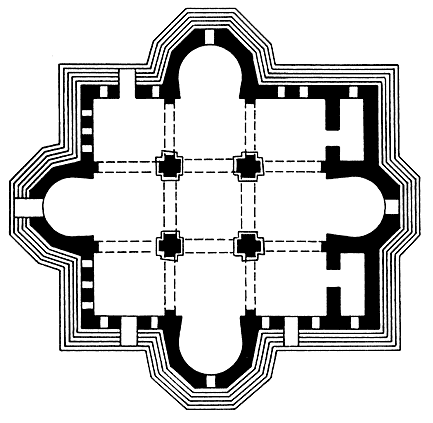
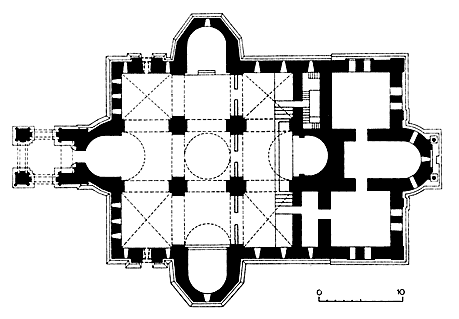
Etchmiadzin has a cruciform plan, four free-standing piers, and four projecting apses, which are semicircular on the interior and polygonal on the exterior. Its roof is mostly flat, except the conspicuous central cupola with the typically Armenian conical roof on a polygonal drum and the four small belfries on top of the apses.
Although the cathedral was renovated many times through the centuries and significant additions were made in the 17th and 19th centuries, it largely retains the form of the building constructed in 483/4, especially the floor plan. The fifth-century building is the core of the cathedral, while the stone cupola, turrets, belfry, and rear extension are later additions. According to Varazdat Harutyunyan, its dome was originally wooden and was replaced with a stone one in a subsequent renovation. Portions of the northern and eastern walls of the original building have survived. Alexander Sahinian argued that Etchmiadzin holds a unique position in Armenian (and non-Armenian) architecture history because it reproduces features of different periods of Armenian architecture. It makes the building of "immense architectural interest." Christina Maranci has argued that its many rebuildings make it "extremely difficult to analyze."
In the West, its style has traditionally been described as Byzantine or linked to Byzantine architecture.{{efn|Its architectural style has been described as Byzantine by Murray's Handbook for Travellers, Richard Phené Spiers, Sven Hedin, Günter Bandmann, and "Armeno-Byzantine" by Alfred Dwight Foster Hamlin. John Mason Neale suggested that its original ground plan is "that of an ordinary Byzantine church". August von Haxthausen quoted Nerses V as describing the cupola as Byzantine, "probably [built] by architects from Constantinople a thousand years ago."
Dimensions and appearance
The cathedral measures 33 by, with its dome rising approximately 34 m. Small by European standards, it is one of the largest churches of its time and one of the largest churches in Armenia. The cathedral's core is built in grey stone, while the 17th century additions in bright red.
19th century British visitors James Bryce and H. F. B. Lynch were not impressed by its architecture. Robert Ker Porter found it "rude" compared to even the "roughest" English Gothic churches. A National Geographic writer described it as an "austere and commanding work", while two Soviet authors described it as a "massive cube surmounted by a faceted cone on a simple cylinder." Robert H. Hewsen noted that it is "neither the largest nor the most beautiful of Armenian churches", nevertheless, "the overall impression presented by the ensemble is inspiring, and Armenians hold the building in great reverence." The rear extension, added by Catholicos Gevorg IV in 1868, was criticized by 19th century visitors for being out of harmony with the rest of the church. File:Էջմիածնի Մայր Տաճար.jpg|View of the cathedral from the south-east Etchmiadzin cathedral 2024.jpg|Etchmiadzin cathedral view in 2024 File:Echmiadzin Cathedral (view from the back).jpg|Side view File:Etchmiadzin.jpg|The bell tower File:Etchmiadzin drum.jpg|The dome
Reliefs
The exterior contains extensive decorative geometric and floral patterns as well as blind arcades and medallions depicting saints.
The most significant reliefs are on the northern wall, which Vahagn Grigoryan has described as the most discussed sculptures of early medieval Armenia. One depicts a standing Saint Thecla and Paul the Apostle seated on cross-legged stool. The other contains an equal-armed cross (Greek cross) with a series of Greek inscriptions that contain several names, including Arxia, Elpid, Daniel, Tirer, and Garikinis, none of whom have been identified. The last two are interpreted to be the Armenian names Tirayr and Garegin. The stones measure 52 by and 47 by. File:Etchmiadzin Cathedral cross relief with Greek inscriptions.png File:Etchmiadzin Cathedral cross relief.png File:Etchmiadzin Cathedral Thecla & Paul relief.png File:Etchmiadzin Cathedral Thecla & Paul.png Maranci found the inscription difficult to date. These reliefs have been tentatively dated between the first and sixth centuries. Some like Shahkhatunian and Ghevont Alishan suggested that these reliefs were created before the invention of the Armenian alphabet , while Sirarpie Der Nersessian believed that they are from the fifth or sixth century. Grigoryan insisted that the reliefs were created in the early fourth century and were part of the original building of Gregory the Illuminator. According to Hasratyan, they are the earliest reliefs on the cathedral's walls and among the earliest examples of Christian Armenian sculpture. ;reliefs and ornaments on the western (main) belfry File:Jerevan - Armenië (2889846743).jpg|Relief of a winged creature File:Մայր Տաճար 29.jpg|Ornaments File:Etchmiadzin detail7.jpg|A relief depicting the Christ File:Etchmiadzin detail5.jpg|Ornaments File:Echmiatsin Mayr tatshar 010.JPG|A cross sculpture
Tibetan bell
The 17th century bell tower previously housed a bell with a Tibetan Buddhist inscription, which was reported by foreign travelers and scholars throughout the 19th century. According to Simon Maghakyan, the bell was removed in the late 1930s by the Soviets and has disappeared without a trace. The inscription survives as a copy in an 1890 book by Ghevont Alishan:

Dan Martin, a scholar of Tibet, wrote that the three-syllable mantra oṃ aḥ hūṃ, repeated thrice on the bell, is ubiquitous in Secret Mantra Buddhism and is used for blessing offerings. He argued that the inscription suggests that the bell was a consecrated Buddhist object. An evidence of Armenian contacts with Buddhism, the bell, Hewsen suggested, was "probably the long-forgotten gift of some Mongol or Ilkhanid khan." Martin proposed an alternative theory; suggesting that the bell may have originally been housed at a Buddhist temple in the area and was later salvaged and transferred to Etchmiadzin or may have been brought from Lhasa to Armenia by New Julfa merchants in the 17th century, around the time the bell tower was built.
Interior
Etchmiadzin's interior is extensively decorated with Persian-influenced frescoes. They depict flowers, birds, scrollwork, arabesque ornamentations. Bryce and Villari found the interior impressive, while Lynch called it "sufficiently remarkable". Porter found the interior "dark and gloomy" with the "ill-drawn, and worse-coloured" paintings and "dingy fresco" adding to the "gloom, without increasing the solemnity." Telfer described it as "gloomy, ineffective, and entirely deficient in any fascinating touches of architectural force and decoration". Bryce said it had a "certain sombre dignity, and an air of hoar antiquity about everything."
Stepanos Lehatsi (Stephen of Poland) painted the belfry in 1664. The early frescoes inside the cathedral were restored in the 18th century. In the 18th and 19th centuries, Armenian painters created frescoes of scenes from the old testament and Armenian saints. Naghash Hovnatan painted parts of the interior between 1712 and 1721. His paintings on the dome and the painting of the Mother of God under the altar have survived to this day. Other members of the prominent Hovnatanian family (Hakob, Harutyun and Hovnatan) created paintings throughout the 18th century. Their work was continued by the succeeding generations of the same family (Mkrtum and Hakob) in the 19th century.
The wooden doors of the cathedral were carved in Tiflis in 1889. The paintings were moved out of the cathedral by the order of Catholicos Mkrtich Khrimian in 1891 and are now kept in various museums in Armenia, including the National Gallery of Armenia. The frescoes inside the cathedral were restored by Lydia Durnovo in 1956, and in 1981–82 by Vardges Baghdasaryan. In the 1950s, the stone floor was replaced with one of marble.
File:Ejmiatsin cupola 2025-3.jpg|The cupola File:Etchmiadzin Cathedral interior.jpg|The interior File:Մայր աթոռ156.JPG|The altar File:Etchmiadzin Cathedral main entrance.jpg|The main entrance
Influence
On Armenian architecture
The design of the cathedral—classified as a "four-apsed square with ciborium," and called "Etchmiadzin-type" in Armenian architectural historiography—was not common in Armenia in the early medieval period. The now-destroyed St. Theodore Church of Bagaran, dating from 624 to 631, was the only known church with a significantly similar plan and structure from that period. Hovhannes Khalpakhchian suggested that the type is also seen in the Mastara Church ().
In the 19th century, during an architectural revival that looked back to Armenia's past, Etchmiadzin's plan was directly copied in new Armenian churches. Some notable examples from this period include the narthex of the St. Thaddeus Monastery in northern Iran, dating from 1811 or 1819 through 1830, and the Ghazanchetsots Cathedral in Shushi, dating from 1868.
Its plan and design also inspired churches in the Armenian diaspora, including in Singapore (1835), Paris (1904), and Bucharest (1911–12).
On European architecture
Josef Strzygowski, who was the first European to thoroughly study Armenian architecture and place Armenia in the center of European architecture, suggested that several churches and chapels in Western Europe have been influenced by the cathedrals of Etchmiadzin and Bagaran due to similarities found within their plans. According to Strzygowski, some examples of churches influenced by Etchmiadzin and Bagaran are the 9th-century church of Germigny-des-Prés in France (built by Odo of Metz, an Armenian architect) and San Satiro of Milan, Italy. This view was later supported by Alexander Sahinian and Varazdat Harutyunyan. Sahinian suggested that Armenian church architecture was spread in Western Europe in the 8th–9th centuries by the Paulicians, who migrated from Armenia en masse after being suppressed by the Byzantines during the Iconoclasm period. Sahinian added many other medieval churches in Europe, such as the Palatine Chapel of Aachen in Germany, to the list of churches to have been influenced by the cathedrals of Etchmiadzin and Bagaran and by Byzantine decorative arts. According to Murad Hasratyan, Etchmiadzin's design was spread to Europe via the Eastern Roman Empire and served as a model—besides Germigny-des-Prés and San Satiro—for the Nea Ekklesia church in Constantinople and the churches of Mount Athos in Greece.
Protection and heritage designation
The cathedral and the surrounding complex covers an area of 16.4 ha and is property of the Armenian Apostolic Church (Mother See of Holy Etchmiadzin). Recognized as a national monument in 1983 by the Soviet Armenian government, this designation was reaffirmed by the government of Armenia in 2002. Joint councils consisting of the Ministry of Culture and the Armenian Apostolic Church are responsible for regulating its conservation, rehabilitation, and usage. In 2000 the UNESCO added Etchmiadzin Cathedral, the churches of St. Hripsime, St. Gayane, Shoghakat and the ruined Zvartnots Cathedral to the list of World Heritage Sites. The UNESCO highlights that the cathedral and churches "graphically illustrate the evolution and development of the Armenian central-domed cross-hall type of church, which exerted a profound influence on architectural and artistic development in the region."

Relics

The museum of the cathedral has numerous items on display, including manuscripts and religious objects. Among its notable exhibits are the Holy Lance (Spear), relics belonging to Apostles of Jesus and John the Baptist, and a fragment of Noah's Ark. Its reliquary also originally held items belonging to Athenogenes of Pedachtoë, though it is unclear if these are still within the church.
Significance
The locus of Etchmiadzin is "a sanctified soil" similar to Temple Mount and the Golden Temple, for Jews and Sikhs, respectively. In his first encyclical (1893) as Catholicos, Mkrtich Khrimian called the cathedral the "Zion of Ararat." In 1991 Catholicos Vazgen I described the cathedral as "our Solomon's Temple." The cathedral complex has been called "Armenian Vatican" as it is a major pilgrimage site for Armenians worldwide. Since the cathedral has been so important to the development of Armenians' sense of identity, a pilgrimage to Etchmiadzin is "as much as ethnic as a religious experience." Theodore Edward Dowling wrote in 1910 that Etchmiadzin and Mount Ararat are the "two great objects of Armenian veneration."
For many centuries, Etchmiadzin was the national and political center of the stateless Armenian people, with one journalist describing it as "the focal point of Armenians everywhere." Before the foundation of the First Republic of Armenia and the official designation of Yerevan as its capital in 1918, Western sources emphasized Etchmiadzin's political significance. A 1920 book prepared by the Historical Section of the British Foreign Office acknowledged that Etchmiadzin "was regarded as the national capital of the Armenians."
Oldest cathedral
Etchmiadzin is usually considered Armenia's first cathedral. A number of sources also hold that Etchmiadzin is the oldest cathedral in the Christendom.
It has sometimes been described as Armenia's first church building, but this claim has found little support among scholars, who usually posit that the country's first church was in Ashtishat, in the Taron region. A 2020 book on the cathedral, authorized by the Armenian Church, insisted that Etchmiadzin is the first church of Christian Armenia, although earlier Christian places of worship such as chapels or shrines existed prior. Robert W. Thomson argues that although Etchmiadzin was not the original center of the Armenian Church (which was and remained in Ashtishat until after the division of the country in 387), it had "clearly been a holy shrine" from the "earliest Christian time in Armenia."
Despite official state atheism, the Soviets often promoted the cathedral's antiquity. A 1982 Soviet guidebook called it the "first Christian church to be built on the territory of the Soviet Union", while travel writer Georgi Kublitsky wrote in 1984 that the cathedral is "believed by some to be the oldest extant building on Soviet territory."
Notable visitors

Early European visitors to Etchmiadzin who gave descriptions of the cathedral included Jean-Baptiste Tavernier (before 1668), Jean Chardin (1673), Joseph Pitton de Tournefort (c. 1700), James Morier (1810–1816), Robert Ker Porter (1817–1820), Friedrich Parrot (1829), Eli Smith and H. G. O. Dwight (1829), August von Haxthausen (1843), Moritz Wagner (1843), Douglas Freshfield (1869), John Buchan Telfer (1870s), James Bryce (1876), H. F. B. Lynch (1893).
Many prominent individuals have visited Etchmiadzin, including Russian diplomat and playwright Alexander Griboedov (1828), Russian mystic Helena Blavatsky (1849), Russian poets Valery Bryusov and Andrei Bely (1929), Fridtjof Nansen (1925), Glenn T. Seaborg (1971), Armenian American writer William Saroyan (1976), English composer Benjamin Britten, Indian Prime Minister Indira Gandhi, Russian singer-songwriter Vladimir Vysotsky, Russian-American poet and essayist Joseph Brodsky, Andrei Sakharov, Cher, Alain Delon, Kim Kardashian and many others.
Religious leaders like Patriarch Cyril of Bulgaria (1967), Archbishops of Canterbury Donald Coggan (1977) and George Carey (1993), Patriarch Ilia II of Georgia (1978, 1997, 2003), Pope John Paul II (2001), Bartholomew I of Constantinople (2001), Ignatius Zakka I Iwas (2002), Patriarch Kirill of Moscow (2010), Pope Francis (2016) have visited Etchmiadzin. Francis gave a prayer at the cathedral on 24 June 2016, where he called the cathedral "a witness to the history of your people and the centre from which its spirituality radiates."
Leaders of several countries, such as Russia (Vladimir Putin in 2005), France (Jacques Chirac in 2006 and Nicolas Sarkozy in 2011), Georgia (Mikheil Saakashvili in 2004, Giorgi Margvelashvili in 2014), Romania (Emil Constantinescu in 1998), Lebanon (Michel Aoun, 2018), Germany (Angela Merkel, 2018), and royalty, such as Nicholas I of Russia (1837), King Mahendra of Nepal (1958), Prince Charles (2013) have visited the cathedral as part of their state or private visits to Armenia.
Cultural depictions
.png)

The coat of arms of Russian-administered Erivan (Yerevan), approved in 1843, featured the cathedral.
The Etchmiadzin monthly, the official periodical of the Mother See of Holy Etchmiadzin founded in 1944, features the cathedral on its cover page as the logo.
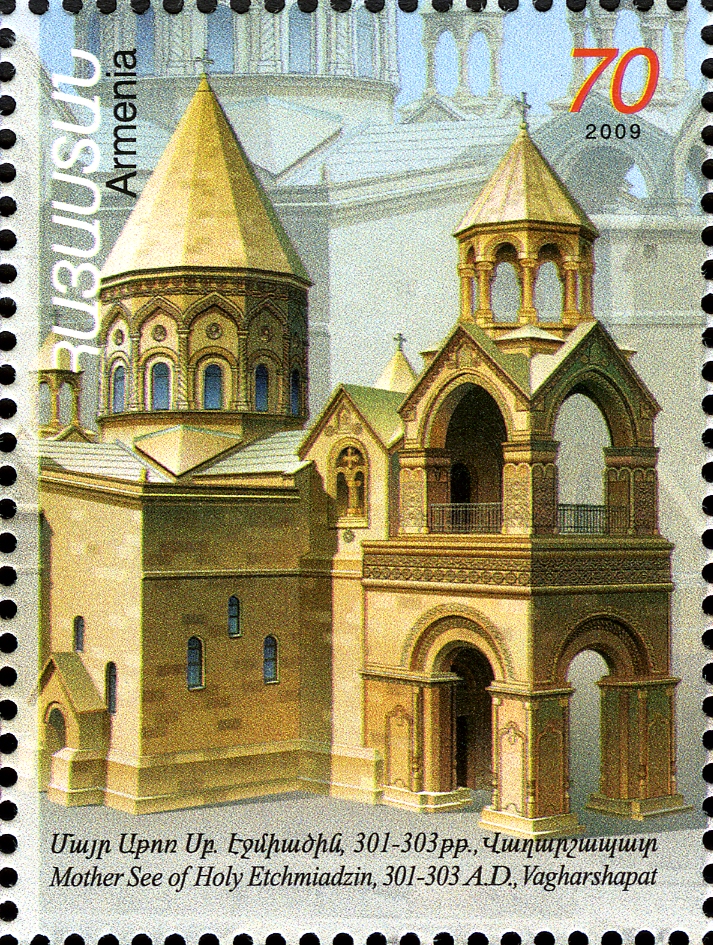
The Soviet Union and Armenia issued postage stamps depicting the cathedral in 1978 and 2009, respectively. The cathedral is depicted on the obverse side of the 50,000 dram banknote (2001) of Armenia.
The cathedral has been depicted in painting by Grigory Gagarin (1847), Panos Terlemezian (1903), and in books by John Mason Neale (1850), August von Haxthausen (1854), John Ussher (1865), and others.
The floor mosaic, created by the 20th-century Israeli artist Hava Yofe, inside the Chapel of Saint Helena at Jerusalem's Church of the Holy Sepulchre depicts the cathedral along with other major Armenian sites. A relief of the cathedral was erected on the headquarters of the Eastern Diocese of the Armenian Church of America next to the St. Vartan Cathedral in New York and silver plate depicting the cathedral is displayed at the American Museum of Natural History in New York.
In the 1991 film Mayrig, directed by French-Armenian director Henri Verneuil, footage of the cathedral is shown when Azad Zakarian, the main character and a son of Armenian genocide survivors, is being questioned about his faith in a Catholic school.
References
;Notes
;Citations
Bibliography
Academic articles
Published books
;Specific
;General
- Reprint of the 1934 ed. published by the Cambridge University Press
References
- Azadian, Edmond Y.. (1999). "History on the Move: Views, Interviews and Essays on Armenian Issues". Wayne State University Press.
- (2010). "Religions of the World: A Comprehensive Encyclopedia of Beliefs and Practices". [[ABC-CLIO]].
- "Ejmiatsin".
- "Պատմաաշխարհագրական ակնարկ [Historical-geographic overview]". Armavir Province: Armenian Ministry of Territorial Administration.
- Jaloyan, Vardan. "Էջմիածնի կաթողիկոսության հիմնադրման քաղաքական և աստվածաբանական հանգամանքները [Theological and political circumstances of the foundation of the Etchmiadzin Catholicosate]". Religions in Armenia.
- (30 June 2014). "The number of foreign tourists visiting Armenia expected to surge to one million".
- Balakian, Peter. (2009). "[[The Burning Tigris]]". HarperCollins.
- (2000). "The Oxford Companion to Christian Thought". Oxford University Press.
- Redgate, A. E.. (2000). "The Armenians". [[Wiley-Blackwell.
- Guroian, Vigen. (2000). "The Oxford Companion to Christian Thought". Oxford University Press.
- Bournoutian, George A.. (1993). "A History of the Armenian People: Pre-history to 1500 A.D". Mazda Publishers.
- (1868). "The Life and Times of S. Gregory the Illuminator: The Founder and Patron Saint of the Armenian Church". [[Rivington (publishers).
- Hmayakyan, Hasmik. (2005). "Հոգևոր ավանդույթների ժառանգությունը (Պտղաբերության պաշտամունքից մինչև քրիստոնեություն) [Heritage of spiritual heritage (From fertility cult to Christianity)]". [[Noravank Foundation]].
- Avetisyan, Kamsar. (1979). "Հայրենագիտական էտյուդներ [Armenian studies sketches]". Sovetakan Grogh.
- "Feast of the Cathedral of Holy Etchmiadzin". Araratian Patriarchal Diocese of the Armenian Holy Apostolic Church.
- "Տոն Կաթողիկե Սբ. Էջմիածնի [Feast of the Cathedral of Holy Etchmiadzin]". Araratian Patriarchal Diocese.
- (2016). "The Eerdmans Encyclopedia of Early Christian Art and Archaeology, ed., Paul Corby Finney". William B. Eerdmans Publishing.
- (2000). "The Heritage of Armenian Literature: From the Oral Tradition to the Golden Age". Wayne State University Press.
- (2013). "Հայրապետական աթոռի' Վաղարշապատից Դվին տեղափոխման հարցի շուրջ [About Transfer of the Patriarchal Throne to Dvin from Vagharshapat]". Armenian Academy of Sciences.
- Ferguson, Everett. (1999). "Encyclopedia of Early Christianity". Routledge.
- (2012). "The Orthodox Christian World". Routledge.
- Grigorian, G. M.. (1976). "Ստեփանոս Օրբելյան [Stepanos Orbelian]". [[Armenian Academy of Sciences]].
- Kurkjian, Vahan. (1958). "A History of Armenia". [[Armenian General Benevolent Union]].
- Gervers, Michael. (1990). "Conversion and Continuity: Indigenous Christian Communities in Islamic Lands Eighth to Eighteenth Centuries". Pontifical Institute of Mediaeval Studies.
- Babaie, Sussan. (2004). "Slaves of the Shah: New Elites of Safavid Iran". I. B. Tauris.
- Cowe, S. Peter. (9 December 2011). "Ejmiatsin".
- (2000). "Armenian Van/Vaspurakan". Mazda Publishers.
- Vivier-Muresan, Anne Sophie. (2007). "Autour de l'Eglise Saint-Georges d'Esfahan". [[School for Advanced Studies in the Social Sciences]].
- "Plan de l'Eglise d'Ecs-miazin ; Profil de l'Eglise d'Ecs-miazin ; Persan fumant le Qalyoun". Brown Digital Repository.
- (2010). "Creative Discoveries of the Russian Artist-travelers". [[Tretyakov Gallery]].
- "Aivazovsky, I. K. View of Echmiadzin in Armenia. 1783–1823". [[Auburn University]].
- "Иванов Михаил (1748–1823). Вид трёх церквей на фоне горы Арарат в Армении.1783". [[Tretyakov Gallery]].
- Nercissian, M. G.. (1972). "Արևելյան Հայաստանի միացումը Ռուսաստանին [Eastern Armenia Joining Russia]". [[Patma-Banasirakan Handes]].
- (2001). "World Christian encyclopedia: a comparative survey of churches and religions in the modern world, Volume 1". Oxford University Press.
- Rev. Samuel G. Wilson. (November 1905). "Riots and the gospel in Transcaucasia". Missionary Review Publishing Company.
- Hovannisian, Richard. (1971). "The Republic of Armenia: The First Years, 1918–1919". University of California Press.
- Asatryan, Hayk. (2004). "Հատընտիր [Selection]". Republican Party of Armenia.
- Ayvazian, Arthur A.. (1985). "Armenian victories at Khznavous and Sardarabad on May 23, 1918: and program for re-establishment of independent and neutral state of Armenia". St. Vartan Press.
- Kayaloff, Jacques. (1973). "The Battle of Sardarabad". [[Walter de Gruyter.
- (2014). "Եկեղեցու սեփականության բռնագրավումը Խորհրդային Հայաստանում (1920 թ. դեկտեմբեր – 1921 թ. փետրվար) [Expropriation of church in Soviet Armenia (December 1920 – February 1921)]". [[Armenian Academy of Sciences]].
- Burchard, Christopher. (1993). "Armenia and the Bible: papers presented to the international symposium held at Heidelberg, July 16-19, 1990". Scholars Press.
- Corley, Felix. (2010). "Eastern Christianity and the Cold War, 1945–91". Routledge.
- Central Diocesan Board. (1958). "Crisis in the Armenian church: text of a memorandum to the National Council of the Churches of Christ in the United States of America on the dissident Armenian Church in America". Armenian National Apostolic Church of America.
- Kolarz, Walter. (1961). "Religion in the Soviet Union". Macmillan.
- (30 January 2003). "Celebrating 1,700th Anniversary of the Consecration of the Mother Cathedral of Holy Etchmiadzin". Mother See of Holy Etchmiadzin, Information Services.
- (3 February 2003). "His Holiness Karekin II Declares 2003 as the Year of Holy Etchmiadzin". Mother See of Holy Etchmiadzin, Information Services.
- (10 June 2014). "Renovation of the Mother Cathedral". Mother See of Holy Etchmiadzin.
- (22 February 2013). "Խորհրդակցություն Մայր տաճարի վերականգնման հարցերի շուրջ [Consultation on the Mother Cathedral's restoration issue]". [[Hetq]].
- (29 September 2024). "Էջմիածնի Մայր տաճարը շուրջ 12 տարվա հիմնանորոգումից հետո վերաօծվեց և դռները բացեց հանրության առջև".
- (29 September 2024). "Մայր տաճարը վերաօծվեց իշխանության ներկայությամբ՝ չնայած եղած լարվածությանը". azatutyun.am.
- (29 September 2024). "Prime Minister Pashinyan attends the re-consecration ceremony of Etchmiadzin Cathedral together with his lady".
- (29 September 2024). "Տեղի ունեցավ Մայր Տաճարի վերաօծման արարողությունը և մատուցվեց Հայրապետական Սուրբ Պատարագ".
- (13 September 2024). "Մայր տաճարում կային հատվածներ, որոնք ուղղակի փլուզման էին ենթակա. գլխավոր ճարտարապետ Ամիրան Բադիշյան".
- (13 September 2024). "Մայր տաճարի վերականգնումն ավարտված է". Shoghakat TV.
- (17 September 2024). "Մայր տաճարի գմբեթին բրոնզաձույլ նոր խաչ է տեղադրվել. Այն հնի կրկնօրինակը չէ, բայց նույն ոճի ու չափի է. ճարտարապետ". news.am.
- (2014). "Sacred Precincts: The Religious Architecture of Non-Muslim Communities Across the Islamic World". BRILL.
- (1875). "Handbook for Travellers in Russia, Poland, and Finland; Including the Crimea, Caucasus, Siberia, and Central Asia". [[John Murray (publishing house).
- {{Cite EB1911. Richard Phené. Spiers. 387]]
- (1910). "Overland to India. Volume 1". [[Macmillan and Co.]].
- (2005). "Early Medieval Architecture as Bearer of Meaning". [[Columbia University Press]].
- (1896). "A Text-Book of the History of Architecture". [[Longmans, Green, and Co.]].
- {{harvnb. Bryce. 1878. Lynch. 1901. Buxton. Buxton. 1914
- {{harvnb. Villari. 1906. Lynch. 1901
- {{harvnb. Bryce. 1878. Lynch. 1901
- Jordan, Robert Paul. (June 1978). "The Proud Armenians". [[The National Geographic Magazine]].
- (1948). "Soviet Russia: The Land and Its People Volume 25". Sheridan House.
- {{harvnb. Telfer. 1876. Lynch. 1901
- {{harvnb. Der Nersessian. 1945. Arakelian. Yeremian. Arevshatian. Bartikian. 1984. Grigoryan. 2012b
- (September 2009). "Խորհրդանշանային պատկերագրության դասական մի օրինակ [A classic example of symbolic iconography]". [[Mother See of Holy Etchmiadzin]].
- (2001). "Byzantium through Armenian Eyes: Cultural Appropriation and the Church of Zuart'noc'". [[Gesta (journal).
- {{harvnb. Grigoryan. 2012b. Shahkhatunian. 1842, {{harvnb. Der Nersessian. 1945
- (8 October 2012). "Многие годы над Первопрестольным Эчмиадзином раздавались звуки священной мантры [For Many Years, Sacred Mantra Sounds Reverberate Over Mother See of Etchmiadzin]". armtoday.info.
- {{harvnb. von Haxthausen. 1854. Bryce. 1878. Lynch. 1901
- (September 24, 2017). "That Tibetan Bell in Armenia Once More".
- [[Marie-Félicité Brosset. (1837). "Note sur quelques monnaies géorgiennes du Musée asiatique et sur une inscription tibétaine d'Edchmiadzin ; par M. Brosset (lu le 25 août 1837) [Note on some Georgian coins from the Asian Museum and on a Tibetan inscription from Edchmiadzin; by Mr. Brosset (read on August 25, 1837)]". [[Russian Academy of Sciences.
- (May 11, 2021). "What Happened to Armenia's Famous Tibetan Bell?".
- (1890). "Այրարատ [Ayrarat]". [[San Lazzaro degli Armeni]].
- (October 14, 2017). "Tibetan Bell in Armenia - Concluding".
- (October 6, 2017). "That Tibetan Bell in Armenia - Part Two".
- (December 15, 1998). "Ejmiatsin".
- {{harvnb. Telfer. 1876. Bryce. 1878
- {{harvnb. Bryce. 1878. Villari. 1906. Lynch. 1901
- link. Mother See of Holy Etchmiadzin
- Hewsen, Robert H.. (15 December 1988). "Bagaran".
- (1962). "Искусство стран и народов мира. 1: Австралия - Египет [Arts of the Countries and Peoples of the World. Vol. 1: Australia - Egypt]". [[Sovetskaya Entsiklopediya]].
- Petrosian, S.. (1978). "[[Soviet Armenian Encyclopedia]] Volume 4".
- Hasratyan, Murad. "Շուշիի Ղազանչեցոց Ս. Ամենափրկիչ եկեղեցի [Ghazanchetsots Church of Shushi]". Institute of Armenian Studies of Yerevan State University <!--.
- Chorbajian, Levon. (1994). "The Caucasian Knot: The History & Geopolitics of Nagorno-Karabagh". [[Zed Books]].
- "Armenian Church". [[National Library Board]].
- "Armenian Cathedral of St. John the Baptist". [[Future for Religious Heritage]].
- (1979). "Բուխարեստի հայկական եկեղեցի [Armenian Church of Bucharest]". [[Mother See of Holy Etchmiadzin]].
- (2005). "Arhitectii Catedralei". Ararat.
- (1904). "Der dom zu Aachen und seine entstellung". J. C. Hinrichs'sche Buchhandlung.
- [[Government of Armenia]]. (2002). "Հայաստանի Հանրապետության Արմավիրի Մարզի Պատմության և Մշակույթի Անշարժ Հուշարձանների Պետական Ցուցակը [List of the Immovable Historical And Cultural Monuments in the Armavir Province of the Republic of Armenia]". Armenian Legal Information System.
- "Cathedral and Churches of Echmiatsin and the Archaeological Site of Zvartnots". UNESCO.
- Lottman, Herbert R.. (29 February 1976). "Despite Ages of Captivity, The Armenians Persevere". [[The New York Times]].
- (1 July 1996). "The Holy Etchmiadzin Museum: History of a Long Journey". [[Armenian General Benevolent Union]].
- Safran, William. (2007). "Nationalism in a Global Era: The Persistence of Nations". Routledge.
- (1968). "Խրիմյան Հայրիկի անդրանիկ կոնդակը [Khrimian Hayrik's First Encyclical]". [[Etchmiadzin (magazine).
- (1991). "Ամենայն Հայոց Վեհափառ Հայրապետի կոնդակը Հայաստանի ազատ ու ինքնիշխան պետության հռչակման առթիվ". [[Etchmiadzin (magazine).
- (1924). "Beginning Again at Ararat". [[Fleming H. Revell Company]].
- Fischer, Louis. (1935). "Soviet Journey". Harrison Smith and Robert Haas.
- (2002). "Pilgrimage: From the Ganges to Graceland: An Encyclopedia, Volume 1". ABC-CLIO.
- (19 August 1994). "Vazgen I, Head of Armenian Church, Dies at 85". [[The New York Times]].
- Historical Section of the Foreign Office. (1920). "Caucasia". Her Majesty's Stationery Office.
- Postajian, Torkom. (2005). "The Armenian Church and the Others".
- Hakobian, Tadevos. (1987). "[[Soviet Armenian Encyclopedia]]".
- Utudjian, Édouard. (1968). "Armenian Architecture: 4th to 17th Century". Editions A. Morancé.
- Papajian, Sarkis. (1974). "A Brief History of Armenia". [[Armenian Evangelical Union of North America]].
- Bauer-Manndorff, Elisabeth. (1981). "Armenia: Past and Present". Reich Verlag.
- (2006). "Eastern Liturgy in the West: The Case of the Armenian Church". Yale Institute of Sacred Music Colloquium: Music, Worship, Arts.
- (2012). "Translators through History". [[John Benjamins Publishing Company]].
- "Holy Etchmiadzin". Diocese of the Armenian Church of America (Eastern).
- (2008). "Encyclopedia of the Peoples of Africa and the Middle East". [[Infobase Publishing]].
- Gertz, Steven. (1 January 2005). "How Armenia "Invented" Christendom". Christianity Today International.
- (2010). "Դպրոցական Մեծ Հանրագիտարան, Գիրք II [Great School Encyclopedia Book II]". [[Armenian Encyclopedia Publishing]].
- (2005). "The Oxford History of Christian Worship". [[Oxford University Press]].
- Nersessian, Vrej. (2001). "Treasures from the Ark: 1700 Years of Armenian Christian Art". [[J. Paul Getty Museum]].
- (1987). "Christianity Today in the USSR". [[International Publishers]].
- (1984). "The Soviet People: Portrait Sketches". Novosti Press Agency Publishing House.
- (1713). "Les six voyages de Jean-Baptiste Tavernier Volume 1". Pierre Ribou.
- (1686). "Journal du voiage du Chevalier Chardin en Perse". Daniel Horthemels.
- (1718). "A voyage into the Levant [Relation d'un voyage du Levant] Volume II".
- Parrot, Friedrich. (2016). "Journey to Ararat". [[Gomidas Institute]].
- Haxthausen, Baron August von. (2016). "Transcaucasia and the Tribes of the Caucasus". Gomidas Institute.
- (1848). "Reise nach dem Ararat und dem Hochland Armenien". J.G. Cotta.
- Скабичевский, Александр. (31 December 1895). "Александр Грибоедов. Его жизнь и литературная деятельность: Биографический очерк А. В. Скабичевского. С портретом Грибоедова, гравированным Геданом". IQPS.
- (7 April 2018). "Boris de Zirkoff on Blavatsky's background and early life".
- Русская художественная литература и геноцид армян: - Page 244, Михаил Давидович Амирханян - 1988
- (2019). "Мемориальная квартира Андрея Белого". [[Pushkin Museum]].
- (28 June 1925). "Fridtjof Nansen bildearkiv – Fridtjof Nansen". [[National Library of Norway]].
- (1972). ""May the Atom ... " A Report of the U.S. Atomic Energy Commission Delegation to the U.S.S.R., August, 1971". [[U.S. Atomic Energy Commission]].
- (31 December 1976). "Վիլյամ Սարոյանը Մայր Աթոռում - Էջմիածին".
- Советская музыка - Issues 7–12 – Page 111
- (9 March 2015). "Ինդիրա Գանդի, Մայր Թերեզա. 20-21-րդ դարերի ամենաազդեցիկ կանանց այցը Հայաստան". [[Armenpress]].
- Карапетян, Давид. (17 January 2005). "Владимир Высоцкий: воспоминания". Захаров.
- "Ереванские этюды Иосифа Бродского".
- "Елена Боннэр. До дневников, Журнал «Знамя», #11, 2005".
- "Modern history [part 2]. How Cher arrived in "freezing" Armenia".
- (18 December 2012). "Alain Delon visited Holy Echmiadzin".
- (October 11, 2019). "Kim Kardashian Reveals She Was Baptized with Her Kids in Armenia and Shares Photos from Ceremony". [[People (magazine).
- (6 June 1967). "Բուլղար օրթոդոքս եկեղեցու պետ, Նորին Սրբություն Տ. Կիրիլ պատրիարքը Մայր Աթոռում - Էջմիածին".
- (31 October 1977). "Քենթրբերիի Արքեպիսկոպոս դոկտոր Ֆրեդերիկ Դոնալդ Կոգանը Մայր Աթոռում - Էջմիածին".
- (30 June 1993). "Քենթրբերիի Արքեպիսկոպոս Նորին Գերաշնորհություն դոկտ. Զորջ Քերիի քարոզը Սուրբ էջմիածնի Մայր տաճարում - Էջմիածին".
- (1978). "Համայն Վրաստանի Պատրիարք-կաթողիկոս Նորին Սրբություն Իլիա Երկրորդը Մայր Աթոռում [His Holiness Ilia II, Catholicos-Patriarch of All Georgia, at the Mother See]". [[Etchmiadzin (magazine).
- (2 May 1997). "Համայն Վրաստանի Կաթողիկոս Պատրիարք Նորին Սրբություն Իլիա Բ-ի այցը Մայր Աթոռ Սուրբ Էջմիածին - Էջմիածին".
- "Վրաց Ուղղափառ Եկեղեցու պետ, Համայն Վրաստանի Կաթողիկոս-Պատրիարք Իլիա Բ-ի այցը Մայր Աթոռ Ս. էջմիածին - Էջմիածին".
- (25 September 2001). "Apostolic Voyage in Armenia Prayer Visit Address of John Paul II, Apostolic Cathedral, Etchmiadzin".
- (30 November 2001). "Կոստանդնուպոլսի Տիեզերական Պատրիարք Բարդուղիմեոս Առաջինի այցը Հայաստան և Մայր Աթոռ Սուրբ էջմիածին, քրիստոնեության Հայաստանում պետական կրոն հռչակման 1700-ամյակի եզրափակիչ տոնակատարություններին մասնակցելու համար - Էջմիածին".
- (31 October 2002). "Անտիոքի և Համայն Արևելքի Ասորի Ուղղափառ Եկեղեցու պետ Նորին Սրբություն Իգնատիոս Զաքքա Ա Իվաս Պատրիարքի այցը Մայր Աթոռ Սուրբ էջմիածին - Էջմիածին".
- (21 October 2002). "Patriarch of Antioch Visits Etchmiadzin". [[Asbarez]].
- (16 March 2010). "Patriarch Kirill's speech at Echmiadzin cathedral". Russian Orthodox Church Department for External Church Relations.
- (24 June 2016). "Visit and Prayer to the Armenian Apostolic Cathedral". [[Holy See]].
- (25 March 2005). "Владимир Путин прибыл в Эчмиадзин [Putin visits Echmiadzin]".
- (1 October 2006). "Ժակ Շիրակը այցելել է Մայր Աթոռ Ս. Էջմիածին [Jacques Chirac visits Mother See of Holy Etchmiadzin]". [[A1plus]].
- (31 October 2011). "Ֆրանսիայի եւ Հայաստանի նախագահների այցը Մայր Աթոռ Ս. Էջմիածին - Էջմիածին".
- (6 October 2011 ). "French President visits Armenia". [[Rustavi 2]] Broadcasting Company.
- (31 March 2004). "Վրաստանի Հանրապետության նախագահ Միխայիլ Սահակաշվիլու այցը Մայր Աթոռ Սուրբ էջմիածին - Էջմիածին".
- (28 February 2014). "Georgian president Giorgi Margvelashvili visits Etchmiadzin".
- (2 July 1998). "Ռումինիայի նախագահի այցը Մայր Աթոռ Սբ. Էջմիածին - Էջմիածին".
- (21 February 2018). "Lebanon president visits Holy Etchmiadzin". news.am.
- (25 August 2018). "Catholicos of All Armenians Garegin II holds meeting with German Chancellor Angela Merkel".
- (25 August 2018). "Անգելա Մերկելն այցելեց Մայր Աթոռ Սուրբ Էջմիածին". 168.am.
- Абрахамян, Ашот Гарегини. (1959). "Рукописные сокровища Матенадарана".
- (7 July 1958). "Նեպալի թագավորը և թագուհին Մայր Աթոռում - Էջմիածին".
- (30 May 2013). "Prince Charles visits the Mother See of Holy Etchmiadzin".
- (August 2000 <!--). "Гербы городов Грузино-Имеретинской губернии Российской империи [Coats of arms of the cities of the Georgian-Imereti province of the Russian Empire]".
- "Герб Еревана [Coat of arms of Yerevan]". Russian Centre of Vexillology and Heraldry.
- ""Էջմիածին" ամսագիր [Etchmiadzin monthly]". Mother See of Holy Etchmiadzin.
- "Banknotes in circulation – 50000 drams". [[Central Bank of Armenia]].
- (1847). "Le Caucase pittoresque".
- Goldhill, Simon. (2009). "Jerusalem, City of Longing". Harvard University Press.
- "Dish, Decorated". [[American Museum of Natural History]].
- (21 August 2012). "Mayrig/Mother (Full Movie in French)". YouTube.
- "Etchmiadzin". Armenian Studies Program [[California State University, Fresno]].
- Hewsen, Robert H.. (2001). "Armenia: A Historical Atlas". University of Chicago Press.
- "Mother See of Holy Etchmiadzin: Mother Cathedral: History". Mother See of Holy Etchmiadzin.
- Sanjian, Avedis Krikor. (1999). "Medieval Armenian Manuscripts at the University of California, Los Angeles". University of California Press.
- Melik-Bakhshyan, Stepan. (2009). "Հայոց պաշտամունքային վայրեր [Armenian places of worship]". Yerevan State University Publishing.
- Chahin, Mack. (2001). "The Kingdom of Armenia: A History". Curzon Press.
- (1879). "[[Encyclopaedia Britannica]] Volume VIII". Adam and Charles Black.
- (1971). "Rome: The Late Empire: Roman Art AD 200-400". [[Thames and Hudson]].
- (1850). "A History of the Holy Eastern Church. Part I". [[Joseph Masters]].
- (1821). "Travels in Georgia, Persia, Armenia, ancient Babylonia, &c. &c. Volume 1". Longman, Hurst, Rees, Orme, and Brown.
- (1818). "A second journey through Persia, Armenia, and Asia Minor, to Constantinople, between the year 1810 and 1816". Longman.
- Sears, Robert. (1855). "An Illustrated Description of the Russian Empire". Robert Sears.
- Freshfield, Douglas W.. (1869). "Travels in the Central Caucasus and Bashan". Longmans, Green, and Co..
- (1833). "Researches of the rev. E. Smith and rev. H.G.O. Dwight in Armenia, Volume 2". [[Crocker & Brewster]].
- (1891). "The Earth and Its Inhabitants: The Universal Geography. Vol. VI: Asiatic Russia". [[James Sprent Virtue.
This article was imported from Wikipedia and is available under the Creative Commons Attribution-ShareAlike 4.0 License. Content has been adapted to SurfDoc format. Original contributors can be found on the article history page.
Ask Mako anything about Etchmiadzin Cathedral — get instant answers, deeper analysis, and related topics.
Research with MakoFree with your Surf account
Create a free account to save articles, ask Mako questions, and organize your research.
Sign up freeThis content may have been generated or modified by AI. CloudSurf Software LLC is not responsible for the accuracy, completeness, or reliability of AI-generated content. Always verify important information from primary sources.
Report