From Surf Wiki (app.surf) — the open knowledge base
Estonian Reform Party
Political party in Estonia

Political party in Estonia
| Field | Value |
|---|---|
| name | Estonian Reform Party |
| native_name | Eesti Reformierakond |
| logo | Estonian Reform Party logo 2019.svg |
| logo_size | 125 |
| colorcode | |
| chairperson | Kristen Michal |
| general_secretary | Timo Suslov |
| founder | Siim Kallas |
| foundation | |
| headquarters | Tallinn, Tõnismägi 9 10119 |
| youth_wing | Estonian Reform Party Youth |
| membership_year | 2024 |
| merger | |
| newspaper | *Paremad Uudised |
| Reformikiri* | |
| membership | 9,669 |
| ideology | |
| position | |
| european | Alliance of Liberals and Democrats for Europe |
| international | Liberal International |
| europarl | Renew Europe |
| slogan | Parem Eesti kõigile |
| ('A Better Estonia for Everyone') | |
| colours | |
| seats1_title | Riigikogu |
| seats1 | |
| seats2_title | Municipalities |
| seats2 | |
| seats3_title | European Parliament |
| seats3 | |
| flag | Flag of the Estonian Reform Party.svgborder |
| flag_alt | Flag of the Estonian Reform Party |
| website | |
| country | Estonia |
| footnotes |
Reformikiri* ('A Better Estonia for Everyone')
The Estonian Reform Party () is a liberal political party in Estonia. The party has been led by Kristen Michal since 2024. It is colloquially known as the "Squirrel Party" () or as "the Squirrels" (), referencing its logo.
It was founded in 1994 by Siim Kallas, then-president of the Bank of Estonia, as a split from Pro Patria National Coalition Party. As the Reform Party has participated in most of the government coalitions in Estonia since the mid-1990s, its influence has been significant, especially regarding Estonia's free-market and low-taxation policies. The party has been a full member of Liberal International since 1996, having been an observer member between 1994 and 1996, and a full member of the Alliance of Liberals and Democrats for Europe (ALDE). Reform Party leaders Siim Kallas, Taavi Rõivas, Andrus Ansip, Kaja Kallas and Kristen Michal have all served as prime ministers of Estonia. From 11 March 2025, the party has been the senior member in a coalition government with Estonia 200.
History
The Estonian Reform Party was founded on 18 November 1994, joining together the Reform Party – a splinter from the Pro Patria National Coalition (RKEI) – and the Estonian Liberal Democratic Party (ELDP). The new party, which had 710 members at its foundation, was led by Siim Kallas, who had been president of the Bank of Estonia. Kallas was not viewed as being associated with Mart Laar's government and was generally considered a proficient central bank governor, having overseen the successful introduction of the Estonian kroon. The party formed ties with the Free Democratic Party of Germany, the Liberal People's Party of Sweden, the Swedish People's Party of Finland, and Latvian Way.
Siim Kallas
Siim Kallas was leader of the Reform Party from 1994 to 2004. He was Prime Minister of Estonia from 2002 to 2003. In the party's first parliamentary election in March 1995, it won 19 seats, catapulting it into second place, behind the Coalition Party. Tiit Vähi tried to negotiate a coalition with the Reform Party, but the talks broke down over economic policy, with the Reform Party opposing agricultural subsidies and supporting the maintenance of Estonia's flat-rate income tax. While the Coalition Party formed a new government with the Centre Party at first, a taping scandal involving Centre Party leader Edgar Savisaar led to the Reform Party replacing the Centre Party in the coalition in November 1995. Kallas was appointed as Minister of Foreign Affairs, with five other Reform Party members serving in the cabinet. The Reform Party left the government in November 1996 after the Coalition Party signed a cooperation agreement with the Centre Party without consulting them.
At the 1999 election, the Reform Party dropped one seat to 18, finishing third behind the Centre Party and the conservative Pro Patria Union. The ER formed a centre-right coalition with the Pro Patria Union and the Moderates, with Mart Laar as Prime Minister and Siim Kallas as Minister of Finance, and with Toomas Savi returned as Speaker. Although the coalition was focused on EU and NATO accession, the Reform Party successfully delivered its manifesto pledge to abolish the corporate tax, one of its most notable achievements. After the October 1999 municipal elections, the three parties replicated their alliance in Tallinn.
The party served in government again from March 1999 to December 2001 in a tripartite government with Pro Patria Union and People's Party Moderates, from January 2002 to March 2003 with the Estonian Centre Party, from March 2003 to March 2005 with Res Publica and People's Union, from March 2005 to March 2007 with the Centre Party and People's Union, from March 2007 to May 2009 with the Pro Patria and Res Publica Union and the Social Democratic Party. From May 2009, the Reform Party was in a coalition government with the Pro Patria and Res Publica Union.
Andrus Ansip

Andrus Ansip was Prime Minister of Estonia from April 2005 to March 2014. After the 2007 parliamentary election the party held 31 out of 101 seats in the Riigikogu, receiving 153,040 votes (28% of the total), an increase of +10%, resulting in a net gain of 12 seats.
Taavi Rõivas
Following the resignation of Andrus Ansip, a new cabinet was installed on 24 March 2014, with Taavi Rõivas of the Reform Party serving as Prime Minister in coalition with the Social Democratic Party (SDE).
In the 2014 European elections held on 25 May 2014, the Reform Party won 24.3% of the national vote, returning two MEPs.
In the 2015 parliamentary election held on 1 March 2015, the Reform Party received 27.7% of the vote and 30 seats in the Riigikogu. It went on to form a coalition with Social Democratic Party and Pro Patria and Res Publica Union. In November 2016, the coalition split because of internal struggle. After coalition talks, a new coalition was formed between Center Party, SDE and IRL, while Reform Party was left in the opposition for the first time since 1999. Rõivas subsequently stepped down as the chairman of the party.
Hanno Pevkur
On 7 January 2017, Hanno Pevkur was elected the new chairman of the Reform Party. Pevkur's leadership was divided from the start and he faced increasing criticism till the end of the year. On 13 December 2017, Pevkur announced that he would not run for the chairmanship from January 2018.
Kaja Kallas
_(cropped).jpg)
Kaja Kallas was elected party leader on 14 April 2018.
Under Kallas' leadership during the 2019 election, the Reform Party achieved its best electoral result to date with 28.8% of the vote and 34 seats, although it initially did not form a government and remained in opposition to the second Ratas government.
In January 2021, after the resignation of Jüri Ratas as prime minister, Kallas formed a Reform Party-led coalition government with the Estonian Centre Party. However, on 3 June 2022, Kallas dismissed the seven ministers affiliated with the Centre Party, governing as a minority government until a new coalition government with Isamaa and SDE as minority partners was formed on 8 July.
In the 2023 parliamentary election, the Reform Party improved on its 2019 electoral performance, with 31.2% of the vote 37 seats. On 7 March 2023, the party initiated coalition negotiations with the new Estonia 200 party and the SDE. A coalition agreement between the three parties was reached by 7 April, allocating seven ministerial seats for the Reform Party, and was officially signed on 10 April. On 17 April, the third Kallas government was sworn into office.
Kristen Michal
In July 2024, Kristen Michal became Estonia’s new prime minister to succeed Kaja Kallas, who resigned as prime minister on July 15 to become the European Union’s new High Representative of the Union for Foreign Affairs and Security Policy.
On 10 March 2025, Kristen Michal announced a "government repair" and expelled the Social Democrats from the coalition. Michal will ask the President to remove the party's ministers from office on 11 March. He stated that the remaining coalition intends to move toward the right and scrap several tax hikes and wage increases.
Ideology and platform
Described as being on the centre, centre-right, or right-wing of the political spectrum, the Estonian Reform Party has variously been described in its ideological orientation as liberal, classical-liberal, liberal-conservative, and conservative-liberal. The party has consistently advocated policies of economic liberalism and fiscal conservatism, and has also been described as neoliberal.
- The party supports Estonian 0% corporate tax on re-invested income and wants to eliminate the dividend tax.
- The party wanted to cut flat income tax rate from 22% (in 2007) to 18% by 2011. Because of the economic crisis, the campaign for cutting income tax rate was put on hold with the tax rate at 21% in 2008 and 2009.
- The party used to oppose VAT general rate increases until late spring 2009, when it changed its position in the light of the dire economic crisis and the need to find more money for the budget. VAT was increased from 18% to 20% on 1 July 2009.
Political support
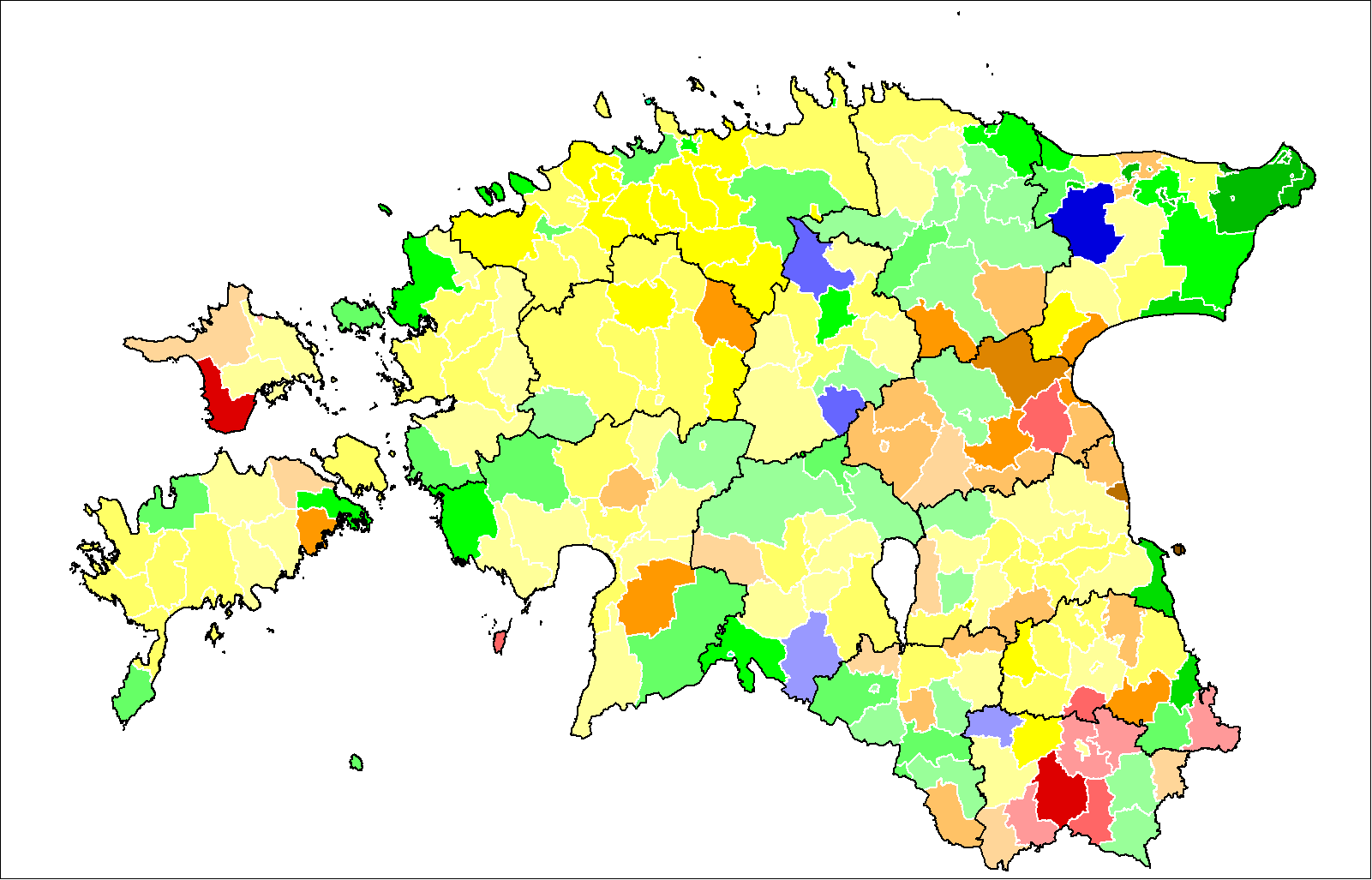
The party is supported predominantly by young, well-educated, urban professionals. The Reform Party's vote base is heavily focused in the cities; although it receives only one-fifth of its support from Tallinn, it receives three times as many votes from other cities, despite them being home to fewer than 40% more voters overall.
Its voter profile is significantly younger than average, while its voters are well-educated, with the fewest high school drop-outs of any party. Its membership is the most male-dominated of all the parties, yet it receives the support of more female voters than average. Reform Party voters also tend to have higher incomes, with 43% of Reform Party voters coming from the top 30% of all voters by income.
Organisation
The Reform Party has been a full member of the Alliance of Liberals and Democrats for Europe Party (formerly the European Liberal Democrat and Reform Party, ELDR) since December 1998. In the European Parliament, the party's MEPS Andrus Ansip and Urmas Paetsits in the ALDE group in the Assembly. The Reform Party has been a full member of the Liberal International since 1996, having been an observer member from 1994 to 1996.
The party claims to have 12,000 members.
The party's youth wing is the Estonian Reform Party Youth, which includes members aged 15 to 35. The organisation claims to have 4,500 members, and its chairman is Doris Lisett Rudnevs.
Election results
Parliamentary elections
| Election | Leader | Votes | % | Seats | +/– | Status | 1995 | 1999 | 2003 | 2007 | 2011 | 2015 | 2019 | 2023 |
|---|---|---|---|---|---|---|---|---|---|---|---|---|---|---|
| Siim Kallas | 87,531 | 16.19 (#2) | New | |||||||||||
| 77,088 | 15.92 (#3) | 1 | ||||||||||||
| 87,551 | 17.69 (#3) | 1 | ||||||||||||
| Andrus Ansip | 153,044 | 27.82 (#1) | 12 | |||||||||||
| 164,255 | 28.56 (#1) | 2 | ||||||||||||
| Taavi Rõivas | 158,970 | 27.69 (#1) | 3 | |||||||||||
| Kaja Kallas | 162,363 | 28.93 (#1) | 4 | |||||||||||
| 190,632 | 31.24 (#1) | 3 |
ImageSize = width:450 height:150 PlotArea = width:420 height:125 left:30 bottom:20 AlignBars = justify
Colors = id:ER value:rgb(0.000,0.500,0.000)
DateFormat = x.y Period = from:0 till:35 TimeAxis = orientation:vertical ScaleMajor = unit:year increment:5 start:5
PlotData= bar:Votes color:yellow width:30 mark:(line,white) align:left fontsize:S bar:95 color:yellow from:start till:16.2 text:16.2 align:center bar:99 color:yellow from:start till:14.9 text:14.9 align:center bar:03 color:yellow from:start till:17.7 text:17.7 align:center bar:07 color:yellow from:start till:27.8 text:27.8 align:center bar:11 color:yellow from:start till:28.6 text:28.6 align:center bar:15 color:yellow from:start till:27.7 text:27.7 align:center bar:19 color:yellow from:start till:28.8 text:28.8 align:center bar:23 color:yellow from:start till:31.2 text:31.2 align:center
ImageSize = width:450 height:150 PlotArea = width:420 height:125 left:30 bottom:20 AlignBars = justify
Colors = id:EK value:rgb(0.000,0.500,0.000)
DateFormat = yyyy Period = from:0 till:40 TimeAxis = orientation:vertical ScaleMajor = unit:year increment:5 start:0
PlotData= bar:Seats color:yellow width:30 mark:(line,white) align:left fontsize:S bar:95 color:yellow from:start till:19 text:19 align:center bar:99 color:yellow from:start till:18 text:18 align:center bar:03 color:yellow from:start till:19 text:19 align:center bar:07 color:yellow from:start till:31 text:31 align:center bar:11 color:yellow from:start till:33 text:33 align:center bar:15 color:yellow from:start till:30 text:30 align:center bar:19 color:yellow from:start till:34 text:34 align:center bar:23 color:yellow from:start till:37 text:37 align:center
European Parliament elections
European representation
In the European Parliament, the Estonian Reform Party sits in the Renew Europe group with one MEP.
In the European Committee of the Regions, the Estonian Reform Party sits in the Renew Europe CoR group, with two full and two alternate members for the 2025–2030 mandate.
Notes
References
Cited sources
References
- "Äriregistri teabesüsteem".
- "ANALÜÜS {{!}} Eesti otsib süüdlast! Valimisõigust piiratakse, aga enne tuleb maha pidada üks vägev poliitmadin".
- "JUHTKIRI {{!}} Michalil on nüüd hiigelvastutus. Läbikukkumine lööks tervet Eestit".
- "TAGATUBA {{!}} Kuskilt andnuks varem või hiljem järele. Kristen Michali valitsusremont oli aja küsimus".
- "Kuidas pullivennast sai Eesti riigi vägevaim ametnik".
- "Maris Lauri - x.com".
- Oskolkov, Petr. (January 2020). "Estonia's party system today: electoral turbulence and changes in ethno-regional patterns". Baltic Region.
- (2 February 2021). "Estonia: Kaja Kallas and the liberal Estonia of the future".
- Bugajski (2002), p. 64
- Nørgaard (1999), p. 75
- (1999). "The Consolidation of Democracy in East-Central Europe". Edward Elgar Publishing.
- Europa Publications (1998), p 336
- Bugajski (2002), p. 52
- Berglund et al (2004), p 67
- Bugajski (2002), p. 53
- (26 March 2014). "Estonia swears in EU's youngest PM, Taavi Roivas".
- "Euroopa Parlamendi valimised".
- "Riigikogu valimised".
- (9 November 2016). "Prime Minister loses no confidence vote, forced to resign". ERR.
- (23 November 2016). "49th cabinet of Estonia sworn in under Prime Minister Jüri Ratas". ERR.
- (5 January 2017). "Reform Party chairmanship debate behind closed doors, internal voting to end on Thursday". ERR.
- (8 January 2017). "Hanno Pevkur elected new Reform Party chairman". ERR.
- (13 December 2017). "Pevkur not to run for Reform lead again, Kallas not announcing yet". ERR.
- (15 April 2018). "Estonia's struggling Reform Party picks first female leader". [[The Sydney Morning Herald]].
- (24 January 2021). "Kaja Kallas to become Estonia's first female prime minister". euronews.
- (3 June 2022). "Estonian prime minister dismisses junior coalition partner from government".
- (8 July 2022). "Reform, SDE, Isamaa strike coalition agreement".
- (2023-03-08). "Estonia's Reform Party starts coalition government talks".
- (7 April 2023). "SDE leader: Coalition agreement ready, includes tax changes".
- (8 April 2023). "Coalition agreement: VAT, income tax to rise by 2 percentage points".
- (10 April 2023). "Gallery: Reform, Eesti 200 and SDE sign coalition agreement". Err.
- (12 April 2023). "Riigikogu gives Kaja Kallas mandate to form new government". Err.
- (22 July 2024). "Estonia's parliament backs Kristen Michal as new PM". POLITICO.
- ERR. (2025-03-10). "Reformierakonna ja Eesti 200 valitsus jätaks ära ettevõtete tulumaksu".
- (1 March 2015). "Estonia's pro-NATO Reform party wins vote overshadowed by Russia". AFP via Yahoo! News.
- Walker, Shaun. "Racism, sexism, Nazi economics: Estonia's far right in power". The Guardian.
- Vello Pettai. (4 March 2019). "Thirty Years of Political Campaigning in Central and Eastern Europe". Springer International.
- Dorothea Keudel-Kaiser. (2014). "Government Formation in Central and Eastern Europe: The Case of Minority Governments". Verlag Barbara Budrich.
- Mindaugas Kuklys. (2014). "Parliamentary Elites in Central and Eastern Europe: Recruitment and Representation". Routledge.
- Elisabeth Bakke. (2010). "Central and East European party systems since 1989". Cambridge University Press.
- (2016). "Encyclopedia of World Political Systems, Volume One". Routledge.
- (2019). "Liberal Parties in Europe". Taylor & Francis.
- Smith, Alison F.. (2020). "Political party membership in new democracies electoral rules in Central and East Europe". Palgrave Macmillan.
- Alari Purju. (2003). "Doing Business with Estonia". GMB Publishing Ltd.
- Kjetil Duvold. (2017). "Borders in the Baltic Sea Region: Suturing the Ruptures". Springer.
- Hans Slomp. (2011). "Europe, a Political Profile: An American Companion to European Politics". ABC-CLIO.
- (5 March 2007). "Die estnischen Parteien". [[Der Standard]].
- (3 March 2019). "Estonia's opposition Reform Party wins general election {{!}} DW {{!}} 3 March 2019".
- (3 March 2003). "Estonian Politicians Maneuvers to Form Coalition Government".
- (2020). "The European Parliament Election of 2019 in East-Central Europe: Second-Order Euroscepticism". Springer Nature.
- (21 August 2014). "Eesti Rahvus Ringhääling".
- Berglund et al (2004), p 65
- Kulik and Pshizova (2005), p. 153
- Kulik and Pshizova (2005), p. 151
- "History : ELDR 1976 – 2009". [[European Liberal Democrat and Reform Party]].
- "Organisatsioon". Estonian Reform Party.
- (11 April 2017). "Juhtimine". Estonian Reform Party Youth.
- (20 April 1974). "Home {{!}} Urmas PAET {{!}} MEPs {{!}} European Parliament".
- "Members Page CoR".
- "Members Page CoR".
This article was imported from Wikipedia and is available under the Creative Commons Attribution-ShareAlike 4.0 License. Content has been adapted to SurfDoc format. Original contributors can be found on the article history page.
Ask Mako anything about Estonian Reform Party — get instant answers, deeper analysis, and related topics.
Research with MakoFree with your Surf account
Create a free account to save articles, ask Mako questions, and organize your research.
Sign up freeThis content may have been generated or modified by AI. CloudSurf Software LLC is not responsible for the accuracy, completeness, or reliability of AI-generated content. Always verify important information from primary sources.
Report