From Surf Wiki (app.surf) — the open knowledge base
Erythema migrans
Rash in several vector-borne diseases
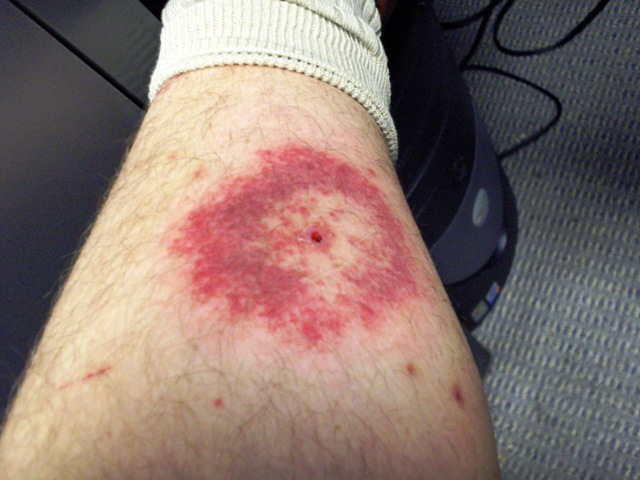
Rash in several vector-borne diseases
Not to be confused with erythema multiforme, despite that both often involve target lesions (but from different causes).
Erythema migrans or erythema chronicum migrans is an expanding rash often seen in the early stage of Lyme disease, and can also (but less commonly) be caused by southern tick-associated rash illness (STARI). It can appear anywhere from one day to one month after a tick bite. This rash does not represent an allergic reaction to the bite, but rather an actual skin infection. The rash's name comes from Neo-Latin for "migrating redness."
|File:Bullseye Lyme Disease Rash.jpg |In Europe, 80% of Lyme rashes look like a "bull's eye," but in only 20% of cases in the United States. (20 percent of Lyme infections show no rash.)
|File:Solid_erythema_migrans_rash_on_the_neck_of_a_woman_with_Lyme_disease.jpg|Erythema migrans ("migrating redness") and may have no definite pattern, as in this Lyme rash on a woman's neck. Rashes from non-Lyme causes may look similar.
Lyme disease
"Erythema migrans is the only manifestation of Lyme disease in the United States that is sufficiently distinctive to allow clinical diagnosis in the absence of laboratory confirmation." Often, but not always, mentions of a target lesion (bull's-eye lesion) are talking about erythema migrans. However, the appearance of erythema migrans can vary considerably: while some look like a bull's eye, in the U.S. most are evenly red or bluish, without a central or ring-like clearing. A minority of patients never have any rash. Because Lyme disease can within a few weeks cause long-term neurologic complications, persons with a rash and recent history of outdoor activities where Lyme is common should seek a doctor for diagnosis.
Presentation
The initial sign of about 80% of Lyme infections is an erythema migrans (EM) rash at the site of a tick bite, often near skin folds, such as the armpit, groin, or back of knee, on the trunk, under clothing straps, or in children's hair, ear, or neck.[[File:Lyme Disease Rash.jpg|thumb|Visible part of the Lyme disease rash showing its characteristic asymmetrical cross-section]]
The EM rash is often accompanied by symptoms of a viral-like illness, including fatigue, headache, body aches, fever, and chills, but usually not nausea or upper-respiratory problems. These symptoms may also appear without a rash, or linger after the rash disappears. Lyme can progress to later stages without these symptoms or a rash.
A person with an asymptomatic EM rash can easily miss its significance. However, if the initial EM rash is not treated, the infection can disseminate through the lymphatic system or blood. Within days or weeks, additional EM rashes, usually smaller, can appear at other sites, or the infection can cause more serious complications in the nervous system, heart, or joints.
Southern tick-associated rash illness
Southern tick-associated rash illness (STARI) produces a similar rash pattern although it develops more quickly and is smaller. This erythema is also sometimes called erythema migrans or EM. The associated infectious agent has not been determined. Antibiotic treatment resolves the illness quickly.
Treatment
Both Lyme disease and STARI can be treated with antibiotics, particularly doxycycline, or amoxicillin in children less than 8 years of age.
History
In a 1909 meeting of the Swedish Society of Dermatology, Arvid Afzelius first presented research about an expanding, ring-like lesion he had observed. Afzelius published his work 12 years later and speculated the rash came from the bite of an Ixodes tick, meningitic symptoms and signs in a number of cases and that both sexes were affected. This rash was known as erythema chronicum migrans, the skin rash found in early-stage Lyme disease.
In the 1920s, French physicians Garin and Bujadoux described a patient with meningoencephalitis, painful sensory radiculitis, and erythema migrans following a tick bite, and they postulated the symptoms were due to a spirochetal infection. In the 1940s, German neurologist Alfred Bannwarth described several cases of chronic lymphocytic meningitis and polyradiculoneuritis, some of which were accompanied by erythematous skin lesions.
References
References
- "Lone star tick a concern, but not for Lyme disease".
- (2017). "Diagnostic Utility of Erythema Migrans". Clinical Infectious Diseases.
- (June 2012). "Diagnosis and management of Lyme disease". Am Fam Physician.
- (20 June 2007). "Does This Patient Have Erythema Migrans?". JAMA.
- (21 December 2018). "Lyme disease rashes and look-alikes". Centers for Disease Control and Prevention.
- (March 2024). "Delayed Diagnosis of Locally Acquired Lyme Disease, Central North Carolina, USA.". Emerging Infectious Diseases.
- (1 September 2018). "Annular Lesions: Diagnosis and Treatment.". American Family Physician.
- (November 2006). "The clinical assessment, treatment, and prevention of Lyme disease, Human Granulocytic Anaplasmosis, and Babesiosis: Clinical Practice Guidelines by the Infectious Diseases Society of America". Clin. Infect. Dis..
- (January 2008). "The rising challenge of Lyme borreliosis in Canada". Can. Commun. Dis. Rep..
- (May 2014). "Clinical practice. Lyme disease". The New England Journal of Medicine.
- Juckett, G. (2014). "In reply: Comment on 'Identifying erythema migrans rash in patients with Lyme disease'". Am Fam Physician.
- Edlow JA. (2002). "Erythema migrans". Med Clin North Am.
- Goddard J (2017) ''Not all erythema migrans lesions are Lyme disease''. The American journal of medicine, 130(2), 231-233.
- Rapini, Ronald P.. (2007). "Dermatology". Mosby.
- (June 2008). "Southern Tick-Associated Rash Illness: Erythema Migrans Is Not Always Lyme Disease". South. Med. J..
- Lipschütz, B.. (1931). "Zur Kenntnis der "Erythema chronicum migrans"". Acta Dermato-Venereologica.
This article was imported from Wikipedia and is available under the Creative Commons Attribution-ShareAlike 4.0 License. Content has been adapted to SurfDoc format. Original contributors can be found on the article history page.
Ask Mako anything about Erythema migrans — get instant answers, deeper analysis, and related topics.
Research with MakoFree with your Surf account
Create a free account to save articles, ask Mako questions, and organize your research.
Sign up freeThis content may have been generated or modified by AI. CloudSurf Software LLC is not responsible for the accuracy, completeness, or reliability of AI-generated content. Always verify important information from primary sources.
Report