From Surf Wiki (app.surf) — the open knowledge base
Eritrean nakfa
Currency of Eritrea
Currency of Eritrea
| Field | Value |
|---|---|
| local_name1 | ናቕፋ |
| local_name_lang1 | ti |
| local_name2 | ناكفا |
| local_name_lang2 | ar |
| image_1 | Banknotes of Eritrea 02.JPG |
| image_title_1 | Nakfa banknotes |
| iso_code | ERN |
| date_of_introduction | 15 November 1997 |
| using_countries | |
| inflation_rate | 9% |
| inflation_source_date | April 2017 |
| pegged_with | U.S. dollar = 15 nakfa |
| subunit_ratio_1 | |
| subunit_name_1 | Cent |
| symbol | Nfk |
| symbol_comment | (Latin script) |
| (Ge'ez script) | |
| (Arabic script) | |
| used_coins | 1, 5, 10, 25, 50, 100 cents |
| used_banknotes | 1, 5, 10, 20, 50, 100 nakfa |
| issuing_authority | Bank of Eritrea |
(Ge'ez script) (Arabic script) The nakfa (ISO 4217 code: ERN; naḳfa, or or نقفة nākfā) is the currency of Eritrea and was introduced on 15 November 1997 to replace the birr at par. The currency takes its name from the Eritrean town of Nakfa, site of the first major victory of the Eritrean War of Independence. The nakfa is divided into 100 cents.
The nakfa is pegged to the US dollar at a fixed rate of US$1 = ERN 15. At earlier times, it was officially pegged at US$1 = ERN 13.50. The currency is not fully convertible, so black market rates available on the streets typically offered a rate of 15 nakfas per dollar.
Between 18 November and 31 December 2015, the Bank of Eritrea began replacement of all nakfa banknotes. The banknote replacement initiative was designed to combat counterfeiting, the informal economy but primarily Sudanese human traffickers who had accepted payments in nakfa banknotes in exchange for transporting would-be migrants primarily to Europe. A consequence of this was substantial amounts of the country's currency existed in vast hoards outside of Eritrea.
The plan to replace the country's currency was top secret and designed to prevent human traffickers bringing their funds back in time to exchange for the new banknotes. On 1 January 2016 the old nakfa banknotes ceased being recognized as legal tender, rendering external stockpiles of currency worthless.
The current series of banknotes is the artwork of an Afro-American banknote designer, Clarence Holbert, and printed by German currency printer Giesecke & Devrient.
Coins
Nakfa coins are made entirely of nickel-clad steel. Each coin has a different reeded edge, instead of consistent reeding for all denominations. The 1 nakfa coin carries the denomination "100 cents". The common reverse shows fighters raising the Eritrean flag, the date "1991" and the legend "Liberty, Equality and Justice."
| Image | Value | Obverse design |
|---|---|---|
| https://www.foreigncurrencyandcoin.com/product/eritrea-1-cent | 1 cent | Red-fronted gazelle |
| https://www.foreigncurrencyandcoin.com/product/eritrea-5-cents | 5 cents | Leopard |
| https://www.foreigncurrencyandcoin.com/product/eritrea-10-cents | 10 cents | North African ostrich |
| https://www.foreigncurrencyandcoin.com/product/eritrea-25-cents | 25 cents | Grévy's zebra |
| https://www.foreigncurrencyandcoin.com/product/eritrea-50-cents | 50 cents | Greater kudu |
| https://www.foreigncurrencyandcoin.com/product/eritrea-100-cents | 100 cents | African bush elephant and calf |
Banknotes
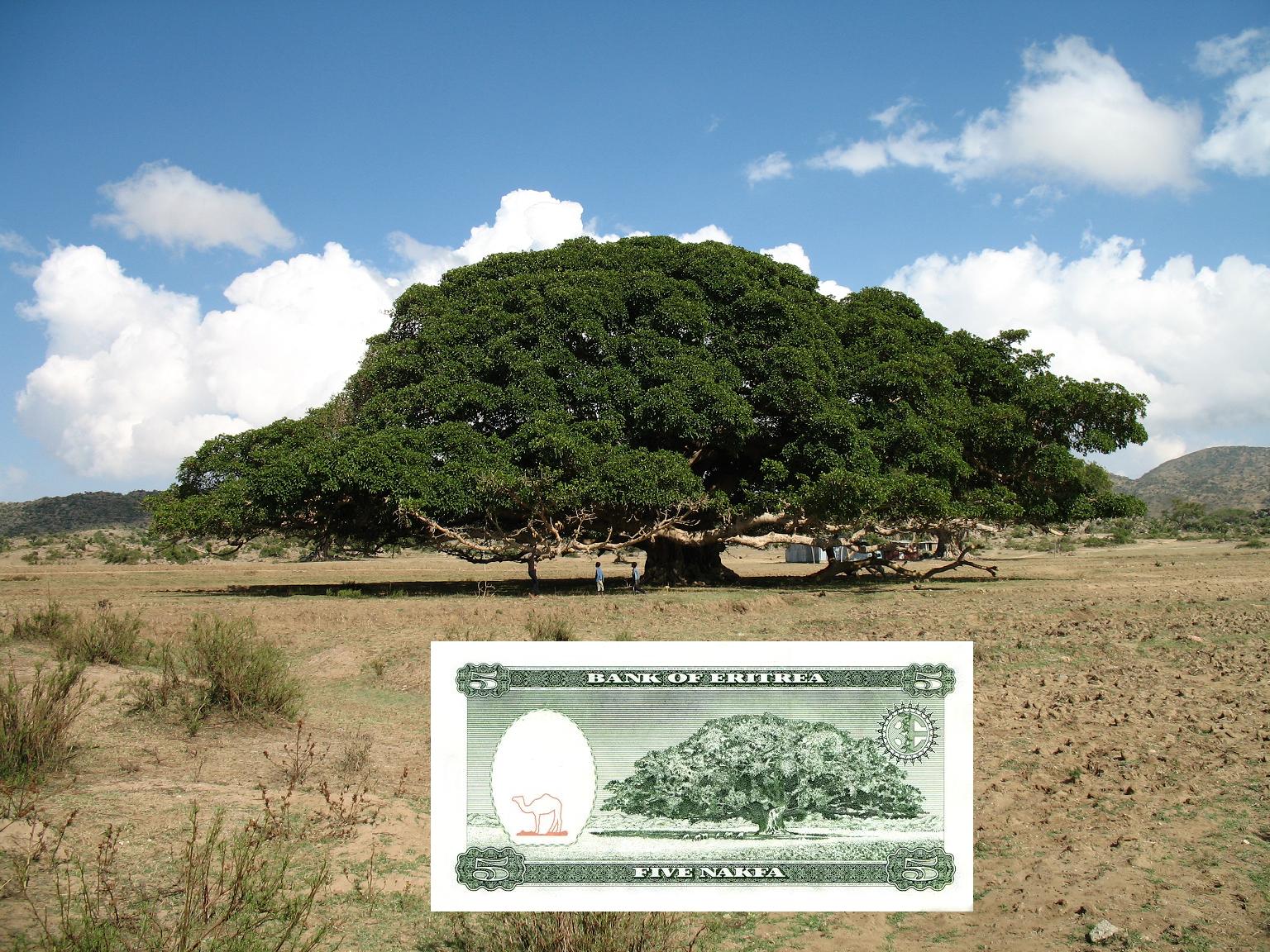
The nakfa banknotes were designed by Clarence Holbert of the United States Bureau of Engraving and Printing in 1994. They depict ordinary people from each of Eritrea's nine principal ethnic groups (Tigrinya, Tigre, Rashaida, Nara, Afar, Saho, Bilen, Beja, Kunama), rather than any political or historical figures.
There have been five series of banknotes since the currency's launch. The first issue for all denominations was dated 24 May 1997; the second issue consists of only the 50 and 100 nakfa notes and is dated 24 May 2004; the third issues also consists of only the 50 and 100 nakfa notes and was dated 24 May 2011, and the fourth issues consisted of only the 10 and 20 nakfa notes and was dated 24 May 2012. (24 May is Eritrea's Independence Day). The current fifth banknote series which rendered all previous currency valueless is dated 24 May 2015.
| Banknotes of the Eritrean nakfa (1997–present series) | Image | Value | Dimensions | Main color | Description | Date of issue | Date of first issue | Watermark | Obverse | Reverse | ||
|---|---|---|---|---|---|---|---|---|---|---|---|---|
| [[File:Eritrea-1Nakfa.jpg | 150px | 1 nakfa]] | ||||||||||
| [[File:1nakfa.jpg | 150px | 1 nakfa]] | 1 nakfa | 140 x 70 mm | Dark brown and black on multicolored underprint | Triple portrait of three children of Eritrea's nine nationalities; flag raising | Children in bush school | 1997 | ||||
| 2015 | 24 May 1997 | Camel head | ||||||||||
| [[File:5 накф аверс.png | 150px | 5 nakfa]] | ||||||||||
| [[File:5_накф_реверс.png | 150px | 5 nakfa]] | 5 nakfa | Triple portrait of Eritrea's nine nationalities: Young boy, young man, and older man; flag raising | Sycamore fig tree | |||||||
| [[File:10 nakfa.jpg | 150px | 10 nakfa]] | ||||||||||
| [[File:10_nakfa_2.jpg | 150px | 10 nakfa]] | 10 nakfa | Triple portrait of three young women of Eritrea's nine nationalities; flag raising | Eritrean railway | 1997 | ||||||
| 2012 | ||||||||||||
| 2015 | ||||||||||||
| [[File:Banknotes of Eritrea 04.JPG | 150px | 20 nakfa]] | 20 nakfa | Triple portrait of three young women of Eritrea's nine nationalities; flag raising | Three agricultural scenes: farmer plowing with a camel, women harvesting, woman on tractor | |||||||
| [[File:Banknotes of Eritrea 06.JPG | 150px | 50 nakfa]] | 50 nakfa | 143 x 71 mm | Brown-red on pale yellow underprint | Triple portrait of three women of Eritrea's nine nationalities; flag raising | Freighter ships at Massawa port | 1997 | ||||
| 2004 | ||||||||||||
| 2011 | ||||||||||||
| 2015 | ||||||||||||
| [[File:Banknotes of Eritrea 05.JPG | 150px | 100 nakfa]] | 100 nakfa | 147 x 72 mm | Blue and black on pale yellow underprint | Farmers plowing with oxen | 1997 | |||||
| 2004 | ||||||||||||
| 2011 |
Exchange rate
Eritrea's government has resisted calls to float the nation's currency, preferring the stability of a fixed exchange rate. However periodic devaluations have been made. the official exchange rate was 15 ERN to 1 USD. ERN is a very weak currency. The de facto exchange rate of the currency is around 100 ERN for US$1. The currency does not have a good demand outside of Eritrea. The black markets that exist in Asmara and a few other towns show the diminishing values of ERN.
References
References
- (April 2017). "Inflation rate, average consumer prices". [[IMF]].
- (2004). "A Broke Nation". Université Cheikh Anta Diop de Dakar.
- (2016). "Eritrea won't shorten national service despite migration fears". Sallina News.
- (2015). "Meet the New Eritrea Nakfa Bank Notes". Tesfa News.
- (2015). "Designing Eritrea's Money was 'Dream Come True'". Tesfa News.
- (2015). "Currency and exchange facilities". Eritrea Be.
- "Nakfa - Eritrean currency".
- "1 Cent, Eritrea".
- "50 Cents, Eritrea".
- (2012). "The Banknote Book". www.BanknoteNews.com.
This article was imported from Wikipedia and is available under the Creative Commons Attribution-ShareAlike 4.0 License. Content has been adapted to SurfDoc format. Original contributors can be found on the article history page.
Ask Mako anything about Eritrean nakfa — get instant answers, deeper analysis, and related topics.
Research with MakoFree with your Surf account
Create a free account to save articles, ask Mako questions, and organize your research.
Sign up freeThis content may have been generated or modified by AI. CloudSurf Software LLC is not responsible for the accuracy, completeness, or reliability of AI-generated content. Always verify important information from primary sources.
Report