From Surf Wiki (app.surf) — the open knowledge base
Erie County, New York
County in New York, United States

County in New York, United States
| Field | Value |
|---|---|
| county | Erie County |
| state | New York |
| type | County |
| flag | Flag of Erie County, New York.gif |
| seal | Seal of Erie County, New York.png |
| founded | 1821 |
| seat wl | Buffalo |
| largest city wl | Buffalo |
| area_total_sq_mi | 1227 |
| area_land_sq_mi | 1043 |
| area_water_sq_mi | 184 |
| area percentage | 15 |
| pop | 954,236 |
| pop_est_as_of | 2024 |
| population_est | 950,602 |
| density_sq_mi | auto |
| ex image | {{multiple image |
| border | infobox |
| total_width | 290 |
| image_style | border:1; |
| perrow | 1/3/2/2 |
| image1 | County and City Hall, Buffalo NY.jpg |
| image2 | Wendt Beach March 2007.jpg |
| image3 | Akron Falls Park - 20211027 - 42 - Akron Falls (tight shot).jpg |
| image7 | Buffalo Botanical Gardens.jpg |
| image4 | Chestnut Ridge Park Oct2010.jpg |
| image5 | Canisius College - Quad 2.jpg |
| image6 | Sunset over the Erie Canal in North Tonawanda, NY..jpg |
| ex image cap | Left to right from top: Erie County Hall, Wendt Beach Park, Akron Falls Park, Chestnut Ridge Park, Canisius University, Gateway Park, Buffalo and Erie County Botanical Gardens |
| district | 23rd |
| district2 | 26th |
| time zone | Eastern |
| named for | Eriechronon |
| leader type | County Executive |
| leader_name | Mark C. Poloncarz (D) |
| census yr | 2020 |
| website |
Erie County is a county along the shore of Lake Erie in the western region of the U.S. state of New York. As of the 2020 census, the population was 954,236. However, in 2023 the estimated population was 946,147. The county seat is Buffalo, which makes up about 28% of the county's population. Both the county and Lake Erie were named for the regional Iroquoian language-speaking Erie tribe of Native Americans, who lived in the area before 1654. They were later pushed out by the more powerful Iroquoian nations tribes. The county is part of the Western New York region of the state.
Erie County, along with its northern neighbor Niagara County, makes up the Buffalo-Niagara Falls metropolitan area, the second largest in the State of New York behind New York City. The county's southern part is known as the Southtowns.
History
When counties were established by the English colonial authorities in the Province of New York in 1683, present-day Erie County was inhabited by the Iroquois. Significant colonization by White Americans did not begin until after the United States had gained independence with the end of the American Revolutionary War in 1783. The U.S. forced the Iroquois to cede most of their lands, as many had been allies of the British during the conflict.
About 1800, the Holland Land Company, formed by American businessmen and their Dutch associates, extinguished aboriginal claims by purchasing the land from New York, acquired the title to the territory of what are today the eight westernmost counties of New York, surveyed their holdings, established towns and began selling lots to individuals. The state was eager to attract settlers and have homesteads and businesses developed. At this time, all of western New York was included in Ontario County.
As the population increased, the state legislature created Genesee County in 1802 out of part of Ontario County. In 1808, Niagara County was created out of Genesee County. In 1821, Erie County was created out of Niagara County, encompassing all the land between Tonawanda Creek and Cattaraugus Creek. The first towns formed in present-day Erie County were the Town of Clarence and the Town of Willink. Clarence and Willink comprised the northern and southern portions of Erie county, respectively. Clarence is still a distinct town, but Willink was quickly subdivided into other towns. When Erie County was established in 1821, it consisted of the towns of Amherst, Aurora, Boston, Clarence, Collins, Concord, Eden, Evans, Hamburg, Holland, Sardinia and Wales.
The county has a number of houses and other properties listed on the National Register of Historic Places listings in Erie County, New York.
In 1861, the hamlet of Town Line in the Town of Lancaster voted 85–40 to secede from the Union. Town Line never sought admission into the Confederate States of America and there is no evidence that men from the community ever fought for the Confederacy. Some reporting from that time indicates the vote was a joke. On January 24, 1946, as part of a nationally reported event, Town Line voted to officially return to the Union after 85 years of Union secession.{{cite news |access-date = September 7, 2012 |url-status = bot: unknown |archive-url = https://archive.today/20120730041300/http://www.buffalonews.com/city/article547531.ece |archive-date = July 30, 2012
Geography
According to the U.S. Census Bureau, the county has a total area of 1,227 sqmi, of which 1,043 sqmi (85%) is land and 184 sqmi (15%) is water.
Erie County is in the western portion of upstate New York, bordering on the lake of the same name. Part of the industrial area that has included Buffalo, it is the most populous county in upstate New York outside of the New York City metropolitan area. The county also lies on the international border between the United States and Canada, bordering the Province of Ontario.
The northern border of the county is Tonawanda Creek. Part of the southern border is Cattaraugus Creek. Other major streams include Buffalo Creek (Buffalo River), Cayuga Creek, Cazenovia Creek, Scajaquada Creek, Eighteen Mile Creek and Ellicott Creek. The county's northern half, including Buffalo and its suburbs, is known as the Northtowns and is relatively flat and rises gently up from the lake. The southern half, known as the Southtowns, is much hillier. It has the northwesternmost foothills of the Appalachian Mountains. The highest elevation in the county is a hill in the Town of Sardinia that tops out at around 1,940 ft above sea level. The lowest ground is about 560 ft, on Grand Island at the Niagara River. The Onondaga Escarpment runs through the northern part of Erie County.
Rivers, streams and lakes
- Buffalo River
- Cattaraugus Creek
- Cayuga Creek
- Cazenovia Creek
- Eighteen Mile Creek
- Ellicott Creek
- Lake Erie
- Niagara River
- Scajaquada Creek
- Tonawanda Creek
Adjacent counties and municipality
- Niagara County - north
- Genesee County - northeast
- Wyoming County - southeast
- Cattaraugus County - south
- Chautauqua County - southwest
- Niagara Region, Ontario, Canada - northwest
Major highways
- [[File:I-90.svg|20px]] [[File:NYS Thruway Sign.svg|20px]] Interstate 90 (New York State Thruway)
- [[File:I-190 (long).svg|22px]] Interstate 190 (Niagara Thruway)
- [[File:I-290 (long).svg|22px]] Interstate 290 (Youngmann Expressway)
- [[File:I-990 (long).svg|22px]] Interstate 990 (Lockport Expressway)
- [[File:US 20.svg|20px]] U.S. Route 20 (Southwestern Boulevard/Transit Road/Broadway)
- [[File:US 20A (NY).svg|22px]] U.S. Route 20A (Big Tree Road)
- [[File:US 62.svg|20px]] U.S. Route 62 (South Park Avenue/Bailey Avenue/Niagara Falls Boulevard)
- [[File:US 219.svg|22px]] U.S. Route 219 (Southern Expressway)
- [[File:NY-5.svg|20px]] New York State Route 5 (Hamburg Turnpike/Buffalo Skyway/Main Street)
- [[File:NY-16.svg|20px]] New York State Route 16 (Seneca Street)
- [[File:NY-33.svg|20px]] New York State Route 33 (Kensington Expressway/Genesee Street)
- [[File:NY-39.svg|20px]] New York State Route 39
- [[File:NY-78.svg|20px]] New York State Route 78 (Transit Road)
- [[File:NY-179.svg|22px]] New York State Route 179 (Milestrip Expressway/Road)
- [[File:NY-198.svg|22px]] New York State Route 198 (Scajaquada Expressway)
- [[File:NY-263.svg|22px]] New York State Route 263 (Grover Cleveland Highway/Millersport Highway)
- [[File:NY-240.svg|22px]] New York State Route 240 (Orchard Park Road/Harlem Road)
- [[File:NY-277.svg|22px]] New York State Route 277 (Union Road)
- [[File:NY-324.svg|22px]] New York State Route 324 (Grand Island Boulevard/Sheridan Drive)
- [[File:NY-354.svg|22px]] New York State Route 354 (Clinton Street)
- [[File:NY-400.svg|22px]] New York State Route 400 (Aurora Expressway)
Erie County routes
Main article: List of county routes in Erie County, New York
National protected area
- Theodore Roosevelt Inaugural National Historic Site
State protected areas
- Amherst State Park, Town of Amherst
- Beaver Island State Park, Town of Grand Island
- Buckhorn Island State Park, Town of Grand Island
- Buffalo Harbor State Park, City of Buffalo
- Evangola State Park, Towns of Brant and Evans
- Great Baehre Swamp Wildlife Management Area, Town of Amherst
- Hampton Brook Woods Wildlife Management Area, Village of Hamburg
- Knox Farm State Park, Town of East Aurora
- Motor Island Wildlife Management Area, Town of Grand Island
- Onondaga Escarpment Unique Area, Town of Akron
- Reinstein Woods Nature Preserve, Town of Cheektowaga
- Spicer Creek Wildlife Management Area, Town of Grand Island
- Strawberry Island State Park, Town of Townawanda
- Tillman Road Wildlife Management Area, Town of Clarence
- Woodlawn Beach State Park, Town of Hamburg
- Zoar Valley Multiple Use Area, Town of Collins
Demographics
| align-fn = center 1790-1960 1900-1990 1990-2000 2010-2014 As of the 2023, there were 954,236 people living in the county. The population density was 915 PD/sqmi. There were 438,747 housing units at an average density of 421 /sqmi. The racial makeup of the county was 77.8 White, 13.9% Black or African American, 0.8% Native American, 5.0% Asian, 0.01% Pacific Islander, 2.4% from other races and 5.4% from two or more races. 6.4% of the population were Hispanic or Latino of any race. 19.6% were of German, 17.2% Polish, 14.9% Italian, 11.7% Irish and 5.0% English ancestry according to Census 2000. 91.1% spoke English, 3% Spanish and 1.6% Polish as their first language.
There were 380,873 households, out of which 29.6% had children under the age of 18 living with them, 46.5% were married couples living together, 13.7% had a female householder with no husband present and 36.1% were non-families. 30.5% of all households were made up of individuals, and 12.5% had someone living alone who was 65 years of age or older. The average household size was 2.41 and the average family size was 3.04. In the county, the population was spread out, with 24.3% under 18, 8.7% from 18 to 24, 28.4% from 25 to 44, 22.7% from 45 to 64, and 15.9% older than 65. The median age was 38 years. For every 100 females, there were 91.6 males. For every 100 females age 18 and over, there were 87.8 males.
The median income for a household in the county was $38,567 and the median income for a family was $49,490. Males had a median income of $38,703 versus $26,510 for females. The per capita income for the county was $20,357. About 9.2% of families and 12.2% of the population were below the poverty line, including 17.3% of those under 18 and 7.8% of those older than 65.
2020 census
| Race / Ethnicity (NH = Non-Hispanic) | title=1980 Census of Population - General Population Characteristics - New York - Table 15 - Persons by Race and Table 16 - Total Persons and Spanish Origin Persons by Type of Spanish Origin and Race (p. 34/29-34/70) | url=https://www2.census.gov/prod2/decennial/documents/1980/1980censusofpopu80134unse_bw.pdf | website=United States Census Bureau | page=}} | title=1990 Census of Population - General Population Characteristics - New York - Table 3 - Race and Hispanic Origin | url=https://www2.census.gov/library/publications/decennial/1990/cp-1/cp-1-34-1.pdf | website=United States Census Bureau | page=45-215}} | title=P004: Hispanic or Latino, and Not Hispanic or Latino by Race – 2000: DEC Summary File 1 – Erie County, New York | url=https://data.census.gov/table?g=050XX00US36029&tid=DECENNIALSF12000.P004 | website=United States Census Bureau | access-date= }} | title=P2: Hispanic or Latino, and Not Hispanic or Latino by Race – 2010: DEC Redistricting Data (PL 94-171) – Erie County, New York | url=https://data.census.gov/cedsci/table?q=p2&g=050XX00US36029&tid=DECENNIALPL2010.P2 | website=United States Census Bureau | access-date= }} | Pop 2020 | % 1980 | % 1990 | % 2000 | % 2010 | % 2020 |
|---|---|---|---|---|---|---|---|---|---|---|---|---|---|---|---|---|---|---|---|---|---|---|
| White alone (NH) | 886,457 | 822,166 | 767,476 | 714,156 | 678,236 | 87.30% | 84.89% | 80.76% | 77.71% | 71.08% | ||||||||||||
| Black or African American alone (NH) | 101,969 | 108,240 | 121,289 | 119,916 | 129,874 | 10.04% | 11.18% | 12.76% | 13.05% | 13.61% | ||||||||||||
| Native American or Alaska Native alone (NH) | 5,064 | 5,357 | 5,354 | 5,199 | 4,667 | 0.50% | 0.55% | 0.56% | 0.57% | 0.49% | ||||||||||||
| Asian alone (NH) | 5,424 | 10,025 | 13,759 | 23,621 | 46,090 | 0.53% | 1.04% | 1.45% | 2.57% | 4.83% | ||||||||||||
| Native Hawaiian or Pacific Islander alone (NH) | x | x | 156 | 165 | 199 | x | x | 0.02% | 0.02% | 0.02% | ||||||||||||
| Other race alone (NH) | 2,168 | 495 | 940 | 1,023 | 3,254 | 0.21% | 0.05% | 0.10% | 0.11% | 0.34% | ||||||||||||
| Mixed race or Multiracial (NH) | x | x | 10,237 | 13,229 | 32,258 | x | x | 1.08% | 1.44% | 3.38% | ||||||||||||
| Hispanic or Latino (any race) | 14,390 | 22,249 | 31,054 | 41,731 | 59,658 | 1.42% | 2.30% | 3.27% | 4.54% | 6.25% | ||||||||||||
| Total | 1,015,472 | 968,532 | 950,265 | 919,040 | 954,236 | 100.00% | 100.00% | 100.00% | 100.00% | 100.00% |
County government and politics
Prior to 1936, Erie County predominantly backed Republican Party candidates, with only four Democratic Party candidates winning the county in a presidential election - James Buchanan in 1856, George B. McClellan in 1864, Grover Cleveland in 1892 and Woodrow Wilson in 1912. However, starting with the 1936 election, it has turned predominantly Democratic since then, with only two Republicans carrying the county in a presidential election-- Dwight D. Eisenhower in 1952 and 1956 and Richard Nixon in 1972, with Nixon being the most recent. In 2016, like many other counties in the Rust Belt, Donald Trump expanded the Republican vote share thanks to his appeal to working-class whites and Ethnic-Catholic voters, keeping the margin in single digits for the first time since 1984. Four years later, in 2020, Joe Biden won 267,270 votes in Erie County, more than Barack Obama in 2008. Biden's margin of victory, however, was smaller than Obama's 2008 victory within the county and Trump's margin, though declining, was still higher than any Republican since 1988 (aside from his 2016 margin).
Erie County executives
| Name | Party | Term |
|---|---|---|
| Edward C. Rath | Republican | 1962–1969 |
| B. John Tutuska | Republican | 1969–1971 |
| Edward Regan | Republican | 1972–1978 |
| Ed Rutkowski | Republican | 1979–1987 |
| Dennis Gorski | Democratic | 1988–1999 |
| Joel Giambra | Republican | 2000–2007 |
| Chris Collins | Republican | 2008–2011 |
| Mark Poloncarz | Democratic | 2012–Present |
Elected officials
| Office | Name | Party | Hometown |
|---|---|---|---|
| County Executive | Mark Poloncarz | Democratic | Buffalo |
| County Comptroller | Kevin R. Hardwick | Democratic | Tonawanda |
| County Clerk | Mickey Kearns | Republican | Buffalo |
| District Attorney | Michael Keane | Democratic | Buffalo |
| County Sheriff | John C. Garcia | Republican | Buffalo |
County legislature
As of 2025, there are seven Democrats, three Republicans, and one Conservative in the county legislature.
| District | Title | Name | Party | Hometown |
|---|---|---|---|---|
| 1 | Lawrence J. Dupre | Democratic | Buffalo | |
| 2 | Taisha St. Jean Tard | Democratic | Buffalo | |
| 3 | Michael Kooshoian | Democratic | Kenmore | |
| 4 | John Bargnesi | Democratic | Town of Tonawanda | |
| 5 | Jeanne Vinal | Democratic | Amherst | |
| 6 | Christopher D. Greene | Republican | Clarence | |
| 7 | Chairman | Timothy J. Meyers | Democratic | Cheektowaga |
| 8 | Frank J. Todaro | Republican | Lancaster | |
| 9 | Majority Leader | John Gilmour | Democratic | Hamburg |
| 10 | Lindsay R. Lorigo | Conservative | West Seneca | |
| 11 | Minority Leader | John J. Mills | Republican | Orchard Park |
Education
School districts
School districts include:
- Akron Central School District
- Alden Central School District
- Amherst Central School District
- Attica Central School District
- Buffalo City School District
- Cheektowaga Central School District
- Cheektowaga-Maryvale Union Free School District
- Cheektowaga-Sloan Union Free School District
- Clarence Central School District
- Cleveland Hill Union Free School District
- Depew Union Free School District
- East Aurora Union Free School District
- Eden Central School District
- Evans-Brant Central School District (Lake Shore) a.k.a. Lake Shore Central School District
- Frontier Central School District
- Grand Island Central School District
- Gowanda Central School District
- Hamburg Central School District
- Holland Central School District
- Iroquois Central School District
- Kenmore-Tonawanda Union Free School District
- Lackawanna City School District
- Lancaster Central School District
- North Collins Central School District
- Orchard Park Central School District
- Springville-Griffith Institute Central School District
- Sweet Home Central School District
- Tonawanda City School District
- West Seneca Central School District
- Williamsville Central School District
- Yorkshire-Pioneer Central School District
"Special act" school districts
- Randolph Academy Union Free School District - In 2011 it took the territory of another special act district, Hopevale Union Free School District
As of the 2010 U.S. census, some parts of this county were not in a defined school district, with some undefined land and some undefined water.
Higher education
- Buffalo State University
- Canisius College
- Daemen College
- D'Youville University
- Erie Community College
- Hilbert College
- Medaille College
- Trocaire College
- University at Buffalo
- Villa Maria College
- Bryant & Stratton College
- Empire State University Cheektowaga campus
Attractions and recreation
Erie County is home to three professional teams—the NFL's Buffalo Bills, the NHL's Buffalo Sabres and the NLL's Buffalo Bandits, along with Division I's Buffalo Bulls and MILB's Buffalo Bisons. The city of Buffalo also features the Buffalo Zoo, The Buffalo History Museum, Burchfield-Penney Art Center and Albright-Knox Art Gallery (all located within a mile of each other in the Delaware Park System), Buffalo and Erie County Botanical Gardens and Buffalo Museum of Science, the Frank Lloyd Wright's Martin House Complex in addition to tourist districts such as Canalside and Larkinville. The Erie County Fair, held every August in the Town of Hamburg from 1820 to 2024 (the 2020 event, like much everything else across the country, was cancelled due to the COVID-19 pandemic), is one of the largest county fairs in the United States.
Erie County Department of Parks, Recreation and Forestry
The Erie County Department of Parks, Recreation and Forestry was established in 1925 with four parks spanning 2280 acres. As of 2003, the county managed 38 properties, totaling approximately 11000 acres of land. Management objectives include providing and maintaining recreational space and the conservation of the county's natural and historic resources. A 2003 Master Plan identified several broad categories of parks operated by the county, including heritage parks, waterfront parks, conservation parks, special purpose parks and forest management areas.
Heritage parks

Erie County's heritage parks include the five original county parks that were established during the 1920s and 1930s. These parks are examples of multiple-use sites with significant scenic, natural and historic features. Each park has unique man-made structures of historical character, many constructed as part of the Works Progress Administration movement in the 1930s.
- Akron Falls Park (established in 1933, acquired by Erie County in 1947)
- Chestnut Ridge Park (established by Erie County in 1926)
- Como Lake Park (established in 1923, acquired by Erie County in 1926)
- Ellicott Creek Park (established by Erie County in 1926)
- Emery Park (established by Erie County in 1925)
Waterfront parks
Waterfront parks include the significant scenic sites and recreational trail systems along the county's Lake Erie shoreline.
- Bennett Beach Park
- Isle View Park
- Riverwalk Park
- Wendt Beach Park
Conservation parks
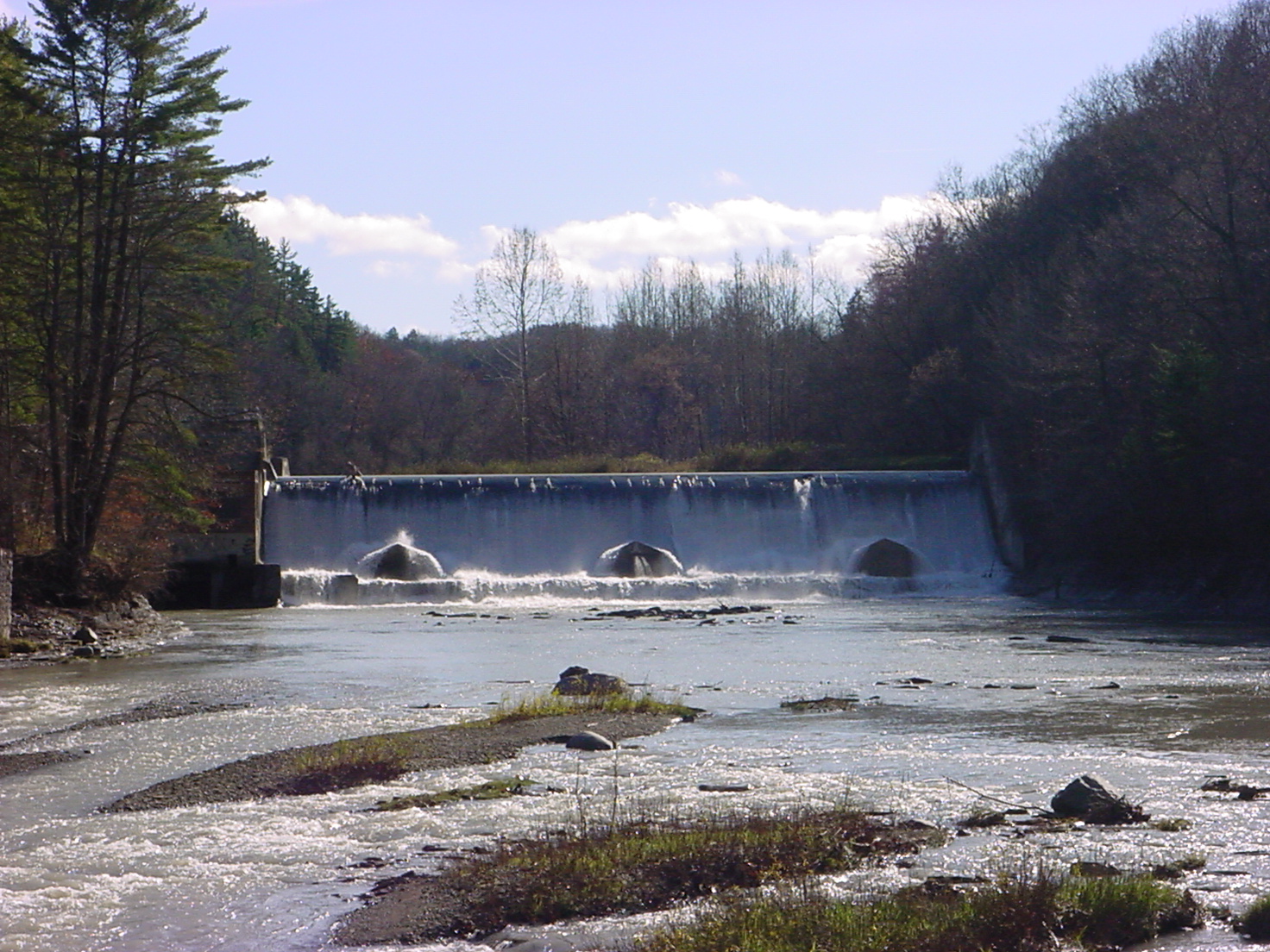
These largely-undeveloped parks are managed primarily for conservation of the natural environment and passive nature-based outdoor recreation activities. These lands are intended to generally remain in a natural state.
- Boston Forest
- Eighteen Mile Creek Park
- Franklin Gulf Park
- Scoby Dam Park
- Sgt. Mark A. Rademacher Memorial Park (commonly known as Hunters Creek Park)
Special purpose parks
Special purpose parks have unique characteristics that provide specific recreational functions within the county's park system.
- Buffalo and Erie County Botanical Gardens
- Elma Meadows Golf Course
- Grover Cleveland Golf Course
- Sprague Brook Park
Forest management areas
Forest management areas are managed by the Erie County Bureau of Forestry, which was established in 1927. These areas include several thousand acres of mostly-coniferous plantation style forest, much of which was planted on abandoned farmland by the Civilian Conservation Corps in the 1930s. These areas are located mostly in the rural southern portion of the county. These lands have limited recreation potential, mostly in the form of trails. Management of these lands is focused on natural resource conservation, in addition to potential commercial resource extraction of timber products or maple syrup.
Communities
| # | Location | Population (2010) | Type | Area |
|---|---|---|---|---|
| 1 | †Buffalo | 278,349 | City | Greater Buffalo |
| 2 | Cheektowaga | 75,178 | CDP | Greater Buffalo |
| 3 | Tonawanda | 58,144 | CDP | Greater Buffalo |
| 4 | West Seneca | 44,711 | CDP | Greater Buffalo |
| 5 | Lackawanna | 19,949 | City | Greater Buffalo |
| 6 | Kenmore | 15,423 | Village | Greater Buffalo |
| 7 | Depew | 15,303 | Village | Greater Buffalo |
| 8 | Tonawanda | 15,130 | City | Greater Buffalo |
| 9 | Eggertsville | 15,019 | CDP | Greater Buffalo |
| 10 | Lancaster | 10,352 | Village | Greater Buffalo |
| 11 | Hamburg | 9,409 | Village | Greater Buffalo |
| 12 | East Aurora | 6,236 | Village | Greater Buffalo |
| 13 | Harris Hill | 5,508 | CDP | Greater Buffalo |
| 14 | Williamsville | 5,300 | Village | Greater Buffalo |
| 15 | Grandyle Village | 4,629 | CDP | Greater Buffalo |
| 16 | Springville | 4,296 | Village | Southern |
| 17 | Lake Erie Beach | 3,872 | CDP | Southern |
| 18 | Sloan | 3,661 | Village | Greater Buffalo |
| 19 | Eden | 3,516 | CDP | Southern |
| 20 | Orchard Park | 3,246 | Village | Greater Buffalo |
| 21 | Wanakah | 3,199 | CDP | Greater Buffalo |
| 22 | Akron | 2,868 | Village | Northeast |
| 23 | ‡Gowanda | 2,709 | Village | Southern |
| 24 | Clarence | 2,646 | CDP | Greater Buffalo |
| 25 | Alden | 2,605 | Village | Northeast |
| 26 | Elma Center | 2,571 | CDP | Greater Buffalo |
| 27 | Blasdell | 2,553 | Village | Greater Buffalo |
| 28 | North Boston | 2,521 | CDP | Southern |
| 29 | Town Line | 2,367 | CDP | Northeast |
| 30 | Angola | 2,127 | Village | Southern |
| 31 | Billington Heights | 1,685 | CDP | Greater Buffalo |
| 32 | Angola on the Lake | 1,675 | CDP | Southern |
| 33 | North Collins | 1,232 | Village | Southern |
| 34 | Holland | 1,206 | CDP | Southern |
| 35 | Farnham | 386 | Village | Southern |
| - | Highland-on-the-Lake | N/A | CDP | Southern |
| - | University at Buffalo | N/A | CDP | Buffalo |
† - County seat
‡ - Not wholly in this county
Cities
- Buffalo
- Lackawanna
- Tonawanda
Towns
- Alden
- Amherst
- Aurora
- Boston
- Brant
- Cheektowaga
- Clarence
- Colden
- Collins
- Concord
- Eden
- Elma
- Evans
- Grand Island
- Hamburg
- Holland
- Lancaster
- Marilla
- Newstead
- North Collins
- Orchard Park
- Sardinia
- Tonawanda
- Wales
- West Seneca
Villages
- Akron
- Alden
- Angola
- Blasdell
- Depew
- East Aurora
- Farnham
- Hamburg
- Kenmore
- Lancaster
- North Collins
- Orchard Park
- Sloan
- Springville
- Williamsville
- Gowanda (partly located in Erie and Cattaraugus counties)

Hamlets
- Akron Junction
- Alden Center
- Armor
- Athol Springs
- Bagdad
- Bellevue
- Big Tree
- Blakeley
- Blossom
- Boston
- Bowmansville
- Brant
- Brighton
- Carnegie
- Chaffee
- Clarksburg
- Cleveland Hill
- Clifton Heights
- Collins Center
- Concord
- Creekside
- Crittenden
- Dellwood
- Derby
- Doyle
- Duells Corner
- Dutchtown
- East Amherst
- East Concord
- East Eden
- East Elma
- East Seneca
- Ebenezer
- Eden Valley
- Ellicott
- Elma
- Evans Center
- Ferry Village
- Footes
- Forks
- Fowlerville
- Gardenville
- Getzville
- Glenwood
- Green Acres
- Griffins Mills
- Holland
- Hunts Corners
- Jerusalem Corners
- Jewettville
- Kenilworth
- Lake View
- Langford
- Lawtons
- Locksley Park
- Looneyville
- Loveland
- Marilla
- Marshfield
- Millersport
- Millgrove
- Morton Corners
- Mount Vernon
- Murrays Corner
- New Ebenezer
- New Oregon
- North Bailey
- North Evans
- Oakfield
- Patchin
- Peters Corners
- Pine Hill
- Pinehurst
- Pontiac
- Porterville
- Protection
- Sand Hill
- Sandy Beach
- Scranton
- Sheenwater
- Shirley
- Snyder
- South Cheektowaga
- South Newstead
- South Wales
- Spring Brook
- Swifts Mills
- Swormville
- Taylor Hollow
- Town Line Station
- Walden Cliffs
- Wales Hollow
- Water Valley
- Webster Corners
- Wende
- West Alden
- West Falls
- Weyer
- Williston
- Windom
- Wolcottsburg
- Woodlawn
- Woodside
- Wyandale
- Zoar
Indian reservations
- Cattaraugus Reservation
- Tonawanda Reservation
References
References
- "State & County QuickFacts". United States Census Bureau.
- (July 1, 2023). "United States Census Bureau Erie County New York".
- "Find a County". National Association of Counties.
- Smyczynski, Christine A.. (2005). "Western New York: From Niagara Falls and Southern Ontario to the Western Edge of the Finger Lakes". The Countryman Press.
- Johnson, Crisfield. (1876). "Centennial History of Erie County, New York; Being its Annals from the Earliest Recorded Events to the Hundredth Year of American Independence". Print. House of Matthews & Warren.
- ''The Burned-Over District: Evolution of County Boundaries.'' [http://olivercowdery.com/census/BurnEvlv.htm Oliver Cowdery Home Page] {{Webarchive. link. (January 29, 2009 , accessed December 7, 2008.)
- {{NRISref. 2008a
- Klein, Christopher. (October 18, 2018). "This New York Village Seceded from the Union...for 85 Years". [[History (American TV channel)]].
- (August 22, 2012). "2010 Census Gazetteer Files". United States Census Bureau.
- "Annual Estimates of the Resident Population for Counties: April 1, 2020 to July 1, 2022".
- "U.S. Decennial Census". United States Census Bureau.
- "Historical Census Browser". University of Virginia Library.
- "Population of Counties by Decennial Census: 1900 to 1990". United States Census Bureau.
- "Census 2000 PHC-T-4. Ranking Tables for Counties: 1990 and 2000". United States Census Bureau.
- "U.S. Census website". [[United States Census Bureau]].
- "Empire State Development".
- "1980 Census of Population - General Population Characteristics - New York - Table 15 - Persons by Race and Table 16 - Total Persons and Spanish Origin Persons by Type of Spanish Origin and Race (p. 34/29-34/70)".
- "1990 Census of Population - General Population Characteristics - New York - Table 3 - Race and Hispanic Origin".
- "P004: Hispanic or Latino, and Not Hispanic or Latino by Race – 2000: DEC Summary File 1 – Erie County, New York".
- "P2: Hispanic or Latino, and Not Hispanic or Latino by Race – 2010: DEC Redistricting Data (PL 94-171) – Erie County, New York".
- "P2: Hispanic or Latino, and Not Hispanic or Latino by Race – 2020: DEC Redistricting Data (PL 94-171) – Erie County, New York".
- included in the Asian category in the 1980 Census
- included in the Asian category in the 1990 Census
- not an option in the 1980 Census
- not an option in the 1990 Census
- Leip, David. "Dave Leip's Atlas of U.S. Presidential Elections".
- "Legislator Dupre".
- "Legislator Tard".
- "Home | Legislator Kooshoian".
- "Home | Legislator Bargnesi".
- "Legislator Jeanne Vinal".
- "Legislator Greene".
- "Legislator Meyers".
- "Legislator Frank J. Todaro".
- "Legislator John Gilmour".
- "Legislator Lorigo".
- "Home | Legislator Mills".
- Geography Division. (January 12, 2021). "2020 CENSUS - SCHOOL DISTRICT REFERENCE MAP: Erie County, NY". [[U.S. Census Bureau]].
- "District Information & History". [[Randolph Academy Union Free School District]].
- "SCHOOL DISTRICT REFERENCE MAP (2010 CENSUS): Erie County, NY". [[U.S. Census Bureau]].
- "Carnival Warehouse".
- (2003). "Erie County Parks System Master Plan - Executive Summary". Erie County.
- (2003). "Erie County Parks System Master Plan, Volume 1, Section 3 - Overall System Framework". Erie County.
- "Bureau of Forestry".
This article was imported from Wikipedia and is available under the Creative Commons Attribution-ShareAlike 4.0 License. Content has been adapted to SurfDoc format. Original contributors can be found on the article history page.
Ask Mako anything about Erie County, New York — get instant answers, deeper analysis, and related topics.
Research with MakoFree with your Surf account
Create a free account to save articles, ask Mako questions, and organize your research.
Sign up freeThis content may have been generated or modified by AI. CloudSurf Software LLC is not responsible for the accuracy, completeness, or reliability of AI-generated content. Always verify important information from primary sources.
Report