From Surf Wiki (app.surf) — the open knowledge base
Equidiagonal quadrilateral
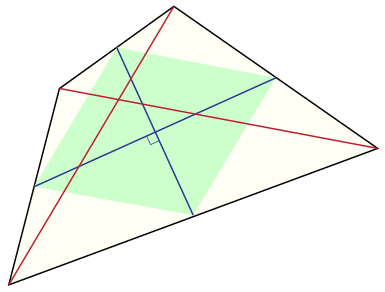
In Euclidean geometry, an equidiagonal quadrilateral is a convex quadrilateral whose two diagonals have equal length. Equidiagonal quadrilaterals were important in ancient Indian mathematics, where quadrilaterals were classified first according to whether they were equidiagonal and then into more specialized types.{{citation
Special cases
Examples of equidiagonal quadrilaterals include the isosceles trapezoids, rectangles and squares.

Among all quadrilaterals, the shape that has the greatest ratio of its perimeter to its diameter is an equidiagonal kite with angles π/3, 5π/12, 5π/6, and 5π/12.{{citation
Characterizations
A convex quadrilateral is equidiagonal if and only if its Varignon parallelogram, the parallelogram formed by the midpoints of its sides, is a rhombus. An equivalent condition is that the bimedians of the quadrilateral (the diagonals of the Varignon parallelogram) are perpendicular.
A convex quadrilateral with diagonal lengths p and q and bimedian lengths m and n is equidiagonal if and only if
:pq=m^2+n^2.
Area
The area K of an equidiagonal quadrilateral can easily be calculated if the length of the bimedians m and n are known. A quadrilateral is equidiagonal if and only if{{citation | access-date = 2013-02-09 | archive-date = 2016-03-04 | archive-url = https://web.archive.org/web/20160304001152/http://forumgeom.fau.edu/FG2013volume13/FG201304.pdf | url-status = dead | access-date = 2014-08-28 | archive-date = 2024-06-05 | archive-url = https://web.archive.org/web/20240605032351/https://forumgeom.fau.edu/FG2014volume14/FG201412index.html | url-status = dead
:\displaystyle K=mn.
This is a direct consequence of the fact that the area of a convex quadrilateral is twice the area of its Varignon parallelogram and that the diagonals in this parallelogram are the bimedians of the quadrilateral. Using the formulas for the lengths of the bimedians, the area can also be expressed in terms of the sides a, b, c, d of the equidiagonal quadrilateral and the distance x between the midpoints of the diagonals as :K=\tfrac{1}{4}\sqrt{(2(a^2+c^2)-4x^2)(2(b^2+d^2)-4x^2)}.
Other area formulas may be obtained from setting p = q in the formulas for the area of a convex quadrilateral.
Relation to other types of quadrilaterals
A parallelogram is equidiagonal if and only if it is a rectangle,{{citation
There is a duality between equidiagonal quadrilaterals and orthodiagonal quadrilaterals: a quadrilateral is equidiagonal if and only if its Varignon parallelogram is orthodiagonal (a rhombus), and the quadrilateral is orthodiagonal if and only if its Varignon parallelogram is equidiagonal (a rectangle).{{citation | access-date = 2012-04-23 | archive-date = 2020-12-05 | archive-url = https://web.archive.org/web/20201205213638/http://forumgeom.fau.edu/FG2012volume12/FG201202.pdf | url-status = dead
Quadrilaterals that are both orthodiagonal and equidiagonal are called midsquare quadrilaterals because they are the only ones for which the Varignon parallelogram (with vertices at the midpoints of the quadrilateral's sides) is a square.
References
This article was imported from Wikipedia and is available under the Creative Commons Attribution-ShareAlike 4.0 License. Content has been adapted to SurfDoc format. Original contributors can be found on the article history page.
Ask Mako anything about Equidiagonal quadrilateral — get instant answers, deeper analysis, and related topics.
Research with MakoFree with your Surf account
Create a free account to save articles, ask Mako questions, and organize your research.
Sign up freeThis content may have been generated or modified by AI. CloudSurf Software LLC is not responsible for the accuracy, completeness, or reliability of AI-generated content. Always verify important information from primary sources.
Report