From Surf Wiki (app.surf) — the open knowledge base
Epistle to Titus
Book of the New Testament
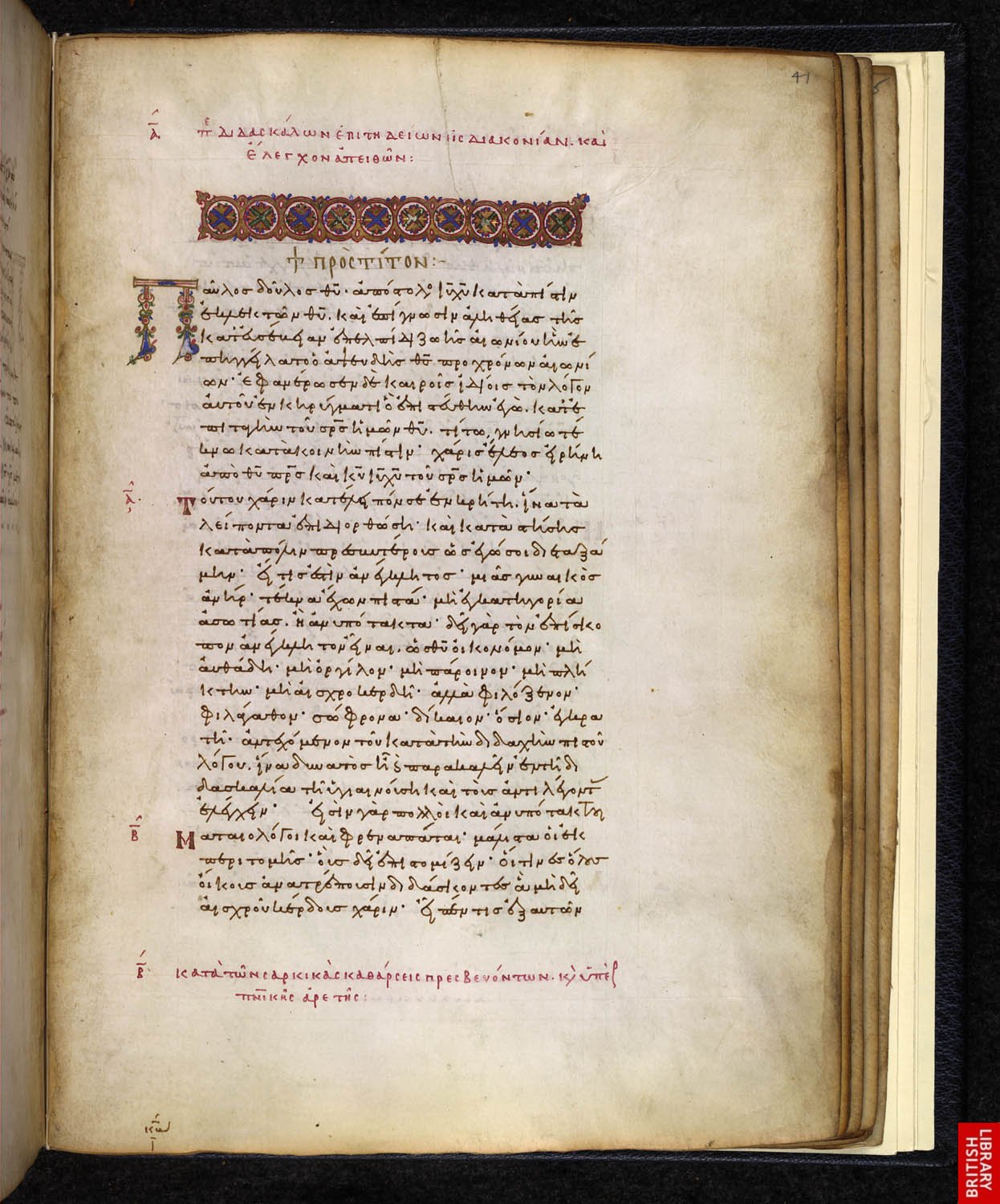
_recto_Titus_1,_11-15.jpg)
Book of the New Testament
The Epistle to Titus is one of the three pastoral epistles (along with 1 Timothy and 2 Timothy) in the New Testament, historically attributed to Paul the Apostle. It is addressed to Saint Titus and describes the requirements and duties of presbyters/bishops.
Text
The epistle is divided into three chapters, 46 verses in total.
Recipient
Not mentioned in the Acts of the Apostles, Saint Titus was noted in Galatians (cf. Galatians 2:1, 3) where Paul wrote of journeying to Jerusalem with Barnabas, accompanied by Titus. He was then dispatched to Corinth, Greece, where he successfully reconciled the Christian community there with Paul, its founder. Titus was later left on the island of Crete to help organize the church there, and later met back with the Apostle Paul in Nicopolis. He soon went to Dalmatia (now Croatia). According to Eusebius of Caesarea in the Ecclesiastical History, he served as the first bishop of Crete.
Authenticity
According to Clare Drury, the claim that Paul himself wrote this letter and those to Timothy "seems at first sight obvious and incontrovertible. All three begin with a greeting from the apostle and contain personal notes and asides", but in reality "things are not so straightforward: signs of the late date of the letters proliferate". There has therefore been some debate regarding the authenticity of the letter.
Opposition to Pauline authenticity
Titus, along with the two other pastoral epistles (1 Timothy and 2 Timothy), is regarded by some scholars as being pseudepigraphical. On the basis of the language and content of the pastoral epistles, these scholars reject that they were written by Paul and believe that they were written by an anonymous forger after his death. Critics claim the vocabulary and style of the Pauline letters could not have been written by Paul according to available biographical information and reflect the views of the emerging church rather than the apostle's. These scholars date the epistle from the 80s AD up to the end of the 2nd century, though most would place it sometime between 80 and 100 AD. The Church of England's Common Worship Lectionary Scripture Commentary concurs with this view: "the proportioning of the theological and practical themes is one factor that leads us to think of these writings as coming from the post-Pauline church world of the late first or early second century".
Titus has a very close affinity with 1 Timothy, sharing similar phrases and expressions and similar subject matter. This has led many scholars to believe that it was written by the same author who wrote 1 and 2 Timothy: their author is sometimes referred to as "the Pastor".
The gnostic writer Basilides rejected the epistle.
Traditional view: Pauline authenticity
Recent scholarship has revived the theory that Paul used an amanuensis, or secretaries, in writing his letters (e.g. Romans 16:22), but possibly Luke for the pastorals. This was a common practice in ancient letter writing, even for the biblical writers.
Epimenides paradox
One of the secular peculiarities of the Epistle to Titus is the reference to the Epimenides paradox: "One of the Cretans, a prophet of their own, said, 'Cretans are always liars'."
Notes
References
Sources
References
- Aland, Kurt. (1995). "The Text of the New Testament: An Introduction to the Critical Editions and to the Theory and Practice of Modern Textual Criticism". [[William B. Eerdmans Publishing Company.
- (2018). "ESV Pew Bible". Crossway.
- "Bible Book Abbreviations".
- {{bibleverse. Titus. 1:1-16. NKJV
- {{bibleverse. Galatians. 2:1–3
- [[Eusebius]], ''[https://www.newadvent.org/fathers/250103.htm Church History]'' III.4
- Drury, C., ''73. The Pastoral Epistles'', in Barton, J. and Muddiman, J. (2001), [https://b-ok.org/dl/946961/8f5f43 The Oxford Bible Commentary] {{Webarchive. link. (2017-11-22 , p. 1220)
- Ehrman, Bart. (2011). "Forged". HarperOne.
- [[Raymond E. Brown]]. ''An Introduction to the New Testament''. New York: Anchor Bible, p. 662, 668.
- Houlden and Rogerson. (2001). "Common Worship Lectionary: a Scriptures Commentary". SPCK.
- [[William Paley]] ''Horae Paulinae'' (1785)
- [[Bart D. Ehrman]]. ''The New Testament: A Historical Introduction to the Early Christian Writings'' 3rd ed. New York: Oxford University Press, 2004. pp. 385ff
- [[Stephen L Harris. Harris, Stephen L.]], Understanding the Bible. Palo Alto: Mayfield. 1985, "The Pastoral Epistles", pp. 340–345
- Jerome. "Nicene and Post-Nicene Fathers: Series II".
- {{bibleverse. Romans. 16:22
- George W. Knight, The Pastoral Epistles: A Commentary on the Greek Text, New International Greek Testament Commentary (Grand Rapids, MI; Carlisle, England: W.B. Eerdmans; Paternoster Press, 1992), 48.
- William D. Mounce, Pastoral Epistles, vol. 46, Word Biblical Commentary (Dallas: Word, Incorporated, 2000), cxxix.
- Richards, E. Randolph. Paul and First-Century Letter Writing: Secretaries, Composition and Collection. Downers Grove, IL; Leicester, England: InterVarsity Press; Apollos, 2004.
- Harry Y. Gamble, "Amanuensis", ed. David Noel Freedman, The Anchor Yale Bible Dictionary (New York: Doubleday, 1992), 172.
- {{Bibleverse. Titus. 1:12–13. ESV
This article was imported from Wikipedia and is available under the Creative Commons Attribution-ShareAlike 4.0 License. Content has been adapted to SurfDoc format. Original contributors can be found on the article history page.
Ask Mako anything about Epistle to Titus — get instant answers, deeper analysis, and related topics.
Research with MakoFree with your Surf account
Create a free account to save articles, ask Mako questions, and organize your research.
Sign up freeThis content may have been generated or modified by AI. CloudSurf Software LLC is not responsible for the accuracy, completeness, or reliability of AI-generated content. Always verify important information from primary sources.
Report