From Surf Wiki (app.surf) — the open knowledge base
Epilobium hirsutum
Plant species in the willowherb family
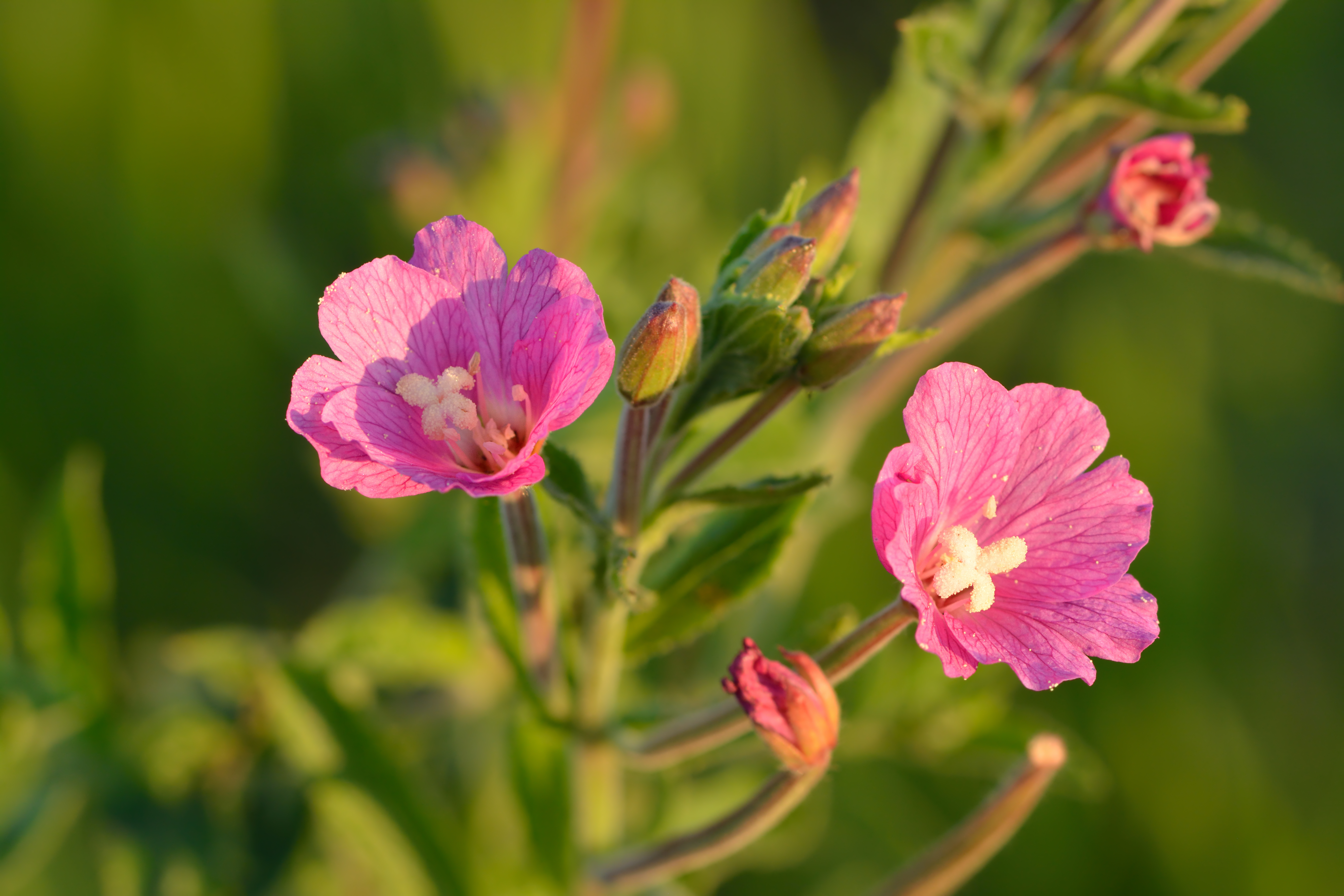
Plant species in the willowherb family
| Chamaenerion grandiflorum | (Weber) Moench | Chamaenerion hirsutum | (L.) Scop. | Epilobium amplexicaule | Lam. | Epilobium aquaticum | Thuill. | Epilobium dubium | Borbás | Epilobium foliosum | Hochst. | Epilobium grandiflorum | All. | Epilobium grandiflorum | Weber | Epilobium himalense | Royle | Epilobium hirsutum subsp. grandiflorum | Ehrh. | Epilobium incanum | Pers. | Epilobium mirei | Quézel | Epilobium nassirelinulci | Stapf | Epilobium ramosum | Huds. | Epilobium serratum | Jacquem. ex C.B.Clarke | Epilobium tomentosum | Vent. | Epilobium velutinum | Nevski | Epilobium villosum | Thunb.
Epilobium hirsutum is a flowering plant belonging to the willowherb genus Epilobium in the family Onagraceae. It is commonly known as the great willowherb, great hairy willowherb or hairy willowherb. Local dialectal names include codlins and cream, apple pie and cherry pie.
Description
It is a tall, perennial plant, reaching up to 2 metres in height. The robust stems are profusely hairy with soft spreading hairs. The hairy leaves are 2–12 cm long and 0.5–3.5 cm wide. They are long and thin and are widest below the middle. They have sharply toothed edges and no stalk. The large flowers have four notched petals. These are purple-pink and are usually 10–16 mm long. There are 8 stamens. The stigma is white and has four lobes. The sepals are green.
It is relatively easy to distinguish from similar species at least in much of its European range, where its flowers are among species of its genus present there.
Distribution and habitat
The native range of the species includes North Africa, most of Europe up to southern Sweden, and parts of Asia. It is absent from much of Scandinavia and north-west Scotland. It has been introduced to North America and Australia.
It typically grows in wet or damp habitats without dense tree-cover up to 2,500 metres above sea-level. Common habitats include marshland and the banks of rivers and streams. It also occurs in anthropogenic contexts such as wet ditches and in general in places rich in nitrates. It flowers from June to September, with a peak in July and August.
Ecology
Epilobium hirsutum inhabits damp and waste places, river-sides and ditches.
The flowers are visited by many types of insects, and can be characterized by a generalized pollination syndrome. A number of insects feed on the leaves including the elephant hawkmoth, Deilephila elpenor.
Trichomes
The plant shows glandular trichomes. They are unicellular, without a specialized basal cell. They have a cutinized cell wall and a protruding pore on the top. The upper part of the trichome cell contains flavonoids, e.g. quercitrin and myricitrin.

References
Bibliography
- Blamey, Marjorie & Grey-Wilson, Christopher (2003) Cassell's Wild Flowers of Britain and Northern Europe, Cassell, London.
- Press, J. R.; Sutton, D. A. & Tebbs, B. M. (1981) Field Guide to the Wild Flowers of Britain, Reader's Digest, London.
- Tutin, T. G. et al. (1968) Flora Europaea, Volume 2. Cambridge University Press.
References
- "''Epilobium hirsutum'' L.".
- (2006). "Non-native Freshwater Plants: Hairy Willow-Herb". Washington State Department of Ecology.
- (2003). "Wild flowers of Britain and Ireland: The Complete Guide to the British and Irish Flora.". A & C Black.
- [[Martin, W. Keble]] 1965. ''The New Concise British Flora in Colour''; with nomenclature edited and revised by Douglas H. Kent and foreword by The Duke of Edinburgh. London: Book Club Associates by arrangement with Ebury Press/ Michael Joseph (1982)
- Stace, C. A.. (2010). "New Flora of the British Isles". Cambridge University Press.
- (1997). "Rosendunört, Epilobium hirsutum". Naturhistoriska riksmuseet.
- (2015). "Competition for pollinators and intra-communal spectral dissimilarity of flowers". Plant Biology.
- Webb, D.A., Parnell, J. and Doogue, D. 1996. ''An Irish Flora''. Dundalgan Press (W.Tempest) Ltd. Dundalk. {{ISBN. 0-85221-131-7
- (2011). "Morphology and glandular activity of unicellular trichomes of Epilobium hirsutum". Biologia Plantarum.
This article was imported from Wikipedia and is available under the Creative Commons Attribution-ShareAlike 4.0 License. Content has been adapted to SurfDoc format. Original contributors can be found on the article history page.
Ask Mako anything about Epilobium hirsutum — get instant answers, deeper analysis, and related topics.
Research with MakoFree with your Surf account
Create a free account to save articles, ask Mako questions, and organize your research.
Sign up freeThis content may have been generated or modified by AI. CloudSurf Software LLC is not responsible for the accuracy, completeness, or reliability of AI-generated content. Always verify important information from primary sources.
Report