From Surf Wiki (app.surf) — the open knowledge base
Epidermal growth factor receptor
Transmembrane protein
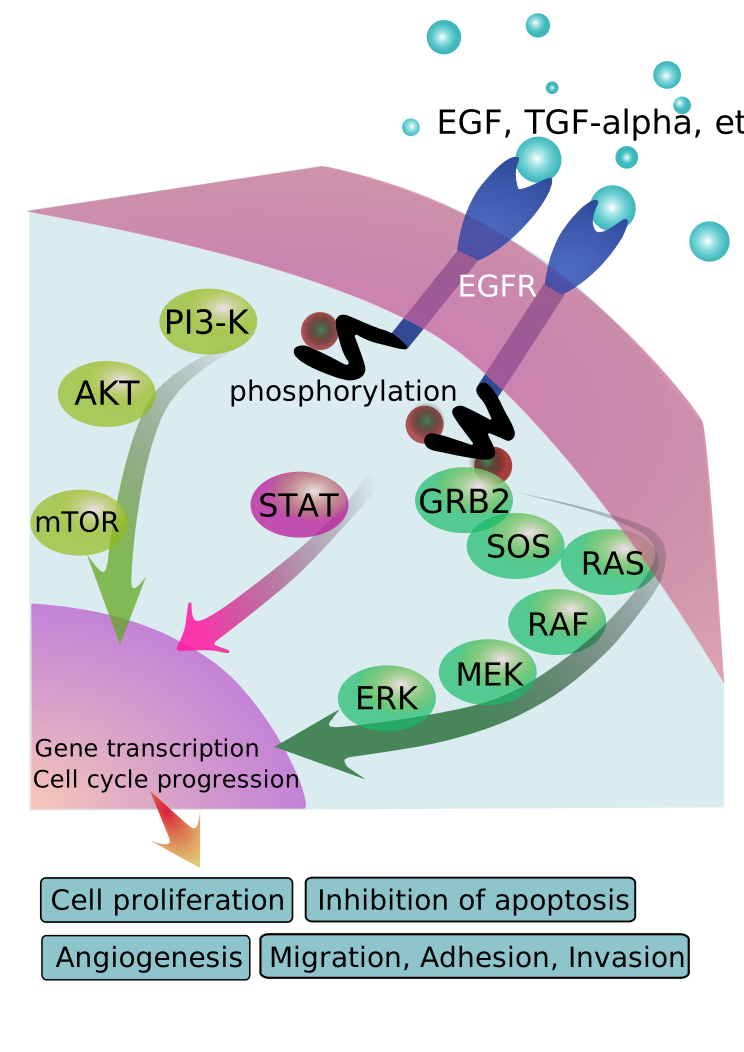
Transmembrane protein
The epidermal growth factor receptor (EGFR; ErbB-1; HER1 in humans) is a transmembrane protein that is a receptor for members of the epidermal growth factor family (EGF family) of extracellular protein ligands.
The epidermal growth factor receptor is a member of the ErbB family of receptors, a subfamily of four closely related receptor tyrosine kinases: EGFR (ErbB-1), HER2/neu (ErbB-2), Her 3 (ErbB-3) and Her 4 (ErbB-4). In many cancer types, mutations affecting EGFR expression or activity could result in cancer.
Epidermal growth factor and its receptor were discovered by Stanley Cohen of Vanderbilt University. Cohen shared the 1986 Nobel Prize in Medicine with Rita Levi-Montalcini for their discovery of growth factors.
Deficient signaling of the EGFR and other receptor tyrosine kinases in humans is associated with diseases such as Alzheimer's, while over-expression is associated with the development of a wide variety of tumors. Interruption of EGFR signalling, either by blocking EGFR binding sites on the extracellular domain of the receptor or by inhibiting intracellular tyrosine kinase activity, can prevent the growth of EGFR-expressing tumours and improve the patient's condition.
Function
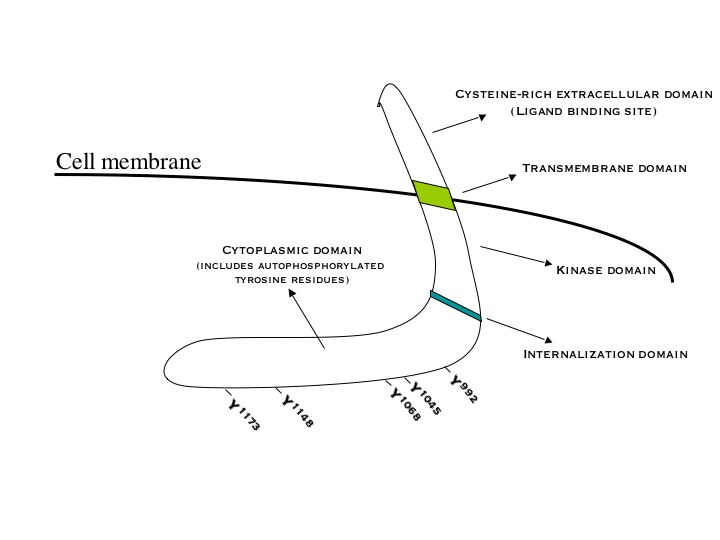
|thumb|Diagram of the EGF receptor highlighting important domains]] Epidermal growth factor receptor (EGFR) is a transmembrane protein that is activated by binding of its specific ligands, including epidermal growth factor and transforming growth factor alpha (TGF-α). ErbB2 has no known direct activating ligand, and may be in an activated state constitutively or become active upon heterodimerization with other family members such as EGFR. Upon activation by its growth factor ligands, EGFR undergoes a transition from an inactive monomeric form to an active homodimer. – although there is some evidence that preformed inactive dimers may also exist before ligand binding. In addition to forming homodimers after ligand binding, EGFR may pair with another member of the ErbB receptor family, such as ErbB2/Her2/neu, to create an activated heterodimer. There is also evidence to suggest that clusters of activated EGFRs form, although it remains unclear whether this clustering is important for activation itself or occurs after activation of individual dimers.
EGFR dimerization stimulates its intrinsic intracellular protein-tyrosine kinase activity. As a result, autophosphorylation of several tyrosine (Y) residues in the C-terminal domain of EGFR occurs. These include Y992, Y1045, Y1068, Y1148, and Y1173, as shown in the adjacent diagram. This autophosphorylation elicits downstream activation and signaling by several other proteins that associate with the phosphorylated tyrosines through their own phosphotyrosine-binding SH2 domains. These downstream signaling proteins initiate several signal transduction cascades, principally the MAPK, Akt and JNK pathways, leading to DNA synthesis and cell proliferation. Such proteins modulate phenotypes such as cell migration, adhesion, and proliferation. Activation of the receptor is important for the innate immune response in human skin. Additionally, the kinase domain of the EGFR can cross-phosphorylate the tyrosine residues of other receptors with which it is aggregated and thereby activate itself.
Biological roles
The EGFR is essential for ductal development of the mammary glands, and agonists of the EGFR such as amphiregulin, TGF-α, and heregulin induce both ductal and lobuloalveolar development even in the absence of estrogen and progesterone.
Role in human disease
Cancer
Mutations that lead to EGFR overexpression (known as upregulation or amplification) have been associated with a number of cancers, including adenocarcinoma of the lung (40% of cases), anal cancers, glioblastoma (50%) and epithelian tumors of the head and neck (80–100%). These somatic mutations involving EGFR lead to its constant activation, which produces uncontrolled cell division. In glioblastoma a specific mutation of EGFR, called EGFRvIII, is often observed. Mutations, amplifications or misregulations of EGFR or family members are implicated in about 30% of all epithelial cancers.
Inflammatory disease
Aberrant EGFR signaling has been implicated in psoriasis, eczema and atherosclerosis. However, its exact roles in these conditions are ill-defined.
Monogenic disease
A single child displaying multi-organ epithelial inflammation was found to have a homozygous loss-of-function mutation in the EGFR gene. The pathogenicity of the EGFR mutation was supported by in vitro experiments and functional analysis of a skin biopsy. His severe phenotype reflects many previous research findings into EGFR function. His clinical features included a papulopustular rash, dry skin, chronic diarrhoea, abnormalities of hair growth, breathing difficulties, and electrolyte imbalances.
Wound healing and fibrosis
EGFR has been shown to play a critical role in TGF-beta1 dependent fibroblast to myofibroblast differentiation. Aberrant persistence of myofibroblasts within tissues can lead to progressive tissue fibrosis, impairing tissue or organ function (e.g. skin hypertrophic or keloid scars, liver cirrhosis, myocardial fibrosis, chronic kidney disease).
Medical applications
Drug target
The identification of EGFR as an oncogene has led to the development of anticancer therapeutics directed against EGFR (called "EGFR inhibitors", EGFRi), including gefitinib, erlotinib, afatinib, brigatinib and icotinib for lung cancer, and cetuximab for colon cancer. More recently AstraZeneca has developed Osimertinib, a third generation tyrosine kinase inhibitor.
Many therapeutic approaches are aimed at the EGFR. Cetuximab and panitumumab are examples of monoclonal antibody inhibitors. However, the former is of the IgG1 type, the latter of the IgG2 type; consequences on antibody-dependent cellular cytotoxicity can be quite different. Other monoclonals in clinical development are zalutumumab, nimotuzumab, and matuzumab. The monoclonal antibodies block the extracellular ligand-binding domain. With the binding site blocked, signal molecules can no longer attach there and activate the tyrosine kinase.
Another method is using small molecules to inhibit the EGFR tyrosine kinase, which is on the cytoplasmic side of the receptor. Without kinase activity, EGFR is unable to activate itself, which is a prerequisite for the binding of downstream adaptor proteins. Ostensibly, by halting the signaling cascade in cells that rely on this pathway for growth, tumor proliferation and migration are diminished. Gefitinib, erlotinib, brigatinib and lapatinib (mixed EGFR and ERBB2 inhibitor) are examples of small molecule kinase inhibitors.
CimaVax-EGF, an active vaccine targeting EGF as the major ligand of EGF, uses a different approach, raising antibodies against EGF itself, thereby denying EGFR-dependent cancers of a proliferative stimulus; it is in use as a cancer therapy against non-small-cell lung carcinoma (the most common form of lung cancer) in Cuba, and is undergoing further trials for possible licensing in Japan, Europe, and the United States.
There are several quantitative methods available that use protein phosphorylation detection to identify EGFR family inhibitors.
New drugs such as osimertinib, gefitinib, erlotinib and brigatinib directly target the EGFR. Patients have been divided into EGFR-positive and EGFR-negative, based upon whether a tissue test shows a mutation. EGFR-positive patients have shown a 60% response rate, which exceeds the response rate for conventional chemotherapy.
However, many patients develop resistance. Two primary sources of resistance are the T790M mutation and MET oncogene. However, as of 2010, there was no consensus of an accepted approach to combat resistance nor FDA approval of a specific combination. Clinical trial phase II results reported for brigatinib targeting the T790M mutation, and brigatinib received Breakthrough Therapy designation status by the FDA in February 2015.
The most common adverse effect of EGFR inhibitors, found in more than 90% of patients, is a papulopustular rash that spreads across the face and torso; the rash's presence is correlated with the drug's antitumor effect. In 10% to 15% of patients, the effects can be serious and require treatment.
Some tests are aiming at predicting benefit from EGFR treatment, as Veristrat.
Laboratory research using genetically engineered stem cells to target EGFR in mice was reported in 2014 to show promise. EGFR is a well-established target for monoclonal antibodies and specific tyrosine kinase inhibitors.
Target for imaging agents
Imaging agents have been developed which identify EGFR-dependent cancers using labeled EGF. The feasibility of in vivo imaging of EGFR expression has been demonstrated in several studies.
It has been proposed that certain computed tomography findings, such as ground-glass opacities, air bronchogram, spiculated margins, vascular convergence, and pleural retraction, can predict the presence of EGFR mutation in patients with non-small cell lung cancer.
Interactions
Epidermal growth factor receptor has been shown to interact with:
- AR,
- ARF4,
- CAV1,
- CAV3,
- CBL,
- CBLB,
- CBLC,
- CD44,
- CDC25A,
- CRK,
- CTNNB1,
- DCN,
- EGF,
- GRB14,
- Grb2,
- JAK2,
- MUC1,
- NCK1,
- NCK2
- PKC alpha,
- PLCG1,
- PLSCR1,
- PTPN1,
- PTPN11,
- PTPN6,
- PTPRK,
- SH2D3A,
- SH3KBP1,
- SHC1,
- SOS1,
- Src,
- STAT1,
- STAT3,
- STAT5A,
- UBC, and
- WAS,
- PAR2.
In fruitflies, the epidermal growth factor receptor interacts with Spitz.
References
References
- (2004). "Review of epidermal growth factor receptor biology". International Journal of Radiation Oncology, Biology, Physics.
- (August 2007). "ErbB receptors: from oncogenes to targeted cancer treatment". The Journal of Clinical Investigation.
- note, a full list of the ligands able to activate EGFR and other members of the ErbB family is given in the [[ErbB#Kinase activation. ErbB]] article)
- (March 1987). "Epidermal growth factor induces rapid, reversible aggregation of the purified epidermal growth factor receptor". Biochemistry.
- (April 2014). "Mechanisms of activation of receptor tyrosine kinases: monomers or dimers". Cells.
- (January 2010). "Nanoscale imaging of epidermal growth factor receptor clustering: effects of inhibitors". The Journal of Biological Chemistry.
- (1984). "Autophosphorylation sites on the epidermal growth factor receptor". Nature.
- (2005). "A comprehensive pathway map of epidermal growth factor receptor signaling". Molecular Systems Biology.
- (September 1998). "Activation and function of the epidermal growth factor receptor and erbB-2 during mammary gland morphogenesis". Cell Growth & Differentiation.
- (June 2008). "Amphiregulin: role in mammary gland development and breast cancer". Journal of Mammary Gland Biology and Neoplasia.
- (June 2008). "The ADAM17-amphiregulin-EGFR axis in mammary development and cancer". Journal of Mammary Gland Biology and Neoplasia.
- (May 2003). "Effect of exogenous epidermal-like growth factors on mammary gland development and differentiation in the estrogen receptor-alpha knockout (ERKO) mouse". Breast Cancer Research and Treatment.
- (December 1996). "Induction of ductal morphogenesis and lobular hyperplasia by amphiregulin in the mouse mammary gland". Cell Growth & Differentiation.
- (November 2009). "Growth factor receptor expression in anal squamous lesions: modifications associated with oncogenic human papillomavirus and human immunodeficiency virus". Human Pathology.
- (2013). "Robbins basic pathology". Elsevier/Saunders.
- (May 2004). "Activating mutations in the epidermal growth factor receptor underlying responsiveness of non-small-cell lung cancer to gefitinib". The New England Journal of Medicine.
- (June 2001). "EGF mutant receptor vIII as a molecular target in cancer therapy". Endocrine-Related Cancer.
- (November 2014). "Knockdown of EGFR inhibits growth and invasion of gastric cancer cells". Cancer Gene Therapy.
- (2000). "The EGF receptor – an essential regulator of multiple epidermal functions". European Journal of Dermatology.
- (May 2006). "The epidermal growth factor receptors and their family of ligands: their putative role in atherogenesis". Atherosclerosis.
- (October 2014). "Epithelial inflammation resulting from an inherited loss-of-function mutation in EGFR". The Journal of Investigative Dermatology.
- (April 2014). "MicroRNA-7 inhibition rescues age-associated loss of epidermal growth factor receptor and hyaluronan-dependent differentiation in fibroblasts". Aging Cell.
- (June 2004). "EGFR mutations in lung cancer: correlation with clinical response to gefitinib therapy". Science.
- (October 2022). "Randomised controlled trial of first-line tyrosine-kinase inhibitor (TKI) ''versus'' intercalated TKI with chemotherapy for ''EGFR''-mutated nonsmall cell lung cancer". ERJ Open Research.
- (12 February 2014). "Network meta-analysis of erlotinib, gefitinib, afatinib and icotinib in patients with advanced non-small-cell lung cancer harboring EGFR mutations". PLOS ONE.
- (April 2023). "Overall survival in advanced epidermal growth factor receptor mutated non-small cell lung cancer using different tyrosine kinase inhibitors in The Netherlands: a retrospective, nationwide registry study". The Lancet Regional Health. Europe.
- (February 2016). "Osimertinib: First Global Approval". Drugs.
- (October 2005). "Pharmacogenetics and pharmacogenomics in oncology therapeutic antibody development". BioTechniques.
- (Winter 2010). "Clinical development and perspectives of CIMAvax EGF, Cuban vaccine for non-small-cell lung cancer therapy". MEDICC Review.
- (11 May 2015). "Cuba Has a Lung Cancer Vaccine—And America Wants It".
- (October 2004). "Quantitative methods for the analysis of protein phosphorylation in drug development". Expert Review of Proteomics.
- (August 2009). "Impact of epidermal growth factor receptor and KRAS mutations on clinical outcomes in previously untreated non-small cell lung cancer patients: results of an online tumor registry of clinical trials". Clinical Cancer Research.
- (2013). "Skin rash could predict the response to EGFR tyrosine kinase inhibitor and the prognosis for patients with non-small cell lung cancer: a systematic review and meta-analysis". PLOS ONE.
- (2012). "Management of EGFR-inhibitor associated rash: a retrospective study in 49 patients". European Journal of Medical Research.
- (October 2006). "Mechanisms of cutaneous toxicities to EGFR inhibitors". Nature Reviews. Cancer.
- (February 2014). "VeriStrat: a prognostic and/or predictive biomarker for advanced lung cancer patients?". Expert Review of Respiratory Medicine.
- (February 2015). "Engineering toxin-resistant therapeutic stem cells to treat brain tumors". Stem Cells.
- (January 2014). "The ErbB/HER family of protein-tyrosine kinases and cancer". Pharmacological Research.
- (May 2015). "Development of a sensitive, stable and EGFR-specific molecular imaging agent for surface enhanced Raman spectroscopy". Journal of Raman Spectroscopy.
- (23 January 2015). "Aggregation of nanoparticles in endosomes and lysosomes produces surface-enhanced Raman spectroscopy". Journal of Nanophotonics.
- (December 2016). "Feasibility of imaging of epidermal growth factor receptor expression with ZEGFR:2377 affibody molecule labeled with 99mTc using a peptide-based cysteine-containing chelator". International Journal of Oncology.
- Herrera Ortiz AF, Cadavid Camacho T, Vásquez Perdomo A, Castillo Herazo V, Arambula Neira J, Yepes Bustamante M, Cadavid Camacho E. Clinical and CT patterns to predict EGFR mutation in patients with non-small cell lung cancer: A systematic literature review and meta-analysis. European Journal of Radiology Open.2022;9:100400. https://doi.org/10.1016/j.ejro.2022.100400
- (October 2004). "EGF receptor (EGFR) signaling promoting invasion is disrupted in androgen-sensitive prostate cancer cells by an interaction between EGFR and androgen receptor (AR)". International Journal of Cancer.
- (August 2004). "The androgen receptor associates with the epidermal growth factor receptor in androgen-sensitive prostate cancer cells". Steroids.
- (January 2003). "ADP-ribosylation factor 4 small GTPase mediates epidermal growth factor receptor-dependent phospholipase D2 activation". The Journal of Biological Chemistry.
- (November 1997). "Interaction of a receptor tyrosine kinase, EGF-R, with caveolins. Caveolin binding negatively regulates tyrosine and serine/threonine kinase activities". The Journal of Biological Chemistry.
- (May 2008). "A tale of two Cbls: interplay of c-Cbl and Cbl-b in epidermal growth factor receptor downregulation". Molecular and Cellular Biology.
- (August 2008). "Ubc4/5 and c-Cbl continue to ubiquitinate EGF receptor after internalization to facilitate polyubiquitination and degradation". Molecular Biology of the Cell.
- (March 2008). "Structural basis for a novel intrapeptidyl H-bond and reverse binding of c-Cbl-TKB domain substrates". The EMBO Journal.
- (March 1999). "cbl-b inhibits epidermal growth factor receptor signaling". Oncogene.
- (October 1999). "Molecular cloning and characterization of a novel cbl-family gene, cbl-c". Gene.
- (June 1999). "cbl-3: a new mammalian cbl family protein". Oncogene.
- (May 2013). "Transforming growth factor-β1 (TGF-β1)-stimulated fibroblast to myofibroblast differentiation is mediated by hyaluronan (HA)-facilitated epidermal growth factor receptor (EGFR) and CD44 co-localization in lipid rafts". The Journal of Biological Chemistry.
- (May 2002). "Identification of epidermal growth factor receptor as a target of Cdc25A protein phosphatase". The Journal of Biological Chemistry.
- (July 1998). "Phosphorylation of CrkII adaptor protein at tyrosine 221 by epidermal growth factor receptor". The Journal of Biological Chemistry.
- (April 1998). "The epidermal growth factor receptor modulates the interaction of E-cadherin with the actin cytoskeleton". The Journal of Biological Chemistry.
- (June 2002). "ErbB-beta-catenin complexes are associated with human infiltrating ductal breast and murine mammary tumor virus (MMTV)-Wnt-1 and MMTV-c-Neu transgenic carcinomas". The Journal of Biological Chemistry.
- (July 1997). "Induction of tyrosine phosphorylation and association of beta-catenin with EGF receptor upon tryptic digestion of quiescent cells at confluence". Oncogene.
- (September 2002). "Decorin binds to a narrow region of the epidermal growth factor (EGF) receptor, partially overlapping but distinct from the EGF-binding epitope". The Journal of Biological Chemistry.
- (February 1999). "Decorin is a biological ligand for the epidermal growth factor receptor". The Journal of Biological Chemistry.
- (July 2002). "Role of the N-terminus of epidermal growth factor in ErbB-2/ErbB-3 binding studied by phage display". Biochemistry.
- (May 1996). "Cloning and characterization of GRB14, a novel member of the GRB7 gene family". The Journal of Biological Chemistry.
- (March 2003). "A proteomics strategy to elucidate functional protein-protein interactions applied to EGF signaling". Nature Biotechnology.
- (March 2002). "UCS15A, a novel small molecule, SH3 domain-mediated protein-protein interaction blocking drug". Oncogene.
- (December 1994). "Grb2/Ash binds directly to tyrosines 1068 and 1086 and indirectly to tyrosine 1148 of activated human epidermal growth factor receptors in intact cells". The Journal of Biological Chemistry.
- (February 1997). "The RIalpha subunit of protein kinase A (PKA) binds to Grb2 and allows PKA interaction with the activated EGF-receptor". Oncogene.
- (March 1994). "A complex of Grb2 adaptor protein, Sos exchange factor, and a 36-kDa membrane-bound tyrosine phosphoprotein is implicated in ras activation in T cells". The Journal of Biological Chemistry.
- (August 1992). "The SH2 and SH3 domain-containing protein GRB2 links receptor tyrosine kinases to ras signaling". Cell.
- (June 1999). "ErbB receptor-induced activation of stat transcription factors is mediated by Src tyrosine kinases". The Journal of Biological Chemistry.
- (April 2001). "Transgenic MUC1 interacts with epidermal growth factor receptor and correlates with mitogen-activated protein kinase activation in the mouse mammary gland". The Journal of Biological Chemistry.
- (September 2001). "The epidermal growth factor receptor regulates interaction of the human DF3/MUC1 carcinoma antigen with c-Src and beta-catenin". The Journal of Biological Chemistry.
- (February 1999). "Identification of Grb4/Nckbeta, a src homology 2 and 3 domain-containing adapter protein having similar binding and biological properties to Nck". The Journal of Biological Chemistry.
- (October 1997). "Induced direct binding of the adapter protein Nck to the GTPase-activating protein-associated protein p62 by epidermal growth factor". Oncogene.
- (December 1992). "The SH2 and SH3 domain-containing Nck protein is oncogenic and a common target for phosphorylation by different surface receptors". Molecular and Cellular Biology.
- (September 1998). "Identification of Nck family genes, chromosomal localization, expression, and signaling specificity". The Journal of Biological Chemistry.
- (December 1998). "Nck-2, a novel Src homology2/3-containing adaptor protein that interacts with the LIM-only protein PINCH and components of growth factor receptor kinase-signaling pathways". Molecular Biology of the Cell.
- (August 2003). "Protein kinase Calpha negatively regulates cell spreading and motility in MDA-MB-231 human breast cancer cells downstream of epidermal growth factor receptor". Biochemical and Biophysical Research Communications.
- (July 2002). "EGF-dependent association of phospholipase C-gamma1 with c-Cbl". Experimental Cell Research.
- (July 1997). "Cytoskeletal association of epidermal growth factor receptor and associated signaling proteins is regulated by cell density in IEC-6 intestinal cells". Journal of Cellular Physiology.
- (May 2002). "Plasma membrane phospholipid scramblase 1 is enriched in lipid rafts and interacts with the epidermal growth factor receptor". Biochemistry.
- (July 2000). "Structural basis of plasticity in protein tyrosine phosphatase 1B substrate recognition". Biochemistry.
- (March 1996). "Determinants of substrate recognition in the protein-tyrosine phosphatase, PTP1". The Journal of Biological Chemistry.
- (September 1998). "Phosphotyrosine 1173 mediates binding of the protein-tyrosine phosphatase SHP-1 to the epidermal growth factor receptor and attenuation of receptor signaling". The Journal of Biological Chemistry.
- (June 2005). "Transforming growth factor {beta} (TGF-{beta})-Smad target gene protein tyrosine phosphatase receptor type kappa is required for TGF-{beta} function". Molecular and Cellular Biology.
- (April 1999). "NSP1 defines a novel family of adaptor proteins linking integrin and tyrosine kinase receptors to the c-Jun N-terminal kinase/stress-activated protein kinase signaling pathway". The Journal of Biological Chemistry.
- (March 2002). "Cbl-CIN85-endophilin complex mediates ligand-induced downregulation of EGF receptors". Nature.
- (October 2002). "CIN85 participates in Cbl-b-mediated down-regulation of receptor tyrosine kinases". The Journal of Biological Chemistry.
- (February 2000). "The Sos1 and Sos2 Ras-specific exchange factors: differences in placental expression and signaling properties". The EMBO Journal.
- (February 1998). "N terminus of Sos1 Ras exchange factor: critical roles for the Dbl and pleckstrin homology domains". Molecular and Cellular Biology.
- (April 2000). "Carbachol-stimulated transactivation of epidermal growth factor receptor and mitogen-activated protein kinase in T(84) cells is mediated by intracellular Ca2+, PYK-2, and p60(src)". The Journal of Biological Chemistry.
- (September 2000). "Adaptor protein Shc undergoes translocation and mediates up-regulation of the tyrosine kinase c-Src in EGF-stimulated A431 cells". Genes to Cells.
- (2005). "Phosphotyrosine interactome of the ErbB-receptor kinase family". Molecular Systems Biology.
- (July 2008). "Identification of c-Cbl as a new ligase for insulin-like growth factor-I receptor with distinct roles from Mdm2 in receptor ubiquitination and endocytosis". Cancer Research.
- (September 1997). "Wiskott-Aldrich syndrome protein is associated with the adapter protein Grb2 and the epidermal growth factor receptor in living cells". Molecular Biology of the Cell.
- (November 2020). "PAR2 induces ovarian cancer cell motility by merging three signalling pathways to transactivate EGFR". British Journal of Pharmacology.
- (March 2003). "Signaling by the Drosophila epidermal growth factor receptor pathway during development". Experimental Cell Research.
This article was imported from Wikipedia and is available under the Creative Commons Attribution-ShareAlike 4.0 License. Content has been adapted to SurfDoc format. Original contributors can be found on the article history page.
Ask Mako anything about Epidermal growth factor receptor — get instant answers, deeper analysis, and related topics.
Research with MakoFree with your Surf account
Create a free account to save articles, ask Mako questions, and organize your research.
Sign up freeThis content may have been generated or modified by AI. CloudSurf Software LLC is not responsible for the accuracy, completeness, or reliability of AI-generated content. Always verify important information from primary sources.
Report