From Surf Wiki (app.surf) — the open knowledge base
Enthusiasm
Intense enjoyment, interest or approval towards something
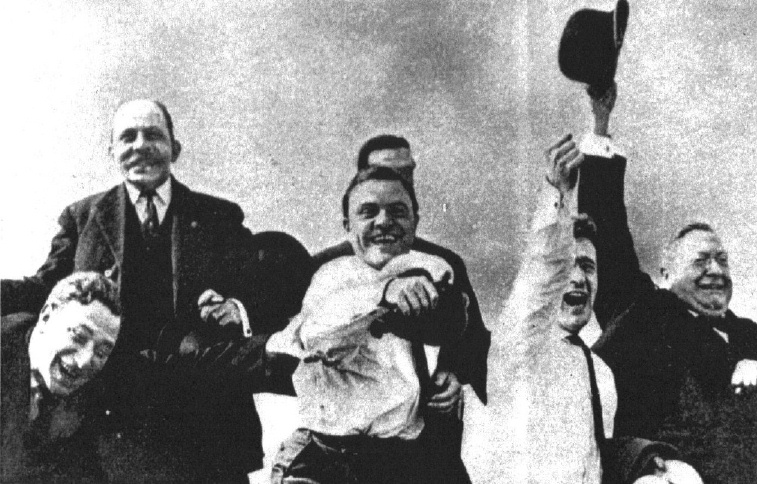
Intense enjoyment, interest or approval towards something
In modern usage, "enthusiasm" refers to intense enjoyment, interest, or approval expressed by a person. The term is allegedly related to playfulness, inventiveness, optimism, zest, verve, and high energy. People can often characterise the modern version of enthusiasm as "infectious" or "contagious", Chart of historical usage of the English phrases "infectious enthusiasm" and "contagious enthusiasm" and sometimes even more metaphorically as a virus in its own right. |publication-place = London |access-date = 26 August 2025
The word once applied, in accordance with its etymology, to persons possessed by a god, or to people who exhibited intense piety.
Historical usage
.jpg)
The word enthusiasm originates from the Greek ἐνθουσιασμός from ἐν (grc, 'in') and θεός (grc, 'god'), meaning 'inspired or possessed by [a] god'. Applied by the Greeks to manifestations of divine possession, by Apollo (as in the case of the Pythia), or by Dionysus (as in the case of the Bacchantes and Maenads), the term enthusiasm was also used in a transferred or figurative sense. Socrates taught that the inspiration of poets is a form of enthusiasm. The term was confined to a belief in religious inspiration, or to intense religious fervor or emotion.
From this, a Syrian sect of the fourth century was known as the Enthusiasts. They believed that "by perpetual prayer, ascetic practices, and contemplation, man could become inspired by the Holy Spirit, in spite of the ruling evil spirit, which the fall had given to him". From their belief in the efficacy of prayer, they were also known as Euchites.
Several Protestant Christian denominations that emerged in the 16th and 17th centuries, especially those who hold revivals, were called enthusiastic.
Pejorative use
During the years that immediately followed the Glorious Revolution, "enthusiasm" was a British pejorative term for advocacy of any political or religious cause in public, i.e. fanaticism. Such "enthusiasm" was seen in the time around 1700 as the cause of the previous century's English Civil War and its attendant atrocities, and thus it was an absolute social sin to remind others of the war by engaging in enthusiasm. The Royal Society bylaws stipulated that any person discussing religion or politics at a Society meeting was to be summarily ejected for being an "enthusiast."
During the 18th century, popular Methodists such as John Wesley or George Whitefield were accused of blind enthusiasm, a charge against which they defended themselves by distinguishing fanaticism from "religion of the heart." Methodists who enthusiastically preach about and experience the new birth (first work of grace) and entire sanctification (second work of grace) often have emotional experiences.
References
References
- (2000). "The Essential Enneagram". HarperCollins.
- Gibson, James. "Wesleyan Heritage Series: Entire Sanctification". South Georgia Confessing Association.
- (2019). "Madness in Socratic Philosophy Xenophon, Plato and Epictetus". University of St Andrews.
- (2012). "Historical dictionary of radical Christianity". Scarecrow Press.
- (1933). "The Restoration Revolt against Enthusiasm". Studies in Philology.
This article was imported from Wikipedia and is available under the Creative Commons Attribution-ShareAlike 4.0 License. Content has been adapted to SurfDoc format. Original contributors can be found on the article history page.
Ask Mako anything about Enthusiasm — get instant answers, deeper analysis, and related topics.
Research with MakoFree with your Surf account
Create a free account to save articles, ask Mako questions, and organize your research.
Sign up freeThis content may have been generated or modified by AI. CloudSurf Software LLC is not responsible for the accuracy, completeness, or reliability of AI-generated content. Always verify important information from primary sources.
Report