From Surf Wiki (app.surf) — the open knowledge base
Enhanced geothermal system
Type of electricity generation system

Type of electricity generation system
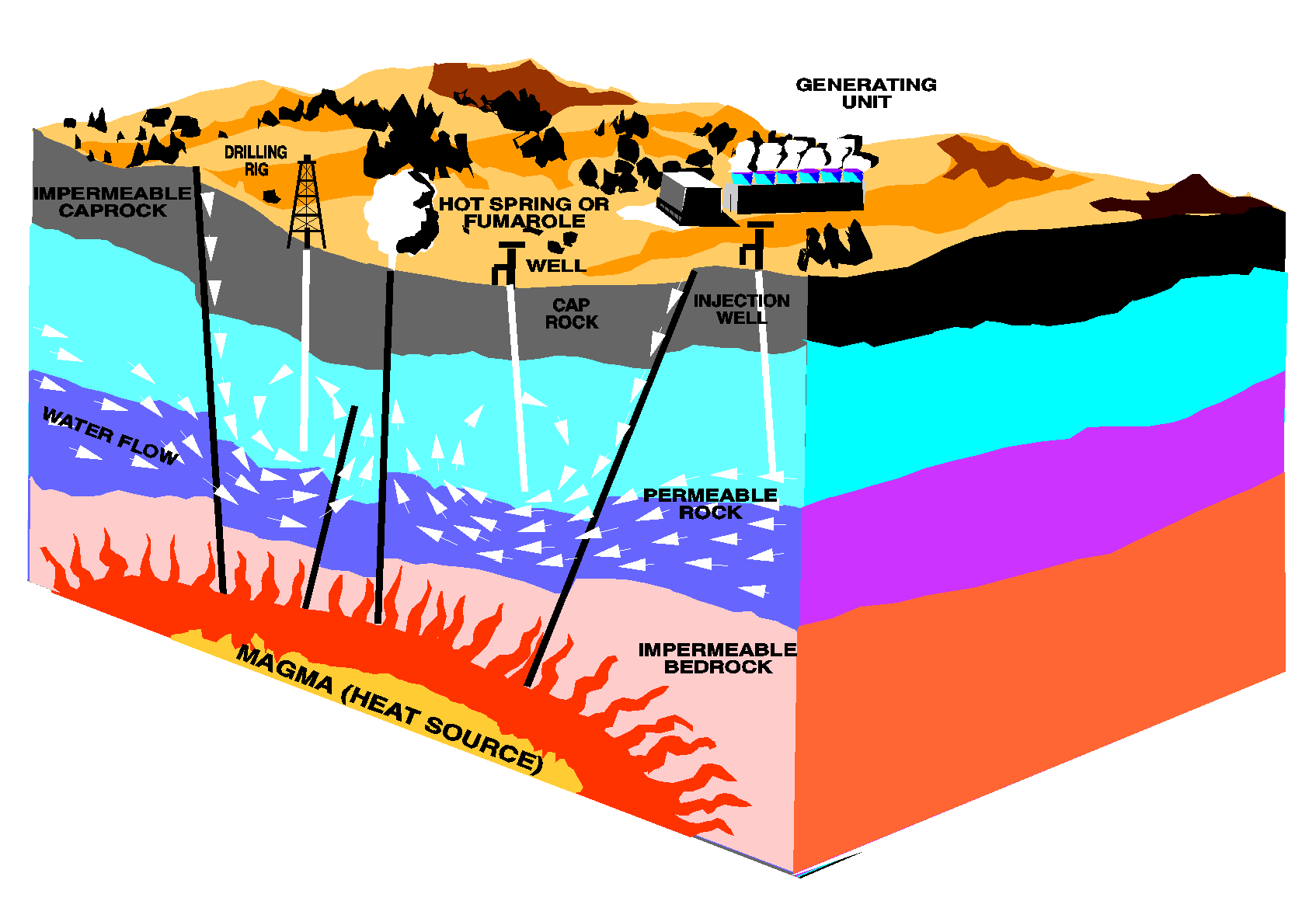
An enhanced geothermal system (EGS) generates geothermal electricity without natural convective hydrothermal resources. Traditionally, geothermal power systems operated only where naturally occurring heat, water, and rock permeability are sufficient to allow energy extraction. However, most geothermal energy within reach of conventional techniques is in dry and impermeable rock. EGS technologies expand the availability of geothermal resources through stimulation methods, such as 'hydraulic stimulation'.
Overview
In many rock formations natural cracks and pores do not allow water to flow at economic rates. Permeability can be enhanced by hydro-shearing, pumping high-pressure water down an injection well into naturally-fractured rock. The injection increases the fluid pressure in the rock, triggering shear events that expand pre-existing cracks and enhance the site's permeability. As long as the injection pressure is maintained, high permeability is not required, nor are hydraulic fracturing proppants required to maintain the fractures in an open state.
Hydro-shearing is different from hydraulic tensile fracturing, used in the oil and gas industry, which can create new fractures in addition to expanding existing fractures.
Water passes through the fractures, absorbing heat until forced to the surface as hot water. The water's heat is converted into electricity using either a steam turbine or a binary power plant system, which cools the water. The water is cycled back into the ground to repeat the process.
EGS plants are baseload resources that produce power at a constant rate. Unlike hydrothermal, EGS is apparently feasible anywhere in the world, depending on the resource depth. Good locations are typically over deep granite covered by a 3 - layer of insulating sediments that slow heat loss.
Advanced drilling techniques can penetrate hard crystalline rock to depths of up to, or exceeding, 15 km, providing access to higher-temperature rock (400 °C and above) as temperature increases with depth.
EGS plants are expected to have an economic lifetime of 20–30 years.
EGS systems are under development in Australia, France, Germany, Japan, Switzerland, and the United States. The world's largest EGS project is a 25-megawatt demonstration plant in Cooper Basin, Australia. Cooper Basin has the potential to generate 5,000–10,000 MW.
Research and development
EGS technologies use a variety of methods to create additional flow paths. EGS projects have combined hydraulic, chemical, thermal, carbon-based, and explosive stimulation methods. Some EGS projects operate at the edges of hydrothermal sites where drilled wells intersect hot, yet impermeable, reservoir rocks. Stimulation methods enhance that permeability. The table below shows EGS projects around the world.
| Name | Country | State/region | Year Start | Stimulation method | References | ||||||||
|---|---|---|---|---|---|---|---|---|---|---|---|---|---|
| Mosfellssveit | Iceland | 1970 | Thermal and hydraulic | ||||||||||
| Fenton Hill | USA | New Mexico | 1973 | Hydraulic and chemical | |||||||||
| Bad Urach | Germany | 1977 | Hydraulic | ||||||||||
| Falkenberg | Germany | 1977 | Hydraulic | ||||||||||
| Rosemanowes | UK | 1977 | Hydraulic and explosive | ||||||||||
| Le Mayet | France | 1978 | Hydraulic | , | |||||||||
| East Mesa | USA | California | 1980 | Hydraulic | last=Entingh | first=D. J. | date=2000 | title=Geothermal Well Stimulation Experiments in the United States | url=https://www.geothermal-energy.org/pdf/IGAstandard/WGC/2000/R0840.PDF | journal=Proceedings World Geothermal Congress}} | |||
| Krafla | Iceland | 1980 | Thermal | ||||||||||
| Baca | USA | New Mexico | 1981 | Hydraulic | |||||||||
| Geysers Unocal | USA | California | 1981 | Explosive | |||||||||
| Beowawe | USA | Nevada | 1983 | Hydraulic | |||||||||
| Bruchal | Germany | 1983 | Hydraulic | ||||||||||
| Fjällbacka | Sweden | 1984 | Hydraulic and chemical | ||||||||||
| Germany | 1984 | last1=Пашкевич | first1=Р.И. | last2=Павлов | first2=К.А. | date=2015 | title=Современное состояние использования циркуляционных геотермальных систем в целях тепло- и электроснабжения | journal=Горный информационно-аналитический бюллетень | pages=388–399 | issn=0236-1493}} | |||
| Hijiori | Japan | 1985 | Hydraulic | ||||||||||
| Soultz | France | 1986 | Hydraulic and chemical | ||||||||||
| Altheim | Austria | 1989 | Chemical | ||||||||||
| Hachimantai | Japan | 1989 | Hydraulic | ||||||||||
| Ogachi | Japan | 1989 | Hydraulic | ||||||||||
| Sumikawa | Japan | 1989 | Thermal | ||||||||||
| Tyrnyauz | Russia | ` | 1991 | Hydraulic | last1=Дядькин | first1=Ю. Д. | date=2001 | title=Извлечение и использование тепла земли | url=https://cyberleninka.ru/article/n/izvlechenie-i-ispolzovanie-tepla-zemli | journal=Горный информационно-аналитический бюллетень (научно-технический журнал) | issue=9 | pages=228–241}} | |
| Bacman | Philippines | 1993 | Chemical | ||||||||||
| Seltjarnarnes | Iceland | 1994 | Hydraulic | ||||||||||
| Mindanao | Philippines | 1995 | Chemical | ||||||||||
| Bouillante | France | 1996 | Thermal | ||||||||||
| Leyte | Philippines | 1996 | Chemical | ||||||||||
| Hunter Valley | Australia | 1999 | |||||||||||
| Groß Schönebeck | Germany | 2000 | Hydraulic and chemical | ||||||||||
| Tiwi | Philippines | 2000 | Chemical | ||||||||||
| Berlin | El Salvador | 2001 | Chemical | ||||||||||
| Cooper Basin: Habanero | Australia | 2002 | Hydraulic | last1=Holl | first1=Heinz-Gerd | title=What did we learn about EGS in the Cooper Basin? | date=2015 | doi=10.13140/RG.2.2.33547.49443 | url=https://doi.org/10.13140/RG.2.2.33547.49443}} | ||||
| Cooper Basin: Jolokia 1 | Australia | 2002 | Hydraulic | ||||||||||
| Coso | USA | California | 1993, 2005 | Hydraulic and chemical | |||||||||
| Hellisheidi | Iceland | 1993 | Thermal | ||||||||||
| Genesys: Horstberg | Germany | 2003 | Hydraulic | ||||||||||
| Germany | 2003 | Hydraulic | |||||||||||
| Unterhaching | Germany | 2004 | Chemical | ||||||||||
| Salak | Indonesia | 2004 | Chemical, thermal, hydraulic and cyclic pressure loading | ||||||||||
| Olympic Dam | Australia | 2005 | Hydraulic | ||||||||||
| Paralana | Australia | 2005 | Hydraulic and chemical | ||||||||||
| Los Azufres | Mexico | 2005 | Chemical | ||||||||||
| Switzerland | 2006 | Hydraulic | |||||||||||
| Larderello | Italy | 1983, 2006 | Hydraulic and chemical | ||||||||||
| Insheim | Germany | 2007 | Hydraulic | ||||||||||
| Desert Peak | USA | Nevada | 2008 | Hydraulic and chemical | |||||||||
| Brady Hot Springs | USA | Nevada | 2008 | Hydraulic | |||||||||
| Southeast Geysers | USA | California | 2008 | Hydraulic | |||||||||
| Genesys: Hannover | Germany | 2009 | Hydraulic | ||||||||||
| St. Gallen | Switzerland | 2009 | Hydraulic and chemical | ||||||||||
| New York Canyon | USA | Nevada | 2009 | Hydraulic | |||||||||
| Northwest Geysers | USA | California | 2009 | Thermal | |||||||||
| Newberry | USA | Oregon | 2010 | Hydraulic | |||||||||
| Mauerstetten | Germany | 2011 | Hydraulic and chemical | ||||||||||
| Soda Lake | USA | Nevada | 2011 | Explosive | |||||||||
| Raft River | USA | Idaho | 1979, 2012 | Hydraulic and thermal | |||||||||
| Blue Mountain | USA | Nevada | 2012 | Hydraulic | |||||||||
| Rittershoffen | France | 2013 | Thermal, hydraulic and chemical | ||||||||||
| Klaipėda | Lithuania | 2015 | Jetting | ||||||||||
| Otaniemi | Finland | 2016 | Hydraulic | ||||||||||
| South Hungary EGS Demo | Hungary | 2016 | Hydraulic | ||||||||||
| Pohang | South Korea | 2016 | Hydraulic | ||||||||||
| FORGE Utah | USA | Utah | 2016 | Hydraulic | |||||||||
| Reykjanes | Iceland | 2006, 2017 | Thermal | ||||||||||
| Roter Kamm (Schneeberg) | Germany | 2018 | Hydraulic | ||||||||||
| United Downs Deep Geothermal Power (Redruth) | UK | 2018 | Hydraulic | ||||||||||
| Eden (St Austell) | UK | 2018 | Hydraulic | ||||||||||
| Qiabuqia | China | 2018 | Thermal and hydraulic | ||||||||||
| Vendenheim | France | 2019 | |||||||||||
| Project Red | USA | Nevada | 2023 | Hydraulic | |||||||||
| Cape Station | USA | Utah | 2023 | Hydraulic |
Australia
Main article: Geothermal power in Australia
The Australian government has provided research funding for the development of Hot Dry Rock technology. Projects include Hunter Valley (1999), Cooper Basin: Habanero (2002), Cooper Basin: Jolokia 1 (2002), and Olympic Dam (2005).
European Union
The EU's EGS R&D project at Soultz-sous-Forêts, France, connects a 1.5 MW demonstration plant to the grid. The Soultz project explored the connection of multiple stimulated zones and the performance of triplet well configurations (1 injector/2 producers). Soultz is in the Alsace.
Induced seismicity in Basel led to the cancellation of the EGS project there.
The Portuguese government awarded, in December 2008, an exclusive license to Geovita Ltd to prospect and explore geothermal energy in one of the best areas in continental Portugal. Geovita is now studying an area of about 500 square kilometers together with the Earth Sciences department of the University of Coimbra's Science and Technology faculty.
South Korea
The Pohang EGS project started in December 2010, with the goal of producing 1 MW.
The 2017 Pohang earthquake may have been linked to the activity of the Pohang EGS project. All research activities were stopped in 2018.
United Kingdom
United States
Early days — Fenton Hill
The first EGS effort — then termed Hot Dry Rock — took place at Fenton Hill, New Mexico with a project run by the federal Los Alamos Laboratory. It was the first attempt to make a deep, full-scale EGS reservoir.
The EGS reservoir at Fenton Hill was completed in 1977 at a depth of about 2.6 km, exploiting rock temperatures of 185°C. In 1979, the reservoir was enlarged with additional hydraulic stimulation and was operated for about 1 year. The results demonstrated that heat could be extracted at reasonable rates from a hydraulically stimulated region of low-permeability hot crystalline rock. In 1986, a second reservoir was prepared for initial hydraulic circulation and heat extraction testing. In a 30-day flow test with a constant reinjection temperature of 20°C, the production temperature steadily increased to about 190°C, corresponding to a thermal power level of about 10MW. Budget cuts ended the study.
2000-2010
In 2009, The US Department of Energy (USDOE) issued two Funding Opportunity Announcements (FOAs) related to enhanced geothermal systems. Together, the two FOAs offered up to $84 million over six years. | access-date = 2009-07-04 | archive-date = 2009-06-09 | archive-url = https://web.archive.org/web/20090609171632/http://apps1.eere.energy.gov/news/news_detail.cfm/news_id=12279 | url-status = dead
The DOE opened another FOA in 2009 using stimulus funding from the American Reinvestment and Recovery Act for $350 million, including $80 million aimed specifically at EGS projects,{{Cite web | access-date = 2009-07-04 | archive-url = https://web.archive.org/web/20090624215012/http://www.energy.gov/news2009/7427.htm | archive-date = 2009-06-24 | url-status = dead
FORGE
Cornell University — Ithaca, NY
Developing EGS in conjunction with a district heating system is a part in Cornell University's Climate Action Plan for their Ithaca campus. The project began in 2018 to determine feasibility, gain funding and monitor baseline seismicity. The project received $7.2 million in USDOE funding. A test well was to be drilled in spring of 2021, at a depth of 2.5 –5 km targeting rock with a temperature 85°C. The site is planned to supply 20% of the campus' annual heating load. Promising geological locations for reservoir were proposed in the Trenton-Black River formation (2.2 km) or in basement crystalline rock (3.5km). The 2 mile deep borehole was completed in 2022.
EGS "earthshot"
In September 2022, the Geothermal Technologies Office within the Department of Energy's Office of Energy Efficiency and Renewable Energy announced an "Enhanced Geothermal Shot" as part of their Energy Earthshots campaign. The goal of the Earthshot is to reduce the cost of EGS by 90%, to $45/megawatt hour by 2035.
Other federal funding and support
The Infrastructure Investment and Jobs Act authorized $84 million to support EGS development through four demonstration projects. The Inflation Reduction Act extended the production tax credit (PTC) for renewable energy sources (including geothermal) until 2024 and included geothermal energy in the new Clean Electricity PTC to begin in 2024.
Induced seismicity
Main article: Induced seismicity
Induced seismicity is earth tremors caused by human activity. Seismicity is common in EGS, because of the high pressures involved. Seismicity events at the Geysers geothermal field in California are correlated with injection activity.
Induced seismicity in Basel led the city to suspend its project and later cancel the project.{{Citation
According to the Australian government, risks associated with "hydrofracturing induced seismicity are low compared to that of natural earthquakes, and can be reduced by careful management and monitoring" and "should not be regarded as an impediment to further development". Induced seismicity varies from site to site and should be assessed before large scale fluid injection.
EGS potential
United States
A 2006 report by MIT, funded by the U.S. Department of Energy, conducted the most comprehensive analysis to date on EGS. The report offered several significant conclusions:
- Resource size: The report calculated United States total EGS resources at 3–10 km of depth to be over 13,000 zettajoules, of which over 200 ZJ were extractable, with the potential to increase this to over 2,000 ZJ with better technology. It reported that geothermal resources, including hydrothermal and geo-pressured resources, to equal 14,000 ZJ — or roughly 140,000 times U.S. primary energy use in 2005.
- Development potential: With an R&D investment of $1 billion over 15 years, the report estimated that 100 GWe (gigawatts of electricity) or more could be available by 2050 in the United States. The report further found that "recoverable" resources (accessible with today's technology) were between 1.2 and 12.2 TW for the conservative and moderate scenarios respectively.
- Cost: The report claimed that EGS could produce electricity for as low as 3.9 cents/kWh. EGS costs were found to be sensitive to four main factors:
- Temperature of the resource
- Fluid flow through the system
- Drilling costs
- Power conversion efficiency
References
References
- Lund, John W.. (June 2007). "Characteristics, Development and utilization of geothermal resources". Oregon Institute of Technology.
- (December 2002). "Hot Dry Rock (HDR) Geothermal Energy Research and Development at Fenton Hill, New Mexico". Oregon Institute of Technology.
- Pierce, Brenda. (2010-02-16). "Geothermal Energy Resources". National Association of Regulatory Utility Commissioners (NARUC).
- Cichon, Meg. (2013-07-16). "Is Fracking for Enhanced Geothermal Systems the Same as Fracking for Natural Gas?". RenewableEnergyWorld.com.
- US Department of Energy Energy Efficiency and Renewable Energy. "How an Enhanced Geothermal System Works".
- (January 2026). "20 slide presentation inc geothermal maps of Australia}}{{Dead link".
- (October 2022). "Superhot Rock Energy: A Vision for Firm, Global Zero-Carbon Energy". Clean Air Task Force.
- Pollack, Ahinoam. (2020). "Gallery of 1D, 2D, and 3D maps from enhanced geothermal systems around the world".
- Pollack, Ahinoam. (2020). "What Are the Challenges in Developing Enhanced Geothermal Systems (EGS)? Observations from 64EGS Sites". World Geothermal Congress.
- (1979-01-01). "Drillhole stimulation in Iceland". Am. Soc. Mech. Eng., (Pap.); (United States).
- (2012). "Serendipity—A Brief History of Events Leading to the Hot Dry Rock Geothermal Energy Program at Los Alamos". Springer.
- Stober, Ingrid. (2011-05-01). "Depth- and pressure-dependent permeability in the upper continental crust: data from the Urach 3 geothermal borehole, southwest Germany". Hydrogeology Journal.
- (1983). "Hydraulic fracturing and geothermal energy". Springer Netherlands.
- Batchelor, A. S.. (1987-05-01). "Development of hot-dry-rock geothermal systems in the UK". IEE Proceedings A.
- Cornet, FH. (1987-01-01). "Results from Le Mayet de Montagne project". Geothermics.
- (1997-04-01). "Evaluation of hydromechanical coupling in a granite rock mass from a high-volume, high-pressure injection experiment: Le Mayet de Montagne, France". International Journal of Rock Mechanics and Mining Sciences.
- Entingh, D. J.. (2000). "Geothermal Well Stimulation Experiments in the United States". Proceedings World Geothermal Congress.
- Axelsson, G. (2009). "Review of well stimulation operations in Iceland". Transactions - Geothermal Resources Council.
- (1999-08-01). "Hot dry rock research experiments at Fjällbacka, Sweden". Geothermics.
- (2015). "Современное состояние использования циркуляционных геотермальных систем в целях тепло- и электроснабжения". Горный информационно-аналитический бюллетень.
- Matsunaga, I. (2005). "Review of the HDR Development at Hijiori Site, Japan". Proceedings of the World Geothermal Congress.
- (2010-07-01). "Contribution of the exploration of deep crystalline fractured reservoir of Soultz to the knowledge of enhanced geothermal systems (EGS)". Comptes Rendus Geoscience.
- Pernecker, G. (1999). "Altheim geothermal plant for electricity production by ORC-turbogenerator". Bulletin d'Hydrogéologie.
- Niitsuma, H.. (1989-07-01). "Fracture mechanics design and development of HDR reservoirs— Concept and results of the Γ-project, Tohoku University, Japan". International Journal of Rock Mechanics and Mining Sciences & Geomechanics Abstracts.
- Ito, Hisatoshi. (2003). "Inferred role of natural fractures, veins, and breccias in development of the artificial geothermal reservoir at the Ogachi Hot Dry Rock site, Japan". Journal of Geophysical Research: Solid Earth.
- Kitao, K. (1990). "Geotherm. Resourc. Counc. Trans". Cold-water Well Stimulation Experiments in the Sumikawa Geotheral Field, Japan.
- (2001). "Извлечение и использование тепла земли". Горный информационно-аналитический бюллетень (научно-технический журнал).
- Алхасов, А.Б.. (2016). "Возобновляемые источники энергии". Издательский дом МЭИ.
- (1995). "Recent Experiences in Acid Stimulation Technology by PNOC-Energy Development Corporation, Philippines". World Geothermal Congress 1995.
- (1996-01-01). "Stimulation of well SN12 in the Seltjarnarnes low-temperature field in SW-Iceland".
- Malate, Ramonchito Cedric M.. (2000). "SK-2D: A CASE HISTORY ON GEOTHERMAL WELLBORE ENHANCEMENT, MINDANAO GEOTHERMAL PRODUCTION FIELD, PHILIPPINES". Proceedings World Geothermal Congress 2000.
- (2010-04-25). "Monitoring of the Bouillante Geothermal Exploitation (Guadeloupe, French West Indies) and the Impact on Its Immediate Environment".
- Malate. (2003). "ACID STIMULATION OF INJECTION WELLS IN THE LEYTE GEOTHERMAL POWER PROJECT, PHILIPPINES". Twenty-Second Workshop on Geothermal Reservoir Engineering, Stanford University.
- (2010-03-01). "Cyclic waterfrac stimulation to develop an Enhanced Geothermal System (EGS)—Conceptual design and experimental results". Geothermics.
- "Scaling of hot brine injection wells: supplementing field studies with reactive transport modeling". TOUGH Symposium 2003.
- (2002). ["Enhanced Permeability by Chemical Stimulation at the Berlín Geothermal field"](http://pubs.geothermal-library.org/lib/grc/1019575.pdf }}{{Dead link). Geothermal Resources Council Transactions.
- (2015). "What did we learn about EGS in the Cooper Basin?".
- (2004). "STIMULATION AND DAMAGE REMOVAL OF CALCIUM CARBONATE SCALING IN GEOTHERMAL WELLS: A CASE STUDY". Proceedings of the World Geothermal Congress.
- (2004). "RESERVOIR CONDITIONS AT 3-6 KM DEPTH IN THE HELLISHEIDIGEOTHERMAL FIELD, SW-ICELAND, ESTIMATED BY DEEP DRILLING, COLD WATER INJECTION AND SEISMIC MONITORING". Twenty-Ninth Workshop on Geothermal Reservoir Engineering.
- (2010). "New Concepts for Extracting Geothermal Energy from One Well: The GeneSys-Project". Proceedings World Geothermal Congress.
- (2010). "Successful Hydraulic Stimulation Techniques for Electric Power Production in the Upper Rhine Graben, Central Europe". Proceedings World Geothermal Congress.
- (1 March 2016). "2014 JRC geothermal energy status report : technology, market and economic aspects of geothermal energy in Europe.". Op.europa.eu.
- (2006). "COILED TUBING ACID STIMULATION: THE CASE OF AWI 8-7 PRODUCTION WELL IN SALAK GEOTHERMAL FIELD, INDONESIA". Thirty-First Workshop on Geothermal Reservoir Engineering.
- "Australian Experiences in EGS Permeability Enhancement –A Review of 3 Case Studies". Thirty-Ninth Workshop on Geothermal Reservoir Engineering.
- (1 October 2014). "Monitoring of induced seismicity during the first geothermal reservoir stimulation at Paralana, Australia". Geothermics.
- (2006). ["Productivity Analysis and Acid Treatment of Well AZ-9ADat the Los Azufres Geothermal Field, Mexico"](http://pubs.geothermal-library.org/lib/grc/1025131.pdf }}{{Dead link). GRC Transactions.
- (1 October 2008). "Characterisation of the Basel 1 enhanced geothermal system". Geothermics.
- (1 January 1985). "Geothermal activity in Italy: Present status and future prospects". Geothermics.
- (1 December 2018). "Long-Term Monitoring of Induced Seismicity at the Insheim Geothermal Site, GermanyLong-Term Monitoring of Induced Seismicity at the Insheim Geothermal Site, Germany". Bulletin of the Seismological Society of America.
- (2012). "HYDRAULIC STIMULATION OF WELL 27-15, DESERT PEAK GEOTHERMAL FIELD, NEVADA, USA". Thirty-Seventh Workshop on Geothermal Reservoir Engineering.
- (2017). "Feasibility of EGS Development at Brady Hot Springs, Nevada". US DOE Geothermal Office.
- (2013). "Engineered Geothermal SystemDemonstration ProjectNorthern California Power Agency, The Geysers, CA".
- (2013). "MASSIVE HYDRAULIC FRACTURING IN LOW PERMEABLESEDIMENTARY ROCK IN THE GENESYS PROJECT". Thirty-EighthWorkshop on Geothermal Reservoir Engineering.
- (2015). "The St. Gallen Project: Development of Fault Controlled Geothermal Systems in Urban Areas". Proceedings World Geothermal Congress 2015.
- (2015). "The St. Gallen Project: Development of Fault Controlled Geothermal Systems in Urban Areas". Proceedings World Geothermal Congress 2015.
- (1 September 2016). "The Northwest Geysers EGS Demonstration Project, California: Part 1: Characterization and reservoir response to injection". Geothermics.
- (2016-09-01). "Results from Newberry Volcano EGS Demonstration, 2010–2014". Geothermics.
- (31 October 2018). "Multiphase fossil normal faults as geothermal exploration targets in the Western Bavarian Molasse Basin: Case study Mauerstetten". Zeitschrift der Deutschen Gesellschaft für Geowissenschaften.
- (2011). ["Permeability Recovery and Enhancements in the Soda Lake Geothermal Field, Fallon, Nevada"](http://pubs.geothermal-library.org/lib/grc/1029283.pdf }}{{Dead link). GRC Transactions.
- (2015). ["Hydraulic and Thermal Stimulation Program at Raft River Idaho, A DOE EGS"](http://pubs.geothermal-library.org/lib/grc/1032159.pdf }}{{Dead link). GRC Transactions.
- (2016). "Current Status of Geothermal Stimulation Technology". 2016 GRC Annual Meeting Presentations.
- (1 January 2017). "Hydrothermal characterization of wells GRT-1 and GRT-2 in Rittershoffen, France: Implications on the understanding of natural flow systems in the rhine graben". Geothermics.
- (2017). "A case study of radial jetting technology for enhancing geothermal energy systems at Klaipėda geothermal demonstration plant". 42nd Workshop on Geothermal Reservoir Engineering.
- (29 August 2019). "Design and implementation of a traffic light system for deep geothermal well stimulation in Finland". Journal of Seismology.
- (2016). ["The South Hungary Enhanced Geothermal System (SHEGS) Demonstration Project"](http://pubs.geothermal-library.org/lib/grc/1032340.pdf }}{{Dead link). GRC Transactions.
- (1 June 2018). "Assessing whether the 2017 Mw 5.4 Pohang earthquake in South Korea was an induced event". Science.
- (2019). "The Utah Frontier Observatory for Research in Geothermal Energy (FORGE): An International Laboratory for Enhanced Geothermal System Technology Development". 44th Workshop on Geothermal Reservoir Engineering.
- (2019). "TheReykjanes DEEPEGS Demonstration Well –IDDP-2". European Geothermal Congress 2019.
- (2015). "PetrothermalEnergyGenerationin Crystalline Rocks (Germany)". Proceedings World Geothermal Congress 2015.
- (2019). "The United Downs Deep Geothermal Power Project". 44th Workshop on Geothermal Reservoir Engineering.
- (15 February 2014). "Understanding geothermal power".
- (1 August 2019). "Exploratory research into the enhanced geothermal system power generation project: The Qiabuqia geothermal field, Northwest China". Renewable Energy.
- (2019 ). European Geothermal Congress 2019.
- Clifford, Catherine. (2023-07-18). "Fervo Energy hits milestone in using oil drilling technology to tap geothermal energy".
- (2023-07-18). "Commercial-Scale Demonstration of a First-of-a-Kind Enhanced Geothermal System". Eartharxiv ePrints.
- "Fracking for heat: Utah could become home to world's largest enhanced geothermal plant".
- "Geothermal Drilling Program".
- "DESTRESS - Pohang". DESTRESS.
- {{Harvnb. Tester. 2006
- Whang, Jyu. (2013). "Climate Action Plan & roadmap 2014-2015". Cornell University.
- "Cornell's Commitment to a Sustainable Campus – Earth Source Heat".
- "$7.2M grant funds exploratory research into Earth Source Heat".
- Tester, Jeffery. (April 26, 2020). "District Geothermal Heating Using EGS Technology to Meet Carbon Neutrality Goals: A Case Study of Earth Source Heat for the Cornell University Campus". Proceedings World Geothermal Congress April 26-May 2, 2020.
- University, Office of Web Communications, Cornell. "Earth Source Heat {{!}} Cornell University".
- (8 September 2022). "DOE Launches New Energy Earthshot to Slash the Cost of Geothermal Power".
- "Enhanced Geothermal Shot".
- (January 2023). "Meet the renewable energy source poised for growth with the help of the oil industry".
- (August 4, 2022). "Inflation Reduction Act Summary". Bipartisan Policy Center.
- {{Harvnb. Tester. 2006
- {{Harvnb. Tester. 2006
- (May 21, 2008). "The Impact of Injection on Seismicity at The Geyses, California Geothermal Field".
- Geoscience Australia. "Induced Seismicity and Geothermal Power Development in Australia". Australian Government.
- Tester, Jefferson W. ([[Massachusetts Institute of Technology]]). (2006). "The Future of Geothermal Energy – Impact of Enhanced Geothermal Systems (EGS) on the United States in the 21st Century". Idaho National Laboratory.
This article was imported from Wikipedia and is available under the Creative Commons Attribution-ShareAlike 4.0 License. Content has been adapted to SurfDoc format. Original contributors can be found on the article history page.
Ask Mako anything about Enhanced geothermal system — get instant answers, deeper analysis, and related topics.
Research with MakoFree with your Surf account
Create a free account to save articles, ask Mako questions, and organize your research.
Sign up freeThis content may have been generated or modified by AI. CloudSurf Software LLC is not responsible for the accuracy, completeness, or reliability of AI-generated content. Always verify important information from primary sources.
Report