From Surf Wiki (app.surf) — the open knowledge base
English language in Northern England
none
none
| Field | Value |
|---|---|
| name | Northern England English |
| familycolor | indo-european |
| altname | Northern English |
| region | Northern England |
| speakers | ? |
| fam2 | Germanic |
| fam3 | West Germanic |
| fam4 | Ingvaeonic |
| fam5 | Anglo-Frisian |
| fam6 | Anglic |
| fam7 | Anglian |
| fam8 | North Anglic |
| fam9 | Northern English |
| script | English alphabet |
| isoexception | dialect |
| glotto | nort3299 |
| glottoname | Northern English |
| notice | IPA |
| map | Foot-strut split.svg |
| mapalt | A map of England, with isoglosses showing how different regions pronounce "sun" |
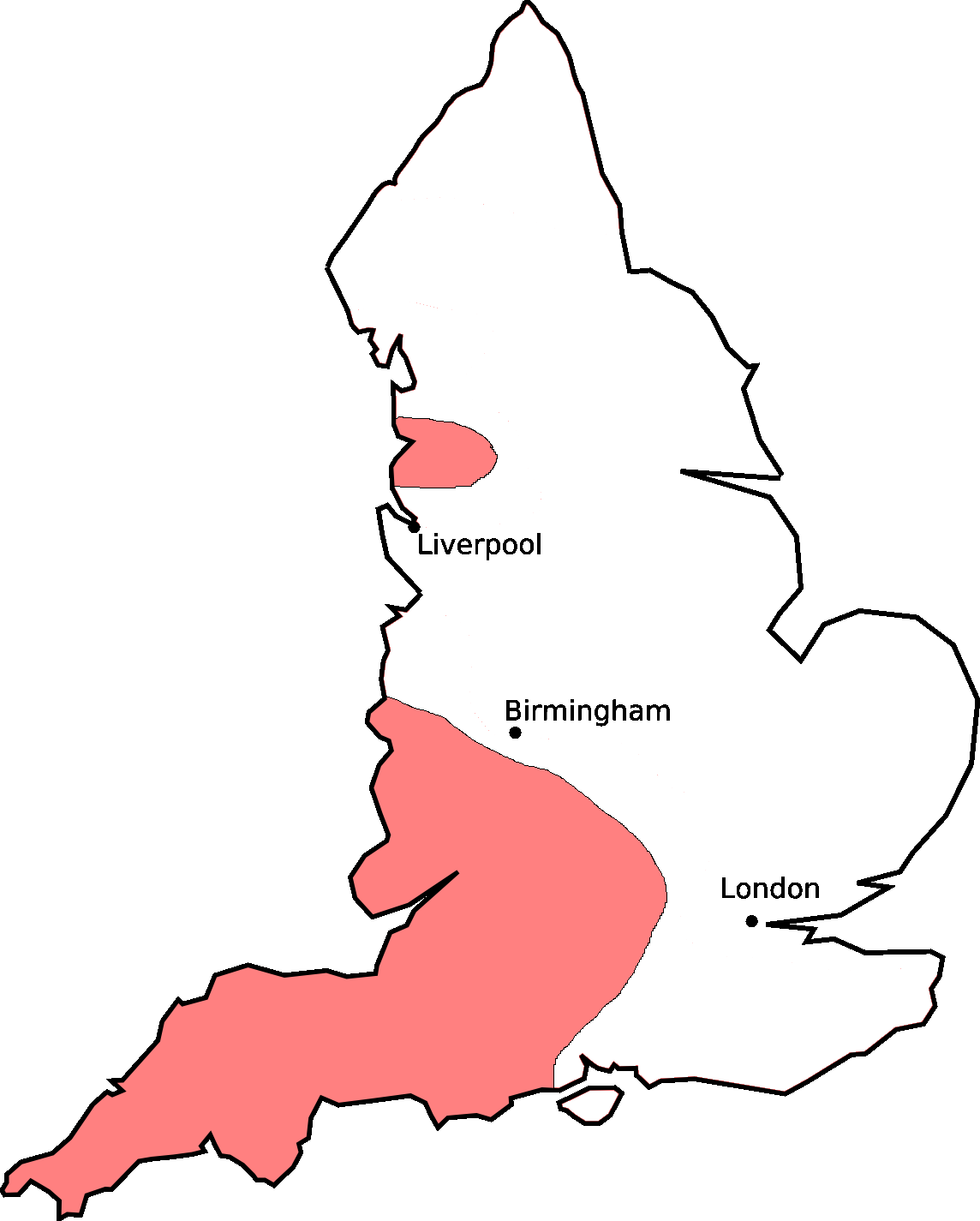
| mapcaption | How the vowel sound in sun varies across England. The thick lines are isoglosses. Northern English dialects have not undergone the FOOT–STRUT split, distinguishing them from Southern English and Scottish dialects. |
the varieties of English spoken in the northern part of England, and focuses on accents and dialects
The spoken English language in Northern England has been shaped by the region's history of settlement and migration, and today encompasses a group of related accents and dialects known as Northern England English or Northern English. cite web |access-date=20 October 2024 |archive-url=https://web.archive.org/web/20231021051923/https://www.bl.uk/british-accents-and-dialects/articles/regional-voices-the-north-south-divide |archive-date=21 October 2023 cite encyclopedia |entry-url=https://oxfordre.com/linguistics/display/10.1093/acrefore/9780199384655.001.0001/acrefore-9780199384655-e-284 |access-date=20 October 2024
The strongest influence on modern varieties of Northern English was the Northumbrian dialect of Middle English. Additional influences came from contact with Old Norse during the Viking Age; with Irish English following the Great Famine, particularly in Lancashire and the south of Yorkshire; and with Midlands dialects since the Industrial Revolution. All these produced new and distinctive styles of speech.--
Traditional dialects are associated with many of the historic counties of England, and include those of Cumbria, Lancashire, Northumbria, and Yorkshire. Following urbanisation in the nineteenth and twentieth centuries, distinctive dialects arose in many urban centres in Northern England, with English spoken using a variety of distinctive pronunciations, terms, and expressions. cite book |editor-first=Raymond |editor-last=Hickey |editor-link=Raymond Hickey |author-link=Raymond Hickey |chapter-url=https://books.google.com/books?id=pNf4CgAAQBAJ&pg=PA1 cite web |access-date=20 October 2024 |archive-url=https://web.archive.org/web/20231112032023/https://www.northumbria.ac.uk/about-us/news-events/news/new-research-reveals-prejudice-against-people-with-northern-english-accents/ |archive-date=12 November 2023 |url-status=live}} and some native speakers modify their Northern speech characteristics in corporate and professional environments. cite journal |doi-access=free |quote-page=16 cite web |access-date=20 October 2024 |archive-url=https://web.archive.org/web/20231109013950/https://accentbiasbritain.org/accents-in-britain/ |archive-date=9 November 2023 |url-status=live
There is some debate about how spoken varieties of English have impacted written English in Northern England; cite book |editor-first=Raymond |editor-last=Hickey |editor-link=Raymond Hickey |chapter-url=https://books.google.com/books?id=pNf4CgAAQBAJ&pg=PA131 cite book |editor-first1=Patrick |editor-last1=Honeybone |editor-first2=Warren |editor-last2=Maguire |chapter-url=https://books.google.com/books?id=KncxEAAAQBAJ&pg=PT10 |quote-page=6
Definition
The varieties of English spoken across modern Great Britain form an accent and dialect continuum, and there is no agreed definition of which varieties are Northern, and no consensus about what constitutes "the North". cite book |editor-first=Raymond |editor-last=Hickey |editor-link=Raymond Hickey |chapter-url=https://eprints.whiterose.ac.uk/96539/8/Montgomery%20authors'%20final%20copy.pdf |access-date=23 October 2024
Wells uses a broad definition of the linguistic North, comprising all accents that have not undergone the TRAP–BATH and FOOT–STRUT splits. On that basis, the isogloss between North and South runs from the River Severn to The Wash, and covers the entire North of England (which Wells divides into "Far North" and "Middle North") and most of the Midlands, including the distinctive Brummie (Birmingham) and Black Country dialects. cite book |author-link=John C. Wells |url-access=registration |access-date=1 January 2025
In his seminal study of English dialects, Alexander J. Ellis defined the border between the North and the Midlands as that where the word house is pronounced with to the north. cite book |chapter-url=https://books.google.com/books?id=pvcKAAAAYAAJ&pg=PA1447 |author-link=Alexander John Ellis |access-date=22 October 2024
According to Wells, although well-suited to historical analysis, Ellis's line does not reflect everyday usage, which does not consider Manchester or Leeds, both located south of the line, as part of the Midlands.
An alternative approach is to define the linguistic North as equivalent to the cultural area of Northern Englandapproximately the seven historic counties of Cheshire, Cumberland, County Durham, Lancashire, Northumberland, Westmorland and Yorkshire, or the three modern statistical regions of North East England, North West England and Yorkshire and the Humber. This approach was taken by the Survey of English Dialects (SED), which used the historic counties (minus Cheshire) as a basis, and grouped Manx English with Northern dialects. cite book
Scottish English is distinct from Northern English, although the two have interacted with and influenced each other.
History
Many historical northern dialects reflect the influence of Old Norse. cite encyclopedia |author-link=Judith Jesch |editor-first1=Robert |editor-last1=Rouse |editor-first2=Siân |editor-last2=Echard |editor-first3=Helen |editor-last3=Fulton |editor3-link=Helen Fulton |editor-first4=Geoff |editor-last4=Rector |editor-first5=Jacqueline A. |editor-last5=Fay |entry-url=https://onlinelibrary.wiley.com/doi/10.1002/9781118396957.wbemlb516 |url-access=subscription cite book |editor-first1=Laurel J. |editor-last1=Brinton |editor1-link=Laurel J. Brinton |editor-first2=Alexander |editor-last2=Bergs |editor2-link=Alexander Bergs |quote-page=214 In addition to previous contact with Vikings, during the 9th and 10th centuries most of northern and eastern England was part of either the Danelaw or the Danish-controlled Kingdom of Northumbria (except for much of present-day Cumbria, which was part of the Kingdom of Strathclyde). Consequently, modern Yorkshire dialects, in particular, are considered to have been influenced heavily by Old West Norse (the ancestor of Norwegian) and Old East Norse (the ancestor of Swedish and Danish). |access-date=3 February 2025 |archive-url=https://web.archive.org/web/20230729094851/https://www.viking.no/the-viking-travels/jorvik-york/yorkshire-dialect-words-of-old-norse-origin/ |archive-date=29 July 2023 |url-status=live
In the 19th century, there was large-scale migration from Ireland to Northern England, particularly to Liverpool and its hinterland. Summarising the views of several scholars, Wales (2006) highlights some features of accents and dialects in the North West influenced by Hiberno-English, such as the dental articulation of dat ("that") and tree ("three"), and the usage of yous as the second-person plural pronoun .
Northern accent and dialect varieties
Varieties include:
- Cheshire dialect
- Cumbrian dialect
- Geordiespoken in Newcastle and Tyneside, which includes southern parts of Northumberland
- Lancashire dialect
- Mackemin Sunderland and Wearside
- Mancunianin Manchester, Salford, various other areas of Greater Manchester, and parts of Lancashire and eastern Cheshire
- Northumbrian dialect
- Pitmatictwo varieties: one in the former mining communities of County Durham, the other in Northumberland
- Scousein Liverpool and Merseyside, with varieties in western Cheshire and southern Lancashire
- Smoggiein Teesside
- Yorkshire dialect.
A survey published in 2022 found that compared to the findings of the Survey of English Dialects carried out in the first half of the twentieth century, the edges of many dialect regions have shifted. Furthermore, there are transitional zones between dialects where towns, such as those between Manchester and Liverpool, may display considerable heterogeneity. The authors also found evidence of dialect regions crossing county boundaries. cite journal |doi-access=free
General Northern English (GNE) refers to a newer "pan-regional standard accent" emerging from dialect leveling and the "reduction of accent variation" found in Northern England. GNE is associated with educated urbanites. A 2020 study sampling 105 accents from Leeds, Liverpool, Manchester, Newcastle upon Tyne and Sheffield discovered a "considerable degree of leveling, especially between Manchester, Leeds and Sheffield, although some differences persist."
Phonological characteristics

Speech features
There are several speech features that unite most of the accents of Northern England and distinguish them from Southern England and Scottish accents.
''Trap{{ndash}}bath'' split
The accents of Northern England generally do not have the trap–bath split observed in Southern England English, so that the vowel in bath, ask and cast is the short vowel : , rather than found in the south. There are a few words in the BATH set like can't, shan’t, half, calf, rather which are pronounced with /ɑː/ in most Northern English accents as opposed to in Northern American accents. The vowel of cat, trap is normally pronounced like in Standard Southern British English, rather than the found in traditional Received Pronunciation or General American, while , as in the words palm, cart, start, tomato, may not be differentiated from by quality, but by length, being pronounced as a longer .
''Foot{{ndash}}strut'' split
The foot–strut split is absent in Northern English, so that, for example, cut and put rhyme and are both pronounced with ; words like love, up, tough, judge, etc. also use this vowel sound. This has led to Northern England being described "Oop North" by some in the south of England. Some words with in RP even have book is pronounced in some Northern accents (particularly in Lancashire, Greater Manchester and eastern parts of Merseyside where the Lancashire accent is still prevalent), while conservative accents also pronounce look and cook as and .
Other vowels
The Received Pronunciation phonemes (as in face) and (as in goat) are often pronounced as monophthongs (such as and ), or as older diphthongs (such as and ). However, the quality of these vowels varies considerably across the region, and this is considered a greater indicator of a speaker's social class than the less stigmatised aspects listed above.
In most areas, happy-tensing has not occurred; the unstressed vowel at the end of words such happy, coffee and *tax'''i''''' is pronounced , like the i in *bit'', and not . This was also the norm in RP until the late 20th century. The tenser , similar to Southern England and Modern RP, is found throughout the North East from Teesside northwards, and in the Merseyside and Hull areas.
The vowel of is a fully open rather than the open-mid of modern Received Pronunciation and Southern England English.
''R'' sound
The most common R sound, when pronounced in Northern England, is the typical English ; however, an is also widespread, particularly following a consonant or between vowels. This tap predominates most fully in the Scouse accent. The North, like most of the South, is largely (and increasingly) non-rhotic, meaning that R is pronounced only before a vowel or between vowels, but not after a vowel (for instance, in words like car, fear, and lurk). However, regions that are rhotic (pronouncing all R sounds) or somewhat rhotic are possible, particularly amongst older speakers:
-
Lancashire and Greater Manchester areas north of the city of Manchester may residually be rhotic or pre-consonantally rhotic (pronouncing R before a consonant but not in word-final position), for example, in Accrington and Rochdale.
-
Lincolnshire may weakly retain word-final (but not pre-consonantal) rhoticity.
-
Uvular rhoticity, in which the same R sound as in French and German is used, has been described as the traditional "burr" of rural, northern Northumberlandpossible as well, though also rare, in County Durham.
Other features
The North does not have the clear distinction between the and common to most other accents in England; most Northern accents pronounce all L sounds with a moderate amount of velarization. Exceptions to this are in Tyneside, Wearside and Northumberland, where L is clear, cite book cite book |author-link2=Peter Trudgill |quote-page=116
Some northern English speakers have noticeable rises in their intonation: to other speakers of English, they may sound "perpetually surprised or sarcastic." cite journal |quote-page=83
Distinctive sounds
| English | ||||||||
|---|---|---|---|---|---|---|---|---|
| diaphoneme | Example words | Manchester | ||||||
| (Mancunian) | Lancashire | Yorkshire | Cumbria | Northumberland | ||||
| (Pitmatic) | Merseyside | |||||||
| (Scouse) | Tyneside | |||||||
| (Geordie) | ||||||||
| first=Joan C. | last=Beal | editor1-last=Schneider | editor1-first=Edgar W. | editor1-link=Edgar W. Schneider | editor2-last=Burridge | editor2-first=Kate | editor2-link=Kate Burridge | editor3-last=Kortmann |
| bath, dance, trap | [a~ä] | |||||||
| bra, calm, father | [aː~äː] | [äː~ɑː] | [ɑː~ɒː] | |||||
| fight, ride, try | Geordie and Northumberland, when not final or before a voiced fricative: [ɛɪ~əɪ] | |||||||
| brown, mouth | [aʊ] | [æʊ] | [aʊ~æʊ] | [ɐʊ] | [æʊ] | [ɐʊ~u:] | ||
| lame, rein, stain | [ɛɪ~e̞ɪ] | Lancashire, Cumbria, and Yorkshire, when before ght as in weight: [eɪ~ɛɪ] | ||||||
| [eɪ] | [ɪə~eː] | |||||||
| bed, egg, bread | [ɛ] | |||||||
| fair, hare, there | [ɛː] | South Lancashire: [ɜː(ɹ)] | ||||||
| North Lancashire: [ɛː(ɹ)] | some places by the Scottish border: [ɛːɹ] | [eː] | ||||||
| (square–nurse merger) | [ɛː] | |||||||
| fur, her, stir | rhotic Lancashire: [ɜːɹ] | East Riding of Yorkshire: [ɛː~ɜː] | ||||||
| rest of Yorkshire: [ɜː] | some places by the Scottish border: [ɜːɹ] | [øː~ʊː] | ||||||
| doctor, martyr, smaller | rhotic Lancashire and some places by the Scottish border: [əɹ~ɜɹ]; also, Geordie: [ɛ~ɐ] | |||||||
| beam, marine, fleece | [ɪi] | [i] | [iː~ɨ̞i] | [iː~ei] | ||||
| city, honey, parties | [ɪ~e] | Hull and northern North Yorkshire: [i] | ||||||
| rest of Yorkshire: [ɪ~e] | [ɪi~i] | [i] | ||||||
| beer, fear, here | rhotic Lancashire and some places by the Scottish border: [ɪə̯ɹ~iː.əɹ] | [iɛ̯] | [iɐ̯] | |||||
| all, bought, saw | [ɒː~ɔː] | [ɒː~ɔː] | [o̞:] | |||||
| horse, north, war | rhotic Lancashire and some places by the Scottish border: [ɒːɹ~ɔːɹ] | |||||||
| hoarse, force, wore | (possible horse-hoarse distinction) | |||||||
| goal, shown, toe | [ɔʊ~ɔo] | West Yorkshire, more commonly: [ɔː] | ||||||
| Hull, especially female: [ɵː] | [ɔu~ɜu~ɛʉ] | [ʊə~oː] | ||||||
| bus, flood, put | Northumberland, less rounded: [ʌ̈]; in Scouse, Manchester, South Yorkshire and (to an extent) Teesside the word one is uniquely pronounced with the vowel [ɒ], and this is also possible for once, among(st), none, tongue, and nothing | |||||||
| poor, sure, tour | rhotic Lancashire and some places by the Scottish border: [ʊə̯ɹ~uː.əɹ] | [o̞:] | [uɐ] | |||||
| food, glue, lose | [ʏː] | North Yorkshire: [ʉ:] | [ʉː] | [yː] | [ʉː] | [ʉu~ʊu~ɵʊ] | ||
| lot, wasp, cough | [ɒ] | |||||||
| intervocalic & postvocalic | racquet, joker, luck | [k] or [k~x] | [k] | [k~x] or | ||||
| [k~ç] | [k~kˀ] | |||||||
| initial | hand, head, home | [∅] or [h] | [h] | |||||
| lie, mill, salad | /l/ is often somewhat "dark" (meaning velarised) [ɫ] throughout northern England, but it is particularly dark in Manchester and Lancashire. | [l] | ||||||
| stressed-syllable | bang, singer, wrong | [ŋ] predominates in the northern half of historical Lancashire | [ŋg] predominates only in South Yorkshire's Sheffield | [ŋg~ŋ] | [ŋ] | |||
| post-consonantal & intervocalic | current, three, pray | [ʁ] in Lindisfarne and traditional, rural, northern Northumberland | [ɾ] | [ɹ~ɾ] | ||||
| intervocalic, final | ||||||||
| & pre-consonantal | attic, bat, fitness | [ʔ] or [t(ʰ)] | [θ̠] or [ʔ] |
Grammar and syntax
In general, the grammatical patterns of Northern English are similar to those of British English. However, Northern English has several unique characteristics. cite web |access-date=5 January 2025 |archive-url=https://web.archive.org/web/20200920210517/https://www.bl.uk/british-accents-and-dialects/articles/grammatical-variation-across-the-uk |archive-date=20 September 2020
Northern Subject Rule
Under the Northern Subject Rule, the suffix "-s", which in Standard English grammar only appears in the third-person singular present, is attached to verbs in many present- and past-tense forms (leading to, for example, "the birds sings"). More generally, third-person singular forms of irregular verbs, such as to be, may be used with plurals and other grammatical persons; for instance "the lambs is out". In modern dialects, the most obvious manifestation is a levelling of the past-tense verb-forms was and were. Either may dominate depending on the region and individual speech patterns (so some Northern speakers may say "I was" and "You was", while others prefer "I were" and "You were"). Furthermore, in many dialects, especially in the far North, weren't is treated as the negation of was. cite book |quote-page=126 |chapter-url=http://lukas-pietsch.de/documents/Pietsch_2005_Concord.pdf |editor-first1=Bernd |editor-last1=Kortmann |editor1-link=:de:Bernd Kortmann |editor-first2=Tanja |editor-last2=Herrmann |editor-first3=Lukas |editor-last3=Pietsch |editor-first4=Susanne |editor-last4=Wagner |editor4-link=:de:Susanne Wagner
Epistemic ''mustn't''
The "epistemic mustn't", where mustn't is used to mark deductions such as "This mustn't be true", is largely restricted within the British Isles to Northern England, although it is more widely accepted in American English, and is likely inherited from Scottish English. A few other Scottish traits are also found in far Northern dialects, such as double modal verbs (might could instead of might be able to), but these are restricted in their distribution and are mostly dying out. |quote-page=38 |access-date=14 February 2025
Pronouns
While standard English now only has a single second-person pronoun, you, many Northern dialects have additional pronouns either retained from earlier forms or introduced from other variants of English.
The pronouns thou and thee have survived in many rural Northern dialects. In some case, these allow the distinction between formality and familiarity to be maintained, while in others thou is a generic second-person singular, and you (or ye) is restricted to the plural. Even when thou has died out, second-person plural pronouns are common. In the more rural dialects and those of the far North, this is typically ye, while in cities and areas of the North West with historical Irish communities, this is more likely to be yous. cite book |editor-first=Raymond |editor-last=Hickey |editor-link=Raymond Hickey |author-link1=:de:Isabelle Buchstaller
Conversely, the process of "pronoun exchange" means that many first-person pronouns can be replaced by the first-person objective plural us (or more rarely we or wor) in standard constructions. These include me (so "give me" becomes "give us"), we (so "we Geordies" becomes "us Geordies") and our (so "our cars" becomes "us cars"). The latter especially is a distinctively Northern trait.
Almost all British vernaculars have regularised reflexive pronouns, but the resulting form of the pronouns varies from region to region. In Yorkshire and the North East, hisself and theirselves are preferred to himself and themselves. Other areas of the North have regularised the pronouns in the opposite direction, with meself used instead of myself. This appears to be a trait inherited from Irish English, and like Irish speakers, many Northern speakers use reflexive pronouns in non-reflexive situations for emphasis. Depending on the region, reflexive pronouns can be pronounced (and often written) as if they ended -sen, -sel or -self (even in plural pronouns) or ignoring the suffix entirely.
Vocabulary
Very few terms from Brittonic languages have survived, with the exception of place-name elements (especially in Cumbria) and, by some accounts, the Yan Tan Tethera counting system, traditionally used in counting stitches in knitting, counting-out games, nursery rhymes, and, reputedly, counting sheep. cite encyclopedia |editor-first1=Steve |editor-last1=Roud |editor1-link=Steve Roud |editor-first2=Jacqueline |editor-last2=Simpson |editor2-link=Jacqueline Simpson |entry-url=https://www.oxfordreference.com/display/10.1093/acref/9780198607663.001.0001/acref-9780198607663-e-944?rskey=URTRMG&result=919 |entry-url-access=subscription
In some Northern English dialects, the forms yan and yen used to mean one, as in someyan ("someone") or that yan ("that one"): Griffiths (2004) notes that "OE án (with long vowel) remained 'an' in the North, with the 'a' breaking to 'ia', 'ie', etc." cite encyclopedia |entry-url=https://archive.org/details/dictionaryofnort0000grif/page/178/mode/1up |url-access=registration |author-link=Bill Griffiths (poet) |access-date=4 February 2025
A corpus study of Late Modern English texts from or set in Northern England found lad ("boy" or "young man") and lass ("girl" or "young woman") were the most widespread "pan-Northern" dialect terms. Other terms in the top ten included a set of three indefinite pronouns owt ("anything"), nowt ("naught" or "nothing") and summat ("something"), the Anglo-Scottish bairn, bonny and gang, and sel/sen ("self") and mun ("must"). Regional dialects within Northern England also had many unique terms, and canny ("clever") and nobbut ("nothing but") were both common in the corpus, despite being limited to the North East and to the North West and Yorkshire respectively.
Notes
References
References
- (2006). "An Atlas of English Dialects". Oxford University Press.
- "Northern English dialects in the Old English period".
- Windsor Lewis, Jack. "Changes in British English pronunciation during the twentieth century"".
- Beal, Joan. (2004). "A Handbook of Varieties of English Volume 1: Phonology". De Gruyter.
- (2013). "Accents of English from Around the World". University of Edinburgh.
- (2003). "The Phonetics of English and Dutch". E.J. Brill.
- (2012). "English Accents & Dialects". Routledge.
- "Phonemes, graphemes and phonics for Liverpool English".
- (2015). "Researching Northern English". John Benjamins.
- "The Celtic Linguistic Influence". Yorkshire Dialect Society.
This article was imported from Wikipedia and is available under the Creative Commons Attribution-ShareAlike 4.0 License. Content has been adapted to SurfDoc format. Original contributors can be found on the article history page.
Ask Mako anything about English language in Northern England — get instant answers, deeper analysis, and related topics.
Research with MakoFree with your Surf account
Create a free account to save articles, ask Mako questions, and organize your research.
Sign up freeThis content may have been generated or modified by AI. CloudSurf Software LLC is not responsible for the accuracy, completeness, or reliability of AI-generated content. Always verify important information from primary sources.
Report