From Surf Wiki (app.surf) — the open knowledge base
Endocardium
Innermost layer of tissue lining the chambers of the heart
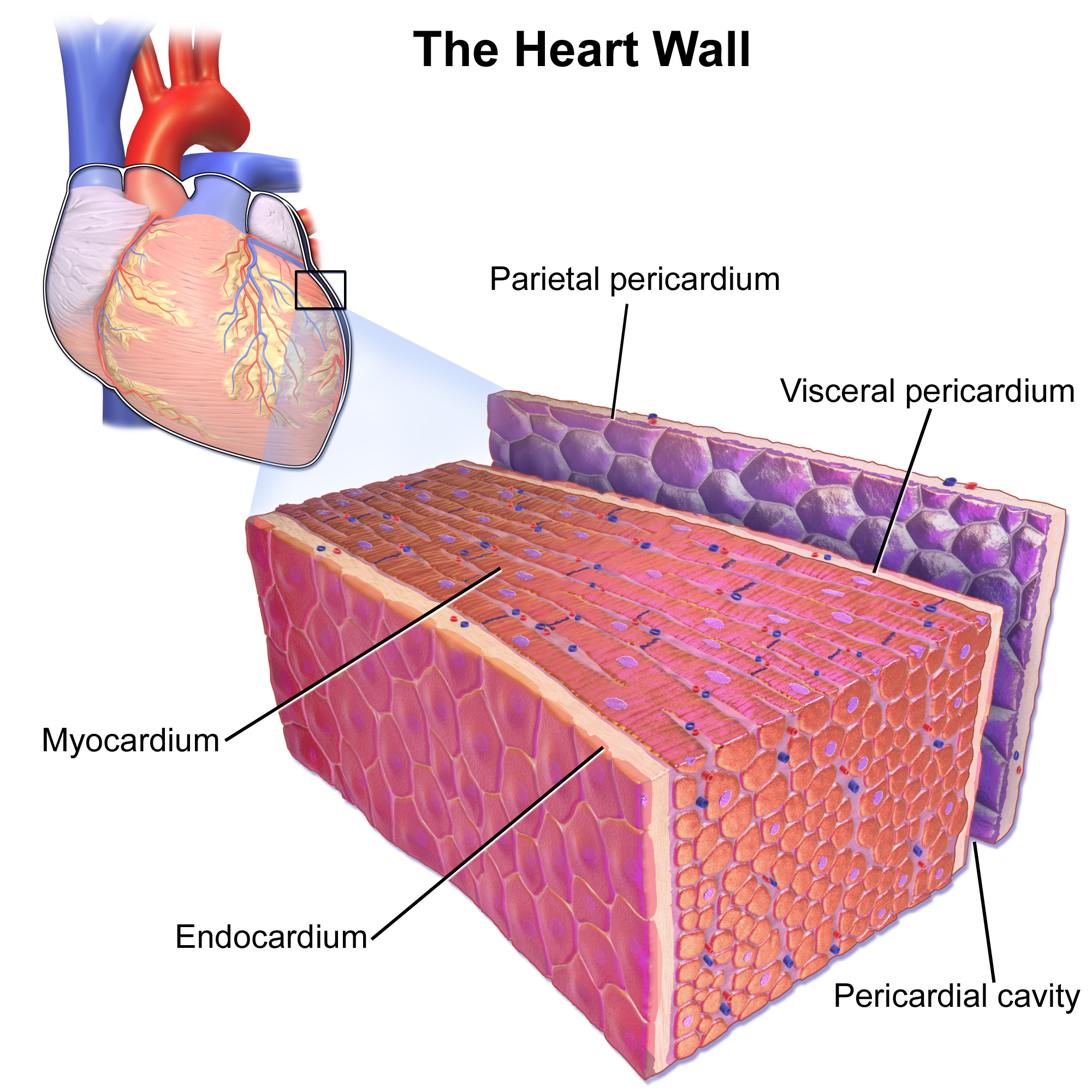
Innermost layer of tissue lining the chambers of the heart
| Field | Value |
|---|---|
| Name | Endocardium |
| Latin | endocardium |
| Image | Gray493.png |
| Caption | Interior of right side of heart |
The endocardium (: endocardia) is the innermost layer of tissue that lines the chambers of the heart. Its cells are embryologically and biologically similar to the endothelial cells that line blood vessels. The endocardium also provides protection to the valves and heart chambers.
The endocardium underlies the much more voluminous myocardium, the muscular tissue responsible for the contraction of the heart. The outer layer of the heart is termed epicardium and the heart is surrounded by a small amount of fluid enclosed by a fibrous sac called the pericardium.
Function

The endocardial endothelium may also act as a kind of blood–heart barrier (analogous to the blood–brain barrier), thus controlling the ionic composition of the extracellular fluid in which the cardiomyocytes bathe.
Clinical significance
In myocardial infarction, ischemia of the myocardium starts at the endocardium and might extend up to the epicardium, disrupting the entire heart wall ("transmural" infarction). Less extensive infarctions are often "subendocardial" and do not affect the epicardium. In the acute setting, subendocardial infarctions are more dangerous than transmural infarctions because they create an area of dead tissue surrounded by a boundary region of damaged myocytes. This damaged region will conduct impulses more slowly, resulting in irregular rhythms. The damaged region may enlarge or extend and become more life-threatening. In the chronic setting, transmural infarctions are more dangerous due to the greater amount of muscular damage and the development of scar tissue leading to impaired systolic contractility, impaired diastolic relaxation, and increased risk for rupture and thrombus formation.
During depolarization the impulse is carried from endocardium to epicardium, and during repolarization the impulse moves from epicardium to endocardium. In infective endocarditis, the endocardium (especially the endocardium lining the heart valves) is affected by bacteria.
References
References
- (October 1992). "The endocardial endothelium". American Journal of Physiology. Heart and Circulatory Physiology.
- (2025). "StatPearls". StatPearls Publishing.
- (November 2011). "The heart endocardium is derived from vascular endothelial progenitors". Development.
- "Endothelial Dysfunction".
- (November 1996). "The cardiac endothelium: Functional morphology, development, and physiology". Progress in Cardiovascular Diseases.
- (2025). "StatPearls". StatPearls Publishing.
- (2010). "Why is the subendocardium more vulnerable to ischemia? A new paradigm". American Journal of Physiology. Heart and Circulatory Physiology.
- (June 1972). "Subendocardial Distribution of Coronary Blood Flow and the Effect of Antianginal Drugs". Circulation Research.
- (2017). "The Heart in Systemic Autoimmune Diseases".
- (2025). "StatPearls". StatPearls Publishing.
- (2025). "StatPearls". StatPearls Publishing.
This article was imported from Wikipedia and is available under the Creative Commons Attribution-ShareAlike 4.0 License. Content has been adapted to SurfDoc format. Original contributors can be found on the article history page.
Ask Mako anything about Endocardium — get instant answers, deeper analysis, and related topics.
Research with MakoFree with your Surf account
Create a free account to save articles, ask Mako questions, and organize your research.
Sign up freeThis content may have been generated or modified by AI. CloudSurf Software LLC is not responsible for the accuracy, completeness, or reliability of AI-generated content. Always verify important information from primary sources.
Report