From Surf Wiki (app.surf) — the open knowledge base
Emmental cheese
Swiss medium-hard Alpine cheese
Swiss medium-hard Alpine cheese
| Field | Value |
|---|---|
| name | Emmental |
| image | Emmentaler Premier Cru.jpg |
| othernames | Emmenthal, Emmentaler, Emmenthaler |
| country | Switzerland |
| source | Cow |
| pasteurized | Not traditionally |
| texture | Medium-hard |
| aging | 2–18 months depending on variety |
| certification | Some varieties |
Emmental is a yellow, medium-hard cheese with natural holes that originated in the Emme Valley in Switzerland. It is classified as a Swiss-type cheese.
History
Emmental cheese originates from the Emme Valley in Switzerland.
It has a savoury but mild taste. While "Emmentaler" is registered as a geographical indication in Switzerland, a limited number of countries recognise the term as a geographical indication: similar cheeses of other origins, especially from France (as "Emmental"), the Netherlands, Bavaria, and Finland, are widely available and sold by that name. In some parts of the world, the names "Emmentaler" and "Swiss cheese" are used interchangeably for Emmental-style cheese.
Production
Three types of bacteria are needed to prepare Emmental: Streptococcus thermophilus, Lactobacillus helveticus, and Propionibacterium freudenreichii. Historically, the eyes were a sign of imperfection, and until modern times, cheese makers would try to avoid them. Nowadays, however, eye formation is valued as a sign of maturation and quality and acoustic analysis has been developed for this purpose. Emmental cheese is usually consumed cold, as chunks or slices, and is also used in a variety of dishes, such as in gratins.
Ziger, a whey cheese, is a by-product of the manufacture of Emmental.


Natural holes in cheese
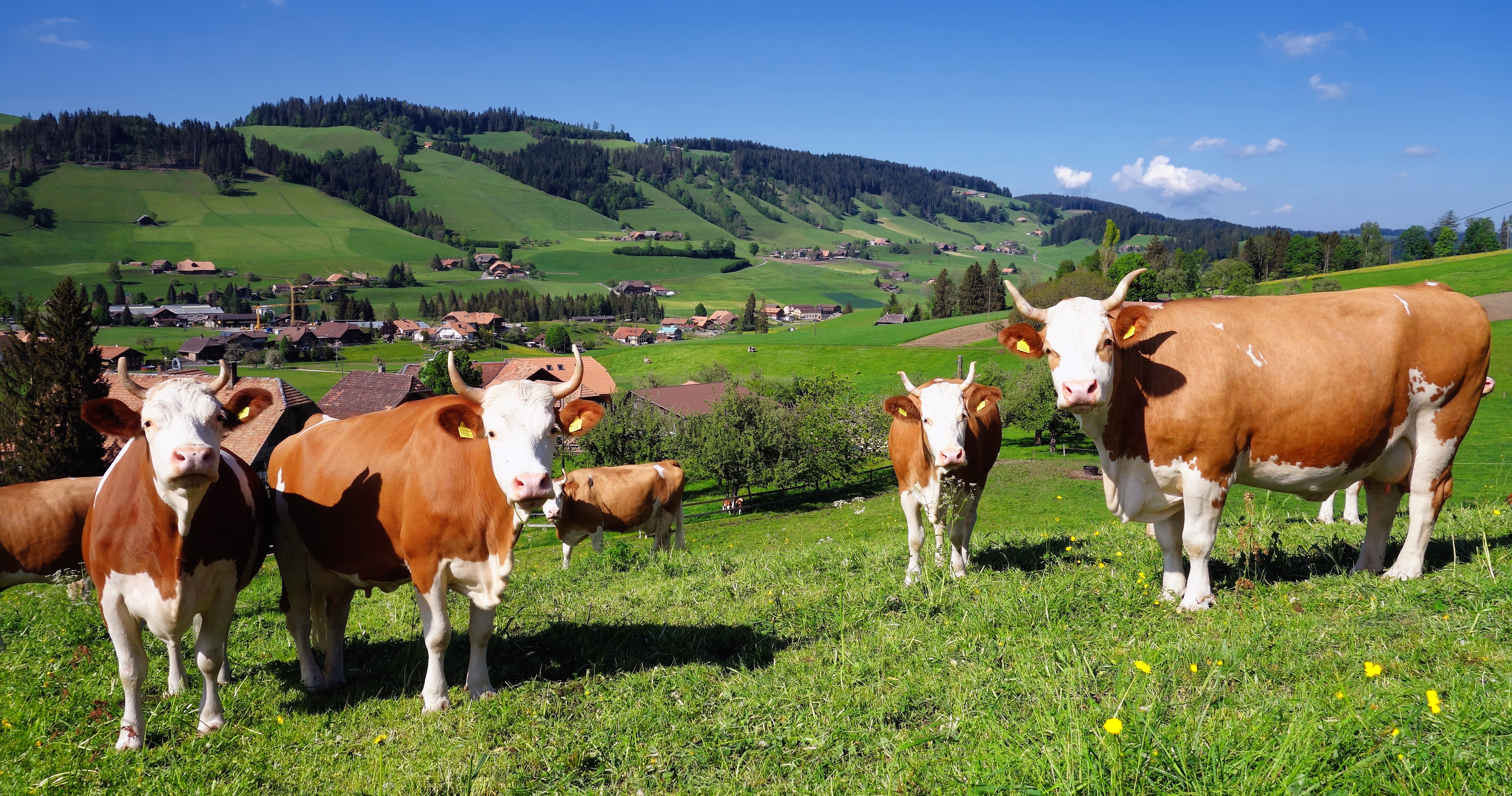
The presence of holes in cheeses such as Gruyère and Emmental was long thought to be due to bacterial activity in the mass of the cheese. In the 21st century it was discovered that it was due to microscopic hay dust that got into the milk during milking. Bacteria formed around the dust particles and produced gases which caused the characteristic holes. In addition to their traditionally favoured appearance, the holes, if not too small, have the beneficial effect of preventing gaps and cracks in the block of cheese from forming. There was some suggestion in the past of a variable effect; Emmental cheese made from summer milk had smaller holes than winter cheese—the cows ate hay in winter, but grass with less dust in summer. Modern production techniques and milking machines are less susceptible to hay dust, and indeed 21st-century Swiss cheeses have fewer and smaller holes.
Holes can be restored to their former size and prevalence by adding hay flower powder to the milk; this is done in Germany and France, but such additives are forbidden in Swiss cheeses.
Protected varieties and nomenclature
Several varieties of Emmental are registered as geographical indications, including:
Switzerland

Emmentaler was registered in 2000 as an appellation d'origine contrôlée (AOC) in Switzerland. In 2013, it was replaced by the appellation d'origine protégée (AOP) certification. The Emmentaler produced according to the AOC-registration needs to be produced in small rural dairies with raw cow's milk, adding only natural ingredients (water, salt, natural starter cultures and rennet); preservatives or ingredients from genetically modified organisms are not allowed. The cheese is produced in a round shape with a natural rind, and aged in traditional cellars for a minimum of four months. Emmentaler must be produced in cantons of Aargau, Bern (except Amtsbezirk Moutier), Glarus, Luzern, Schwyz, Solothurn, St Gallen, Thurgau, Zug or Zurich, or in the See- and Sensebezirk of canton of Freiburg.
Outside Switzerland
Emmentaler is also recognised as a geographical indication in the Czech Republic, France, Georgia, Germany, Hungary, Jamaica, Portugal, Russia, Slovakia and Spain.

Three cheeses containing the word Emmental are protected under EU law:
- Allgäuer Emmentaler, from Bavaria, Germany, has PDO status
- Emmental de Savoie, from Savoie, France, has PGI status
- Emmental français est-central from Franche-Comté, France, also has PGI status
In many parts of the English-speaking world the terms "Emmentaler" and "Swiss cheese" are both used to refer to any cheese of the Emmental type, whether produced in Switzerland or elsewhere. The United States Department of Agriculture, for example, uses the terms "Swiss cheese" and "Emmentaler cheese" interchangeably.
Emmental-style cheeses
Emmental cheese is very widely imitated around the world, often just called "Swiss cheese". Specific European types include:
- Grevé from Sweden
- Jarlsberg cheese from Norway
- Maasdam cheese from the Netherlands, with Leerdammer being one variety
Notes
References
References
- "EMMENTAL Definition & Meaning".
- (2014). "The Science of Cheese". OUP USA.
- "Emmentaler".
- "Emmentaler".
- ''Scientific American'' "Cheese Story", August 2010, p. 33
- (27 November 2019). "Acoustic techniques to detect eye formation during ripening of Emmental type cheese". Innovative Food Science & Emerging Technologies.
- "[https://www.cheesesfromswitzerland.com/en/cheese-varieties/range/emmentaler-aop Emmentaler AOP]", Switzerland Cheese Marketing. Retrieved 26 October 2020.
- "Ziger / Sérac". Culinary Heritage of Switzerland.
- Bondolfi, Sibilla. (11 June 2024). "The mysterious (court) case of the disappearing cheese holes". Swissinfo.
- (28 May 2015). "Swiss scientists plug hole in cheese knowledge". The Guardian.
- "Emmentaler: AOC-Gütesiegel".
- Government of Switzerland. "Appellations d'origine et indications géographiques".
- (13 September 2004). "AOC-Label für den Käse mit den grössen Löchern". Swiss Info.
- "Pflichtenheft Emmentaler". Government of Switzerland.
- (3 September 2021). "Emmentaler". Origin GI.
- (1997-01-24). "DOOR". Ec.europa.eu.
- (1996-06-21). "DOOR". Ec.europa.eu.
- "DOOR". Ec.europa.eu.
- [https://www.ams.usda.gov/grades-standards/swiss-cheese-emmentaler-cheese-grades-and-standards Swiss Cheese, Emmentaler Cheese Grades and Standards], U.S. Department of Agriculture, accessed March 25, 2020
- ''[https://naldc.nal.usda.gov/download/CAT87213821/PDF How to Buy Cheese] {{Webarchive. link. (2021-03-10 '', U.S. Department of Agriculture (1971), p. 15)
This article was imported from Wikipedia and is available under the Creative Commons Attribution-ShareAlike 4.0 License. Content has been adapted to SurfDoc format. Original contributors can be found on the article history page.
Ask Mako anything about Emmental cheese — get instant answers, deeper analysis, and related topics.
Research with MakoFree with your Surf account
Create a free account to save articles, ask Mako questions, and organize your research.
Sign up freeThis content may have been generated or modified by AI. CloudSurf Software LLC is not responsible for the accuracy, completeness, or reliability of AI-generated content. Always verify important information from primary sources.
Report