From Surf Wiki (app.surf) — the open knowledge base
Emissary veins
Anatomical feature of the circulatory system
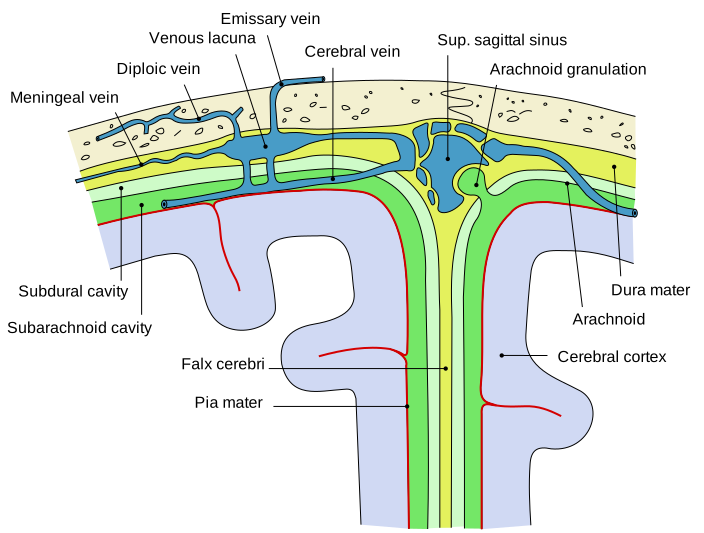
Anatomical feature of the circulatory system
| Field | Value |
|---|---|
| Name | Emissary veins |
| Latin | vena emissaria |
The emissary veins connect the extracranial venous system with the intracranial venous sinuses. They connect the veins outside the cranium to the venous sinuses inside the cranium. They drain from the scalp, through the skull, into the larger meningeal veins and dural venous sinuses. They may also connect to diploic veins within the skull.
Emissary veins have an important role in selective cooling of the head. They also serve as routes where infections are carried into the cranial cavity from the extracranial veins to the intracranial veins.
There are several types of emissary veins including the posterior condyloid, mastoid, occipital and parietal emissary veins.
Structure
There are also emissary veins passing through the foramen ovale, jugular foramen, foramen lacerum, and hypoglossal canal.
Function
Because the emissary veins are valveless, they are an important part in selective brain cooling through bidirectional flow of cooler blood from the evaporating surface of the head. In general, blood flow is from external to internal but the flow can be altered by increased intracranial pressure.
Clinical significance
One notable emissary vein, the vein of Vesalius, travels through the sphenoidal emissary foramen inferior to the zygomatic arch, connecting the pterygoid plexus with the cavernous sinus. This is an important route for the spread of infection as cranial nerve VI and the internal carotid pass through the cavernous sinus, with cranial nerves III, IV, V1, and V2 passing alongside the lateral wall of the sinus. Subsequent infection or inflammation in the cavernous sinus can result in septic cavernous sinus thrombosis, with resultant damage to the cranial nerves contained within, as well as further spread of the infection leading to meningitis.
Rupture of an emissary vein can result in a subgaleal hemorrhage, a rare but serious injury most often seen as a complication of vacuum extraction.
References
References
- (25 July 2023). "StatPearls". StatPearls Publishing.
- Bajzer, Christopher. (2004). "Cerebral vascular venous drainage". Remedica.
- (November 1988). "The significance of asymmetry of the foramen of Vesalius.". American Journal of Neuroradiology.
- Leestma, J.E.. (2008). "Forensic Neuropathology, Second Edition". CRC Press.
- (3 October 1980). "Subgaleal hematoma. A complication of instrumental delivery.". JAMA.
This article was imported from Wikipedia and is available under the Creative Commons Attribution-ShareAlike 4.0 License. Content has been adapted to SurfDoc format. Original contributors can be found on the article history page.
Ask Mako anything about Emissary veins — get instant answers, deeper analysis, and related topics.
Research with MakoFree with your Surf account
Create a free account to save articles, ask Mako questions, and organize your research.
Sign up freeThis content may have been generated or modified by AI. CloudSurf Software LLC is not responsible for the accuracy, completeness, or reliability of AI-generated content. Always verify important information from primary sources.
Report