From Surf Wiki (app.surf) — the open knowledge base
Emil Jannings
German actor (1884–1950)

German actor (1884–1950)
| Field | Value | |||||||||
|---|---|---|---|---|---|---|---|---|---|---|
| name | Emil Jannings | |||||||||
| image | Emil Jannings - no watermark.jpg | |||||||||
| caption | Jannings | |||||||||
| birth_date | ||||||||||
| birth_place | Rorschach, Switzerland | |||||||||
| death_date | ||||||||||
| death_place | Strobl, Allied-occupied Austria | |||||||||
| birth_name | Theodor Friedrich Emil Janenz | |||||||||
| nationality | German | |||||||||
| occupation | Actor | |||||||||
| years_active | 1914–1945 | |||||||||
| spouse | {{plainlist | |||||||||
| * Lucy Höfling<ref>{{Cite book | url | https://books.google.com/books?id=fjEWDAAAQBAJ&q=emil+jannings+lucy+hofling&pg=PA46 | title=Cinema and the Swastika: The International Expansion of Third Reich Cinema | isbn=9780230289321 | last1=Winkel | first1=Roel Vande | last2=Welch | first2=D. | date=7 February 2007 | publisher=Springer }} (divorced 1919) |
| children | 1 | |||||||||
| signature | Unterschrift Emil Jannings (1884-1950).png |
-
Lucy Höfling (divorced 1919)
Emil Jannings (born Theodor Friedrich Emil Janenz; 23 July 1884 – 2 January 1950) was a Swiss-born German actor who was popular in Hollywood films in the 1920s. He was the first recipient of the Academy Award for Best Actor for starring in The Last Command and The Way of All Flesh. Jannings remains the only German ever to win in that category.
He is best known for his films with F. W. Murnau and Josef von Sternberg, including 1930's The Blue Angel (Der blaue Engel, with Marlene Dietrich. The Blue Angel was meant as a vehicle for Jannings to secure a place for himself in the new medium of sound film, but he was ultimately overshadowed by Dietrich. Jannings went on to leading roles in State Films (Staatsauftragsfilme) in Nazi Germany.
Early life
Jannings was born in Rorschach, Switzerland, the son of Emil Janenz, an American businessman from St. Louis, and his wife Margarethe (née Schwabe), originally from Germany. Jannings held German citizenship; while he was still young the family moved to Leipzig in the German Empire and further to Görlitz after the early death of his father.
Jannings ran away from school and went to sea. When he returned to Görlitz, his mother finally allowed him to begin a traineeship at the local theatre, starting his stage career. From 1901 onwards he worked with several theatre companies in Bremen, Nuremberg, Leipzig, Königsberg, and Glogau before joining the Deutsches Theater ensemble under director Max Reinhardt in Berlin. Permanently employed from 1915, Jannings met with playwright Karl Vollmöller, fellow actor Ernst Lubitsch, and photographer Frieda Riess, who after World War I, were contributors of Weimar Culture in 1920s Berlin. Jannings' breakthrough was in 1918 with his role as Judge Adam in Kleist's Broken Jug at the Schauspielhaus.
Career
Jannings was a theatre actor who went into films but remained dissatisfied with the limited expressive possibilities in the silent era. Having signed with UFA, he starred in Die Augen der Mumie Ma (The Eyes of the Mummy, 1918) and Madame Dubarry (1919), both with Pola Negri opposite him. He also performed in the 1922 film version of Othello and in F. W. Murnau's 1924 film The Last Laugh (Der Letzte Mann), as a proud but aged hotel doorman who is demoted to a washroom attendant. Jannings worked with Murnau on two other films, taking on the title role in Tartuffe (Herr Tartüff, 1925), and as Mephistopheles in Faust (1926).
United States
His increasing popularity enabled Jannings to sign with Paramount Pictures and eventually follow Negri and Lubitsch to Hollywood. His first American film, The Way of All Flesh, directed by Victor Fleming, now lost, was released in 1927, and in the following year he performed in Josef von Sternberg's The Last Command. In 1929, Jannings won the first Best Actor Oscar for his work in both films. He and Sternberg also made Street of Sin (1928), though they differed on Jannings' acting style.
Jannings was dubbed in Lubitsch's part-talkie The Patriot (1928), although his own voice was restored after Jannings objected. In Europe, he starred opposite Marlene Dietrich in 1930's The Blue Angel, which was filmed simultaneously in English and in German Der blaue Engel. Jannings' thick German accent was difficult to understand, ending his American career.
According to Susan Orlean, author of Rin Tin Tin: The Life and The Legend, Jannings was not actually the winner of the first best actor award, but the runner-up. While researching her book, Orlean thought she discovered that it was in fact Rin Tin Tin, the German Shepherd dog, one of the biggest movie stars of the day, who won the vote. The Academy, however, worried about not being taken seriously if the first Oscar went to a dog, awarded the trophy to the runner-up. However, this claim is otherwise unverified and labelled as untrue by most sources.
In 1960, Jannings was posthumously honored with a star on the Hollywood Walk of Fame at 1630 Vine Street for his contributions to motion pictures.
Nazi Germany

After the Nazi seizure of power in 1933, Jannings stayed on, prolonging his career by making State Films. He starred in several films promoting Nazism, in particular the Führerprinzip by presenting unyielding historical characters, in Der alte und der junge König (The Old and the Young King, 1934), Der Herrscher (The Ruler, 1937) directed by Veit Harlan, Robert Koch (1939), Ohm Krüger (Uncle Kruger, 1941), and Die Entlassung (The Dismissal, 1942). He also took part in The Broken Jug directed by Gustav Ucicky. For his work in Nazi Cinema, Minister of Propaganda Joseph Goebbels named Jannings an "Artist of the State" (Staatsschauspieler)
The filming of Wo ist Herr Belling? was aborted when troops of the Allied Powers entered Germany in 1945. Jannings reportedly carried his Oscar statuette as proof of his ties to America. His substantial association with Nazi propaganda left him subject to denazification. Other actors resumed their careers, but Jannings never worked as an actor again.
As his former co-star Marlene Dietrich became a US citizen and influential anti-Nazi activist, spending much of the war entertaining troops on the front lines and broadcasting on behalf of the OSS, she particularly loathed Jannings for his Nazi ties, terming her former co-star a "ham".
Death
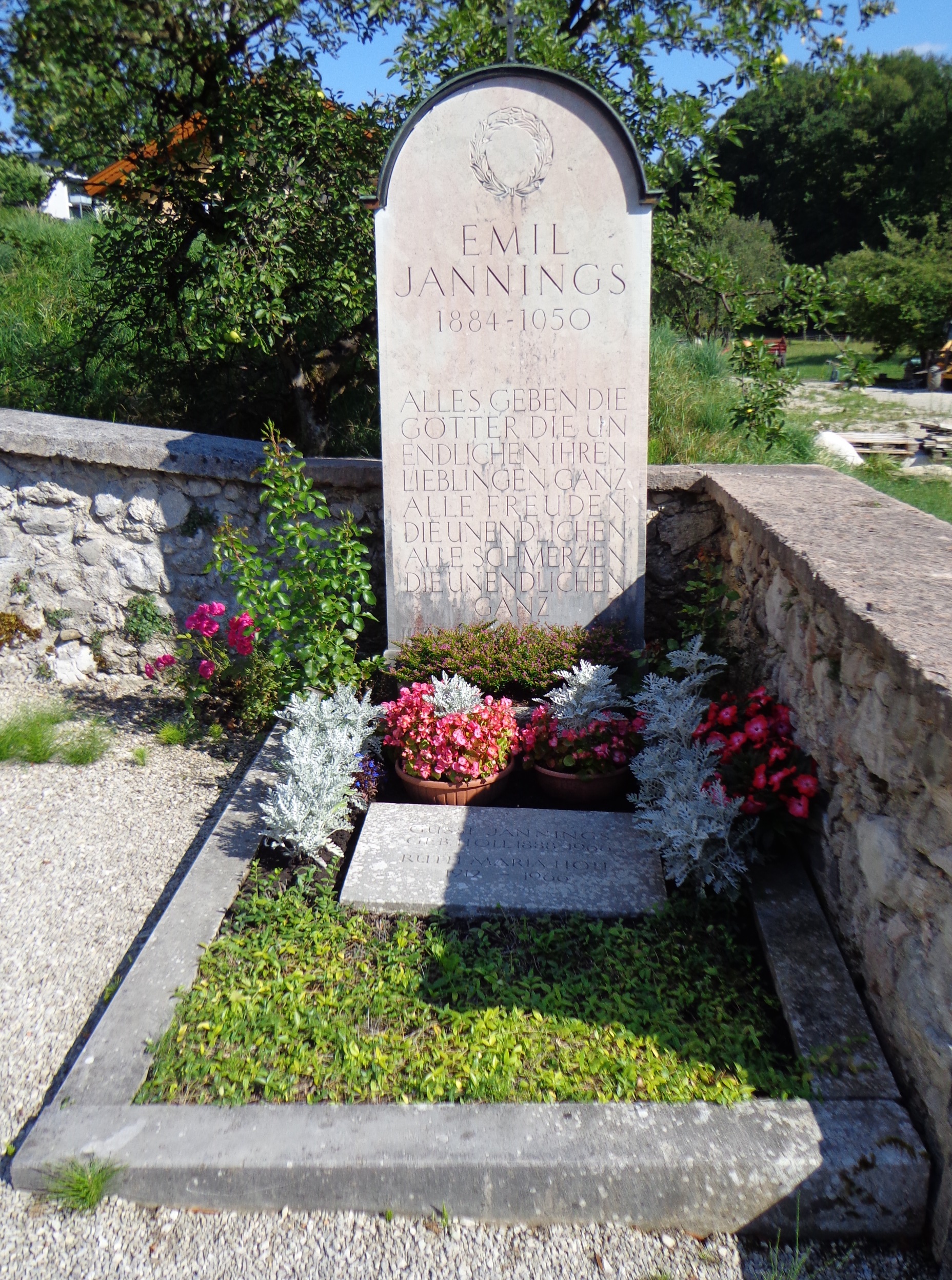
Jannings retired to Strobl near Salzburg, Austria, and became an Austrian citizen in 1947. He died in 1950, aged 65, from liver cancer. He is buried in the St. Wolfgang cemetery. His Best Actor Oscar is displayed at the Berlin Filmmuseum.
Marriages
Jannings was married four times. His first three marriages ended in divorce, his last with his death. His last three marriages were to German stage and film actresses, Hanna Ralph, Lucie Höflich, and Gussy Holl. He had a daughter, Ruth-Maria (born 1920), from his first marriage to Lucy Höfling.
Cultural depictions
- Hilmar Eichhorn portrayed a fictionalized version of Jannings in Inglourious Basterds (2009), directed by Quentin Tarantino. This fictional Jannings dies at the end of the film.
- In 1972's Cabaret, singer Sally Bowles (Liza Minnelli) finds herself at a high-society dinner party; she tries to impress by suggesting that she is friendly with Emil Jannings.
- In Series 1 of the BBC's epic Second World War drama World on Fire (2019) American journalist Nancy Campbell, played by Helen Hunt, accepts an invitation from neighbours in Berlin to see the latest Emil Jannings film, saying: “Well, I love Emil Jannings, and I loved him in The Blue Angel.”
Filmography
| Year | Title | Role | Notes |
|---|---|---|---|
| 1914 | Arme Eva | ||
| Im Schützengraben | Extra | ||
| Passionels Tagebuch | |||
| 1916 | Aus Mangel an Beweisen | Dr. Langer | |
| Die Bettlerin von St. Marien | Baron Gelsburg | ||
| Frau Eva | |||
| Im Angesicht des Toten | Paul Werner | ||
| Life Is a Dream | Verführer (the seducer) | a.k.a. Das Leben ein Traum (German original title) | |
| A Night of Horror | Banker | a.k.a. Nächte des Grauens (German original title) | |
| Stein unter Steinen | |||
| 1917 | ** | Quabbe, the jailer | The Merry Jail (Europe: English title) |
| When Four Do the Same | Segetoff | a.k.a. Wenn vier dasselbe tun (German original title) | |
| Hoheit Radieschen | |||
| The Marriage of Luise Rohrbach | Wilhelm Rohrbach | a.k.a. Die Ehe der Luise Rohrbach (German original title) | |
| Der Zehnte Pavillon der Zitadelle | |||
| Das Geschäft | S. H. Haßler | ||
| Lulu | |||
| The Ring of Giuditta Foscari | a.k.a. Der Ring der Giuditta Foscari (German original title) | ||
| The Sea Battle | a.k.a. Die Seeschlacht (German original title) | ||
| Unheilbar | |||
| 1918 | The Seeds of Life | James Fraenkel, stock exchange broker (Börsenmakler) | |
| John Smith, American engineer (amerikanischer Ingenieur) | a.k.a. Keimendes Leben (German original title) | ||
| The Eyes of the Mummy | Radu, an Arab | Die Augen der Mumie Ma (German original title) | |
| Fuhrmann Henschel | |||
| Nach zwanzig Jahren | Horst Lundin 'Korn' | ||
| 1919 | Rose Bernd | Arthur Streckmann | |
| Madame Dubarry | Louis XV | a.k.a. Passion | |
| Vendetta | Tomasso | ||
| The Daughter of Mehemed | Vaco Juan Riberda, Fabrikbesitzer | a.k.a. Die Tochter des Mehemed (German original title) | |
| The Man of Action | Jan Miller | a.k.a. Der Mann der Tat (German original title) | |
| 1920 | Colombine | Carlo | a.k.a. Die Braut des Apachen (German original title) |
| Anna Boleyn | Henry VIII | a.k.a. Deception | |
| The Skull of Pharaoh's Daughter | Osorcon, Pharao of Egypt | a.k.a. Der Schädel der Pharaonentochter (German original title) | |
| Algol | Robert Herne | ||
| The Big Light | Lorenz Ferleitner | a.k.a. Das große Licht (German original title) | |
| Kohlhiesel's Daughters | Peter Xaver | a.k.a. Kohlhiesels Töchter (German original title) | |
| 1921 | The Rats | Bruno | a.k.a. Die Ratten (German original title) |
| The Oath of Peter Hergatz | a.k.a. Der Schwur des Peter Hergatz (German original title) | ||
| Danton | Georges Danton | a.k.a. All for a Woman | |
| The Bull of Olivera | General François Guillaume | a.k.a. Der Stier von Olivera (German original title) | |
| The Brothers Karamazov | Dimitri Karamasoff | a.k.a. Die Brüder Karamasoff (German original title) | |
| 1922 | Peter the Great | Peter the Great | a.k.a. Peter der Große (German original title) |
| Othello | Othello | ||
| The Loves of Pharaoh | Pharao Amenes | a.k.a. Das Weib des Pharao (German original title) | |
| The Countess of Paris | Ombrade | a.k.a. Die Gräfin von Paris (German original title) | |
| 1923 | All for Money | S. I. Rupp | (USA); a.k.a. Alles für Geld (German original title) |
| Tragedy of Love | Ombrade | a.k.a. Tragödie der Liebe (German original title) | |
| 1924 | The Last Laugh | Hotel Porter | (USA); a.k.a. Der letzte Mann (German original title) |
| Husbands or Lovers | Husband | ||
| Waxworks | Harun al-Rashid | ||
| Quo Vadis | Nero | Extant | |
| 1925 | Variety | Boss Huller | a.k.a. Jealousy (USA) |
| Love is Blind | Emil Jannings | ||
| 1926 | Tartuffe | Tartuffe | |
| Faust – A German Folktale | Mephisto | Extant | |
| 1927 | The Way of All Flesh | August Schilling | Academy Award for Best Actor; Lost film |
| 1928 | Sins of the Fathers | Wilhelm Spengler | excerpts and clips are preserved of this film. Unconfirmed about the total film |
| The Patriot | Czar Paul I | Lost film | |
| The Street of Sin | Basher Bill | Lost film | |
| The Last Command | Gen. Dolgorucki / Grand Duke Sergius Alexander | Academy Award for Best Actor; Extant | |
| 1929 | Betrayal | Poldi Moser | |
| 1930 | Darling of the Gods | Albert Winkelmann | a.k.a. Liebling der Götter (German original title) |
| The Blue Angel | Prof. Immanuel Rath | US title; a.k.a. Der blaue Engel | |
| 1932 | Storms of Passion | Gustav Bumke | German original title; a.k.a. Stürme der Leidenschaft a.k.a. Tempest |
| 1933 | Die Abenteuer des Königs Pausole | King Pausole | a.k.a. The Adventures of King Pausole (English title) |
| The Merry Monarch | |||
| 1934 | Der Schwarze Walfisch | Peter Petersen | German original title; a.k.a. The Black Whale (International: English title) |
| 1935 | The Old and the Young King | Frederick William I of Prussia | a.k.a. The Making of a King (USA); Der alte und der junge König (German original title) |
| 1936 | The Dreamer | Direktor Prof. Niemeyer | a.k.a. Traumulus (German original title) |
| 1937 | The Broken Jug | Adam, Dorfrichter | a.k.a. Der zerbrochene Krug (German original title) |
| The Ruler | Matthias Clausen | a.k.a. Der Herrscher (German original title) | |
| 1939 | Robert Koch | Robert Koch | |
| Der Trichter. (Nr. III) | scenes deleted | ||
| 1941 | Ohm Krüger | Paul Kruger | a.k.a. Uncle Kruger (International: English title) |
| 1942 | Die Entlassung | Otto von Bismarck | a.k.a. Bismarck's Dismissal (UK) |
| 1943 | ** | Fabrikdirektor Hoffmann | |
| 1945 | ** | Firmenchef Eberhard Belling | a.k.a. Where Is Mr. Belling? (English title) |
References
References
- (7 February 2007). "Cinema and the Swastika: The International Expansion of Third Reich Cinema". Springer.
- Roman Rocek: Die neun Leben des Alexander Lernet-Holenia. Eine Biographie. Böhlau, Wien u.a. 1997; {{ISBN. 3-205-98713-6. S. 186
- Frank Noack: "Jannings. Der erste deutsche Weltstar". Collection Rolf Heyne, [[München]] 2012
- Fleming, Mike Jr.. (3 January 2012). "Susan Orlean: Throw Rin Tin Tin A Bone & Give Back The Pooch's Best Actor Oscar".
- (15 February 2017). "No, Rin Tin Tin Didn't Really Win the First Best Actor Oscar".
- Meares, Hadley. (16 March 2021). "Which Best Actor Winner Allegedly Once Shouted, "Don't Shoot. I Have Won an Oscar"?".
- (25 October 2019). "Walk of Fame Stars-Emil Jannings".
- (2001). "Propaganda and the German Cinema, 1933-1945". I.B.Tauris.
- (8 March 2024). "The Nazi who won the Oscars' first ever Best Actor award".
- ''[[Marlene (1984 film). Marlene]]'' (1984)
- link. (23 September 2015 , Obituary for Emil Jannings (2 January 1950), chroniknet.de]; accessed 26 October 2014.)
- {{IMDb name. 417837
- (1952). ""Image" on the art and evolution of the film: Photographs and articles from the magazine of the International Museum of Photography". Dover Publications.
- (14 January 1950). "Billboard".
- (4 January 1950). "Herr Emil Jannings A Great Film Actor".
This article was imported from Wikipedia and is available under the Creative Commons Attribution-ShareAlike 4.0 License. Content has been adapted to SurfDoc format. Original contributors can be found on the article history page.
Ask Mako anything about Emil Jannings — get instant answers, deeper analysis, and related topics.
Research with MakoFree with your Surf account
Create a free account to save articles, ask Mako questions, and organize your research.
Sign up freeThis content may have been generated or modified by AI. CloudSurf Software LLC is not responsible for the accuracy, completeness, or reliability of AI-generated content. Always verify important information from primary sources.
Report