From Surf Wiki (app.surf) — the open knowledge base
Emergency tourniquet
Device used to stop blood loss in an emergency

Device used to stop blood loss in an emergency
modern emergency tourniquets
List of references in order of appearance.
Emergency tourniquets are cuff-like devices designed to stop severe traumatic bleeding before or during transport to a care facility. They are wrapped around the limb, proximal to the site of trauma, and tightened until all blood vessels underneath are occluded. The design and construction of emergency tourniquets allows quick application by first aid responders or the injured persons themselves. Correct use of tourniquet devices has been shown to save lives under austere conditions with comparatively low risk of injury. In field trials, prompt application of emergency tourniquets before the patient goes into shock are associated with higher survival rates than any other scenario where tourniquets were used later or not at all.
Tourniquet design
Existing guidelines call for the use of improvised "rope-and-stick" tourniquets as a last resort to stop severe bleeding. However, purpose-made tourniquet devices that are well designed can provide greatly increased safety and efficacy. Variability in performance has been shown to exist between various designs and application methods.
Mechanical advantage
Mechanisms that confer sufficient mechanical advantage are essential for applying adequate pressure to stop bleeding, particularly on the lower extremities. Pressures that occlude venous but not arterial flow can exacerbate hemorrhage and cause damage to healthy tissue.
Mechanical characteristics of emergency tourniquet devices
| Tourniquet | Strap width (cm) | Mechanism | Note |
|---|---|---|---|
| XFORCE Tourniquet | 2.5 - 3.8 | Mechanical Ratchet Lever and Ladder Strap | Automatic self-securing strap and mechanical ratcheting lever for one finger application |
| SAM XT Tourniquet | 3.7 | Windlass and Buckle | Buckle sets with correct force; windlass finishes pressure |
| Combat Application Tourniquet (CAT) | 3.8 | Windlass | Stick and strap inside outer sleeve |
| Emergency & Military Tourniquet (EMT) | 9.1 | Pneumatic | Hand pump and inflatable bladder |
| K2 Tactical Tourniquet (K2) | 3.8 | Clamp | Modified wood clamp |
| Smart Tactical Application Tourniquet (S.T.A.T.) | 2.5 | Ratchet | Strap with ratcheting mechanism |
| Last Resort Tourniquet (LRT) | 5.1 | Ratchet | Strap with ratcheting mechanism |
| London Bridge Tourniquet (LBT) | 2.4 | Ratchet | Strap with ratcheting mechanism |
| Mechanical Advantage Tourniquet (MAT) | 3.8 | Block and tackle | Pulleys on outer frame |
| One-Handed Tourniquet (OHT) | 2.8 | Elastic | Parallel bungee cords and clamp |
| Self-Applied Tourniquet System (SATS) | 3.8 | cam | Cantilever system |
| Special Operations Forces Tactical Tourniquet (SOFTT) | 3.7 | Windlass | Stick and strap |
| Glia tourniquet | Variable | Windlass | Stick and strap |
Most commercial tourniquets cost in the range from $30-$50 (USD). Results from laboratory and field testing suggest that windlass and pneumatic mechanisms are effective where other systems fail due to excessive pain, slipping, inadequate force, or mechanical failure.
Pressure gradients
Pressure underneath a tourniquet cuff is not evenly distributed, with the highest pressures localized around the cuff center line and decreasing to zero near the cuff edges. A high rate of change of pressure across the cuff width, or a high cuff pressure gradient, is a leading cause of nerve and muscle injury from tourniquet use. Over pressure protection in certain emergency tourniquets also help to prevent excessive force from damaging the limb.
Risks
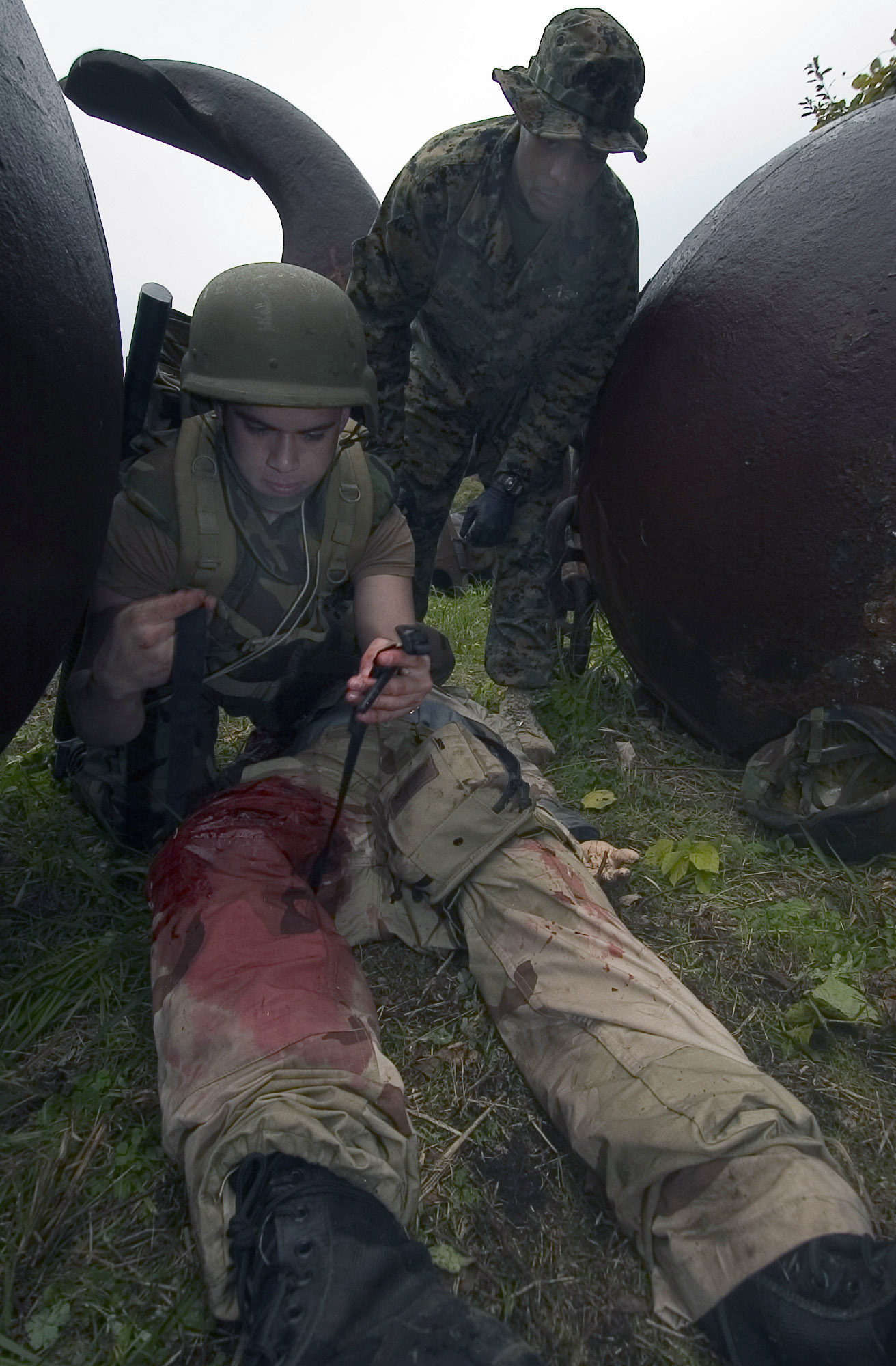
Possible risks of complications—morbidity—related to emergency tourniquet use include
Emergency care services implementing routine tourniquet use, especially in the civilian setting, should exercise caution and ensure that training is adequate for optimal results. Designed tourniquet devices are routinely tightened over healthy limbs during training with no ill effects, and recent evidence from combat hospitals in Iraq suggests that morbidity rates are low when users adhere to standard best practices. Since no better alternatives exist for users to self-apply with only basic training, the benefit of tourniquet use far outweighs the risks.
Safe tourniquet practice involves:
Current developments

Field experience
Latest field trials suggest that wider straps are more effective and less painful than tourniquets with thinner straps. The concept of limb occlusion pressure is also gaining prominence over the misconception that greater applied force results in greater effectiveness. In addition, studies of failed cases indicate that the correct devices should be coupled with training that facilitates realistic expectations and correct user actions.
Emerging needs
Despite the success of widespread tourniquet deployment to limit combat casualties, many preventable deaths from hemorrhage occur where conventional tourniquet use is inappropriate.
In early 2025, a study was published to address such concerns titled "The XForce Tourniquet: A Comparative Analysis with the CAT Tourniquet to Advance Efficacy and Establish Foundations for Smart Hemorrhage Control". The publication is the first of its kind to study the first ever smart intelligent next generation tourniquet with GPS tracking and standalone GSM telecommunications that will have advanced Artificial Intelligence / Machine Learning smart features such as automated emergency alerts and telemedicine capabilities.
In the abstract of the study it states "Tourniquets have demonstrated life-saving efficacy within military settings as essential tools in hemorrhage control. Despite their proven effectiveness, traditional windlass-based tourniquets such as the Combat Application Tourniquet (CAT) present challenges in rapid application and ease of use, particularly within civilian emergency contexts. The XForce Tourniquet (XForce TQ) has been developed to address these limitations with a novel ratcheting mechanism and self-securing strap. These design features aim to improve usability and application speed while also demonstrating the XForce tourniquets' ability to serve as the foundation for broader telemedicine tourniquet initiatives."
The research was supported by grant funding from the New Jersey Commission on Science, Innovation, and Technology (CSIT) as part of its initiative to support New Jersey startups. The Center for innovation at Rutgers Robert Wood Johnson Medical School and Robert Wood Johnson University Hospital provided location & resources for data collection & analysis.
The need exists for controlling junctional bleeding, especially in the pelvic area. In 2012, the Combat Ready Clamp (CRoC) was selected by the U.S. Army Institute of Surgical Research (USAISR) for that purpose. Another emerging need is more refined training regimes and doctrine based on scientific evidence, which can ensure that future tourniquet practice and policies are in line with the most current body of knowledge.
References
References
- (2005). "Effectiveness of self-applied tourniquets in human volunteers". Informa Healthcare.
- (February 2008). "Practical use of emergency tourniquets to stop bleeding in major limb trauma". Lippincott Williams & Wilkins.
- (January 2009). "Survival with emergency tourniquet use to stop bleeding in major limb trauma". Lippincott Williams & Wilkins.
- (October 2011). "The military emergency tourniquet program's lessons learned with devices and designs". Association of Military Surgeons of the U.S..
- (2005). "ONR/MARCORSYSCOM Evaluation of Self-Applied Tourniquets for Combat Applications". United States Navy Experimental Diving Unit Technical Report.
- (2007). "Evaluation of Self-Applied Tourniquets for Combat Applications, Second Phase.". US Navy Experimental Diving Unit Technical Report.
- (December 2009). "Surgical tourniquets in orthopaedics". JBJS.
- (September 2011). "An evaluation of two tourniquet systems for the control of prehospital lower limb hemorrhage". Lippincott Williams & Wilkins.
- (December 2011). "Battle casualty survival with emergency tourniquet use to stop limb bleeding". Lippincott Williams & Wilkins.
- (October 2022). "Stop the BleedⓇ". Current Problems in Surgery.
- "The XForce Tourniquet: A Comparative Analysis with the CAT Tourniquet to Advance Efficacy and Establish Foundations for Smart Hemorrhage Control".
- "The XForce Tourniquet: A Comparative Analysis with the CAT Tourniquet to Advance Efficacy and Establish Foundations for Smart Hemorrhage Control".
- "TELE-TQ by Auric Innovations".
- "The XForce Tourniquet: A Comparative Analysis with the CAT Tourniquet to Advance Efficacy and Establish Foundations for Smart Hemorrhage Control".
- "The XForce Tourniquet: A Comparative Analysis with the CAT Tourniquet to Advance Efficacy and Establish Foundations for Smart Hemorrhage Control".
- (2011). "New Tourniquet Device Concepts for Battlefield Hemorrhage Control". U.S. Army Medical Department Journal.
- "New truncal tourniquet ready for battle use".
This article was imported from Wikipedia and is available under the Creative Commons Attribution-ShareAlike 4.0 License. Content has been adapted to SurfDoc format. Original contributors can be found on the article history page.
Ask Mako anything about Emergency tourniquet — get instant answers, deeper analysis, and related topics.
Research with MakoFree with your Surf account
Create a free account to save articles, ask Mako questions, and organize your research.
Sign up freeThis content may have been generated or modified by AI. CloudSurf Software LLC is not responsible for the accuracy, completeness, or reliability of AI-generated content. Always verify important information from primary sources.
Report