From Surf Wiki (app.surf) — the open knowledge base
EMD F40PH
North American diesel locomotive class

North American diesel locomotive class
| Field | Value | |
|---|---|---|
| name | EMD F40PH / F40PHR | |
| powertype | Diesel-electric | |
| gauge | ||
| image | AMTK 315 Tun17 CZ Nwcstle Mar1995RP - Flickr - drewj1946.jpg | |
| caption | Amtrak No. 315 F40PHR on the eastbound California Zephyr at Tunnel No. 17 near Newcastle, California in 1995 | |
| builder | GM Electro-Motive Division (EMD) | |
| General Motors Diesel (GMD) | ||
| Morrison-Knudsen (MK) | ||
| MotivePower (MPI) | ||
| aarwheels | B-B | |
| uicclass | Bo'Bo' | |
| trucks | Blomberg M | |
| poweroutput | 3000 - | |
| builddate | {{Plainlist | |
| totalproduction | {{Plainlist | |
| primemover | EMD 16-645E3 | |
| alternator | AR10/D14 | |
| tractionmotors | D77 | |
| length | 56 ft | |
| width | 10 ft | |
| height | 15 ft | |
| locoweight | 260000 - | |
| enginetype | V16 Diesel | |
| aspiration | Turbocharged | |
| cylindercount | 16 | |
| multipleworking | AAR | |
| locobrakes | Air, Dynamic | |
| trainbrakes | Air | |
| coupling | Knuckle | |
| maxspeed | 103 - | |
| notes |
General Motors Diesel (GMD) Morrison-Knudsen (MK) MotivePower (MPI)
- 1975–1992 (EMD)
- 1988–2007 (MK / MPI)
- 475 (EMD)
- 31 (MK / MPI) The ** EMD F40PH** is a four-axle 3000 - B-B diesel-electric locomotive built by General Motors Electro-Motive Division in several variants from 1975 to 1992. Intended for use on Amtrak's short-haul passenger routes, it became the backbone of Amtrak's diesel fleet after the failure of the EMD SDP40F. The F40PH also found widespread use on commuter railroads in the United States and with VIA Rail in Canada. Additional F40PH variants were manufactured by Morrison-Knudsen and MotivePower between 1988 and 1998, mostly rebuilt from older locomotives.
Amtrak retired its fleet of F40PHs in the early-2000s in favor of the GE Genesis, but the locomotive remains the mainstay of VIA Rail's long-distance trains; a depiction of the locomotive hauling The Canadian is featured on the reverse of the Frontier series Canadian $10 bill. The F40PHs are still a common sight on many other commuter railroads throughout the United States. In addition, Amtrak has kept 22 of its F40PHs in use as non-powered control units.
Background
Amtrak inherited an aging and mechanically incompatible fleet of diesel locomotives from various private railroads on its startup in 1971. The most modern locomotives remained in private hands for freight service, or to operate the various commuter services which, by law, did not pass to Amtrak. To replace these Amtrak ordered 150 EMD SDP40F locomotives, which began entering service in 1973. These were supplemented by 25 GE P30CHs which entered service in 1975. The SDP40F was a troubled design; problems with weight distribution led to a series of derailments in the mid-1970s. Meanwhile, the poor truck design of the P30CH (and the electric GE E60CP) curtailed further orders of that unit when Amtrak found itself needing more short- and medium-distance power in the spring of 1975.
Design
The design of the F40PH was based on the EMD GP40-2 freight road switcher locomotive and shared that locomotive's turbocharged EMD 645E3 V16 cylinder, two-stroke, water-cooled diesel engine (prime mover). The prime mover developed 3000 hp at 893 RPM. The main (traction) generator converts mechanical energy from the prime mover into electricity distributed through a high voltage cabinet to the traction motors. Each of the four traction motors is geared to a pair of driving wheels; the gear ratio determines the maximum speed of the locomotive. A standard F40PH has a gear ratio of 57:20, permitting a maximum speed of 103 mph. Some Amtrak F40PHs were delivered with a 56:21 gearing for 110 mph. The first 30 locomotives were built with a 1500 gal fuel tank. Subsequent units were built with a 1800 gal tank. Beginning with the EMD F40PH-2, introduced in 1985, the prime mover developed 3200 hp. Many of the original F40PHs were updated to match that output. The locomotives were 56 ft long. A standard F40PH weighs 260000 lb.
For passenger service the F40PH has another electrical alternator, the head-end generator. The HEP unit generates three-phase AC power at 480 V (500 kW on the first order, 800 kW on later units) for lighting, heating and air-conditioning the train. Originally, F40PHs powered the HEP alternator from the prime mover. As a result of that, the train had to be at a constant 60 Hz frequency, and the prime mover had to turn at a constant 893 RPM while supplying head end power (even standing still, with the throttle in idle). Power to the traction motors was controlled by varying the field excitation of the main (traction) generator. On some later versions of the F40PH (and on many rebuilt F40s), a second small auxiliary diesel engine at the rear of the locomotive powers the HEP alternator. In these engines, the prime-mover speed varies in the usual way. They can be identified by the diesel exhaust at the rear of the locomotive and by their quiet idle. Remaining F40s, with the constant-RPM prime movers, are noticeably louder.
In the initial design the battery box and air reservoirs were located forward of the fuel tank. In locomotives manufactured after 1977 these were relocated behind the tank. The battery box returned to its original location in the F40PH-2. The F40PH-2s delivered to Caltrain incorporated Southern Pacific Railroad-style headlights.
The designation "F40PH" stood for the following: "F" for the full-width cowl carbody, "40" as the locomotive is part of EMD's 40-series (based on the GP40-2 freight locomotive), "P" for passenger service, and "H" for head-end power.
History

Amtrak ordered its first 30 EMD F40PHs on May 8, 1975. The first of the new locomotives entered service on April 9, 1976. Amtrak intended the locomotives for short routes such as the San Diegan in California and Northeast Corridor services in the then non-electrified route portion between New Haven, Connecticut and Boston, Massachusetts.
The long-distance routes were protected by the then-new EMD SDP40F, described by J. David Ingles in late 1975 as the "stars of Amtrak's long-distance trains". However, two events led to a major change in thinking within Amtrak regarding the EMD SDP40F. The first event was a sharp decline in the mechanical reliability of the EMD SDP40F, including several derailments. The second event was the unusually harsh winter of 1976–1977, which sidelined many of Amtrak's aging steam-heated coaches. Amtrak suspended numerous routes and pressed the new HEP-equipped Amfleet I coaches, designed for short runs, into service. The F40PH, with its built-in HEP generator, was the natural choice to haul these coaches. As problems with the EMD SDP40F mounted, Amtrak adopted the F40PH as its long-term solution nationwide for diesel engine service.
In the spring of 1977 Amtrak traded 40 EMD SDP40Fs back to EMD. Components including the prime mover were installed into an EMD F40PH frame. The 40 rebuilt locomotives, designated F40PHR, were identical to new-build EMD F40PHs, incorporating the larger fuel tank and more powerful HEP generator which had become standard.
Amtrak ultimately acquired 132 F40PHRs in this manner — which combined with new orders between 1975 and 1988 and with the purchase of six GMD F40PHs from GO Transit in 1990 — led to a fleet of 216 locomotives, the country's largest fleet.
The first commuter rail operator to order F40PHs was Chicago's Regional Transportation Authority (RTA), a forerunner to Metra, who ordered 74 between 1977 and 1983. Metra ordered 41 more between 1988 and 1992. Other agencies who bought the F40PH included the Massachusetts Bay Transit Authority (MBTA) (18), Caltrain (20), GO Transit (6), New Jersey Transit (17), and VIA Rail (59). Finally, the rail construction firm Speno ordered four. In total EMD built 449 locomotives, including the F40PHR trade-ins.
The F40PH performed well for Amtrak: at the start of the 1990s only four had been retired due to wrecks. The locomotive was at the center of Amtrak's advertising. Trains magazine estimated that on average, each F40PH traveled as many as 175000 mi a year.
Amtrak began replacing the F40PH with the GE Dash 8-32BWH in 1991, the GE P40DC in 1993, and the GE P42DC in 1996. All were retired by 2001 with the arrival of the last P42DC, and their last regular assignment was on the Maple Leaf in December 2001. The Panama Canal Railway acquired several ex-Amtrak F40PHs for both freight and passenger service; the 480V head-end power matched the voltage used by the refrigeration in Maersk Sealand containers.
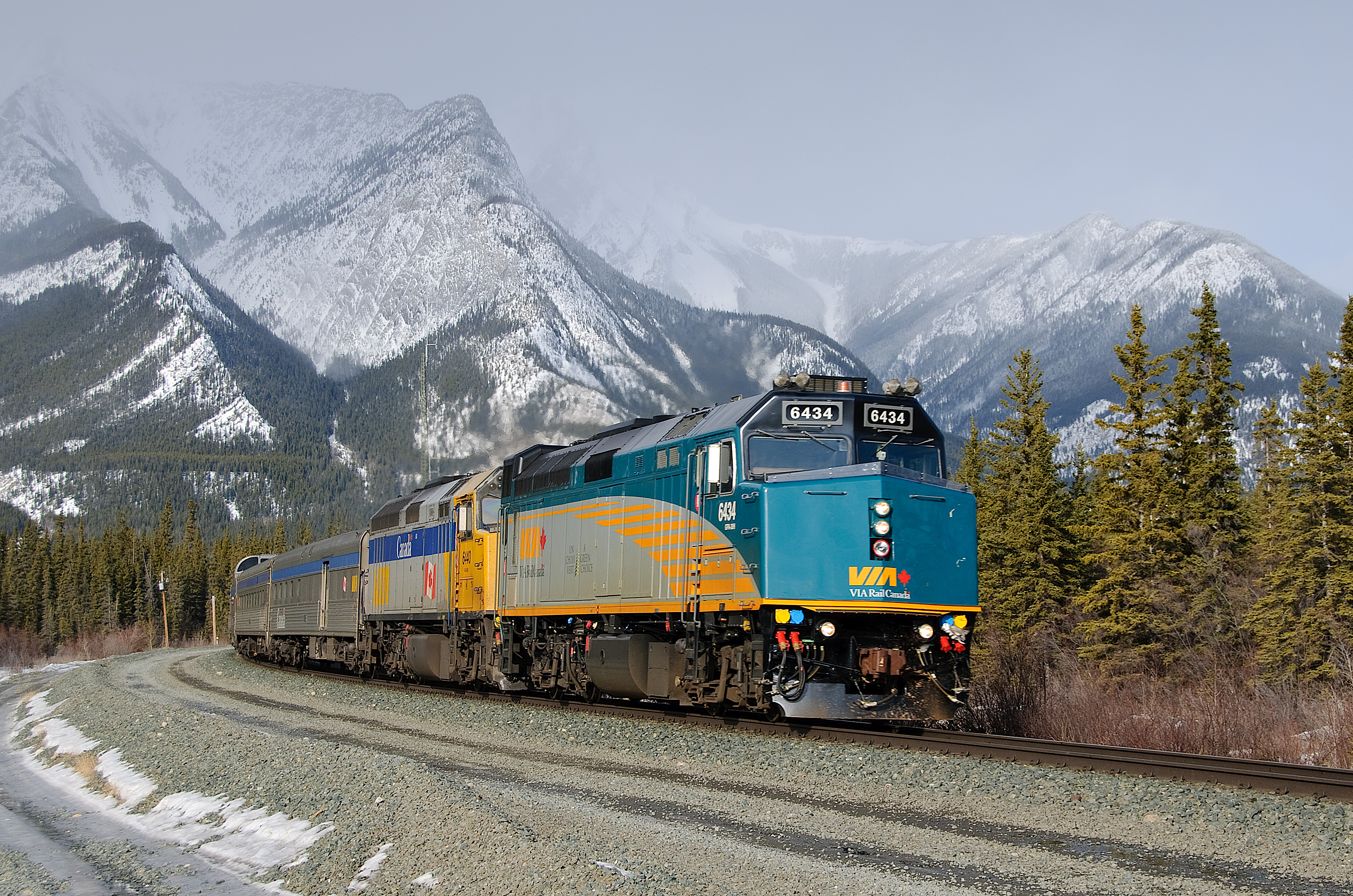
The EMD F40PH has continued to serve VIA Rail into the 21st century: between 2007 and 2012 VIA refurbished its entire fleet for CAD$100 million. The rebuild program included separate HEP generators, overhauled engines, a third headlight addition, cab reconditioning, additional safety horns at the front, and repainting into the newer VIA scheme. Rebuilt locomotive No. 6403, pulling the Canadian through the Rocky Mountains, was included on the back of the redesigned Canadian ten-dollar note in 2013 (The actual 6403 was later renumbered to 6459.) As of 2018, VIA has 53 such EMD F40PH locomotives in service. VIA started another round of rebuilding for 39 F40PH-2D locomotives in 2024, with the goal of extending their lifespan to 2035. These F40PH locomotives are now supplemented by GE P42DC locomotives delivered in 2001 and by Siemens SCV-42 locomotives delivered in 2023.
Variants
.jpg)
As Amtrak's F40PH fleet was replaced by newer GE Genesis-series locomotives, Amtrak converted a number of the retired units into baggage/cab cars. Colloquially known as "cabbages" (a portmanteau of "cab" and "baggage"), and officially known as Non-Powered Control Units (NPCUs), these units had their diesel engines, traction motors, and main alternators removed, as well as a large roll-up door installed in the side (allowing the former engine compartment to be used for baggage). Amtrak converted 22 locomotives into cabbage cars between 1996 and 2007. Each converted unit was renumbered by prefixing "90" to its original number. In 2011, Amtrak converted F40PH No. 406 (later renumbered 90406) to an NPCU to enable push-pull operation of Amtrak's 40th-anniversary exhibit train; in addition, a HEP generator was installed to supply auxiliary power. However, unlike other NPCUs, it resembles an operational F40PH externally.
Some F40PHs found their way into freight service, after suitable modifications. The F40M-2F, which runs on the San Luis and Rio Grande Railroad and formerly the Canadian American Railroad, was regeared for a maximum speed of 65 mph and given an enlarged 2900 gal fuel tank. It was also fitted with a door, platform, and steps at the front. One unit, 450, was acquired by Western Maryland Scenic Railroad in 2018.
In 2023-2024, Rolling Stock Solutions, an American locomotive leasing company, rebuilt several F40PH locomotives for leasing to commuter rail operators and dubbed them the F40PH-4C. These feature a remanufactured Tier 0+ prime mover (EMD 16-645E3B) and a separate Tier 4 HEP generator, as well as microprocessor controls. The first of these locomotives, numbered "1001", was unveiled in Boston in mid-October 2024.
Original owners
.jpg)
.jpg)
Electro-Motive Division manufactured 475 F40PHs of all types between 1975 and 1992. The orders for GO Transit and VIA Rail Canada were built by General Motors Diesel (GMD), the company's Canadian subsidiary. Morrison-Knudsen (M-K) and its successor MotivePower (MPI) remanufactured another 31 locomotives between 1988 and 1998.
| Railroad | Model | Quantity | Road numbers | Total | 509 |
|---|---|---|---|---|---|
| Altamont Corridor Express | MPI F40PH-3C | 6 | 3101–3106 | ||
| Amtrak | EMD F40PH | 78 | 200–229; 270–279; 300–309; 332–359 | ||
| EMD F40PHR | 132 | 230–269; 280–299; 310–331; 360–400; 401–409 | |||
| Caltrain | EMD F40PH-2 | 20 | 900–919 | ||
| MPI F40PH-2C | 3 | 920–922 | |||
| Coaster | M-K F40PHM-2C | 5 | 2101–2105 | ||
| GO Transit | GMD F40PH | 6 | 510–515 | ||
| Massachusetts Bay Transportation Authority | EMD F40PH | 18 | 1000–1017 | ||
| EMD F40PH-2C | 26 | 1050–1075 | |||
| M-K F40PHM-2C | 12 | 1025–1036 | |||
| Metra | EMD F40PH-2 | 11 | 174–184 | ||
| EMD F40PHM-2 | 30 | 185–214 | |||
| NJ Transit | EMD F40PH | 17 | 4113–4129 | ||
| Regional Transportation Authority | EMD F40PH | 74 | 100–173 | ||
| Speno | EMD F40PH-2M | 4 | S1–S4 | ||
| Tri-Rail | M-K F40PHL-2 | 5 | 801–805 | ||
| M-K F40PH-2C | 3 | 807–809 | |||
| VIA Rail | GMD F40PH-2 | 59 | 6400–6458 |
Preservation
Three ex-Amtrak F40PHs have been preserved:
- No. 231 at the Illinois Railway Museum (formerly owned by Dynamic Rail Preservation)
- No. 281 at the California State Railroad Museum
- No. 307 at the North Carolina Transportation Museum
Two Coaster F40PHM-2C locomotives have been preserved: No. 2103 at the Pacific Southwest Railway Museum and No. 2105 at the Southern California Railway Museum. In October 2024, the Southern California Railway Museum began fundraising in hopes of preserving a non-rebuilt Caltrain F40PH-2 locomotive.
Notes
Footnotes
References
References
- {{Harvnb. Simon. Warner. 2011
- {{Harvnb. Holland. 2009
- {{Harvnb. Holland. 2009
- {{Harvnb. Holland. 2009
- {{Harvnb. Holland. 2009
- {{Harvnb. Solomon. 2016
- {{Harvnb. Graham-White. Weil. 1999
- {{Harvnb. McDonnell. 2002
- {{Harvnb. Pinkepank. Marre. 1979
- {{Harvnb. McDonnell. 2002
- {{Harvnb. McDonnell. 2002
- {{Harvnb. Solomon. 2016
- {{Harvnb. Ingles. 1975
- {{Harvnb. Ingles. 1975
- {{Harvnb. Holland. 2009
- {{Harvnb. Graham-White. Weil. 1999
- {{Harvnb. Cook. 1991
- {{Harvnb. Simon. Warner. 2011
- {{Harvnb. Holland. 2009
- {{Harvnb. Graham-White. Weil. 1999
- {{Harvnb. Graham-White. Weil. 1999
- {{Harvnb. Lustig. 2002
- {{Harvnb. Johnston. 2002
- "VIA Rail Canada and CAD Railway Industries Ltd. Sign $100 Million, 5-year Contract to Rebuild 53 F-40 Locomotives".
- "Backgrounder: The locomotive rebuild program".
- (November 7, 2013). "More plastic for your wallet: A look at Canada's new polymer bills". [[CBC News]].
- . (2018). ["Locomotives – F40PH-2"](https://www.viarail.ca/en/about-via-rail/our-fleet/locomotives-f40ph-2).
- (September 29, 2024). "News photo: Bound for rebuilding".
- {{Harvnb. Graham-White. Weil. 1999
- {{Harvnb. McDonnell. 2015
- {{Harvnb. Wilson. 2009
- (September 8, 2016). "Rebuilt Metra locomotive returns to Chicago". [[Railway Gazette International]].
- {{Harvnb. Solomon. 2012
- {{Harvnb. Solomon. 2016
- (November 3, 2020). "MBTA receives first of 10 rebuilt F40s".
- (April 29, 2019). "Fiscal and Management Control Board Commuter Rail Locomotive Overhaul Contract".
- {{Harvnb. Holland. 2009
- "Exhibit Train Equipment History". Amtrak.
- "Rail World Locomotive Leasing EMD F40M-2F Freight Locomotive". [[Rail World]].
- "Western Maryland Scenic acquires F40 to bolster diesel fleet | Trains Magazine".
- "All new locomotives ready to go". Rolling Stock Solutions.
- "Remanufactured F40 specification". Rolling Stock Solutions.
- Rolling Stock Solutions. "RSTX 1001 Heading to Boston".
- Mitchell, Alexander D. IV. (January 6, 2019). "Historic Diesels relocated from Utah to Nevada".
- Franz, Justin. (April 17, 2024). "Amtrak F40 Restored to Phase III Paint". Railfan & Railroad.
- (July 2, 2025). "Two former Amtrak diesels donated to Illinois Railway Museum". Trains News Wire.
- (June 1, 2017). "Amtrak F40s: Where Are They Now?".
- Franz, Justin. (July 20, 2022). "Coaster F40 Bound for Southern California Railway Museum". Railfan and Railroad Magazine.
- (August 12, 2022). "Historic Coaster Locomotive 2103 Arrives at Campo". Pacific Southwest Railway Museum Association.
- Franz, Justin. (October 16, 2024). "Effort Launched to Save Caltrain F40PH-2".
This article was imported from Wikipedia and is available under the Creative Commons Attribution-ShareAlike 4.0 License. Content has been adapted to SurfDoc format. Original contributors can be found on the article history page.
Ask Mako anything about EMD F40PH — get instant answers, deeper analysis, and related topics.
Research with MakoFree with your Surf account
Create a free account to save articles, ask Mako questions, and organize your research.
Sign up freeThis content may have been generated or modified by AI. CloudSurf Software LLC is not responsible for the accuracy, completeness, or reliability of AI-generated content. Always verify important information from primary sources.
Report