From Surf Wiki (app.surf) — the open knowledge base
Embroidery
Art or handicraft of decorating fabric or other materials with needle and thread or yarn
_LACMA_AC1994.131.1.jpg)
Art or handicraft of decorating fabric or other materials with needle and thread or yarn
.jpg)
Embroidery is the art of decorating fabric or other materials using a needle to stitch thread or yarn. It is one of the oldest forms of textile art, with origins dating back thousands of years across various cultures.**** Common stitches found in early embroidery include the chain stitch, buttonhole or blanket stitch, running stitch, satin stitch, and cross stitch. Modern embroidery continues to utilize traditional techniques, though many contemporary stitches are exclusive to machine embroidery.
Embroidery is commonly used to embellish accessories and garments is usually seen on quilts, clothing, and accessories. In addition to thread, embroidery may incorporate materials such as pearls, beads, quills, and sequins to highlight texture and design. Today, embroidery serves both decorative and functional purposes and is utilized in fashion expression, cultural identity, and custom-made gifts.
A person who is doing embroidery is called an embroiderer. An archaic term is broderer, derived from French broderie for 'embroidery'.
Classification

Embroidery can be classified according to what degree the design takes into account the nature of the base material and by the relationship of stitch placement to the fabric. The main categories are free or surface embroidery, counted-thread embroidery, and needlepoint or canvas work.
In free or surface embroidery, designs are applied without regard to the weave of the underlying fabric. Examples include crewel and traditional Chinese and Japanese embroidery.
Counted-thread embroidery patterns are created by making stitches over a predetermined number of threads in the foundation fabric. Counted-thread embroidery is more easily worked on an even-weave foundation fabric such as embroidery canvas, aida cloth, or specially woven cotton and linen fabrics. Examples include cross-stitch and some forms of blackwork embroidery.
While similar to counted thread in regards to technique, in canvas work or needlepoint, threads are stitched through a fabric mesh to create a dense pattern that completely covers the foundation fabric. Examples of canvas work include bargello and Berlin wool work.
Embroidery can also be classified by the similarity of its appearance. In drawn thread work and cutwork, the foundation fabric is deformed or cut away to create holes that are then embellished with embroidery, often with thread in the same color as the foundation fabric. When created with white thread on white linen or cotton, this work is collectively referred to as whitework. However, whitework can either be counted or free. Hardanger embroidery is a counted embroidery and the designs are often geometric. Conversely, styles such as Broderie anglaise are similar to free embroidery, with floral or abstract designs that are not dependent on the weave of the fabric.
History

Origins
The process used to tailor, patch, mend and reinforce cloth fostered the development of sewing techniques, and the decorative possibilities of sewing led to the art of embroidery. Indeed, the remarkable stability of basic embroidery stitches has been noted:
The art of embroidery has been found worldwide and several early examples have been found. The earliest surviving embroidered cloth comes from Egypt. The Egyptians were skilled at embroidery, using appliqué decorations with leather and beads. Works in China have been dated to the Warring States period (5th–3rd century BC). In a garment from Migration period Sweden, roughly 300–700 AD, the edges of bands of trimming are reinforced with running stitch, back stitch, stem stitch, tailor's buttonhole stitch, and Whip stitch, but it is uncertain whether this work simply reinforced the seams or should be interpreted as decorative embroidery.
Historical applications and techniques


.jpg)
Depending on time, location and materials available, embroidery could be the domain of a few experts or a widespread, popular technique. This flexibility led to a variety of works, from the royal to the mundane. Examples of high status items include elaborately embroidered clothing, religious objects, and household items often were seen as a mark of wealth and status.
In medieval England, Opus Anglicanum, a technique used by professional workshops and guilds in medieval England, was used to embellish textiles used in church rituals. In 16th century England, some books, usually bibles or other religious texts, had embroidered bindings. The Bodleian Library in Oxford contains one presented to Queen Elizabeth I in 1583. It also owns a copy of The Epistles of Saint Paul, whose cover was reputedly embroidered by the Queen.
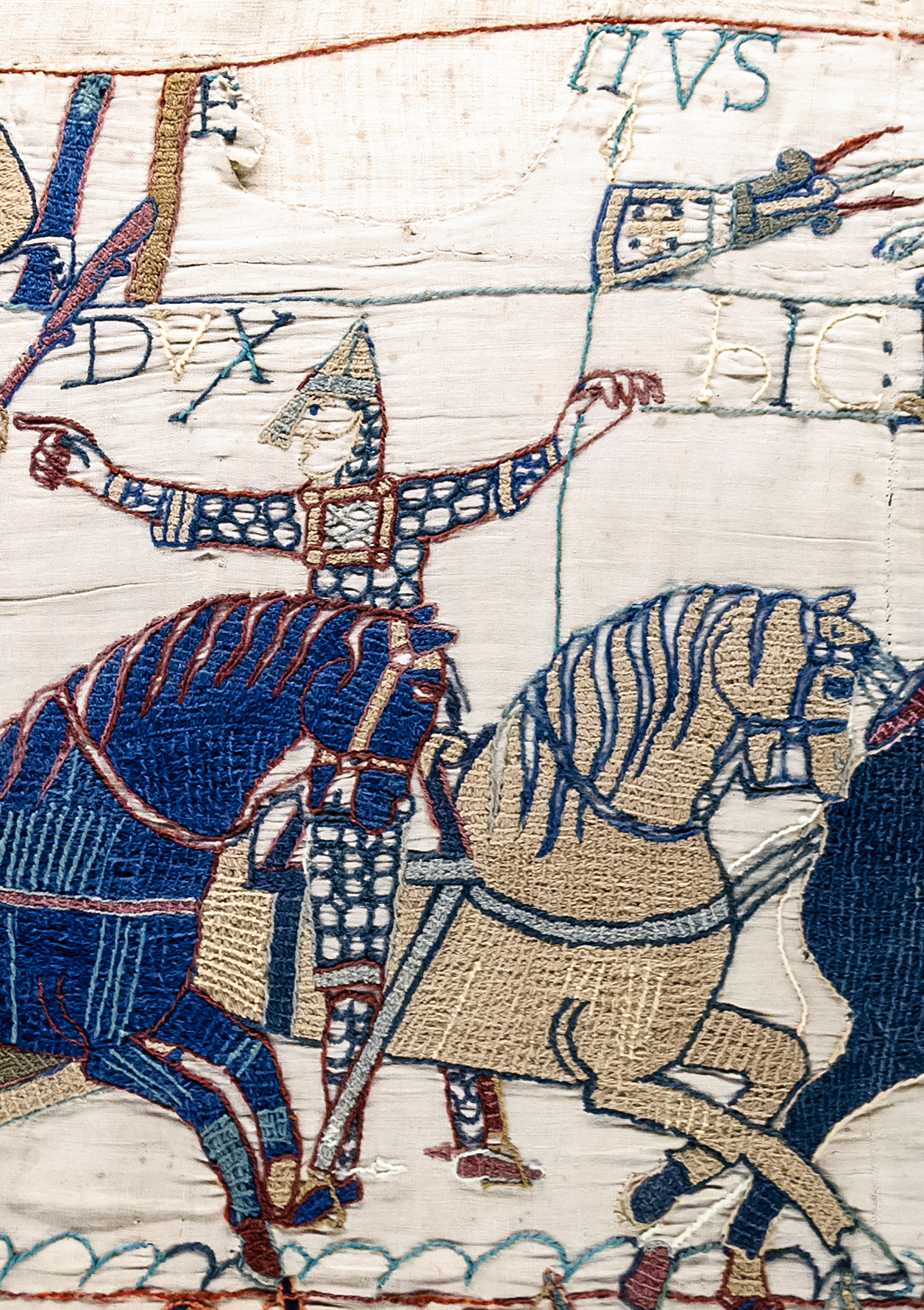
One of the oldest complete embroidered works still in existence is the Bayeux Tapestry, an embroidered cloth nearly 70 m long and 50 cm tall that depicts the events leading up to the Norman Conquest of England in 1066, led by William, Duke of Normandy, challenging Harold II, King of England, and culminating in the Battle of Hastings. It is thought to date to the 11th century, within a few years of the battle.
In 18th-century England and its colonies, with the rise of the merchant class and the wider availability of luxury materials, rich embroideries began to appear in a secular context. These embroideries took the form of items displayed in private homes of well-to-do citizens, as opposed to a church or royal setting. Even so, the embroideries themselves may still have had religious themes. Samplers employing fine silks were produced by the daughters of wealthy families. Embroidery was a skill marking a girl's path into womanhood as well as conveying rank and social standing.
Embroidery was an important art and signified social status in the Medieval Islamic world as well. The 17th-century Turkish traveler Evliya Çelebi called it the "craft of the two hands". In cities such as Damascus, Cairo and Istanbul, embroidery was visible on handkerchiefs, uniforms, flags, calligraphy, shoes, robes, tunics, horse trappings, slippers, sheaths, pouches, covers, and even on leather belts. Craftsmen embroidered items with gold and silver thread. Embroidery cottage industries, some employing over 800 people, grew to supply these items.
In the 16th century, in the reign of the Mughal Emperor Akbar, his chronicler Abu al-Fazl ibn Mubarak wrote in the famous Ain-i-Akbari:
Embroidery was often perceived primarily as a domestic task performed by women, frequently viewed as a leisurely activity rather than recognized as a skilled craft. Women who lacked access to formal education or writing implements often used embroidery to document their lives through stitched narratives, effectively creating personal diaries through textile art, especially when literacy was limited.
Embroidery is also a folk art, using materials that were accessible to nonprofessionals. Examples include Hardanger embroidery from Norway; Merezhka from Ukraine; Mountmellick embroidery from Ireland; Nakshi kantha from Bangladesh and West Bengal; Achachi from Peru; and Brazilian embroidery. Many techniques had a practical use such as Sashiko from Japan, which was used as a way to reinforce clothing.
In marginalized communities, embroidery has also served as a tool of empowerment and expression. For example, in Inner Mongolia, embroidery initiatives arose in response to economic pressures intensified by climate change, including desertification, allowing women to express themselves and preserve cultural identities through traditional embroidery skills. Embroidery has also preserved the stories of marginalized groups, particularly women of color, whose experiences were historically underrepresented in written records. In South African communities, embroidered "story cloths" have captured and preserved critical perspectives and events otherwise missing from historical narratives.
21st century
Since the late 2010s, there has been a growth in the popularity of embroidering by hand. As a result of visual social media such as Pinterest and Instagram, artists can share their work more extensively, which has inspired younger generations to pick up needlework.
Contemporary embroidery artists believe hand embroidery has grown in popularity as a result of an increasing need for relaxation and digitally disconnecting practices. Many people are also using embroidery to creatively upcycle and repair clothing, to help counteract over-consumption and fashion industry waste.
Modern canvas work tends to follow symmetrical counted stitching patterns with designs emerging from the repetition of one or just a few similar stitches in a variety of hues. In contrast, many forms of surface embroidery make use of a wide range of stitching patterns in a single piece of work.
In literature
Embroidery portrays a large function of representation in many literary works. Hobbies in regards to stitching, dressmaking, or quilting have learned to be acquainted with women through the 18th to 19th century. Embroidery alters itself in literary contexts to perform as a symbol instead of a depiction of culture and rooted history. Novels by Jane Austen capture a depiction where women are riddled with silent productivity and installs certain societal norms within a specific gender.
In Greek mythology the goddess Athena is said to have passed down the art of embroidery (along with weaving) to humans, leading to the famed competition between herself and the mortal Arachne.
Traditional hand embroidery around the world
| Traditional embroidery | Origin | Stitches used | Materials | Picture | ||||||||
|---|---|---|---|---|---|---|---|---|---|---|---|---|
| Aari embroidery | Kashmir and Kutch, Gujarat, India | Chain stitch | Silk thread, fabric, beads or sequins | |||||||||
| Art needlework | England | [[File:Embroidered_Panel_Morris_and_Company_detail.jpg | frameless | 150x150px]] | ||||||||
| Assisi embroidery | Assisi, Italy | Backstitch, cross stitch, Holbein stitch | Cloth, red thread, silk, stranded perlé cotton | [[File:AssisiBorder.JPG | frameless | 155x155px]] | ||||||
| Balochi needlework | Balochistan, Pakistan | Beads, cloth, shisha, thread | [[File:سوزندوزی_پرکار_بلوچی.jpg | frameless | 150x150px]] | |||||||
| Bargello | Florence, Italy | Vertical stitches (e.g. "flame stitch") | Linen or cotton canvas, wool floss or yarn | [[File:Purse_(USA),_18th_century_(CH_18457595).jpg | frameless | 287x287px]] | ||||||
| Berlin wool work | Berlin, Germany | Cross stitch or tent stitch | Linen or cotton canvas, wool floss or yarn | [[File:Woman's_Purse_Berlin_Wool_Work_M2007_211_280_2.jpg | frameless | 188x188px]] | ||||||
| Blackwork | England | Backstitch, Holbein stitch, stem stitch | Linen or cotton fabric, black or red silk thread | [[File:English_cover,_AIC.jpg | frameless | 150x150px]] | ||||||
| Brazilian embroidery | Brazil | Bullion knots, cast-on stitch, drizzle stitch, French knots, featherstitch, fly stitch, stem stitch | Cloth, rayon thread | [[File:Brazilian_Embroidery_Flowers.jpg | frameless | 150x150px]] | ||||||
| Broderie anglaise | Czechia | Buttonhole stitch, overcast stitch, satin stitch | White cloth and thread | [[File:Boy's_frock_broderie_anglaise.png | frameless | 150x150px]] | ||||||
| Broderie perse | India | Chintz, thread | [[File:Quilt_LACMA_M.87.125.jpg | frameless | 150x150px]] | |||||||
| Bunka shishu | Japan | Punch needle techniques | Rayon or silk thread | |||||||||
| Candlewicking | United States | Knotted stitch, satin stitch | Unbleached cotton thread, unbleached muslin | [[File:Candlewick_Spread,_c._1825,_Eastern_United_States_(cropped).jpg | frameless]] | |||||||
| Chasu | Korea | Chain stitch, couching, leaf stitch, long-and-short stitch, mat stitch, outline stitch, padding stitch, satin stitches, seed stitch | [[File:MET DP14467.jpg | frameless | 150x150px]] | |||||||
| Chikan | Lucknow, India | Backstitches, chain stitches, shadow-work | Cloth, white thread | [[File:Chikan_embroidery_on_a_saree_pallu.jpg | frameless | 200x200px]] | ||||||
| Colcha embroidery | Southwestern United States | Cotton or linen cloth, wool thread | [[File:Embroidered_coverlet_(Colcha)_MET_DP268047.jpg | frameless | 150x150px]] | |||||||
| Crewelwork | Great Britain | Chain stitch, couched stitches, knotted stitches, satin stitch, seed stitch, split stitch, stem stitch | Crewel yarn, linen twill | [[File:Crewel_curtain_c_1696_England_leaf_detail.jpg | frameless | 228x228px]] | ||||||
| Goldwork | China | Couching, Holbein stitch, stem stitch | Cloth, metallic thread | [[File:Ախալցխայի_տարազ_մանրամասն.jpg | frameless | 150x150px]] | ||||||
| Gota patti | Rajasthan, India | [[File:Kota_sari_with_gota_patti_by_ashish_01.JPG | frameless | 200x200px]] | ||||||||
| Gu Xiu | Shanghai, China | Silk cloth and thread | [[File:Gu_embroidery.jpg | frameless | 200x200px]] | |||||||
| Hardanger embroidery | Norway | Buttonhole stitch, cable stitch, fly stitch, knotted stitch, picot, running stitch, satin stitch | White thread, white even-weave linen cloth | [[File:Forkle_-_Norsk_Folkemuseum_-_NF.1913-1552_-_bilde_2.jpg | frameless | 199x199px]] | ||||||
| Hedebo embroidery | Hedebo, Zealand, Denmark | White linen cloth and thread | [[File:Tællesyning.jpg | frameless | 200x200px]] | |||||||
| Kaitag textiles | Kaytagsky District, Dagestan, Russia | Laid-and-couched work | Cotton cloth, silk thread | [[File:Kaitag.jpg | frameless | 150x150px]] | ||||||
| Kalaga | Burma | [[File:Mandalay-Sein_Myint_Tapestry-12-Wandteppich-gje.jpg | frameless | 258x258px]] | ||||||||
| Kantha | Eastern India | Old saris, thread | [[File:Kantha_(Quilt)_LACMA_AC1994.131.1.jpg | frameless | 203x203px]] | |||||||
| Kasidakari | India | Chain stitch, darning stitch, satin stitch, stem stitch | ||||||||||
| Kasuti | Karnataka, India | Cross stitch, double running stitch, running stitch, zigzag running stitch | Cotton thread and cloth | [[File:Kasuti embroidery.jpg | 150x150px | Motifs of kasuti embroidery]] | ||||||
| Khamak | Kandahar, Afghanistan | Satin stitch | Cotton or wool fabric, silk thread | |||||||||
| Kuba textiles | The Congo | Embroidery, appliqué, cut-pile embroidery | Raffia cloth and thread | [[File:Brooklyn_Museum_26549_Raffia_Cloth.jpg | frameless | 250x250px]] | ||||||
| Kutch embroidery | Kutch, Gujarat, India | Cotton cloth, cotton or silk thread | [[File:Tuch_meqwar.jpg | frameless | 150x150px]] | |||||||
| Lambada embroidery | Banjara people | [[File:Blouse_(kanchali)_and_skirt_(ghaghara),_Banjara_community,_Saurashtra,_Gujarat,_India,_view_1,_mid_20th_century,_cotton,_glass_mirrors_-_Textile_Museum_of_Canada_-_DSC00975.JPG | frameless | 150x150px]] | ||||||||
| Mountmellick work | Mountmellick, County Laois, Ireland | Knotted stitches, padded stitches | White cotton cloth and thread | [[File:Runner,_table_(AM_1992.250-5).jpg | frameless | 200x200px]] | ||||||
| Opus anglicanum | England | Split stitch, surface couching, underside couching | Linen or velvet cloth, metallic thread, silk thread | [[File:Opus_Anglicanum_(Chasuble)_MET_cl1982.432.R.jpg | frameless | 150x150px]] | ||||||
| Opus teutonicum | Holy Roman Empire | Buttonhole stitch, chain stitch, goblien stitch, pulled work, satin stitch, stem stitch | White linen cloth and thread | [[File:Kloster Lüne Textilmuseum 2.jpg | frameless | 150x150px]] | ||||||
| Or nué | Western Europe | Couching | Fabric, metallic thread, silk thread | [[File:Clevelandart_1953.129.jpg | frameless | 150x150px]] | ||||||
| Orphrey | [[File:Four_fragments_of_Orphrey_Bands_Made_into_a_Panel_MET_DP-14399-001.jpg | frameless | 250x250px]] | |||||||||
| Needlepoint | Ancient Egypt | Cross stitch, tent stitch, brick stitch | Linen or cotton canvas, wool or silk floss or yarn | [[File:Motifs_pour_Broderies_-_1re_série_-_Planche_21_(cropped).jpg | frameless | 254x254px]] | ||||||
| Phool Patti ka Kaam | Uttar Pradesh, India | |||||||||||
| Phulkari | Punjab | Darning stitches | Hand-spun cotton cloth, silk floss | [[File:Patiala Phulkari.jpg | 200x200px]] | |||||||
| Piteado | Central America | Ixtle or pita thread, leather | [[File:Corona_Piteada_2016.jpg | frameless | 150x150px]] | |||||||
| Quillwork | North America | Beads, cloth, feathers, feather quills, leather, porcupine quills | [[File:Huron_Moccasin.png | frameless | 150x150px]] | |||||||
| Rasht embroidery | Rasht, Gilan Province, Iran | Chain stitch | Felt, silk thread | [[File:Iran,_Rasht,_19th_century_-_Prayer_Rug_-_1916.1297_-_Cleveland_Museum_of_Art.tif | frameless | 150x150px]] | ||||||
| Redwork | United States | Backstitch, outline stitch | Red thread, white cloth | |||||||||
| Richelieu | Purportedly from 16th century Italy, revival in 19th century England and France | Buttonhole stitch | White thread, white cloth | [[File:Cutwork_embroidery_depicting_a_flock_of_birds_on_pillowcase_made_of_post-war_coarse_fabric.jpg | frameless | 222x222px]] | ||||||
| Rushnyk | last=K | first=Roman | date=2012-08-07 | title=FolkCostume&Embroidery: Rushnyk embroidery of southern East Podillia | url=https://folkcostume.blogspot.com/2012/08/rushnyk-embroidery-of-southern-east.html | access-date=2022-04-16 | website=FolkCostume&Embroidery}} | Cross stitch, Holbein stitch, satin stitch | Linen or hemp cloth, thread | [[File:Ukrainian_Embroidery_offered_at_Soyuzivka.jpg | frameless | 226x226px]] |
| Sashiko | Japan | Running stitch | Indigo-dyed cloth, white or red cotton thread | [[File:MET_RT792C.jpg | frameless | 150x150px]] | ||||||
| Sermeh embroidery | Achaemenid Persia | Termeh cloth, velvet, cotton fabrics, various threads | ||||||||||
| Sewed muslin | Scotland | Muslin, thread | [[File:Dress,_women's_(AM_1995.8.14-10).jpg | frameless | 275x275px]] | |||||||
| Shu Xiu | Chengdu, Sichuan, China | Satin, silk thread | ||||||||||
| Smocking | England | Cable stitch, honeycomb stitches, knotted stitches, outline stitch, stem stitch, trellis stitch, wave stitch | Any fabric supple enough to be gathered, cotton or silk thread | [[File:Smock,_child's_(AM_1995.8.1-5).jpg | frameless | 200x200px]] | ||||||
| Stumpwork | England | [[File:Mirror_MET_DP158572.jpg | frameless | 196x196px]] | ||||||||
| Su Xiu | Suzhou, Jiangsu, China | Silk cloth and thread | [[File:Shuzhou.manufaktura.jedwabny.haft.artystyczny.JPG | frameless | 243x243px]] | |||||||
| Suzani | Central Asia | Buttonhole stitches, chain stitches, couching, satin stitches | Cotton fabric, silk thread | [[File:Jiva,_Itchan_Kala_12.jpg | frameless | 229x229px]] | ||||||
| Tatreez | Palestine, Syria | Cross stitch | Cotton fabric, silk thread | [[File:Embroidery from Beersheba Dress (Palestinian Thobe) (2).jpg | frameless | 150x150px]] | ||||||
| Tenango embroidery | Tenango de Doria, Hidalgo, Mexico | [[File:ElviraClementeGomez030.jpg | frameless | 275x275px]] | ||||||||
| Velours du Kasaï | Kasai, the Congo | [[File:Velour_du_kasaï.jpg | frameless | 176x176px]] | ||||||||
| Vietnamese embroidery | Vietnam | [[File:Tranh thêu Đà Lạt.jpg | frameless | 200x200px]] | ||||||||
| Xiang Xiu | Hunan, China | Silk cloth, black, white, and grey silk thread | ||||||||||
| Yue Xiu | Guangdong, China | Silk cloth and thread | ||||||||||
| Zardozi | Iran and India | Cloth, metallic thread | [[File:Wedding_outfit_from_Delhi,_India,_Honolulu_Museum_of_Art,_2016-43-01_a-c.JPG | frameless | 150x150px]] | |||||||
| Zmijanje embroidery | Zmijanje, Bosnia and Herzegovina | Blue thread, white cloth | [[File:Zmijanje_embroidery_in_BL_store_2.jpg | frameless | 267x267px]] | |||||||
| Theu tay Truyen thong | Vietnam | Layerd stitch | Silk thread, controlled thin stiches |
Materials and tools
Materials
.jpg)
The fabrics and yarns used in traditional embroidery vary from place to place. Wool, linen, and silk have been in use for thousands of years for both fabric and yarn. Today, embroidery thread is manufactured in cotton, rayon, and novelty yarns as well as in traditional wool, linen, and silk. Ribbon embroidery uses narrow ribbon in silk or silk/organza blend ribbon, most commonly to create floral motifs.
Canvas work techniques, in which large amounts of yarn are buried on the back of the work, use more materials but provide a sturdier and more substantial finished textile.
Tools

A sewing needle is the main stitching tool in embroidery, and comes in various sizes and types. The tips may be sharp or blunt, depending on the type of material the needle needs to be drawn through. Tapestry needles are blunt and larger than a chenille needle which is sharp and shorter than a standard embroidery needle.
In both canvas work and surface embroidery, an embroidery hoop or frame can be used to stretch the material and ensure even stitching tension that prevents pattern distortion. Frames can come in a square or rectangular shape and prevent the canvas from distorting. The two types of frames used are scroll and artist's stretcher bars.
Beeswax is often used to treat thread. It smooths and strengthens threads, especially silk and metallic threads.
Machine embroidery


Mass-produced machine embroidery emerged in the early 20th century. As embroidery shifted from personalized craft to mechanical output during the Industrial Revolution, the craft developed into a structured industry centered on large-scale production. The first embroidery machine was the hand embroidery machine, invented in France in 1832 by Josué Heilmann. The next evolutionary step was the schiffli embroidery machine. The latter borrowed from the sewing machine and the Jacquard loom to fully automate its operation. The manufacture of machine-made embroideries in St. Gallen in eastern Switzerland flourished in the latter half of the 19th century. Both St. Gallen, Switzerland and Plauen, Germany were important centers for machine embroidery and embroidery machine development. Many Swiss and Germans immigrated to Hudson county, New Jersey in the early twentieth century and developed a machine embroidery industry there. Shiffli machines have continued to evolve and are still used for industrial scale embroidery.
Contemporary embroidery is stitched with a computerized embroidery machine using patterns digitized with embroidery software. In machine embroidery, different types of "fills" add texture and design to the finished work. Machine embroidery is used to add logos and monograms to business shirts or jackets, gifts, and team apparel as well as to decorate household items for the bed and bath and other linens, draperies, and decorator fabrics that mimic the elaborate hand embroidery of the past.
Machine embroidery is most typically done with rayon thread, although polyester thread can also be used. Cotton thread, on the other hand, is prone to breaking and is avoided.
There has also been a development in free hand machine embroidery, new machines have been designed that allow for the user to create free-motion embroidery which has its place in textile arts, quilting, dressmaking, home furnishings and more. Users can use the embroidery software to digitize the digital embroidery designs. These digitized design are then transferred to the embroidery machine with the help of a flash drive and then the embroidery machine embroiders the selected design onto the fabric.
Art therapy
The practice of slow threading and repetitive motion ensues a calming process within a persons mind. Therapists portray the process as getting to regulate certain emotions, allowing patients to reminisce on memory. As embroidery holds a rich history, this invokes a calming and grounding state where people learn to regulate emotions as they embroider. It is an activity where the mind is able to think on its own and encourages strong reflection on identity, memorabilia, and culture.
Gallery
File:Nakshi Kantha, Sonargaon Folk Art and Craft Museum.jpg|Nakshi Kantha from Sonargaon, Bangladesh Folk Arts and Crafts Foundation File:Kazakh rug chain stitch embroidery.jpg|Traditional embroidery in chain stitch on a Kazakh rug, contemporary. File:Cover, silk embroidery on cotton. Iran, Caucasus; 1st half of 18th century. Stored at The David Collection, inventarnummer 37-1969.jpg|Caucasian embroidery File:English cope.jpg|English cope, late 15th or early 16th century. Silk velvet embroidered with silk and gold threads, closely laid and couched. Contemporary Art Institute of Chicago textile collection. File:St. Galler Stickerei Muster c.jpg|Extremely fine underlay of St. Gallen Embroidery File:Turkish embroidery.jpg|Traditional Turkish embroidery. Izmir Ethnography Museum, Turkey. File:Croatian embroidery.jpg|Traditional Croatian embroidery. File:EMBROIDERED EGGS BY I FOROSTYUK.jpg|Decorated Easter eggs from the Luhansk region of Ukraine File:Ախալցխայի տարազ մանրամասն.jpg|Gold embroidery on a gognots (apron) of a 19th-century Armenian bridal dress from Akhaltsikhe File:Korean embroidery patterns.jpg|Brightly coloured Korean embroidery. File:Uzbekistan embroidery.jpg|Uzbekistan embroidery on a traditional women's parandja robe. File:Woman headdress Kalash.jpg|Woman wearing a traditional embroidered Kalash headdress, Pakistan. File:Bedouin bookmark.jpg|Bookmark of black fabric with multicolored Bedouin embroidery and tassel of embroidery floss File:Woman's Robe a l'anglaise with Petticoat LACMA M.66.31a-b (4 of 6).jpg|Chain-stitch embroidery from England File:Bulgarian embrodery from Sofia and Trun.jpg|Traditional Bulgarian Floral embroidery from Sofia and Trun. File:Pedro Bruno - A Pátria.jpg|A 1919 painting depicting the Brazilian flag being embroidered by a family. File:Funchal, Mesas de Natal com Bordado Madeira 3.jpg|Exhibition in Funchal about tablecloths made with Madeiran embroidery
Notes
Citations
Bibliography
- {{cite book
- {{cite book
- {{cite book |editor1-last=Netherton |editor1-first=Robin |editor2-last=Owen-Crocker |editor2-first=Gale R. |editor2-link=Gale Owen-Crocker
- {{cite book |ref= |url-access= registration
- {{cite book
References
- Fowler, Cynthia. (April 25, 2019). "The Modern Embroidery Movement". Bloomsbury Visual Arts.
- "Top 12 Basic Hand Embroidery Stitches".
- [https://trc-leiden.nl/trc-needles/people-and-functions/professions-and-functions/broderer Broderer]
- Corbet, Mary. (October 3, 2016). "Needlework Terminology: Surface Embroidery".
- Yvette Stanton. (30 March 2016). "Early Style Hardanger". Vetty Creations.
- Catherine Amoroso Leslie. (1 January 2007). "Needlework Through History: An Encyclopedia". Greenwood Publishing Group.
- Marie Schuette and Sigrid Muller-Christensen, ''The Art of Embroidery'' translated by Donald King, Thames and Hudson, 1964, quoted in {{harvnb. Netherton. Owen-Crocker. 2005
- (January 2018). "Needlework". Funk & Wagnalls New World Encyclopedia.
- Coatsworth, Elizabeth: "Stitches in Time: Establishing a History of Anglo-Saxon Embroidery", in {{harvnb. Netherton. Owen-Crocker. 2005
- (1978). "Needlework : an illustrated history". Paddington Press.
- Caviness, Madeline H.. (2001). ["Reframing Medieval Art: Difference, Margins, Boundaries"](http://dca.lib.tufts.edu/caviness/}}; {{Cite journal). Tufts University.
- Power, Lisa. (27 March 2015). "NGV embroidery exhibition: imagine a 12-year-old spending two years on this...". The Sydney Morning Herald.
- Stone, Caroline. (May–June 2007). "The Skill of the Two Hands".
- Werner, Louis. (July–August 2011). "Mughal Maal".
- Fowler, Cynthia. (April 25, 2019). "The Modern Embroidery Movement". Bloomsbury Visual Arts.
- Barber, Elizabeth Wayland. (April 1, 1994). "Women's Work: The First 20,000 Years: Women, Cloth, and Society in Early Times". W. W. Norton & Company.
- (7 Oct 2016). "Handa City Sashiko Program at the Society for Contemporary Craft".
- Siddle, Kat. "Sashiko". Colette Media, LLC.
- "Community threads together".
- Merwe, Ria van der. (2017). "From a silent past to a spoken future. Black women's voices in the archival process". Archives and Records: The Journal of the Archives and Records Association.
- Kouhia, A. (2023). Crafts in the Time of Coronavirus: Pandemic Domestic Crafting in Finland on Instagram’s Covid-Related Craft Posts. M/C Journal, 26(6). https://doi.org/10.5204/mcj.2932
- Mayne, A. (2020). Make/share: Textile making alone together in private and social media spaces. Journal of Arts & Communities, 10(1–2), 95–108. https://doi.org/10.1386/jaac_00008_1
- Elin. (2019-06-11). "History of embroidery and its rise in popularity".
- (13 April 2024). "How a traditional craft became a Gen-Z statement".
- Henry, Robin. (2021). "Stitching Women: A Short History of Embroidery and What It Means in the Novels of Jane Austen".
- Synge, Lanto. (2001). "Art of Embroidery: History of Style and Technique". Antique Collectors' Club.
- (2020-10-27). "The History and Technique of Candlewicking and Whitework".
- "Technique - Opus Anglicanum".
- "Technique - Opus Teutonicum".
- K, Roman. (2012-08-07). "FolkCostume&Embroidery: Rushnyk embroidery of southern East Podillia".
- K, Roman. (2014-07-01). "FolkCostume&Embroidery: Ukrainian Rose Embroidery".
- Ollman, Leah. (October 25, 2017). "Quiet power of embroidery hits eloquently". The Los Angeles Times.
- "UNESCO - Zmijanje embroidery".
- "Glossary of Embroidery Terms".
- "Materials Required for Hand Embroidery".
- Adamson, Glenn. (Jan 10, 2019). "The Invention of Craft". Bloomsbury Visual Arts.
- Willem. "Hand Embroidery Machine".
- Röllin, Peter. ''Stickerei-Zeit, Kultur und Kunst in St. Gallen 1870–1930''. VGS Verlagsgemeinschaft, St. Gallen 1989, {{ISBN. 3-7291-1052-7 (in German)
- Schneider, Coleman. (1968). "Machine Made Embroideries". Globe Lithographing Company.
- (2008-11-02). "Choosing Machine-Embroidery Threads". The Taunton Press, Inc.
- Wolk, N. (2025). "Wolk, N., & Bat Or, M. (2025). Embodied embroidery: therapeutic aspects of embroidery in art therapy from therapists’ perspectives. International Journal of Art Therapy, 1–11".
This article was imported from Wikipedia and is available under the Creative Commons Attribution-ShareAlike 4.0 License. Content has been adapted to SurfDoc format. Original contributors can be found on the article history page.
Ask Mako anything about Embroidery — get instant answers, deeper analysis, and related topics.
Research with MakoFree with your Surf account
Create a free account to save articles, ask Mako questions, and organize your research.
Sign up freeThis content may have been generated or modified by AI. CloudSurf Software LLC is not responsible for the accuracy, completeness, or reliability of AI-generated content. Always verify important information from primary sources.
Report