From Surf Wiki (app.surf) — the open knowledge base
Elizabeth Mallet
English printer and bookseller
English printer and bookseller
| Field | Value |
|---|---|
| name | Elizabeth Mallet |
| occupation | Printer and bookseller |
| years_active | 1672–1706 |
| notable_works | The Daily Courant |
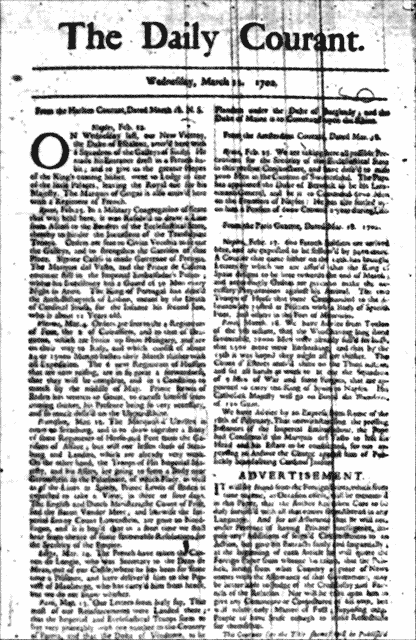
Elizabeth Mallet ( 1672–1706) was an English printer and bookseller who produced England's first daily newspaper, The Daily Courant.
In 1672, Mallet married David Mallet. During the 1670s and 1680s, she and David dominated the trade in printed speeches given by condemned prisoners before execution at Tyburn ("last dying speeches"), publishing them from Blackhorse Alley in Fleet Street. After David died in 1683, she apprenticed their son David to the printing and bookselling trade, and ran two presses. However, her son failed in this enterprise.
Within ten years Mallet was again in charge of the family business, publishing serial news publications such as The New State of Europe (launched 20 September 1701) and sensational tracts.
Mallet launched The Daily Courant on 11 March 1702. It was a single newssheet carrying digests of foreign papers. She avoided news from London because publishing it risked government reprisals, and would have been more easily contradicted. Writing under a male name, Mallet claimed only to provide the facts, and to let the reader make up their own minds, saying: “Nor will [the Author] take it upon himself to give any Comments or Conjectures of his own, but will relate only Matter of Fact; supposing other People to have Sense enough to make Reflections for themselves.”
Some commentators says that Mallet could be called the first editor of a daily newspaper in Britain, although the job title had not yet been invented. Mallet may have also been significant in changing our whole idea of time, contributing to the feeling of speed in modern life. Historians such as Charles Sommerville, Mark Turner and Joel Wiener argue that frequent news changed ideas of time, away from divine planning to an empty, unknowable future.
References
References
- (2014). "Dying to be Read: Gallows Authorship in Late Seventeenth-Century England". Authorship.
- (2010). "The Oxford Companion to the Book". Oxford University Press.
- Pank, Philip. (2002-03-11). "Fleet Street".
- (2015-03-11). "11 March 1702 – the world's first daily newspaper published". MoneyWeek.
- (1953). "The Rise of England's First Daily Newspaper". Journalism Bulletin.
- (1996). "The news revolution in England: cultural dynamics of daily information". Oxford University Press.
- (2002). "Periodical Time in the Nineteenth Century". Media History.
- (2011). "The Americanization of the British press, 1830s–1914: speed in the age of transatlantic journalism". Palgrave Macmillan.
This article was imported from Wikipedia and is available under the Creative Commons Attribution-ShareAlike 4.0 License. Content has been adapted to SurfDoc format. Original contributors can be found on the article history page.
Ask Mako anything about Elizabeth Mallet — get instant answers, deeper analysis, and related topics.
Research with MakoFree with your Surf account
Create a free account to save articles, ask Mako questions, and organize your research.
Sign up freeThis content may have been generated or modified by AI. CloudSurf Software LLC is not responsible for the accuracy, completeness, or reliability of AI-generated content. Always verify important information from primary sources.
Report