From Surf Wiki (app.surf) — the open knowledge base
Elizabeth de Burgh, 4th Countess of Ulster
Anglo-Irish noble (1332–1363)
Anglo-Irish noble (1332–1363)
| Field | Value |
|---|---|
| name | Elizabeth de Burgh |
| image | Arms of the House of de Burgh.svg |
| caption | Arms of de Burgh: Or, a cross gules. |
| succession | suo jure Countess of Ulster |
| predecessor | William Donn de Burgh, 3rd Earl |
| regent | Lionel of Antwerp, 1st Duke of Clarence |
| reg-type | jure uxoris Earl |
| successor | Philippa Plantagenet, 5th Countess with Edmund Mortimer, 3rd Earl of March |
| spouse | |
| issue | Philippa Plantagenet, 5th Countess of Ulster |
| father | William Donn de Burgh, 3rd Earl of Ulster |
| mother | Maud of Lancaster |
| birth_date | 6 July 1332 |
| birth_place | Carrickfergus Castle, Carrickfergus, County Antrim, Ireland |
| death_date | 10 December 1363 |
| death_place | Dublin, Ireland |
| burial_place | Bruisyard, Suffolk |
| house | Burgh |
| reg-type = jure uxoris Earl Elizabeth de Burgh, Duchess of Clarence, suo jure 4th Countess of Ulster and 5th Baroness of Connaught ( ; 6 July 1332 – 10 December 1363) was a Norman-Irish noblewoman who married Lionel of Antwerp, 1st Duke of Clarence.
Family
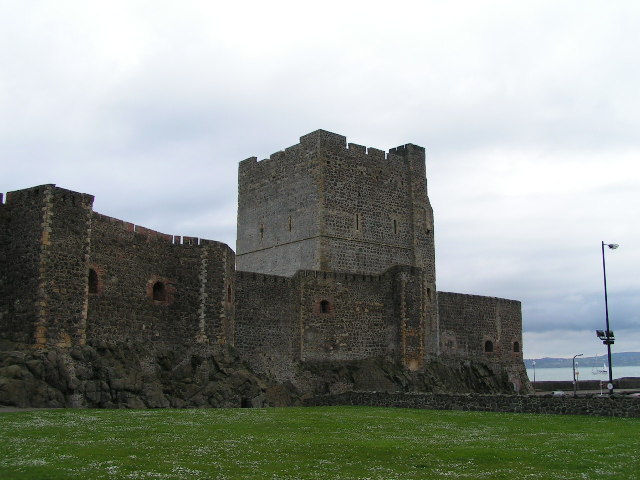
Elizabeth was born at Carrickfergus Castle near Belfast, Ireland, the only child of William Donn de Burgh, 3rd Earl of Ulster, and Maud of Lancaster, Countess of Ulster. She was the last of the senior legitimate line of the descendants of William de Burgh. Her paternal grandparents were John de Burgh and Elizabeth de Clare, and her maternal grandparents were Henry, 3rd Earl of Lancaster and Maud Chaworth. Her younger half-sister was Maud de Ufford, through her mother's second marriage to Sir Ralph de Ufford, Justiciar of Ireland.
Marriage
Upon William's murder on 6 June 1333, she became the sole legal heir to all the de Burgh lands in Ireland. Actually, her kinsmen Sir Edmond de Burgh of Clanwilliam, Sir Edmond Albanach Bourke the Mac William Iochtar, Sir Ulick Burke the Mac William Uachtar became the de facto heads of the family and owners of de Burgh land during the Burke Civil War. This is because she was merely 11 months old at the time.
As Countess of Ulster, she was raised in England and married Lionel of Antwerp, 1st Duke of Clarence, on 15 August 1352 at the Tower of London. He was the second son of Edward III of England and his queen consort, Philippa of Hainault. As a boy, the poet Geoffrey Chaucer served as page to Elizabeth.
The couple had one child, Philippa, born on 16 August 1355, the eldest grandchild of Edward III and Queen Philippa. Elizabeth's daughter Philippa succeeded as Countess of Ulster, and married Edmund Mortimer, 3rd Earl of March, in 1368. Both their titles passed to their son Roger Mortimer, and eventually through their granddaughter Anne de Mortimer, who married into the House of York. The House of York would base its claim to the English throne on their descent from Lionel of Antwerp.
Elizabeth died in Dublin in 1363 during her husband's term as Governor of Ireland. She was buried at Bruisyard Abbey, Suffolk; as her body was being repatriated, her husband obtained royal approval for her mother's new foundation of Franciscan nuns there.
Ancestry
References
Citations
Bibliography
-
- Earls of Ulster and Lords of Connacht, 1205–1460 (de Burgh, de Lacy and Mortimer), p. 170.
References
- Burke, Bernard. (1884). "The General Armory of England, Scotland, Ireland, and Wales; comprising a registry of armorial bearings from the earliest to the present time". Harrison & Sons.
- (2000). "Nobles and Nobility in Medieval Europe: Concepts, Origins, Transformations". [[Boydell & Brewer]].
- (1989). "A New History of Ireland: IX: Maps, Genealogies, Lists, A Companion to Irish History, Part II". Oxford University Press.
- (2022). "Vere [née Ufford], Maud de, countess of Oxford (1345?–1413), noblewoman".
- [https://www.irishtimes.com/culture/books/the-very-different-chaucer-connection-in-ireland-and-england-1.3907331 Marion Turner, ''The Very Different Chaucer Connection in Ireland and England'', Irish Times, 3 June 2019]
- E 101/394/19 in the National Archives, translated at http://clarescribe.org/wp-content/uploads/2018/03/THE-LAST-JOURNEY-1364.pdf {{Webarchive. link. (22 January 2022 , is the expense account of Nicholas de Fladebury & John de Neuborne who escorted Elizabeth's body via Chester & Coventry for the funeral at Bruisyard on 11 March 1364.)
- (1989). "A New History of Ireland: IX: Maps, Genealogies, Lists, A Companion to Irish History, Part II". Oxford University Press.
This article was imported from Wikipedia and is available under the Creative Commons Attribution-ShareAlike 4.0 License. Content has been adapted to SurfDoc format. Original contributors can be found on the article history page.
Ask Mako anything about Elizabeth de Burgh, 4th Countess of Ulster — get instant answers, deeper analysis, and related topics.
Research with MakoFree with your Surf account
Create a free account to save articles, ask Mako questions, and organize your research.
Sign up freeThis content may have been generated or modified by AI. CloudSurf Software LLC is not responsible for the accuracy, completeness, or reliability of AI-generated content. Always verify important information from primary sources.
Report