From Surf Wiki (app.surf) — the open knowledge base
Elisha
Prophet and wonder-worker in the Hebrew Bible
.jpg)
Prophet and wonder-worker in the Hebrew Bible
| Field | Value |
|---|---|
| honorific_prefix | Prophet |
| name | Elisha |
| image | Chapelle des Carmélites - Interieur - Élisée ressuscitant le fils de la Sunamite par Despax (cropped).jpg |
| caption | Detail from Elisha resurrecting the son of the Shunammite by , mid-18th century |
| titles | Saint |
| birth_date | Approximately |
| death_date | Approximately |
| death_place | Samaria |
| venerated_in | |
| feast_day | June 14 (liturgical calendars of the Eastern Orthodox and Eastern Catholic Churches) |
| influences | Elijah |
Elisha (God is my salvation) was, according to the Hebrew Bible, an Israelite prophet and a wonder-worker. His name is commonly transliterated into English as Elisha via Hebrew, Eliseus via Greek and Latin, Ełishe (Yeghishe/Elisha) via Armenian or Alyasa via Arabic, and Elyasa or Elyesa via Turkish. Also mentioned in the New Testament and the Quran, Elisha is venerated as a prophet in Judaism, Christianity and Islam and writings of the Bahá'í Faith refer to him by name.
Before he settled in Samaria, Elisha passed some time on Mount Carmel. He served from 892 until 832 BCE as an advisor to the third through the eighth kings of Judah, holding the office of "prophet in Israel". He is called a patriot because of his help to soldiers and kings.
In the biblical narrative, he is a disciple and protégé of Elijah, and after Elijah was taken up in a whirlwind, Elisha received a double portion of his power and he was accepted as the leader of the sons of the prophets. Elisha then went on to perform twice as many miracles as Elijah.
Scholars hold different opinions regarding the historical background, composition and social context of the Elisha narratives. The stories give unique insights into the folk religion of the Kingdom of Israel.
Bible stories
The story of Elisha is told in the Hebrew Bible/Old Testament in 1 Kings 19 and 2 Kings 2 through 2 Kings 9, ending in 2 Kings 13. He is mentioned again in the New Testament in Luke 4 ().
Anointing
Elisha's story is related in the Books of Kings (Second Scroll, chapters 2–14) in the Hebrew Bible (part of the Nevi'im). According to this story, he was a prophet and a wonder-worker of the Kingdom of Israel who was active during the reigns of Joram, Jehu, Jehoahaz, and Jehoash (Joash). Elisha was the son of Shaphat, a wealthy land-owner of Abel-meholah; he became the attendant and disciple of Elijah.
His name first occurs in chapter 19 of the Books of Kings in the command given to Elijah to anoint him as his successor. After learning in the cave on Mount Horeb, that Elisha, the son of Shaphat, had been selected by Yahweh as his successor in the prophetic office, Elijah set out to find him. On his way from Mount Horeb to Damascus, Elijah found Elisha ploughing with twelve yokes of oxen. Elijah went over to him, threw his mantle over Elisha's shoulders, investing him with the prophetic office. Elisha became Elijah's close attendant until Elijah entered heaven alive, although no details of Elisha are given during those years.
Elijah taken in the whirlwind

Ein es-Sultan in Jericho (also known as "Elisha's Spring"), believed to be the fountain purified by Elisha in 2 Kings 2:19–22, now inside a protective building]]
Elisha accompanied Elijah to Jericho, where according to , "the sons of the prophets" tell Elisha that the would "will take away thy master from thy head to-day".
The story of the departure of Elijah and of Elisha inheriting his powers is told in . Elijah and Elisha went to the Jordan River. Elijah rolls up his mantle and strikes the water, the waters of which divided so as to permit both to pass over on dry ground. Elisha asks to "inherit a double-portion" of Elijah's spirit. Suddenly, a chariot of fire and horses of fire appeared and Elijah was lifted up in a whirlwind. As Elijah was lifted up, his mantle fell to the ground and Elisha picked it up. This is the second time that Elisha comes in contact with his teacher's mantle, which as a cultic vestment is associated with prophetic might and authority.
Some scholars see this as indicative of the property inheritance customs of the time, where the oldest son received twice as much of the father's inheritance as each of the younger sons. In this interpretation Elisha is asking that he may be seen as the "rightful heir" and successor to Elijah. Critics of this view point out that Elisha was already appointed as Elijah's successor earlier in the narrative and that Elisha is described as performing twice as many miracles as Elijah. In this interpretation the "double-portion" is not merely an allusion to primacy in succession, but is instead a request for greater prophetic power even than Elijah.
Miracles
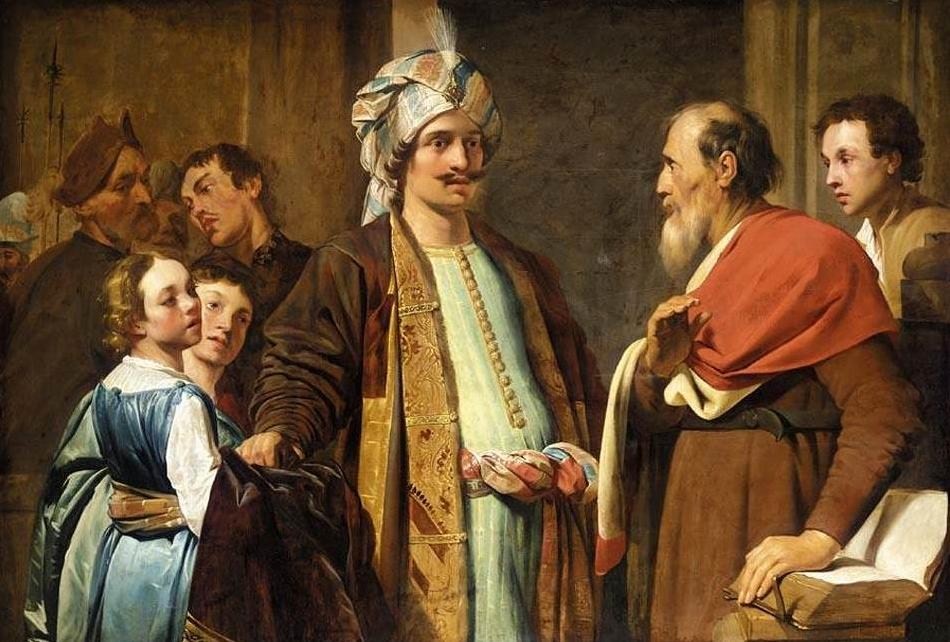
By means of the mantle left to fall from Elijah, Elisha miraculously recrossed the Jordan and returned to Jericho, where he won the gratitude of the people by purifying the unwholesome waters of their spring and making them drinkable.
When the armies of Judah, Israel and Edom, then allied against Mesha, the Moabite king, were being tortured by drought in the Idumean desert, Elisha consented to intervene. His double prediction regarding relief from drought and victory over the Moabites was fulfilled on the following morning.
When a group of boys (or youths){{efn|Hebrew hbo, translated 'youths' in the New International Version. The Jewish Encyclopedia entry on Elisha states, "The offenders were not children, but were called so (hbo) because they lacked (hbo) all religion (Soṭah 46b)."
To relieve a prophet's widow importuned by a harsh creditor, Elisha multiplied a little oil as to enable her not only to pay her debt but to provide for her family needs. Jewish tradition identifies the widow's husband as Obadiah, the servant of King Ahab, who hid 100 prophets of Yahweh in two caves.
According to , Elijah resuscitated a Phoenician boy in the city of Zarephath. In the second Book of Kings, Elisha obtained for a rich lady of Shunem the birth of a son. When the child died some years later, Elisha successfully resuscitated the child.

To nourish the sons of the prophets pressed by famine, Elisha changed a pottage made from poisonous gourds into wholesome food. in a story which is comparable with the miracles of Jesus in the New Testament.
Elisha cured the Syrian military commander Naaman of leprosy but punished his own servant Gehazi, who took money from Naaman. Elisha allowed Naaman to continue in the service of the Syrian king and therefore be present in the worship of Rimmon in the Syrian temple. According to the Gospel of Luke, Jesus referred to Naaman's healing when he said, "And there were many lepers in Israel in the time of Elisha the prophet: and none of them was cleansed but Naaman the Syrian."
Elisha's actions included repeatedly saving King Jehoram of Israel from the ambushes planned by Benhadad, bewildering with a strange blindness the soldiers of the Syrian king, making iron float to relieve from embarrassment a son of a prophet, and confidently predicting the sudden flight of the enemy at the siege of Samaria and the consequent cessation of the famine in the city,
Elisha then journeyed to Damascus and prophesied that Hazael would be king over Syria. and the slaughter of Ahab's seventy sons, proved how he executed that demand.
Elisha's final days
.jpg)
While Elisha lay on his death-bed in his own house, Jehoash of Israel, the grandson of Jehu, came to mourn over his approaching departure, and uttered the same words as those of Elisha when Elijah was taken away, indicating his value to him: "My father, my father! the chariot of Israel, and the horsemen thereof". Jehoash assists Elisha to fire an arrow eastwards from the window of his room, predicting as it lands:
Elisha predicted three successful battles over the Arameans, but no absolute victory.
According to the Books of Kings the year after Elisha's death and burial (or, in the following spring) a body was placed in his grave. As soon as the body touched Elisha's remains the man "revived and stood up on his feet".
Veneration

Elisha is venerated as a saint in a number of Christian churches. His feast day is on June 14, on the Eastern Orthodox, and Eastern Catholic liturgical calendars (for those churches which use the traditional Julian calendar, June 14 falls on June 27 of the modern Gregorian calendar). The Armenian Apostolic Church commemorates his feast day on the Thursday following the fifth Sunday after Pentecost (July 1 in 2021). John of Damascus composed a canon in honor of Elisha, and a church was built at Constantinople in his honor.
In Western Christianity Elisha is commemorated in the calendar of saints of the Carmelites, a Catholic religious order, who claim a spiritual descent from him, following a decree of the Carmelite General Chapter of 1399.
Julian the Apostate (361–363) gave orders to burn the relics of the prophets Elisha, Obadiah and John the Baptist, who were buried next to each other in Sebastia, but they were rescued by the Christians, and part of them were transferred to Alexandria.
Elisha is commemorated on 20 June – translation of the relics and garments of the Apostles Luke, Andrew, and Thomas, the Prophet Eliseus, and Martyr Lazarus of Persia found , during the time of the emperor Romanos Lakapenos (919–944) in a monastery of Saint Augusta into the Church of the Holy Apostles in Constantinople under Emperor Constantine Porphyrogenitus () by Saint Patriarch Polyeuctus of Constantinople (956–970).
Eliseus is also commemorated on July 20 with Aaron, Elias and Moses.
In Islam
Main article: Elisha in Islam

Elisha () is venerated as a prophet in all of Islam, and is prophetic successor to Elijah (Arabic: ar). Elisha is mentioned twice in the Quran as a prophet, alongside fellow prophets. According to the Quran, Elisha is exalted "above the worlds (or to their people)" () and is "among the excellent" (). Islamic sources that identify Elisha with Khidr cite the strong relationship between al-Khidr and Elijah in Islamic tradition. Around four thousand prophets were sent between Moses and Jesus, including figures such as Joshua, Elijah, Elisha, David, Solomon, Isaiah, Jeremiah, Jonah, and John the Baptist, who upheld the Torah and corrected deviations among the Israelites, with the finality of prophethood in Muhammad.
Some Muslims believe the tomb of Elisha is in Al-Awjam in the eastern region of Saudi Arabia. The shrine was removed by the Saudi Government because such veneration is not in accordance with the Wahhabi or Salafi reform movement dominant in Saudi Arabia. It had been an important landmark for many centuries during the time of Ottoman Arabia, and had been a very popular pilgrimage destination for Muslims of all sects throughout the pre-modern period.
Notes
References
References
- Wells, John C.. (1990). "Elisha". Longman.
- {{bibleverse. Luke. 4:27 "And there were many lepers in Israel in the time of Elisha the prophet. Yet not one of them was cleansed—only Naaman the Syrian."
- ''Revisioning the Sacred: New Perspectives on a Bahái̓́ Theology'', Volume 8. p. 32. Jack McLean. 1997.
- J. K. Mead, "Elisha" in Bill T. Arnold and H. G. M. Williamson (eds.), ''Dictionary of the Old Testament: Historical Books'' (InterVarsity Press, 2005), pp. 254–258.
- Collins, John J. ''Introduction to the Hebrew Bible''. Minneapolis: Fortress, 2004. pp. 268–269.
- [https://www.biblegateway.com/quicksearch/?quicksearch=Elisha&version=NIV&resultspp=250 103 Bible results for "Elisha" from New International Version], Bible Gateway. Accessed 21 April 2024.
- Achtemeijer, Paul L. ed., and Dennis R. Bratcher, Ph.D. "Elisha." HarperCollins Bible Dictionary. New York, New York: HarperCollins Publishers, 1996.
- {{cite encyclopedia. link
- [https://www.nationalshrine.org/blog/biblical-figures-elisha-miracle-worker/ "Biblical Figures: Elisha, Miracle Worker", Basilica of the National Shrine of the Immaculate Conception, February 1, 2021]
- (1872). "Dothie, William Plaskett. ''The history of the prophet Elisha''".
- [https://www.britannica.com/biography/Elisha Britannica, The Editors of Encyclopaedia. "Elisha". ''Encyclopedia Britannica'', 7 Feb. 2024]
- (November 2, 2003). "Asking for a double portion". Rabat International Church.
- Francis, RW. "The Prophetic Double Anointing". gospel.org.nz.
- Zucker, David J., "Elijah and Elisha" Part II, ''Jewish Bible Quarterly'', vol.41, no.1, 2013
- {{bibleverse. 1 Kings. 18:3–16. NKJV; cf. [http://biblehub.com/commentaries/2_kings/4-1.htm Pulpit Commentary on 2 Kings 4], accessed 22 December 2017
- "Elisha". Orthodox Church in America.
- He fed a hundred men with twenty loaves of new [[barley]], leaving some leftover,{{bibleverse. 2 Kings. 4:42–44. HE
- {{bibleverse. Matthew. 14:15–21, {{bibleverse. Matthew. 15:32–38, {{bibleverse. John. 6:5–14
- Naaman, at first reluctant, obeyed Elisha, and washed seven times in the [[River Jordan]]. Finding his flesh "restored like the flesh of a little child", the general was so impressed by this evidence of God's power, and by the disinterestedness of his prophet, as to express his deep conviction that "there is no other God in all the earth, but only in Israel."{{bibleverse. 2 Kings. 5:15
- {{bibleverse. Luke. 4:27. KJV
- ordering the elders to shut the door against the messenger of Israel's ungrateful king,{{bibleverse. 2 Kings. 6:25–32. HE
- {{bibleverse. 2 Kings. 6:13–23. HE
- "Eliseus". the Order of Carmelites.
- {{bibleverse. 2 Kings. 7:1–20. HE
- Elisha directs one of the sons of the prophets to anoint Jehu, the son of [[Jehoshaphat (father of Jehu). 2 Kings. 9:30–34
- {{bibleverse. 2 Kings. 9:11–10:30. HE
- {{bibleverse. 2 Kings. 2:12. KJV, {{bibleverse. 2 Kings. 13:14. KJV
- {{Bibleverse. 2 Kings. 13:17. NKJV
- {{bibleverse. 2 Kings. 13:20–21. HE
- ''Domar: the calendrical and liturgical cycle of the Armenian Apostolic Orthodox Church'', Armenian Orthodox Theological Research Institute, 2003, p. 446.
- [http://www.carmelite-seremban.org/Spirituality/carmelite_calendar.html Carmelite Calendar] {{webarchive. link. (July 13, 2007)
- Paul L. Rothermel. (2010-08-19). "Jesus was never married". St. Ignatius reading.
- Denys Pringle, ''The Churches of the Crusader Kingdom of Jerusalem: A Corpus. Vol. 2: LZ (excluding Tyre)'', p. 283.
- "The Monastery of St. Macarius the Great".
- "ЕЛИСЕЙ, ПРОРОК - Древо".
- "Mojżesz".
- Tottoli, Roberto, "Elisha", in: ''Encyclopaedia of the Qurʾān'', General Editor: Jane Dammen McAuliffe, Georgetown University, Washington DC. Brill Online.
- Tottoli, Roberto, "Elisha", in: ''Encyclopaedia of Islam'', THREE, Edited by: Kate Fleet, Gudrun Krämer, Denis Matringe, John Nawas, Everett Rowson. Brill Online.
- Qur'an 6:86
- Qur'an 38:48
- al-Rabghūzī, ''Stories of the prophets'', ed. Hendrik E. Boeschoten, M. Vandamme, and Semih Tezcan [Leiden 1995], 2:460
- [[Ahmad Yar Khan Naeemi. Mufti Ahmad Yar Khan Naeemi.]] ''[[iarchive:tafseer-e-naeemi-jild-1-1. Tafsir Naeemi: Vol. 1.]]'' Lahore: Naeemi Kutub Khanah, 2009, Part 1, Chapter 2, Verse 87, Scholarly Exegesis, p. 532.
- "Religious curbs in Saudi Arabia – Report: Jafariya News, December 12 News".
- "Salafi Bidah in respecting the signs of Allah".
- [[:ar:اليسع. اليسع]] (Al-Yasa) {{in lang. ar
This article was imported from Wikipedia and is available under the Creative Commons Attribution-ShareAlike 4.0 License. Content has been adapted to SurfDoc format. Original contributors can be found on the article history page.
Ask Mako anything about Elisha — get instant answers, deeper analysis, and related topics.
Research with MakoFree with your Surf account
Create a free account to save articles, ask Mako questions, and organize your research.
Sign up freeThis content may have been generated or modified by AI. CloudSurf Software LLC is not responsible for the accuracy, completeness, or reliability of AI-generated content. Always verify important information from primary sources.
Report