From Surf Wiki (app.surf) — the open knowledge base
Eliot Ness
American Prohibition agent (1903–1957)
American Prohibition agent (1903–1957)
| Field | Value | ||||
|---|---|---|---|---|---|
| name | Eliot Ness | ||||
| image | Eliotness.jpg | ||||
| caption | Ness, | ||||
| birth_date | |||||
| death_date | |||||
| birth_place | Chicago, Illinois. U.S. | ||||
| death_place | Coudersport, Pennsylvania, U.S. | ||||
| spouse | {{plainlist | ||||
| * {{marriage | Edna Stahle | 1929 | 1938 | end | div}} |
| * {{marriage | Evaline Michelow | 1939 | 1945 | end | div}} |
| alma mater | University of Chicago | ||||
| signature | Eliot Ness signature.svg | ||||
| module | {{Infobox police officer | ||||
| embed | yes | ||||
| department | Bureau of Prohibition | ||||
| Cleveland Division of Police | |||||
| serviceyears | BOP: 1926–1935 | ||||
| CDP: 1935–1942 | |||||
| rank | Chief Investigator of the Prohibition Bureau for Chicago in 1934 | ||||
| Director for Public Safety for Cleveland, Ohio |
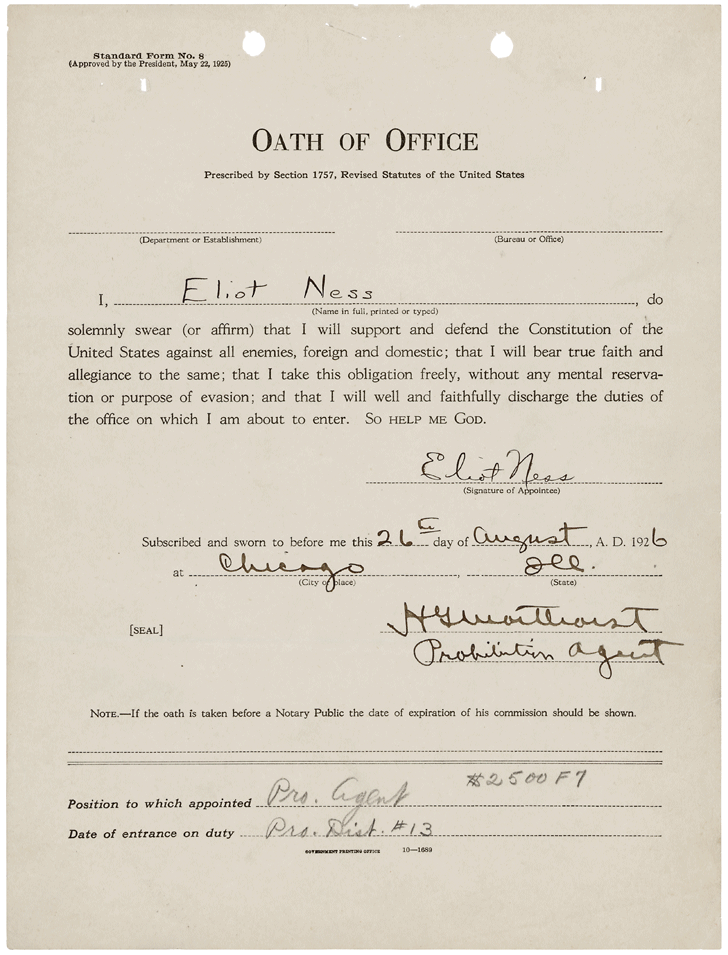
Cleveland Division of Police CDP: 1935–1942 Director for Public Safety for Cleveland, Ohio Eliot Ness (April 19, 1903 – May 16, 1957) was an American Prohibition agent known for his efforts to bring down Al Capone while enforcing Prohibition in Chicago. He was leader of a team of law enforcement agents nicknamed The Untouchables, handpicked for their incorruptibility. The release of his memoir The Untouchables, months after his death, launched several screen portrayals establishing a posthumous fame for Ness as an incorruptible crime fighter.
Early life
Eliot Ness was born on April 19, 1903, in the Roseland neighborhood of Chicago, Illinois. He was the youngest of five children born to Peter Ness (1850–1931) and Emma King (1863–1937). His parents, both Norwegian immigrants, operated a bakery. Ness attended Christian Fenger High School in Chicago. He was educated at the University of Chicago, graduating in 1925 with a degree in political science and business administration, and was a member of Sigma Alpha Epsilon. He began his career as an investigator for the Retail Credit Company of Atlanta assigned to the Chicago territory, where he conducted background investigations for the purpose of credit information. In 1929, he returned to the university to take a graduate course in criminology taught by August Vollmer, a noted police reformer and chief of the Berkeley Police Department. Vollmer's ideas about professionalizing law enforcement would influence Ness throughout his career.
Career
1926–1931
Ness' brother-in-law, Alexander Jamie, an agent of the Bureau of Investigation (which became the Federal Bureau of Investigation in 1935), influenced Ness to enter law enforcement. Ness joined the U.S. Treasury Department in 1926, working with the 1,000-strong Bureau of Prohibition in Chicago.
In March 1930, attorney Frank J. Loesch of the Chicago Crime Commission asked President Herbert Hoover to take down Al Capone. Agents of the Bureau of Internal Revenue, working under Elmer Irey and Special Agent Frank J. Wilson of the Intelligence Unit, were already investigating Capone and his associates for income tax evasion. In late 1930, Attorney General William D. Mitchell, seeking a faster end to the case, implemented a plan devised by President Hoover for sending a small team of Prohibition agents, working under a special United States attorney, to target the illegal breweries and supply routes of Capone while gathering evidence of conspiracy to violate the National Prohibition Act (informally known as the Volstead Act). U.S. attorney George E.Q. Johnson, the Chicago prosecutor directly in charge of both the Prohibition and income tax investigations of Capone, chose the 27-year-old Ness (now assigned to the Justice Department) to lead this small squad.
In his The Untouchables book, Ness claimed to have originated the idea for an incorruptible federal force, and gave substantial credit to the Secret Six for both the creation of the group and Ness' appointment to lead it.
In October 1930, Alexander Jamie was named chief investigator for the powerful Chicago-based vigilantes, and, according to Ness, both Jamie and Secret Six founder Col. Robert Isham Randolph spoke to Johnson to endorse Ness' idea.
“I understand you’re the one who came up with this plan for closing down Capone’s breweries, which has been brought to my attention by Robert Isham Randolph,” Ness quoted Johnson as saying. Johnson said he supported the idea, and then turned to who would lead it: “Frankly, I had several men in mind, but you were recommended highly to me by the Secret Six and also by your brother-in-law Alexander Jamie.”

With corruption of Chicago's law enforcement agents endemic, Ness went through the records of all Prohibition agents to create a reliable team (initially of six, eventually growing to about ten) later known as "The Untouchables." Raids against illegal stills and breweries began in March 1931. Within six months, Ness' agents had destroyed bootlegging operations worth an estimated $500,000 (almost $9.9 million in 2022) and representing an additional $2 million ($39.5 million in 2022) in lost income for Capone; their raids would ultimately cost Capone in excess of $9 million ($178 million in 2022) in lost revenue. The main source of information for the raids was an extensive wiretapping operation.
In 1931, a member of Al Capone's gang promised Ness that he would receive $2,000 every week ($36,684.27 in 2022) if he ignored their bootlegging activities. Ness refused the bribe. Failed attempts by members of the Chicago Outfit to bribe or intimidate Ness and his agents inspired Charles Schwarz of the Chicago Daily News to begin calling them "untouchables". George Johnson adopted the nickname and promoted it to the press, establishing it as the squad's unofficial title.
The efforts of Ness and his team inflicted major financial damage on Capone's operations and led to his indictment on 5,000 violations of the Volstead Act in June 1931. Federal judge James H. Wilkerson prevented that indictment from coming to trial, instead pursuing the tax evasion case built by George Johnson and Frank Wilson. On October 17, 1931, Capone was convicted on three of 22 counts of tax evasion. He was sentenced to eleven years in prison and, following a failed appeal, began his sentence in 1932. On May 3, 1932, Ness was among the federal agents who took Capone from the Cook County Jail to Dearborn Station, where he boarded the Dixie Flyer to the Atlanta Federal Penitentiary—the only time the two men are known to have met in person.
1932–1957
In 1932, Ness was promoted to Chief Investigator of the Prohibition Bureau for Chicago. Following the end of Prohibition in 1933, he was assigned as an alcohol tax agent in the "Moonshine Mountains" of southern Ohio, Kentucky, and Tennessee, and in 1934 he was transferred to Cleveland, Ohio. In December 1935, Cleveland mayor Harold H. Burton hired Ness as the city's Safety Director, which put him in charge of both the police and fire departments. Ness soon began a reform program inspired by the ideas of August Vollmer, which focused on professionalizing and modernizing the police, stopping juvenile delinquency, and improving traffic safety. He declared war on the mob, and his primary targets included "Big" Angelo Lonardo, "Little" Angelo Scirrca, Moe Dalitz, John Angerola, George Angersola, and Charles Pollizi.
Ness was also Safety Director at the time of the murders known as the Cleveland Torso Murders, occurring in the Cleveland area from 1935 to 1938; though he had oversight of the police department, he was only peripherally involved in the investigation. Ness interrogated one of the prime suspects of the murders, Dr. Francis E. Sweeney, using a polygraph test. At one point, two bodies of the victims of the serial killer were placed within view of Ness' office window.
In 1938, Ness and his wife Edna divorced. His otherwise successful career in Cleveland withered gradually. He especially fell out of favor after he had the city's large shantytowns evacuated and burned during the Cleveland Torso Murders. Cleveland critics targeted his divorce, his high-profile social drinking, and his conduct in a car accident one night when he was driving drunk. Although there were no victims in the accident, Ness, fearful that he might lose his job, tried to get the accident covered up. Later, his involvement in the accident was revealed by a local newspaper and calls for his resignation increased; however, Burton's successor as mayor, Frank Lausche, kept Ness on.{{cite encyclopedia |access-date = May 8, 2012
In 1939, Ness married illustrator Evaline Michelow. In 1942, the Nesses moved to Washington, D.C., where he worked for the federal government. He directed the battle against prostitution in communities surrounding military bases, where venereal disease was a serious medical issue. Later he made a number of forays into the corporate world, all of which failed owing to his lack of business acumen. In 1944, he left to become chairman of the Diebold Corporation, a security company based in Ohio.{{cite web |access-date = May 8, 2013 |archive-url = https://web.archive.org/web/20120508024112/http://www.diebold.com/150/featurestories_1944.htm |archive-date = May 8, 2012 |url-status = dead

After his second divorce and third marriage, he ran unsuccessfully for Mayor of Cleveland in 1947,{{cite web |access-date = November 24, 2021 |archive-url = https://web.archive.org/web/20160828173435/http://clevelandpolicemuseum.org/collections/eliotness.html |archive-date = August 28, 2016 |url-status = dead
In later years, Ness struggled financially; he was nearly penniless at the time of his death, with his role in bringing down Al Capone having been largely forgotten.
Personal life
Ness was married to Edna Stahle (1900–1988) from 1929 to 1938, illustrator Evaline Michelow (1911–1986) from 1939 to 1945, and artist Elisabeth Andersen Seaver (1906–1977) from 1946 until his death in 1957. He also had an adopted son, Robert (1946–1976).
Death
.jpg)
Shortly after his approval of the final galleys for The Untouchables, on whose writing he and Oscar Fraley had been collaborating as a means, on Ness' part, of earning money in his later years, Ness collapsed and died of a heart attack at his home in Coudersport, Pennsylvania, on May 16, 1957. He was 54 years of age. His body was cremated, and his ashes were scattered in one of the small ponds on the grounds of Lake View Cemetery in Cleveland. An admirer later donated a plot near the pond and erected a cenotaph in his honor there.
Ness was survived by his widow, Elisabeth Andersen Seaver, and adopted son, Robert.
Legacy
Archive
The Western Reserve Historical Society houses additional Ness papers, including a scrapbook (1928–1936); copies of newspaper clippings (1935–1950); a typewritten manuscript detailing Ness' career in Chicago; and miscellaneous papers, including a report on the Fidelity Check Corporation and Guaranty Paper, of which Ness was president.
Art, entertainment, and media
Numerous media works have been developed based on Eliot Ness' life and the legend surrounding his work in Chicago. The first of these resulted in Ness' last years in collaboration with Oscar Fraley in writing the book The Untouchables (1957), which was published after Ness' death and went on to sell 1.5 million copies. Although the historical veracity of this book has been questioned, later research suggests that it is broadly accurate. A 21-page manuscript that Ness wrote for the book is housed in the archives of the Western Reserve Historical Society in Cleveland, Ohio.

The book was adapted in multiple media and inspired many additional works. The best-known adaptations include the 1959 TV series The Untouchables, which starred Robert Stack as Ness and was narrated by Walter Winchell, which itself was parodied by The Unmentionables, a 1963 Bugs Bunny cartoon where Bugs played "Elegant Mess"; and the 1987 film The Untouchables, directed by Brian De Palma, which starred Kevin Costner as Ness, Sean Connery, and Robert De Niro as Al Capone. These two fictionalized portrayals, more than actual history, have inspired numerous novels; a TV-movie, The Return of Eliot Ness, in which Stack returned to the role; a second, short-lived 1993 TV series titled The Untouchables, which starred Tom Amandes as Ness and William Forsythe as Capone; stage plays such as Peter Ullian's In the Shadow of the Terminal Tower; and comic books such as Torso. Ness was portrayed by actor Jim True-Frost in the fifth-season episode "The Good Listener" of the HBO television series Boardwalk Empire.
Max Allan Collins used Ness as the "police contact/best friend" character in his series of historical private eye novels featuring Chicago detective Nate Heller. Later he spun Ness off into his own series, set during his tenure as Cleveland's Public Safety Director. The first book, The Dark City (1987), depicted Ness' getting hired and undertaking a cleanup of the graft-ridden police force; the second, Butcher's Dozen (1988), his pursuit of the serial killer known as the Mad Butcher of Kingsbury Run. Bullet Proof (1989) pitted Ness against labor racketeers intent on taking over Cleveland's food service industry. Ness is mentioned in many hip hop and rap tracks ("California Love", for example). Murder by the Numbers (1993) depicted Ness' investigation of the numbers racket in Cleveland. All of these novels, while fictionalized, were closely based on actual cases investigated by Ness and the Cleveland Police. Collins also wrote a one-man stage play, Eliot Ness – An Untouchable Life, which was nominated for an Edgar Award. Collins wrote Ness into his graphic novel Road to Perdition.
In 2018, Collins collaborated with historian A. Brad Schwartz on a nonfiction dual biography of Ness and Capone entitled Scarface and the Untouchable: Al Capone, Eliot Ness, and the Battle for Chicago. Collins' and Schwartz's second volume about Ness' years in Cleveland, entitled Eliot Ness and the Mad Butcher, was published in 2020.
In The Young Indiana Jones Chronicles, Frederick Weller portrayed a young Elliot Ness in the eleventh episode The Mystery of the Blues. In the episode, he is portrayed as the roommate of Indiana Jones at the University of Chicago.
The video game called The Untouchables was released in 1989 by Ocean Software for ZX Spectrum, Amstrad CPC, Commodore 64, MSX, Atari ST, Amiga, MS-DOS, Nintendo Entertainment System, and Super NES.
Ness is mentioned by FBI agent Jimmy Woo as his idol growing up in "We Interrupt This Program" (release date: January 29, 2021), episode 4 of Disney+ miniseries WandaVision.
Ness is a character in Supernatural in Season 7 Episode 12 "Time After Time" (release date: January 13. 2012). He was a hunter in 1944 and together with Dean Winchester he hunted down Chronos.
Beer
Cleveland-based Great Lakes Brewing Company, which claims several connections to Ness (including the brewery owners' mother having worked as his stenographer), named an amber lager "Eliot Ness" and included several subtle nods to his career in the beer description and label art.
Proposed building naming
On January 10, 2014, Illinois U.S. Senators Dick Durbin and Mark Kirk and Ohio Senator Sherrod Brown proposed naming the headquarters of the Bureau of Alcohol, Tobacco, Firearms and Explosives in Washington, D.C., after Ness. If approved, it would have been called the Eliot Ness ATF Building. Brown said in a statement: "Eliot Ness is perhaps best known as the man who helped to bring Al Capone to justice. But Eliot Ness was more than just a Chicago U.S. prohibition agent. He fought for law and justice in Ohio, and fought for peace and freedom in World War II. He was a public servant and an American hero who deserves to be remembered."
Chicago Aldermen Edward M. Burke (14th Ward) and James Balcer (11th Ward) introduced a resolution in the Chicago City Council to oppose the renaming. In a news release, Burke said: "Eliot Ness had a checkered career after leaving the federal government. I simply do not think his image matches the actual reality of his legacy."

The authors of two separate Ness biographies later disputed the accuracy of Burke's claims, suggesting he mischaracterized Ness' career. "If Hollywood has given Eliot Ness too much credit for getting Capone," Max Allan Collins wrote in an article for HuffPost, "he has received too little credit anywhere else for helping professionalize law enforcement in the mid-20th Century."
Although the Senate resolution was never adopted, the main atrium in the ATF headquarters building was later renamed for Eliot Ness and features a historical exhibit about the Untouchables.
Festival and museum
Coudersport, Pennsylvania, the town where Ness spent his final months and died, has held an annual "Eliot Ness Festival" every third weekend in July since 2018. Past events have included a public reunion of people descended from the original Untouchables, a dramatization of Al Capone's trial, film screenings, author talks, and antique car shows.
In 2019, an "Eliot Ness Museum" inspired by the annual festival opened in downtown Coudersport, featuring several antique cars and exhibits describing Ness' life and career.
References
References
- (2018). "Scarface and the Untouchable: Al Capone, Eliot Ness, and the Battle for Chicago". William Morrow.
- Heimel, Paul W.. (1997). "Eliot Ness: The Real Story". Knox Books.
- [http://www.essortment.com/all/eliotnessuntou_rnjc.htm ''Biography of Eliot Ness'' (Essortment)] {{webarchive. link. (August 16, 2010)
- “U. S. Dry Agent Is New Investigator for ‘Secret Six’,” ''Belleville (IL) News-Democrat'', October 31, 1930, 2.
- [Eliot Ness, with Oscar Fraley, ''The Untouchables''. (New York: Pocket Books, 1987), pp. 11-21.
- Hoffman, Dennis Earl. (2010). "Scarface Al and the Crime Crusaders: Chicago's Private War Against Capone". Southern Illinois University Press.
- Okrent, Daniel. (2010). "Last Call: The Rise and Fall of Prohibition". Scribner.
- (January 13, 2024). "Al Capone – American criminal".
- "Eliot Ness biography – birthday, trivia – American Law Officer – Who2".
- ""Eliot Ness 1902–1957" The Alcohol and Tobacco Tax and Trade Bureau.gov web site".
- Bovsun, Mara. (June 30, 2013). "Pile of bones: Eliot Ness hunted Cleveland serial killer, but mystery remains".
- "Torso Murders – Cleveland Police Museum".
- "Haunted History'' – Season 1 Episode 6 ''The Torso Murders"
- (2000). "Eliot Ness: The Real Story". Cumberland House.
- Pearl, Matthew. (2017-12-27). "Behind The Untouchables: The Making of the Memoir That Reclaimed a Prohibition-Era Legend".
- "Whatever happened to Eliot Ness after the trial of Al Capone?".
- Vigil, Vicki Blum. (2007). "Cemeteries of Northeast Ohio: Stones, Symbols & Stories". Gray & Company, Publishers.
- Badal, James Jessen. (2001). "In the Wake of the Butcher: Cleveland's Torso Murders". Kent State University Press.
- "Finding aid for the Eliot Ness Papers". OhioLINK.
- (January 9, 1994). "Oscar Fraley, 79, 'Untouchables' author obituary". [[The New York Times]].
- New York: Pocket Books, trade paperback printing, 2002: pp.194ff
- "Scarface and the Untouchable – Max Allan Collins – Hardcover".
- "A Conversation With Max Allan Collins On Graphic Novel "The Night I Died"".
- (July 30, 2020). "'Eliot Ness and the Mad Butcher' Review: An Untouchable Second Act". Wall Street Journal.
- Wendel, Kim. (March 2023). "Battle over "Untouchables" Eliot Ness estate involves NE Ohio". WKYC.
- Great Lakes Brewing Company Fact Sheet. "Eliot Ness Amber Lager".
- Bona, Mark. "Great Lakes Brewing Co. unveils new labels". Cleveland Plain Dealer.
- Skiba, Katherine. "'Untouchable' idea – building named for Eliot Ness". Chicago Tribune.
- (January 10, 2014). "Sens. Brown, Kirk, And Durbin Introduce Bipartisan Resolution To Honor Famed Prohibition Agent, Eliot Ness". Office of Senator Sherrod Brown.
- (January 15, 2014). "Pair of aldermen oppose effort to rename ATF HQ after Eliot Ness". [[Chicago Tribune]].
- Perry, Douglas. (January 24, 2014). "The truth about Eliot Ness". Chicago Tribune.
- Collins, Max Allan. (January 23, 2014). "They should name a building for him". [[HuffPost]].
- (July 12, 2018). "The Untouchable Eliot Ness Is Getting His Own Fest".
- Bogdan, Ruth. (July 18, 2018). "Eliot Ness Fest to feature trial re-enactment, Untouchables reunion". Olean Times Herald.
- Holtz, Christine. (September 2, 2019). "Antique Car and Truck Museum in Coudersport celebrates career of Eliot Ness". Bradford Era.
- (October 5, 2019). "Antique Car and Truck Museum in Coudersport celebrates career of Eliot Ness". Endeavor News.
This article was imported from Wikipedia and is available under the Creative Commons Attribution-ShareAlike 4.0 License. Content has been adapted to SurfDoc format. Original contributors can be found on the article history page.
Ask Mako anything about Eliot Ness — get instant answers, deeper analysis, and related topics.
Research with MakoFree with your Surf account
Create a free account to save articles, ask Mako questions, and organize your research.
Sign up freeThis content may have been generated or modified by AI. CloudSurf Software LLC is not responsible for the accuracy, completeness, or reliability of AI-generated content. Always verify important information from primary sources.
Report