From Surf Wiki (app.surf) — the open knowledge base
Elias Magnus Fries
Swedish mycologist (1794–1878)
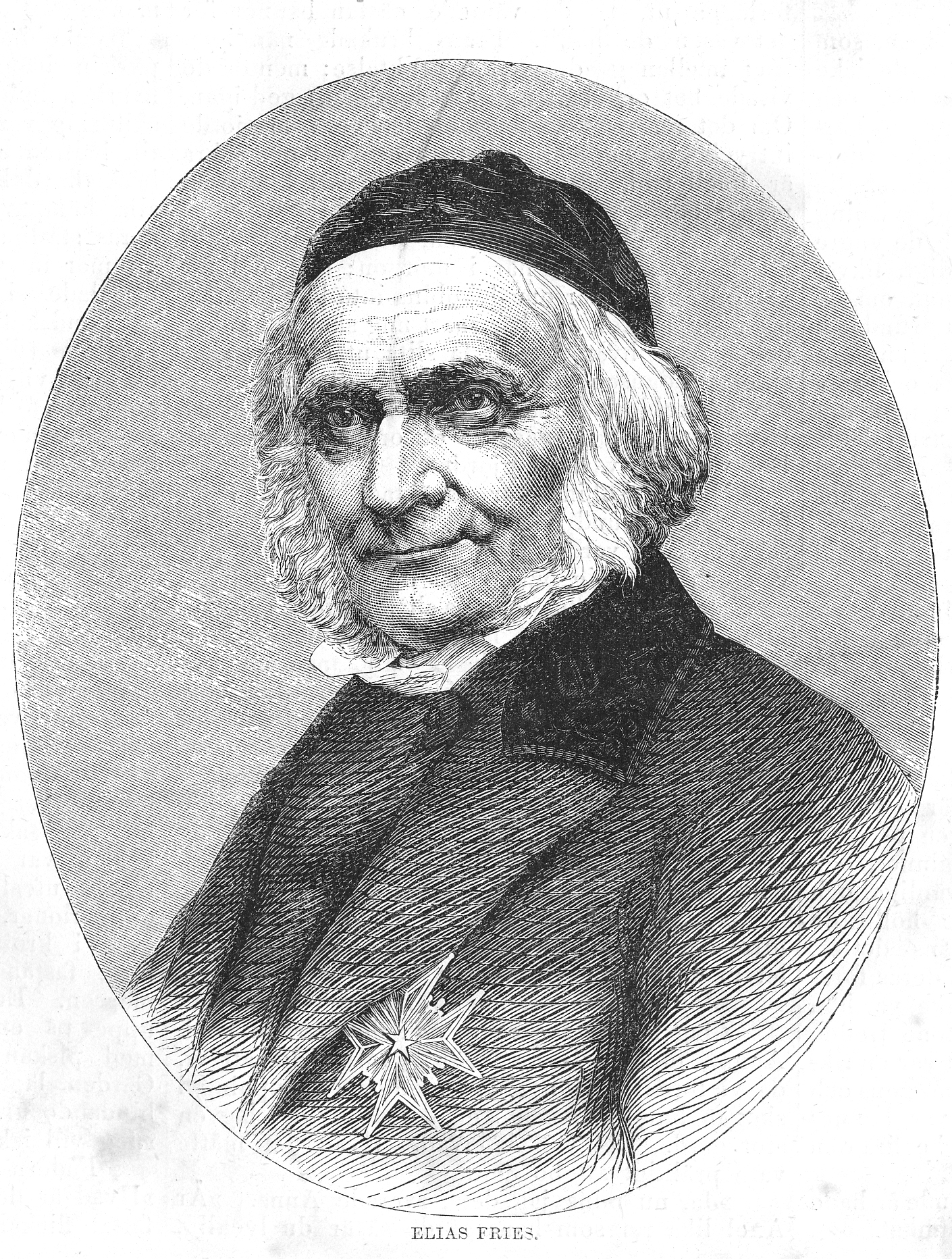
Swedish mycologist (1794–1878)
| Field | Value |
|---|---|
| name | Elias Magnus Fries |
| image | Elias_Magnus_Fries.jpg |
| birth_date | |
| birth_place | Femsjö, Hylte Municipality, Småland, Sweden |
| death_date | |
| death_place | Uppsala |
| field | Mycology, botany |
| work_institution | Lund University |
| (1814–1834), | |
| Uppsala University | |
| (1834–1878) | |
| alma_mater | Lund University |
| known_for | Founder of modern fungal taxonomy |
| author_abbreviation_bot | Fr. |
| awards | Foreign Honorary Member of the American Academy of Arts and Sciences |
(1814–1834), Uppsala University (1834–1878)

Elias Magnus Fries (15 August 1794 – 8 February 1878) was a Swedish mycologist and botanist. He is sometimes called the "Linnaeus of Mycology". In his works he described and assigned botanical names to hundreds of fungus and lichen species, many of which remain authoritative today.
Career
Fries was born at Femsjö (Hylte Municipality), Småland, the son of the pastor there. He attended school in Växjö.
He acquired an extensive knowledge of flowering plants from his father. In 1811 Fries entered Lund University He obtained his doctorate in 1814. In the same year he was appointed an associate professorship in botany. Fries edited several exsiccata series, the first starting in 1818 under the title Lichenes Sveciae exsiccati, curante Elia Fries and the last together with Franz Joseph Lagger under the title Hieracia europaea exsiccata. He was elected a member of the Royal Swedish Academy of Sciences, and in 1824, became a full professor. In 1834 he became Borgström professor That year he was also appointed director of the Uppsala University Botanical Garden. In 1853, he became rector of the University.
Fries most important works were the three-volume Systema mycologicum (1821–1832), Elenchus fungorum (1828), the two-volume Monographia hymenomycetum Sueciae (1857 and 1863) and Hymenomycetes Europaei (1874).
Fries is considered to be, after Christian Hendrik Persoon, a founding father of the modern taxonomy of mushrooms. His taxonomy of mushrooms was influenced by Goethe and the German romantics. He utilized spore color and arrangement of the hymenophore (pores, gills, teeth etc.) as major taxonomic characteristics. He was one of the most prolific authors of new fungal species, having formally described 3210 in his career.
Fries died in Uppsala on 8 February 1878. When he died, The Times commented: "His very numerous works, especially on fungi and lichens, give him a position as regards those groups of plants comparable only to that of Linnaeus." Fries was succeeded in the Borgström professorship (from 1859 to 1876) by Johan Erhard Areschoug, after whom Theodor Magnus Fries, the son of Elias, held the chair (from 1877 to 1899).
Publications
- Monographia Pyrenomycetum Sueciae (1816)
- Systema Mycologicum (1821)
- Systema Orbis Vegetabilis (1825)
- Elenchus Fungorem (1828)
- Lichenographia Europaea Reformata (1831)
- Epicrisis Systematis Mycologici: seu synopsis hymenomycetum (1838)
Botanical reference
Family
His wife was Christina Wieslander (1808–1862), with whom he raised nine children. His son Theodor Magnus Fries became a botanist and lichenologist, eventually holding the Borgström professorship himself, and another son, Oscar Robert Fries, became a physician in Gothenburg while maintaining a keen interest in mycology. Theodor "Thore" Magnus's sons Thore Christian Elias Fries and Robert Elias Fries also became botanists.{{cite web |access-date = 2008-05-06 |archive-url = https://web.archive.org/web/20071209081753/http://www.systbot.uu.se/information/history/fries.htm |archive-date = 2007-12-09
References
References
- (1981). "Aspects of mycological history". Bulletin of the British Mycological Society.
- (1908). "Fries, Elias Magnus".
- {{Cite EB1911
- (1878). "Elias Magnus Fries". Nature.
- "Lichenes Sveciae exsiccati, curante Elia Fries: IndExs ExsiccataID=155274629". Botanische Staatssammlung München.
- "Hieracia europaea exsiccata: IndExs ExsiccataID=838092032". Botanische Staatssammlung München.
- {{Cite Americana
- Gulden, Gro. (2007). "Elias Magnus Fries". Kunnskapsforlaget.
- "Elias Magnus Fries (1794–1878) – a brief biography".
- (2018-05-18). "Elias Magnus Fries".
- Lücking, Robert. (2020). "Three challenges to contemporaneous taxonomy from a licheno-mycological perspective". Megataxa.
- (July 2006). "Biographical Index of Former Fellows of the Royal Society of Edinburgh 1783–2002". The Royal Society of Edinburgh.
- ''The Times'', Thursday, 21 February 1878; p. 6; Issue 29184; col. C
- [https://runeberg.org/sbh/a0042.html Areschoug, John Erhard] in Herman Hofberg, Frithiof Heurlin, Viktor Millqvist, Olof Rubenson, 1906, ''Svenskt biografiskt handlexikon'', Albert Bonniers Förlag, Stockholm, pp. 42–43. (In Swedish)
- [https://runeberg.org/sbh/a0361.html Fries, Teodor (Thore) Magnus] in Herman Hofberg, Frithiof Heurlin, Viktor Millqvist, Olof Rubenson, 1906, ''Svenskt biografiskt handlexikon'', Albert Bonniers Förlag, Stockholm, pp. 361–362. (In Swedish)
- (2015). "The mycological legacy of Elias Magnus Fries". IMA Fungus.
This article was imported from Wikipedia and is available under the Creative Commons Attribution-ShareAlike 4.0 License. Content has been adapted to SurfDoc format. Original contributors can be found on the article history page.
Ask Mako anything about Elias Magnus Fries — get instant answers, deeper analysis, and related topics.
Research with MakoFree with your Surf account
Create a free account to save articles, ask Mako questions, and organize your research.
Sign up freeThis content may have been generated or modified by AI. CloudSurf Software LLC is not responsible for the accuracy, completeness, or reliability of AI-generated content. Always verify important information from primary sources.
Report