From Surf Wiki (app.surf) — the open knowledge base
Electrostatic levitation
Process of levitating a charged object using electric fields
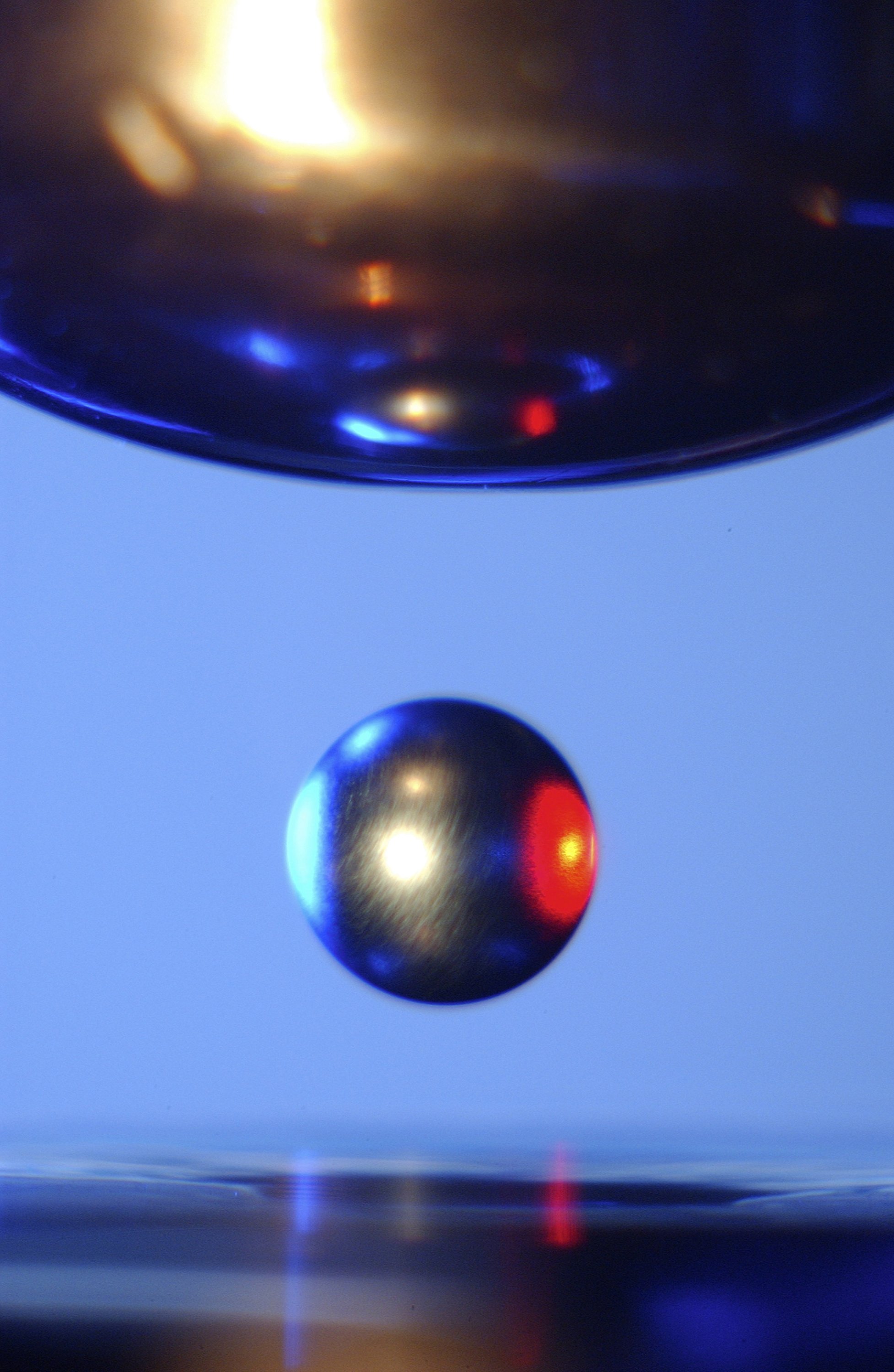
Process of levitating a charged object using electric fields
Electrostatic levitation is the process of using an electric field to levitate a charged object and counteract the effects of gravity. It was used, for instance, in Robert Millikan's oil drop experiment and was used to suspend the gyroscopes in Gravity Probe B during launch.
Due to Earnshaw's theorem, no static arrangement of classical electrostatic fields can be used to stably levitate a point charge. There is an equilibrium point where the two fields cancel, but it is an unstable equilibrium. By using feedback techniques it is possible to adjust the charges to achieve a quasi static levitation.
Earnshaw's theorem
Main article: Earnshaw's theorem
The idea of particle instability in an electrostatic field originated with Samuel Earnshaw in 1839 and was formalized by James Clerk Maxwell in 1874 who gave it the title "Earnshaw's theorem" and proved it with the Laplace equation. Earnshaw's theorem explains why a system of electrons is not stable and was invoked by Niels Bohr in his atom model of 1913 when criticizing J. J. Thomson's atom.
Earnshaw's theorem holds that a charged particle suspended in an electrostatic field is unstable, because the forces of attraction and repulsion vary at an equal rate that is proportional to the inverse square law and remain in balance wherever a particle moves. Since the forces remain in balance, there is no inequality to provide a restoring force; and the particle remains unstable and can freely move without restriction.
Levitation
The first electrostatic levitator was invented by Dr. Won-Kyu Rhim at NASA's Jet Propulsion Laboratory in 1993. A charged sample of 2 mm in diameter can be levitated in a vacuum chamber between two electrodes positioned vertically with an electrostatic field in between. The field is controlled through a feedback system to keep the levitated sample at a predetermined position. Several copies of this system have been made in JAXA and NASA, and the original system has been transferred to California Institute of Technology with an upgraded setup of tetrahedra four beam laser heating system.
On the Moon the photoelectric effect and electrons in the solar wind charge fine layers of Moon dust on the surface forming an atmosphere of dust that floats in "fountains" over the surface of the Moon.
References
References
- Samuel Earnshaw "On the Nature of the Molecular Forces which regulate the Constitution of the Luminiferous Ether," ''Transactions of the Cambridge Philosophical Society,'' Cambridge University Press, Vol. 7, pp. 97–122 (1842).
- James Clerk Maxwell, ''A Treatise on Electricity and Magnetism,'' Macmillan and Co., "Earnshaw's theorem" p. 139 (1873)
- Bohr, Niels. (July 1913). "I. On the constitution of atoms and molecules". The London, Edinburgh, and Dublin Philosophical Magazine and Journal of Science.
- W. K. Rhim, S. K. Chung, D. Barber, K. F. Man, G. Gutt, A. Rulison, and R. E. Spjut, Review of Scientific Instruments 64, 2961 (1993).
- [http://www.firstscience.com/site/articles/moonfountains.asp Bell, Trudy E., "Moon fountains"], FirstScience.com, 2001-01-06.
- [http://www.spacedaily.com/reports/Dust_Gets_A_Charge_In_A_Vacuum.html Dust gets a charge in a vacuum]
This article was imported from Wikipedia and is available under the Creative Commons Attribution-ShareAlike 4.0 License. Content has been adapted to SurfDoc format. Original contributors can be found on the article history page.
Ask Mako anything about Electrostatic levitation — get instant answers, deeper analysis, and related topics.
Research with MakoFree with your Surf account
Create a free account to save articles, ask Mako questions, and organize your research.
Sign up freeThis content may have been generated or modified by AI. CloudSurf Software LLC is not responsible for the accuracy, completeness, or reliability of AI-generated content. Always verify important information from primary sources.
Report